

Jersey
Author: Elliott Garber, DVM · Updated
The Jersey is the small fawn dairy cow with the black muzzle and the cream ring around it, and she is the breed people mean when they say they want a family milk cow. She comes from the Island of Jersey in the Channel Islands, she is the smallest of the six major dairy breeds in the United States, and she gives less milk than a Holstein but far richer milk. On the Council on Dairy Cattle Breeding 2021 herd averages, the most recent edition CDCB has published, Jersey herds averaged 18,570 lb of milk at 4.86 percent fat and 3.72 percent protein, against 26,404 lb at 3.92 percent fat and 3.16 percent protein for Holstein herds.
That trade is the whole breed in one sentence: about 30 percent less milk in the bucket, and roughly a quarter more fat and protein in every pound of it. For a commercial dairy paid on components it is an economic argument. For a household milking one cow, it is the difference between skimming cream off the top and wondering where the cream went.
This page is the full breed picture for both readers: real numbers from the registry and from national milk recording, the parts of the Jersey reputation that hold up and the parts that do not, an honest account of what a house cow actually demands, and the safety point about dairy bulls that any guide aimed at families has to make. If you already own one, you can start her free profile and records on Creatures in a few minutes and keep her calvings, milk weights and treatments in one place.

| Also called | Jersey cow, Jersey cattle, the Island breed |
|---|---|
| Origin | Island of Jersey, Channel Islands |
| Primary use | Dairy, with milk sold on solids or used at home for cream, butter and cheese |
| Mature size | About 950 lb for cows and 1,500 lb for bulls, calves about 55 lb at birth (American Jersey Cattle Association and National All-Jersey) |
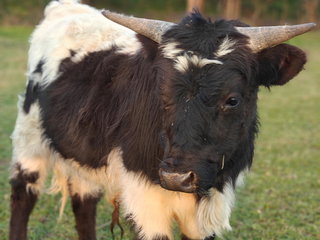
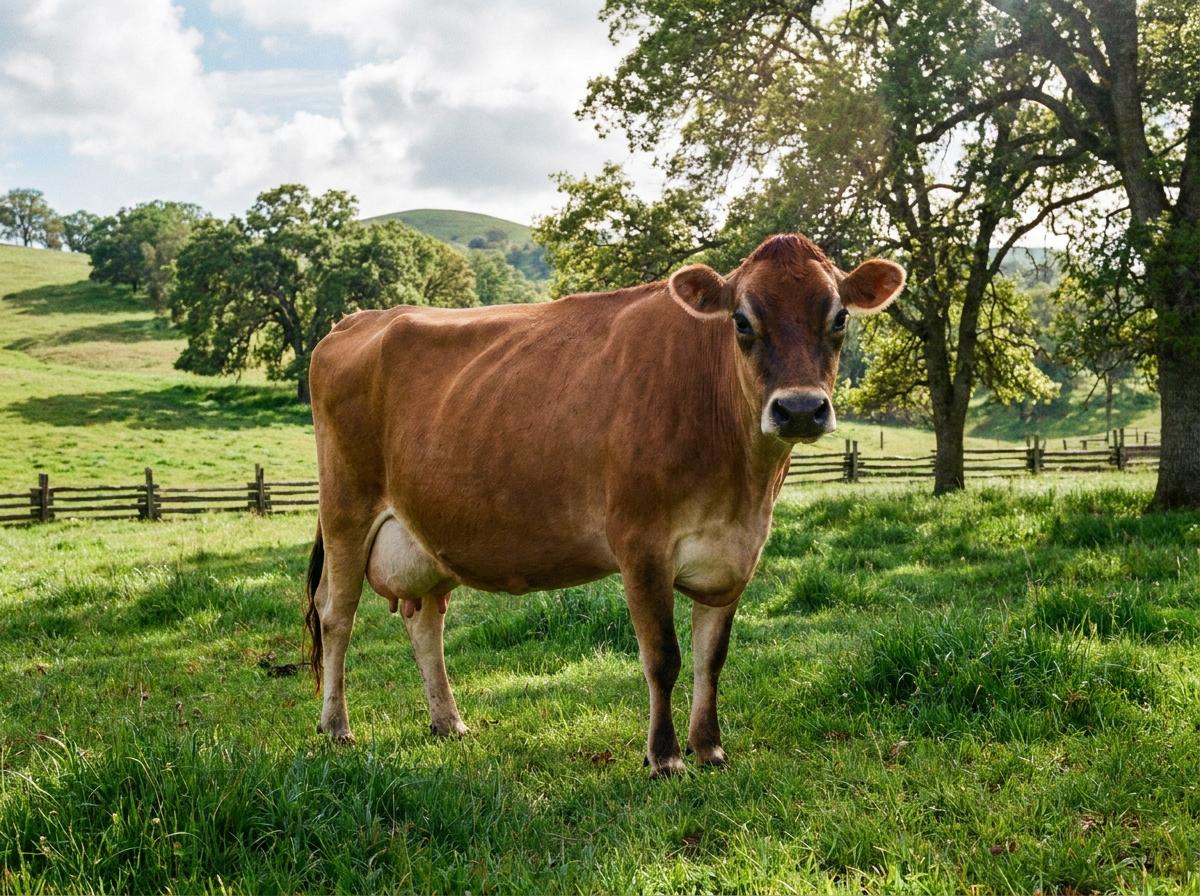
| Coat and markings | Usually fawn, ranging to darker brown and occasionally almost black, sometimes with white markings; black nose with a lighter ring above it, black hooves |
| Milk (US herd average) | 18,570 lb at 4.86 percent fat and 3.72 percent protein (CDCB 2021 DHI herd averages, all test plans) |
| Milk (standardized lactation) | 20,931 lb at 4.82 percent fat and 3.68 percent protein for cows calving in 2020 (CDCB 305 day standardized averages) |
| Compared with Holstein | Less volume, higher components: Holstein herds averaged 26,404 lb at 3.92 percent fat and 3.16 percent protein in the same CDCB table |
| Registry | American Jersey Cattle Association in the US (organized 1868); the Jersey Herd Book on the island, kept by the Royal Jersey Agricultural and Horticultural Society since 1866 |
| How common | An estimated 14.2 percent of all US dairy cows, about 1.8 million head at December 2025 (AJCA) |
| Watch for | Higher incidence of milk fever than most breeds (Merck Veterinary Manual), and the standing safety rule that dairy bulls are not pets |
Browse listings, public profiles, breeders, or add your animal.
How to recognise a Jersey
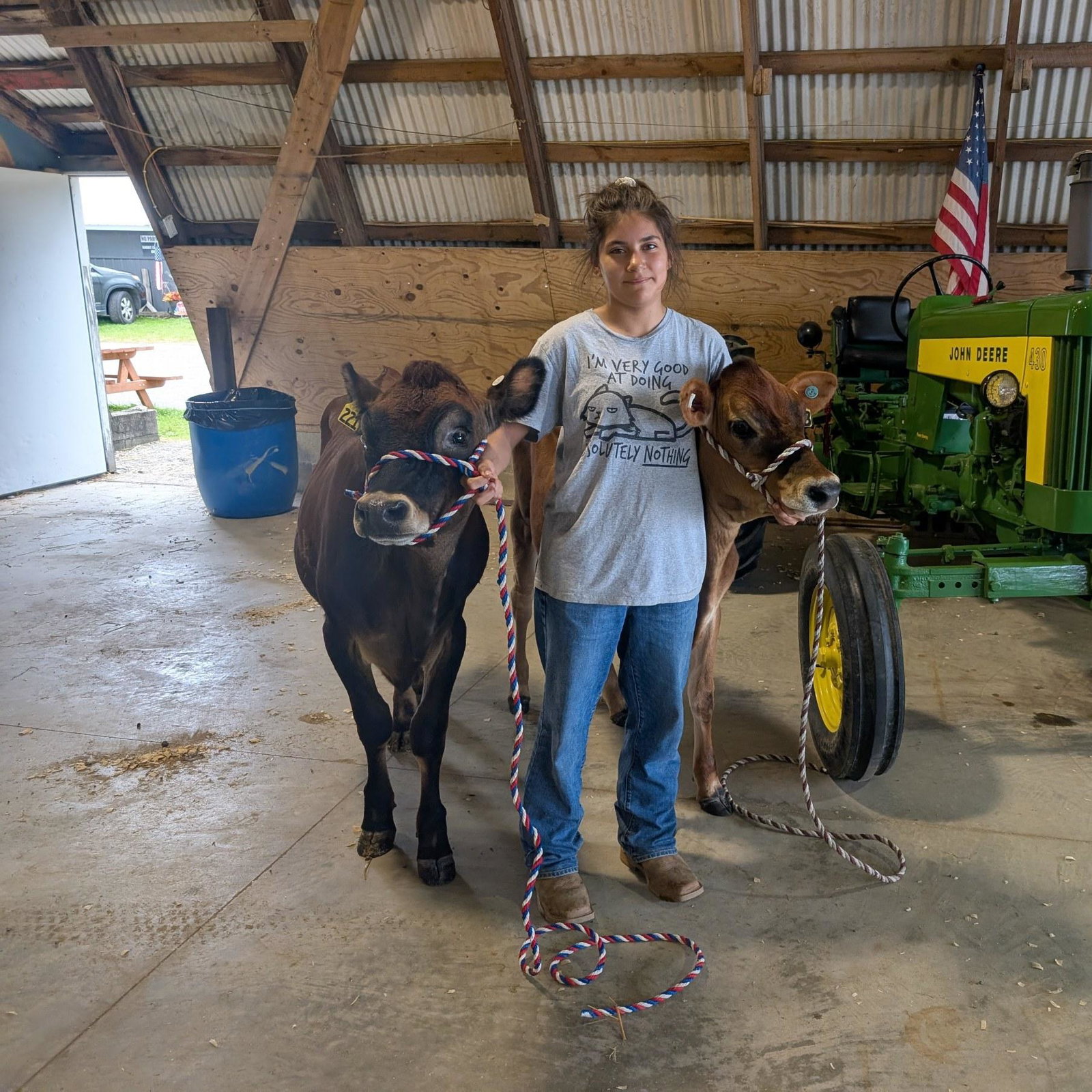
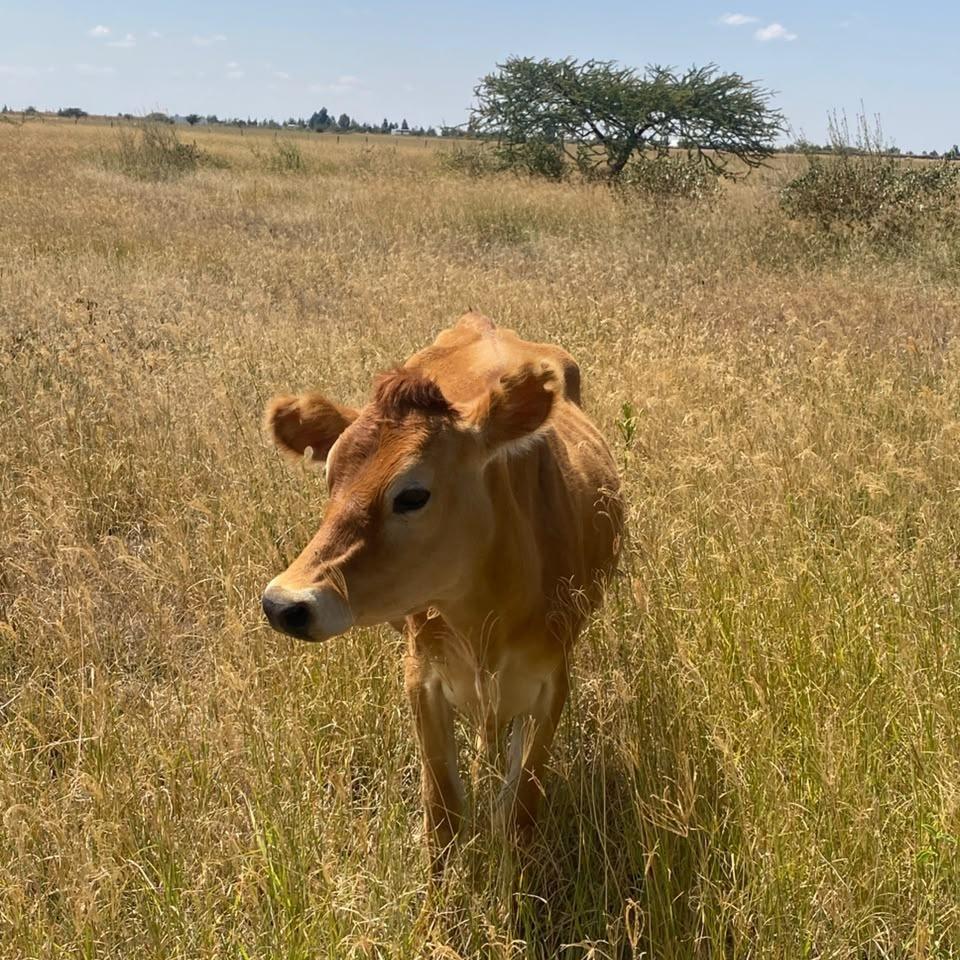
The breed association’s own description is short and useful. National All-Jersey’s Jersey cow page puts it this way: Jerseys are usually fawn coloured, “can also have white markings or be almost black”, their noses are black with a white ring above the nose, and their hooves are black.
In practice you are looking for four things at once, because any one of them on its own will send you wrong.
- A small, refined, dished head. The profile between the eyes and the nose is concave rather than straight, the forehead is broad, the eyes are large and dark and set well out. This is the feature that separates a Jersey from a Guernsey or a Brown Swiss at a glance.
- A black muzzle with a lighter ring around it. The pale band encircling the dark muzzle is the single most quoted Jersey marking. It is also the one most often missing from stock photographs of “Jersey cows” that are actually something else.
- Fawn, but not reliably. Coat runs from pale fawn through mid brown, and a very dark, almost black Jersey is still a Jersey. Colour alone proves nothing.
- A dairy frame, not a beef frame. Angular rather than blocky, with a visible hip, a lean shoulder, a deep barrel and fine clean legs, carrying an udder that is genuinely part of the animal’s shape rather than an afterthought.
The tail switch is dark, and the hooves are dark and hard. If you are looking at a fawn cow with a straight profile, a heavy square hindquarter and a pale muzzle, you are probably looking at a beef breed or a cross rather than a Jersey.

Size: a small cow, with the numbers
National All-Jersey puts the typical mature Jersey at about 950 lb for females and 1,500 lb for males, with calves weighing about 55 lb at birth. The Purebred Dairy Cattle Association, the umbrella body for the US dairy breed associations, gives a slightly lower breed figure of 900 lb and, on the same page, puts a mature Guernsey at about 1,200 lb and a mature Holstein at 1,500 lb. Both Jersey figures belong in front of you: the association’s 950 lb and PDCA’s 900 lb are describing the same animal with a small honest spread, not contradicting each other.
The Jersey is routinely called the smallest of the major dairy breeds, and nothing found in writing this contradicts it, but it is worth being exact about the evidence. PDCA states mature weights for only three breeds on that page, so what is demonstrated rather than asserted is this: a Jersey cow is roughly 250 to 300 lb lighter than a Guernsey and roughly 500 lb lighter than a Holstein. That is not a trivia point when you are the one leading her through a gate, lifting a calf, or working out whether your barn, your trailer and your handling setup are adequate.
Two consequences matter more than the number itself. Small cows eat less, which is the foundation of every efficiency claim the breed makes. And small calves are born easily, which is why Jersey bulls are used across other breeds to reduce calving trouble even when nobody wants a Jersey heifer out of the mating.
The PDCA page also carries breed production averages that sit well below the current CDCB figures used throughout this article. Treat PDCA as the source for its cross-breed size comparison, not for production.
Butterfat and protein: the reason the breed exists
This is the defining trait, so it is worth being precise about which number is which. CDCB publishes two different national datasets, and they answer different questions.
Actual herd averages. The Summary of 2021 DHI Herd Averages (Report K-3, Table 2) reports what herds actually produced, across all test plans:
| Jersey | 18,570 lb milk, 4.86 percent fat (904 lb), 3.72 percent protein (690 lb) |
|---|---|
| Holstein | 26,404 lb milk, 3.92 percent fat (1,034 lb), 3.16 percent protein (836 lb) |
| Brown Swiss | 20,254 lb milk, 4.23 percent fat, 3.44 percent protein |
| Guernsey | 15,945 lb milk, 4.72 percent fat, 3.40 percent protein |
| Ayrshire | 15,350 lb milk, 4.07 percent fat, 3.18 percent protein |
| Milking Shorthorn | 14,743 lb milk, 3.68 percent fat, 3.13 percent protein |
The Jersey figure rests on 680 herds and 325,928 cow-years; the Holstein figure on 9,385 herds and 3,170,706 cow-years. This is the most recent edition CDCB has published.
Standardized lactation averages. The companion report standardizes each record to 305 days, twice daily milking, and a mature-age basis, which makes animals more comparable but excludes records that cannot be used in national genetic evaluations. For cows calving in 2020 it puts the US Jersey average at 20,931 lb of milk, 4.82 percent fat (1,008 lb) and 3.68 percent protein (769 lb) from 359,470 records, against 28,023 lb, 3.96 percent fat (1,111 lb) and 3.15 percent protein (882 lb) for Holsteins from 2,193,001 records. CDCB itself says the herd-average report is the more current of the two and may give the better breed comparison, which is why the herd averages lead here.
Read those tables honestly and three things are true at once.
- On percentages, the Jersey wins clearly. Nearly a full point more butterfat and more than half a point more protein than a Holstein, and the highest of any of the six breeds on either table.
- On volume, the Holstein wins clearly. Around 8,000 lb more milk per cow per year.
- On total pounds of fat and protein per cow, the Holstein is still ahead. 1,034 lb of fat against 904 lb, 836 lb of protein against 690 lb. Anyone who tells you a Jersey out-produces a Holstein on components per cow is not reading the same table.
The Jersey case is not that she beats a Holstein per cow. It is that she does it on less cow. That is a different argument, and it is the one the next section is about.
Efficiency: what is measured and what is marketing
The association’s own promotional publication, Why Jerseys (American Jersey Cattle Association, 2021), states that Jerseys “tip the scales at roughly 75% of Holsteins’ body weight” while eating “80% of the intake of Holsteins”, and that US Jerseys average more than 17 times their body weight in milk each lactation. It is a marketing document and should be read as one, but the underlying comparison is the reason large commercial herds have switched.
The strongest independent support in that document is a peer-reviewed life-cycle assessment published in the Journal of Dairy Science (Capper and Cady, 2012), which the association summarises as finding that to produce the same quantity of protein, milkfat and other solids, the Jersey population needs 32 percent less water and 11 percent less land and has a 20 percent smaller total carbon footprint than the Holstein population. Note what that is measuring: equal output of solids, not equal numbers of cows.
The document also reports Cheddar yields per hundredweight of milk of 12.94 lb for Jersey, 11.44 lb for Brown Swiss and 10.43 lb for Holstein, from CDCB DHI herd averages with the arithmetic done by National All-Jersey. That is a plant-side figure. It matters if you are selling to a cheesemaker or making cheese yourself, and it is roughly why a household with one Jersey ends up with visibly more cheese and butter than the milk volume alone suggests.
Where the same document quotes individual nutritionists on feed conversion ratios, treat those as informed opinion rather than published measurement. They are presented in the source as quotations, not as study results, and this page does not repeat them as numbers.
Temperament, and the part about bulls
Jersey cows have a long reputation for being docile, curious and people-oriented, and for being easier to handle than a much heavier animal simply because there is less of them. That reputation is genuine and it is one of the main reasons the breed suits a smallholding. It is also a reputation rather than a measured trait: there is no registry or extension source ranking dairy breeds against each other for temperament, so treat it as what experienced keepers consistently report, and judge the individual animal in front of you.
Dairy bulls are a different subject entirely, and a family-cow guide that skips it is failing the reader.
The University of Minnesota Extension’s farm safety guidance on handling bulls, reviewed in 2026 and written by an Extension farm safety educator and a veterinarian, states that bulls caused 48 percent of cattle-related fatalities in US Department of Labor injury and fatality data while making up only about 2 percent of cattle nationwide, and that “while dairy bulls are often considered more aggressive and dangerous than beef bulls, the advice in this article applies to both dairy and beef producers.”
Its first recommendation is blunt: the best way to avoid the danger is to keep bulls off the farm and breed by artificial insemination. Its other rules are worth repeating in full, because they are the ones people ignore around a bull they raised:
- Even “nice” bulls that were bottle-fed as calves get more aggressive with age.
- A bull does not need a history of aggression. An attack can happen at any time, to anyone, with any bull.
- Never allow children to work with a bull.
- Never turn your back on a bull, always have an escape plan before you enter the pen, and tell visitors there is a bull on the property and where he is.
You will often hear specifically that Jersey bulls are the most dangerous of all. We could not find that claim in an extension or agency source, so this page does not assert it, and it does not need to: the sourced position, that dairy bulls in general are widely considered more dangerous and that no bull of any breed should be trusted, already tells a family with children exactly what to do. Use AI, sell the bull calves, and do not keep a bull because he was sweet at six months.

Keeping a Jersey as the family milk cow
What a house cow actually demands
A lactating cow is a twice-a-day appointment for most of the year, at roughly the same two times every day, in every weather, whether or not you are ill, travelling or busy. Nothing about the Jersey changes that. She is smaller and generally easier to handle than the alternatives, which lowers the physical demand and not the schedule.
The volume is the part people underestimate. Even a modest Jersey on the CDCB herd average is producing something in the order of 5 to 6 gallons a day at peak. A household that drinks two gallons a week needs a plan for the rest before the cow arrives: calves or a pig to take the surplus, a cheese and butter routine you will genuinely keep up, or a legal outlet, which varies by state and is worth checking with your own state department of agriculture before you buy rather than after.
Budget for the whole system, not the cow. Winter forage, a clean water supply that does not freeze, sound fencing, a place to milk that stays clean, mineral, hoof care, and a veterinarian who works on cattle and will take you as a client. Our cattle cost guide walks through the recurring numbers.
If you are comparing dairy breeds for a house cow, the Brown Swiss guide applies the same daily-work questions and separates a milk record from an expectation.
Once-a-day milking and calf sharing
Both of the usual escape routes from the twice-a-day schedule are real, and both cost milk. That is the honest framing.
Once-a-day milking is a mainstream commercial system in New Zealand rather than a shortcut. A review in JDS Communications (Lopez-Villalobos et al., 2023) reports that over a full lactation, cows milked once a day averaged 27 percent less milk, 23 percent less fat and 24 percent less protein than cows milked twice a day, with higher fat and protein percentages, and had better reproductive performance. About 10 percent of New Zealand herds milk once a day for the whole lactation. For a house cow this is often the right trade, and it should be entered into knowing the cost.
Calf sharing, leaving the calf on the cow for part of the day and milking the other part, is now a researched commercial practice under the name cow-calf contact. A systematic review in the Journal of Dairy Science (Meagher et al., 2019) found that allowing cows to nurse calves “generally decreased the volume of milk available for sale during the nursing period”, that there was no consistent evidence of reduced milk production over a longer period, and that prolonged nursing increased calf weight gains. The same review is careful to say the strength of its conclusions is limited because relatively few studies address most of these effects. So: the calf drinks what you do not get, the calf grows better for it, and the long-run effect on the cow is not established.
Feeding
Feeding a Jersey is feeding a dairy cow, scaled down. Forage first, clean water always available, minerals formulated for cattle, and concentrate matched to what she is actually milking rather than to a fixed scoop. Underfeeding through late pregnancy and early lactation is the classic route into lost condition and metabolic trouble. Our cattle feeding guide covers ration structure and forage quality in detail, so this page does not repeat it.
The one Jersey-specific adjustment worth naming: because she is small, it is easy to overfeed her relative to her frame while thinking you are being generous. Body condition, not the feed bucket, is the measure.
Health notes that are genuinely breed-relevant
Most Jersey health management is ordinary cattle health management. One item is not.
Milk fever. The Merck Veterinary Manual states plainly that parturient paresis is “most common in high-producing dairy cows entering their third or later lactations” and that “the incidence is higher in Jersey and Guernsey breeds.” Most cases occur between the onset of calving and roughly three days into lactation. Merck also notes that hypocalcaemia contributes to dystocia, uterine prolapse, retained fetal membranes, metritis, displaced abomasum and mastitis, so the calcium problem tends to arrive with company. Prevention is nutritional and prepartum, and Merck names negative dietary cation-anion difference diets and phosphorus binders among the measures.
For an owner this converts into something concrete. Know the calving date, be present or nearby, know what a cow going down after calving looks like, and have your veterinarian’s number and their view on prepartum management agreed in advance rather than at 2am. Our calving guide covers the normal sequence, and the cattle gestation calculator will give you the due window from the breeding date.
Beyond that: a parasite plan built for your climate, hoof care on a schedule, milking hygiene and udder health as the daily priority, and the vaccinations your veterinarian recommends for your region and your herd’s exposure. Our cattle vaccination guide is a starting point for that conversation, not a substitute for it. Every medical decision belongs with a veterinarian who can examine the animal.
Heat and climate
The association describes Jerseys as more tolerant of heat than the larger breeds, and there is a published comparison behind the idea rather than only folklore.
A short communication in the Journal of Dairy Science (Smith et al., 2013) compared 142 Jersey and 586 Holstein cows kept on the same farm, the Bearden Dairy Research Center at Mississippi State University, using Dairy Herd Improvement Association records and a temperature-humidity index threshold of 72 for heat stress. Holstein milk yield declined under moderate and severe heat stress; Jersey milk yield declined only under severe heat stress. Holstein milk fat percentage fell under moderate and severe heat stress; Jersey milk fat percentage did not differ by heat stress category. The authors’ conclusion is worth quoting exactly as they wrote it: Jersey cows appeared to be more heat tolerant than Holstein cows, however Holstein cows still produced larger volumes of milk.
That is one retrospective study on one research herd, so treat it as good evidence for a real breed difference rather than as a settled magnitude. The practical advice does not change either way: shade, moving air, and constant clean water are what actually protect a cow in a hot climate, whatever her breed.
A2 milk: what is established and what is not
Jerseys are often marketed as an A2 breed, and this is the part of the topic that most needs care.
The genetics are real and testable. Beta-casein, one of the main milk proteins, comes in variants including A1 and A2, and an individual cow’s genotype can be determined from a DNA sample. Measured frequencies do differ between populations. A study of five dairy populations in Ecuador (published in 2025) found A2 allele frequencies of 0.727 in Jersey, 0.628 in Holstein Friesian and 0.643 in Brown Swiss, with the A2A2 genotype at 0.500 in Jersey against 0.400 in Holstein Friesian. The adjacent sentence in that paper matters just as much as the numbers: no significant differences in allele frequency were observed among the breeds. A survey of 590 Jersey cows on eight farms in Okayama Prefecture, Japan (published in 2022), found group-based genotype frequencies of 0.665 A2A2, 0.303 A1A2 and 0.032 A1A1, which its authors described as numerically higher in A2 than figures reported for Holsteins and for Mexican and Danish Jerseys.
So the fair statement is that Jerseys tend toward higher A2 frequencies than Holstein-type populations in the studies that have measured it, that plenty of individual Jerseys still carry A1, and that a specific cow’s status is a laboratory result rather than a breed guarantee. If A2A2 matters to you, test the animal.
The human health claims are contested, and this page does not endorse them. The first systematic review of the gastrointestinal effects of A1 compared with A2 beta-casein, published in Advances in Nutrition in 2017 and available in full, found evidence in humans from a limited number of studies, one clinical study on intestinal transit and two on stool consistency, and concluded that further research in humans is required. It is also relevant that three of that review’s four authors disclosed consulting arrangements, honoraria or grant support involving the a2 Milk Company or the A2 Corporation, which is disclosed in the paper itself and should be part of how you read it.
Buy a Jersey because you want her milk and her size and her temperament. Do not buy one on a health claim the literature has not settled.

Miniature Jerseys and Danish Jerseys
Two names come up constantly alongside “Jersey” and neither means the same thing.
Miniature Jerseys are selected small animals promoted for homesteads with little land. The American Jersey Cattle Association does not appear to have anything to do with them: a search of the association’s own website for “miniature” returns no matching content at all, on pages where the word “Jersey” appears hundreds of times. They are handled by separate private registries outside the AJCA herd book, which means the paperwork, the height standards and the level of production recording behind a miniature Jersey are not the paperwork behind a Registered Jersey. That is not an argument against the animals, but it is a reason to ask precisely which registry a seller means and what that registry actually records. We keep a separate miniature Jersey page with listings and breeders.
Danish Jerseys are not a different breed. They are the Danish national population of Jersey cattle, built on imports from the Channel Island and shaped by decades of separate selection, and they show up in US pedigrees through imported genetics. See the Danish Jersey page for that side of the family.
Where the breed came from
The Jersey comes from an island of about 45 square miles. The Royal Jersey Agricultural and Horticultural Society, founded in 1833 and incorporated by an Act of the States of Jersey in 1884, established the Jersey Herd Book in 1866 and describes it as the oldest such record in the world. Every animal on the island is recorded in it.
The isolation is the other half of the story. The island herd was closed to imported cattle for roughly two centuries, which is why the breed stayed distinct enough to be exported as a fixed type. That changed in 2008, when the Artificial Insemination of Domestic Animals (Bovine Semen) (Jersey) Order 2008 came into force. A Government of Jersey freedom of information response accepted that its own citizenship guide had gone out of date on exactly this point, having still described the island as allowing no cattle imports at all, and confirmed the correction that in July 2008 the States of Jersey ended the ban and allowed the import of bull semen, with only genetically pure semen producing progeny eligible for the Jersey Herd Book.
In the United States, National All-Jersey dates the first Registered Jersey imports to 1850, and the American Jersey Cattle Association was organized in 1868, making it the oldest dairy breed association in the country. Through 31 December 2025 it had compiled pedigree records for 7,583,245 animals and recorded 80,270 in 2025 alone.
The breed is not a rarity to be rescued. AJCA estimates that Jerseys, registered and unregistered together, make up about 14.2 percent of all dairy cows in the United States, with the national Jersey population estimated at 1.8 million head at December 2025.
Buying a Jersey: what to actually check
There is no reliable published price series for the breed and this page will not invent one. The shape of the market is consistent, though: an unregistered grade cow or a bottle calf is the cheap end, a registered cow with real production behind her is not, and the premium tracks the paperwork and the records rather than the colour. Compare current Jersey listings and talk to established herds in the Creatures breeder directory before you agree a number.
Before money changes hands:
- Ask for milk records, not milk stories. A serious seller has daily or monthly weights, and often DHIA test data with components and somatic cell counts. This is the most production-tested dairy breed in the country. The numbers exist.
- Ask about somatic cell history specifically. It is the cheapest available proxy for udder health, and udder health decides how long she works.
- Get the registration papers in your hand if you are buying registered stock, and confirm which registry. AJCA and a private miniature registry are not interchangeable.
- Look at the udder and the feet in person. Attachment and teat placement decide whether she is comfortable to milk for years; sound feet and legs decide whether she gets to the feeder.
- Ask what she has been fed and how she has been handled. A cow who has never stood to be milked by a stranger is a different proposition from one who walks onto the stand.
- Ask about herd health testing and what the testing routine actually is. A seller who tests and can show you results is telling you something about the whole operation.
- Ask about her calving history, including any milk fever, retained placenta or assisted calving, given what Merck says about breed incidence.
- Match the cow to your schedule before you match her to your fences. Twice a day, most of the year, is the real decision.
Frequently asked questions
How much milk does a Jersey cow give?
On the CDCB 2021 DHI herd averages, US Jersey herds averaged 18,570 lb of milk per cow per year at 4.86 percent fat and 3.72 percent protein. On CDCB’s standardized 305 day basis for cows calving in 2020, the Jersey average was 20,931 lb at 4.82 percent fat and 3.68 percent protein. A family cow at those averages is producing several gallons a day at peak, which is usually more than a household can drink.
Is Jersey milk really higher in butterfat?
Yes, and by a wide margin. In the same CDCB herd-average table, Jersey milk tested 4.86 percent fat against 3.92 percent for Holstein, 4.72 percent for Guernsey, 4.23 percent for Brown Swiss, 4.07 percent for Ayrshire and 3.68 percent for Milking Shorthorn. Jersey protein at 3.72 percent was also the highest of the six.
How big is a Jersey cow?
About 950 lb for a mature cow and about 1,500 lb for a bull according to National All-Jersey, with calves around 55 lb at birth. PDCA gives a breed average of 900 lb. Either way she is the smallest of the major US dairy breeds, roughly 500 lb lighter than a Holstein cow.
Are Jersey cows good for beginners?
They are a common first milk cow for good reasons: smaller and easier to handle than the alternatives, widely available, richly recorded, and generally calm. The caveat is not about the breed. It is whether you are ready to milk twice a day for most of the year, and to manage the surplus.
Are Jersey bulls dangerous?
Treat any bull as dangerous. Extension farm safety guidance reports that bulls cause 48 percent of cattle-related fatalities in US injury data while being about 2 percent of cattle, notes that dairy bulls are often considered more aggressive than beef bulls, and recommends keeping bulls off the farm and breeding by artificial insemination. Bottle-raising does not make a bull safe. It is a common route to the opposite.
Do Jerseys handle heat well?
Better than Holsteins, on the available evidence. A same-farm comparison of 142 Jersey and 586 Holstein cows at Mississippi State found Holstein yield fell under moderate and severe heat stress while Jersey yield fell only under severe heat stress, and Jersey milk fat percentage held steady where Holstein’s did not. Shade, airflow and water still do most of the work.
Is Jersey milk A2?
Not automatically. Studies have measured higher A2 allele frequencies in Jersey populations than in Holstein-type populations, but plenty of individual Jerseys carry A1, and the one direct multi-breed comparison cited on this page found no statistically significant difference between breeds. A specific cow’s status is a DNA test result. The human health claims attached to A2 remain unsettled in the peer-reviewed literature, so this page does not make them.
Are Jersey cattle rare?
No. The AJCA estimates Jerseys at about 14.2 percent of all US dairy cows and the national population at roughly 1.8 million head at December 2025. They are the second most common dairy breed in the country by a wide margin behind Holstein.
Do this next on Creatures
Creatures is the records, marketplace and directory layer for the whole job, from comparing dairy breeds to keeping one house cow’s numbers straight.
Find a cow. Browse Jersey cattle on the marketplace and search trusted breeders and dairies in the Creatures directory. New to it? Start with saving searches and using your watchlist.
Get alerted. A well recorded family cow does not sit on the market, so set a free Jersey listing alert and we will tell you when one is posted. No account needed to start.
Add your cow. Already milking one? Create a free animal profile in a few minutes, no account needed to start. The walkthrough is in adding an animal to Creatures.
Keep the records this breed deserves. Calving dates, milk weights, body condition, treatments and their withdrawal times all belong in one place. Add a record against her profile, set reminders for boosters and rechecks and subscribe to them as a calendar feed, and download a printable packet of her records to take to the clinic. The record sheet opens for any visitor to look around, and a free account saves what you enter. See adding a record, health and medical records, which are private by default, and reminders and upcoming care.
List your herd. Running a dairy or selling heifers? Create a free organization profile, then get listed in the breeder directory so buyers looking for recorded Jersey stock can find you. Working with family or staff? See creating an organization and adding your team.
Sell with the paperwork ready. Read how seller payout works before you list, keep the herd’s history straight with our cattle record keeping guide, and compare the breed against the rest of the field on the Creatures cattle species page or against the volume breed on the Holstein page.