Pig
Sus scrofa domesticus
Author: Elliott Garber, DVM · Published
Pigs are domestic swine, descended from the Eurasian wild boar and kept for pork, for breeding stock, for small-farm pasture and, more and more often, as pets. Their many breeds sort into three practical types: the commercial breeds behind the pork industry, the heritage and pasture breeds raised on small farms, and miniature pet pigs. A sow carries her litter about 114 days, a pet pig commonly lives 10 to 15 years, and even a “mini” pig usually grows to 100 pounds or more. Shopping already? Search the Creatures directory of pig breeders and farms by breed and state.
Breeds come first below: the types of pigs and the breeds you will meet in North America. Cost, lifespan, housing, feeding, health, breeding and farrowing, buying and record keeping follow, each in brief with a link to the guide that goes deeper, and the free pig tools, a gestation calculator and a weight calculator among them, appear where you would use them. If pigs are one part of a small farm, the Creatures guides to goats, sheep and chickens cover the rest of the barnyard.

| Species | Domestic pig, Sus scrofa domesticus (listed by some taxonomists as Sus domesticus) |
|---|---|
| Main types | Commercial maternal and terminal breeds, heritage and pasture breeds, miniature and pet pigs |
| Size | Market hogs about 280 to 290 lb at six months (289 lb US average at slaughter in 2025); Large Black boars reach 700 to 800 lb; most mature potbellied pigs weigh under 200 lb |
| Diet | Omnivores: a complete feed balanced for age and purpose, constant clean water, no meat scraps |
| Social needs | Social animals that sleep in contact with other pigs: plan on at least two |
| Gestation | About 114 days (3 months, 3 weeks and 3 days); US litters averaged 11.96 pigs saved in mid-2026 |
| Lifespan | Pet pigs commonly 10 to 15 years; market hogs reach slaughter weight at about 6 months |
| Price (2026) | Weaned feeder pigs roughly $45 to $100 a head, depending on weight and the hog market; registered breeding stock from a few hundred dollars into the thousands |
| US herd | 74.3 million hogs and pigs on September 1, 2026 |
Browse listings, public profiles, breeders, or add your animal.
What pigs are, and how many kinds there are
The domestic pig is a single species. Taxonomists write it either as a subspecies of the Eurasian wild boar, Sus scrofa domesticus, or as a species of its own, Sus domesticus, which is how the American Society of Mammalogists’ Mammal Diversity Database lists it. People domesticated it from wild boar more than 10,000 years ago: archaeological evidence shows pig domestication under way in the Near East by about 10,500 years ago, and genetic and archaeological evidence supports a separate, independent domestication in China.
The pig family, Suidae, is wider than the farm pig, with 18 living species in version 2.5 of that database (July 2026): the domestic pig plus 17 wild ones, among them the wild boar, the African common warthog and red river hog, the tusked babirusa of Indonesia and the endangered pygmy hog of India. Peccaries such as the collared peccary look like pigs but belong to a separate family of the Americas, and guinea pigs are rodents. Every farm hog, show pig, heritage breed and pet mini pig is the same domestic species, which is why they interbreed freely.
Ads and sale bills use a handful of terms with exact meanings. The first four below are the definitions in USDA’s market reporting glossary for swine:
- Boar: an intact male.
- Sow: an adult female that has had one or more litters.
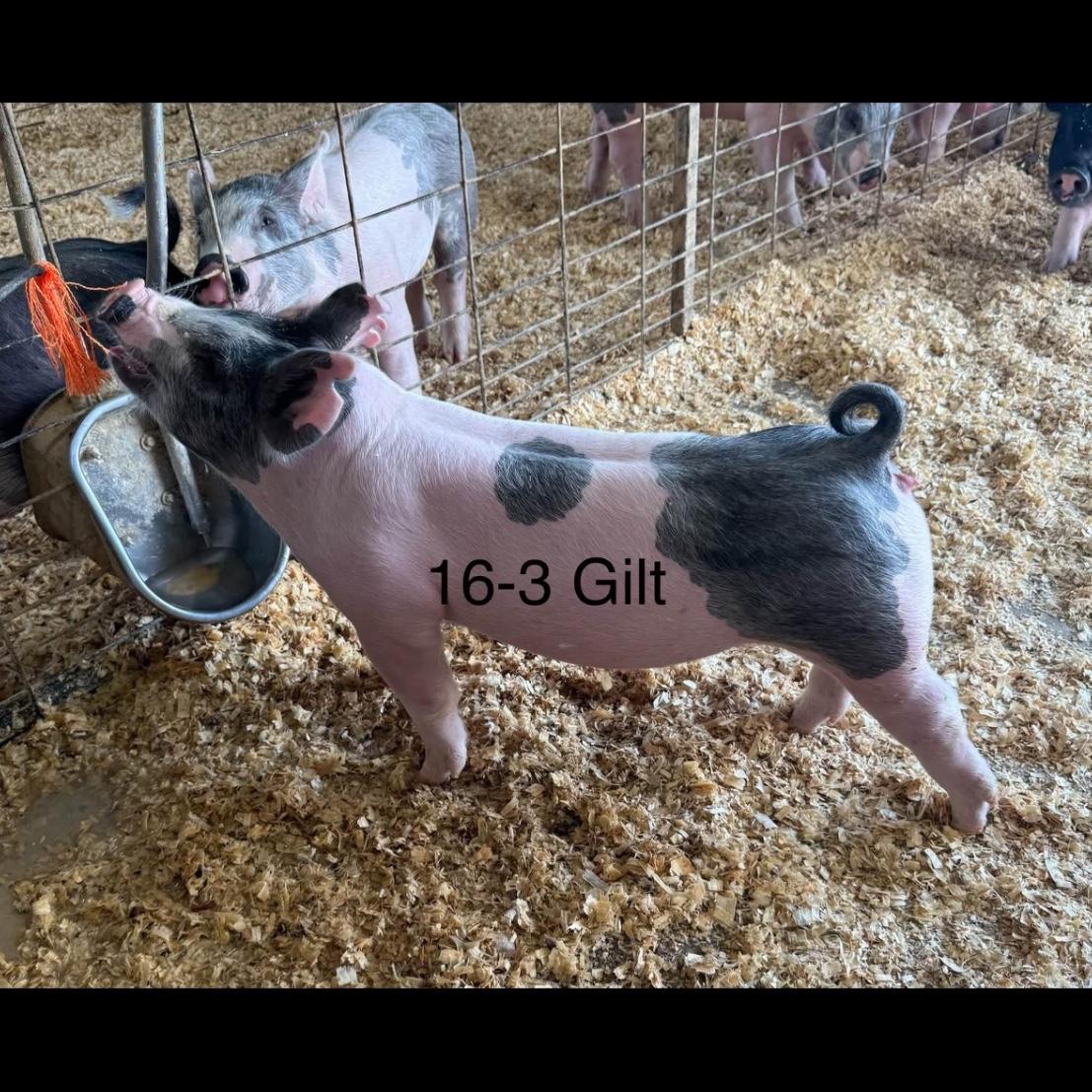
- Gilt: a young female yet to produce her first litter.
- Barrow: a male castrated before he reached sexual maturity. Most market pigs are barrows and gilts; they made up 97.5 percent of federally inspected US hog slaughter in 2025, according to USDA’s annual slaughter summary.
- Feeder pig: a weaned pig sold to be grown out for meat. USDA’s weekly feeder pig report quotes prices on a 40 pound basis, with a per-pound adjustment for heavier lots.
- Farrowing: giving birth. A sow farrows a litter.
Every pig roots with its powerful snout, and Merck advises pet owners to expect and tolerate rooting rather than fight it, so plan the ground, the fence and the house around it. Intelligence, a strong social drive and almost no ability to sweat shape the rest of their care.
Types of pigs and pig breeds
Breed counts run into the hundreds. In its Status and Trends of Animal Genetic Resources 2022 report, the UN Food and Agriculture Organization records 566 local pig breeds worldwide (232 in Asia and 194 in Europe and the Caucasus), 34 international breeds kept across borders, and 70 pig breeds already reported extinct. Well over a hundred have their own pages on Creatures, listed A to Z lower on this hub, each with its breeders and public profiles. For choosing a pig, though, the question that matters is purpose: pork, a breeding herd, a pasture pig for a small farm, or a companion.
In the United States, three registries keep the herd books for the main purebred breeds. The National Swine Registry records the Duroc, Hampshire, Landrace and Yorkshire, which it says make up 87 percent of the purebred hog population in the United States. Certified Pedigreed Swine records the Chester White, Hereford, Poland China and Spotted breeds and now also registers the Tamworth, and the American Berkshire Association has kept the Berkshire herd book since 1875.
| Maternal breeds | Yorkshire (Large White), Landrace and Chester White: white pigs chosen for litter size and mothering |
|---|---|
| Terminal sire breeds | Duroc, Hampshire, Pietrain, Spotted, Poland China and Berkshire: growth, muscle and pork quality |
| Commercial hybrids | Crossbred sow lines such as the Camborough, mated to terminal boars to produce market pigs |
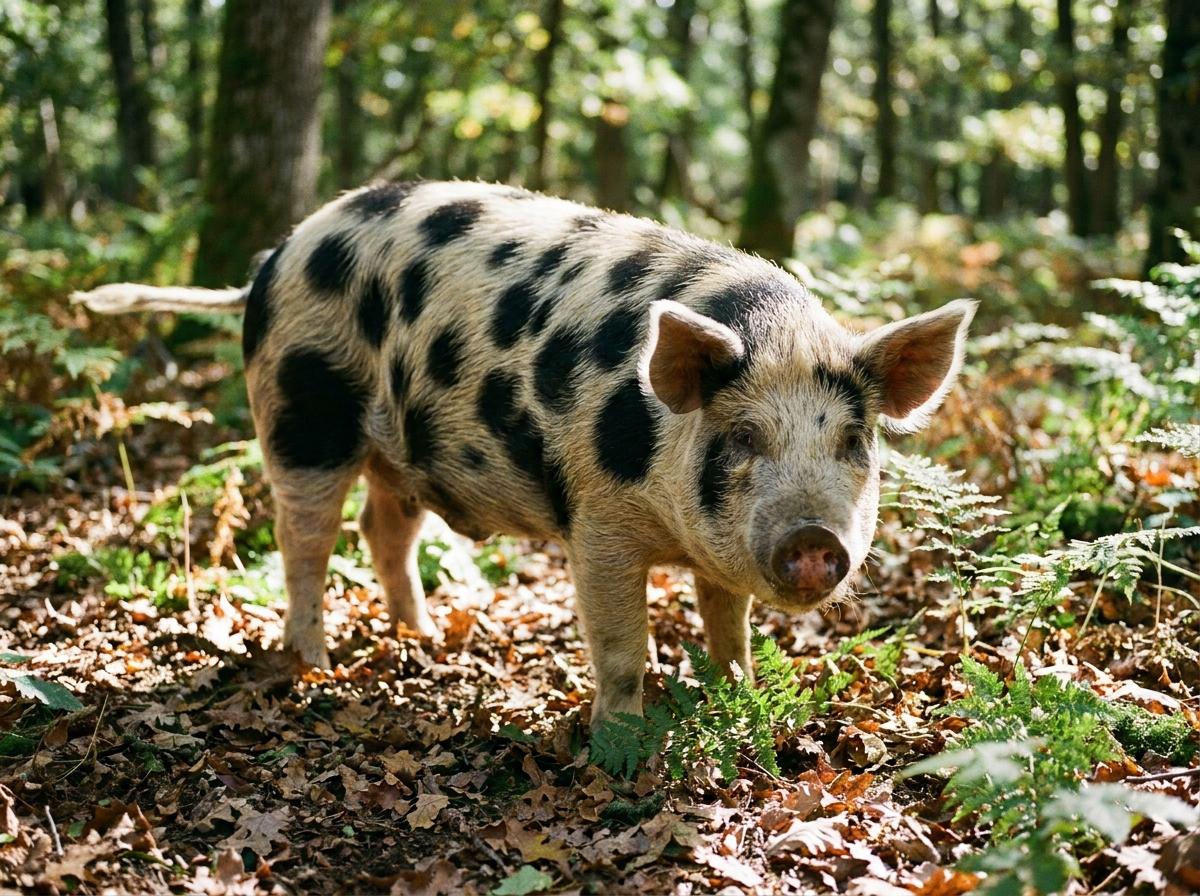
| Heritage and pasture | Large Black, Gloucestershire Old Spots, Tamworth, Red Wattle, Mulefoot, Guinea Hog and other older outdoor breeds |
| Grazing breeds | Kunekune and Idaho Pasture Pig: medium-sized pigs bred to make good use of pasture |
| Chinese and lard breeds | Meishan and the Taihu group, Mangalitsa |
| Miniature and pet pigs | Potbellied pigs, Juliana and mixed mini pigs; teacup and micro are sales labels, not breeds |
| Research minipigs | Yucatan and Göttingen, best known as biomedical research breeds |
Commercial maternal breeds: the white breeds
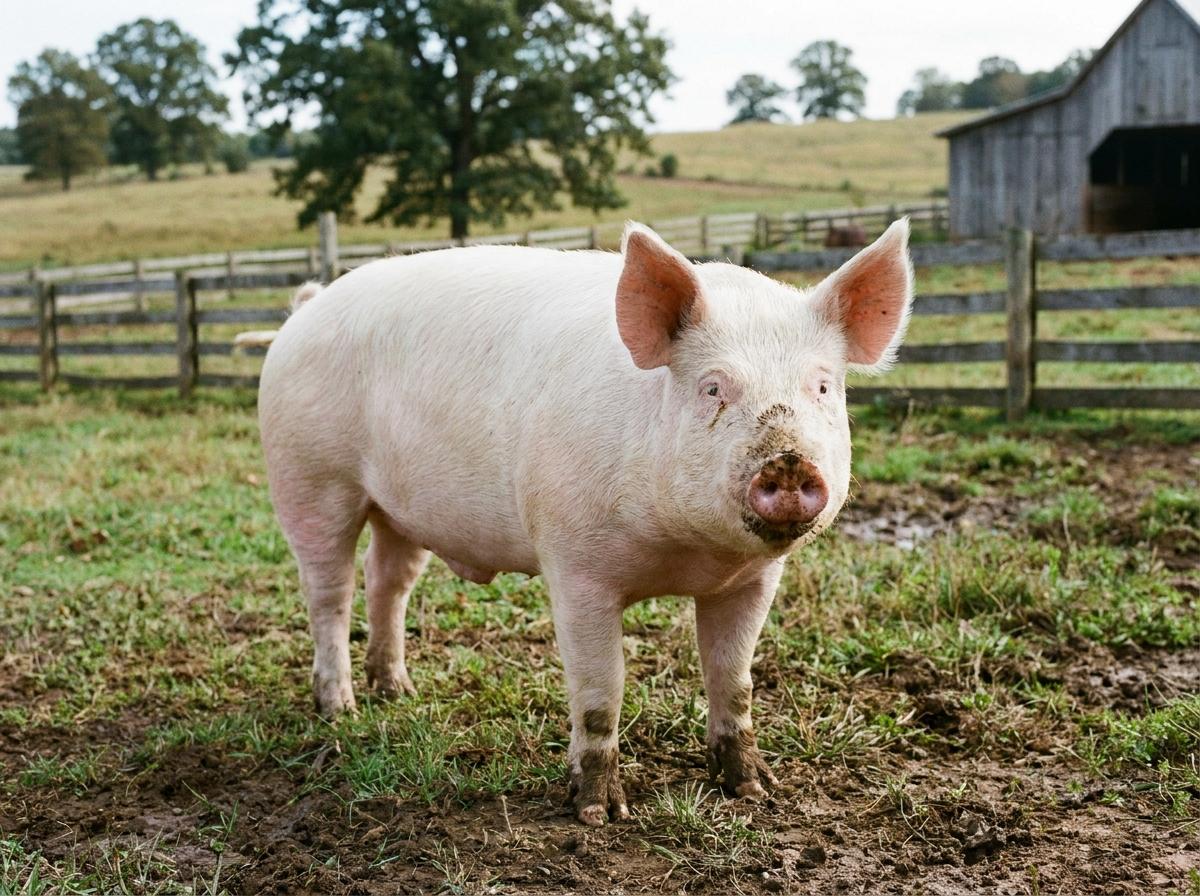
Maternal breeds are chosen for the sow’s side of the business: big litters, heavy milking, good mothering and a long working life. The Yorkshire, known as the Large White through most of the world, is white with erect ears, was developed in the English county of York, and is the most recorded swine breed in both the United States and Canada; the National Swine Registry’s Yorkshire page calls it the Mother Breed. The Landrace is white too, but long-bodied, with drooping ears that slant forward along the face. It descends from the Danish Landrace: USDA bought 24 Danish pigs for research in the early 1930s, and the American Landrace Association formed in 1950 once Denmark lifted its restrictions, as the NSR’s Landrace history records. The Chester White, from Chester County, Pennsylvania, is the third white maternal breed; Certified Pedigreed Swine lists its strengths as mothering ability, durability and soundness, and its ears must be down.
In commercial herds these breeds work mostly as grandparent stock: the NSR describes Yorkshires and Landrace being crossed to produce first-cross (F1) parent females with full maternal hybrid vigor, and breeding companies sell their own crossbred sow lines, such as PIC’s Camborough. For a small farm raising pork, Penn State Extension’s guide to raising small groups of pigs puts it simply: crossbreds grow faster and more efficiently than purebreds, and any modern commercial breed will do the job. White-skinned pigs need shade outdoors; the Livestock Conservancy credits the dark and ginger coats of breeds such as the Large Black and Tamworth with protecting them from sunburn.
Terminal sire and meat breeds: the colored breeds
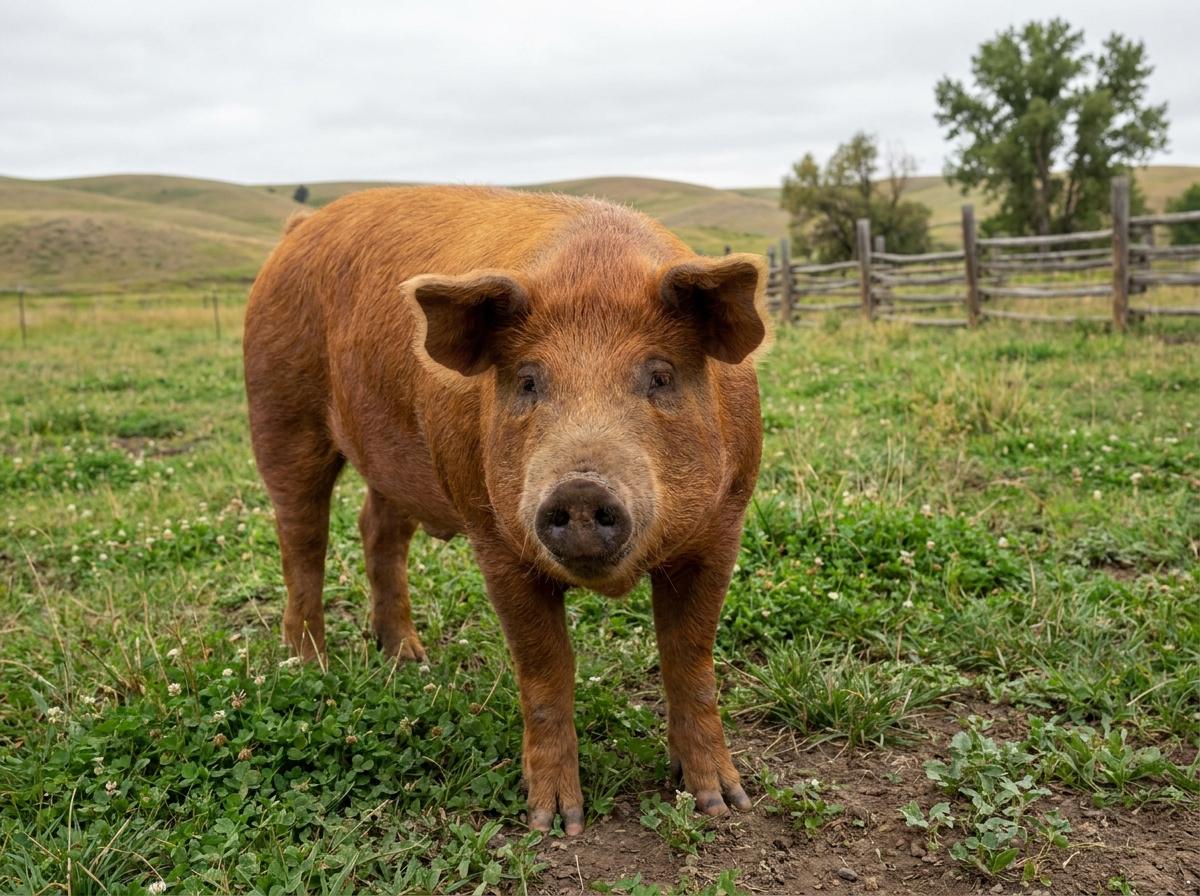
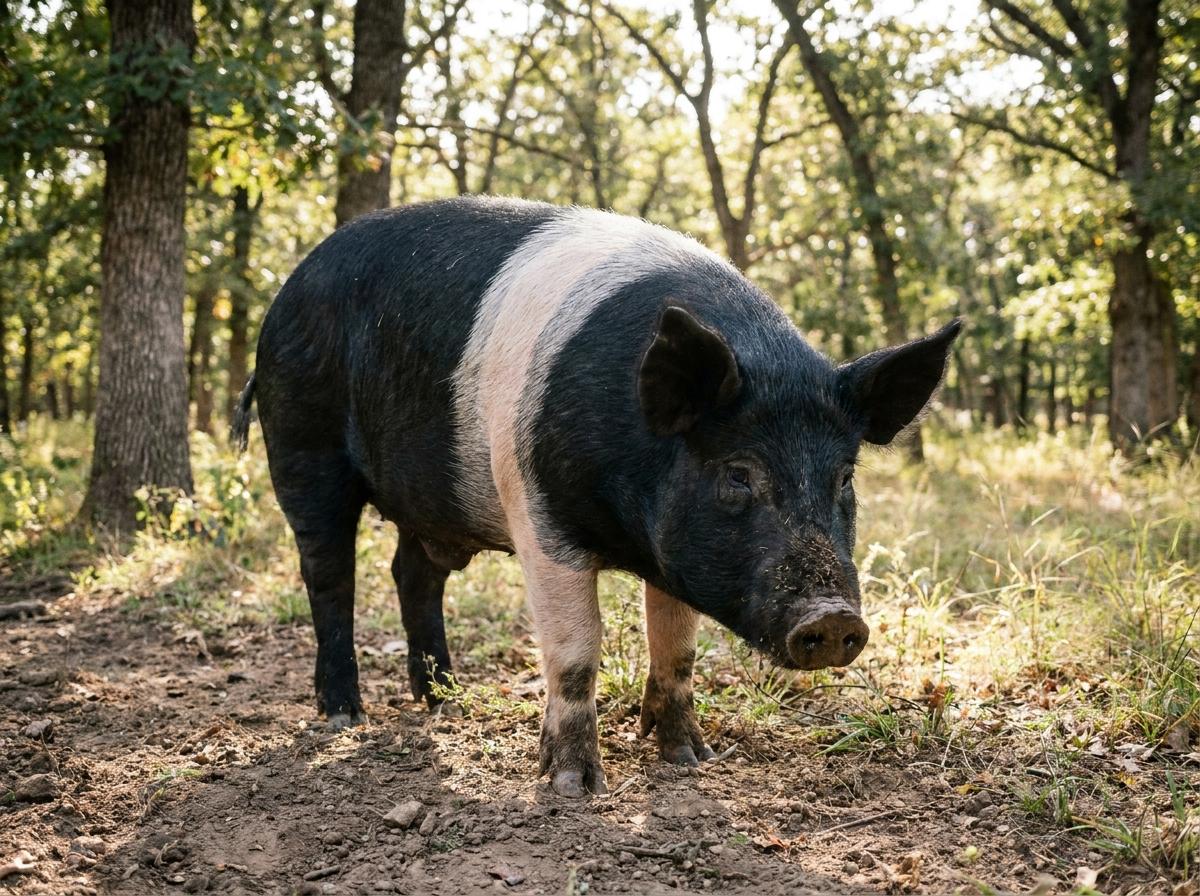
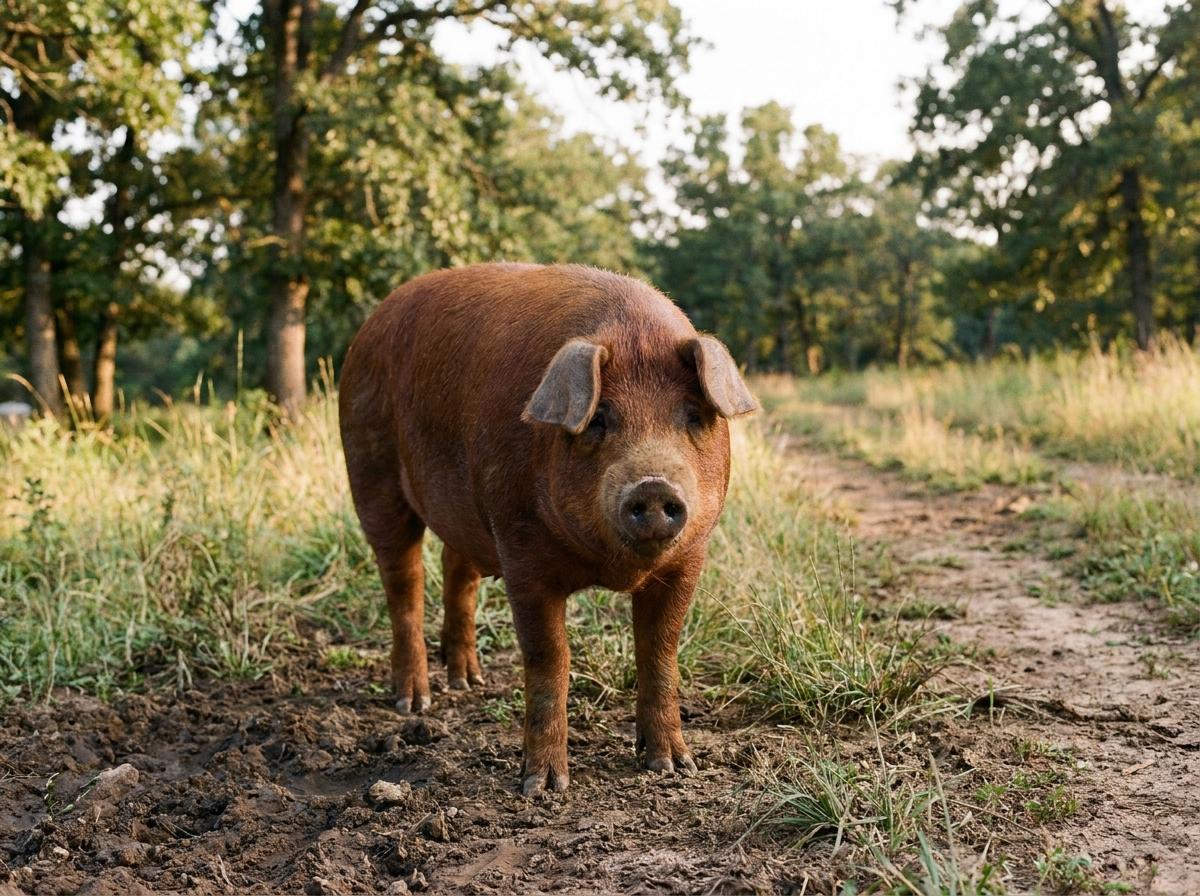
A terminal sire is the boar at the end of a crossbreeding program: his offspring all go to market, so he is chosen for growth, muscle and meat quality rather than mothering. The Duroc is a red pig with drooping ears, anywhere from light gold to deep mahogany, developed in New York and New Jersey from the Red Durocs and the Jersey Reds. It is the second most recorded breed in the United States, and the NSR calls Duroc boars the predominant terminal sire used in the world. The Hampshire is black with a white belt across the shoulders and front legs, has erect ears and is a lean, heavily muscled meat breed; its ancestors came from Hampshire County, England, between 1825 and 1835 and were developed in Kentucky, according to the NSR’s Hampshire history. The heavily muscled Belgian Pietrain is used the same way, and its guide explains the breed’s history with the stress gene.
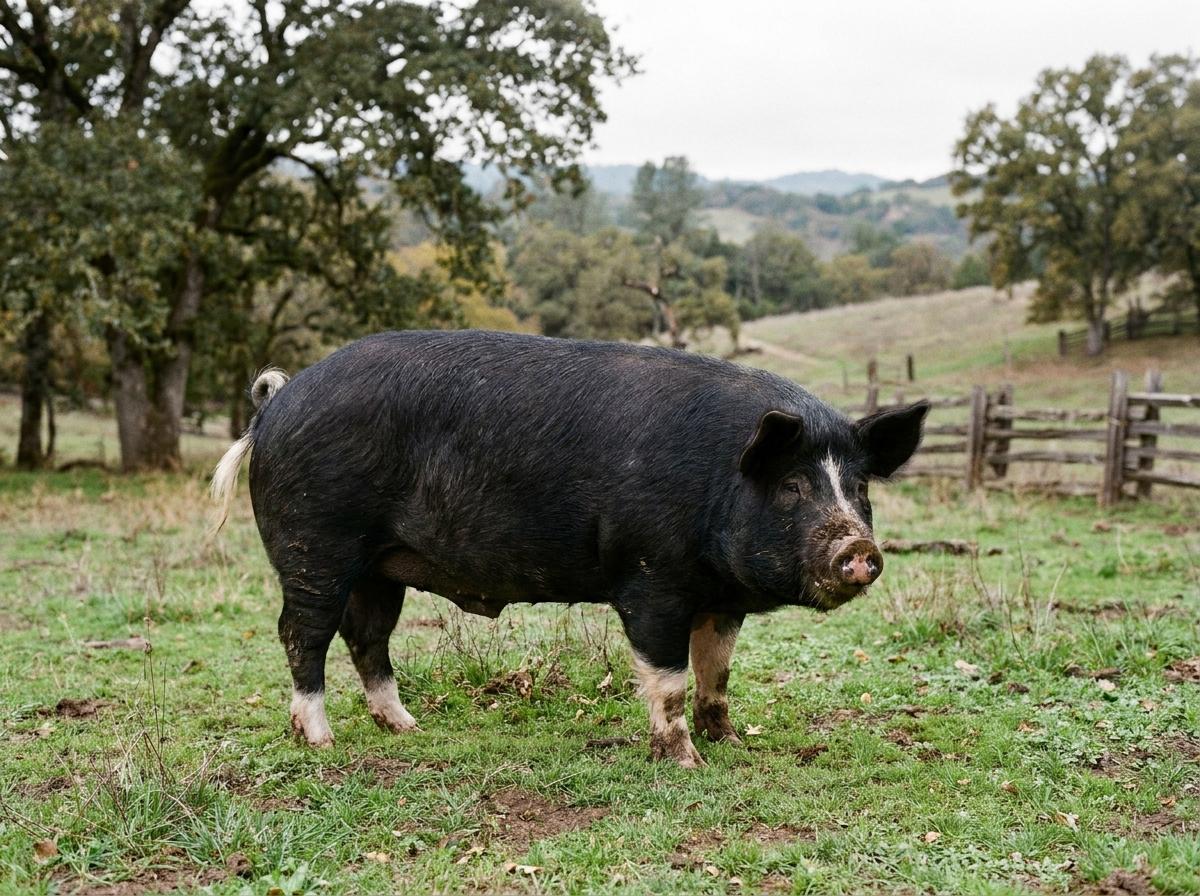
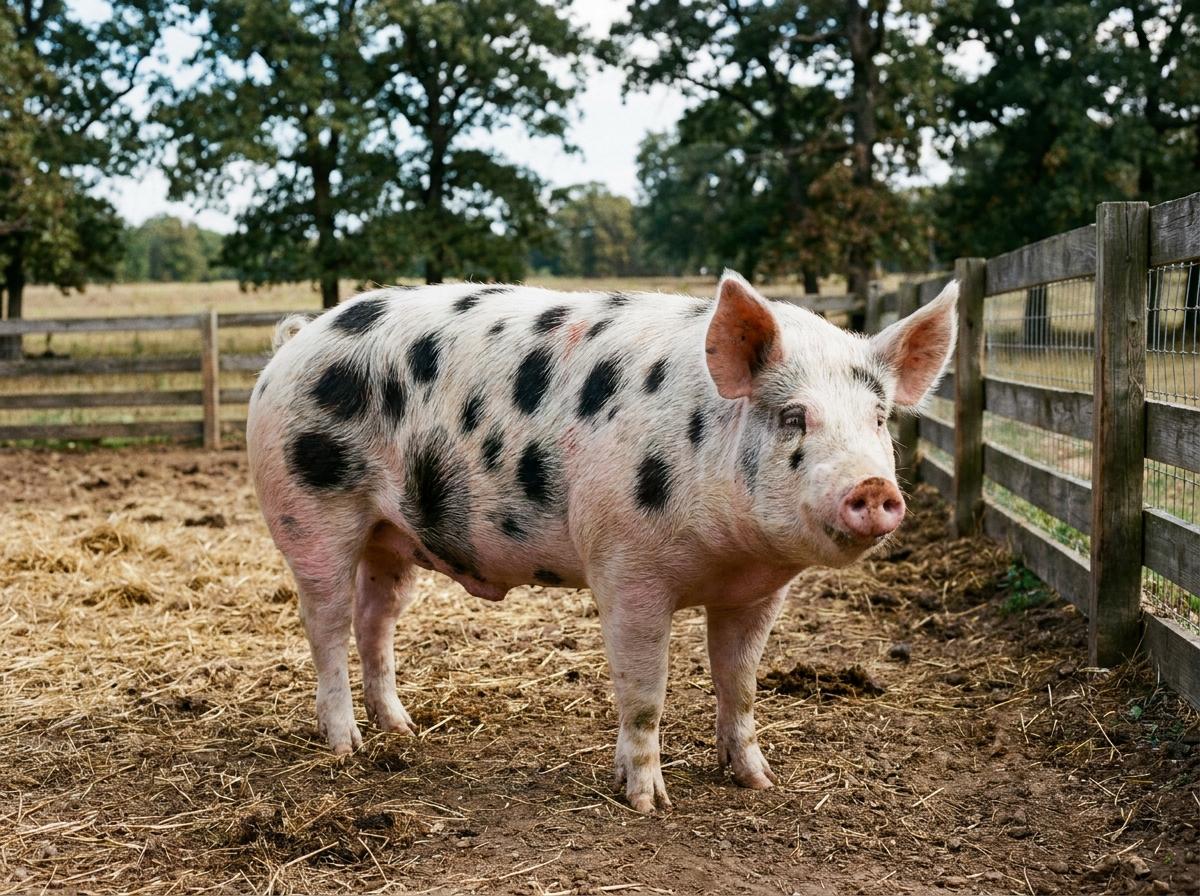
The Berkshire is known for well-marbled pork, and the American Berkshire Association, which calls itself the oldest swine registry in the world, runs a Registered Berkshire Pork program for it. A Berkshire is black with six white points (face, four feet and the tip of the tail) and carries its ears erect, under the association’s eligibility rules. The Poland China has the same six white points, but its ears must be down: erect ears are an absolute disqualification in the Poland China color requirements. The breed began in the Miami Valley of southwestern Ohio, where the Shakers brought in Big China hogs in 1816. The black-and-white Spotted breed grew from Poland China stock in central Indiana, with two imported Gloucestershire Old Spots adding blood, and was called the Spotted Poland China until its association changed the name in 1960, as Certified Pedigreed Swine recounts. The Hereford hog is red with a white face, like the cattle it is named for; it was developed in Iowa and Nebraska from Duroc and Poland China bloodlines, and its registry was organized in 1934.
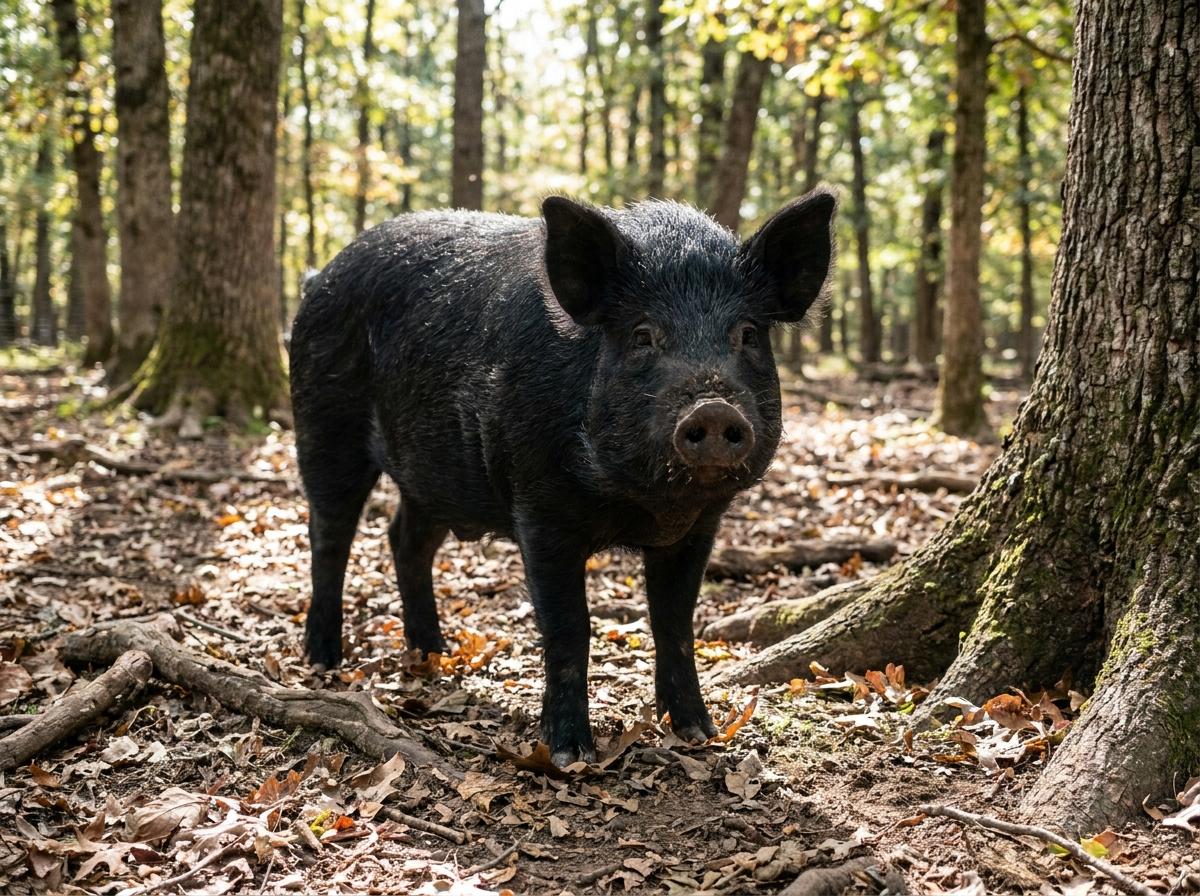
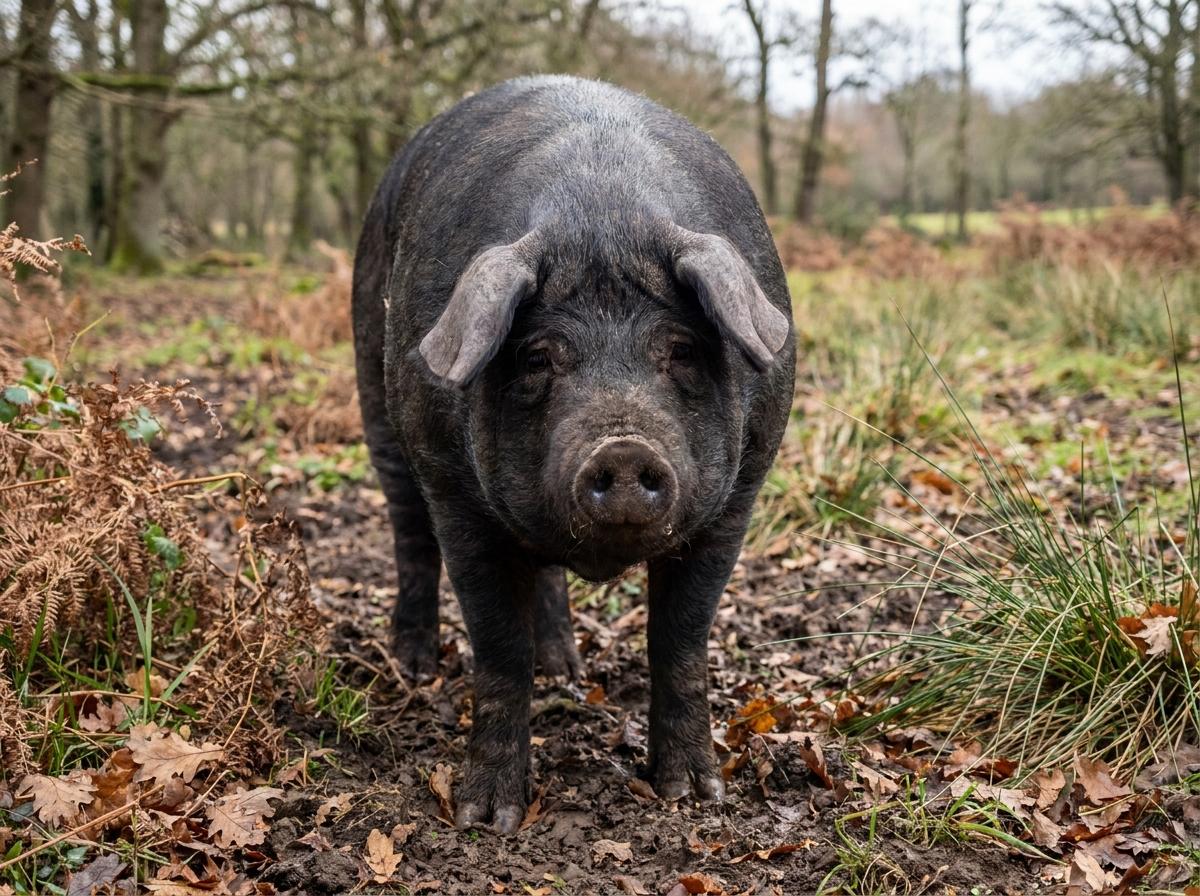
Telling the black breeds apart is mostly about ears and white. A Berkshire has six white points and erect ears, a Poland China has six white points and drooping ears, a Hampshire has a white belt and erect ears, a Spotted pig has large black and white spots and ears that are not erect, and a Large Black (below) is solid black with huge ears hanging over its face. If you are buying registered breeding stock, ask about the stress gene as well: the NSR requires its Durocs, Hampshires, Landrace and Yorkshires to be stress negative.
Heritage and pasture breeds
Heritage breeds are the older outdoor breeds that farms relied on before pork production moved indoors, and the shift to intensive husbandry after World War II pushed many of them close to extinction. Most forage and mother well outdoors, and Penn State Extension notes that they are prized for their history and for specialty markets rather than for fast growth. On the Livestock Conservancy’s 2026 Conservation Priority List, four pig breeds are critical (Choctaw, Mulefoot, Ossabaw Island and Large Black), four are threatened (Guinea Hog, Red Wattle, Gloucestershire Old Spots and Meishan) and the Tamworth is recovering.

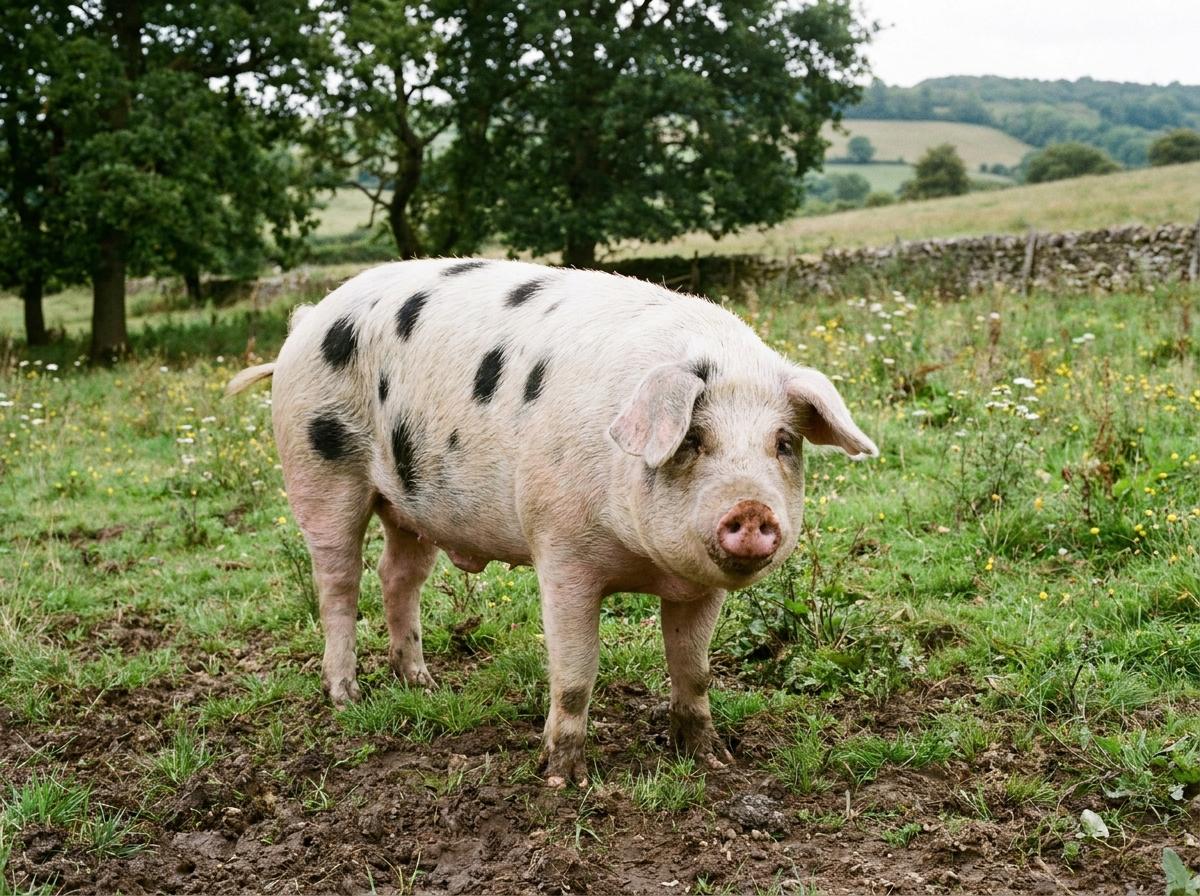
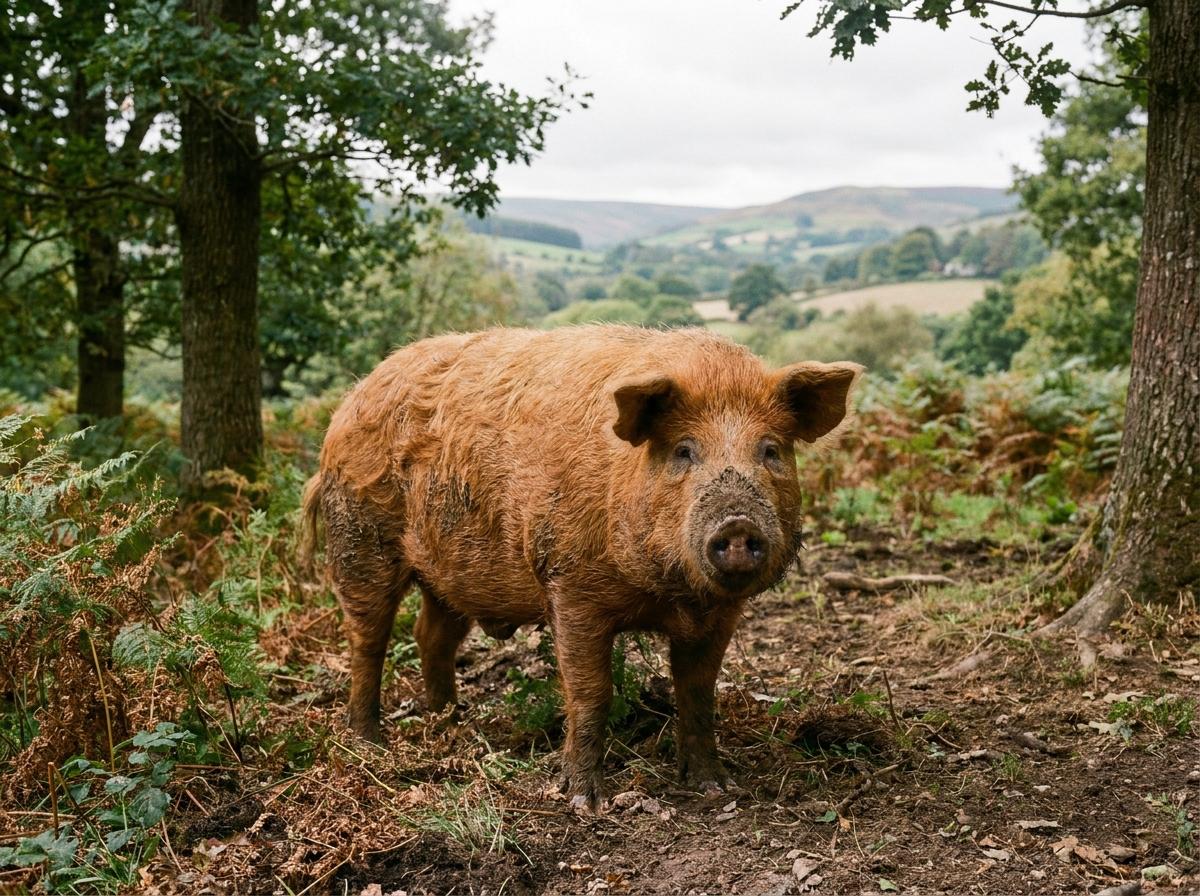
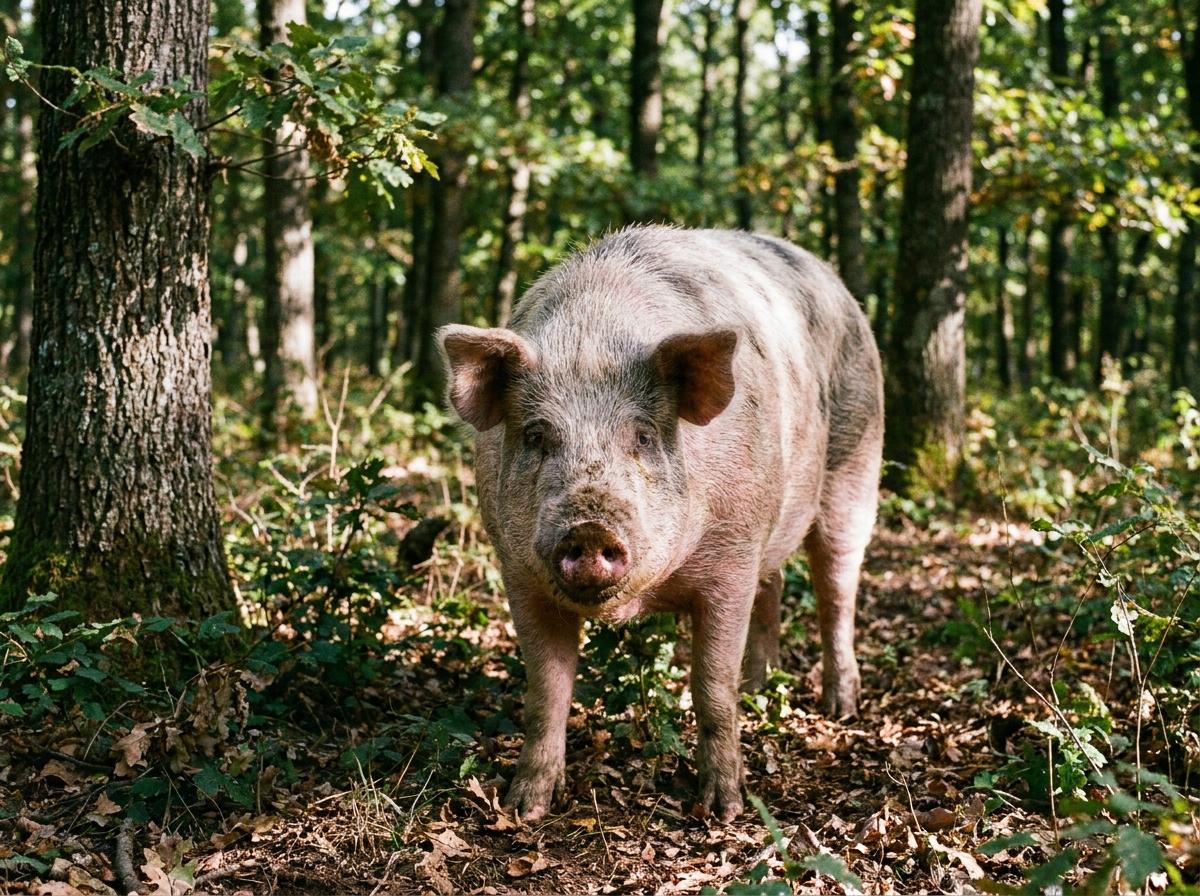
The breeds look nothing alike. The Large Black is solid black with large, thin lop ears that fall forward over its face, a docile pasture pig whose boars reach 700 to 800 pounds, according to the Livestock Conservancy’s Large Black page. The Gloucestershire Old Spots, white with black spots and big lop ears, was the English “orchard pig” that gleaned windfall fruit; its boars reach about 600 pounds. The ginger-red Tamworth is long, lean and long-snouted, built to forage in oak and beech woods, and matures at 500 to 600 pounds. The Red Wattle is a large red hog with a fleshy wattle hanging from each side of its neck, and the solid black Mulefoot is named for its single, uncloven hoof. Some heritage hogs are much smaller: the hairy black American Guinea Hog, with upright ears, has boars of 175 to 200 pounds and sows of 85 to 150 according to the Livestock Conservancy’s Guinea Hog page, and the Ossabaw Island hog, descended from pigs the Spanish left on a Georgia island, runs 100 to 200 pounds on the island and roughly 150 to 300 pounds in farm herds. The rare Choctaw hog of southeastern Oklahoma, 120 to 150 pounds, also traces to Spanish stock, but the Conservancy describes its temperament as aggressive and rates it for intermediate to experienced keepers.
Two European rarities have their own guides on Creatures: the red-and-white belted Husumer, or Danish Protest Pig, from northern Germany, and the curly-coated Mangalitsa, a fat-type breed indigenous to Hungary. Many heritage pigs grow fat easily, so they still need a complete diet matched to their stage of life, and the Conservancy’s Guinea Hog page warns that both sexes can be fertile as early as 3 months old, so separate young boars and gilts early.
Grazing breeds: Kunekune and Idaho Pasture Pig
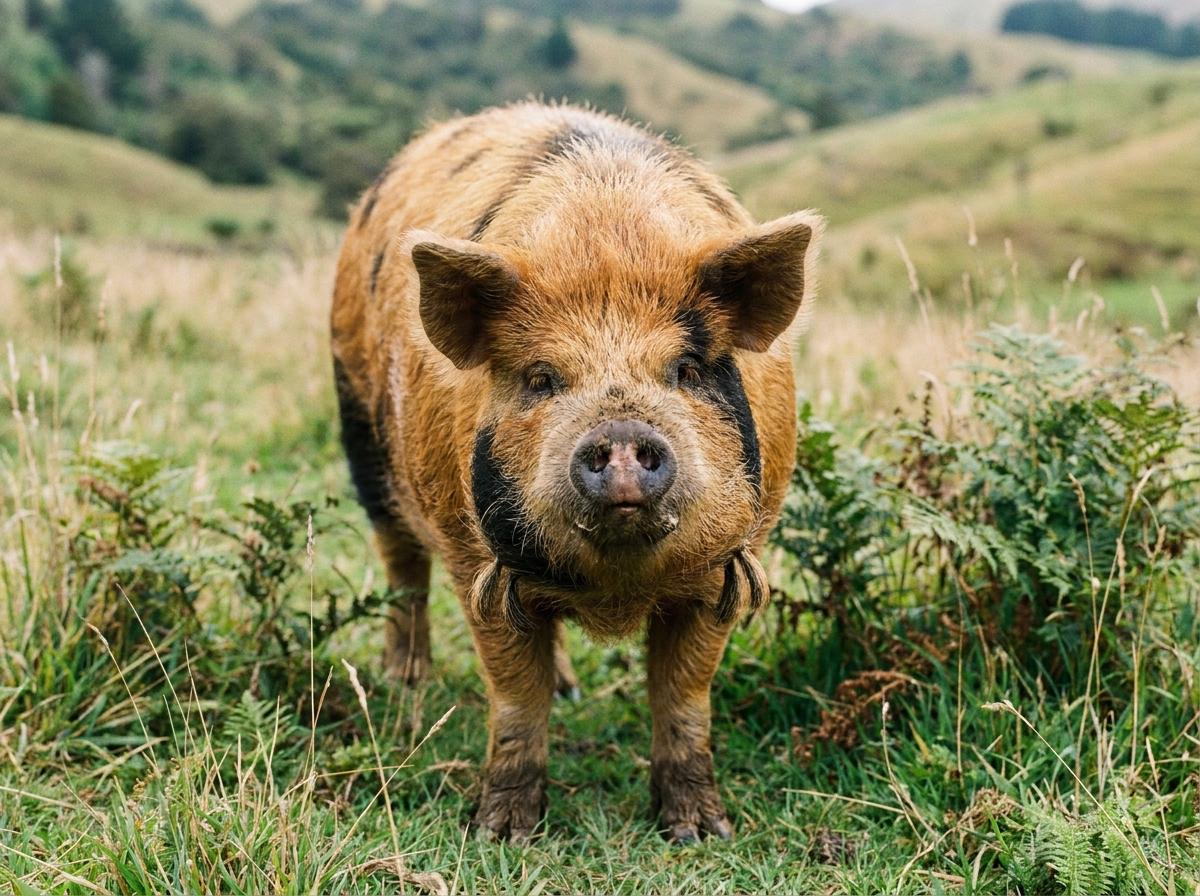
The Kunekune developed in New Zealand from pigs of Asian origin and was kept almost solely by Maori communities, and most Kunekunes in New Zealand today descend from 18 animals collected for a breeding program in the late 1970s, according to New Zealand’s rare breeds society. It is short-legged and round, with a short upturned snout and, on many pigs, a pair of tassels hanging from the lower jaw. The name means “plump”, but it is not a mini pig: the American KuneKune Pig Society describes it as a medium-sized grazing breed, not a mini or micro pig. The Idaho Pasture Pig is a newer breed built from Duroc, Old Berkshire and Kunekune, and its registry describes mature sows of 250 to 350 pounds and boars of 350 to 450.
Grazing breeds use pasture well, but grass is not a complete diet. Penn State Extension is direct about it: pigs need more energy and protein to grow than grass alone can provide, so even a grazing pig needs a balanced ration and minerals alongside its pasture.
Chinese breeds: Meishan and the Taihu pigs
Asia has more local pig breeds than any other region in the FAO count, and the best known outside China are the Taihu pigs from the Lake Tai region, a group of related breeds that includes the Meishan. They are known for enormous litters: by their third farrowing Meishan sows typically have 14 to 16 piglets, and they reach puberty at about 90 days, according to the Livestock Conservancy’s Meishan page. US Meishans trace back to 99 animals imported in 1989 for a joint USDA and university research project.
Miniature and pet pigs
Potbellied pigs were among the first miniature pigs to become popular as pets in the United States, after they were introduced in the mid-1980s. The Merck Veterinary Manual’s description of potbellied pigs gives the type: a short, wrinkled snout, small erect ears, a pronounced potbelly, a swayed back and a straight tail with a switch at the end, usually black. Adults should not exceed 18 inches at the shoulder, and most mature potbellied pigs weigh under 200 pounds, against a farm hog that can pass 1,000. Pet types you will see advertised include the Vietnamese potbelly and the spotted, leaner Juliana, but as potbellied pigs grew popular they were crossed with other miniature swine and even commercial pigs, so most pet pigs today are mixes that vary widely in size.
That is where buyers get hurt. Merck’s professional edition is plain that the term teacup pig has no strict definition. Miniature pet pigs commonly weigh 100 to 150 pounds, they rarely reach full size before 2 to 3 years old, and because pigs can breed at 3 months old, a seller can show you a small mother who is not finished growing herself. The American Mini Pig Association sizes pigs by measured height and age rather than labels such as micro, teacup, nano or pixie, and notes that most reach adult height by about 5 years. Selecting for tiny size also magnifies inherited problems. The Juliana guide and the pig lifespan guide go into the size question in detail.
Two minipig breeds belong mostly to the laboratory. The slate-gray, nearly hairless Yucatan miniature pig was developed at Colorado State University and is widely used as a biomedical research model, and the Göttingen minipig is another research line, used in studies of obesity and diabetes among others. Some Yucatans are now kept on homesteads, but neither breed is a teacup pig.
What pigs cost to buy and keep
A pig can cost under $50 or several thousand dollars, because “pig” covers three separate markets. Feeder pigs bought to raise for meat are priced like a commodity and follow the hog market. In the week ending October 2, 2026, USDA’s weekly National Direct Feeder Pig Report put 40 pound feeder pigs at an average of $47.79 a head ($45 to $52), delivered to the buyer’s farm for commercial lots of hundreds of pigs, down from $79.34 in the same week a year earlier. At local sale barns, where you haul the pig yourself, weight drives the price: the How Much Does a Pig Cost? guide found mid-July 2026 auction lots from $47.50 to $102.50 a head for pigs of roughly 36 to 98 pounds. Registered breeding stock is priced for its genetics and records, and the cost guide puts it at a few hundred dollars into the low thousands, with elite show and AI boars far higher. To price a specific pig, try the free livestock value calculator: choose pig, sex and age, and it returns a directional range drawn from verified auction-sale statistics. Pet mini pigs have no dependable published market price at all; the cost guide explains why, and why a very cheap piglet is a warning sign rather than a bargain.
For a meat pig, the purchase is the small number. A 50 pound pig started in May typically reaches a market weight of 250 to 280 pounds by November, Penn State Extension says, and feed is 60 to 70 percent of the total cost of producing a market hog, according to University of Minnesota Extension. Add bedding, a vet visit or two and the processing fee at the end; the Creatures directory lists processing services by state. For a pet or breeding pig, budget for the years: feed, bedding, fencing repairs, annual hoof and tusk trims for a pet, and a vet who knows pigs, every year of a life that can run past a decade.
How long pigs live
A pet pig kept for life usually lives 10 to 15 years. The Merck Veterinary Manual’s pet owner edition gives potbellied pigs a range of 8 to 25 years with 10 to 15 common in healthy pigs, its professional edition gives miniature pigs about 8 to 20, and both editions add the same warning: obese or unusually small pigs are likely to have shorter lives. That is a commitment closer to a dog’s than to a farm animal’s, so plan for it before you buy.
Farm pigs live far shorter lives because of what they are kept for, not because of their biology. Penn State Extension’s description of farrow-to-finish swine production allows about six months to raise a litter to a market weight of about 280 pounds, and US market hogs averaged 289 pounds live at slaughter in 2025, according to USDA’s slaughter summary. Breeding sows stay longer, but not as long as most people assume: a review in Porcine Health Management found mean sow life from birth to removal of 992 to 1,088 days in European and Japanese herds, or roughly 2.7 to 3 years. Heritage sows on small farms can work much longer; the Livestock Conservancy says well-managed Guinea Hog sows can live up to 14 years. The How Long Do Pigs Live? guide goes through each case and the records that help a pet pig reach the long end of the range.
Housing, fencing and shelter
Pigs need surprisingly little room when they are housed and a good deal more when they live outdoors, because rooting turns small paddocks into mud. Penn State Extension notes that pigs spend most of their time eating, sleeping and rooting, and that pigs without indoor housing need more space, less for their own sake than for spreading manure and managing the pasture. For a pet potbellied pig, the Merck Veterinary Manual’s housing advice calls for an outdoor pen of at least 50 square feet per pig, with a sleeping and feeding shelter, fencing set firmly into the ground, and a pen that is moved from time to time onto fresh ground.

Shelter and heat. A three-sided shelter, open on one side, is enough for pigs with access to pasture, according to Penn State, but every pig needs one. Heat is the bigger danger. Pigs have only a limited number of functional sweat glands; adults are most comfortable at 65 to 75°F, temperatures above 85°F are stressful, and extended heat with high humidity can kill a pig that is not used to it, as Merck’s management guidance for miniature pet pigs explains. Give them shade, moving air, cool ground to lie on and somewhere to wallow: a mud wallow on a farm, or a child’s plastic wading pool for a pet. Young pigs are the opposite problem: Penn State notes that pigs under about 50 pounds need help keeping warm, so they need dry, deep bedding and shelter from drafts.
Fencing. Pigs go over, under and through fences that hold other livestock, and an escaped pig can turn feral quickly. Ontario’s agriculture ministry, in its factsheet on fencing for outdoor pig production, recommends combining strong woven wire with electric wires low (at pig height) and high, testing electric fences daily, and avoiding barbed wire, which can injure pigs and especially sows’ udders. It also explains a quirk worth knowing: a pig that touches an electric wire for the first time tends to lunge forward through it, so train new pigs on a short stretch of wire set in front of a solid wall. Penn State adds one more trick: a strand of electric wire at ground level inside the pen stops pigs digging under the fence, but keep it away from the gate or they will refuse to walk out. Choosing the Right Fence for Animals compares the options.
Water. Pigs need clean water at all times. Penn State recommends automatic waterers rather than buckets, which pigs tip over and play in, and Merck notes that water dispensers must be fixed in place because a pig that spills its water can end up with salt poisoning (salt toxicosis) from going without it.
Indoors. A house pig needs its own defined area with a sleeping corner and a litter box, a rooting box filled with blankets or dirt, ramps instead of steps, and a floor kept clear of anything it could swallow. Merck’s routine care advice lists swallowed objects and fractures from jumping off furniture as the most common injuries in pet pigs.
Feeding pigs: what pigs eat
Pigs are omnivores that will eat almost anything, which is exactly why their diet has to be managed. US farm pigs are typically fed a complete feed built on corn and soybean meal, the diet the Merck Veterinary Manual’s nutrient requirement tables are written around, and pigs need 36 essential nutrients plus water from it. Young pigs need much more protein, and especially the amino acid lysine, than finishing pigs do, so feed is formulated by stage. For a small group, Penn State recommends buying a premixed ration made for the pigs’ weight rather than mixing your own.
How much to feed depends on the pig’s job. Meat pigs are usually fed free choice from a self-feeder so they can grow as fast as they can, Penn State explains. Pet pigs are the opposite: they gain weight easily and lose it with great difficulty, and Merck ties obesity in pet pigs to joint disease, lameness and pain. Feed a commercial ration made for miniature pigs, measured by body weight and divided into at least two meals a day, with green leafy vegetables and grass to fill them up, fruit only as a training reward, and no high-calorie treats or table scraps. Merck also advises against feeding pet pigs from bowls at all: scatter the ration in the grass or put it in a foraging toy so every meal involves rooting. Many house and garden plants are toxic to pigs, so check what your pig can reach.
Food waste is regulated. Under the Swine Health Protection Act, anyone feeding pigs food waste that contains or has touched meat, poultry or fish, such as scraps collected from restaurants or cafeterias, needs a license and must cook it at 212°F for 30 minutes, and many states ban the practice altogether. The federal law exempts a household’s own kitchen scraps fed on the same property, but that is no reason to feed them: Penn State’s advice for small farms is to keep meat out of anything you feed pigs, because scraps can spread diseases such as trichinella and African swine fever. African swine fever has never been found in the United States, but USDA notes it has recently been detected in Haiti and the Dominican Republic, and keeping pork scraps away from pigs is one of the simplest ways to protect your own.
Weigh pigs rather than guessing. Feed, dewormer and medication amounts go by weight, and a growth record shows a pet pig’s weight drifting up long before you can see it. No scale? Measure the heart girth and body length with a tape, and the free pig weight calculator turns them into an estimate, no account needed; estimating weight with the weight calculator shows where to put the tape.
Health basics
Find a veterinarian who treats pigs before you bring one home. Merck’s routine care page is frank that a vet with pet pig experience can be hard to find, since few small animal vets are trained in pigs and livestock vets may not be nearby, and suggests starting with your state veterinary medical association’s referral service. For a farm pig, How to Find a Large Animal Vet explains how to locate a farm-call practice; for a house pig, How to Find an Exotic Animal Vet is the better place to start.
A pig health program comes down to a few habits:
- Vaccines. Which vaccines a pig needs depends on its contact with other pigs, wildlife and other animals, so your vet sets the program. For pet pigs, Merck describes a first round at or after 4 weeks old, a second 3 to 4 weeks later and boosters every 6 to 12 months, with erysipelas in every combination it lists.
- Parasites. Bring a fresh fecal sample to checkups. Sarcoptic mange is the most common parasitic disease of pet pigs and it spreads to people, so Merck advises preventive treatment for every young or newly bought pet pig, even one showing no signs.
- Hooves and tusks. Pet pigs that do not walk on rough ground need their hooves trimmed about once a year. Their tusks erupt at 5 to 7 months, grow for life and need trimming too, usually under sedation.
- Spaying and neutering. For pets this is not optional. Merck recommends neutering males at 2 to 3 months and spaying females at 4 to 6 months, and says intact males do not make suitable pets.
- Antibiotics and withdrawal. A vet now stands between you and most antibiotics: medically important antibiotics used in feed have required a Veterinary Feed Directive since January 2017, and the last over-the-counter ones moved to prescription labels from June 11, 2023. Every drug given to a pig raised for meat also has a withdrawal time, a period after treatment before the pig can be slaughtered for food; ask your vet for it and record the date it clears.
- Biosecurity. USDA asks pig owners to work out a biosecurity plan with their vet and to keep their pigs away from feral swine, using double fencing where wild pigs are around. Buy from healthy herds.
Know your own pigs’ normal. Merck’s guide to selecting a healthy potbellied pig describes it well: active and alert, no discharge from the eyes, nose or ears, no limping, and urinating and passing manure easily. When a pig stops eating, lies apart, limps or strains, note the date and what you saw, and call your vet sooner rather than later.
Social life and handling
A pig should not live alone. Pigs prefer to sleep touching other pigs, Merck notes, and too little normal contact with their own kind may feed the aggression some mature pet pigs develop. Plan on at least two: a pair of spayed and neutered pets, or a small group of feeder pigs. The exceptions are practical. A newly bought pig should be kept apart from your own pigs at first, for as long as your vet recommends, and Merck advises keeping breeding boars in secure pens, never in the house.
Pet pigs go through a hard stage. At about 2 years old, many potbellied pigs start challenging people and other pigs for rank, an aggressive 100 pound pig can hurt an adult, and Merck records that this is when many pet pigs are abandoned or given up to shelters. Harness and leash training from a young age, rewarding the behavior you want and never using punishment, which makes pigs fearful and more aggressive, all help, as Merck’s management guidance explains. Farm pigs are handled the same patient way: Penn State notes that pigs do not like to be pushed, so let them move at their own pace and use a solid panel (a hurdle) to steer them. Remember that tusks are sharp; Merck warns that long canine teeth can easily injure a person.
Breeding, gestation and farrowing
Domestic pigs breed year round, though summer heat can dent fertility. Sows and gilts cycle about every 21 days (18 to 24), with heat lasting about 1 to 2 days in gilts and 2 to 3 days in sows, according to the Merck Veterinary Manual’s breeding management chapter. A sow in standing heat holds rigidly still when pressure is put on her back, the test producers use to time breeding. Most sows come back into heat 3 to 7 days after their piglets are weaned.

A sow is pregnant for about 114 days, the “3 months, 3 weeks and 3 days” of the old rule, which is the figure in Purdue University’s owner guide What to Expect When Your Sow Is Expecting. Modern commercial sows tend to run a day or two longer, averaging 115 to 116 days from first service, and Merck gives potbellied pigs 113 to 115 days. The free pig gestation calculator turns a breeding date into a farrowing date and planning window, and Pig Gestation Period: How Long Are Pigs Pregnant? has a full farrowing date chart and the factors that move the date.
Litter sizes vary by type. US sows saved an average of 11.96 pigs per litter in June to August 2026, according to USDA’s Quarterly Hogs and Pigs report, Meishan sows often have 14 to 16, and potbellied litters range from 1 to 12, according to Merck’s potbellied pig breeding page, which also discourages breeding pet pigs as an amateur.
Most sows farrow without help, but know the timing. Purdue’s guide says the first piglet usually arrives 15 to 20 minutes after the sow starts straining and the rest follow every 15 to 20 minutes, and that a sow straining for more than 30 to 45 minutes without producing a piglet needs help: if nobody on hand has experience delivering piglets, call your vet straight away. Potbellied sows are more prone to difficult births because of a narrower birth canal and heavier body condition. Newborn piglets need colostrum, the first milk, and real warmth: Purdue recommends an environment above 90°F for the first couple of weeks, in a protected corner where the sow cannot lie on them or reach the heat source, with any cords out of reach.
Where to find pigs and breeders
Good pigs come with a history, so buy where you can see it.
- Breeders and farms. A farm visit shows you the herd, the sire and dam, and their paperwork. Search pig breeders and farms on Creatures by breed and state. Most listings are compiled from public sources, so check the details with each farm before you visit.
- Breed registries and clubs. Registered pigs come with papers, and the associations above keep breeder lists and run sales. To find one, browse the registry directory on Creatures, which sorts breed registries and associations by species.
- Youth and show pig sales. Many registered breeders sell show pigs for 4-H and FFA projects; 4-H and FFA Livestock Projects explains how a swine project works.
- Auctions. Sale barns sell feeder pigs cheaply, but Penn State warns that auction pigs carry a higher disease risk; if you buy there, make sure each pig can be traced to its premises of origin.
- Online listings. Sellers on the Creatures marketplace pass verification before they list, but pig listings are few or none at any given time, so a free alert is the surer way to hear about one.
Wherever the pig comes from, ask for its birth date, its vaccination and treatment records, the herd’s health history, and for registered breeding stock, the registration papers and stress status. Merck’s advice for pet pigs applies to any pig: look at where it has been kept (clean, with water, food, a rooting area and shelter), have a vet of your choice examine it before you buy, or get a written agreement that you can return it if a prompt vet exam finds a problem.
For a pet pig, add three more steps. First, check your zoning before you fall in love: Merck notes that most zoning ordinances classify potbellied pigs as livestock, so they are banned from residential property in many communities, and they do not suit apartments. Second, meet the parents and ask their ages; the American Mini Pig Association advises that a parent 2 years or older gives a far more accurate idea of adult size than any label. Third, walk away from any seller who promises a teacup or micro pig or guarantees a tiny adult weight. Adult pigs that need new homes are worth considering too, because you can see exactly how big they are.
Then plan the trip home. A pig crossing a state line needs official identification (the federal exemptions are narrow, for example a group born and raised together on one farm and hauled straight to slaughter, so they will not cover pigs you are bringing home), often a certificate of veterinary inspection too, and the receiving state can add rules of its own, so phone its state veterinarian’s office before you load up. Livestock Health Certificates explains what a CVI is, and Livestock Transport covers moving animals safely.
Records to keep for every pig
Good records earn a fair price from the next buyer, and they answer the questions a vet, a registry or a state animal health official will ask. Start with identification. Registered pigs are ear-notched within days of birth: in the system Certified Pedigreed Swine describes, notches in the right ear give the litter number and notches in the left ear the pig’s number within the litter. For pigs moving between states, federal rules accept official ear tags, ear notches or tattoos recorded with a breed registry, and for feeder and slaughter pigs, a tag or tattoo carrying the premises identification number of the farm they came from, which your state animal health office assigns. After that, write each event down the day it happens:
- the pig’s birth date, its sire and dam, its ear notch or tag and any registration number;
- each breeding date, the boar or AI sire used, and any pregnancy check result;
- the farrowing date, how many piglets were born alive and how many were weaned, and any problems;
- weights, once a month for growing pigs and pets;
- each vaccination, dewormer and treatment, with the product, the date given and the date any withdrawal ends;
- hoof and tusk trims, for pet pigs;
- each purchase and sale, and every time a pig changes location.
Livestock Record Keeping shows what to record with examples, and Livestock Bookkeeping Basics covers the money side, from feed bills to Schedule F. Families showing pigs at the fair can start with the guide to 4-H livestock record books. For a registered pig, add the pedigree: the free pedigree chart maker prints a pedigree three generations deep, registration numbers included, no account needed. Naming a new arrival? The pig name generator offers a few hundred ideas.
A free Creatures profile for each pig keeps its identification, pedigree, photos and all of those records together, sends reminders for boosters, trims and due dates, and lets you transfer the pig to a buyer with its history when you sell. A pen of feeder pigs does not need a profile for each animal: you can track animals without individual profiles as a group. The help guides on health and medical records and adding a record show how.
Frequently asked questions
How many species of pigs are there?
There is one domestic pig, written as Sus scrofa domesticus or Sus domesticus, and every farm, heritage and pet breed belongs to it. The wider pig family, Suidae, has 18 living species in the Mammal Diversity Database, including the wild boar, warthogs, babirusas and the pygmy hog. Peccaries are a separate family, and guinea pigs are rodents.
What are the main types of pigs?
Commercial breeds, heritage and pasture breeds, and miniature pet pigs. Commercial breeds split into white maternal breeds such as the Yorkshire and Landrace and colored terminal sire breeds such as the Duroc and Hampshire. Heritage breeds such as the Large Black and Tamworth are older outdoor breeds, and pet pigs are mostly potbellied pigs and mixed miniature pigs.
What is the most common pig breed in the United States?
The Yorkshire is the most recorded purebred swine breed in the United States and Canada, followed by the Duroc, according to the National Swine Registry. Commercial pork production leans on crossbreds, though: the registry describes Yorkshire and Landrace being crossed to make the sow, which is then mated to a terminal boar such as a Duroc.
How long do pigs live?
Pet pigs commonly live 10 to 15 years, and Merck’s outer range runs from 8 to as many as 25. Market hogs reach slaughter weight at about six months, and in the European and Japanese herds studied, commercial sows were removed at roughly 3 years old on average.
What do pigs eat?
Pigs are omnivores. Farm pigs eat a complete feed, usually built on corn and soybean meal and formulated for their stage of growth, while pet pigs eat a measured ration made for miniature pigs, with greens and only small amounts of fruit. Keep meat scraps away from pigs: they can spread disease, commercial food waste containing meat can only be fed under a federal license after cooking, and many states ban feeding it at all.
How much does a pig cost?
It depends on the market. In commercial lots, a 40 pound feeder pig averaged $47.79 a head delivered in USDA’s weekly report for the week ending October 2, 2026, and auction lots in July ran up to about $100 a head. Expect a few hundred dollars to the low thousands for registered breeding stock, and remember that feeding a pig to market weight costs far more than buying it.
How long is a pig pregnant?
About 114 days, or 3 months, 3 weeks and 3 days. Modern commercial sows average 115 to 116 days from first service, and potbellied pigs carry 113 to 115 days.
Are teacup or micro pigs real?
No. The Merck Veterinary Manual says the term teacup pig has no strict definition, and miniature pet pigs commonly grow to 100 to 150 pounds. They keep growing for 2 to 3 years or longer, so a seller who guarantees a tiny adult size cannot know it.
Can you keep just one pig?
It is better not to. Pigs are social, they prefer to sleep in contact with other pigs, and Merck links a lack of contact with other pigs to aggression in some mature pet pigs, so plan on at least two, spayed or neutered if they are pets.
Do this next on Creatures
Whether you are looking for your first pig, bringing feeder pigs home or already running a breeding herd, these are the useful next steps, in the order most readers need them.
Get told when the right pig is listed. Pig listings are rare right now, so set a free pig listing alert and Creatures emails you when matching pigs are posted, no account needed to start. Here is how saved searches work.
Find breeders by breed and state. Search the Creatures breeder directory, or go straight to pig breeders and farms, and ask each one for health records, birth dates and a look at the parents.
See what is for sale now. Browse pigs on the Creatures marketplace, where sellers pass verification before they can list.
Brought pigs home? Create a free profile for each pig with its ear notch or tag, birth date, breed and photos, no account needed to start. The walkthrough is in adding an animal to Creatures.
Keep the records that protect your pigs and your money. Vaccinations, treatments and withdrawal dates, breedings, farrowings, weights and trims: add a record. The record sheet opens for any visitor to look around, and a free account saves what you enter. See recording a breeding and reminders and upcoming care for boosters and due dates.
Raise or sell pigs? Farms and breeders can create a free farm or breeder profile so buyers searching for pigs can find you, no account needed to start. See getting listed in the breeder directory, adding your team and how seller payout works.
Use the free pig tools. Work out a farrowing date with the pig gestation calculator, estimate weight with a tape and the pig weight calculator, check auction prices with the livestock value calculator, print a pedigree chart, or find a name in the pig name generator.