Hampshire
Author: Elliott Garber, DVM · Published
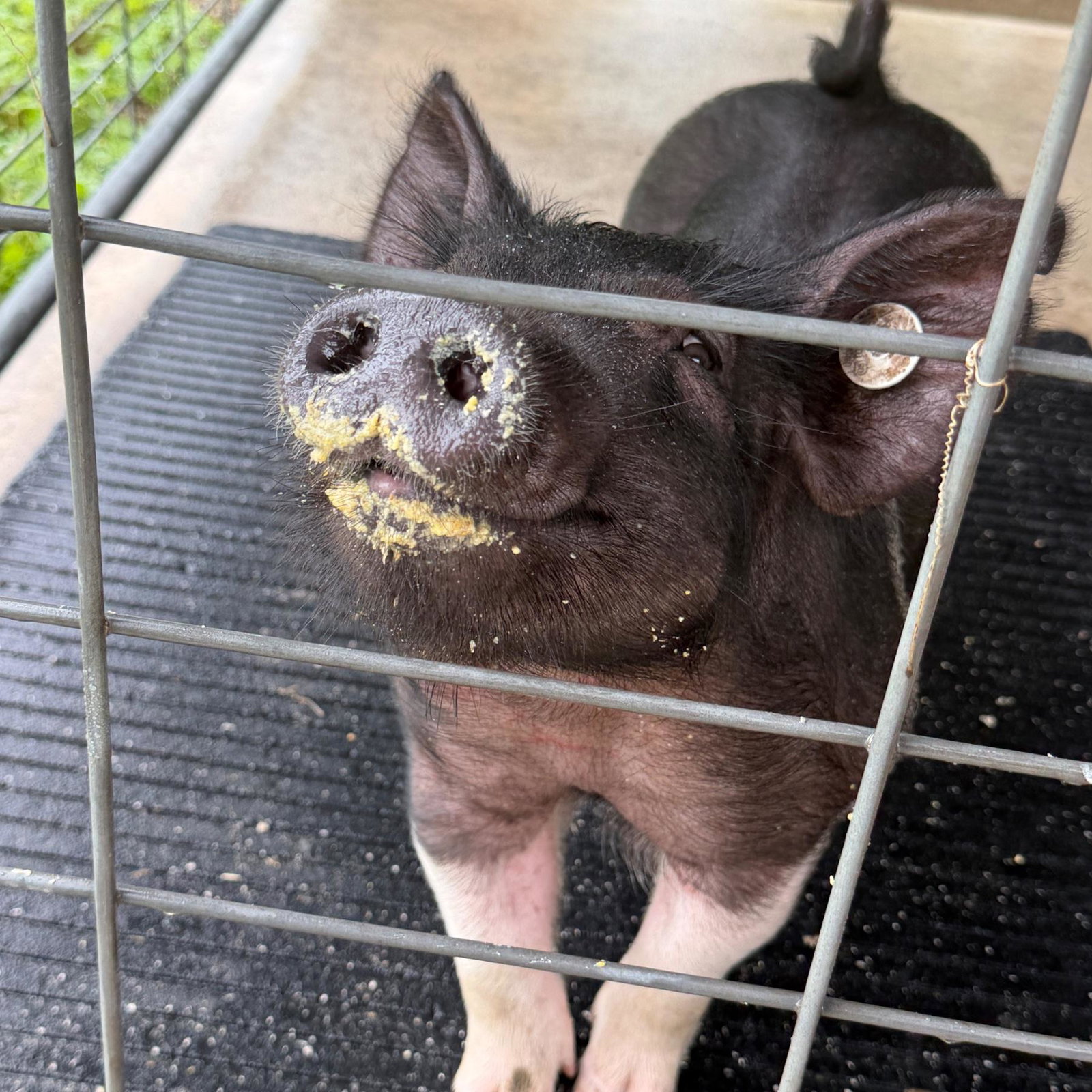
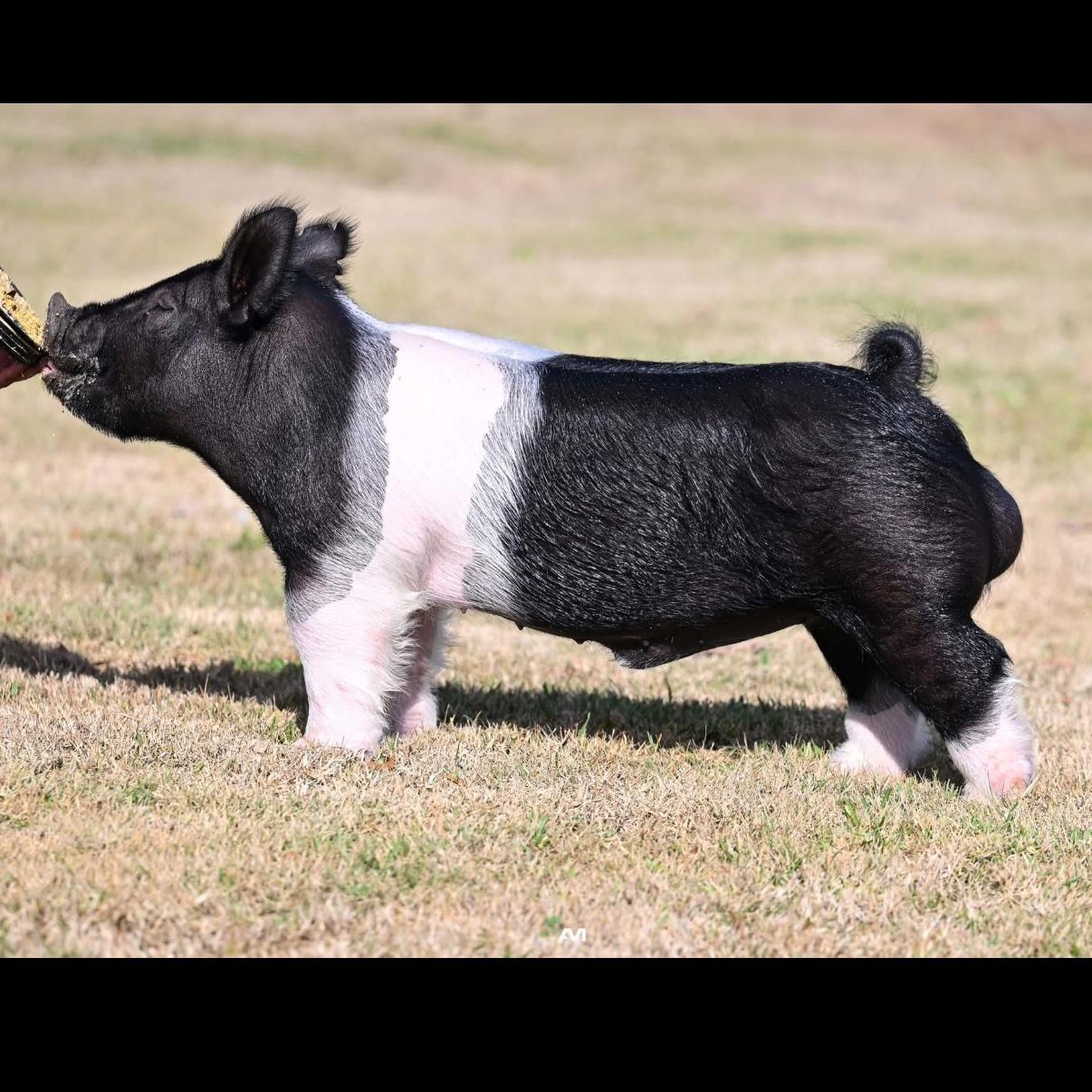
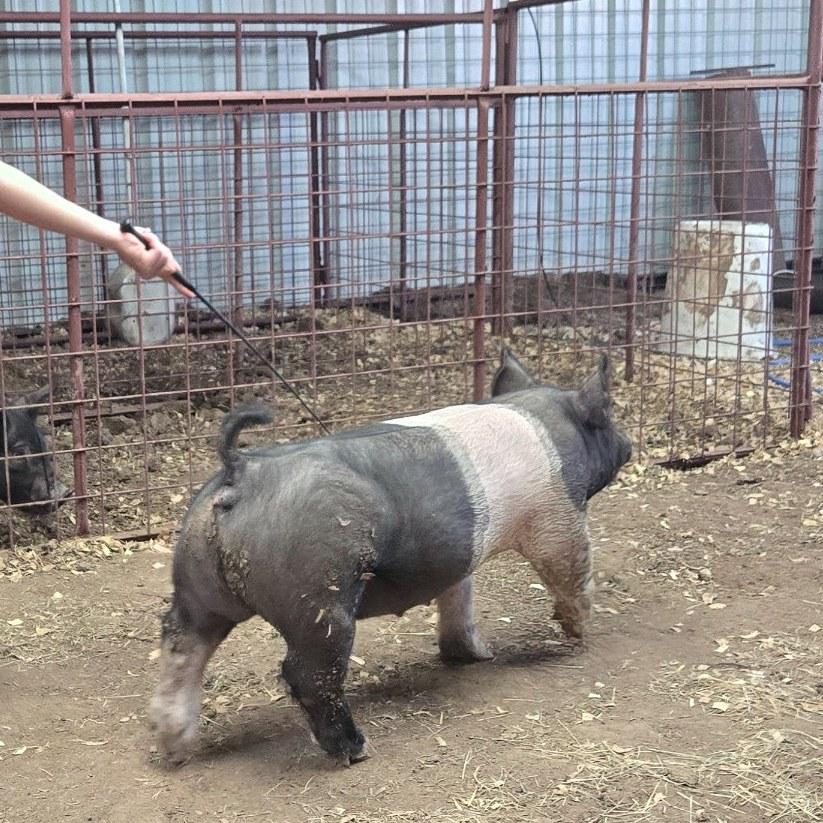
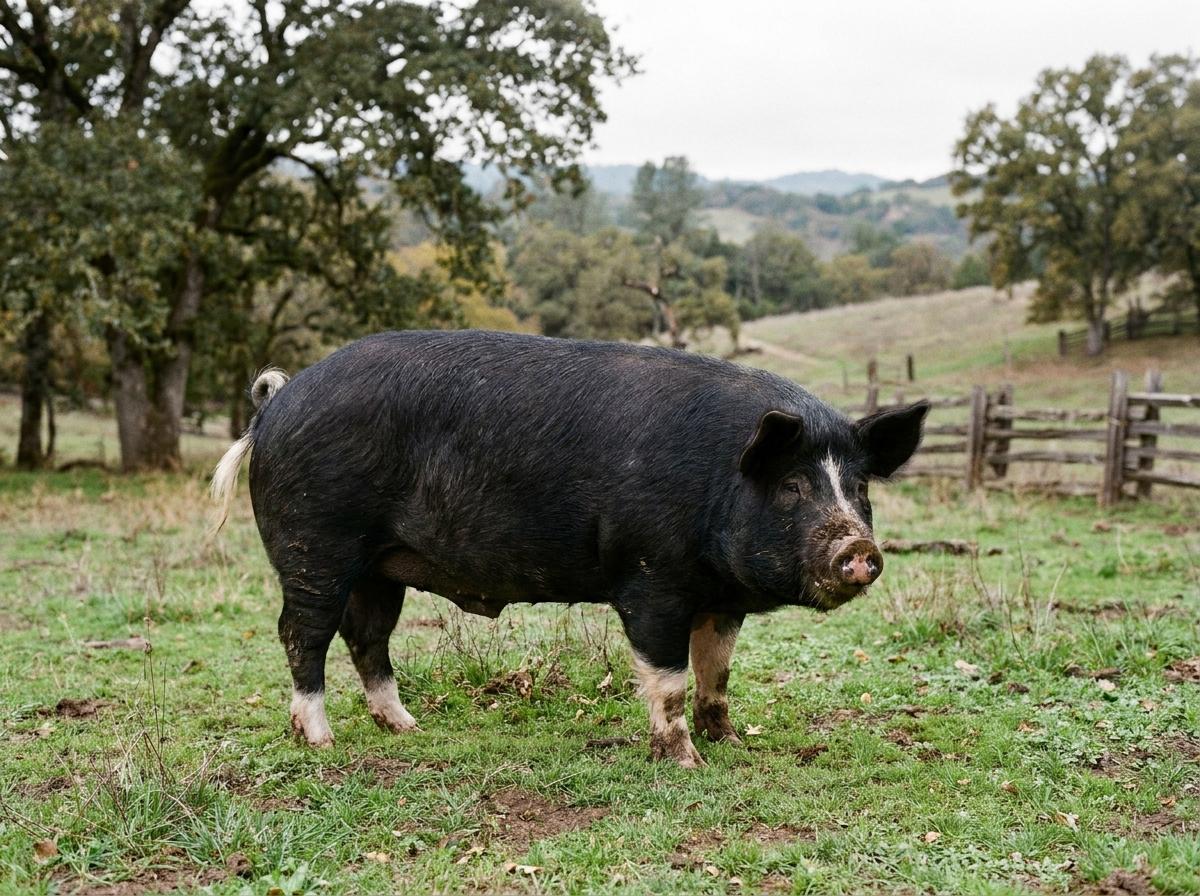
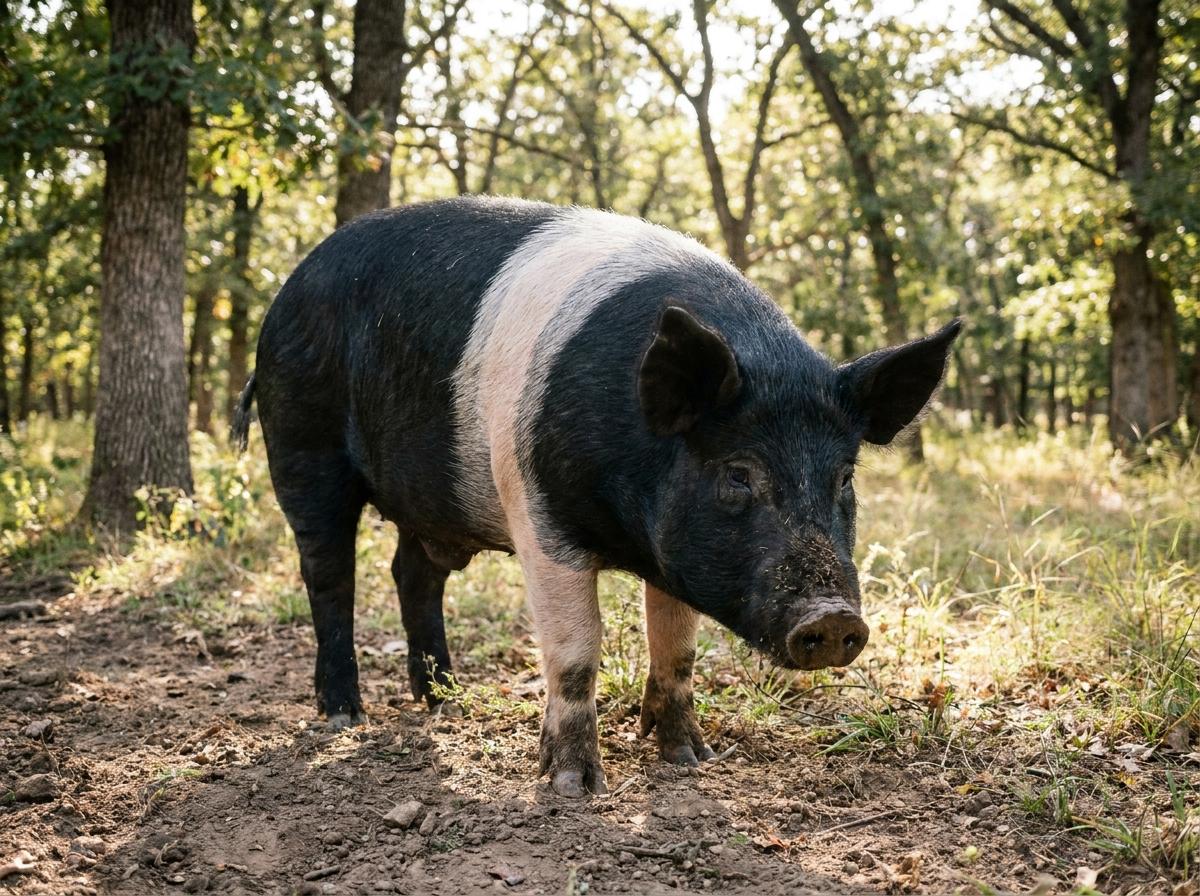
The Hampshire is a black pig with a white belt: a band of white hair that wraps around the shoulders and runs down both front legs, on a lean, heavily muscled, erect-eared meat hog. It is an American breed with English roots, registered in the United States by the National Swine Registry, which describes it as the fourth most recorded pig breed in the country. Commercial producers use Hampshire boars as terminal sires to put muscle and lean into market hogs, and at county fairs the belted barrow is one of the most familiar sights in the youth show ring. If you already raise one, you can give it a free profile on the Creatures pig pages and keep its records there.

| Look | Black with a white belt that encircles the shoulders and both front legs; erect ears |
|---|---|
| Type | Lean, heavily muscled meat breed |
| Main commercial role | Terminal sire for crossbred market hogs |
| US registry | National Swine Registry (Hampshire Swine Registry), West Lafayette, Indiana |
| Origin | English belted pigs imported between 1825 and 1835, developed in Kentucky as the “Thin Rind” |
| First US record association | American Thin Rind Association, Erlanger, Kentucky, May 1893; renamed Hampshire in 1904 |
| Genetics to ask about | Stress gene (must be negative for registration) and the RN “acid meat” gene |
| Typical market weight | About 250 to 280 lb for a finished hog (Penn State Extension) |
Browse listings, public profiles, breeders, or add your animal.
What is a Hampshire pig?
A Hampshire is a purebred meat hog, and it is usually the first breed people learn to recognize on sight, because nothing else common in American barns looks like it. The registry’s own description is short: Hampshires are “black with a white belt,” they have erect ears, and the belt is “a strip of white across the shoulders that covers the front legs around the body.” It calls the breed heavily muscled and lean.
That combination of belt and ears is what separates a Hampshire from the other black and white pigs you will meet. The belt alone does not do it. Other belted breeds exist, most notably the British Saddleback, covered further down. For registered breeding stock, the belt also has to meet specific rules, which matter a great deal if you are buying a pig to show or to breed from.
Hampshires sit alongside three other breeds in the same registry. The National Swine Registry was formed in 1994 when the American Yorkshire Club, the Hampshire Swine Registry and the United Duroc Swine Registry consolidated, and the American Landrace Association joined in January 1998. Today it records purebred Duroc, Hampshire, Landrace and Yorkshire swine from one office in West Lafayette, Indiana. So when you compare a Hampshire with a Duroc, an American Yorkshire or a Landrace, you are comparing four breeds that share one set of paperwork, one DNA testing program and one junior show circuit.
Where the Hampshire came from: English stock and the Kentucky “Thin Rinds”
The Hampshire is often described as one of the oldest American hog breeds still in existence, and its early history is honestly a little uncertain. The two most careful accounts, the National Swine Registry’s breed history and Oklahoma State University’s Breeds of Livestock project, agree on the outline.
The ancestors were belted pigs from Britain that the registry calls the “Old English Breed,” a type it places in southern Scotland and northern England. They had a reputation for large size, which was a criticism in an era when pigs were commonly killed at around 125 pounds live weight, and they were admired for prolificacy, hardiness, foraging ability and carcass quality. Importations to America are thought to have been made between 1825 and 1835 from the county of Hampshire in southern England, which is where the breed name eventually came from. Some of the early imports were known as the McKay hog, after a man believed to have brought them over.
Most of the descendants of those imports went to Kentucky, and that is where the breed was really made. There the pigs were known as “Thin Rinds.” The registry explains the name plainly: their skin was thinner than that of most hogs. (You will see it repeated online that the name came from the amount of lean meat. The registry’s explanation is the skin.) Kentucky’s belted hogs became popular for their hardiness, vigor, prolificacy and foraging, and the registry records that butchers from Ohio travelled into Kentucky each year to contract for them ahead of time at a premium.
The paper trail runs like this, all from the registry’s history:
- May 1893. A small group of Kentucky farmers met in Erlanger, Kentucky, and formed the first record association, the American Thin Rind Association, “to keep the blood pure in these black hogs with a white belt.”
- 1904. Because the same belted hog went by so many local names (McGee hog, McKay, Saddleback, Ring Middle, Thin Rind), the name was changed to the American Hampshire Record Association.
- 1907. The Kentucky organization was discontinued and the American Hampshire Swine Record Association took over.
- 1922. The name was shortened to the Hampshire Swine Record Association.
- 1939. The name Hampshire Swine Registry was adopted.
- 1994. The Hampshire Swine Registry consolidated with the Yorkshire and Duroc associations to form the National Swine Registry.
Between 1910 and 1920 the breed spread through the Corn Belt, and the registry dates its greatest popularity to after 1930. The modern Hampshire has changed a great deal from the thin-skinned forager of the 1800s. Decades of selection for lean growth and muscle turned it into the carcass specialist it is today.

How to identify a Hampshire: the belt, the ears and the registry rules
If you searched “black pig with white belt,” this is the section you want. Three features, checked together, identify a Hampshire.
The belt. A continuous band of white hair crosses the shoulders and covers both front legs, all the way to the feet, on an otherwise black pig. The width of the belt varies from pig to pig, and the edges are rarely ruler straight.
The ears. Hampshire ears stand up. The registry’s eligibility rules require Hampshire breed character, “ears must be erect and not rounded,” so a belted pig whose ears flop forward is telling you it is something else, or a cross.
The head. A purebred Hampshire has a black head. The registry rules out white hair or streaking on the forehead.
What the registry actually allows
The Hampshire Swine Registry board last updated its breed eligibility requirements in March 2016, and they split into two sets of rules.
Market barrows and gilts (the pigs shown as market animals) must be black with a white belt starting on the front leg, and the belt may partially or totally encircle the body. An animal with a black head and a totally white body is also eligible. They must have erect ears, must be ear notched within seven days of birth, must have no white hair or streaking on the forehead, must have no red hair, must show no evidence of an extra dewclaw, and must be stress negative. There are no underline (teat) requirements for market animals.
Breeding boars and gilts must meet the same rules, but the belt standard tightens. The belt has to totally encircle the body, including both front legs and feet. White on the nose is allowed only if it does not break the rim of the nose, and with the mouth closed the white under the chin cannot exceed what a US quarter would cover. White on the rear legs is allowed as long as it does not extend above the knob of the hock. To be exhibited at breeding stock shows, a Hampshire must have six or more functional teats on each side of the underline; pin teats and inverted nipples do not count. Animals can be recorded with fewer than 12 teats, they just cannot be shown in breeding classes.
Off-belts. A Hampshire whose markings fall short of the breeding standard is called an off-belt. Under current registry policy an off-belt can still be used for breeding and its offspring can be registered, and it can still be shown in market classes, but it is not eligible for breeding swine shows. If a seller prices a pig as “show quality breeding stock,” this is the first thing to check.
The registry also uses DNA to police the breed. According to the NSR’s DNA testing page, the Hampshire registry moved from a physical test mating to a DNA color test for AI sires in 2004 and extended it to all Hampshire sires in 2014. Since June 2019, Hampshire litters must be sired by a boar that has passed the Hampshire DNA breed profile test, which checks both breed composition and color.
Hampshire or saddleback?
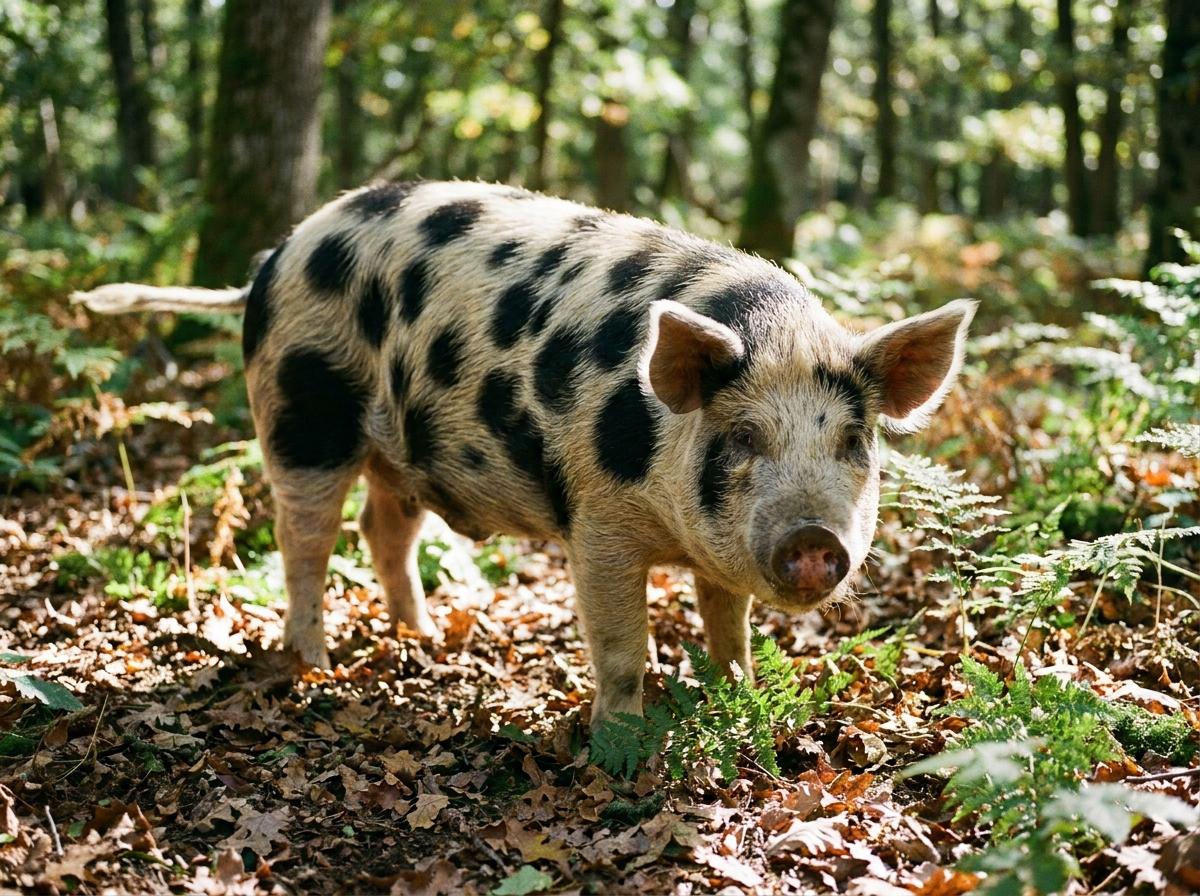
The British Saddleback is the pig most often mistaken for a Hampshire. It was formed in 1967 by combining two older belted British breeds, the Wessex Saddleback and the Essex, and the Rare Breeds Survival Trust describes the British Saddleback as having a broad white saddle that encircles both forelegs, just like a Hampshire, but its ears are large and “carried forward, and nearly meeting at the tips.” That is the quickest field test: Hampshire ears stand up, Saddleback ears come forward toward the face. The Saddleback is also a different animal in purpose: a British heritage breed that the RBST lists as At Risk, rather than a lean commercial terminal sire. Creatures has a page on the British Saddleback if you want to compare them side by side.
A belted pig can also simply be a crossbred with Hampshire in it. The belt is a strongly inherited pattern, which is exactly why it turns up on so many commercial crossbred market hogs. A belted feeder pig at a sale barn is not evidence of a purebred Hampshire. Registration papers are.
What Hampshires are used for: lean meat and the terminal sire
The Hampshire’s modern job is to sire market hogs. The National Swine Registry’s own pitch for the breed calls it “America’s meat and muscle sire” and says that when used as a terminal sire, Hampshires offer the most effective way to increase primal yield, the valuable cuts that packer pricing grids reward.
A terminal sire is the boar at the end of a crossbreeding system. Commercial herds typically keep a crossbred sow, often built from maternal breeds such as Yorkshire, Landrace and the Chester White, and breed her to a boar from a sire breed chosen for growth and carcass. Every one of those offspring goes to market; none is kept for breeding, which is why the sire is “terminal.” The idea is to get hybrid vigor in the sow and muscle and carcass merit from the sire. Duroc, Hampshire and Berkshire boars are all used this way, and breeders choose among them for what each is reputed to add. The Hampshire’s reputation, and the registry’s pitch, is leanness and muscle.
The registry also argues that Hampshire females have a place in commercial sow herds and describes them as durable, long-lived mothers. That is the breed association speaking, so treat it as a claim rather than an independent finding, but it is a reminder that the breed is not purely a sire line.
Where does that leave a small farmer? If you are raising a few pigs for your own freezer, a Hampshire or Hampshire cross will grow into a lean, well-muscled carcass. If you want heavily marbled pork, you may prefer to cross the Hampshire with a breed known for eating quality, or look at other breeds altogether. Our pages on the Poland China and the Spotted Poland China cover two other traditional American meat breeds.
Hampshire genetics: the RN gene and the stress gene
Two genes come up again and again with Hampshires. Both matter to anyone buying breeding stock, and both are testable.
The RN “acid meat” gene
For decades, meat scientists noticed that pork from Hampshire and Hampshire-cross pigs could have an unusually low ultimate pH, and the effect became associated with the breed. The cause is a dominant allele called RN-, from the French term Rendement Napole, a measure of how much cured, cooked ham you get from raw meat.
In 2000, Denis Milan and colleagues published in Science that the RN- mutation is a single amino acid substitution (R200Q) in a gene called PRKAG3, which codes for part of a muscle enzyme (AMPK) involved in energy metabolism. The paper’s abstract states that “a high proportion of purebred Hampshire pigs carries the dominant RN- mutation,” which raises muscle glycogen and has beneficial effects on meat content but detrimental effects on processing yield.
In practice, carriers store extra glycogen in their muscles, which turns into lactic acid after slaughter. The Pork Information Gateway’s fact sheet on swine genetic abnormalities (See, Rothschild and Christians) summarizes the result: carriers of this dominant gene show lower pH, paler color, lower protein extractability, lower water holding capacity and greater cooking loss in the loin, and the condition is reported primarily in Hampshire or Hampshire-cross pigs. That is bad news for ham curing and processing yield. Some studies have also reported advantages in tenderness and flavor, so the picture for fresh pork is mixed.
How common was it? A University of Illinois study published in the Journal of Animal Science in 2000 measured muscle glycolytic potential, from a live muscle biopsy, in 204 purebred American Hampshires from 23 breeders and classified 176 of them as carrying at least one copy of RN-, an estimated allele frequency of 0.63. That classification used glycogen levels as a stand-in for the gene rather than a DNA test. That study is now a quarter of a century old. Breeders have had a DNA test since the gene was identified, and some populations have deliberately selected against it, so do not assume a modern Hampshire line carries it. Ask. A seller of breeding stock should be able to tell you the RN status of a boar.
The stress gene (halothane, PSS)
Porcine stress syndrome is caused by a recessive mutation in a calcium release channel in muscle. Pigs carrying it can collapse or die when stressed, and the meat is prone to the pale, soft, watery defect. The same Pork Information Gateway sheet notes the catch that kept it in herds: carrier and positive pigs are heavier muscled than negative pigs, so selection for muscle tended to keep it around. Our Pietrain page covers the breed most tied to that gene.
For Hampshires the rule is simple. The National Swine Registry has required that all sires of litters farrowed on or after July 1, 2004 have a negative stress status on file by DNA test before the litter can be registered, and “stress negative” is on the Hampshire eligibility list for both market and breeding animals. A registered Hampshire with complete paperwork should be stress negative. A belted crossbred with no paperwork comes with no such assurance.

Hampshires in the show ring
For many American families the Hampshire is a 4-H or FFA pig before it is anything else. Market hog shows at county and state fairs are organized by breed or by color class, and belted Hampshires and Hampshire crosses are a fixture of them.
The breed side of that culture runs through the National Swine Registry and its youth organization. The National Junior Swine Association describes itself as the largest youth livestock organization in the world, with more than 12,000 members, and it hosts regional and national shows, showmanship and judging contests and leadership events for young people working with the four NSR breeds.
A few practical points for new exhibitors:
- Know which class your pig is for. A purebred Hampshire market barrow or gilt has to meet the market eligibility rules above (belt starting on the front leg, erect ears, no forehead white, no red hair, no extra dewclaw, stress negative, ear notched within seven days of birth). Breeding gilt classes use the stricter belt and underline rules. Many county fairs also run their own rules, so read the fair book before you buy.
- Buy with the show date in mind. Show pigs are bought at a weight and age that lets them finish on the fair’s schedule. Your 4-H or FFA advisor or county extension agent is the best person to help you plan that.
- Protect yourself and the pig at the fair. Pigs and people can pass influenza viruses to each other in crowded swine barns. The CDC’s guidance on preventing the spread of flu between pigs and people is to wash your hands with soap and running water before and after contact with pigs, to keep food and drink out of pig areas, and to remove sick pigs from an exhibition area right away. Tell your veterinarian and the show veterinarian if your pig seems off.
Raising a Hampshire: housing, feed, water and heat
A Hampshire needs the same fundamentals as any growing pig. The breed-specific points are that it is a fast-growing, lean meat animal selected for performance, and like every pig it copes badly with heat. The notes below come from extension guidance; make every health decision with a veterinarian who knows pigs.

Space and bedding. Penn State Extension’s guide to raising small groups of pigs suggests planning for around 8 square feet per growing pig and notes that pigs spend most of their time eating, sleeping and rooting. Treat that as a floor for pen size, and give more when you can. Keep a dry, well-bedded lying area. Pigs keep a clean dunging area when they have room to separate it from where they sleep and eat.
Fencing. Pigs dig. Penn State recommends a strand of electric wire inside the pen at ground level to keep pigs from rooting under a fence. A muscular Hampshire leaning on a weak panel will find it.
Feed. Pigs need more energy and protein to grow than grass alone can provide, so commercial complete rations, fed in phases by weight, are the practical route for a small operation. Younger pigs around 50 pounds need a higher protein, lysine-specified diet, and pigs past about 200 pounds can move to less. Penn State gives a typical target market weight of 250 to 280 pounds, reached by about November for pigs started at 50 pounds in May, depending on health, temperature, nutrition and growth rate.
Water. Provide a constant supply of fresh, clean water. Automatic waterers work better than buckets, which pigs tip over.
Heat. Pigs do not have functional sweat glands, as Penn State’s guide to keeping pigs cool in summer puts it, and mature pigs are most comfortable between about 50 and 75 degrees Fahrenheit. Above about 80 degrees, larger pigs can run into heat stress quickly. Give plenty of water, shade and ventilation, shift feeding to the cooler parts of the day, and keep handling to a minimum in the heat. A dark-coated, heavily muscled Hampshire in full sun on a hot fair day is exactly the pig to watch.
Health. Build a relationship with a veterinarian before you have a problem, because pigs are susceptible to parasites, bacterial infections and viral diseases. Buy from a breeder with documented herd health records rather than an anonymous auction lot where you can.
For the full picture of how long pigs live and what that means for breeding stock, see our pig lifespan guide.
Buying a Hampshire: show pigs, feeder pigs and breeding stock
“Hampshire pig for sale” can mean three quite different purchases, and they should be judged differently.
Feeder pigs. A weaned pig you intend to raise for meat. Many feeder pigs sold as “Hampshire” are Hampshire crosses, which is perfectly fine for the freezer. Judge a feeder on health, growth and structure, not markings. Our guide to how much a pig costs, which works from USDA auction reports, found weaned feeder pigs commonly selling for roughly $50 to $100 a head at auction, with price tracking weight.
Show pigs. Bought to be exhibited, usually by a young person on a fair timeline. Price depends on genetics, the breeder’s show record and the individual pig, and a promising show barrow from a well-known program can cost many times what a feeder costs. There is no reliable published average for Hampshire show pigs specifically, so compare several breeders rather than trusting a single quote.
Registered breeding stock. Boars and gilts with NSR registration, recorded ear notches and a negative stress test. The same cost guide puts registered breeding stock generally from a few hundred dollars into the low thousands, with elite sires at registry sales going far higher. If you plan to breed a gilt, the guide to the pig gestation period covers the roughly 114-day pregnancy and getting ready for farrowing.
Before money changes hands, check the following:
- Papers match the pig. Ask for the registration certificate and check that the ear notches on the pig match the ones recorded.
- Stress status. A registered Hampshire’s sire must be stress negative by DNA test. Ask for it in writing.
- RN status if you are buying a boar or plan to sell pork for curing. Ask whether the line has been tested.
- The belt and ears, if you intend to show breeding stock: belt fully around the body and both front legs and feet, erect ears, no forehead white, no red hair, and white on the hind legs no higher than the hock.
- Underline on a breeding gilt: six or more functional teats per side to be eligible for breeding shows.
- Feet and legs. Watch the pig walk on a firm surface. Heavily muscled pigs need sound structure.
- Herd health. Ask about the herd’s vaccination and disease history, and involve your own veterinarian.
You can browse Hampshire pig listings on Creatures, find farms in the Creatures breeder directory, and if your new pig still needs a name, try the pig name generator.
Frequently asked questions
What does a Hampshire pig look like?
Black, with a white belt of hair around the shoulders that covers both front legs, and erect ears. For registered breeding stock the belt must totally encircle the body including both front legs and feet, and the head must be black with no white on the forehead.
Where did the Hampshire pig come from?
From belted English pigs imported to the United States between 1825 and 1835, according to the National Swine Registry. The breed was developed mainly in Kentucky, where the pigs were called “Thin Rinds” for their thin skin. The first record association formed in Erlanger, Kentucky, in 1893, and the name Hampshire was adopted in 1904.
Is a Hampshire pig a good meat pig?
It is a lean, heavily muscled meat breed and one of the main terminal sire breeds used to produce commercial market hogs. If you want heavily marbled pork, many small farmers cross the Hampshire with a breed known for eating quality.
Who registers Hampshire pigs?
In the United States, the National Swine Registry in West Lafayette, Indiana, which also registers Durocs, Landrace and Yorkshires. Registered sires must be stress negative by DNA test.
What is the difference between a Hampshire and a Saddleback?
Both are black pigs with a white belt over the shoulders and front legs. The Hampshire has erect ears and is a lean American meat breed. The British Saddleback has large ears carried forward, nearly meeting at the tips, and is a British heritage breed.
What is the Hampshire “acid meat” gene?
The RN- allele of the PRKAG3 gene, which raises muscle glycogen and lowers the pH of the meat after slaughter, reducing curing and processing yield. It was historically common in Hampshires, and breeders can test for it.
How big does a Hampshire get?
Market hogs are typically finished at about 250 to 280 pounds. Breeding boars and sows grow considerably larger than that, so plan fencing and handling facilities for a heavy, strong adult.
Are Hampshire pigs good for 4-H?
They are one of the most common breeds in youth market hog shows, and the National Junior Swine Association runs a national show circuit for the four NSR breeds. Check your fair’s rules and the breed’s market eligibility rules before you buy.
Do this next on Creatures
Whether you are choosing a first 4-H barrow, raising a few feeder pigs for the freezer or breeding registered Hampshires, Creatures is the records, marketplace and directory layer that keeps it all in one place.
Compare breeds. Start with the Creatures pig pages, then compare the Hampshire with the other NSR breeds, the Duroc, American Yorkshire and Landrace, and with its lookalike, the British Saddleback. If you keep other livestock, the Nachi goat is another breed defined by one unmistakable trait.
Find one. Browse Hampshire pig listings and search trusted farms in the Creatures breeder directory. New to the marketplace? Read saving searches and using your watchlist.
Get alerted. Good show and breeding prospects sell quickly. Set a free Hampshire listing alert and we will email you when a matching listing is posted. No account needed to start.
Add your pig. Already raising one? Create a free Hampshire profile in a few minutes, no account needed to start. The walkthrough is in adding an animal to Creatures.
Keep weights, tests and vet visits. A weight log is the most useful record a show or feeder pig can have, and breeding stock needs its stress and DNA results kept with it. Add a record on Creatures. The record sheet opens for any visitor, and a free account saves what you enter. See adding a record and health and medical records.
List your herd. Breeding registered Hampshires or selling show pigs? Create a free farm profile, no account needed to start, then get listed in the breeder directory and read creating an organization and adding your team if family members help run the barn. When you sell, how seller payout works explains how you get paid.