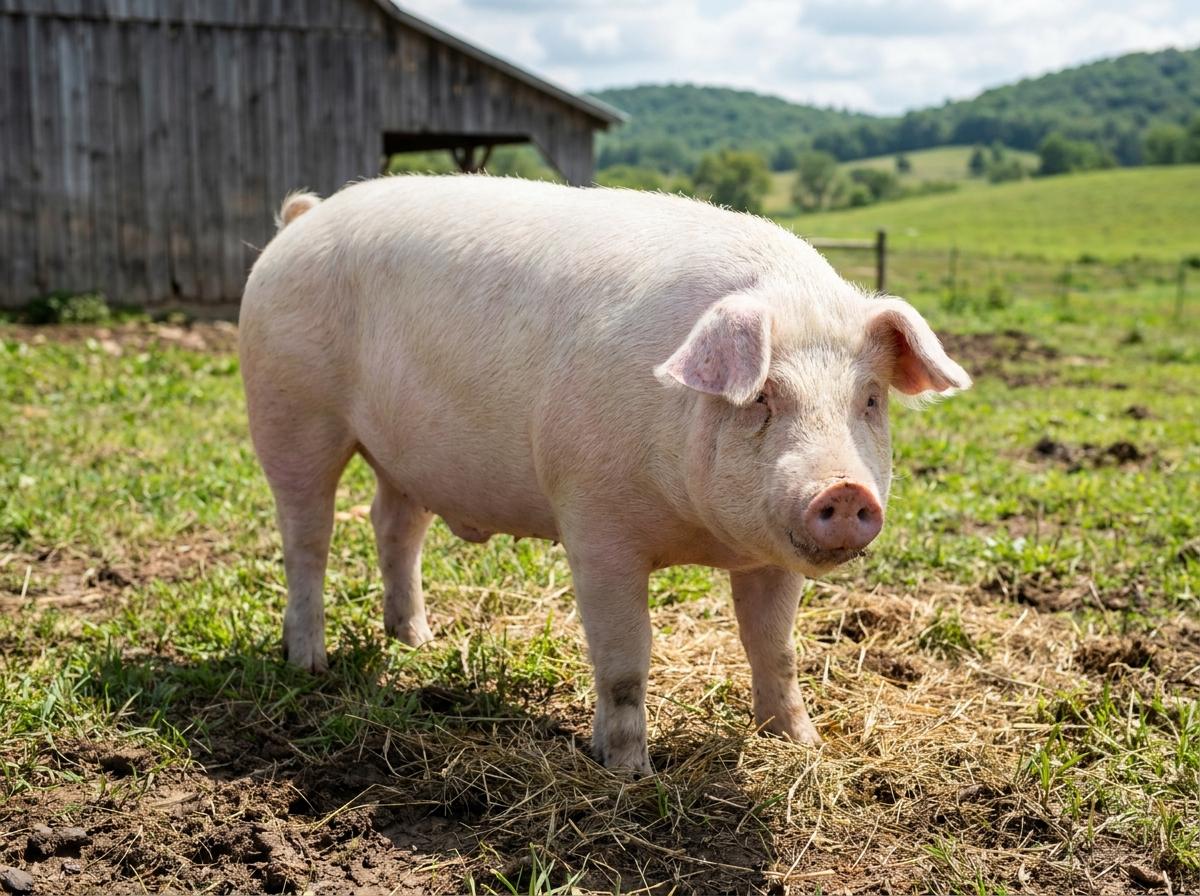
Chester White
Author: Elliott Garber, DVM · Published
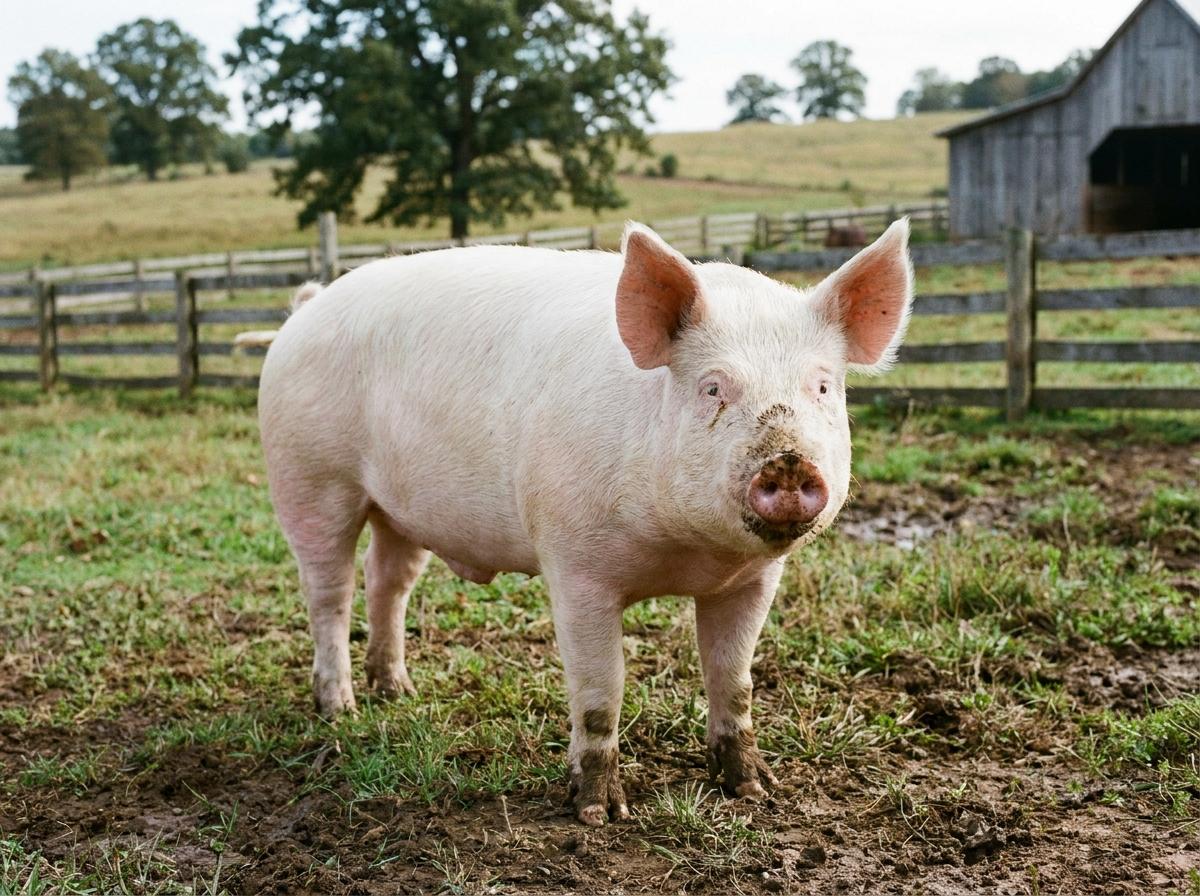
The Chester White is an all-white American pig with medium-size drooping ears, developed in Chester County, Pennsylvania, in the early 1800s and kept today mainly as a maternal breed: the sow side of a crossbreeding program, valued for mothering ability, durability and soundness. In the United States it is registered by the Chester White Swine Record Association through Certified Pedigreed Swine (CPS) in Peoria, Illinois, not by the National Swine Registry that handles the Yorkshire, Landrace, Duroc and Hampshire. If you already keep Chester Whites, you can give each one a free profile and keep its records on the Creatures pig pages.

| Look | Solid white hair and pale skin; medium-size ears that point down |
|---|---|
| Main role | Maternal breed: sows and gilts for crossbreeding, plus purebred seedstock and show pigs |
| Origin | Chester County, Pennsylvania; a white boar imported from England between 1815 and 1818 crossed on local white pigs |
| US registry | Chester White Swine Record Association, part of Certified Pedigreed Swine, Peoria, Illinois |
| Registry strengths claimed | Mothering ability, durability and soundness |
| Registration musts | Solid white, ears down, ear notched within 7 days of birth, sires DNA stress tested negative |
| Genetic test to ask about | Alymphoplasia (“water belly”), a recessive condition the association now helps breeders test for |
| Care watch point | White skin burns: shade, water and a cool lying area are not optional |
Browse listings, public profiles, breeders, or add your animal.
What is a Chester White pig?
A Chester White is a purebred white hog. Its breed association describes it as solid white with ears that are “down and medium size,” and it lists the breed’s strengths as “mothering ability, durability, and soundness.” That makes it a sow breed first. In a typical commercial or small-farm crossbreeding plan, a Chester White or Chester-cross female raises the litters and a boar from a meatier sire breed puts the muscle into the market pigs.
Iowa State University’s Iowa Pork Industry Center puts it plainly in its guide to crossbreeding and hybrid vigor: the three white breeds, Yorkshire, Landrace and Chester White, are known for maternal traits and “excel as sows with large litters,” while the dark breeds, Duroc, Hampshire, Poland China, Spotted and Berkshire, are known for carcass or terminal traits. The same guide summarizes the Chester White as better in conception rate, litter size weaned and growth rate. The University of Kentucky’s swine breed reference also files it under maternal breeds and lists conception rate and mothering ability as its traits.
One point trips up a lot of buyers. The Chester White is not a National Swine Registry breed. The NSR, in West Lafayette, Indiana, records four breeds: Duroc, Hampshire, Landrace and Yorkshire. The Chester White belongs to a separate registry office, Certified Pedigreed Swine, whose breeds page lists the Chester White alongside the Hereford, Poland China, Spotted and, since the Tamworth association voted in 2025 to merge with CPS, the Tamworth. Papers, ear notch rules, sale events and junior shows for Chester Whites run through CPS and its Chester White association, so a Chester White with NSR papers is not a thing to accept at face value.
If you are comparing white breeds, Creatures has pages for the American Yorkshire, the Landrace and the British Large White. The identification section below covers how to tell them apart.
Where the Chester White came from
The breed takes its name from where it was made. The Chester White Swine Record Association’s history, which Oklahoma State University’s Breeds of Livestock project reproduces in fuller form, says the breed originated in Chester County, Pennsylvania, and was first called the Chester County White before “county” was dropped.
The fuller version, as reproduced by Oklahoma State, runs like this. Before 1812, Yorkshire and Lincolnshire pigs from England were already in the area, along with a white strain the record calls the “Chester” breed from Jefferson County, New York, and the three were intermingled for some years before 1815. Then, sometime between 1815 and 1818, Captain James Jeffries imported a single white boar from England, described as a Bedfordshire or a Cumberland. That boar was used heavily on the white pigs of the county, and the Chester White breed grew out of those matings.
A note on the brief details you will see repeated online. Many summaries list the foundation as Yorkshire, Lincolnshire and Cheshire pigs. The association’s history, in the fuller version Oklahoma State reproduces, names Yorkshire and Lincolnshire imports plus the Jefferson County, New York, strain, and then the imported boar. We have kept to the association’s wording here rather than guess which spelling of the New York strain is right. The captain’s surname also appears as Jefferis in some Pennsylvania local histories.
The record associations, from rivals to one registry
The Chester White spent its first century with several competing herd books, which is where the O.I.C. name comes from. Following the association’s history:
- 1884. Thomas Sharpless started the first Chester White Record Association and served as its first secretary.
- 1885. An association formed to record the “Todd” strain. In 1894 it became the American Chester White Record Association, in Columbus, Ohio.
- 1893. The National Chester White Record Association formed, with offices in West Chester, Pennsylvania.
- 1894. The Standard Chester White Association formed in Indianapolis, Indiana.
- 1909. The Western O.I.C. Recording Co. was formed in Nebraska.
- From about 1911. Through the efforts of F.F. Moore of Rochester, Indiana, the separate associations and recording offices were combined into one, the Chester White Swine Record Association.
- 1930. The association was reincorporated under Delaware law, with offices in Rochester, Indiana.
- June 1, 1986. The offices moved to Peoria, Illinois, where the breed is recorded today through Certified Pedigreed Swine.
The Moore family also started the breed’s first magazine in 1910, the White Breeders Companion, renamed the Chester White Journal in July 1918.
What O.I.C. means
O.I.C. stands for Ohio Improved Chester, a strain of the white Chester type that was recorded under its own name around the turn of the twentieth century. The Western O.I.C. Recording Co. listed above was one of those recording offices, and the association’s history counts it among the rival record keepers that were folded into the single Chester White Swine Record Association. In other words, O.I.C. is a branch of the Chester White story rather than an unrelated breed. If you see “O.I.C.” on an old sale bill, a barn sign or a family story, that is the lineage it points to. If you are buying registered stock today, the registry that matters is the Chester White association at CPS.

How to identify a Chester White
Three white breeds dominate American purebred swine, and at a glance they can look alike. The ears do most of the work.
- Chester White: ears down, medium size. That is the association’s own wording, and it is a registration requirement, not just a description.
- Yorkshire: ears erect. The American Yorkshire Club’s breed requirements say Yorkshire market animals must possess Yorkshire breed character, “ears must be erect.” A prick-eared white pig is not a Chester White.
- Landrace: ears down, larger and slanting forward. The American Landrace Association’s breed page describes ears that “droop and slant forward” with their top edges nearly parallel to the bridge of a straight nose, on a long body. A Chester White’s ear is medium size, so a big, flat, forward-slanting ear on a very long white pig points to Landrace.
Coat and skin are the next check. A Chester White is solid white with no colored hair. Pigmented spots on the skin are tolerated only within narrow limits, as the registry rules below show.
What the registry requires
The Chester White breed guidelines on the CPS site carry an effective date of September 20, 2021. For a Chester White to be recorded or shown, it:
- must possess Chester White breed characteristics;
- must be ear notched within 7 days of birth;
- must be solid white in color, with no color on the skin larger than a silver dollar and no colored hair;
- is disqualified if spots of non-white skin pigmentation exceed five in number;
- must have ears that are down and medium size;
- is disqualified by any sign of weighted ear tags, or evidence that such tags were used in the past;
- must have six functional teats on each side to be exhibited, whether boar or gilt.
The association also requires that every sire used for recorded litters be DNA stress tested negative before it can enter the Chester White recording base, and that sires from negative-by-negative matings are tested too. Pigs consigned to national shows and sales or state association events are guaranteed stress negative by the exhibitor.
Mothering, litter size and what the research says
The Chester White’s reputation rests on its sows. The association claims mothering ability, durability and soundness as the breed’s strengths, and it says packers like its white skin and muscle quality. Those are the breed association’s words, so treat them as a claim to check against a particular herd rather than an independent finding. Research gives a more measured picture.
The most useful older evidence comes from breed evaluation work summarized in the Pork Industry Handbook fact sheet Crossbreeding Programs for Commercial Pork Production by Charles Christians (University of Minnesota) and Rodger Johnson (Oklahoma State University). Pooling results from Oklahoma and the regional NC-103 swine project, it reports that “the Chester White female excels in 21-day litter weight per female exposed,” which the authors call a measure of overall reproductive efficiency. The same summary found crossbred Yorkshire and Landrace females ranked highest across reproductive traits, and found the Duroc faster than the Chester White, Hampshire and Yorkshire to reach market weight. These are decades-old data from herds that no longer exist, so read them as describing the breed’s historic strengths, not today’s line averages.
A 1988 study from Auburn University in the Journal of Animal Science compared crossbred sows built from Yorkshire-Landrace, Chester White-Landrace and Chester White-Yorkshire crosses across 321 litters. Litters from the two Chester White-cross sow types were larger at birth than litters from Yorkshire-Landrace sows, but the differences were not significant at 21 days, 56 days or marketing. That is a fair summary of where the Chester White sits: a genuinely prolific, useful maternal breed that gives a crossbred sow good numbers, without claiming it beats every other white breed at weaning.
Modern Chester White herds vary a great deal. If mothering is why you want the breed, ask a breeder for actual sow records: number born alive, number weaned, litter weaning weight and how long sows stay productive in the herd. A breeder who keeps those records is worth more than any breed-level average.

Where the Chester White fits in crossbreeding
Most Chester Whites work in crossbreeding systems, so it helps to know the basic shapes. Iowa State’s crossbreeding guide describes three:
- Terminal cross. A boar, purebred or crossbred, is used on crossbred sows, for example a Chester White by Yorkshire female. Every pig goes to market. It captures full hybrid vigor and is simple to manage, but replacement gilts have to be bought in, and every purchased gilt is a disease risk.
- Rotational cross. Two to four breeds take turns as the sire, and replacement gilts are kept from within the herd. Only boars or semen come in from outside, which lowers disease risk and suits small herds, but the breeds must be reasonably good at both mothering and growth, and hybrid vigor is lower (about 67 percent of the possible amount with two breeds, 86 percent with three).
- Rotaterminal. A few sows are bred rotationally to maternal boars to produce replacement gilts, and the rest go to terminal boars for market pigs. Iowa State notes it is more complicated to run and needs roughly 200 litters a year to work.
The same guide makes a point worth weighing if your pigs live outdoors or in hoop barns: a crossbred sow with some dark-breed ancestry may be more rugged and durable in those settings than an all-white sow. That is not a case against the Chester White, but it is a reason to think about the sire side of a rotation, and about sun exposure, before you commit to an all-white herd on open pasture.
Crossbreeding pays mostly on the maternal side. The Pork Industry Handbook summary above shows the heterosis advantage for traits like litter size at weaning and 21-day litter weight is much larger when the sow herself is crossbred than when a purebred sow is simply bred to a boar of another breed. That is why a Chester White female is usually crossed with another white breed to make the sow, rather than used only as a purebred.
For the sire side, the Hampshire is the classic lean terminal breed, and the Duroc and Berkshire are the other common choices. The Chester White’s sister breeds at CPS, the Poland China and the Spotted (our page calls it the Spotted Poland China), are traditional American meat breeds with their own followings in the show ring.
Chester White genetics: the stress gene and “water belly”
Two genetic conditions matter to anyone buying or breeding registered Chester Whites.
The stress gene. Porcine stress syndrome is a recessive condition that can make pigs collapse or die under stress and is linked to pale, soft, watery pork. The Chester White association’s rule is simple: every sire used for recorded litters must be DNA stress tested negative before its litters can be recorded, and pigs sent to national and state association shows and sales are guaranteed stress negative by the exhibitor. A registered Chester White with complete paperwork should come from a stress-negative sire. A white crossbred pig with no papers carries no such assurance.
Alymphoplasia, or “water belly.” This is newer. The University of California, Davis, Veterinary Genetics Laboratory describes alymphoplasia in pigs as an inherited disorder of lymphatic development in which affected piglets are typically stillborn with severe, generalized fluid accumulation, the “water belly” breeders see in the field. It is autosomal recessive, and the laboratory lists Chester White and its derivatives as the breeds the test applies to. A carrier (one copy) is expected to be normal but passes the variant to about half of its offspring; an affected piglet needs a copy from both parents. The Chester White Swine Record Association has announced on the CPS site that it will pay $15 per animal toward water belly testing for the first 500 Chester Whites submitted through the association office.
What that means for a buyer: if you are buying a boar, or a gilt you plan to breed, ask for the stress status on the pedigree and ask whether the animal has been tested for water belly. Two carriers mated together can produce affected litters, so testing breeding stock is how breeders avoid it.
Chester Whites in the show ring
Chester Whites are a regular sight in junior and open swine shows, both as purebred breeding gilts and boars and as market barrows and gilts. The breed’s show life runs through CPS: the association’s rules on ear character, color, underline and stress status above apply to animals at its national and state association events, and CPS publishes its own show ring and sale codes of ethics.
A few practical points for exhibitors:
- Match the pig to the class. Breeding classes judge the whole animal against the breed guidelines, including six functional teats per side. Many county fairs run their own rules as well, so read the fair book before you buy.
- Know the current show rules. CPS announced that from January 1, 2026, blowers, portable coolers and any paint or adhesive are banned at CPS open shows. Check the association’s announcements before each season.
- Plan around heat. A white pig in a crowded summer barn is at risk from both heat and sunburn, covered in the next section. Your 4-H or FFA advisor and county extension agent can help you plan feeding and timing for a show date.
- Protect people and pigs. Influenza can pass between pigs and people in crowded swine barns. The CDC’s guidance on preventing flu spread between pigs and people is to wash your hands with soap and running water before and after contact with pigs, keep food and drink out of pig areas, and remove sick pigs from exhibitions promptly.

Raising Chester Whites: sun, heat, housing and feed
A Chester White needs what any pig needs, with one breed-specific priority: white skin burns. The notes below come from extension and veterinary guidance. Make health decisions with a veterinarian who knows pigs.
Shade and sunburn. Pigs without dark skin pigment have no natural protection from strong sun. Oregon State University Extension’s review of pasture-based pork production notes that sunburn risk can be reduced by using pigmented breeds and providing shade, and that shade is essential, along with unlimited cool drinking water and wallowing areas kept in the shade. Virginia Tech’s extension guidance on boars used for pasture mating makes the same point: pigmented breeds and access to shade decrease the risk of sunburn. For a Chester White kept outdoors, that means real shade in every pen and paddock, all day. The Merck Veterinary Manual’s guidance on potbellied pig health adds that sunburn can develop with sudden high-intensity sun, so turning pale pigs out onto bright pasture after a winter indoors deserves extra care. Oregon State also warns that sunblock should not be used on food animals without consulting your veterinarian.
Heat. Pigs lack functional sweat glands. Penn State Extension’s guide to keeping pigs cool in summer puts mature pigs’ comfort zone at roughly 50 to 75 degrees Fahrenheit and warns that larger pigs can run into heat stress quickly above about 80 degrees. Give water, shade and ventilation, feed in the cooler parts of the day, and handle pigs as little as possible in the heat.
Space and bedding. Penn State’s guide to raising small groups of pigs suggests planning around 8 square feet per growing pig. Treat that as a minimum and give more when you can. Keep a dry, well-bedded lying area; pigs keep a separate dunging area when they have room. For sows farrowing on a small farm, a clean, dry, well-bedded pen and close attention in the first days after birth matter more than any breed label. Our guide to the gestation period for pigs covers how long a sow carries a litter and how to prepare for farrowing, and the pig gestation calculator gives the farrowing date from a breeding date.
Fencing. Pigs root and push. Penn State recommends a strand of electric wire inside the pen at ground level to stop pigs rooting under a fence.
Water and feed. Provide a constant supply of fresh, clean water; automatic waterers beat buckets, which pigs tip over. Growing pigs need more energy and protein than pasture alone provides, so complete rations fed in phases by weight are the practical route. Penn State gives a typical market weight of 250 to 280 pounds. The pig weight calculator estimates weight from heart girth and length when you have no scale. Breeding sows and boars grow much larger and heavier than market hogs, so build handling facilities and fencing for a big adult, not a feeder pig.
Health. Build a relationship with a veterinarian before you need one, and buy from herds that can show you health records; Penn State notes that pigs are susceptible to parasites, bacterial infections and viral diseases. Iowa State’s guide advises isolating incoming breeding stock for 30 to 60 days and consulting your veterinarian about tests and vaccinations before mixing new pigs with your herd.
For how long pigs typically live and what that means for a breeding sow’s working life, see our pig lifespan guide.
Buying a Chester White: registered or commercial
“Chester White for sale” covers several different purchases, and each should be judged on its own terms.
Registered breeding stock. Gilts, sows and boars with CPS registration, recorded ear notches and a stress-negative sire. These are the animals to buy if you want to breed purebred Chester Whites, sell registered stock or show in breeding classes. Our guide to how much a pig costs puts registered breeding stock generally from a few hundred dollars into the low thousands, with exceptional show and AI sires going far higher. There is no reliable published average price for Chester Whites specifically.
Commercial white gilts and crossbreds. Commercial maternal gilts are usually crossbreds, and a white crossbred gilt may carry Chester White, Yorkshire or Landrace breeding in any mix. For a small farm that wants productive sows rather than show papers, a good crossbred gilt can be the better buy. Judge her on her dam’s records, her underline and her feet and legs rather than on the breed name.
Feeder pigs. A white feeder pig raised for meat does not need to be a purebred Chester White. The same cost guide found weaned feeder pigs commonly selling for roughly $50 to $100 a head at auction, with price tracking weight.
Before you pay for registered Chester White breeding stock, check the following:
- Papers match the pig. The registration certificate should come from the Chester White association at CPS, and the ear notches on the pig should match the ones recorded.
- Stress status. The sire must be DNA stress tested negative. Ask to see it.
- Water belly test status, especially for a boar or a gilt you plan to breed.
- Breed character. Solid white with no colored hair, no more than five small pigmented spots, and ears down and medium size.
- Underline. Six functional teats on each side if you want to exhibit, and a sound, evenly spaced underline in any gilt you keep for breeding.
- Feet and legs. Watch the pig walk on firm ground. Soundness is one of the breed’s selling points, so hold the breeder to it.
- Sow records. Ask about the dam’s litters: born alive, weaned and weaning weights.
- Herd health. Ask about vaccination and disease history and involve your own veterinarian.
You can browse Chester White listings on Creatures, look for farms in the Creatures breeder directory, and if a new gilt still needs a name, try the pig name generator.
Frequently asked questions
What does a Chester White pig look like?
Solid white hair over pale skin, with medium-size ears that point down, on a long, deep body. Registered animals may carry no colored hair and no more than five small pigmented skin spots.
Where did the Chester White come from?
Chester County, Pennsylvania. According to the breed association, local white pigs of Yorkshire, Lincolnshire and New York origin were crossed with a white boar imported from England between 1815 and 1818, and the breed grew from those matings.
Is the Chester White registered with the National Swine Registry?
No. The NSR records Duroc, Hampshire, Landrace and Yorkshire. Chester Whites are registered by the Chester White Swine Record Association through Certified Pedigreed Swine in Peoria, Illinois.
What is an O.I.C. pig?
O.I.C. stands for Ohio Improved Chester, a strain of the Chester White family that was once recorded under its own name, including by a Western O.I.C. Recording Co. formed in Nebraska in 1909, before the rival record associations were consolidated into the Chester White Swine Record Association.
Are Chester Whites good mothers?
Their breed association lists mothering ability as the breed’s main strength, and extension guides class the Chester White with the Yorkshire and Landrace as a maternal breed. Research found Chester White-cross sows had larger litters at birth than Yorkshire-Landrace sows, though not significantly more pigs at weaning. Ask any breeder for their own sow records.
Do Chester White pigs get sunburned?
They can. White-skinned pigs have no pigment to shield them, so outdoor Chester Whites need shade all day, plenty of cool water and a shaded wallow or cool lying area. Ask your veterinarian before using any sunscreen on a pig raised for food.
What is the difference between a Chester White and a Yorkshire?
Both are white, but a Yorkshire has erect ears and a Chester White’s ears point down. They are also registered by different organizations: the Yorkshire by the National Swine Registry, the Chester White through Certified Pedigreed Swine.
What is “water belly” in Chester Whites?
Alymphoplasia, an inherited recessive disorder in which affected piglets are typically stillborn with severe fluid buildup. A DNA test identifies carriers, and the Chester White association is helping members pay for testing.
Do this next on Creatures
Whether you are choosing a first show gilt, building a small sow herd or breeding registered Chester Whites, Creatures is the records, marketplace and directory layer that keeps your pigs and their paperwork together.
Compare breeds. Start with the Creatures pig pages, then compare the Chester White with the other white maternal breeds, the American Yorkshire and Landrace, and with the terminal sire it is most often paired with, the belted Hampshire.
Find one. Browse Chester White pig listings and search trusted farms in the Creatures breeder directory. New to the marketplace? Read saving searches and using your watchlist.
Get alerted. Registered Chester White gilts and boars do not come up every week. Set a free Chester White listing alert and we will email you when a matching listing is posted. No account needed to start.
Add your pig. Already keeping Chester Whites? Create a free Chester White profile for each gilt, sow or boar, no account needed to start. The walkthrough is in adding an animal to Creatures.
Keep litter, test and vet records. For a maternal breed, the litter log is the record that sells the next gilt: born alive, weaned, weaning weights, plus stress and water belly results and vet visits. Add a record on Creatures. The record sheet opens for any visitor, and a free account saves what you enter. See adding a record and health and medical records.
List your herd. Breeding registered Chester Whites or selling show gilts and commercial white females? Create a free farm profile, no account needed to start, then get listed in the breeder directory and read creating an organization and adding your team if family members help run the barn. When you sell, how seller payout works explains how you get paid.