

Spotted Poland China
Author: Elliott Garber, DVM · Updated
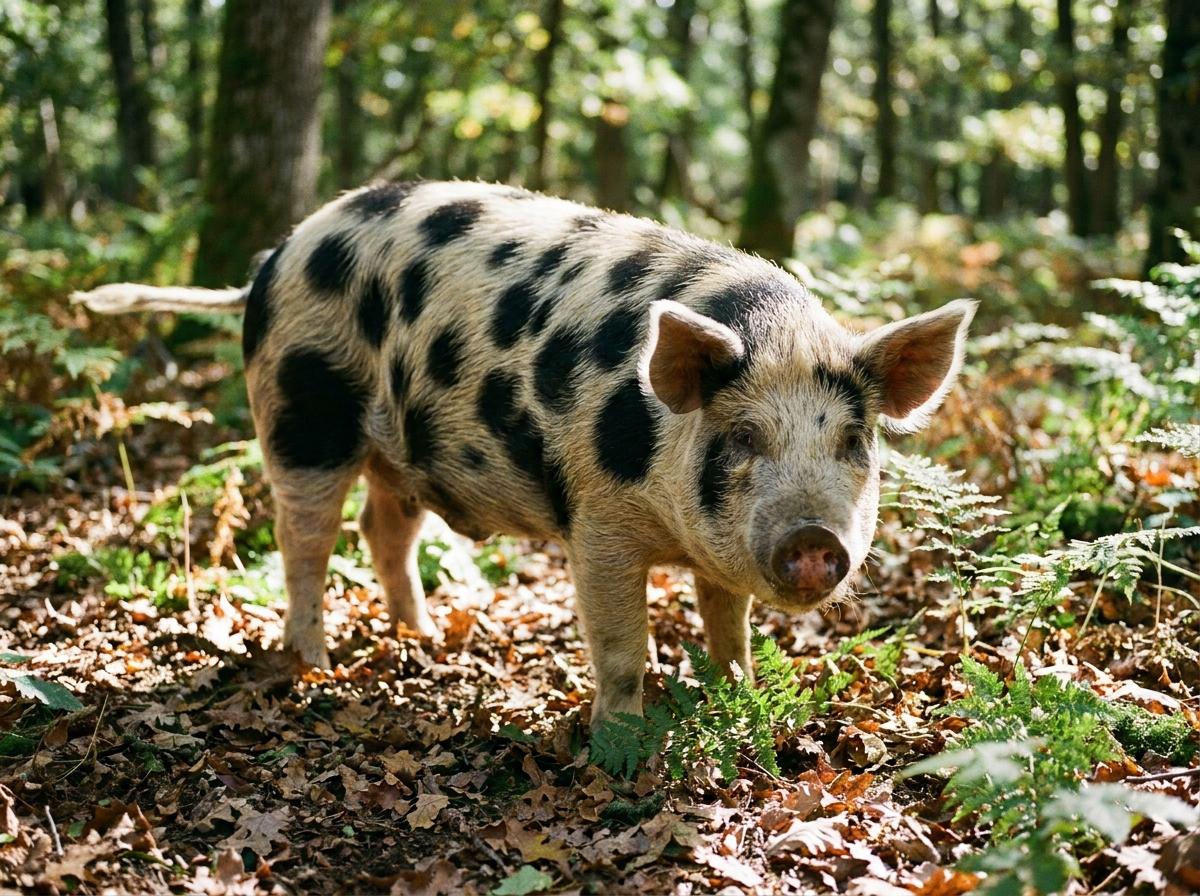
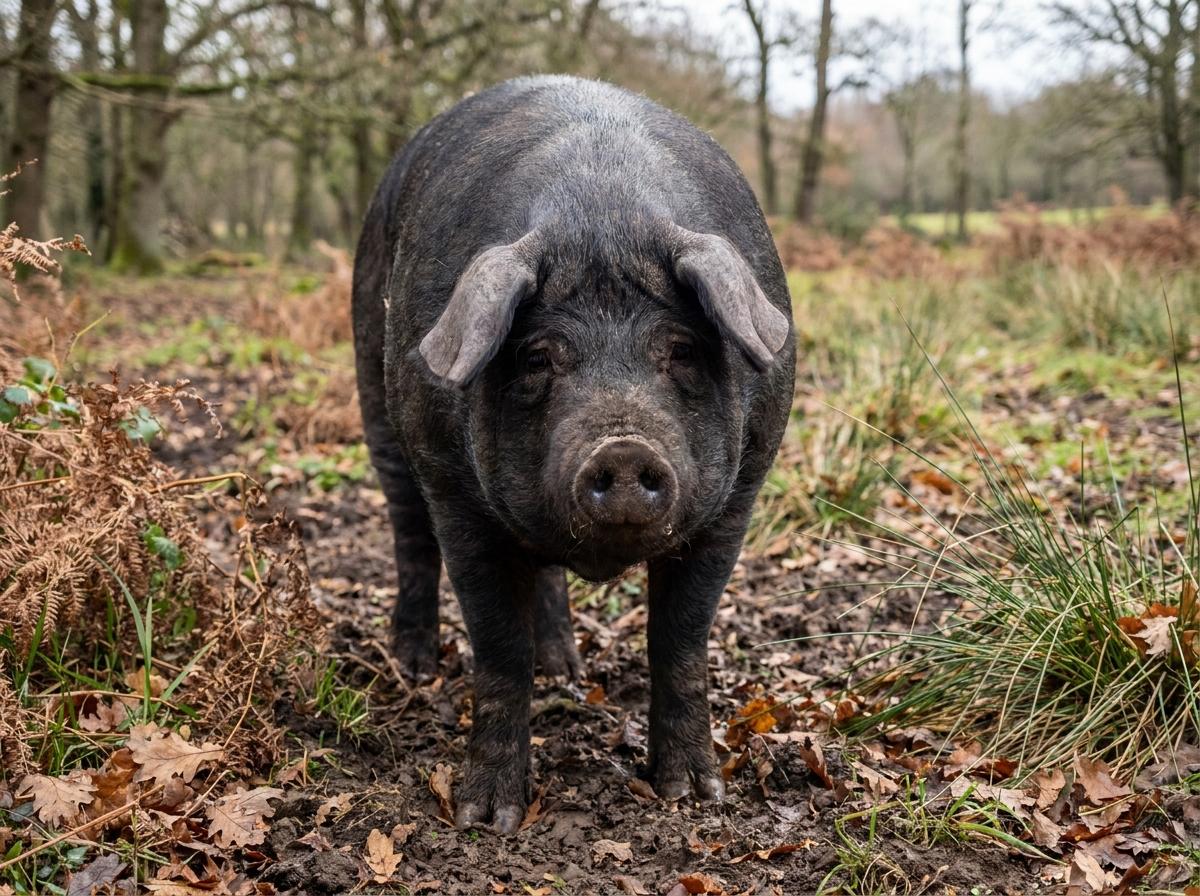
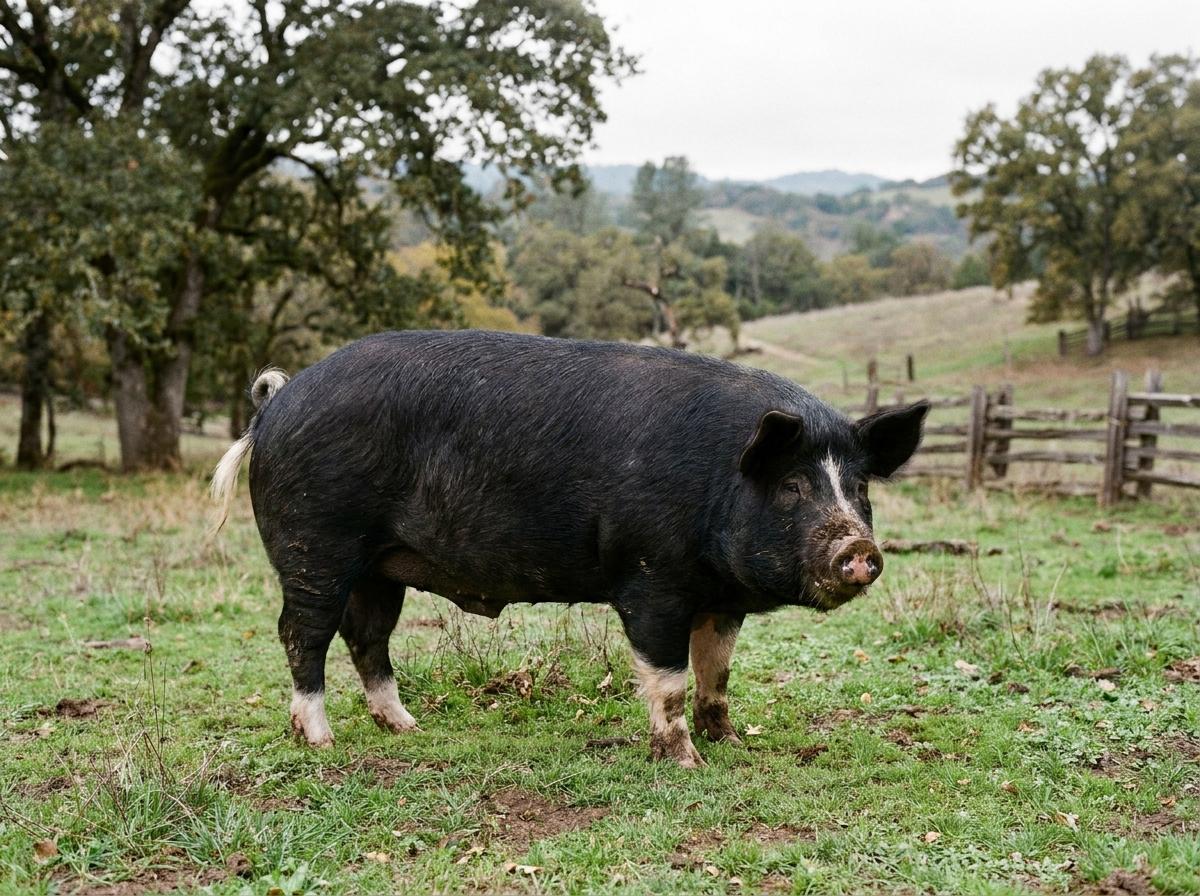
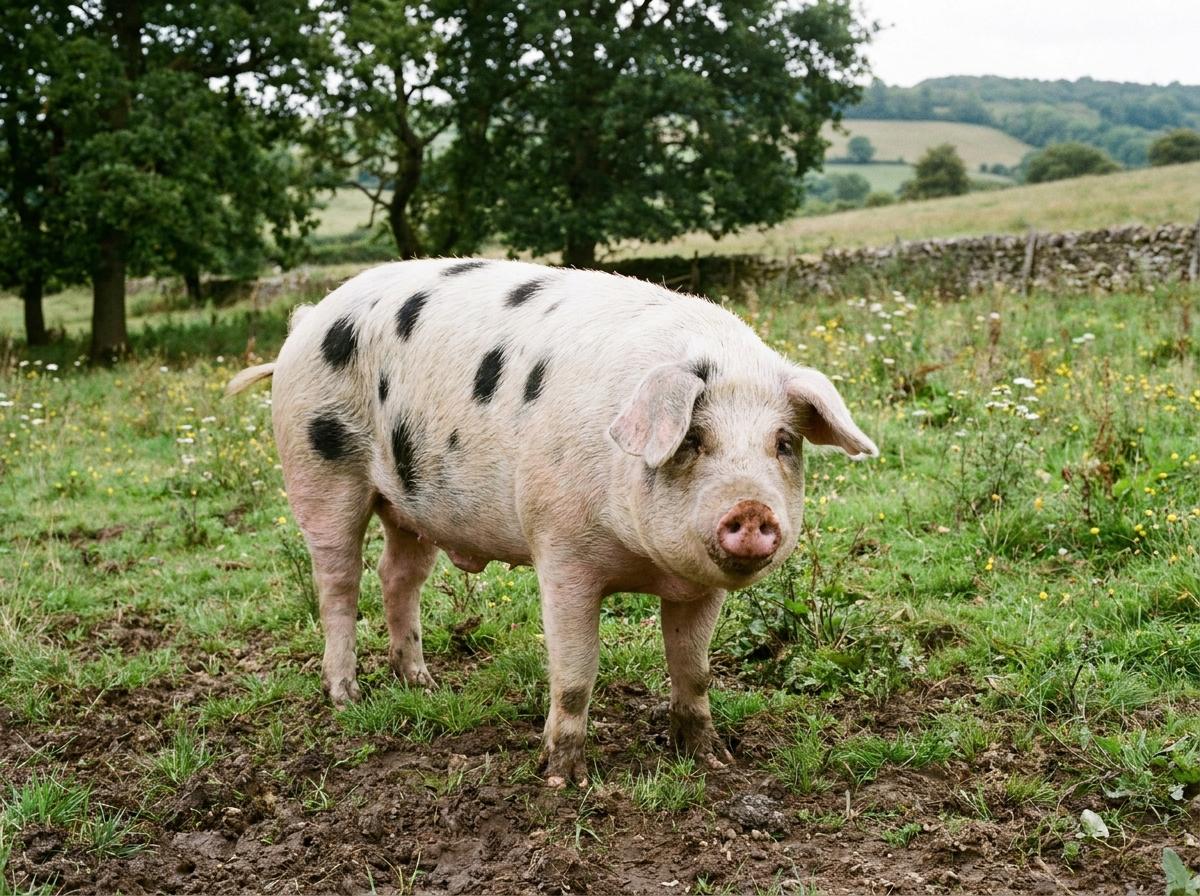
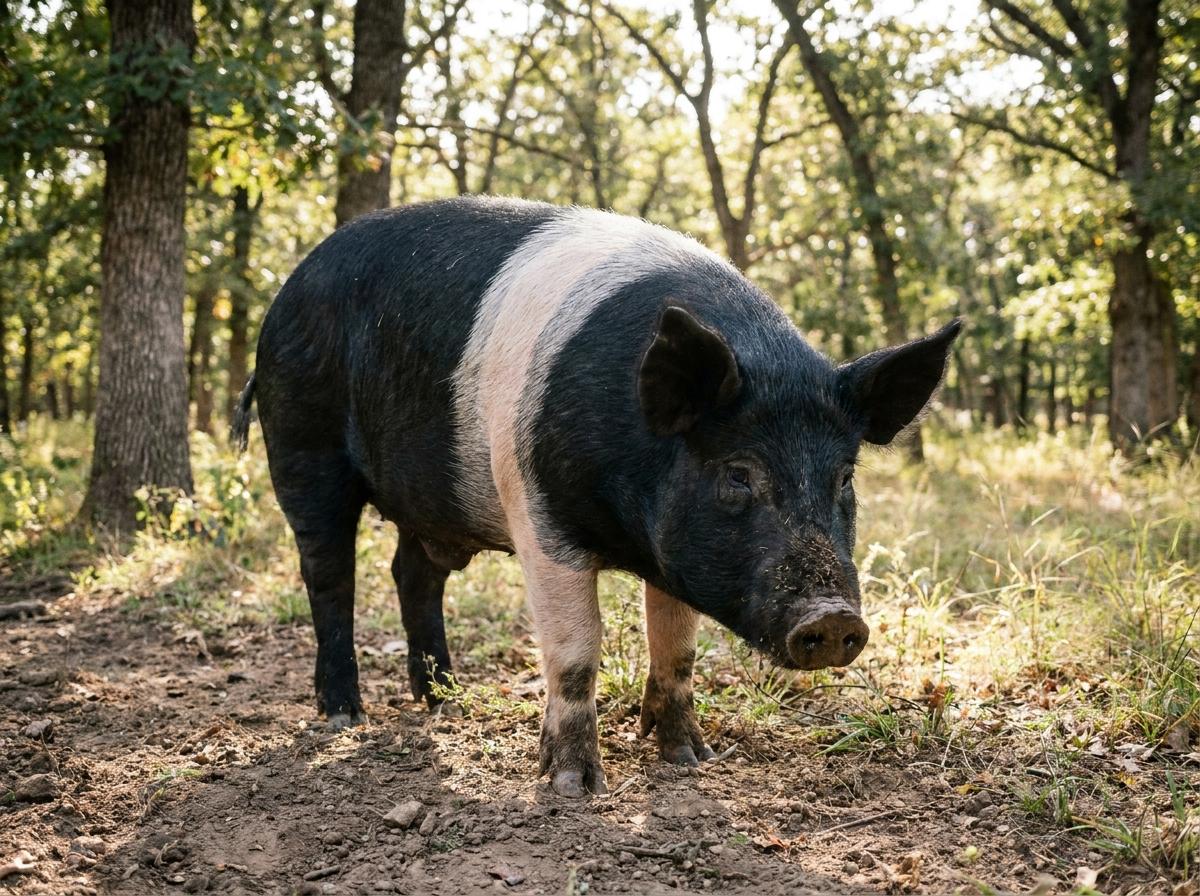
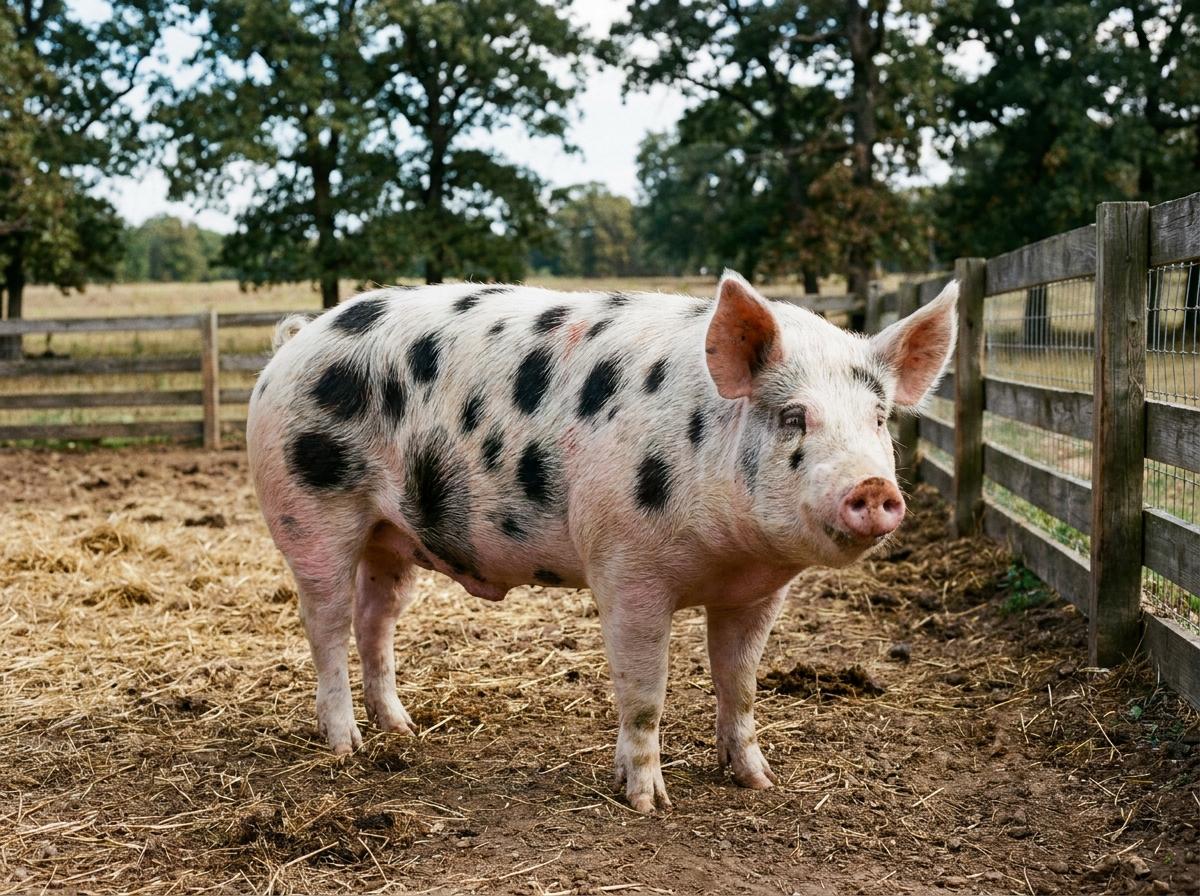
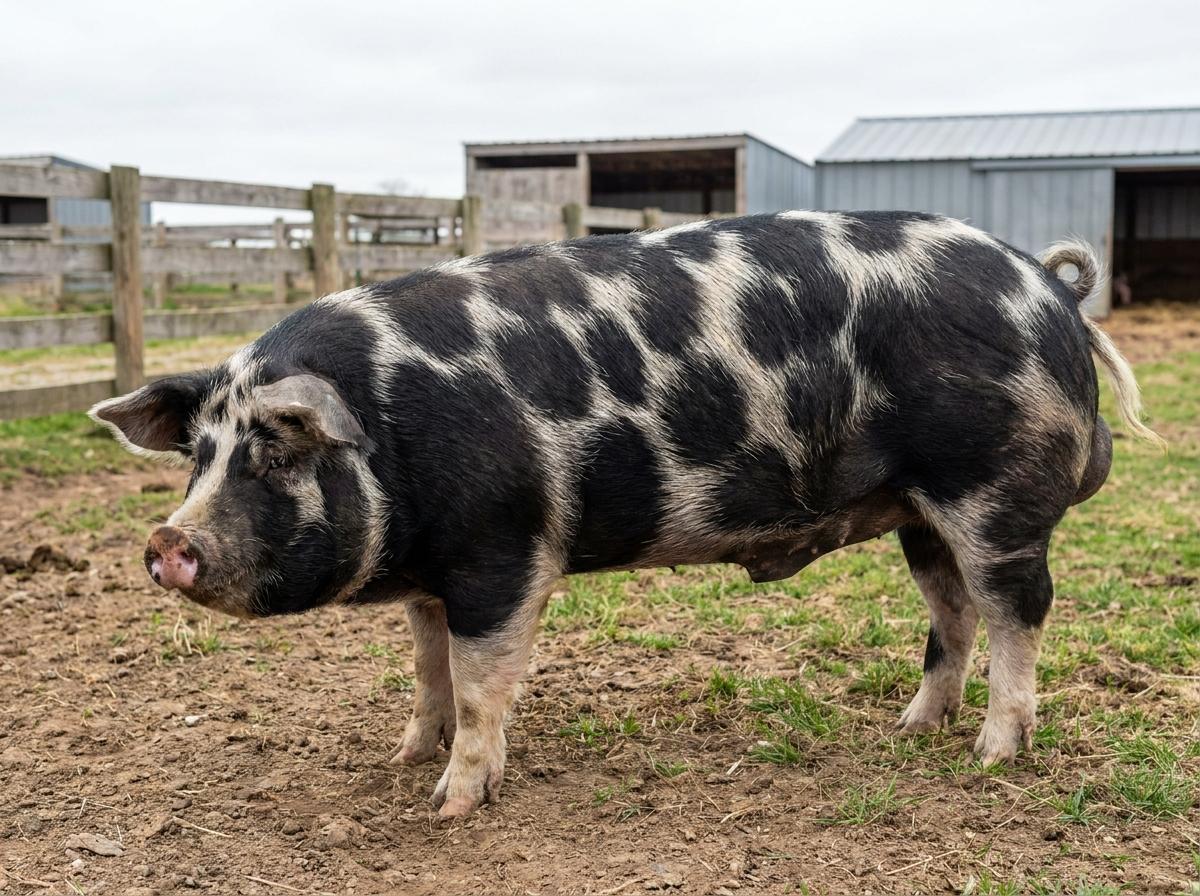
The Spotted is an American meat hog covered in large black and white spots, with medium ears that hang forward over the face and a thick, deep body built for muscle. Its full historical name was the Spotted Poland China, still what most people search for, but the association shortened it in 1960. The important part: this is not a color variety of the Poland China. It is a separate breed with its own color standard. A Poland China is black with six white points. A Spotted is boldly spotted black and white. Both are registered by Certified Pedigreed Swine in Peoria, Illinois. If the pig in front of you is solid black with white feet and a white nose, you want our Poland China guide instead.

| Current breed name | Spotted, or Spots. “Spotted Poland China” is the pre-1960 name. |
|---|---|
| Registry | Certified Pedigreed Swine, Peoria, Illinois, through the National Spotted Swine Record |
| Origin | Central Indiana, from Ohio Poland China and Big China stock plus imported English Old Spots |
| Coat | Large distinct black and white spots. No red or brown tint, no belt, no solid black head forward of the ears. |
| Ears | Medium, drooping forward. Erect ears are a disqualification. |
| Confused with | Poland China (black, six white points), Hampshire (black with a white belt), Gloucestershire Old Spots (English, larger lop ears) |
| Main use | Sire side of a commercial cross, purebred seedstock, and junior show projects. Finishing weight 250 to 290 lb, which is MSU Extension’s desirable show weight rather than a breed standard. |
| Find one | Spotted pigs in the Creatures marketplace |
Browse listings, public profiles, breeders, or add your animal.
Spotted or Poland China? Check the pattern first
The mix-up is historical, not visual. For the first fifty years of its registered life this breed was called the Spotted Poland China, so half a century of farm signs and sale bills carry the longer name. The pattern settles it in two seconds.
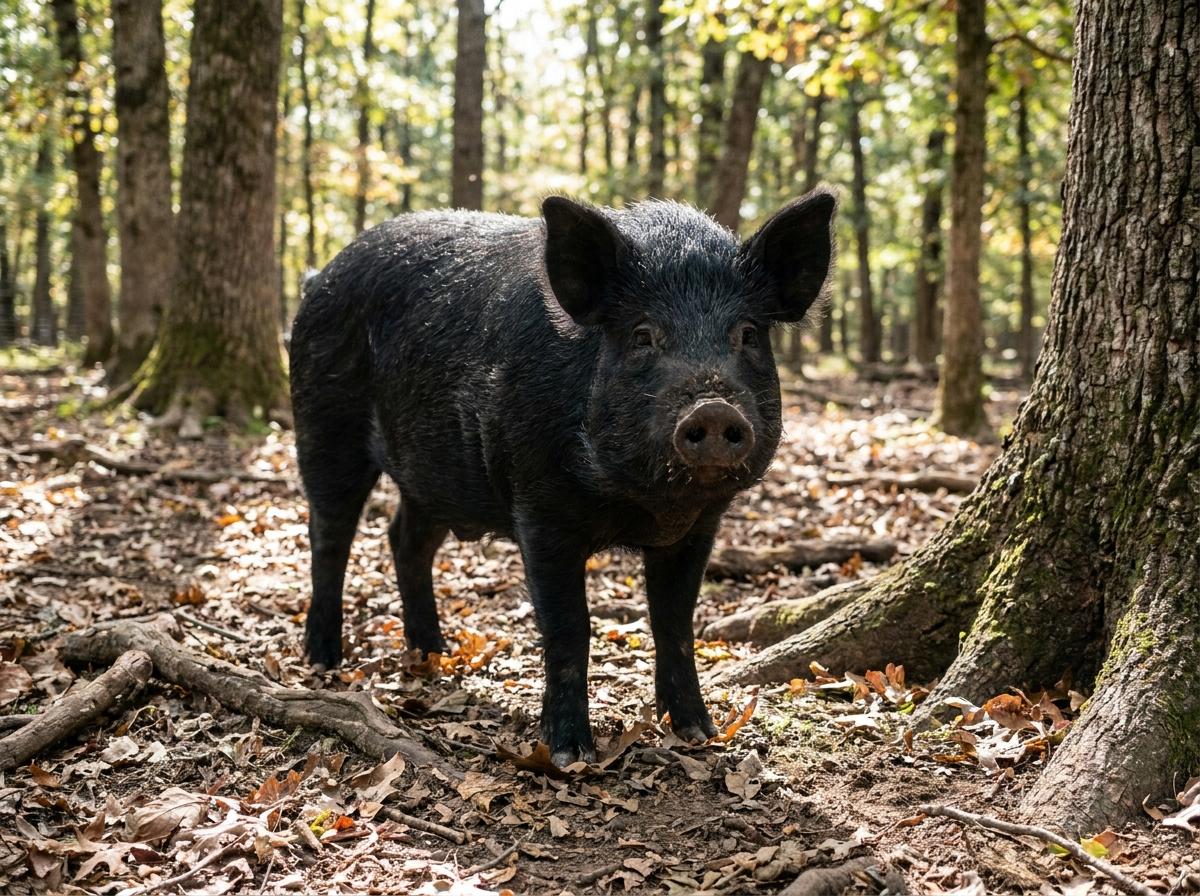
A Poland China is black. The standard asks for six white points, meaning the nose, the four feet and the switch of the tail, with the ears carried down. A solid white face is a disqualification, not one of the points. A splash of white on the body is tolerated and an animal may have at most one solid black leg. Sandy or red hair disqualifies, and so do erect ears.
A Spotted is black and white, and the spots are the point. The standard allows black and white only, so any red-tinted or brown spot makes the animal ineligible. There must be no solid black head from the ears forward, which puts a fully black-faced pig out, and ears must not be erect. There is also a belt rule: an unbroken white band across the back third of both shoulder blades running down to the foreleg is not permitted, and that is what keeps a Hampshire-patterned pig from being recorded as a Spot. Both standards come from Certified Pedigreed Swine and took their current form in September 2021.
Two other lookalikes matter. A Hampshire is black with a clean white belt around the shoulders and front legs, the exact pattern the Spotted standard excludes. A Gloucestershire Old Spots is English, white with fewer and larger black spots and much longer lop ears. It helped build the American breed but is not the same animal. If you want the solid black one, our Poland China pig guide sits alongside the wider pig breeds collection.
What the registry actually requires

Color is only the first gate. The rest of the rules are about identification and soundness, and they decide whether the pig you buy can be registered or shown at all.
- Ear notching within seven days of birth. The permanent litter and individual identification. It cannot be done retroactively, so a pig that missed the window is a problem.
- Six functional teats on each side for boars and gilts entering exhibition. That underline rule keeps the breed able to raise a litter, and it is worth counting yourself on any gilt you plan to keep.
- A DNA card on file for the sire before any litter can be recorded, plus banked DNA on the sow for litters born on or after 1 October 2024.
- Stress status identified on sires, meaning the gene behind porcine stress syndrome. Animals entered at a national show must be identified and either negative or a carrier, and the registry’s rule on positives is flat: no stress positive animal may be shown or sold.
- No weighted ear tags, and evidence that an ear was tampered with is grounds for disqualification.
Two rules changed for 2026. Every Spot boar shown at a CPS national show must now be stress tested and banked regardless of what the paper says, and CPS open shows have banned blowers, portable coolers, paint and adhesive since 1 January. Confirm current rules with the association before you enter, because show rules move.
How the breed got here, and why the name changed
The story starts in the Miami Valley of southwestern Ohio, where the Poland China was assembled out of the Warren County hog. Part of that foundation was a group of Big China hogs brought from a Philadelphia firm in 1816 by the Shaker Society: one boar and three sows, three of them white and the fourth carrying sandy to black spots.
Spotted animals kept turning up in that population. Three men in Putnam and Hendricks counties in Indiana brought boars and sows back from Ohio over a period of years and crossed them onto their own hogs, deliberately keeping the large black and white spotting rather than breeding it out. Two hogs imported from England and known as Gloucester Old Spots were added for fresh blood. The Livestock Conservancy describes the Gloucestershire Old Spots as a white pig with black spots and large lop ears, calm and hardy outdoors, whose genetics went into several American breeds in the twentieth century.
Those breeders eventually wanted a pedigree record of their own. It was organized at Bainbridge, Indiana and incorporated under Indiana law in January 1914 as the National Spotted Poland China Record, according to Oklahoma State University’s breed records.
The name change came at the 1960 annual meeting, where the board and the membership voted to rename the association the National Spotted Swine Record, Inc. and to call the breed Spotted Swine, or Spots. That is the whole answer to why a breed everyone still searches for as “Spotted Poland China” reads as something shorter on every registration paper today. The office moved to Lafayette, Indiana in December 1985 and to Peoria, Illinois in May 1992, and the record now operates as part of Certified Pedigreed Swine, which also handles the Chester White, Hereford, Poland China and, since 2026, the Tamworth.
One thing the Spotted is not is rare. Neither it nor the Poland China appears on The Livestock Conservancy’s conservation priority list. These are working commercial breeds, not heritage breeds under watch.
Growth, feed efficiency, and what the breed is actually for
American pork is produced by crossbreeding, and breeds are chosen for the job they do in the cross. The white breeds, Yorkshire, Landrace and Chester White, are traditionally the mother side, selected for litter size and milk. The colored breeds, the Spotted among them, sat on the sire side, selected for growth, feed conversion and carcass. The registry describes Spots as passing fast, feed efficient, meaty qualities to their offspring, which is the sire-breed pitch stated plainly.
The complication is that nobody publishes a current breed-average performance table, and the best comparative data in print is old. Purdue Cooperative Extension’s crossbreeding factsheet PIH-39 carries three, worth reading with the dates attached:
- Purebred barrows at the 1985 and 1986 National Barrow Show. Sixty five Spotted barrows averaged 1.68 lb of gain per day and reached 220 lb at 172 days, second only to the Duroc on gain and effectively tied with it on days to market. Loin muscle area was mid pack at 4.72 square inches. Tenth rib backfat averaged 1.20 inches, on the fatter side of the eight breeds tested, against 0.91 for the Hampshire.
- Boars in central test stations, 1984 through 1986. Here the picture flips. 801 Spotted boars averaged 2.09 lb of gain per day on 2.63 lb of feed per pound of gain, which is seventh of eight breeds on gain and sixth on feed conversion, behind the Duroc, Hampshire and Yorkshire at 2.49 lb of feed per pound of gain. On backfat it did better, third leanest at 0.79 inches.
- The NC-103 multi-breed research summary, drawn from work completed in the 1970s, rated the Spotted above average for age at 220 lb, below average for backfat, and substantially below average both for litter size raised and for 21-day litter weight.
Read together, those tables are the most useful thing here. The barrow show put the Spotted near the top on growth and the boar stations put it near the bottom, same decade, same breed. The NC-103 litter ratings sit awkwardly next to the breed’s own history, which describes a big-boned, prolific hog. PIH-39 explains the wobble without flinching: the NC-103 estimates come from work finished in the 1970s, and the barrow show and test station entries are pigs breeders chose to enter rather than a random sample.
So the conclusion for a buyer in 2026 is not that the breed is fast or fat. It is that breed averages will not tell you what a particular Spotted pig will do, and the herd’s own records will. Ask for real weights, dates and litter numbers. If a seller cannot produce them, that is information too.
Sows, litters and farrowing

The Spotted female has always had a better reputation on farms than in the research summaries. Oklahoma State’s records repeat the view from commercial producers that she is underrated, and that Spotted influence in a sow herd adds productivity, gentleness and durability. Durability is the operative word.
The reproductive biology is standard pig biology, not a breed quirk. Gestation runs about 114 days, the old “three months, three weeks, three days” rule, and gilts and sows cycle roughly every 21 days with a normal range of 17 to 25, according to Penn State Extension. For scale, USDA’s June 2026 Quarterly Hogs and Pigs report put US producers at 11.87 pigs saved per litter for the March to May quarter. A purebred sow on a small farm is not run like a commercial unit and should not be judged against that, but it shows where the industry sits.
What decides your outcome at farrowing is the setup. A clean, dry, draft-free pen with deep bedding, a separate creep where piglets can get warm without being lain on, and water the sow can reach without getting up will do more for live piglets than any breed decision. Feed a controlled ration through early and mid gestation so she does not get overfat, increase it late, then increase it a lot through lactation. Overfat sows farrow badly.
If you plan to register the litter, sort the paperwork before you breed: both parents registered, DNA banked on sire and sow, notching pliers ready inside the first week.
Conformation and soundness

The type is a classic American meat hog: medium length, deep through the rib, heavy through ham and loin. A hog that will carry 280 lb by six months and several hundred pounds as a breeder lives or dies on its feet and legs, so structure is the first thing to look at and the last thing you can fix.
Start at the ground. Toes should point straight ahead and be even in size, not one long and one short. Pasterns need enough slope to cushion each step without being so long and weak that the pig walks down on them. From behind, the rear legs should be straight, and a pig wider at the hocks than at the toes only gets worse as it gets heavier. Standing perfectly straight in the hock, called post-legged, is a real lameness risk, and too much angle, called sickle-hocked, brings its own problems.
Then watch it walk, on solid footing rather than slats, because slatted and wire floors hide unsoundness. You want long, smooth strides and feet set down softly. A pig that throws its rear feet out and hits the ground hard is telling you something that only gets louder with weight. A level top matters too: a steep shoulder leaves the front legs too straight, so the pig cannot reach forward and goes short and choppy.
Picking a Spotted show pig for 4-H or FFA
Show pig projects are one of the main reasons the Spotted still has breeders, and selection rewards arithmetic as much as eye.
Work backwards from the show date. Most show pigs are six to seven months old at show time, with about six and a half as the target. Healthy pigs gain 1.5 to 1.8 lb per day when fed properly, and a well bred project pig with individual attention often exceeds 2 lb, according to Michigan State University Extension. MSU works a clean example: with 125 days to the fair and a 1.6 lb daily gain, a 50 lb pig lands near 250 lb on show day, and desirable exhibition weights run 250 to 290 lb. Do that sum before you buy, and leave a margin for the week the pig goes off feed.
Know your show’s rules first. If yours judges everything together, breed matters far less than the individual. If yours has a Spotted class, the registry color rules become the reason a pig gets sifted at the gate: black and white only, no red or brown tinting, no solid black head forward of the ears, no full white belt, ears not erect.
Select on the six things that actually get placed: soundness, muscling, leanness, body width, frame size, and how it all fits together. For muscle, look from behind. Width through the center of the ham is the best single indicator, and you want the pig wider through the middle and lower ham than across the rump. The loin should be wide, with a distinct groove and rounded edges. The old test from the LSU AgCenter show pig guide still works: set a golf ball in the middle of the loin and it should roll toward the head or tail, not off the side.
See the pig walk, on a normal fill. A sale lets you compare many pigs at once, but they are fitted for sales and stressed by hauling. Buying at the farm costs a driving day and lets you see the sire and dam.
Start keeping records the day you get the pig: purchase weight and date, feed changes, weekly weights, treatments. It turns feeding from guesswork into a number, which is the difference between making weight and missing it. Feed efficiency is just pounds of feed per pound of gain, so 3.5 means the pig ate 3.5 lb to put on one, and lower is better.
Temperament and handling
Spots have a long-standing reputation for being easy to handle, and the registry’s own history leans on gentleness as a selling point for the female. Treat that as a starting point, not a guarantee. Temperament comes from the individual animal and how it has been handled, far more than from the breed column on a pedigree.
A boar in breeding condition and a sow with a fresh litter both deserve a solid barrier no matter how quiet the line is. Pigs are clever, curious and strong, they work a fence with the snout from underneath rather than over the top, and a bored hog will test a weak gate for entertainment. Watch how the seller’s stock behaves around people: pigs that come to the fence calmly have been handled well, and that tells you more than any breed description.
Housing, fencing and feed on a small place
Spotted hogs suit deep-bedded barns, managed pasture and woodlot systems. The requirements are the ordinary ones for a large pig, done properly.
- Shade and a wallow in summer. Pigs cannot sweat, so a clean wallow is welfare rather than indulgence. Site it so runoff does not foul feed or water. White skin on a Spotted sunburns, so shade is not optional in an open lot.
- Dry bedding and a wind break in winter, in a draft-free lying area.
- Fencing that works from below. Woven wire or hog panels with a low electric strand or two. Train young pigs to electric inside a secure pen first.
- Feed to the stage. Growing pigs need a balanced grain and protein ration, protein highest when young and tapering toward finish. Pasture, garden surplus and dairy supplement but will not finish a hog alone. Gestating sows need a controlled ration, lactating sows a lot more, and everything needs constant clean water.
- Rotate ground. Continuous use of one paddock builds up parasites and mud, and rotation is the cheapest parasite control there is.
Work with a swine veterinarian on vaccination, parasite control, biosecurity and anything involving medication. Parasites are the routine problem in outdoor pigs, lameness in heavy ones.
Cost and where to find them
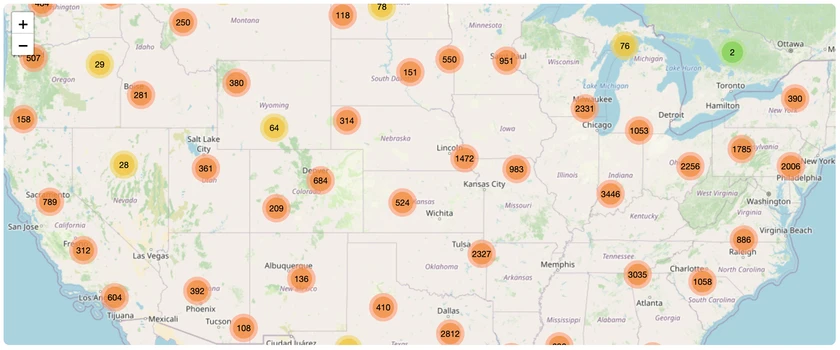
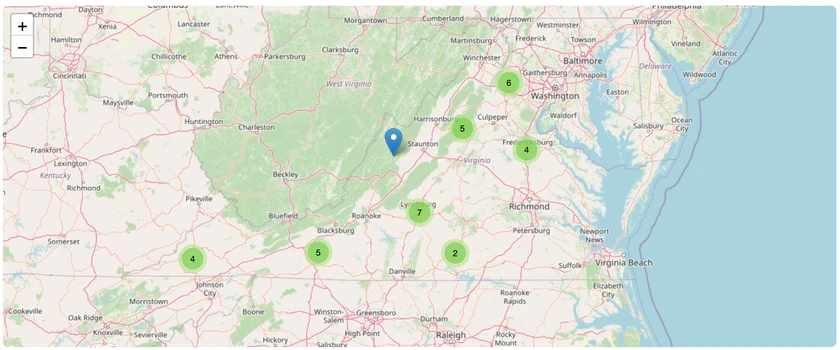
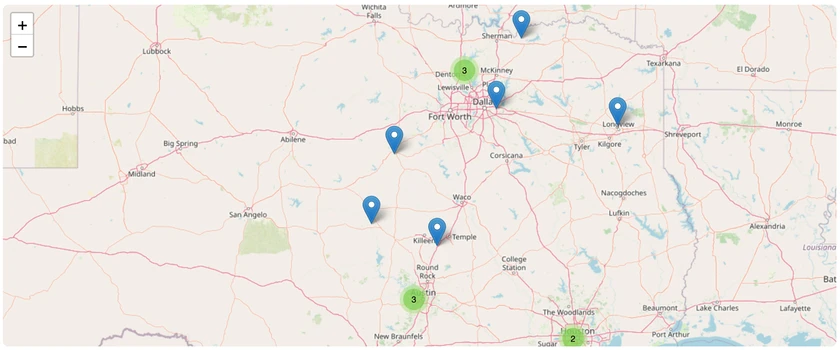
Spotted breeders cluster in the Corn Belt, with the historical center of gravity in central Indiana, and around the junior show circuit. Availability is regional, seasonal and thinner than for the mainstream commercial breeds.
Prices vary too much by region, season and purpose for a single figure to be honest. A weaned feeder pig raised for meat is the cheapest entry, usually the low hundreds of dollars or less. Registered breeding stock costs more, reflecting pedigree, structure and records. A show prospect out of a proven litter runs well above that, and that price says as much about the sale as the pig. Check local auction reports and talk to more than one breeder before deciding what fair looks like.
Whatever you pay, buy on structure, health and honest records rather than markings. A well marked pig with bad feet is a bad pig with good spots.
Frequently asked questions
Is the Spotted Poland China the same as the Poland China?
No. They share ancestry but they are separate registered breeds with different color standards. The Poland China is black with six white points. The Spotted is black and white spotted. The shared name is a leftover from before 1960.
What is the breed officially called now, and who registers it?
Spotted, or Spots. The association renamed itself the National Spotted Swine Record, Inc. at its 1960 annual meeting and dropped “Poland China” from the breed name at the same time. It operates today as part of Certified Pedigreed Swine in Peoria, Illinois, which also handles the Chester White, Hereford, Poland China and Tamworth.
Are Spotted pigs the same as Gloucestershire Old Spots?
No. The Gloucestershire Old Spots is an English breed with larger lop ears and a different spotting pattern, listed as Threatened by The Livestock Conservancy. Two imported Old Spots hogs contributed to the American breed’s foundation, which is where the confusion starts.
How big does a Spotted pig get?
It is a full-size production hog. The 250 to 290 lb figure quoted everywhere is Michigan State Extension’s desirable weight for a project pig at show time, not a breed standard and not a packer specification, and a well grown pig reaches it at around six months. Mature breeding animals reach several hundred pounds. The registry publishes no Spotted-specific mature weight standard, so treat any precise figure with suspicion.
Can I show a spotted pig I bought without papers?
In an open or crossbred class, usually yes. In a breed class, no. Breed classes need registration, and registration needs a recorded litter, an ear notch inside seven days, and parents that meet the standard.
Do this next on Creatures
Creatures is the records, profile and marketplace layer breeders and owners use to keep an animal’s history in one place and find trusted farms.
Looking for a Spotted pig. Browse Spotted pigs in the marketplace, and if nothing is listed right now, set a free listing alert so new ones find you. No account needed to start, and saving searches and using your watchlist shows how. The breeder directory is the other place to look.
Already have one, or a project pig arriving. Add your pig to Creatures and keep weights, treatments, breeding dates and pedigree together from day one. No account needed to start. See adding an animal to Creatures.
Then log what decides the outcome: weekly weights, feed changes, vaccinations, deworming, farrowing dates. The record sheet opens for any visitor, and a free account saves what you enter. Add a record for your pig, with adding a record as the reference.
Breeding or selling Spots. Create your farm or breeder profile so buyers can find you, no account needed to start. Getting listed in the breeder directory covers visibility, creating an organization and adding your team covers setup, and how seller payout works covers payment.
Comparing breeds. The companion Poland China pig guide covers the solid black breed, inside the full pig breeds collection. Weighing sire-side options across species? Maine-Anjou cattle is the same muscle-and-frame question in beef, and the Black Bengal goat is the opposite trade-off, a small prolific breed selected for numbers rather than size.