

Dutch Harness Horse
Author: Elliott Garber, DVM · Updated
The Dutch Harness Horse, called the Tuigpaard at home in the Netherlands, is a warmblood bred for one job: a spectacular high-stepping trot in fine harness. It is not a riding horse that happens to drive. It was built after the Second World War out of the old Dutch Gelderland and Groningen farm horses, refined with Hackney blood, and it is selected inside the KWPN (the Royal Warmblood Studbook of the Netherlands) as its own breeding direction, separate from the riding-type Dutch Warmblood most people picture when they hear KWPN.
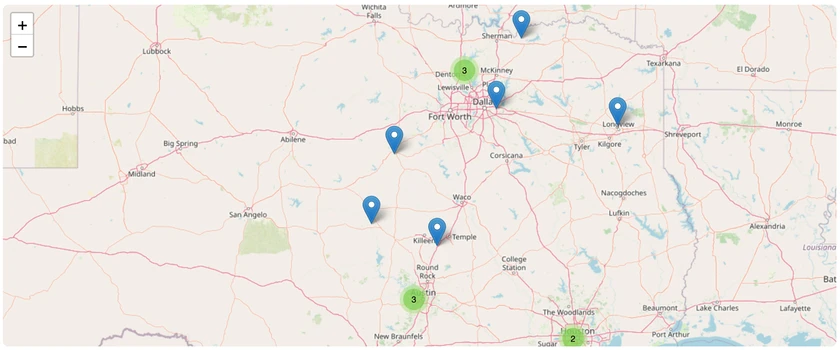
That sentence hides two different animals, and confusing them is the most common mistake buyers make. In the Netherlands, “Dutch Harness Horse” means a KWPN-registered Tuigpaard. In the United States it usually means an American Dutch Harness Horse, registered by the ADHHA, which is explicit that it registers a type rather than a closed breed. Both are below, with how to tell the breed from the horses it gets confused with, where the extreme trot really comes from, what papers to ask for, and the honest reality of buying one. To see what is available now, start with Dutch Harness Horses on the Creatures marketplace.

| Also called | Tuigpaard, Dutch Tuigpaard, KWPN harness horse, DHH |
|---|---|
| Origin | Netherlands, built after 1945 from Gelderland and Groningen farm horse stock plus Hackney blood |
| Studbooks | KWPN harness horse breeding direction (Netherlands); ADHHA (United States), which registers a type rather than a closed breed |
| Signature trait | Long moment of suspension in the trot, foreleg folded high at the knee, hind leg stepping deep under the body, proud high-set neck |
| Primary use | Fine harness show driving; also park, saddle seat and roadster classes in North America |
| Height | ADHHA gives an average of 15.2 hands; the KWPN publishes no breed range, only a 1.60 m minimum at the withers to qualify for its ster predicate |
| Colors | Usually bay, brown, black or chestnut, often with white markings |
| Temperament | Keen, sensitive and forward. The KWPN breeding goal asks for a horse that is easy to handle, easy to drive and intelligent, with a willing and hard-working character |
Browse listings, public profiles, breeders, or add your animal.
What is a Dutch Harness Horse?
The KWPN divides its horses into breeding directions, each with its own goal and its own breeding council. Since 2006 there have been four in the Netherlands (dressage, jumping, harness, and the Gelders horse) and five in North America, where hunter is separated out. That is why a Tuigpaard and a Grand Prix dressage horse can carry the same studbook letters and look almost nothing alike.
The KWPN-NA breeding goal for harness horses is short and worth reading literally: a horse that sustains competition at the highest level, moves correctly and in balance with suppleness, carrying power and impulsion, is easy to handle, easy to drive and intelligent with a willing and hard-working character, and has proud self-carriage combined with specific trot characteristics, meaning good suspension, a foreleg that moves out well with high knee action, and a hind leg that comes under the body with power.
The United States differs in one important way. The American Dutch Harness Horse Association states plainly that the Dutch Harness Horse “is a type of horse” and that “pure breeding is not a goal,” so breeding stock can come from suitable sources outside the registry. The ADHHA show rules set the line at 50 percent or more Dutch Harness Horse blood, confirmed by pedigree and DNA, for registration. Any horse of any pedigree can be recorded with ADHHA, but a recorded horse cannot compete in ADHHA classes until it has been through a keuring and selected for registration. Registered and recorded are different things, and a seller who blurs them is telling you something.
The horses it gets confused with
Most confusion around this breed is entity confusion, not a factual dispute.
- Dutch Warmblood. Same studbook, different breeding direction. The riding type is bred for dressage or jumping and a longer, flatter stride; the harness horse is bred for elevation. Papers alone will not tell you which you are looking at, so read the breeding direction on the document.
- Gelder horse. Also a current KWPN direction and the closest thing to the common ancestor of the rest. The ADHHA calls it “a versatile, basic horse,” not a show type, and notes that a harness horse missing its own breeding goal might fit the Gelders goal, never the reverse.
- Groningen and Gelderland. The two old Dutch farm and carriage populations the modern breed came from. Historical names, not synonyms for today’s Tuigpaard.
- Hackney. An English breed with its own extreme trot, used as improvement blood here and still shown in separate Dutch classes under its own rules.
- Friesian. The other famous black Dutch horse with a showy trot, but a closed studbook: heavier, feather-legged, long thick wavy mane, effectively no white markings. A Dutch Harness Horse is lighter, cleaner-legged, and often carries a blaze and socks.
- Standardbred. The one that trips people up on the word “harness.” Harness racing is a speed sport for Standardbred trotters and pacers pulling a sulky against the clock. The Standardbred’s pacing side traces in part to the Canadian Pacer, a pacing strain of the old French-Canadian horse. Harness showing is judged on how a horse goes, not how fast.
If what you actually need is a road horse for everyday driving, that trade runs mostly on Standardbreds in North America. A Dutch Harness Horse is the wrong tool: a show animal, expensive, and bred to be electric rather than placid.
Origin and history
Dutch farmers kept two useful horses: in the north the Groningen, heavier and plainer, suited to clay soils, and in the south and east the Gelderland, lighter and leggier and already a stylish carriage type. Both were selected hard for temperament and durability, because a horse the whole family could not handle was not kept. Alongside them ran a tradition of flashy “Sunday horses,” bred by putting the best mares to the highest-trotting stallions, and the ADHHA history of the breed traces that Dutch taste for an upright, high-stepping horse back centuries.
Mechanization ended the working horse, and the harness type survived because breeders kept selecting for show quality instead of pulling power. Two stallions carry most of the credit. Oregon, born in 1950, passed on a powerful trot and high open motion and effectively rescued the type. Renovo, born in 1975 and named for renewal, added refinement to what had become an Oregon-saturated population, produced 17 approved sons, and turned the Tuigpaard into a modern show horse. The registry caught up around the same time: the regional Dutch studbooks merged in 1970, and in 1988 the organization received its Royal designation and became the KWPN.
Hackney influence, usually given all the credit for the breed’s flash, is largely modern. A 2012 pedigree study found the Hackney share of the population rose from 4.2 percent in 1980 to 21.1 percent in 2009, while American Saddlebred influence peaked near 4.5 percent and has since fallen below 1 percent. Most of the change from carriage horse to show horse happened inside the Dutch population itself.
What a Dutch Harness Horse looks like

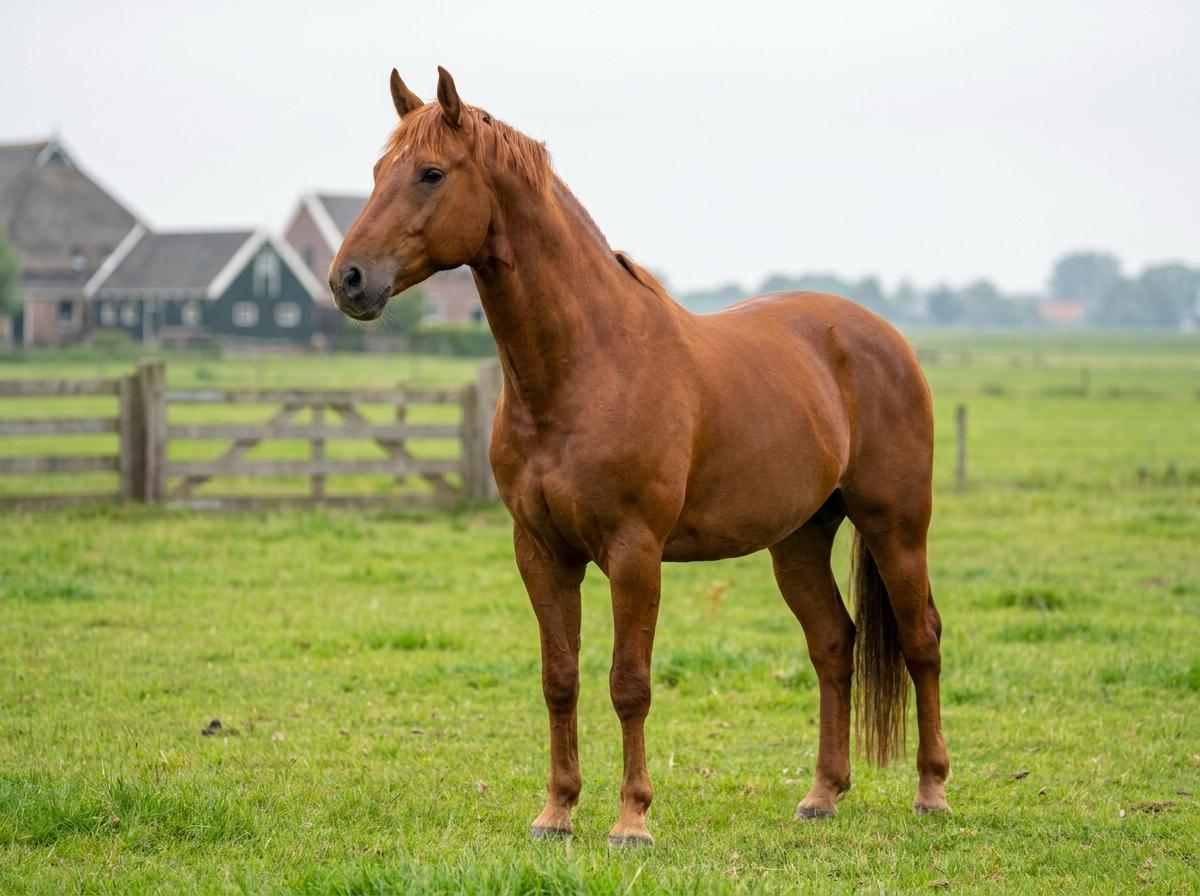
The ADHHA breed standard asks for a horse that looks powerful in motion with high-stepping action front and rear, carrying itself with an upright neck, a clean well laid-back shoulder, and prominent withers sitting higher than the back and croup. It calls the squareness of the trot and the soundness of legs and feet paramount. Five things identify the breed from across a field:
- A very long neck set high and arching upward out of the shoulder, with a light throatlatch.
- A refined, straight-profiled head. Not dished, not Roman, far finer than the heads of the farm horses behind it.
- An uphill, rectangular, long-lined frame built to collect and lift in front.
- A level croup with a high-set tail carried up and out in movement. With the neck set, this is the fastest way to tell a harness-type KWPN from a riding-type one.
- The trot. A long moment of suspension, the foreleg folded high at the knee and reaching well forward, the hind leg stepping deep under the body.
Are Dutch Harness Horses gaited?
No. A gaited horse performs an ambling gait: a smooth four-beat intermediate gait, usually with no moment of suspension, bred into breeds like the Tennessee Walking Horse or the Icelandic. The Dutch Harness Horse walks, trots and canters, and its trot is an ordinary two-beat diagonal gait selected to an extreme of height and hang time. What looks exotic is the amplitude, not the footfall pattern.
Where the high knee action really comes from

This is the most misreported thing about the breed, and it is really a question about what you are buying.
You will read almost everywhere that Dutch rules ban pads and weighted shoes, so a Tuigpaard’s knee action must be entirely natural. The rulebook says otherwise. Dutch harness competition now runs under the Stichting Aangespannen Sport (SAS) rather than the national federation, and how that happened is worth knowing before you read a rule as proof of anything. The KNHS asked in 2019 for a ban on ear plugs and the overcheck rein, members threatened to end their membership over it, and the harness and Hackney associations left the federation in 2020, the year before the KNHS ban on the overcheck came into force on 1 April 2021. The current SAS competition regulations (2026 edition, dated 23 April) permit weighted shoeing for tuigpaarden and cap it rather than forbid it: base shoe no thicker than 12 mm, a rubber or leather pad between hoof and first shoe no thicker than 5 mm, a plastic or aluminium counter-shoe no more than 18 mm (12 mm if iron), and total shoeing thickness no more than 35 mm, past which the horse is disqualified.
The same rulebook constrains equipment, without going as far as the federation wanted to. The overcheck is expressly permitted as part of the harness, but only as a limit: it may not fix the head position, and using it to fix the head disqualifies the entry at the judges’ discretion. Ear nets, ear caps and anything else that can influence ear position are banned, and only soft, invisible plugs are allowed, purely to damp noise. The judging criteria also say that where performances are equal, the horses presented most naturally must be placed above those going less freely.
So the honest picture is a breed with real, heritable, selected-for action, presented inside a regulated ceiling, under a rulebook that keeps a device the federation moved to ban and then tells its own judges to reward the horse that needs the least help. Both halves of that are true, and a buyer should hold them at the same time.
It is also contested at home. A 2020 report by the Dutch animal law organization Dier&Recht, Paardenleed in de aangespannen sport, argues the sport in its present form breaches Dutch animal welfare law and documents overlong hooves, heavy shoes, and training with leg weights, chains and elastics as means of pushing leg action further. Read it for what it is: an advocacy document, written against the old KNHS rulebook in the year the associations walked out, not against the SAS regime that governs the sport today. The argument still matters, and a buyer should ask direct questions about how a given horse is trained and shod.
North American rules are looser again. Under the ADHHA show rules, horses in all age groups and divisions may show with a shoe, pads and wedges, and bands are permitted at least half an inch below the coronary band. Chains, shackles and full blinders are barred from competition grounds, and no item may be used to alter natural ear carriage. Do not assume the Dutch ceiling applies to a horse shown on this side of the Atlantic, and do ask what a horse’s feet look like without its show shoeing. Either way the gait is athletically extreme, and keeping a horse sound through a show career depends on good feet, good legs, sensible conditioning, and a farrier and veterinarian who understand the job.
Temperament
The honest description is not “calm family horse,” whatever some breed roundups say. The KWPN asks for a cooperative, keen, intelligent, hard-working horse, and good ones are exactly that. But the qualities that make a horse electric in the show ring, sensitivity and forward energy, also make it hotter and more reactive than a typical riding warmblood. It wants a job and structured daily work, and it rewards a consistent, experienced handler far more than a casual one. A nervous or inconsistent home brings out the reactive side quickly. If you are new to horses, come to this breed with a trainer rather than learning the basics on one alone.
Driving, showing and the crossbred market
The home discipline is fine harness show driving, where the horse is presented to a light show vehicle and judged on suspension, front-leg use, hindleg engagement and overall presence. The Dutch scene is serious but small: the Dier&Recht report cites 2019 figures putting the whole aangespannen sport at roughly 400 people involved and about 100 active competing members.
In North America the same trait sells into more arenas. ADHHA shows run three division groups and a horse is expected to stay in one: Park (in-hand, fine harness, park saddle), Pleasure (in-hand, pleasure driving, pleasure saddle) and Roadster (in-hand, roadster to bike, wagon or under saddle).
The crossbred market matters more than most breed pages admit, because it is where much North American Dutch Harness blood ends up. A cross on an American Saddlebred is registered through the Half American Saddlebred Registry of America and shown in Half American Saddlebred classes. A cross on an Arabian is a Half-Arabian. The Arabian Horse Association registration rules require one parent registered as a purebred Arabian, and rule out a registered Thoroughbred or Anglo-Arabian on the other side, because those crosses belong in the Anglo-Arabian registry instead. A Dutch Harness sire clears that easily. One term to drop before you go looking, though: “fine harness” is Saddlebred and ADHHA vocabulary, and the Arabian world does not use it. There is no Half-Arabian fine harness class anywhere on AHA’s class code list. The classes these horses actually go in are Half-Arabian park horse, English pleasure, formal driving and pleasure driving.
Harness blood also goes into dressage breeding, and that is debated. Writing in a KWPN-NA harness committee newsletter, breeder Scot Tolman describes both sides: some Dutch Harness Horses achieve their expressive front by lifting through the loin connection, which is what a dressage breeder wants, while others get there by cranking the head back, sinking behind the wither and throwing out the front legs. Those horses, he writes, can be fantastic fine harness horses and still not belong in dressage breeding. If someone is selling you a harness-bred prospect as a dressage horse, that is the distinction to ask about.
Papers, keurings and predicates

For a breed this small, paperwork is a large part of what you are buying.
- Predicates are earned. The KWPN awards ster for above-average conformation and movement at a studbook inspection, with a minimum height of 1.60 m at the withers. For harness horses the KWPN-NA handbook sets ster at a minimum upper-beam score of 68 with a combined conformation and movement score of at least 140 points. Harness mares are automatically keur-eligible once ster, and reach keur through a driving IBOP score of at least 75 points or through competition results.
- The studbook is open, but bounded. For harness breeding the KWPN recognizes the Dutch Hackney Studbook, the Hackney Horse Society in England and, in North America only, the American Saddlebred Horse Association. A mare’s pedigree may not contain more than 75 percent Hackney and American Saddlebred blood combined to qualify for the harness foalbook or Register A. That is how outside blood gets in without taking over.
- WFFS status is published, so ask for it. All actively covering KWPN-approved stallions are tested for Warmblood Fragile Foal Syndrome and the results are published. Carrier status does not cost a stallion its approval; the point is to let breeders avoid pairing two carriers.
- PROK, not D-OC, is the joint screening that applies. The KWPN’s genomic breeding value for osteochondrosis underpins the D-OC predicate, but KWPN-NA states directly that the harness and Gelders populations have drifted far enough from the jumping and dressage reference population that the breeding councils decided not to use genome selection for them. Expect PROK radiographic screening on a harness horse, and treat a claimed D-OC on one as a reason to look harder at the paperwork.
- ADHHA registration is not KWPN registration. Both are legitimate and they mean different things. The price gap between an imported KWPN-papered horse and an ADHHA-registered American-bred one is not a discount on the same product.
Care and husbandry
Most of it is standard good horse care: dry shelter, clean footing, safe fencing, daily turnout, forage and concentrates matched to the actual workload, clean water, minerals, dental care, and a vaccination and deworming program set with your veterinarian for your region. Because these are energetic, reactive animals, turnout and consistent work are how you keep the mind settled and the body sound.
The part specific to the breed is feet and legs, because a horse bred and shown for extreme trot action lives and dies by them. Keep a consistent, skilled farrier schedule, know which rulebook your shoeing has to satisfy if you show, watch the lower legs and joints closely, and condition sensibly rather than drilling the big trot into a tired animal. Treat heat, swelling or a change of gait as something to investigate early. Written records of shoeing dates, soundness notes and training load pay for themselves, because patterns are far easier to see on a timeline than in memory.
No single inherited disease defines this breed, which is not the same as nothing to ask about. Given the small gene pool, ask about the health and soundness history of the individual horse and its close relatives rather than assuming a clean slate, and leave medical decisions to a veterinarian who can examine the animal.
Size, color and lifespan
The KWPN publishes no height range for the harness horse and no public measured survey exists, so treat any confident range you see as an estimate. The ADHHA show rules give an average of 15.2 hands for the American Dutch Harness Horse, a lighter frame than the tall riding-type Dutch Warmblood. The same rule publishes a weight range of roughly 1,300 to 1,700 pounds, which reads heavy for a light horse of that height, so use a weight tape on the horse in front of you rather than a book figure. The one number the KWPN publishes is a floor, not a range: 1.60 m at the withers for ster eligibility.
Coat colors are usually solid, and bay, brown, black and chestnut are what you will mostly see. Extensive white markings are common and welcome: the same show rules require that a horse’s white markings not be hidden or dyed. Neither registry publishes a color standard for this breed, so color here is whatever the breeding population happens to carry rather than a rule you can check a horse against, and nobody should be pricing a Dutch Harness Horse on its coat. There is no breed-specific lifespan study, so expect the general horse range, commonly around 25 to 30 years with good care, and remember that a show career is far shorter than a life.
Rarity, price and buying
The clearest published picture of the breed’s genetics is a 2012 pedigree study by Schurink, Arts and Ducro in Livestock Science (abstract via Wageningen University). Working from 54,170 pedigree records, it found an average inbreeding coefficient of 0.080 for the 2005 to 2009 cohort and a rate of inbreeding above the FAO guideline of 0.01 per generation, with a genetic bottleneck between 1965 and 1974 around the studbook’s formation. Four ancestors accounted for 50 percent of the gene pool in that recent cohort, which is the statistical shadow of stallions like Oregon and Renovo. The encouraging half is that management appears to be working: average inbreeding stabilized and then dropped, and the authors point to unrelated outside stallions, deliberate mate selection and limits on popular sires as the levers. For a buyer that is a reason for diligence rather than alarm.
On price there is no reliable public figure and we will not invent one. Value tracks what it does in any performance breed: bloodlines, quality and correctness of the gaits, show record, age, training and temperament. A proven show horse from sought-after lines and an untrained three-year-old prospect are not the same purchase, so treat any confident single number quoted online with suspicion. The bigger hurdle for North American buyers is supply: the breed is concentrated in the Netherlands, and importing adds real cost and logistics on top of the purchase, including transport, health certification and quarantine where it applies.
Worth checking before you commit:
- Read the papers properly. KWPN with a harness breeding direction, ADHHA registered, ADHHA recorded and unregistered are four different things.
- Match the horse to the discipline. A fine harness prospect and a steady saddle seat mount are selected for overlapping but not identical qualities.
- Ask for records. Show results, training history, soundness and veterinary records, and shoeing history tell you more than one good video of a trot.
- Ask what the feet look like out of show shoes. With the Dutch and American rules this far apart, that question separates a horse with real action from a horse with a good farrier.
- Have the horse examined. A pre-purchase examination by an independent veterinarian is standard at this price and workload, with particular attention to feet, legs and joints.
Browse Dutch Harness Horses on the Creatures marketplace and look for breeders and trainers in the Creatures directory. Because good horses of this breed are uncommon outside the Netherlands, a saved listing alert is usually the most practical way to catch one when it appears.
Frequently asked questions
Is the Dutch Harness Horse the same as a Dutch Warmblood?
They share the KWPN studbook but are different breeding directions with different goals. The Dutch Warmblood most people mean is the riding-type sport horse. The Tuigpaard is bred to its own standard for harness action, with a higher neck set, a level croup with a high-set tail, and that extreme trot.
Are Dutch Harness Horses gaited?
No. They walk, trot and canter. The trot is a normal two-beat diagonal gait selected to an extreme of height and suspension, not a four-beat ambling gait like a Tennessee Walking Horse or an Icelandic.
Is a Dutch Harness Horse a good beginner horse?
Generally no. It is a keen, sensitive, forward breed that wants an experienced handler and consistent work. A beginner can enjoy one with professional support, but it is not a breed to learn the basics on alone.
Do this next on Creatures
Whether you are researching the breed, hunting a prospect, or already keeping one, Creatures is the records, marketplace and directory layer for it.
Compare the breed. See where it sits among other horses on the Creatures horse species page, check it against the riding-type Dutch Warmblood and the Standardbred it gets confused with, or contrast it with a heavy driving and draft type like the Brabant.
Find a horse. Browse Dutch Harness Horses on the marketplace and search trusted breeders and trainers in the Creatures directory. New to it? Start with saving searches and using your watchlist.
Get alerted. Good horses of this breed are uncommon outside the Netherlands, so set a free Dutch Harness Horse listing alert and we will tell you when one is posted. No account needed to start.
Add your horse. Already have one? Create a free animal profile in a few minutes, and try the horse name generator if the barn name is still undecided. The walkthrough is in adding an animal to Creatures.
Track farrier, training and health. Log records on Creatures: the record sheet opens for any visitor to look around, and a free account saves what you enter. See adding a record, health and medical records, and reminders and upcoming care for shoeing and vaccination schedules.
List your operation. Breed, train or sell? List your operation in the Creatures directory so buyers can find you, and see getting listed in the breeder directory.