Could they have a red foal?
Both parents carry red.
Reveal this pairing
Picture the possibilities
Choose two horses. Discover the colors a foal could grow into.
Reviewed by Elliott Garber, DVMUpdated How it works and sources
No DNA test needed
Choose each horse’s closest color.
Make a guess, then explore. These examples use clearly labeled assumptions.
Both parents carry red.
Reveal this pairingExplore a golden pairing.
Reveal this pairingOne parent has a Gray variant.
Reveal this pairingYour foal color map
Palomino stallion × Palomino mare Change parents
Exact chances for each foal, per conception. Based on: appearance.
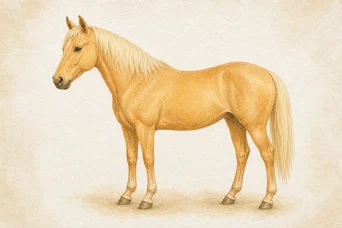 PalominoChestnut base · one CreamChance: 50%Exact chance
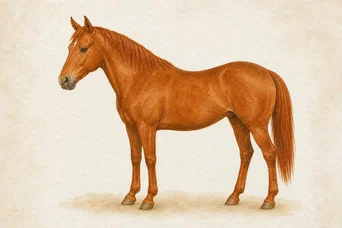 ChestnutChestnut base · no expressed Cream/PearlChance: 25%Exact chance
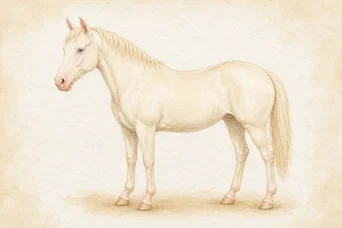 CremelloChestnut base · two CreamChance: 25%Exact chance
Mushroom is included when a parent looks Mushroom or has a Mushroom result or what-if. Two normal-looking carriers can still produce one.
Lethal White Overo is checked when a parent shows Frame or mixed white or has a Frame result or what-if. A horse with very little white can still carry Frame; test before breeding Paint-type horses.
1 health note for this pairing
Chestnut base · one Cream
Chance: 50%
Exact chance for each foal, per conception.
Chestnut base · no expressed Cream/Pearl
Chance: 25%
Exact chance for each foal, per conception.
Chestnut base · two Cream
Chance: 25%
Exact chance for each foal, per conception.
Each branch is a what-if, with no assumed frequency. We do not average the possibilities.
Palomino, Chestnut and Cremello stay possible no matter which hidden color genes the parents carry.
We checked every gene combination that fits the colors you chose (6,561 parent combinations). Appearance alone cannot tell us which hidden combination is more common, so we do not average them. A range shows the lowest and highest chance across those combinations, and colors are listed with the highest guaranteed chance first.
The color map covers base color, Cream/Pearl, Champagne, Mushroom when included, Dun, Silver, Gray, Classic Roan and Lethal White Overo. Other pattern chances are shown separately; they can overlap the colors.
Explore the look
Open a collection to explore this result alongside related reviewed colors and patterns.
A horse’s appearance can match more than one genetic combination, so each possible foal color comes with the full chance range its appearance supports. Add DNA results whenever you have them to narrow those ranges and unlock exact odds.
This calculator uses the coat-color tests listed below. It covers Extension, Agouti, Cream and Pearl, Champagne, Dun, Silver, Gray, Mushroom, Frame Overo, linked KIT white patterns, Leopard Complex with PATN1, Splashed White, and Brindle1. Health notes summarize published research; ask your veterinarian what they mean for a particular horse.
How it works: the method, health notes and peer-reviewed references
Explore example pairings with named DNA panels and exact odds
Your saved pairings are private. A shared link opens an independent copy with no horse names or photos.
Verify your email to save this pairing privately. No horse or breeding records are created.
Agouti · Brindle 1 · Champagne · Cream · Dominant White · Dominant White W20 · Dun · Frame Overo · Gray · Leopard Complex · Mushroom · Non-Dun 1 · Pattern-1 (PATN1) · Pearl · Red Factor · Roan · Sabino 1 · Silver · Splashed White · Tobiano
Horse color genetics can be wonderfully surprising. Choose the colors you see or enter the DNA results you know, then explore the coats and patterns their foal could inherit, complete with useful health and inheritance notes.
Start with familiar coat colors or go deeper with the names used on common DNA test panels.
Start with the big picture, then open any color, pattern, or health note you want to explore.
Start with the parents’ visible colors, or add DNA results for core coat colors, Champagne, Mushroom, selected KIT white-pattern families, Leopard Complex and PATN1, MITF and PAX3 Splashed White families, and sex-linked Brindle1.
When both reports contain all the information the calculator needs, Creatures can show one set of odds for the supported results you entered. If the reports do not show which linked variants were inherited together, it shows the possibilities separately and explains what remains unknown.
The percentages shown always count every conception. For example, an O/O Frame Overo combination stays in the calculation, so Creatures never makes the chances for surviving foals look higher by quietly removing it.
Health notes highlight research connected to the colors and DNA results in the pairing. A veterinarian or testing laboratory can help you understand what a finding means for an individual horse.
Shade, marking boundaries, roaning, seasonal coats, and age can all change how a color appears. The calculator groups these horses under the same color family while showing the patterns and modifiers that may add variety.
Explore each possibility on its own. The testing laboratory may be able to show which linked variants sit together on the same chromosome, and you can update the calculator whenever you learn more.
Reviewed by Elliott Garber, DVM · Last reviewed