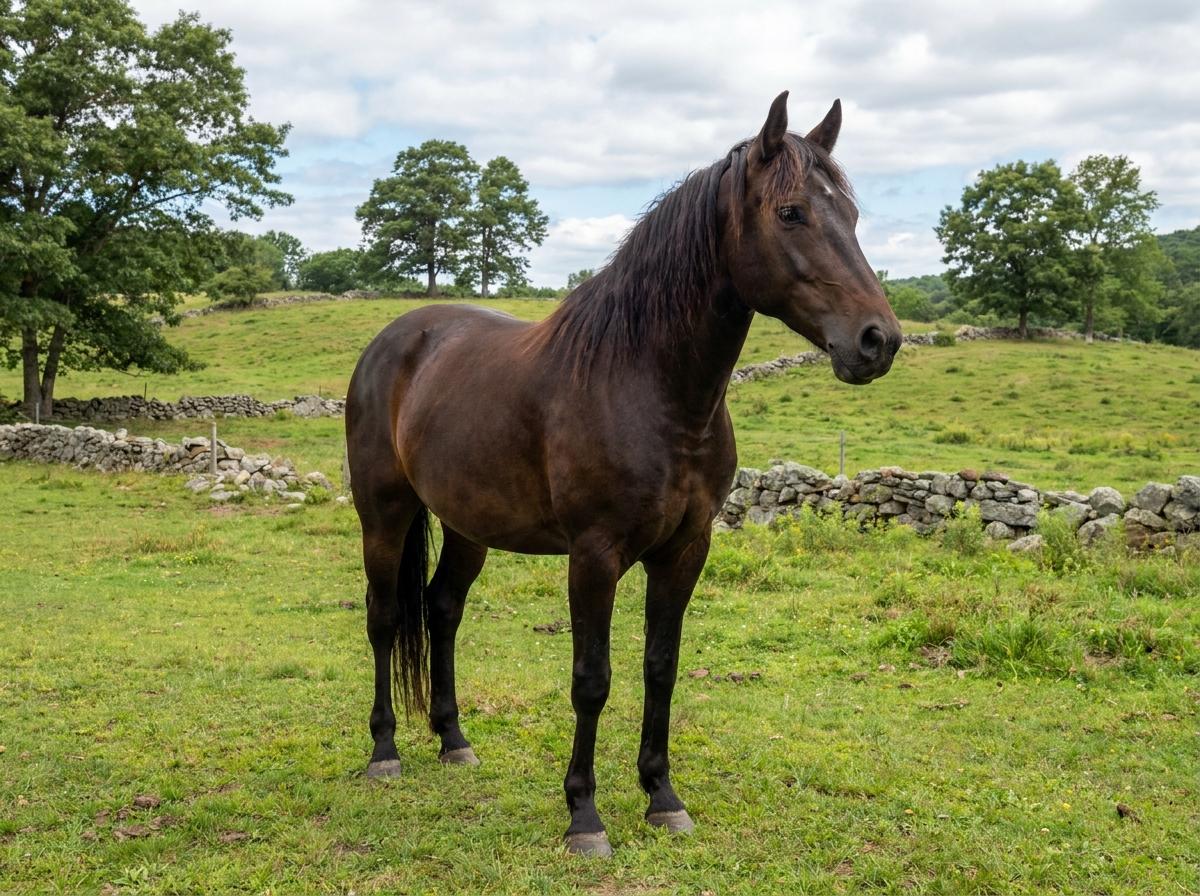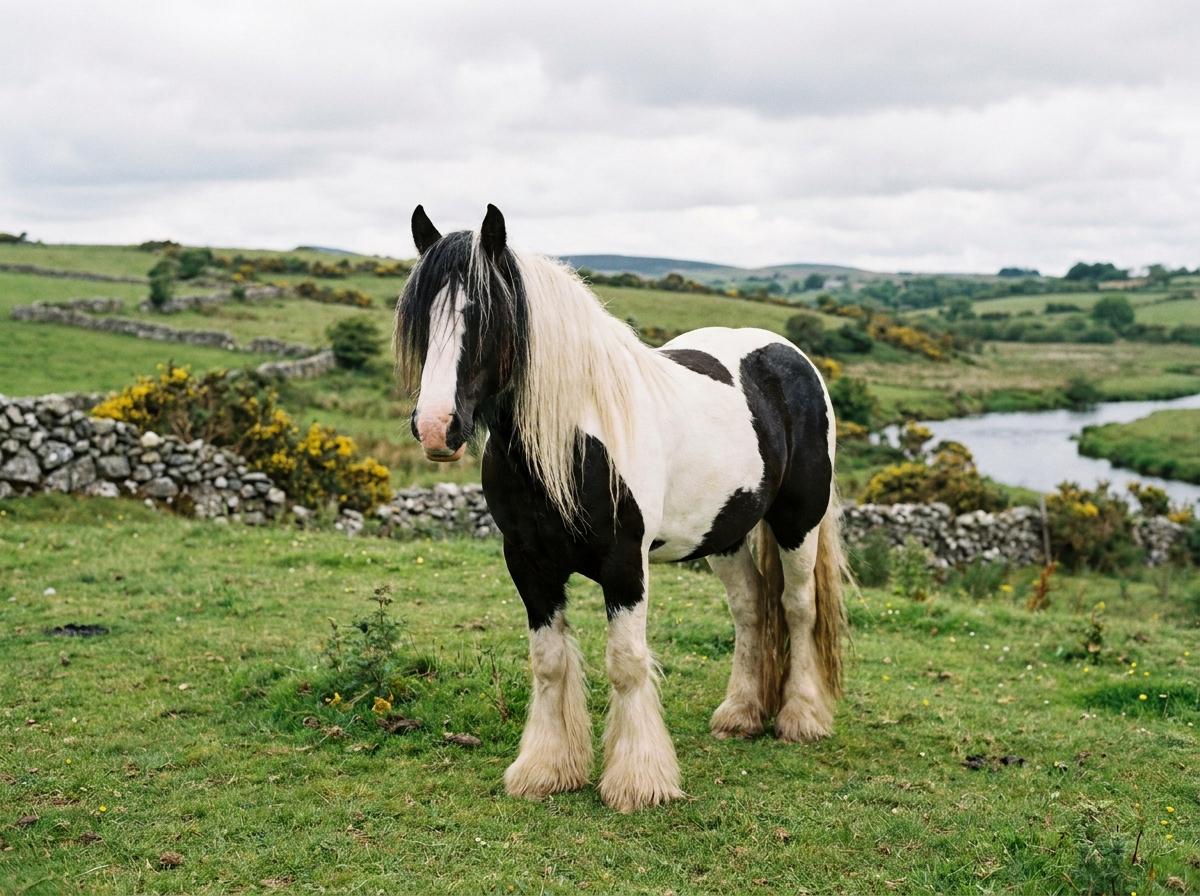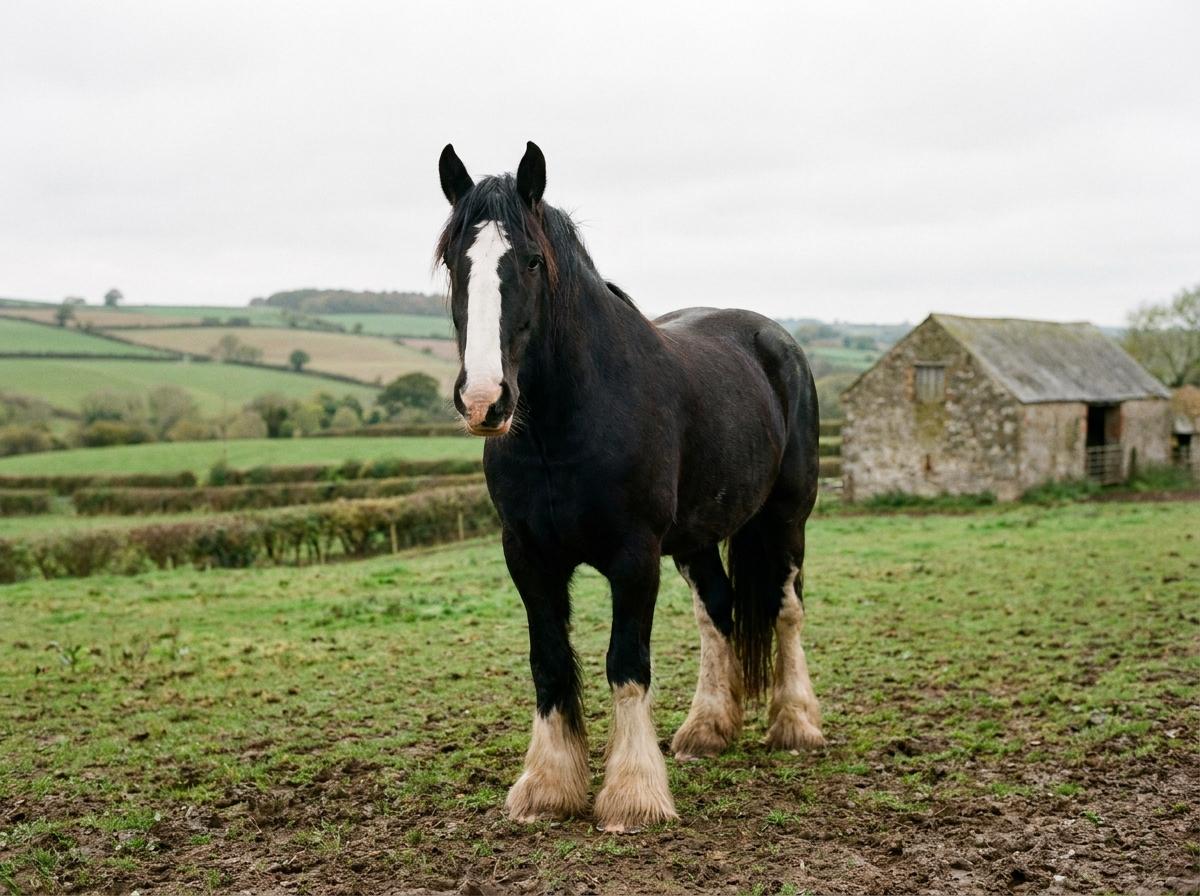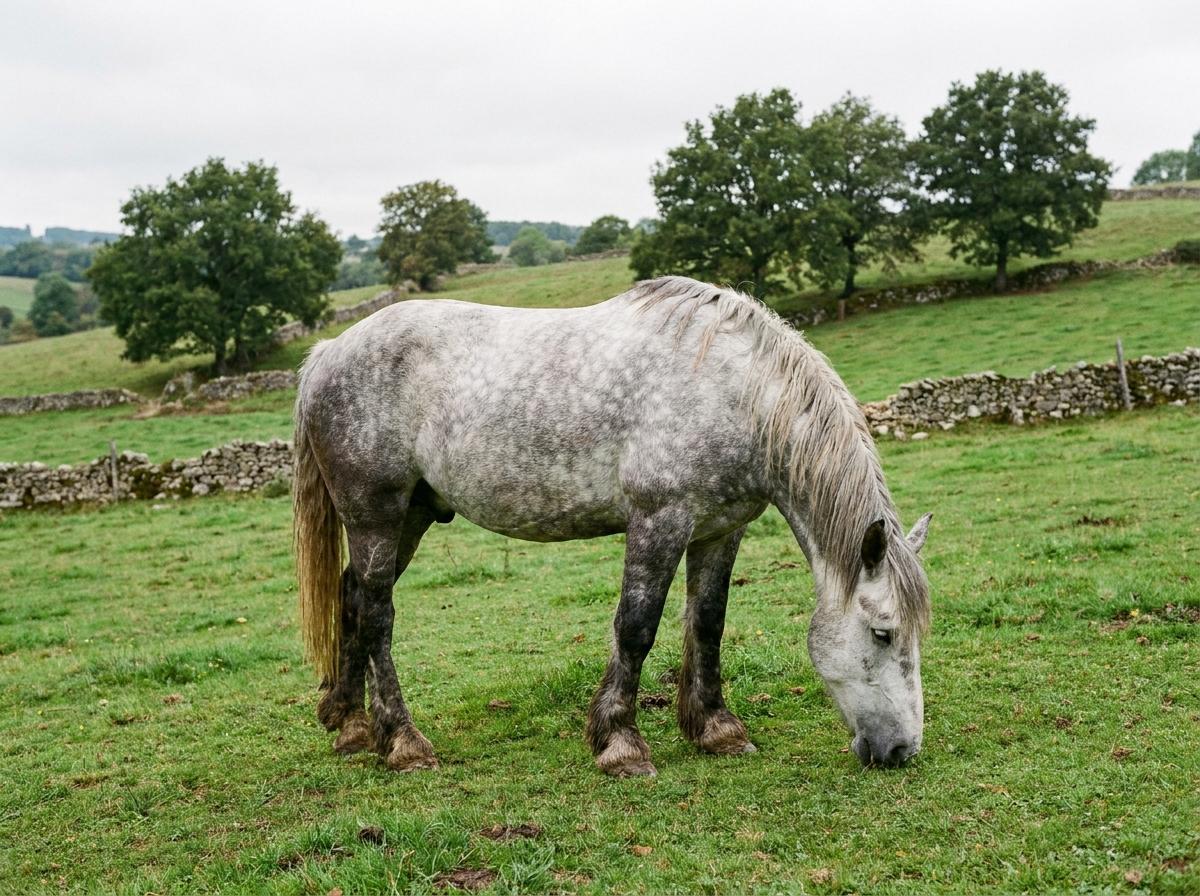
Percheron
The Percheron is a French draft horse from Le Perche, an old province southwest of Paris, and it became the most popular heavy horse in America. Most Percherons are grey or black, stand roughly 16 to 18 hands, weigh around 1,900 pounds on average, and have clean lower legs without the heavy feathering of a Clydesdale or Shire. They are known for a calm, willing temperament, and today they plough, log, pull carriages and show hitches, and get crossed with lighter horses to make sport horses. If you are looking for one, the Percheron breeder directory on Creatures is the fastest place to start.
This guide covers where the breed actually came from (and which parts of the story are tradition rather than record), what the registry says about size and colour, the health issue every Percheron buyer should know by name, and how to buy a registered horse with your eyes open.

| Origin | Le Perche, western France (Huisne valley) |
|---|---|
| Type | Heavy draft horse, clean legged with little or no feathering |
| Height | 15 to 19 hands; most between 16.2 and 17.3 hands (US registry) |
| Weight | Averages around 1,900 lb; big horses exceed 2,000 lb |
| Colours | Usually grey or black; sorrel, bay and roan also occur |
| Temperament | Calm, alert, willing worker; an easy keeper |
| Key health note | High carrier rate for the PSSM1 muscle disease; a DNA test is available |
| US registry | Percheron Horse Association of America (roots in 1875 to 1876) |
Browse listings, public profiles, breeders, or add your animal.
What is a Percheron?
A Percheron is a heavy draft horse: a big, strong, heavily muscled horse bred to pull. The Percheron Horse Association of America (PHAA), the breed’s North American registry, describes a horse with heavy muscling in the lower thighs, a long level croup with a big round hip, a wide deep chest, a straight face, a large prominent eye and “refined ears,” and it puts particular weight on “clean action and quality conformation of the feet and legs.”
That last point is the practical way most people tell a Percheron from the other big draft breeds. A Clydesdale or a Shire carries long, silky feathering on the lower legs. A Percheron’s legs are clean, with little or no feather. Add a grey or black coat and an arched, high-carried neck and you have the look most people picture when they hear the name. To compare it with other draft and riding breeds, start from the Creatures horse species page.
Percherons are also common in the United States, and Percheron breeders are listed across the country in the Creatures breeder directory.
Where the Percheron came from
The breed is named for its cradle. The PHAA’s origin and history page describes Le Perche as an old province about 53 by 66 miles, some 50 miles southwest of Paris, bordering Normandy and the grain country of the Beauce. It was gently rolling, well watered and fertile, and its people were horse producers who sold to the rest of France and, eventually, the world.
The honest starting point is that nobody knows the breed’s deep origins. The PHAA itself says the origin “is shrouded in myth,” because the foundations of the breed predate documentation and pedigrees by several centuries.
The war-horse tradition
Breed histories often say the Percheron descends from the horses of medieval French knights. The PHAA notes that paintings from the Middle Ages usually show French knights on grey or white chargers, and that Perche horses had “considerable substance for that time.” Treat this as tradition, not documented pedigree. There is no unbroken record linking any living Percheron to a medieval warhorse, and archaeological work on medieval horses suggests even the elite warhorse was far smaller than a modern Percheron. Our guide to the destrier explains what is actually known about the knight’s horse and why the draft-giant image is mostly a later invention.
What the records support better is the change that came after armour went out of use. According to the PHAA, Perche breeders shifted toward horses that could pull heavy stagecoaches (diligences) at a steady trot, and grey was favoured because it showed up at night. As rail replaced the coaches, they bred heavier horses for Paris omnibuses and for farm work on the Beauce, then heavier still for hauling freight from docks and railheads.
The Arabian question
You will read that the Percheron carries Arabian blood. The claim is old, and the sources disagree about how much it matters. France’s Académie d’Agriculture (2023) says only that Arabian origins are “supposed” (in French, “on suppose”), with the story that horses left behind after the Battle of Poitiers in 732 ended up in the region, and adds that European origins are part of the picture too. Some breed histories add that Arabian stallions stood at the royal stud at Le Pin from the 18th century and helped restart Perche breeding after the Revolution, though other breed historians doubt those horses had much influence. The PHAA still describes the Percheron’s refined ears as suggesting “his arabian ancestry.” The fair summary: some Arabian or other Oriental blood was probably used at times, and nobody can measure how much of it survives in the modern breed.
Jean le Blanc and the French stud book
Breed histories commonly trace modern Percheron lines to a 19th century foundation stallion named Jean le Blanc, often given a foaling date of 1823; treat that, like the older origin stories, as breed tradition. What the PHAA’s own history makes clear is the direction of travel through the 19th century: from a coaching horse toward a heavier draft horse for farms and freight. The French breed society, the Société Hippique Percheronne, was founded in 1883, and the breed’s stud book opened the following year, according to the Académie d’Agriculture.
Percherons in America: the boom, the bust and the comeback
America had no heavy horse breed of its own, and after the Civil War it needed a great many big horses for farms, freight and growing cities. The PHAA’s history records that the first French imports, in 1839 and 1851, actually came from Normandy rather than Le Perche. Once American importers discovered Le Perche itself, the trade exploded: in the 1880s almost 5,000 stallions and over 2,500 mares were imported from France, mostly from Le Perche, a number the association says exceeded the imports from Great Britain and the rest of continental Europe.
An importers’ association formed in Chicago in the winter of 1875 to 1876 as the National Association of Importers and Breeders of Norman Horses. Its stud book changed name to “Percheron-Norman” and then simply “Percheron.” The financial panic of 1893 bankrupted that first association, and a new one formed in 1902, the line from which today’s association descends. The association’s magazine marked its 150th anniversary in 2026, counting from those 1870s roots.
The breed’s peak is easy to state and hard to overstate. The PHAA reports annual registrations of around 10,000 a year by the 1910s, and says that in the 1930s more than 70 percent of the purebred draft horses in America were Percherons. Then tractors won. After the Second World War came what the association calls the greatest liquidation of draft horse stock in history, and in 1954 just 85 Percherons were registered.
The breed survived because a small group of breeders refused to let it go, helped by the Amish farmers who kept working with horses. Registrations climbed back to 2,257 by 1998. The Livestock Conservancy graduated the Percheron from its Conservation Priority List in 2013, citing breeding in North America and conservation work by the French national stud, with a global population above 32,000 at that time.
Size, colour and how to recognise a Percheron
Here is what the PHAA’s breed description says, which is the right place to check numbers rather than a sales ad:
- Height: 15 to 19 hands, with most Percherons between 16.2 and 17.3 hands. (One hand is four inches, measured at the withers.)
- Weight: up to about 2,600 pounds, averaging around 1,900 pounds. The association’s own breed card gives “up to 2,300 pounds” as a top weight, so treat the upper end as a range, not a rule.
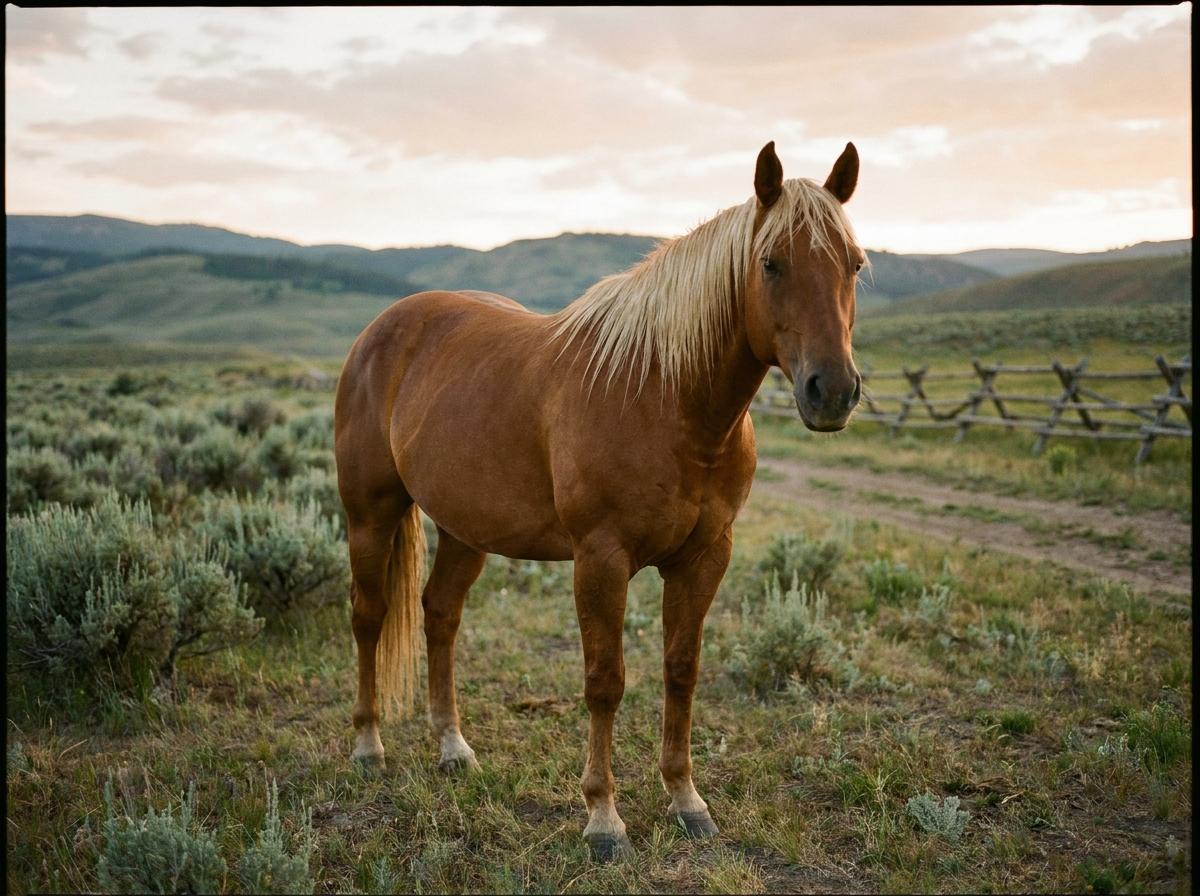
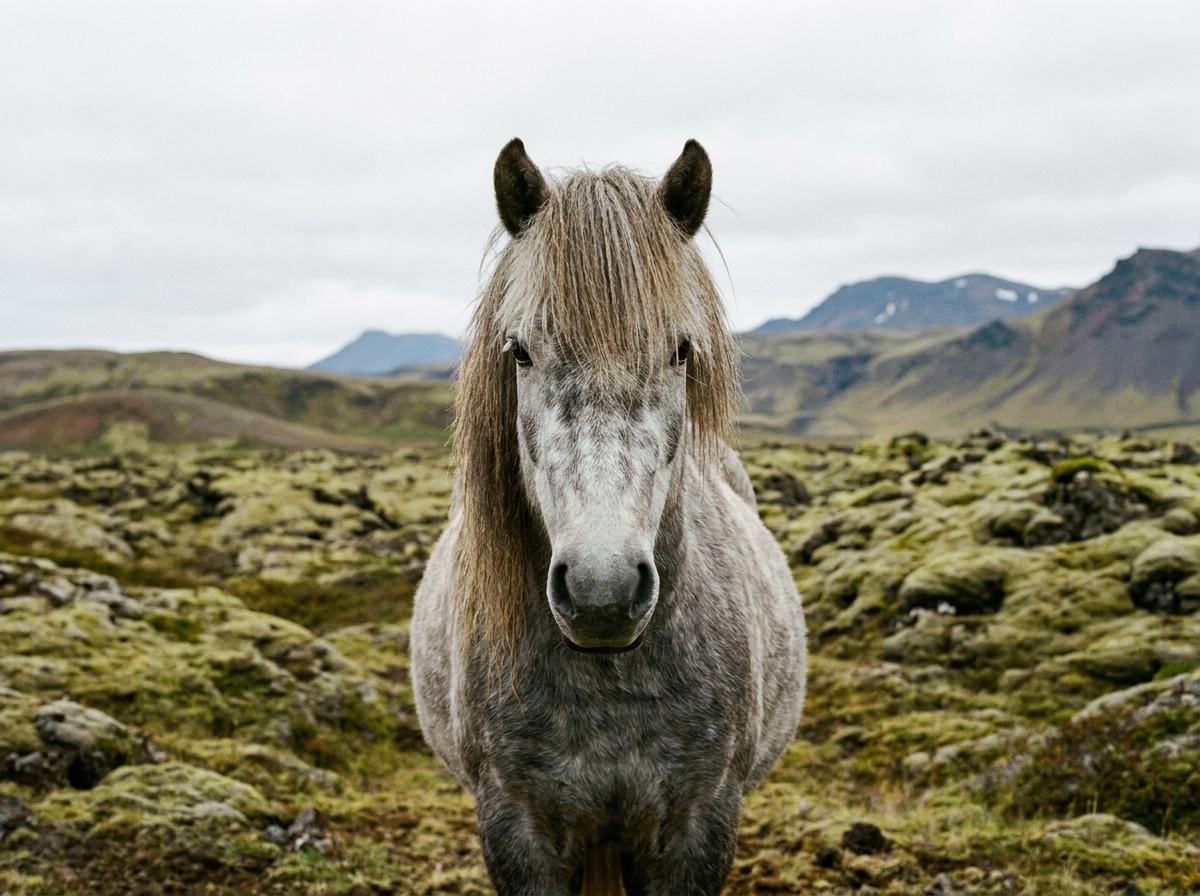
- Colour: usually black or grey, though sorrels, bays and roans also occur. White markings on the head and feet are common, but excessive white is undesirable.
Size varies by country and by what breeders are selecting for. The Académie d’Agriculture gives an average height of 1.68 metres in France (a range of 1.55 to 1.85 m, roughly 15.1 to 18.1 hands) and weights of 500 to 1,200 kg, and notes that French breeders prefer tall horses. The PHAA also records that American breeders deliberately downsized the breed in the 1930s, and that the fashion for big show hitches later reversed the trend.
Grey or black?
Both colours are classic. In France, the Académie says dapple grey is the most characteristic and most common colour, with black rarer and sought after by some buyers. It also notes that American registries record the rarer roan, bay and chestnut coats, which the French registry does not.
A practical point for buyers of young stock: grey is a colour that develops. The PHAA’s registration instructions warn that “grey horses nearly always appear black at birth” and that black horses do not turn grey. A grey foal usually shows at least a few white hairs above the eyes or on the forehead, and the association asks for any horse carrying grey to be registered as grey, even if it still looks black. So a jet-black yearling from a grey parent may be a grey in waiting. The free horse coat color calculator shows how grey passes from a grey parent to its foals.
What about buckskin, palomino or “22 hand” Percherons?
People search for these, so a straight answer: the PHAA’s breed description lists black, grey, sorrel, bay and roan, and its height range tops out at 19 hands. Colours such as buckskin and palomino come from the cream dilution gene, which the association’s descriptions do not mention. A horse advertised as a buckskin or palomino Percheron is worth checking carefully; it may be a cross, which is fine as long as it is sold as one. The same goes for extreme size claims. Ask for registration papers and a measuring stick, not a photo taken from ground level.
Temperament and what Percherons do today
The PHAA describes the Percheron as “proud, alert, intelligent and willing,” with “marked tractability,” and an easy keeper. Individual horses vary with handling and training, as with any breed, but the reputation for steadiness is the reason Percherons are trusted in crowds, on farms and in the woods.

The breed’s current jobs, drawn from the PHAA and the Académie d’Agriculture:
- Farming. Amish and other horse-powered farms still plough, plant and haul with Percheron teams. In France, a 2020 survey of draft-horse operators (all breeds) reported by the Académie found market gardening, vineyards and forestry were the main uses.
- Logging. The PHAA points out that a horse can extract timber from a small woodlot without the wide roads machinery needs, sparing the trees that are left.
- Carriages, wagons and show hitches. The PHAA describes a horse with the strength to pull heavy loads and the style to pull a fine carriage, and the association runs an All-American program for hitch horses, the multi-horse teams shown at fairs and draft shows.
- Riding. The PHAA notes that Percherons can be ridden and that some have made fine jumpers. A well-trained Percheron can be a steady trail or pleasure horse for a rider who fits it, and some are used for jousting and medieval displays.
- Crossbreeding. Percherons are crossed with lighter breeds, such as the Thoroughbred, to produce sport horses and substantial riding horses. The PHAA runs a crossbred registry for these horses.
- Meat, in France. The Académie lists meat production among the breed’s outlets in France, alongside work, sport and leisure driving.
In France, the Académie describes two working types within the breed: a heavier “trait” type for field and forest work, and a lighter, more active “diligencier” type for leisure driving and riding.
If you are comparing breeds, other heavy horses with Creatures pages include the Boulonnais, another French draft, and the Belgian Draft. For a completely different corner of North American horse history, see the Canadian Pacer, a light, gaited strain of eastern Canada and the northeastern United States that was valued in the same horse-powered centuries.
Percheron health: PSSM1 and other draft-horse issues
Percherons are generally sound, hardy horses, but three conditions come up often enough in draft breeds that every owner should know them by name. None of this replaces your veterinarian, who should be your first call for any muscle, movement or skin problem.
PSSM1 (type 1 polysaccharide storage myopathy)
PSSM1 is an inherited muscle disease caused by a dominant mutation in the GYS1 gene, which makes muscle store too much glycogen and an abnormal form of it. A University of Minnesota-led study of breeds in Europe and North America (McCue and colleagues, Animal Genetics, 2010) found the mutation in 11 breeds and ranked Percherons highest: the share of horses genetically susceptible ranged from 0.5 percent to 62.4 percent across those breeds, with the Percheron at the top of that range. In plain terms, in that sample well over half of the Percherons tested carried at least one copy.
Carrying the mutation does not mean a horse will be visibly sick. The Merck Veterinary Manual notes that in draft horses chronic signs may include loss of muscle mass, progressive weakness and trouble getting up, and that some draft horses develop severe episodes of muscle breakdown. Cornell researchers described fatal cases in Belgian and Percheron horses back in 1997 (Valentine and colleagues, Equine Veterinary Journal), and a UC Davis case report flagged the same risk in Percheron crosses (Sprayberry and colleagues, 1998), which matters if you are buying a draft cross or a warmblood with Percheron lines.
What helps, according to Merck: a diet built on forage at 1.5 to 2 percent of body weight, with more than 15 percent of digestible energy from fat and starch kept low. Merck also notes that a few days of rest before exercise is a common trigger for episodes and that horses with chronic tying-up do not do well on prolonged rest, which is why vets usually pair the diet with regular exercise and as much turnout as possible. Merck lists the diagnosis as a genetic test on blood or hair, so you can know a horse’s status before you buy or breed. Because the mutation is dominant, a horse with one copy can pass it to roughly half its foals; breeding decisions are worth talking through with your vet.
Shivers
Shivers is a chronic movement disorder. The horse walks forward normally but has difficulty when a hind foot is lifted by hand and when backing up, because the hind leg flexes or extends abnormally, and owners often report muscle twitching. A University of Minnesota survey study (Draper and colleagues, Equine Veterinary Journal, 2015) found it usually starts before age seven, often progresses, and is more common in tall horses and males, and that draft breeds were over-represented among confirmed cases. No proven treatment was reported. Watch how a horse picks up its hind feet for the farrier, and how it backs, before you buy.
Melanomas in grey horses
Grey horses of every breed are prone to melanomas, dark lumps that the Merck Veterinary Manual says appear most often on the perineum and the base of the tail, though they can develop anywhere, including the ears, and tend to grow in size and number over time. The University of Minnesota’s equine genetics group states that melanomas occur in about 80 percent of grey horses older than 15. Many grow slowly, but some do not. If you own an older grey Percheron, have your vet check those areas at routine visits and note any new lump in the horse’s record; our guide to horse health records covers what to keep.
Weight, fasting and fat metabolism
Draft horses are easy keepers, and obesity brings its own problems. Merck’s nutritional requirements for horses links obesity with laminitis and insulin resistance, and warns that ponies and draft breeds are especially at risk of hyperlipidemia (a dangerous rise in blood fats that can lead to liver failure) if they go without feed for long periods, over 24 hours. A sick draft horse that stops eating needs a vet promptly.
Feeding, housing and hoof care
Percherons eat more than a light horse because they weigh more, but less than their size suggests. Merck groups draft horses with the easy keepers, whose minimum maintenance energy need is about 0.03 Mcal of digestible energy per kilogram of body weight, compared with 0.04 for a hard keeper such as a Thoroughbred. It also advises that draft and draft-cross youngsters may need 10 to 20 percent less than standard recommendations to grow well without getting fat.
The PHAA’s breed card puts a mature Percheron’s daily intake at 25 to 50 pounds of hay, depending on age and work, with grain or commercial feed on top for working horses, and fresh clean water always available. For a horse that has tested positive for PSSM1, or one that is simply fat, your vet may well recommend cutting the grain and replacing extra calories with fat, as described above. Score body condition by eye and hand rather than by weight tape: Merck notes that weight tapes are not suitable for draft horses.
Housing does not need to be exotic, but it needs to be big. A draft horse needs a larger stall, wider doorways, taller ceilings and sturdier fencing than a light horse, plus as much turnout as you can give, which also helps with PSSM1 management. Timber or safe mesh fencing is better than barbed wire for any horse.

Feet and the farrier
Good feet and legs are part of the breed standard, and they are also where draft ownership gets expensive. The PHAA’s breed card notes that Percheron feet “can grow to as big as the size of a dinner plate,” and some working and show horses wear steel shoes. General extension guidance from extension.org is a trim or reset at least every six to eight weeks in summer, stretching to six to twelve weeks in winter when hooves grow more slowly. Not every farrier works on drafts, so find one who does before you bring a horse home, and teach young horses to pick up and hold their feet politely: a 1,900 pound horse leaning on a farrier is a real hazard. Keep a record of each trim, shoeing and hoof problem; patterns are easier to spot on paper than in memory.
Buying a Percheron
Registered, grade or crossbred?
- Registered purebred. A horse registered with the PHAA has papers in the Percheron Stud Book of America. The association’s registration application requires the sire and dam to be registered and the sire to have DNA markers on file, and asks for every white marking to be drawn and described. Papers matter most if you plan to breed, show in registered classes or resell. To print a horse’s lineage from its papers, use the free horse pedigree chart maker.
- Grade horse. A Percheron-type horse without papers can be an excellent worker or riding horse and usually costs less, but you are buying the individual, not a pedigree.
- Crossbred. Percheron crosses are common and often very good riding horses. The PHAA’s crossbred registry can document them.
When you look at a registered horse, check that the colour and markings on the papers match the horse in front of you. The Creatures directory also has a page for the Percheron Horse Association of America if you want to look up the registry itself.
The pre-purchase exam and the PSSM1 test
Have your own equine vet do a pre-purchase exam. The American Association of Equine Practitioners’ pre-purchase exam template is a useful reminder of what the exam is: a snapshot of the horse’s health on the day, not a guarantee of future soundness, and not an assessment of temperament or suitability for your plans. For a Percheron, ask the vet to pay particular attention to how the horse moves and backs up, how it handles having its hind feet lifted (shivers), its muscling and body condition, and, on a grey, any melanomas. Ask the seller for a PSSM1 result, or have one run.
Then judge the part no exam covers: manners and training. The PHAA calls the breed tractable, but a big horse with poor groundwork is still dangerous. Ask to see the horse caught, led, tied, groomed, have its feet handled and, if it is sold as broke to drive or ride, worked by the seller before you try it.
What does a Percheron cost?
Prices vary widely with age, training, registration and purpose. A weanling or an unstarted grade horse sits at the low end; a safe, proven driving horse, a matched team, a show hitch prospect or a registered broodmare costs much more. As one published data point, the Académie d’Agriculture reported 2023 prices of 2,000 to 4,000 euros for young horses bought for resale and 7,000 to 8,000 euros for a trained, ready-to-use horse at a training centre at the Haras du Pin in Normandy, with prices rising on demand. For a wider look at purchase and upkeep costs, see how much a horse costs, and for where to look and how to avoid problem sellers, our guide on where to buy a horse.

Breeding your own
If you are thinking of breeding, start with PSSM1 status for both parents, soundness, temperament and a realistic plan for the foal. Horse gestation runs about eleven months; the horse gestation calculator gives the due date, and our horse gestation guide covers the timeline and foaling preparation. Remember the colour lesson above: a grey mare’s foal may be born almost black and turn grey over its first years.
Frequently asked questions
Where does the Percheron come from?
Le Perche, a former province in western France, about 50 miles southwest of Paris. The breed takes its name from the region.
How tall is a Percheron?
The PHAA gives a range of 15 to 19 hands, with most between 16.2 and 17.3 hands. In France the average is about 1.68 metres, roughly 16.2 hands.
How much does a Percheron weigh?
Around 1,900 pounds on average, according to the PHAA, with large horses well over a ton.
What colours are Percherons?
Usually grey or black. Sorrel, bay and roan also occur and can be registered in North America. Grey foals are usually born dark and lighten with age.
Are Percherons descended from knights’ horses?
That is a long-standing breed tradition, not a documented pedigree. Medieval warhorses were also much smaller than a modern Percheron.
Are Percherons good riding horses?
Many are. The PHAA notes they can be ridden and some have made fine jumpers. A well-trained Percheron suits a rider who wants a steady, substantial horse; check that your saddle fits a broad back and that you can mount safely.
What health problems do Percherons have?
The big one is PSSM1, an inherited muscle disease for which Percherons showed the highest carrier rate in a 2010 multi-breed study. Draft breeds are also over-represented in shivers, and grey horses are prone to melanomas with age. A DNA test is available for PSSM1.
Who registers Percherons in the US?
The Percheron Horse Association of America, which traces its roots to an importers’ association formed in Chicago in 1875 to 1876.
Do this next on Creatures
Whether you already own a Percheron, are shopping for one, or breed them, these are the useful next steps.
Give your Percheron a profile. Record registration number, colour, markings, PSSM1 status and pedigree in one place: create a free profile for your Percheron, no account needed to start. The walkthrough is in adding an animal to Creatures.
Keep its health, hoof and training history. Vet visits, test results, farrier trims and shoeing, body condition, training milestones: start a record for your horse. The record sheet opens for any visitor to explore, and a free account saves what you enter. See adding a record, health and medical records and reminders and upcoming care for farrier and vaccination dates.
Get told when a Percheron is listed. Set up a free Percheron listing alert, no account needed to start. Here is how saved searches work.
Browse Percherons for sale. Check current Percherons on the Creatures marketplace, and ask every seller for papers, a PSSM1 result and a pre-purchase exam.
Breed Percherons? Farms, studs and hitch teams can create a free organization profile, no account needed to start. See how directory listing works and how to add your team.
Find trusted breeders. Search the Creatures breeder directory, or go straight to Percheron breeders.
Keep exploring. Start from the horse species page, find a name in the horse name generator, or read about the destrier and the Canadian Pacer.