

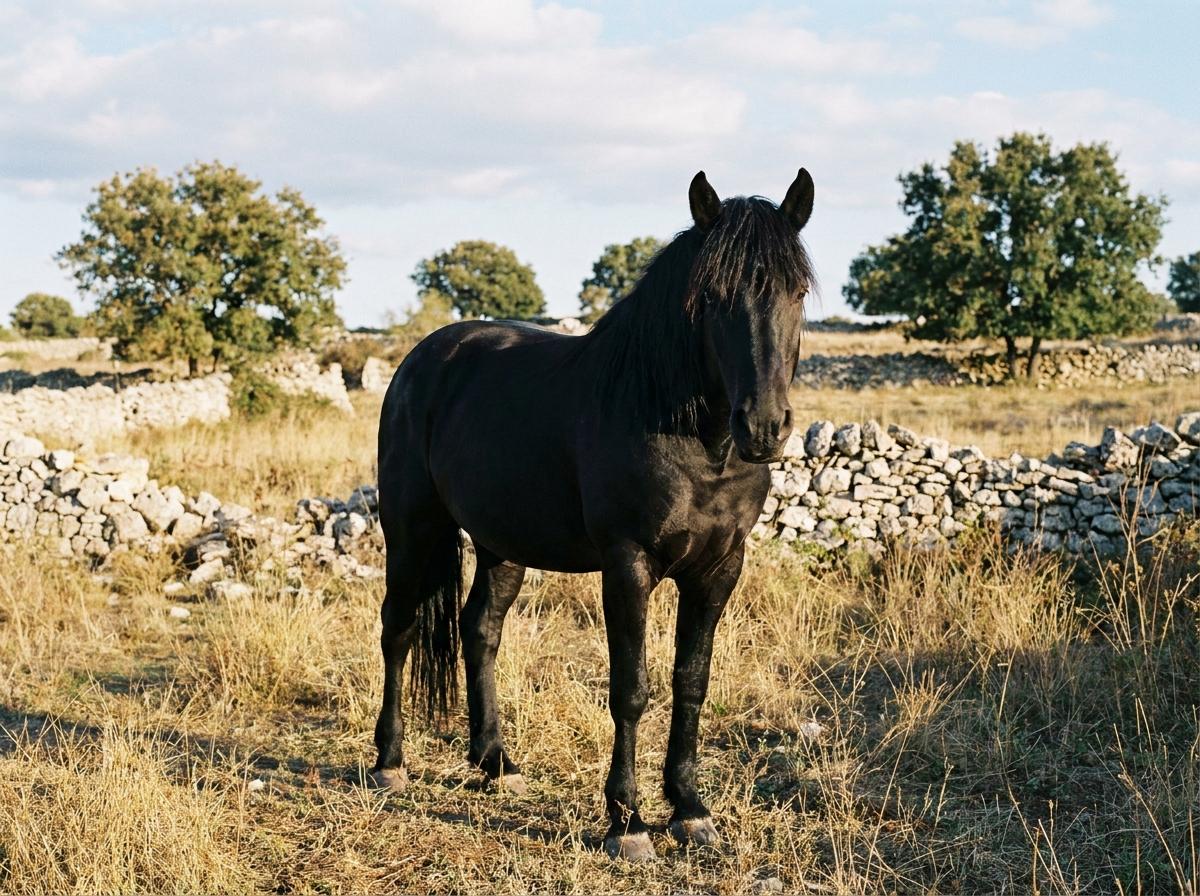
Murgese
The Murgese is a black Italian riding horse from the Murge plateau of Apulia (Puglia), in the south of Italy. It is compact and deep-bodied, almost always raven black, and best known for two things: exceptionally hard black hooves that let many individuals work barefoot, and a calm, trainable temperament that suits trekking, cross-country riding, and long days on rough ground. It is also a genuinely rare breed, concentrated in its home region and uncommon anywhere else, so most of what circulates online about it mixes solid history with romantic legend. This page separates the two: what the breed actually is, where it came from, how to recognize a correct one, what it is like to keep, and the honest reality of finding one outside Italy.
| Also called | Cavallo delle Murge, Murgese horse |
|---|---|
| Origin | The Murge plateau, Apulia (Puglia), southern Italy |
| Foundation | Barb and Arabian stock crossed onto local Neapolitan horses |
| Modern registry | Selection restarted in 1926; studbook now managed by ANAMF in Italy |
| Primary use | Riding, trekking, cross-country, equestrian tourism; historically farm and light draft work |
| Coat | Predominantly raven black; roughly 2% dark roan or iron grey, per the breed standard |
| Height | About 150 to 170 cm (roughly 14.3 to 16.3 hands); stallions taller than mares |
| Hooves | Hard, black, compact; many individuals work barefoot |
| Temperament | Gentle, willing, easy to train; sure-footed on rough terrain |
| Availability | Rare; concentrated in Apulia and Italy, uncommon elsewhere |
Browse listings, public profiles, breeders, or add your animal.
What is a Murgese horse?
The Murgese, in Italian the Cavallo delle Murge, is a light riding horse native to the Murge, a limestone plateau that covers much of the province of Bari and the surrounding parts of Apulia in southern Italy. In its own region it is simply the horse of the Murge, and the whole breed still centers on that landscape of dry-stone walls, olive groves, and thin rocky pasture. That ground shaped the animal. A horse raised moving over limestone tends to have tough feet and careful footwork, and both are hallmarks of the breed today.
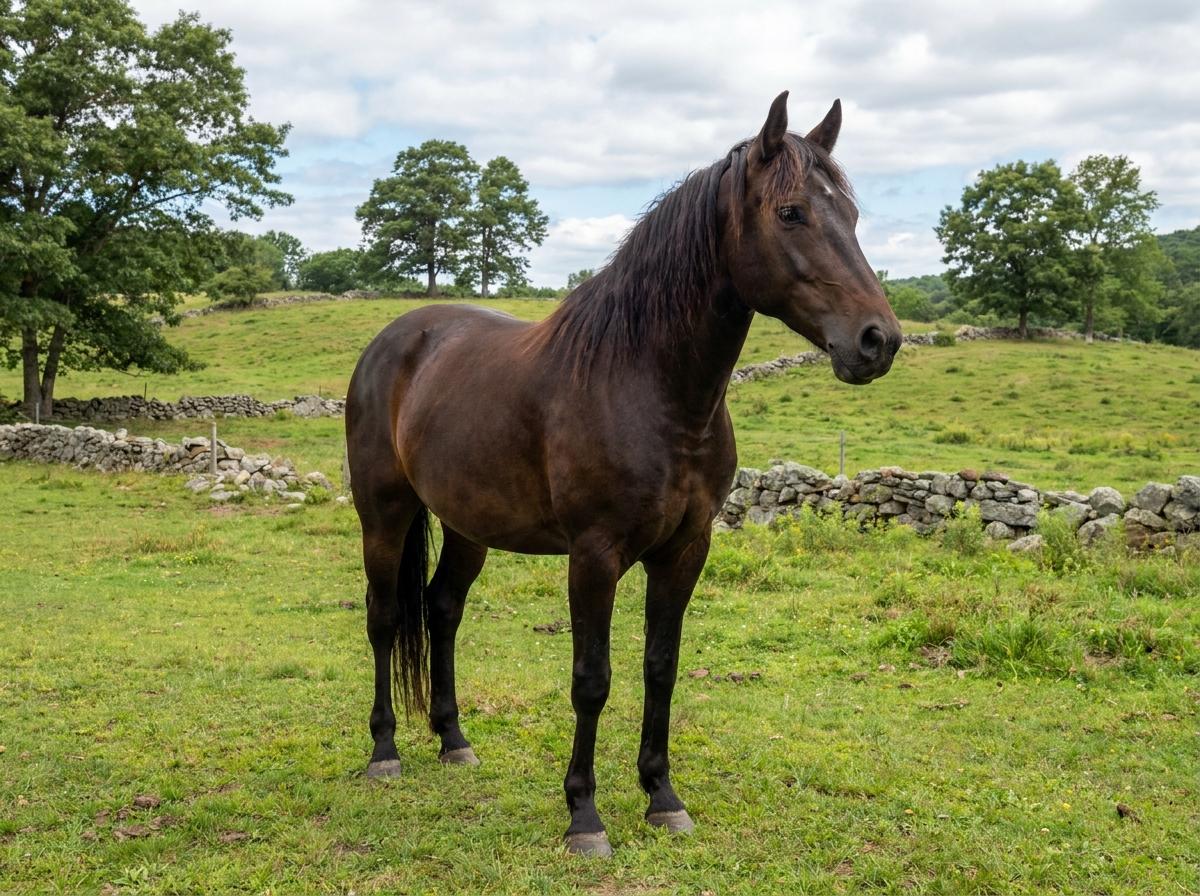
Physically the Murgese sits in the middle of the size scale, a medium-framed saddle horse rather than a pony or a heavy draft animal. It is almost always black, deep through the chest, muscular in the neck, and built more for stamina and sure-footedness than for speed. Modern breeders select it as a riding and trekking horse, and it has a growing following in equestrian tourism because it is comfortable to sit, steady in the head, and happy to cover uneven country all day.
Set your expectations early, because the breed carries a fair amount of folklore. You will read that the Murgese is an ancient breed, that it carried armored knights without shoes, and that it founded the Lipizzaner. Some of that is well grounded; some is repeated tradition the historical record does not fully pin down. Where the evidence is solid, this page says so, and where it is a nice story that cannot be confirmed, it says that too. If you are comparing the Murgese against other saddle breeds, the broader Creatures horse species page is a useful place to line them up side by side.
Where the Murgese comes from
The breed as we know it took shape during the long centuries of Spanish rule in southern Italy, which lasted until the early eighteenth century. The traditional account, repeated in most breed references, is that Barb and Arabian horses brought in from Spain and North Africa were crossed onto the local horses of the region, including the Neapolitan horse that the Apulian studs were famous for. The result was a hardy, elegant, black saddle horse well suited to cavalry and estate work. Some sources tie the early crossing to the Count of Conversano, a noble family of the area, though that specific attribution is treated as disputed rather than documented fact, so it is best read as tradition.
The Murge studs supplied riding and cavalry horses through the fifteenth and sixteenth centuries, when horses of this type were in real demand. After that heyday the population declined, and by the late nineteenth and early twentieth centuries the old Murge horse had dwindled close to disappearing. The modern breed is a deliberate revival rather than an unbroken line.
That revival has a clear starting point. In 1926 the Italian authorities began organized registration and selection of the breed at the royal stallion depot (the Regio Deposito Stalloni) at Foggia, working from a small foundation of nine stallions and forty-six mares. A handful of early stallions, among them Granduca di Martina, Araldo delle Murge, and Nerone, were especially influential in setting the modern type. A breeders’ association followed in 1948, tied to the region’s other famous native animal, the Martina Franca donkey, and it was renamed in 1990. In 2008 an Italian ministerial decree formally established the breed’s studbook, which is now managed by ANAMF, the national association of breeders of the Murgese horse and the Martina Franca donkey.
One more shift matters for anyone reading old descriptions. Through the first half of the twentieth century the Murgese was still a general-purpose working and light-draft horse. From the second half of the century, breeders deliberately selected toward a lighter, more refined riding type. So a modern registered Murgese is a saddle horse first, and older accounts describing a heavier farm animal are describing an earlier stage of the same breed.

The claimed influence on other breeds
A lot of the Murgese’s fame rests on the idea that it helped found other, more famous breeds, above all the Lipizzaner. Here the honest answer is “shared roots, not a clean line of descent.”
The Lipizzaner is built on six classical stallion lines, and two of them, Conversano and Neapolitano, trace back to Neapolitan horses of exactly the kind the Apulian studs produced. Because the Murge region was part of the Kingdom of Naples and its studs supplied Neapolitan-type horses, breed writers have long linked the Murgese to those lines, and you will see the claim stated flatly on many websites. What the primary record supports is the common Neapolitan ancestry, not a documented transfer of specifically Murgese animals into the Lipizzaner foundation. The same caution applies to claims that exported Murge horses shaped the Danish Frederiksborg and the Czech Kladruber. It is plausible given the trade in Neapolitan horses of the era, and it is repeated in the breed literature, but treat it as heritage tradition rather than a proven pedigree. The safe summary is that the Murgese and several baroque European breeds drew on the same Neapolitan and Iberian well, which is interesting enough without overstating it.
What a Murgese looks like
A correct Murgese is easy to recognize once you know the diagnostic features, and most of them come straight from the ANAMF breed standard.
- Black coat. The standard calls for a shiny raven black with no particular markings. A small share of the breed, on the order of two percent, shows a dark roan or iron grey coat instead. Other colors are not typical, so a Murgese that is bay, chestnut, or heavily marked with white is either not correct to the standard or not purebred.
- Light, straight to slightly convex head. The head is of medium length and not heavy, with a broad forehead, large eyes, mobile nostrils, and a profile that runs straight or very slightly convex. This is the Barb and oriental influence showing through.
- Muscular neck with a wide base. The neck is well muscled and set on a broad base, carried with an abundant mane and forelock. It gives the breed its characteristic strong, upstanding front.
- Deep chest and pronounced withers. The Murgese is deep through the girth with a well-developed chest, the build of a horse meant to keep going rather than to sprint.
- Strong legs with large joints. The limbs are firm, with wide, well-defined joints and good bone, sitting under a compact, load-bearing frame.
- Hard black hooves. The feet are regular and the horn is dense, dark, and compact.
Put together, the impression is of a solid, honest, deep-bodied black horse with a refined head and plenty of substance below the knee. It is not a delicate animal and it is not a heavy one; it reads as a working saddle horse bred to last.

The famous black hooves
If the Murgese is known for one thing, it is its feet. The breed has a strong reputation for exceptionally hard, dense black hooves, and many Murgese work sound and barefoot over the same rocky ground that would chip or bruise softer-footed horses. This is the practical root of the old stories about Murge horses carrying riders long distances without shoes. Those cavalry-era tales are folklore and cannot be verified in detail, but the underlying trait is real and consistent: a well-bred Murgese tends to have good, tough feet, which is a meaningful advantage for trekking and endurance-style riding.
Two caveats. First, “many go barefoot” is not “every Murgese never needs shoes.” Hoof quality still varies between individuals, and workload, terrain, nutrition, and trimming all matter. Second, good genetics do not replace good farriery. Whatever the breed, hoof care decisions should be made with a qualified farrier and, where there is a problem, a veterinarian.
Temperament and what they are used for
The breed standard describes the Murgese as gentle, rarely aggressive, obedient, and easy to train, and that reputation is a large part of why the breed has found a modern niche. Owners and trekking operators consistently describe it as level-headed and willing, the kind of horse that stays sensible on a narrow trail. As always, temperament is shaped by handling and training as much as by breeding, and an intact stallion is a different proposition from a gelding or a quiet mare, so judge the individual in front of you rather than the label.
In terms of jobs, the Murgese today is mainly a riding and trekking horse. Its sure feet and steady mind make it well suited to equestrian tourism across the rough Apulian countryside, and the breed is also used for general riding, cross-country work, driving, activities with children, and hippotherapy. Historically it did farm and light-draft work, which is why older sources sometimes present it as a workhorse; the modern selected animal keeps the substance but is bred for the saddle.
Size, weight, and lifespan
For height, use the breed standard rather than round internet numbers. Registered Murgese generally stand about 150 to 170 cm at the withers, which is roughly 14.3 to 16.3 hands, with stallions taller than mares. The current ANAMF standard gives roughly 155 to 170 cm for stallions and 150 to 164 cm for mares. Some other published versions cite slightly lower cutoffs (around 168 cm for stallions and 162 cm for mares), so treat any single number as approximate and expect real variation within the breed.
Weight is harder to state precisely, and worth being careful about. The studbook standard defines the breed by height and conformation rather than by a fixed weight, and there is no published morphometric weight figure that can be quoted as breed fact. Secondary references put a horse of this size and build in the general range of a medium riding horse, but that is an inference from frame, not a measured breed standard, so read it as a rough ballpark rather than a specification.
Lifespan is similar. There is no breed-specific survival study for the Murgese, so the responsible thing is to use the general expectation for a well-kept horse, commonly in the mid-twenties and sometimes beyond, rather than to invent a breed number. A sound, correctly managed Murgese should have the working longevity you would expect of any hardy saddle horse, but that is a general statement, not a documented breed figure.
Care and management
The Murgese is often described as an easy keeper, and its background on thin Apulian pasture fits that. None of this replaces a working relationship with an equine veterinarian and a good farrier, but the broad strokes are worth knowing before you take one on.
Feeding. A horse selected on sparse ground is generally efficient, which is a double-edged trait. Good doers hold condition on modest forage, but that same efficiency means they can gain weight and risk metabolic problems if they are fed like a hard-working sport horse when they are only hacking out. Base the diet on forage, feed to the actual workload, and monitor body condition rather than filling a bucket by habit.
Feet. The breed’s strong hooves are an asset, not an excuse to skip maintenance. Whether a given Murgese stays barefoot or needs shoes depends on its individual feet, its workload, and the ground it works on. Keep it on a regular farrier schedule and let the farrier make the shoeing call.
Routine health. Standard equine care applies: a parasite-control plan suited to your management, dental checks, and the core vaccinations your veterinarian recommends for your area and use. Because good records make all of this easier to manage over a horse’s long life, it helps to keep vaccination dates, farrier visits, dental work, and any health events in one place from the day the horse arrives. You can log all of that on a free Creatures animal profile, and the help article on adding a record walks through how the record sheet works.
Handling. The breed’s easy temperament rewards consistent, fair handling. Sensible groundwork and steady exposure to the trails and situations it will actually meet will get more out of a Murgese than drilling, and the calm brains the breed is known for are partly made by good management.
Rarity, buying, and the importation reality
This is where the Murgese asks for a clear head. It is a rare breed, and its rarity shapes everything about acquiring one.
The population is small and concentrated in Italy, above all in Apulia. A 2022 genealogical study of the breed worked from a pedigree of 6,923 animals born between 1900 and 2020 and described a current base of roughly 5,000 breeding animals, with a low effective population size (on the order of 47) and about half of the breed’s genetic diversity tracing to only six ancestors. An earlier official count for 2005 recorded about 107 stallions, 1,080 mares, and 350 foals. The exact headcount you see quoted will vary by year and source, but the shape is consistent: this is a numerically small, regionally concentrated breed that conservation-minded breeders actively manage to keep genetically healthy. It is best thought of as a heritage breed with a limited gene pool, not a widely available commercial one.
Outside Italy the practical reality is scarcity. There are Murgese breeders in a handful of other countries, but numbers are low and the breed is genuinely uncommon in North America. Importing a horse from Italy is possible but it is a serious undertaking: live-horse import into the United States runs through USDA APHIS requirements including testing and a period of quarantine, plus the substantial cost and logistics of international equine transport. None of that is a reason not to pursue the breed, but it does mean an imported Murgese is a considered, expensive project rather than an impulse buy, and you should budget and plan for the process with the relevant authorities and a reputable shipper.
If you are shopping, a few practices matter more than usual for a rare breed:
- Confirm registration and pedigree. For a breed this concentrated, papers through ANAMF or the relevant national studbook are how you know you are buying an actual Murgese rather than a black horse of similar type. Ask for them.
- See the whole horse, not the color. Black is the breed’s signature, but coat is the easy part. Judge the head, the neck, the depth of chest, the legs and feet, and above all the temperament and soundness for the work you have in mind.
- Check the feet honestly. The breed’s hoof reputation is real, but assess this individual’s feet and hoof history rather than assuming.
- Verify provenance for anything sold as imported or rare. Be clear on exactly what “Murgese” means for the specific animal in front of you, and get it in writing.
Because genuine stock appears infrequently, the most practical way to catch one is to watch the market continuously rather than checking now and then. You can browse current listings on the Creatures horse marketplace, look for farms and breeders in the Creatures directory, and set a free listing alert (below) so a new Murgese comes to you.
Frequently asked questions
Are all Murgese horses black?
Almost. The breed standard calls for raven black, and the large majority of Murgese are black. A small share, roughly two percent, are dark roan or iron grey. Other colors are not typical of the breed, so a bay, chestnut, or heavily white-marked “Murgese” is not correct to the standard.
Is the Murgese a rare breed?
Yes. It is a numerically small, regionally concentrated breed, centered in Apulia in southern Italy, with a low effective population size that conservation-minded breeders manage carefully. It is uncommon outside Italy and genuinely rare in North America.
Did the Murgese really found the Lipizzaner?
Not exactly. The Murgese and two of the Lipizzaner’s classical stallion lines share Neapolitan ancestry, which is why the two breeds are often linked. But that is common heritage rather than a documented transfer of specifically Murgese horses into the Lipizzaner foundation, so it is best described as shared roots.
Can Murgese horses really go without shoes?
Many can. The breed is known for hard, dense black hooves, and a lot of Murgese work sound and barefoot on rough ground. That said, hoof quality still varies between individuals, and shoeing decisions should be made with a farrier for the specific horse and its workload.
What is a Murgese used for?
Mostly riding and trekking. Its sure feet and calm temperament suit it to equestrian tourism, trail and cross-country riding, driving, work with children, and hippotherapy. Historically it also did farm and light-draft work.
How big is a Murgese?
Roughly 150 to 170 cm at the withers, about 14.3 to 16.3 hands, with stallions taller than mares. It is a medium-framed saddle horse, deep-bodied and substantial rather than tall.
Do this next on Creatures
Whether you are researching the breed, trying to find genuine stock, or already keeping a Murgese, Creatures is the records, marketplace, and directory layer to do it in one place.
Find one. Browse Murgese horses on the marketplace and search trusted farms and breeders in the Creatures directory. New to the marketplace? See saving searches and using your watchlist.
Get alerted. Genuine Murgese stock appears rarely, so set a free Murgese listing alert and we will tell you when one is posted. No account needed to start.
Add your horse. Already have a Murgese? Create a free animal profile in a few minutes. The walkthrough is in adding an animal to Creatures.
Track health and training. Keep vaccination, farrier, dental, and training records on Creatures. The record sheet opens for any visitor to look around, and a free account saves what you enter. See adding a record for the full how-to.
List your stud or farm. Breed or stand Murgese? Create an organization profile so buyers searching for this hard-to-find breed can reach you, and read getting listed in the breeder directory and creating an organization and adding your team to set it up.
Compare breeds. Still deciding? Start from the horse species page, and if you follow rare heritage breeds across species, see our sister guides to the Molossus of Epirus livestock guardian dog and the Danish Landrace sheep.