
Molossus of Epirus
Author: Elliott Garber, DVM · Published
The Molossus of Epirus is a large livestock guardian dog from the mountains of Epirus in northwestern Greece, recognized today as one of the country’s native breeds by the Kennel Club of Greece (Kynologikos Omilos Ellados, or KOE). It carries the name of the ancient Molossian dogs that classical writers praised more than two thousand years ago, and it still does the ancient job: standing between a flock and the wolves, jackals, and brown bears of the Pindus range. Two different things share this name, and most of what circulates online blurs them together. One is the modern working breed you can actually meet in a Greek mountain village. The other is the famous dog of antiquity, which is long gone and far less documented than the internet suggests. This page keeps them apart, sticks to what can be sourced, and is honest about the large parts of the story that are guesswork.
| Also called | Molossos tis Ipirou, Epirus Molosser, Epirus Mastiff |
|---|---|
| Origin | Epirus, the mountainous northwest of Greece |
| Type | Mountain molossoid livestock guardian dog |
| Recognition | Kennel Club of Greece (KOE); not recognized by the FCI or AKC |
| Height | Males about 66 to 75 cm at the withers (26 to 30 in), females roughly 64 to 74 cm, per the KOE standard |
| Weight | Large to giant; Greek breed documentation puts males around 40 to 75 kg (about 88 to 165 lb), females lighter |
| Coat | Dense, straight, medium-length double coat (roughly 5 to 6 cm on the body) with a soft undercoat |
| Availability | Very rare; concentrated in rural Greece and effectively unavailable as pet stock abroad |
Browse listings, public profiles, breeders, or add your animal.
Two dogs, one name
The name “Molossus of Epirus” points at two separate animals, and confusing them is the single biggest source of bad information online.
The first is the ancient Molossus, sometimes called the Molossian hound. This was a renowned guardian and working dog of classical antiquity, tied to the Molossian people of Epirus. It is extinct as a distinct animal, and what we actually know about it is thinner than the confident breed profiles you will find on general pet sites.
The second is the modern Molossus of Epirus, a living livestock guardian dog that the Kennel Club of Greece recognizes as a native breed alongside the Greek Shepherd, the Cretan Hound, the Greek Hound, the Kokoni, and others. The modern breed comes from the same mountains and does the same guarding work, and its keepers see it as the surviving expression of that old regional guardian type. That is a heritage claim about place and function, not a proven unbroken pedigree back to a dog Aristotle saw.
Most of the sensational numbers online (exact weights, tidy temperament checklists, confident “direct ancestor of the Neapolitan Mastiff” statements) get attached to the name without a source. Where this article gives a figure, it comes from the KOE breed standard or from primary and scholarly material about the ancient dog. Where the honest answer is “we do not really know,” it says so.
The ancient Molossian dog
Epirus sits in the northwest corner of Greece, spilling across the modern border into southern Albania. In antiquity it was home to the Molossians, a Greek tribe and kingdom, and their guardian dogs became famous across the Mediterranean. The Molossians put a dog on their silver coinage, which tells you how central the animal was to how they saw themselves.
Ancient writers mention these dogs repeatedly. The earliest surviving literary reference appears in a comedy by the Athenian playwright Aristophanes late in the fifth century BC, and Molossian dogs turn up afterward in a long list of Greek and Roman authors, among them Aristotle, Virgil, Horace, and Martial. Virgil, giving practical farm advice in the Georgics, tells the reader that with such dogs on guard you need never fear a midnight thief, a wolf attack, or raiders at your back. That is the job description in one line: property and flock protection against people and predators.
Aristotle is the most useful ancient source because he was trying to describe rather than praise. In his History of Animals he treats the Molossian dogs of Epirus as more than one kind of dog. The ones used for hunting, he says, were not markedly different from ordinary dogs, while the ones used with flocks were larger and fiercer than usual. Modern readers take this to mean the “Molossus” was never a single standardized breed in the way we use that word now. It was a regional type, or a landrace, shaped by a job rather than by a stud book.
That distinction matters, because a great deal of popular writing treats the ancient Molossus as the tidy fountainhead of every big dog alive: mastiffs, Saint Bernards, Great Danes, Rottweilers, and more are routinely traced back to it. It is a good story, and it may contain some truth, but historians of the dog treat the straight-line version with caution. The theory leans heavily on inference and on the loose ancient habit of calling many large dogs “Molossian,” and there is little hard evidence for a single Epirote ancestor founding the modern molosser group. So enjoy the lineage as heritage and legend, and be skeptical of anyone who states it as settled fact. The claim that the Molossus of Epirus is the direct ancestor of the Neapolitan Mastiff sits in exactly this contested territory.
You will also read that Alexander the Great marched with these dogs and loosed them in battle. Stories of Molossian war dogs are old and often repeated, but they are the romantic end of the record, not the documented core. Treat them as tradition.
What the modern breed is
Set the legends aside and there is a real, living dog. The modern Molossus of Epirus is a mountain-type livestock guardian, recognized in Greece by the Kennel Club of Greece. It is not recognized by the Federation Cynologique Internationale (FCI) or the American Kennel Club, so you will not find it in those registries or on the show circuits they run. Within Greece it is counted among the native breeds the KOE has documented and written standards for; the country now recognizes seven such breeds, the newest being the Rhodian Hound in 2026.
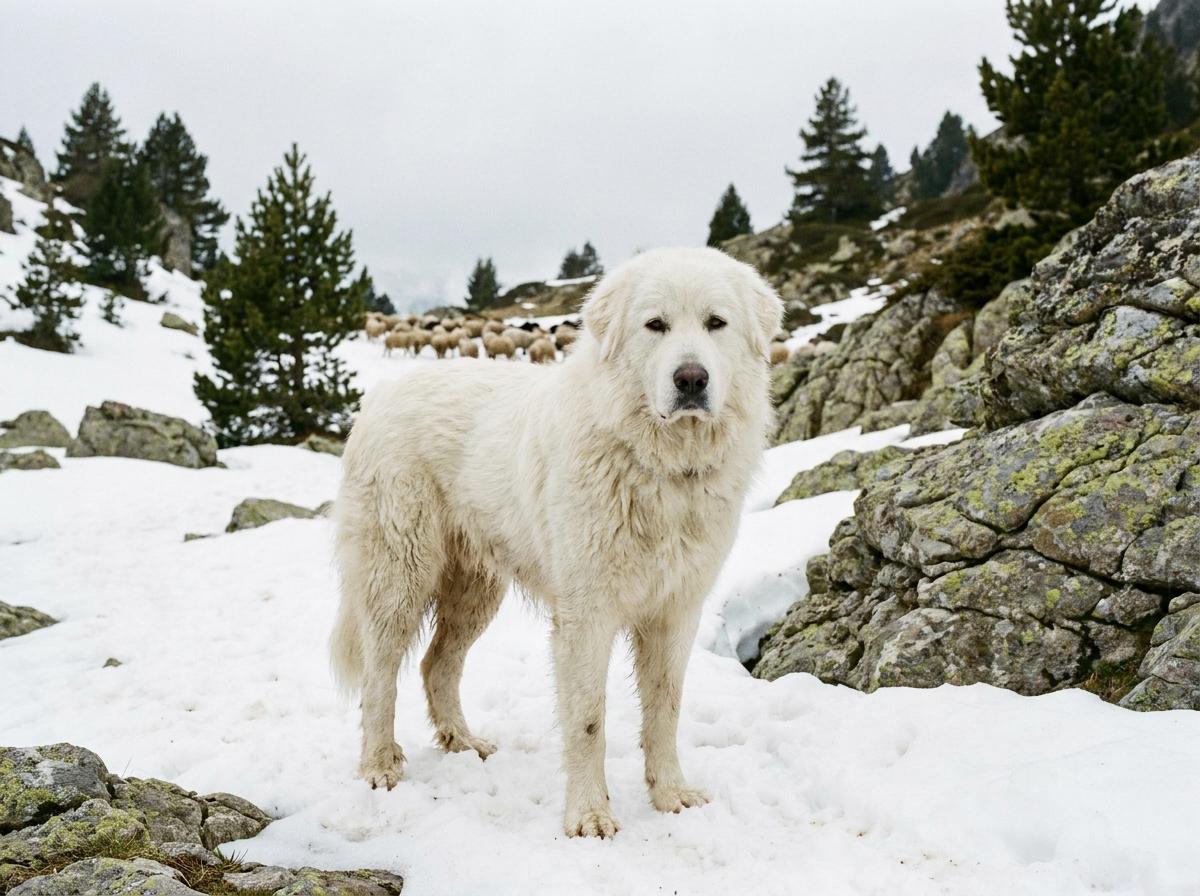
Its work is unchanged from Virgil’s day. Northern Greece still has large predators. Gray wolves persist in the northern mountain ranges along the Albanian and Bulgarian borders, and Greece holds a brown bear population estimated at several hundred animals, concentrated in the Pindus range that runs through Epirus. Golden jackals are present too. A guardian breed here is not decorative. It lives with the flock, reads the terrain, and is expected to face a wolf or a bear if one comes for the sheep. That single fact explains almost everything about the dog’s size, coat, independence, and temperament.
The Molossus of Epirus is closely related to, and easily confused with, Greece’s other big guardian, the Greek Shepherd (Ellinikos Poimenikos). The KOE recognizes both as separate breeds from overlapping mountain stock, and one of the practical ways they are distinguished is by coat color and markings. If you are trying to tell Greek guardians apart, that is the honest summary: they are cousins from the same working world, formalized into distinct standards fairly recently.

Size, build, and coat
This is a large to genuinely giant dog, and here the breed standard lets us be precise instead of guessing.
According to the KOE breed standard, males stand roughly 66 to 75 cm at the withers (about 26 to 30 in) and females roughly 64 to 74 cm, with only a modest difference between the sexes compared with many breeds. Weight is described in the standard in terms of proportion, giving the impression of a strong, compact animal rather than a fixed number, but Greek breed documentation puts males in the region of 40 to 75 kg (about 88 to 165 lb), with females somewhat lighter. Take the top of that range as the exceptional big male rather than the everyday dog. The build is powerful and moderately proportioned, with heavy bone, a deep body, and a large, strong, rectangular head. There is no reliable, breed-specific measured survey of individual maximum sizes, so treat these as the standard’s target ranges, not records.
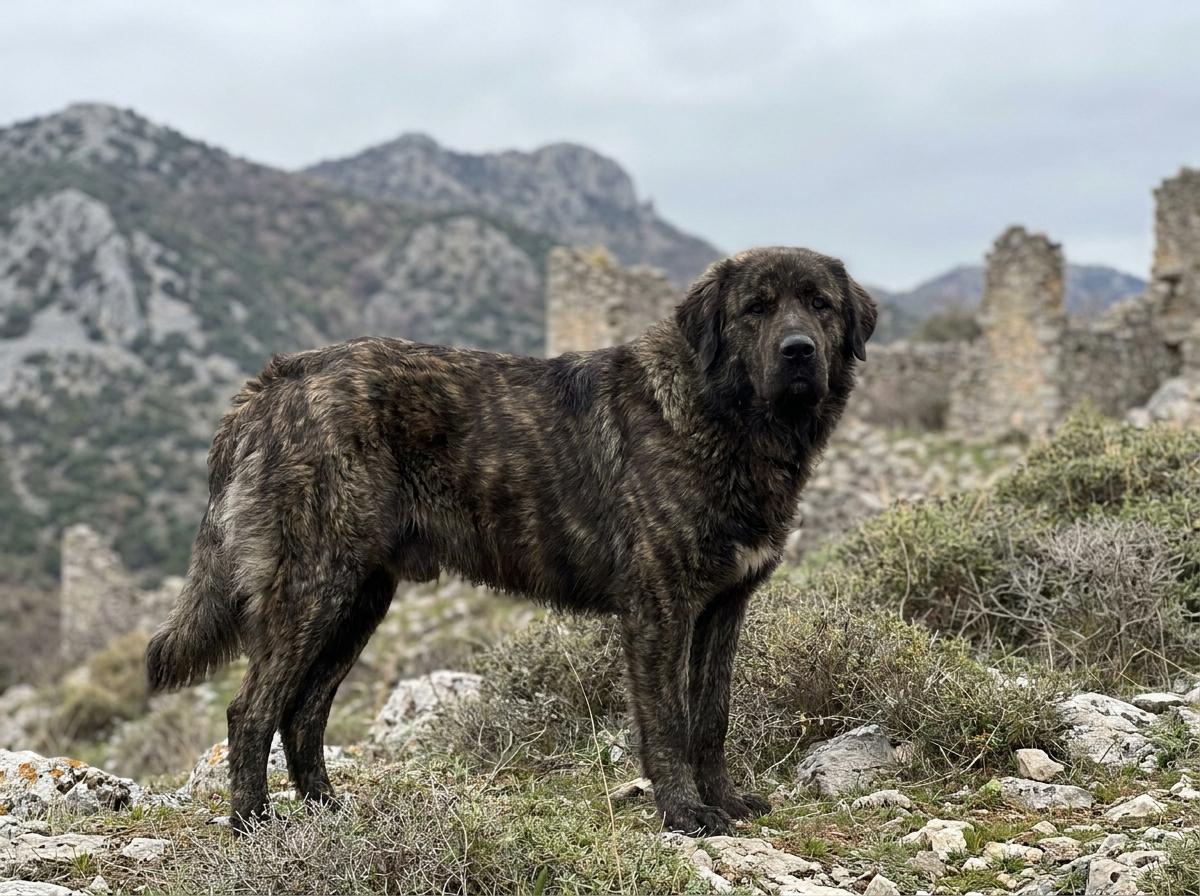
On coat, the popular sites get it wrong often enough to be worth correcting directly. This is not a short, smooth-coated dog. The KOE standard describes a dense, tight, straight coat of medium length with an abundant soft undercoat: shorter on the head, ears, and legs, and longer on the body, on the order of 5 to 6 cm. That double coat is exactly what a dog needs to sleep out on a cold mountainside through a Pindus winter.
Color is broad. The standard accepts solid reds, fawns, yellows, and blacks, as well as black and tan, brindle and black-brindle, and wolf-gray and deer shades, with or without a black mask. Small white patches on the chest and toes are tolerated but not preferred. So a Molossus of Epirus can look quite varied, and coat color is one of the traits Greek registries use to keep it distinct from the Greek Shepherd.
Temperament and who should keep one
The KOE standard describes the breed as intelligent, loyal, and deeply bonded to its flock and its people, steady in temperament, friendly toward the humans in its own world, and ready to protect livestock or property when it needs to. That is a guardian’s profile, and it is worth reading carefully, because a good livestock guardian is not the same animal as a family pet that happens to be big.
Guardian breeds are bred to think for themselves. A dog that has to decide, alone at three in the morning, whether the shape at the treeline is a stray sheep or a wolf cannot wait for a command. That independence is a feature in the mountains and a challenge in a suburban yard. These dogs tend to be calm and unflappable rather than jumpy, affectionate with their own household, naturally wary of strangers and strange dogs, and territorial about the space and animals they consider theirs. They bark, sometimes a great deal, because barking is part of how a guardian warns off a threat before it turns into a fight.
Popular breed pages like to frame all of this as a risk of “dominance aggression” that a firm owner must suppress. That is not a useful way to think about a livestock guardian, and it is not how the standard describes the dog. The real requirements are more practical: early, thorough socialization, calm and consistent handling, secure fencing, genuine space, and ideally a job. This is not a first dog, not an apartment dog, and not a breed to take on because it looks impressive. It is a working animal that is happiest and safest with an experienced owner who understands guardians and can give it room and purpose. If you cannot offer that, a different breed will make both of you happier.

Living and working with a mountain guardian
If you are seriously considering one, plan around what the dog is built to do rather than fighting it.
Space and containment. A guardian needs room and a boundary it respects. Secure, tall fencing is not optional, both to keep the dog with its charges and to prevent it from expanding its patrol into a neighbor’s land. These are big, strong, determined animals, and flimsy fencing does not hold them.
A job, or a good substitute. On a farm, the job is the flock. Without livestock, an owner has to supply structure, exercise, and mental engagement, or a bored guardian will invent its own work, usually barking, patrolling, and guarding things you would rather it ignored.
Socialization. Because the breed is naturally suspicious of the unfamiliar, early and ongoing exposure to people, animals, and situations is the single most important thing an owner does. A well-socialized guardian is discerning. An under-socialized one is indiscriminately reactive.
Grooming and climate. The dense double coat handles cold well and needs regular brushing, more during seasonal sheds. This is a cold-mountain dog by design, so heat management matters in warm climates: shade, water, and sensible timing for activity.
Health. There is no published, breed-specific health survey or lifespan study for the Molossus of Epirus, so anyone quoting an exact life expectancy for it is guessing. What is reasonable to say is general: giant guardian breeds tend to live shorter lives than small dogs, and very large, deep-chested dogs carry the usual large-breed concerns around joints and bloat (gastric dilatation and volvulus). None of that is documented as a breed-specific pattern here, so treat it as prudent large-dog awareness, not a diagnosis. Keep good records from day one, and defer every medical decision and any question of medication to a veterinarian who can examine the animal. Good record keeping is genuinely useful with a rare breed, where each dog’s history is part of a small and poorly documented population; you can start a free profile and log vaccinations, weights, and vet visits on Creatures, and the health and medical records help guide walks through how.
Rarity, conservation, and finding one honestly
Here is the part that most “where to buy” pages will not tell you plainly: this is a genuinely rare breed with no real pet-market pipeline, and you should be wary of anyone who makes acquiring one sound easy.
The Molossus of Epirus lives where it works. Its stronghold is rural, mountainous northwestern Greece, in the hands of shepherds and a small community of Greek breeders and enthusiasts trying to keep the type alive. There is no dated, official population count I can point you to, so this article will not invent a headcount; honestly, the breed is uncommon even in Greece and effectively absent as available pet stock outside it. Because it is not FCI or AKC recognized, it does not move through the international show and pet channels that spread better-known breeds around the world.
Conservation of Greece’s working guardians is a real and active concern. Organizations such as ARCTUROS, a long-running Greek wildlife NGO, have worked to sustain native Greek shepherd dogs and place them with mountain farmers, partly because functioning guardian dogs reduce conflict between livestock keepers and protected predators like the brown bear and wolf. That work is about preserving a living, working animal in its landscape, which is a very different thing from producing puppies for a pet market abroad.
So what should a serious, ethical would-be owner actually do? Start by being realistic about whether you can offer a guardian breed the life it needs, then work through people who know the breed in its home region: Greek breed clubs, established Greek guardian-dog keepers, and the KOE. Ask about the parents’ working temperament, health, and living conditions, and expect the process to be slow. If your real goal is a large livestock guardian rather than this specific rare breed, there are well-established, more accessible guardian breeds kept for the same purpose, and choosing one of those is often the more responsible path than importing a rare dog into a home that cannot suit it.
When you are ready to look, Creatures is the records, marketplace, and directory layer to organize the search in one place. You can browse dogs on the Creatures marketplace and search for breeders and guardian-dog people in the Creatures directory. Because genuine stock is so scarce, a saved listing alert (in the hub below) is usually the most practical way to hear about one if it ever appears. And if you want to keep exploring uncommon regional breeds, Creatures covers plenty of them across species, from the Danish Landrace sheep, another native landrace kept going by dedicated conservation breeders, to the Korean Bobtail cat, a regional native with its own local history. The through-line is the same one that runs through this whole page: real breeds are tied to real places, and the honest ones come with provenance, not hype. For the wider picture on canine breeds, the Creatures dog species page is the hub.
Frequently asked questions
Is the Molossus of Epirus the same as the ancient Molossus?
Not exactly. The ancient Molossus (the Molossian hound) is an extinct dog type of classical antiquity, known mainly from ancient writers and art. The modern Molossus of Epirus is a living livestock guardian breed from the same region, recognized by the Kennel Club of Greece, that carries the old name and does the old job. Continuity of place and function is well founded; a proven unbroken pedigree back to antiquity is not.
Is the breed recognized by the AKC or FCI?
No. It is recognized within Greece by the Kennel Club of Greece as one of the country’s native breeds, but not by the American Kennel Club or the Federation Cynologique Internationale.
How big is a Molossus of Epirus?
Large to giant. The KOE standard puts males at roughly 66 to 75 cm at the withers (about 26 to 30 in) and females roughly 64 to 74 cm. Greek breed documentation cites weights for males in the region of 40 to 75 kg (about 88 to 165 lb), with females lighter. The very top of that range is the exceptional male, not the average.
Does it have a short coat?
No, and this is a common error online. The standard describes a dense, straight, medium-length double coat with a soft undercoat, longer on the body than on the head and legs. It is built for cold mountain nights, not for a smooth-coated look.
Is it a good family pet?
For most families, no. It is a working livestock guardian, independent, territorial, wary of strangers, and often vocal. With an experienced owner, real space, secure fencing, thorough socialization, and ideally a guarding job, it can be a devoted companion. It is not suited to first-time dog owners, small homes, or apartment living.
Is it really descended from the dogs of Alexander the Great and the ancestor of all mastiffs?
Those are popular claims, not established facts. Ancient war-dog stories and the “ancestor of every big breed” family tree are traditional narratives that historians treat with caution, and genetics has not confirmed the tidy version. The breed’s real heritage is its long regional history as a mountain guardian, which is impressive enough on its own.
Where can I buy one?
There is no ordinary pet-market pipeline for this breed. It is concentrated in rural Greece and is effectively unavailable as pet stock abroad. Serious buyers work through Greek breed clubs, established guardian-dog keepers, and the Kennel Club of Greece, and should expect a slow, careful process. If you simply want a livestock guardian, a more widely available guardian breed is usually the more responsible choice.
Do this next on Creatures
Whether you are researching this rare guardian, hoping to source genuine stock, or already keeping one, Creatures is the records, marketplace, and directory layer to do it in one place.
Get alerted. Genuine stock is extremely rare, so set a free Molossus of Epirus listing alert and Creatures will tell you if one is ever posted. No account needed to start. If you are new to alerts, see saving searches and using your watchlist.
Browse and search. Look through dogs on the marketplace and find trusted breeders and guardian-dog people in the Creatures directory.
Add your dog. Already keeping one? Create a free animal profile in a few minutes. The walkthrough is in adding an animal to Creatures.
Track health and records. Start health and care records for your dog. The record sheet opens for any visitor to look around, and you will need a free account to save what you enter. See adding a record for the full how-to.
Organize a breed club or farm. Working to conserve this breed with others? Create an organization profile so keepers and buyers can find you, and read creating an organization and adding your team.