American
Author: Elliott Garber, DVM · Published
The American rabbit is a large domestic breed developed in California, with a long, semi-arched body and blue or white coat. It is a specific breed, not a collective name for rabbits born in the United States. The Livestock Conservancy currently places it in the Watch category. For owners tracing a line, the rabbit pedigree chart maker organizes the ancestry you enter while leaving the underlying evidence in your hands.

| Identity | American, a specific United States breed |
|---|---|
| Body | Long, semi-arched mandolin outline |
| Varieties | Blue and White |
| Mature bucks | 9 to 11 pounds, per the Livestock Conservancy |
| Mature does | 10 to 12 pounds, per the Livestock Conservancy |
| Conservation | Watch, Conservancy page checked October 29, 2026 |
| Home | Room for large rabbits and compatible company |
Browse listings, public profiles, breeders, or add your animal.
A particular American breed
The Livestock Conservancy’s American rabbit profile credits Lewis H. Salisbury of Pasadena, California, with developing the American Blue. The breed was developed for meat and fur, and today the Conservancy also lists pet use. Its name should not be confused with American Sable, American Fuzzy Lop or a generic American-bred rabbit.
ARBA recognizes Blue and White varieties and lists a maximum weight of 12 pounds. The Conservancy gives mature weights of 9 to 11 pounds for bucks and 10 to 12 pounds for does. These breed ranges help with space planning and identification; they do not replace an individual body-condition assessment.
The Conservancy page read for this guide, on October 29, 2026, lists Watch status. Conservation categories change as populations are assessed. Older pages still describe American rabbits as Critical, including ARBA’s brief breed summary. Use the organization maintaining the conservation list for the current category rather than combining the two labels.
Blue and White, with a mandolin outline

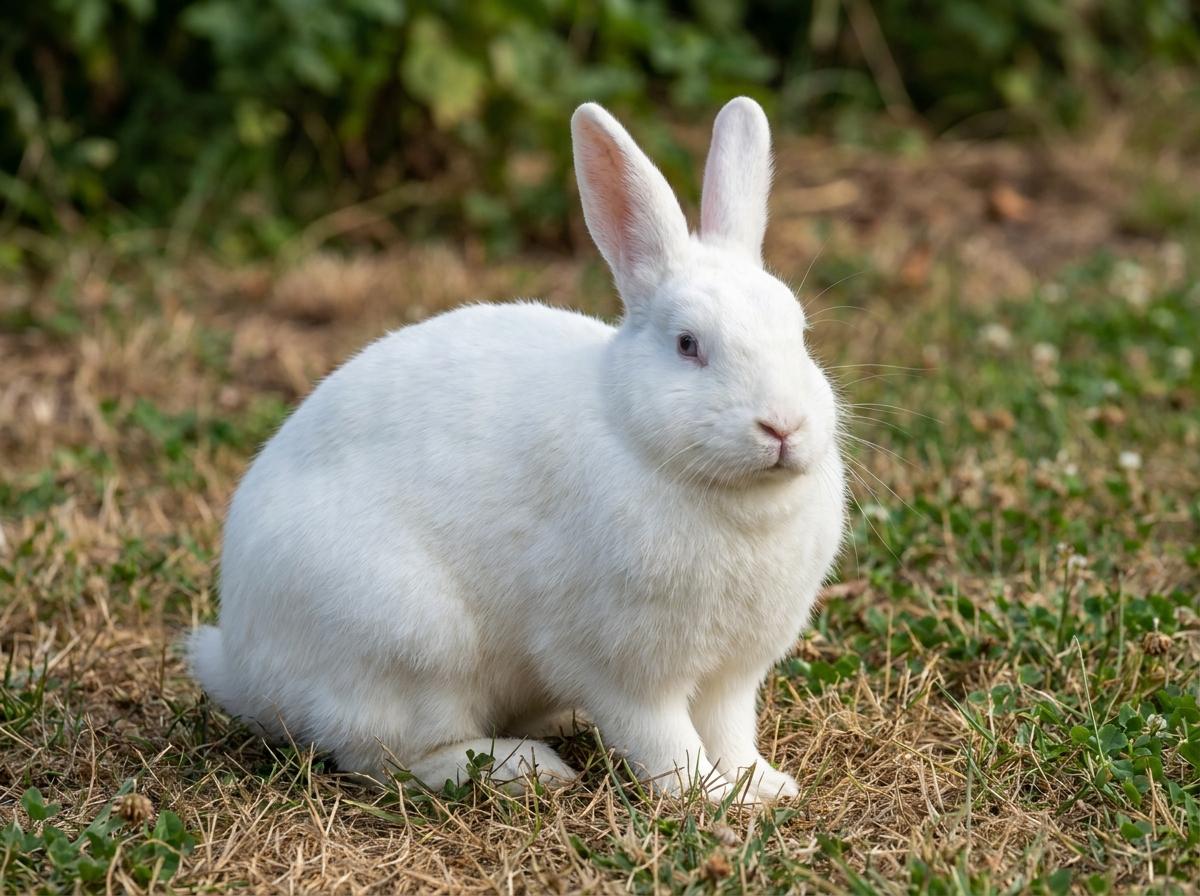
The characteristic semi-arch is often called a mandolin shape. The back rises from the shoulder area toward rounded hindquarters, producing a longer outline than a compact rabbit. Blue Americans have a deep blue coat; White Americans have white fur and pink eyes. The Conservancy describes both the shape and the varieties.
The rabbit colors guide explains why coat-color names and breed identity need separate evidence. A blue rabbit is not automatically an American. Compare the whole animal, its lineage and the breed named on its records. A white coat is even less distinctive by itself. Ask for adult side-view photographs and the parents’ documented identities if breed authenticity matters to your purchase.
Within the wider rabbit breed collection, the compact, marked Dutch and plush-coated Rex make useful comparisons. The American’s long body and normal coat should guide both identification and practical housing choices.
For a show prospect, ask the breeder to explain type, color quality and any known faults under the current standard. A conservation label does not make every individual suitable for breeding or showing.
What Watch status means for a keeper
The category is a reason to pay attention to sound breeding populations and accurate records, not an instruction that every owner should produce litters. A good companion home is still a valid home. If conservation breeding is your purpose, discuss the line’s ancestry, relatedness, health and placement plan with experienced breeders and the relevant breed organization before buying a pair.
Ask what information supports claims such as unrelated, rare line or preservation stock. A pedigree can show recorded relationships, but missing names do not prove that animals are unrelated. Retain the original documents and describe gaps instead of filling them with guesses.
The rabbit pedigree import checklist is useful when transferring names and parents into a new record. A chart maker can make that information easier to read; it cannot validate an old pedigree on its own.
Room for a large rabbit and its companion

Choose housing for the mature animals, not the size of the kit on collection day. Provide generous secure exercise space, dry comfortable resting surfaces, hides and foraging opportunities. The RSPCA’s housing guidance recommends a compatible rabbit companion, with room for the pair to be together and apart. Large rabbits need a setup that accommodates their full movement, not simply a larger food bowl.
Use solid non-slip flooring and keep litter clean. Singapore’s Animal and Veterinary Service calls for solid flooring, safe bedding, protection of electrical wires and enrichment for chewing and foraging. Although some historical utility-breed descriptions discuss wire-bottom hutches, that is not the housing model used here.
An indoor room or roomy pen can be practical if it is properly rabbit-proofed. Outdoor housing must also protect against predators, weather and overheating. The rabbit housing guide helps compare the whole environment rather than choosing on the hutch alone.
When introducing a companion, plan a gradual bonding process. Two rabbits of a rare breed are not automatically compatible, and an intact pair can create an unplanned breeding problem.
Feeding, grooming and health

A large frame does not call for unlimited concentrated feed. Healthy adult rabbits need a hay-centered diet, suitable greens, a measured amount of plain pellets and clean water. Adjust feeding for body condition and life stage with veterinary advice. The RSPCA diet guidance explains the importance of high-fiber forage; our rabbit diet guide supplies a practical daily checklist.
Check the coat and skin gently during grooming, especially when loose hair increases. Check nails, feet, chin and hindquarters rather than judging health from a glossy coat. The RSPCA’s health advice covers dental care, daily checks and preventive veterinary care. Ask your veterinarian about appropriate local vaccination and parasite prevention.
Reduced appetite, very few droppings, abnormal breathing, a painful posture or difficulty moving should not wait for a routine appointment. Seek prompt veterinary guidance. A record of what changed and when is useful, but recording a problem is not treatment.
Support a large rabbit’s whole body and hindquarters when lifting is necessary. The Merck Veterinary Manual describes spinal injury associated with struggling during restraint. Floor-level interaction is often easier for everyone than repeated carrying.
Responsible breeding and useful records
If breeding is planned, decide first why the pairing is worthwhile and where every rabbit could live. Conservation interest does not remove the need for soundness, reproductive welfare, appropriate facilities and veterinary support. Discuss any previous kindling problems or poor outcomes before repeating a pairing.
Keep parent identities, source documents, breeding dates, litter outcomes, weights and health events together. The rabbit gestation calculator is a planning aid from an entered date, not a pregnancy test or guaranteed kindling date. Record actual outcomes afterward.
The rabbit color calculator can explore color inheritance from the assumptions you provide. A Blue or White label does not reveal every hidden allele, prove that two rabbits are unrelated or certify breed purity. Unknowns should remain visible in both the calculator inputs and the breeding record.
Cost and finding the right animal
No single national price reliably describes American rabbits. Region, availability, age, documentation and the seller’s terms all matter. Obtain a dated quote and compare the complete arrangement, including transport, health information and ongoing support. Do not treat a conservation category as evidence that a particular asking price is fair.
Budget for large-rabbit housing, hay, litter, a compatible companion and rabbit-experienced veterinary care. The rabbit cost guide separates acquisition from the longer-term costs. A low purchase price does not make the lifetime commitment small.
Ask these questions before paying:
- Is this documented American stock or a rabbit identified mainly by color?
- Can I see the parents’ identities and adult type?
- What does the seller know about relationships within the line?
- What health problems, foot issues or breeding difficulties have occurred?
- What food and housing is the rabbit used to?
- What documents, identification and support transfer with it?
- What is the plan if the placement does not work?
The where-to-buy-a-rabbit guide helps compare rescue and breeder routes. Search results and directory profiles do not establish that a suitable American is in stock. If you are waiting, use a listing alert and keep checking the details of any match.
After choosing the animal, the rabbit name generator can help with an everyday name. Preserve any existing identification on its records.
Frequently asked questions
Is the American rabbit a breed or a species?
It is a domestic rabbit breed. A rabbit living in America is not necessarily an American rabbit.
Is the American rabbit still Critical?
The Livestock Conservancy page checked for this guide lists Watch. Older summaries use different categories, so check the current list when making a conservation-status claim.
What colors are recognized?
ARBA lists Blue and White. The Conservancy describes pink eyes in White Americans. Color alone does not establish breed ancestry.
Are American rabbits good pets?
They can be companions when the individual and home are well matched. The Conservancy describes a docile temperament, but meet the rabbit and assess its actual behavior rather than treating a breed description as a guarantee.
Should a pet owner breed one to help conserve the breed?
Only with a responsible plan, suitable facilities, support and homes for offspring. Keeping a companion well does not require breeding it.
Do this next on Creatures
Start with your animal. Start an animal profile, no account needed to start. See adding an animal to Creatures for the steps.
Keep the evidence. Add a care or health record. The sheet opens for visitors; a free account saves it. Read adding a record and retain the original documents beside your observations.
Wait for a suitable match. Set an American rabbit listing alert for future matching listings. No account needed to start. An alert does not establish that an animal is available now. The guide to saved searches and the watchlist explains the workflow.
Check current listings. Browse American rabbit marketplace results and verify the individual, records and sale terms with the seller.
Research people and organizations. Use the breeder directory as a starting point. A profile is not a health certification, endorsement or guarantee of current stock.
Represent your organization. If you run a breeding operation, start an organization profile. No account needed to start. Review creating an organization; starting a profile does not verify breeding claims.