Appaloosa
Author: Elliott Garber, DVM · Published
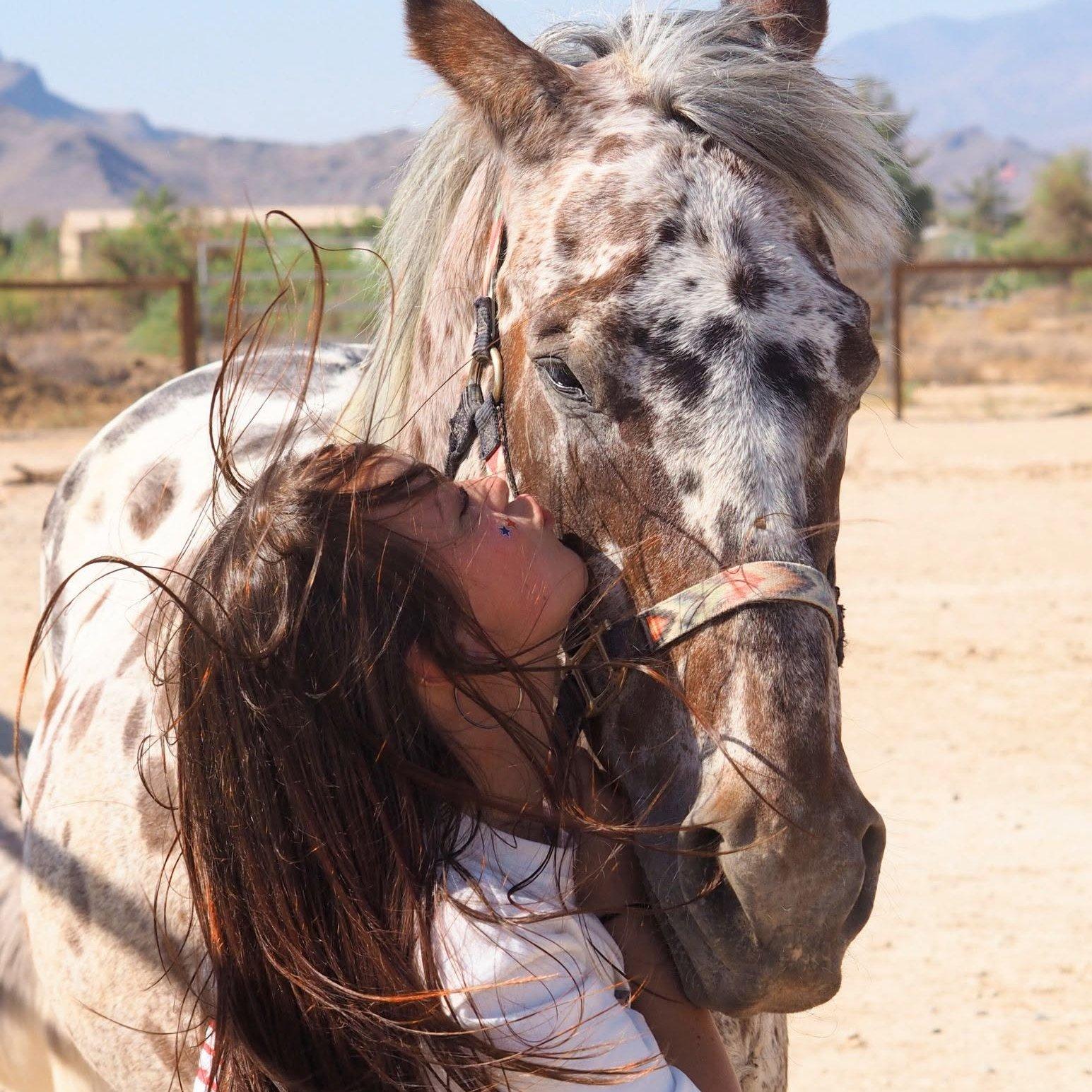
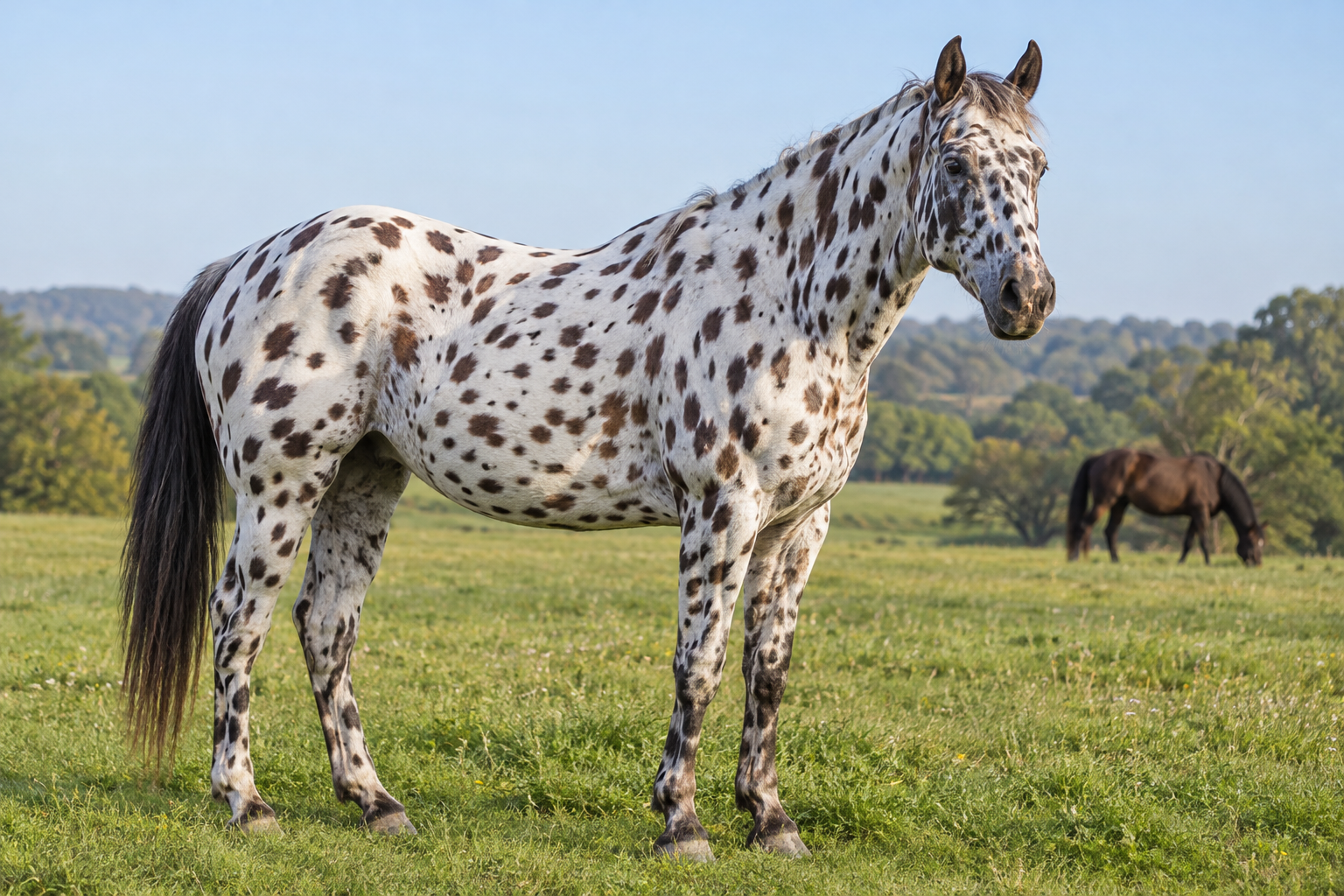
The Appaloosa is a horse breed with varied coats, from bold leopard spots and white blankets to little visible pattern. Leopard Complex (LP) and modifiers such as PATN1 help explain its appearance, but a coat photograph cannot establish breed registration or an eye-health diagnosis. The horse coat color calculator lets you explore supported inheritance from the parents’ actual test results.
| Identity | Horse breed, not every leopard-spotted horse |
|---|---|
| US registry | Appaloosa Horse Club (ApHC) |
| Spotting complex | LP, with modifiers including PATN1 |
| Pattern variety | Leopard, blanket, fewspot or minimal pattern |
| CSNB | Two LP copies are associated with night blindness |
| ERU | Risk associations do not diagnose an individual horse |
Browse listings, public profiles, breeders, or add your animal.
A breed with history, not simply a spotted coat
The Appaloosa’s American history is closely linked to the Nez Perce people and the Palouse region. The Appaloosa Horse Club was established in 1938 to preserve and develop the breed. The club’s history page describes that background and its modern range of western and English activities.
That history belongs to the breed. Leopard-complex spotting also occurs in other breeds, so a spotted coat alone does not make an undocumented horse a registered Appaloosa. Conversely, a registered Appaloosa may be solid or minimally patterned. Verify the certificate, horse identity and transfer requirements through the Appaloosa Horse Club registration service.
For the wider distinctions among base colors, dilution and white pattern, use the horse color overview. The Paint Horse guide covers a separate breed and registration system.
Recognizing patterns and characteristics
The ApHC handbook is the place to check current breed and registration rules. The UC Davis Leopard Complex description lists mottled skin, visible white sclera and striped hoof walls among the associated characteristics. An individual horse need not show every characteristic, and none of these observations substitutes for its paperwork or DNA test.
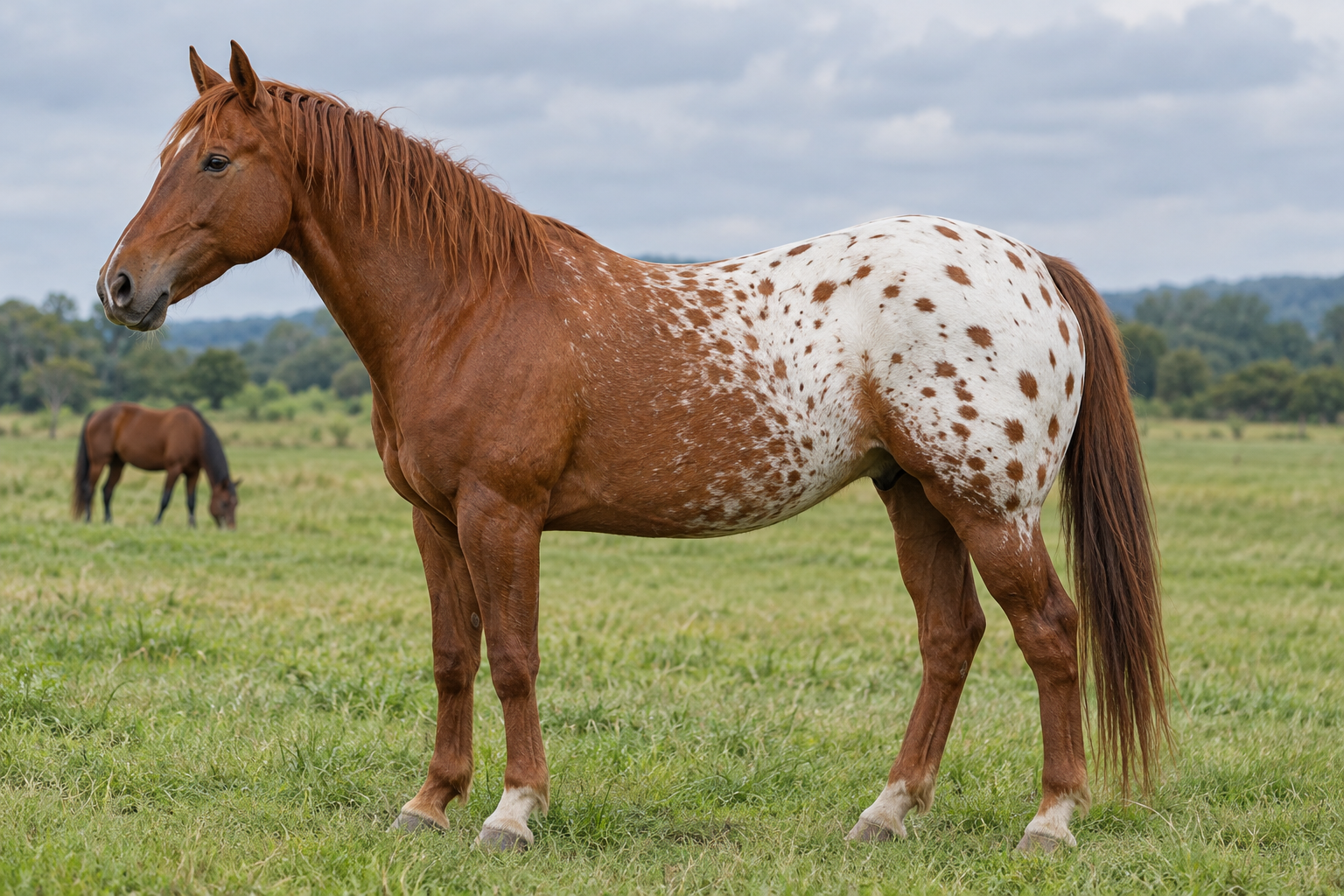
- Leopard: A large white patterned area with pigmented spots.
- Blanket: White over the hindquarters, with or without spots.
- Fewspot: Extensive white with few pigmented spots.
- Varnish roaning: Progressive interspersing of white hair associated with LP.
- Mottled skin: Mixed pigmented and unpigmented skin, often evident at the muzzle.
Record what you can actually see and date the photograph. Appaloosa pattern can change with age, so a foal photograph and an adult photograph may look different. Do not use a change in the white-hair pattern alone to diagnose gray or classic roan; those are separate genetic questions.
LP and PATN1 do different jobs
LP is associated with leopard-complex spotting. The primary TRPM1 study identified an insertion associated with the spotting complex and congenital stationary night blindness. One and two LP copies can produce different appearances. DNA is the appropriate way to determine the tested copy count.
PATN1 modifies how much white appears in a horse that also has LP. The primary PATN1 research identified a strongly associated variant in RFWD3. It supports PATN1 as a major modifier, not a complete map of every spot. The UC Davis PATN1 test page explains why PATN1 needs LP for its characteristic effect.
A PATN1 result does not turn an LP-negative horse into a leopard-patterned horse. Nor does the absence of PATN1 guarantee that an LP-positive horse will have no white pattern. Other modifiers and variation remain. Keep the two results separate, and do not convert a percentage of white in a picture into a lab call.
Eye health: distinguish night blindness from uveitis
Congenital stationary night blindness (CSNB) affects vision in low light. Horses with two LP copies are affected by the LP-associated form. This connection is supported by the TRPM1 research, rather than by a general claim that spotted horses see poorly. The UC Davis LP guidance explains the test results and health context.
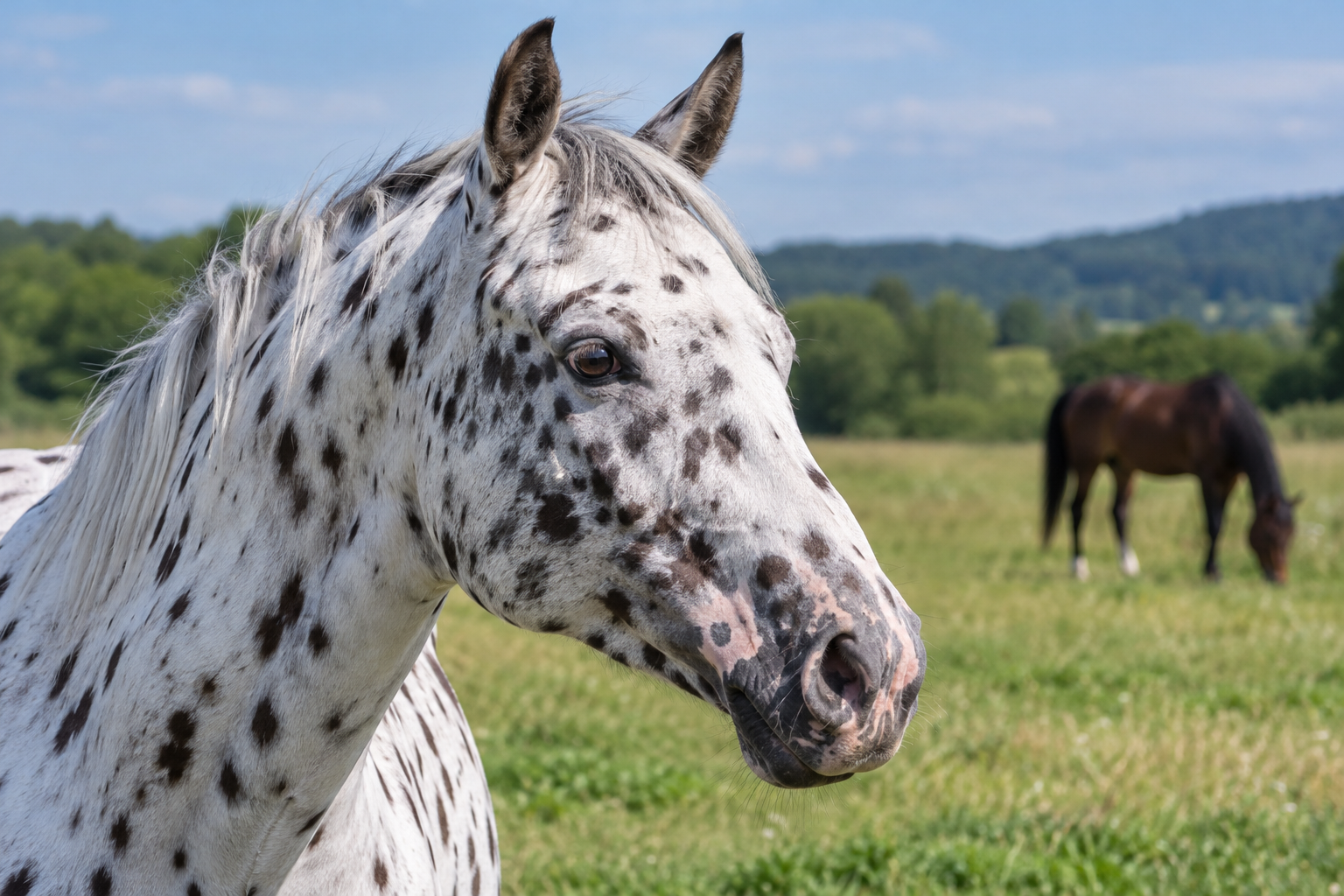
An LP/LP result is a reason to discuss low-light management with your veterinarian and caregivers. Tell a new boarding barn or trainer about the result. If a horse hesitates or behaves differently at dusk, do not assume disobedience or try to diagnose it from that behavior alone. Have its vision assessed.
Equine recurrent uveitis (ERU) is a different disease involving inflammation inside the eye. Research in Appaloosas found an association with LP and suggested a role for PATN1 and other depigmentation factors; the authors said their functional roles required more investigation. A separate western Canadian study also found greater ERU risk in LP/LP horses in its study population. These are associations, not a promise that every LP/LP horse develops ERU or that an LP-negative horse cannot have eye disease.
Make eye history part of a purchase examination and ongoing veterinary care. An eye that is painful, squinting, tearing or cloudy needs prompt veterinary attention. UC Davis’s clinical ERU guide explains that insidious disease may lack obvious painful episodes. A comfortable-looking eye is not a substitute for an examination. Ask your veterinarian how to monitor the individual horse; do not begin treatment from a coat-color guide.
What registration proves
ApHC has Regular and Non-Characteristic classifications. Its registration quick facts explain the ordinary pedigreed route: at least one Regular ApHC parent, with the other parent registered through ApHC or a named approved association, subject to restrictions. The classification also depends on the association’s pattern and characteristic rules.
Ask the club about unusual cases, advancement and any special registration programs. Do not assume that buying an LP test buys registration, or that breed papers report the full color genotype. When examining paperwork, compare identifying markings, registered name and numbers against the horse in front of you. The horse pedigree papers guide gives a document review sequence.
Choosing and caring for an Appaloosa
Start with the rider’s intended use and the horse’s actual training. Request recent unedited riding video, watch the horse handled and arrange a suitable pre-purchase veterinary examination. Include the eye history and any LP report in that conversation. A familiar coat pattern is no guarantee of a familiar temperament.
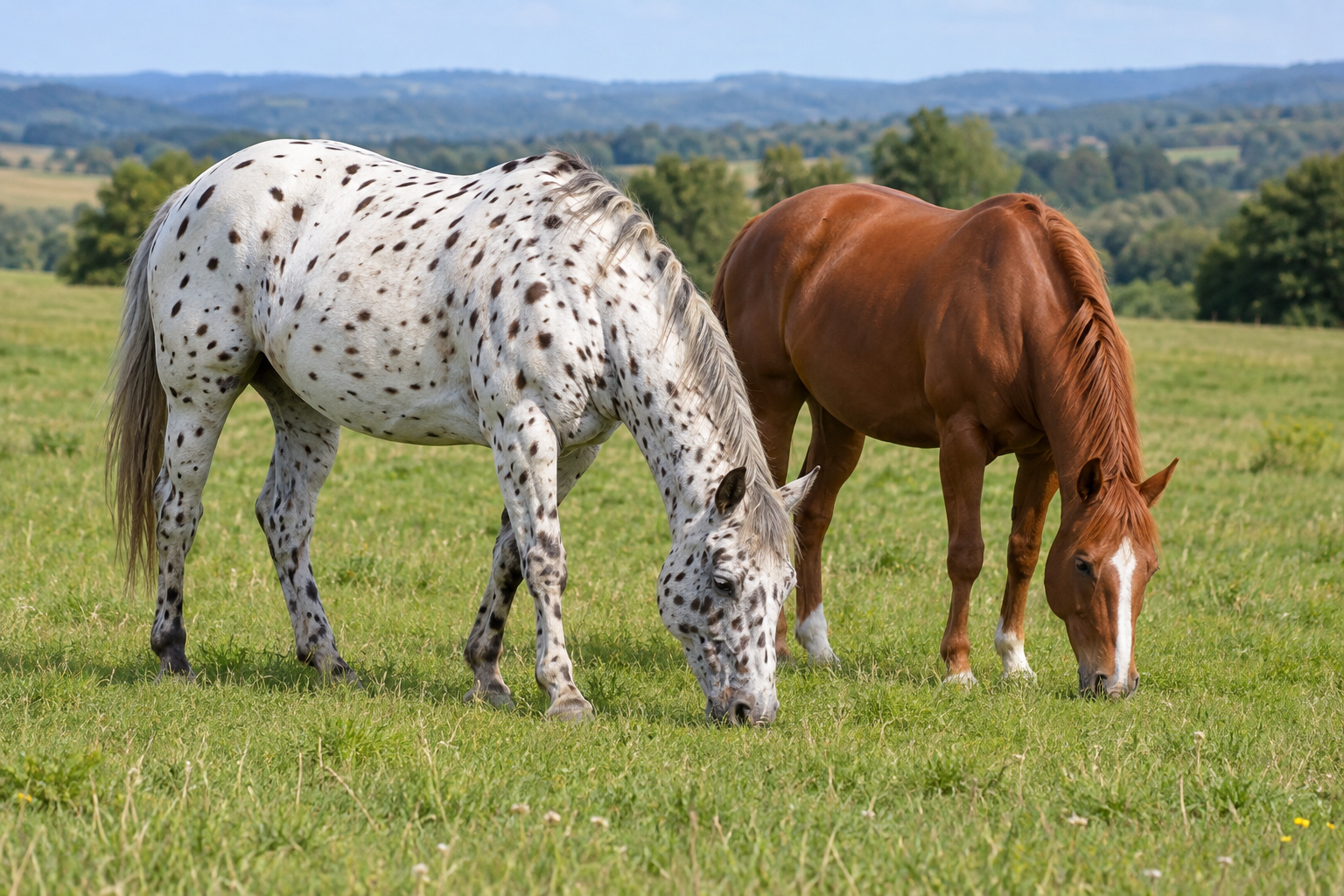
Avoid a universal height, price or personality promise. Breeding lines, training and individual history matter more to a purchase decision than the number of spots. Compare like-for-like horses and confirm what is included in the sale, including transfer paperwork and original test reports. The where to buy a horse guide helps organize the process.
Plan daily care around the actual horse: appropriate feed, water, safe turnout, companionship, hoof care and veterinary care. Ask the veterinarian to incorporate any vision limitation into the management plan. If a caregiver changes, send the medical instructions and relevant records, rather than relying on a description such as “a fewspot with sensitive eyes.”
Explore an LP pairing on Creatures
The LP/N by LP/N example keeps inheritance and health separate. For those specific panels, each conception has a 25% chance of LP/LP, 50% N/LP and 25% N/N. Those are LP genotype outcomes. They are not exact probabilities for a leopard, blanket or a particular placement of spots.
Enter the parents’ full supported results in the calculator. Keep unknowns unknown. The tool can show separate scenarios when the information does not justify one exact answer. Its methods page explains linked loci and the limits on pattern extent.
Use the horse pedigree chart maker to lay out ancestry you enter, then retain the original records behind it. A chart does not verify parentage. The horse color DNA records guide explains how to preserve reports separately from observations and predictions.
Appaloosa questions
Does every Appaloosa have spots?
No. The breed includes horses with little visible pattern and Non-Characteristic registration. A coat label alone does not tell you the horse’s registration class.
Does PATN1 mean the horse has night blindness?
No. The LP-associated CSNB result concerns two LP copies. PATN1 is a pattern modifier. Read both laboratory results and discuss eye health with your veterinarian.
Can a coat-color calculator tell me where a foal’s spots will be?
No. It can model supported inheritance under the inputs provided. It does not predict an individual patch or spot map, diagnose ERU or issue registration papers.
Do this next on Creatures
Keep the evidence with the individual horse, then use it when comparing a pairing or speaking with a seller. Browse the horse guides for related ownership topics.
- Start your horse’s profile. No account is needed to start. The adding an animal guide explains the flow.
- Add a record with the original report or observation. It opens for visitors; a free account is required to save. Read adding a record and health and medical records.
- Save a listing alert for your search. This starts an email signup flow; it does not promise matching horses are available now. See saved searches and the watchlist.
- Browse the filtered marketplace and ask for the records relevant to the actual horse.
- Use the breeder directory to explore profiles and ask your own questions about practices, documentation and suitability.
- Start a breeder or farm profile. No account is needed to start; the organization guide explains profile and team setup.