

Snowshoe
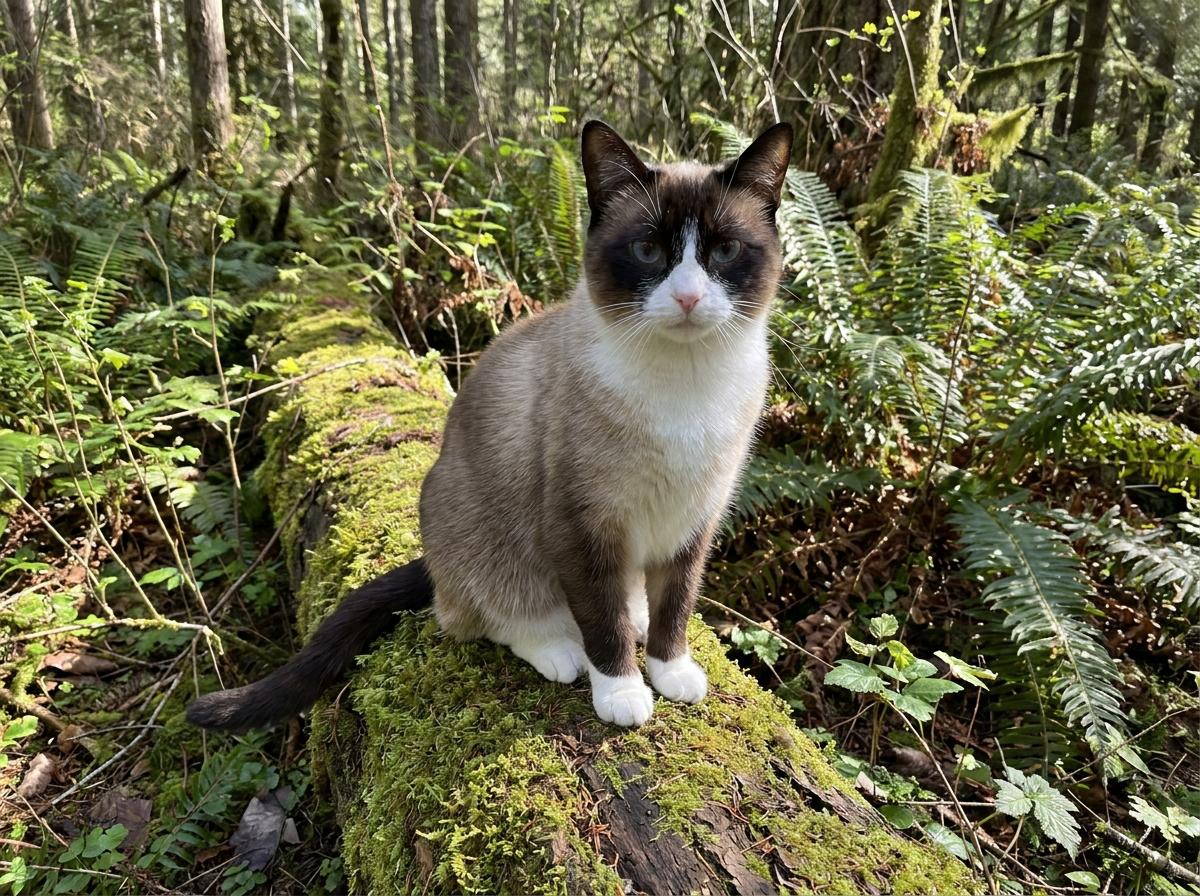
A Snowshoe is a shorthaired, blue-eyed pointed cat with white feet, a breed that began with three white-footed kittens in a Siamese litter in Philadelphia in the 1960s. Its look is a Siamese-style colorpoint coat (darker ears, mask, legs, and tail on a paler body) overlaid with a white spotting pattern: white mittens on the paws and, on the best-marked cats, a white inverted V running down the nose. It is recognized by TICA, ACFA, FIFe, and the UK’s GCCF, but not by the Cat Fanciers’ Association, and it is genuinely rare, partly because the ideal markings are so hard to breed.
This guide covers where the breed came from, what each registry actually recognizes, why a perfectly marked Snowshoe is the exception rather than the rule, what living with one is like, and how to buy one without paying Snowshoe money for a Siamese mix. If you are still comparing breeds, the Creatures cat species page is the place to start, and because Snowshoe kittens are scarce, you can set a free Snowshoe listing alert while you read, so you hear when one is posted.

| Origin | Philadelphia, Pennsylvania, 1960s; developed from Siamese and bicolor American Shorthair cats |
|---|---|
| Recognized by | TICA, ACFA, CFF, FIFe (since 2004), and GCCF (championship since 2013); not a CFA breed |
| Coat | Short to medium-short, smooth and glossy, with no noticeable undercoat |
| Pattern | Pointed with white: four white paws, and ideally a white inverted V on the face |
| Eyes | Blue in every color and pattern |
| Size | Medium; GCCF gives about 9 to 12 lb for males and 7 to 10 lb for females |
| Temperament | Registries describe an affectionate, people-oriented, intelligent cat, often a soft-voiced talker |
| Rarity | Rare; 36 Snowshoe kittens were registered with FIFe in 2024, out of more than 96,000 |
Browse listings, public profiles, breeders, or add your animal.
What is a Snowshoe cat?
The Snowshoe is a moderate, athletic, shorthaired breed built on two things at once: the pointed coloring of the Siamese and a white spotting pattern that puts white on the feet and, ideally, the face. The UK’s Governing Council of the Cat Fancy (GCCF) sums up the body in its Snowshoe breed profile as combining the heftiness of its shorthair ancestors with the length of its oriental ones, with the build of a runner rather than a weightlifter.
Three things are easy to get wrong about it:
- It is not simply a Siamese with white feet. Registry standards call for a moderate head and body (ACFA says the type was modeled on the old-style Siamese often called the “applehead,” not today’s svelte show Siamese) plus a specific white pattern that the Snowshoe standards require.
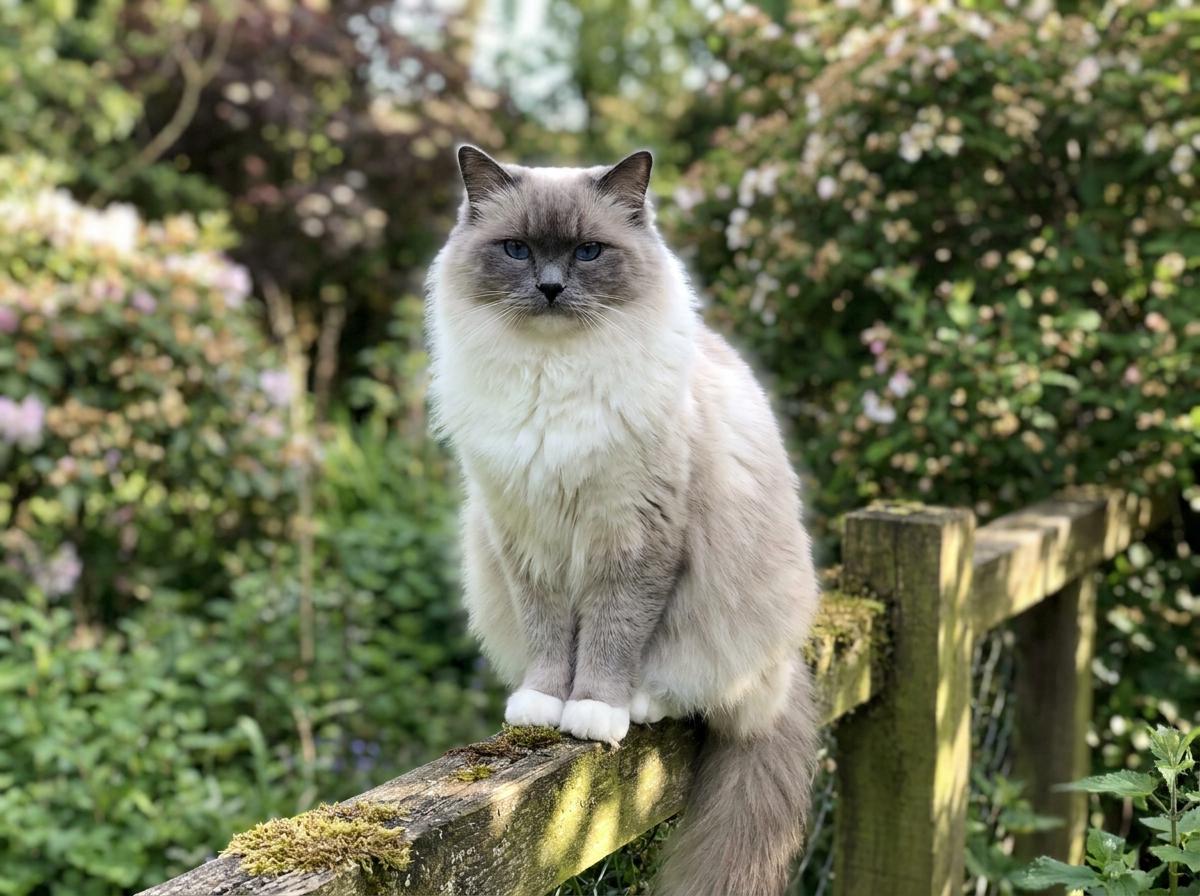
- It is not a shorthaired Birman or Ragdoll. Both of those are also pointed, blue-eyed cats with white on the feet, but they are longer-coated breeds with their own histories. GCCF says plainly that the Snowshoe is not to be confused with either and is not related to them (with one historical footnote about British lines, covered below).
- “Snowshoe” is also used loosely. Many pointed cats with white feet that turn up in shelters, homes, and online ads are called “snowshoe” as a description of their look. That is fine as a nickname, but it is not the same as a registered Snowshoe from a breeding program, which matters a great deal when money changes hands.
If you are comparing the Snowshoe with its relatives, the Siamese, the older-style Thai cat, and the American Shorthair are the breeds that went into it, and the Birman and Ragdoll are the look-alikes most often confused with it.
The Highlander is another distinctive-looking cat for which registration and parentage matter more than an impression from a photo.
Origin: a Philadelphia Siamese litter
The breed’s origin story is consistent across the registries that tell it. The American Cat Fanciers Association’s Snowshoe page says that in the 1960s Dorothy Hinds-Daugherty, a Siamese breeder in Philadelphia, set out to develop a moderate, white-footed Siamese-type cat, which she named the Snowshoe. The GCCF breeding policy for the Snowshoe adds the detail that started it: three kittens with white feet in one of her Siamese litters. The FIFe breed profile gives the same account and says she worked with seal point Siamese and bicolor American Shorthairs, then bred the offspring back to Siamese to get the pointed look with white feet.
The GCCF policy notes that repeating the original mating did not reproduce the white feet, which is why she turned to the bicolor American Shorthair. ACFA’s history also mentions an earlier, short-lived 1950s attempt at a white-footed Siamese type under the name “Silver Laces,” a name that still turns up in breed histories.
The breed nearly disappeared more than once:
- 1960s and 1970s. Hinds-Daugherty promoted her cats at local shows and wrote a basic standard, and the Cat Fanciers’ Federation (CFF) accepted them for exhibition. When she left the fancy, Vikki Olander of Norfolk, Virginia, took the breed on, wrote a more polished standard, and won experimental registration with CFF and the American Cat Association.
- 1977. According to ACFA, only four Snowshoes had been registered by then, and Olander was the only breeder left.
- Revival. Jim Hoffman of Defiance, Ohio, and Georgia Kuhnell of Cincinnati contacted CFF about the breed independently, were put in touch with Olander, and more breeders followed. CFF recognized the Snowshoe for championship by 1982.
- 1990. ACFA advanced the breed to championship, and Snowshoes were first shown for championship honors there in May 1990.
Snowshoes in Britain and Europe
The European story ran separately. GCCF’s breeding policy says British judge Pat Turner met the breed at a New York show in the early 1980s and started a UK breeding group, and that interest rose and fell until, by 1998, a single UK breeder was left. To widen a tiny gene pool, the British breeders used bicolor Ragdolls as an outcross, a practice GCCF ended on 30 October 2013. Imported American lines followed from 2002. FIFe granted full recognition with championship showing from 1 January 2004, and GCCF moved the breed through preliminary recognition (2004) and provisional status (February 2013) to championship status on 24 October 2013.
Registry recognition: who accepts the Snowshoe
Recognition is one of the most searched and most misreported Snowshoe facts. Here is what each registry’s own material shows, checked on 30 September 2026:
- TICA (The International Cat Association). TICA has a Snowshoe breed page and a published Snowshoe standard that places the breed in its Pointed category, recognizes mitted and bicolor patterns, and lists the American Shorthair and Siamese as permissible outcrosses. Breed histories date TICA recognition to the early 1990s; we could not open a TICA page that states the year, so we leave it there.
- ACFA (American Cat Fanciers Association). Championship breed since 1990. ACFA’s standard allows only seal and blue points, on the reasoning that lighter colors hide marking flaws until a cat is old enough to breed.
- CFF (Cat Fanciers’ Federation). The breed’s first registry, with championship status from 1982.
- FIFe (Fédération Internationale Féline). Recognized in 2004; the FIFe Snowshoe standard is the main reference in much of Europe.
- GCCF (UK). Championship breed since October 2013, in the Foreign section, with its own Snowshoe standard of points.
- CFA (Cat Fanciers’ Association). The Snowshoe does not appear on CFA’s list of breeds. If a seller tells you a kitten is “CFA registered” as a Snowshoe, ask to see the paperwork, because CFA does not register the breed.
Standards differ in the details. TICA’s describes a mitted pattern (typically about a quarter white) and a bicolor pattern (typically a quarter to a half white, with a white facial pattern required and less white preferred). GCCF shows only its “classic” pattern, four white paws and no more than a third white overall, while cats with no white, too much white, or a bicolor pattern can be registered and used for breeding but not shown. Whichever registry you deal with, the paperwork should name it.
What a Snowshoe looks like

The registry standards agree on the essentials, even where the wording differs. From the FIFe, GCCF, and TICA standards:
- Head. A broad modified wedge with gently rounded contours, about as wide as it is long, with high cheekbones. In profile there is a slight change of angle at the nose bridge, so the forehead and nose form two distinct planes.
- Ears. Medium to medium-large, broad at the base, with slightly rounded tips, continuing the line of the wedge.
- Eyes. Walnut or oval shaped, slanted toward the base of the ears, and always blue. GCCF asks for “the deeper the blue the better” and treats any eye color other than blue as a reason to withhold awards.
- Body. Medium, long, firm, and muscular without bulk. TICA’s standard notes “surprising heft” when the cat is lifted. Extremes in either direction, a cobby body or a dainty Oriental one, are faults.
- Coat. Short to medium-short, smooth, glossy, and close-lying, with no noticeable undercoat. A plush, woolly, or double coat is penalized, and GCCF does not allow longhaired Snowshoes to be used for breeding.
- Color. Any of the pointed colors in TICA and FIFe, including seal, blue, chocolate, lilac, and more, with tabby and tortie point versions in FIFe and GCCF. ACFA shows only seal and blue.
On size, GCCF’s breed profile gives roughly 9 to 12 pounds for males and 7 to 10 pounds for females, with some females as large as males. Those are typical figures, not limits written into a standard.
The pattern names you will see
- Mitted. White limited mostly to the paws, with white on the chest and chin allowed. No white facial marking, or only a little.
- Classic or bicolor with the inverted V. The show ideal: a symmetrical white inverted V starting on the bridge of the nose and covering the nose, whisker pads, and chin, with front mittens and back boots evenly matched. GCCF’s standard sets the front white ideally at the angle between paw and leg and the back white to just below the hock.
- Too much white or no white. High-white (sometimes van-like) and fully pointed cats with no white are born in Snowshoe litters too. GCCF, for example, lets them be registered and used for breeding but not shown, because they are not what the standard rewards.
Why a perfectly marked Snowshoe is so hard to breed

The Snowshoe’s difficulty is genetic, and it comes from combining two unrelated traits that each behave differently.
The points and the blue eyes: a temperature-sensitive enzyme
The pointed pattern comes from a variant of the tyrosinase (TYR) gene. UC Davis’s Veterinary Genetics Laboratory explains on its colorpoint restriction page that the Siamese variant makes pigment production temperature-sensitive: pigment is reduced over the warmer parts of the body, so color concentrates on the cooler extremities (ears, face, legs, and tail), and the eyes are blue. The Siamese allele is recessive to full color, so a cat must inherit it from both parents to be pointed. That part is easy to fix in a breed: two pointed parents produce pointed kittens.
It also explains two things owners notice. Snowshoe kittens are born almost entirely white, with the points appearing over the first weeks, according to GCCF. And the body color darkens with age; TICA’s standard says full color, points, and white area development can take up to two years, especially in dilute colors.
The white feet and face: a dominant, variable spotting gene
The white comes from a different gene entirely. According to UC Davis, white spotting in cats is caused by an insertion of a feline endogenous retrovirus in the KIT gene, a finding published by David and colleagues in 2014, and the lab’s white spotting test page (which lists the Snowshoe among breeds for testing) says white spotting is inherited as a dominant trait. The crucial line for Snowshoe breeders is what the same page says next: the pattern of white spotting does not correlate with having one or two copies, and “the gene/genes controlling the pattern of white spotting remain unknown.”
In other words, a breeder can control whether a kitten is pointed, and whether it carries white spotting, but not exactly where the white lands. GCCF’s breeding policy describes the practical result. Cats with one copy of the spotting gene can be mitted or classic, depending on how much white that line tends to produce. Two copies usually mean more white than the standard wants. Pushing for a white face also tends to push more white onto the legs and body. By GCCF’s reckoning, even two perfectly marked classic cats would be expected to produce only about half their kittens with the classic pattern, with the rest pointed without white or carrying too much white.
A patterned coat alone is not a pedigree; the Sokoke guide explains what to check for this rare breed.
ACFA’s breed page says much the same from a breeder’s side: the preferred pattern does not breed true, and its writer reports that litters still include roughly a quarter solid-pointed kittens with no white and a quarter with far too much white. Treat those fractions as one breeder’s experience rather than a measured statistic, but the point stands. Every litter is a lottery on markings, which is a big part of why the breed stays rare and why pet-quality Snowshoes (a crooked V, one high sock, a spot of color on a white toe) are common and perfectly good pets.
For a different recognized distribution of white and color, the Turkish Van guide explains the van pattern while keeping coat appearance separate from proof of breed ancestry.
Type complicates it further
Markings are only half the job. Breeders also have to hold the moderate head, ear set, and body between the American Shorthair and the Siamese. GCCF’s standard is explicit that type comes first: a cat of good type and poor pattern should place above a cat of poor type and perfect pattern. Its breeding policy also says health must be the overriding consideration in any Snowshoe breeding program.
Temperament

Registries describe the Snowshoe consistently, though every description is a generalization. FIFe calls the breed affectionate, sweet-tempered, and mellow, fond of people and attention, and compatible with children and other pets. GCCF describes an inquisitive, active, intelligent cat that is usually a “talker” with a soft, melodic voice, often forms a primary bond with one person, and loves interactive play, with many learning to fetch. TICA’s own summary adds a useful caution: like snowflakes, no two have the same personality, and some are shy, some bossy, and others caregivers. ACFA notes that Snowshoes can be hesitant with strangers.
What that adds up to in practice:
- An involved cat, not an ornamental one. Plan on daily interactive play. Wand toys, puzzle feeders, and climbing space suit the breed’s energy.
- Company matters. GCCF says most fit well into multi-cat homes, though some prefer to be the only cat. If you are out all day, a well-matched second cat may suit a Snowshoe better than long hours alone.
- Individuals vary. A shy Snowshoe is not a defective one. Meet the kitten, and ideally its mother, before you commit, and ask the breeder how each kitten behaves.
If interactive play is central to your choice, compare the Japanese Bobtail guide and ask each keeper how the individual cat spends an ordinary day.
Everyday care
The Snowshoe is an easy keeper on grooming. Its short single coat needs only occasional brushing, and TICA suggests weekly brushing keeps it in order. The coat can change with the seasons, and GCCF’s breeding policy notes that cats with outdoor access may darken further in winter.
Beyond that, a Snowshoe needs what any cat needs: a complete diet fed to keep it lean, fresh water, clean litter trays, scratching posts, climbing space, vaccinations (our kitten vaccination schedule explains the first-year course) and parasite control on your veterinarian’s schedule, and neutering unless it is part of a registered breeding program. Because the breed is people-focused, enrichment and attention are part of its care, not extras.
Health
There is no large health study of the Snowshoe, and no reliable breed-specific lifespan figure. Even GCCF’s own breed page quotes two different ranges (9 to 15 years in one place, 14 to 20 in another), so treat any single number with caution and plan for a long-lived cat. What the evidence does show is limited:
- Urate bladder stones. A 2012 study in the Journal of the American Veterinary Medical Association, based on more than 5,000 urate stones submitted to the Minnesota Urolith Center, found the Snowshoe among breeds with significantly higher odds of urate stone submission than mixed-breed cats. The numbers behind that were tiny (3 Snowshoe cases), so the estimate is very imprecise, and the authors note the study cannot show cause and effect. It is still a reason to know the signs of urinary trouble, which the Cornell Feline Health Center lists as difficult or painful urination, going more often, crying out while urinating, blood in the urine, and urinating outside the litter box. Cornell stresses that a cat passing little or no urine may have a urethral obstruction, which is an absolute emergency.
- Inherited conditions from the parent breeds. Because Siamese and shorthair cats went into the breed, GCCF’s breeding policy recommends testing breeding Snowshoes for polycystic kidney disease (PKD) and progressive retinal atrophy (PRA), and breeding only from cats that test normal. The policy says the breed was not affected by these at the time of writing, while GCCF’s breed page says PKD has been reported. Either way, ask a breeder for the parents’ results.
- Blood types. GCCF notes that both type A and type B blood occur in the breed. That matters mainly to breeders, because mating a type B queen to a type A tom can cause neonatal isoerythrolysis, a frequently fatal condition in newborn kittens. It also matters if your cat ever needs a transfusion.
None of this replaces a veterinarian. Register with a vet when your kitten comes home, keep its vaccination and health records together, and take any change in eating, litter habits, or behavior seriously.
Rarity, cost, and buying a Snowshoe honestly
The Snowshoe is rare by any measure. In FIFe’s 2024 breeding statistics, 36 Snowshoe registrations were recorded out of 96,075 across all breeds, against more than 16,000 for the British Shorthair. Its absence from CFA also means fewer North American shows where you can meet breeders in person.
Rarity shapes the buying process:
- Expect few breeders and some waiting. With so few breeders, a well-bred kitten may not be available when you are ready, and breeders commonly keep waiting lists. Getting on one, or setting an alert so you hear about new listings, is a sensible way to shop.
- Price is not a quality signal on its own. There is no reliable national price guide for Snowshoes. Pet-quality kittens usually cost less than show or breeding prospects, and a kitten sold with breeding rights costs more again. The purchase price is also the small part of the budget; our guide to what a cat costs to own covers the rest.
- Watch for Siamese mixes sold as Snowshoes. A pointed cat with white feet is not automatically a Snowshoe. Many are Siamese crosses or household cats that happen to carry both traits. They can be lovely pets, but they should be priced and described as what they are.
What to ask any Snowshoe breeder:
- Which registry are the kittens registered with? TICA, ACFA, CFF, FIFe member clubs, or GCCF. Ask for the parents’ registration details, and remember that CFA does not register Snowshoes.
- Can I see a pedigree? GCCF’s advice to kitten buyers is that a registered kitten should come with a pedigree certificate showing at least three generations, plus registration and vaccination paperwork. You can turn the pedigree into a printable chart with the free cat pedigree chart maker.
- What health testing have the parents had? Ask specifically about PKD and PRA results, and blood type if you plan to breed.
- Can I meet the mother, and see where the kittens are raised? Kittens raised in the home, handled daily, are better prepared for family life.
- When will the kitten come home? GCCF says a breeder must not let a kitten go until at least seven days after its full vaccination course, which in practice means at least 13 weeks old.
- Pet, show, or breeding? A reputable breeder will tell you why a kitten is pet quality (usually markings) and explain their neutering terms in writing.
Before you pay a deposit, read our guide to finding a responsible breeder. It is written for Maine Coon buyers, but the checks on paperwork, health testing, and deposits apply to any pedigree kitten. Our Creatures breeder directory lists trusted catteries, and the Snowshoe breeder listings show who is currently listed.
Is a Snowshoe right for you?
A quick honest check:
- You want an interactive cat. Snowshoes tend to follow their people, talk to them, and expect play.
- You are home enough, or have a second cat. A bored, lonely Snowshoe is not the cat the breed descriptions promise.
- You care more about temperament than perfect markings. Most Snowshoes are not show-marked, and a pet-quality cat with lopsided mitts is the same cat to live with.
- You can wait. With so few breeders, patience is part of buying one.
- You will keep up routine vet care and know the signs of urinary trouble.
If most of that fits, a Snowshoe is a sociable, low-grooming companion with one of the most distinctive looks in the cat world. If you want a quieter, more independent shorthair, a breed like the British Shorthair may suit you better.
Frequently asked questions
Is a Snowshoe cat a real breed?
Yes. It is a recognized breed with published standards from TICA, ACFA, FIFe, and GCCF. It is not recognized by CFA. Many pointed cats with white feet are called “snowshoe” informally, but only a cat from registered Snowshoe lines is a Snowshoe in the breed sense.
Are Snowshoe cats rare?
Yes. FIFe recorded 36 Snowshoe registrations in 2024 out of more than 96,000, and breeders are few in most countries. The difficulty of breeding the preferred markings is one reason the breed has stayed small.
What is the difference between a Snowshoe and a Siamese?
Snowshoe standards require white on all four feet and prefer a white inverted V on the face; the Siamese it was developed from is a pointed breed without that white pattern. The Snowshoe is also a more moderate, heavier-feeling cat than the modern show Siamese, closer in type to the older applehead style.
Is a Snowshoe the same as a Ragdoll or Birman?
No. All three are pointed, blue-eyed cats that can have white feet, but the Ragdoll and Birman are longhaired breeds with separate histories. GCCF notes some British Snowshoe lines used bicolor Ragdolls as an outcross before 2013, but the breeds are distinct.
Why are Snowshoe kittens white?
The pointed color depends on a temperature-sensitive enzyme, and kittens are born warm all over, so they start out nearly white. The points develop over the first weeks, and full color can take up to two years.
Do all Snowshoes have the white V on the face?
No. The white inverted V is the preferred show pattern, but white spotting is hard to control, so many Snowshoes are mitted (white feet with little or no white on the face) or have more or less white than the standard prefers.
Are Snowshoe cats good with children and other pets?
Registry descriptions say they generally are, and GCCF notes most fit into multi-cat homes. Individuals vary, so meet the kitten first and introduce it to children and other animals gradually.
Do this next on Creatures
Whether you are still deciding, waiting on the right kitten, or already sharing your home with a Snowshoe, Creatures keeps the listings, breeders, and records in one place.
Get alerted first. Set a free Snowshoe listing alert and we will email you when a new one is posted, the best way to hear about a kitten from a breed with so few litters. No account needed to start. See saving searches and using your watchlist.
Find a Snowshoe. See the Snowshoe breeders listed in the Creatures directory, browse the wider breeder directory, and check Snowshoe listings on the marketplace, which are often empty for a breed this rare.
Compare breeds. Read about the Siamese behind the Snowshoe’s points and the British Shorthair if you want a calmer shorthair, or browse every breed on the cat species page.
Add your cat. Already have a Snowshoe? Create a free profile for your cat in a few minutes, no account needed to start, and record its registry, pattern, and color. Still choosing a name? Try the free cat name generator. The profile walkthrough is in adding an animal to Creatures.
Keep the records. Add vaccination, weight, health test, and vet records so everything is in one place. The record sheet opens for any visitor, and a free account saves what you enter. See adding a record and health and medical records, and set booster dates as reminders with reminders and upcoming care.
Breed Snowshoes? Create your cattery’s profile, no account needed to start, then get listed in the breeder directory so buyers searching for Snowshoes can find you. Plan litters with the free cat gestation calculator and our guide to how long cats are pregnant.