

Najdi
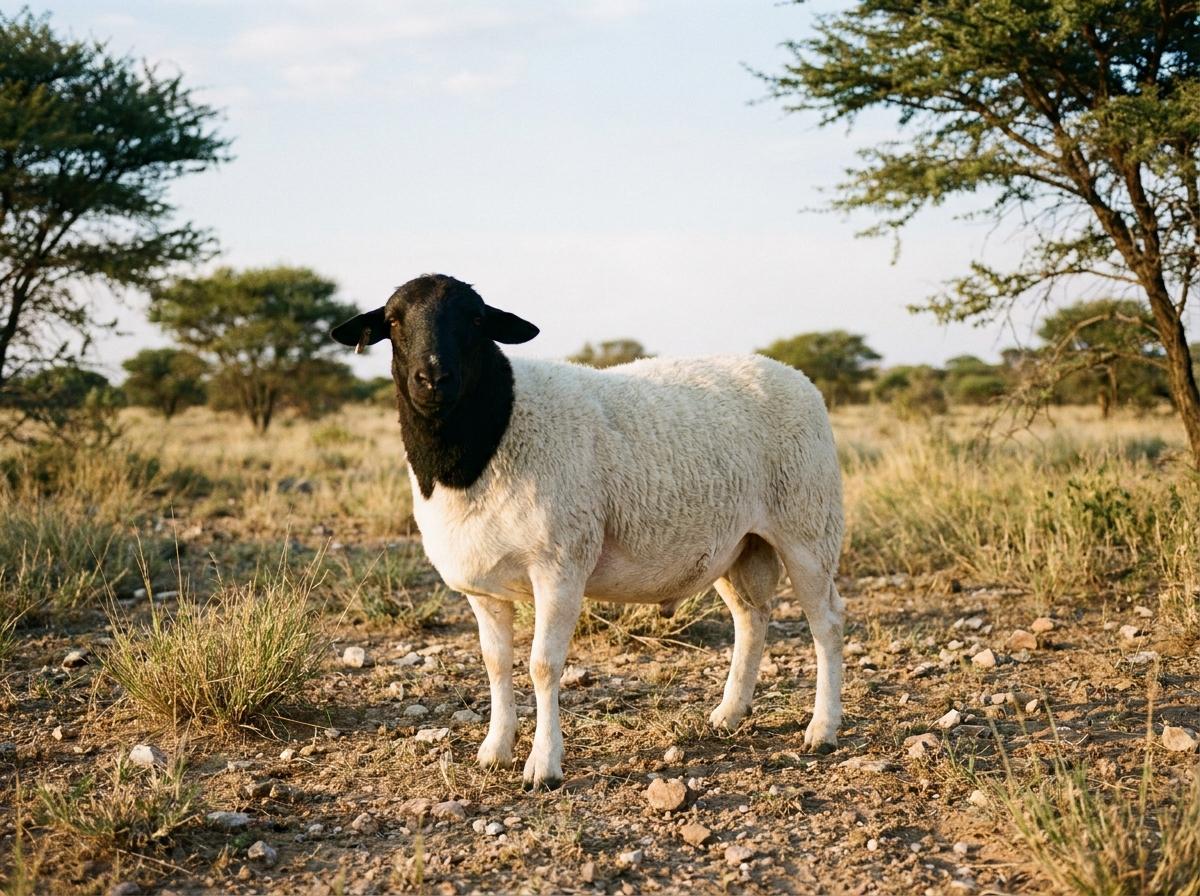
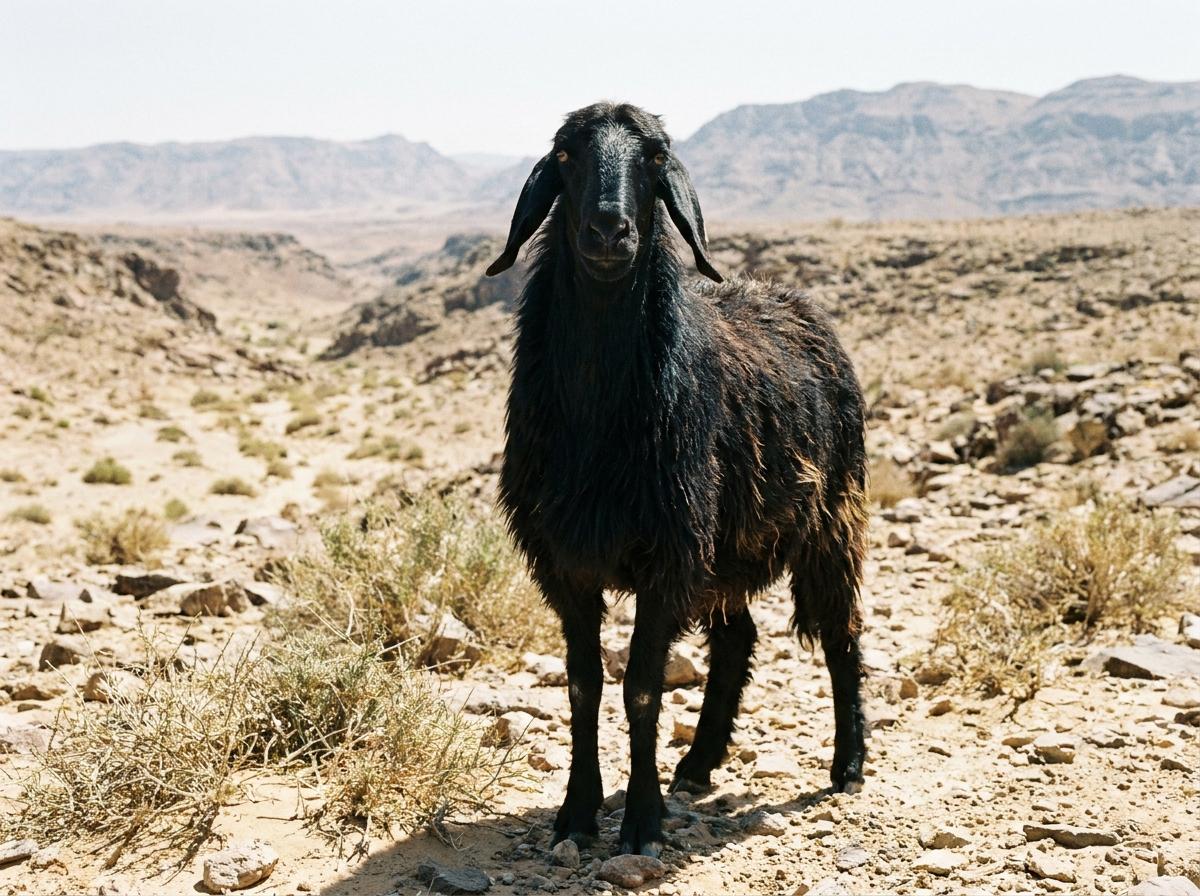
The Najdi is Saudi Arabia’s tall black sheep with a white head, named for the Najd plateau of central Arabia. You can pick one out at a distance: long legs, a deep body, a long face with a convex Roman nose, ears that hang well below the jaw, and a heavy fat tail. Most Najdi sheep are kept for meat today, though the breed was long valued for its milk and its coarse wool as well. It also has a second life as the star of Gulf livestock beauty contests, where single animals have changed hands for sums that have nothing to do with the meat market. That gap between the show ring and the farm gate is the thing most pages about this breed get wrong, so it gets a full section below, alongside what the breed is, what it looks like, what it actually produces, and what to check before you buy. If you keep sheep already, you can compare breeds on the Creatures sheep species page or see what is currently listed in the sheep marketplace.

Browse listings, public profiles, breeders, or add your animal.
What is a Najdi sheep?
The Najdi is an indigenous Saudi breed, one of a small group of native fat tailed sheep that also includes the Naeimi (often treated as the local Awassi), the Harri, the Sawakni and a few regional types. It takes its name from Najd, the arid interior plateau that Riyadh sits on. It is the principal native sheep of the country’s central and eastern regions, and it is reported across the border in Kuwait as well as in Jordan, Iraq and Oman.
Two things make it distinctive among Arabian sheep. The first is size. In a 2023 phenotypic survey of Saudi breeds by Elzarei and colleagues in the Journal of Agricultural Science, the Najdi came out largest on every body measurement taken, roughly a tenth bigger than the Naeimi and the Harri. The second is the face and ears, which are so exaggerated that people meeting the breed for the first time regularly mistake the photographs for goats.
It is worth being plain about what kind of population this is. The Najdi is a landrace, shaped by a specific place and by generations of local selection rather than by a written herdbook and a single published standard. There is no international breed association issuing an official height and weight table you can hold a given animal against, which is why the numbers below come from research flocks and surveys and vary between them. Creatures covers other regional livestock that readers hit the same problems with, including the Miniature Mediterranean donkey of Sicily and Sardinia and the Garron, the working pony type of the Scottish Highlands. Loose naming and headline claims that run well ahead of the evidence recur with both. The donkey is the useful contrast on the standards question: it began as regional island stock too, but it has been formalized since, with the Miniature Donkey Registry holding the herdbook and the National Miniature Donkey Association publishing a breed standard built around a 36 inch height limit. The Najdi has nothing equivalent.
Origin, and where the breed is kept
The breed comes out of the Najd, the interior of the Arabian Peninsula, where sheep were kept by moving them between grazing and water rather than by growing feed for them. That history is still visible in the animal. A Najdi is built long in the leg and light in the body for its height, which suits walking to feed, and it carries its fat reserve in the tail rather than spread through the carcass.
Saudi sheep keeping has changed faster than the sheep have. A survey of 104 farms holding 21,214 head, published in the journal Animals in 2026 by a team working across the Kingdom’s main agro-ecological zones, found flocks running the full span from traditional grazing to fully housed intensive units, with the southern region lagging the central and eastern regions on productivity largely because it still leans on traditional grazing. Most Najdi you would meet on a working farm today live in shaded, hand fed systems rather than on open range.

Outside Saudi Arabia the breed thins out quickly. It is present in neighboring Gulf and Levantine countries and it appears in Gulf livestock shows. Beyond that region we found no evidence of established Najdi breeding stock in Europe, the Americas or Australasia, and animal health rules govern whether new live animals can be brought in at all. Both points are covered in the cost section below.
What a Najdi sheep looks like
The diagnostic features are consistent enough that a single photograph usually settles an identification.
- Black body, white head. The body is black, covered in long, coarse, slightly wavy hair rather than a fine fleece. The head and face are white, and the change happens at the neck, often as a band of mixed black and white. Descriptions in the genetic literature add white spotting on the legs and the tail.
- A convex Roman nose. The head is long and narrow with a pronounced outward curve along the nose. This is the feature the show ring pushes hardest, and it is worth knowing that before you look at a lineup of expensive animals.
- Very long pendulous ears. The ears are long, narrow and thin, and they hang well below the jaw line. They are the reason the breed reads as goat like in photographs.
- A fat tail. Like most sheep of the region, the Najdi stores fat in a broad tail rather than as an even cover over the carcass. It is a real, visible structure, not a figure of speech.
- Hornless, mostly. Ewes are polled. Rams are usually polled too, and where horn tissue appears it tends to be scurs rather than a full horn.

On size, published figures do not agree, and you should treat any single number with care. A 2025 genome study in Frontiers in Genetics gives averages of 62 kg and 86 cm at the withers for males and 45.5 kg and 76 cm for females. The Slow Food Foundation’s Ark of Taste entry records rams at about 76.5 kg and ewes at about 56.1 kg by 18 months. Those are not contradictions so much as different animals: range kept stock and well fed farm stock are two different weights, and the gap between them is a useful thing to remember when a seller quotes you a figure. If you want a repeatable way to size up an animal in front of you, the general method is in the Creatures guide to how much a sheep weighs and how to estimate it.
The show ring, and what it selects for
Saudi and wider Gulf livestock culture runs beauty competitions for camels, goats and sheep, and the Najdi is the sheep at the center of them. The best documented event in English is still the first one. On 30 October 2008, the Associated Press reported on a pageant for Saudi bred Najdi sheep held on a stretch of desert north of Riyadh, organized by the businessman Faisal al-Saadoun, with a crowd of about 4,000. Animals were walked down a carpeted runway after a fireworks display and a poetry competition, and finalists were auctioned. The judging, per that report, weighed the span of the cheeks, the length of the neck and the color of the coat, and favored tall animals without unwanted fat. The organizer’s stated aim was to push Saudi breeders toward quality.
The tradition did not stop there. Gulf agricultural shows have continued to run sheep classes with a Najdi category, and the judging emphasis on the head has stayed put: The National’s coverage of a 2019 livestock contest in Abu Dhabi noted that for the Najdi a steeply curved face is essential. Slow Food’s heritage entry for the breed likewise records its place in Saudi sheep beauty competition.
This matters beyond the spectacle, because it shapes the national flock. The 2026 breeder survey in Animals found that Saudi flocks rely heavily on breeding within the herd and on selecting animals by appearance rather than by measured production, and it names that combination as the mechanism behind what the authors call a genetic vulnerability paradox. A breed can sit well above the FAO’s numerical threshold for “not at risk” and still be accumulating inbreeding and losing production progress, because head shape is what gets rewarded and nobody is weighing the lambs. If you buy into this breed, that is the single most useful thing to understand about the market you are buying in.
Genetics and inbreeding
The genetic picture is the least discussed part of this breed and the most consequential if you plan to breed.
The 2025 Frontiers in Genetics study compared Najdi, Naemi and Harri sheep using genome wide markers. The Najdi separated cleanly from the other two on principal component analysis, which fits a population that has been kept apart, and it carried the highest inbreeding of the three: a runs of homozygosity inbreeding coefficient of 0.053, a separate inbreeding coefficient of 0.092 calculated from marker heterozygosity, and the longest total run length at 143.37 Mb. Long runs of homozygosity indicate recent rather than ancient inbreeding. The study also returned the lowest effective population size of the three breeds for its Najdi sample, and concluded that the breed needs active conservation work.
An earlier microsatellite study of Arabian sheep, published in Frontiers in Genetics in 2018, found a statistically significant inbreeding coefficient of 0.091 for the Najdi, which is the same story from different markers.
Read carefully, none of that says the breed is about to vanish. Saudi Arabia has a large national sheep population and the Najdi is a common animal in it. What the numbers say is narrower and more practical: within the breeding groups these studies sampled, animals are more closely related to each other than a well managed population would be, and the practices that produced that result are still the normal ones. For a buyer, the takeaway is to ask about the sire’s origin and to avoid a flock that has used its own rams for years without bringing anything in.
What Najdi sheep produce
Meat
Meat is what the breed is bought for now. A 2021 feeding trial published in Frontiers in Veterinary Science compared Awassi, Harri and Najdi lambs on the same ration and gives the clearest side by side numbers available.
The Najdi lambs ate 1.64 kg a day, gained 0.28 kg a day, and reached a final live weight of 48.54 kg with a cold carcass of 24.06 kg. Dressing percentage came out at 49.50 percent on slaughter weight, higher than the Awassi. Backfat was 1.29 mm, well under the Awassi’s 2.58 mm, which is to say a leaner carcass at the same finishing point. On eating quality the results split: the Najdi had the lowest cooking loss at 28.96 percent and scored highest for flavor intensity with the sensory panel, while the Awassi and Harri came out ahead on the tenderness measures, with lower hardness and chewiness. Flavor first, tenderness second, is a fair summary.
Najdi meat is the traditional choice for Saudi feast cooking, and the Slow Food Ark of Taste entry names ma’riq and hamees among the dishes it is most used in.
Milk
The breed was historically milked and still is on some farms, but nobody should buy one expecting a dairy animal. Research at King Saud University on Najdi ewes gives yields around two liters a day while a lamb is suckling and well under one liter a day once the lamb is off and the ewe is being milked, well below what a specialist dairy sheep breed gives.
The composition is better news than the volume. A 2023 study in Veterinary Sciences followed 126 Najdi ewes on a farm near Riyadh and measured fat between roughly 3.2 and 3.9 percent and protein between roughly 4.0 and 4.9 percent across the first two months of lactation. Those authors also found that milk composition held up in ewes that came out of lambing in poorer body condition, which is a genuinely useful trait in a system where feed supply swings.
Wool
The fleece is coarse. It was historically spun and woven locally rather than sold into a fine wool market, and it is now a minor product at best. Treat shearing as a management job rather than a revenue line: the animal still needs it done on a sensible schedule for heat and skin health, and the general timing and technique are in the Creatures guide to shearing sheep.
Reproduction and mothering
This is a single lamb breed. In a study of 242 lambings in an intensively managed Najdi flock, published in the Journal of Animal Research, average litter size came out at about 1.31 lambs, rising with parity. Twins happen and triplets occasionally do, but a Najdi flock does not produce the lamb crop that a prolific breed produces, and any sales pitch built on high twinning rates deserves a hard question.

The same study is worth knowing about for a second reason. The Najdi has a local reputation as a poor mother, and the measurements did not support it: dystocia ran at 4.5 percent, lambing took about half an hour, and ewes began licking their lambs within a couple of minutes. What the flock did show was a high rate of lamb rejection, around a fifth of lambings and worst in first time mothers, and the main driver was several ewes lambing at once in the same pen rather than anything about the ewes themselves. That is a management finding, not a breed defect, and it points at individual lambing pens as the fix. The signs to watch for and what to have ready are in the Creatures lambing guide.
Timing matters more in this breed than in some. Work on productive longevity in Awassi and Najdi ewes under intensive management in the northern Arabian Peninsula, published in Small Ruminant Research, put the optimum age at first lambing at 20 to 22 months for Najdi ewes, and found that ewes bred to lamb at 13 months or younger carried a much higher risk of being culled out. The same work recorded shorter productive lives for Najdi ewes than for Awassi, averaging about 1,635 days against 2,204, and 3.3 lamb crops against 4.1. Pushing ewe lambs early costs you at the far end.
Desert adaptation: what the comparison shows
The Najdi is routinely described as an exceptionally drought hardy desert sheep. It is a desert sheep, and it copes with heat and sparse feed that would flatten a temperate breed. The claim that it is the toughest of the region’s sheep is a different claim, and the direct comparison does not support it.
Alamer and Al-Hozab tested Awassi and Najdi side by side under water deprivation across seasons and published the results in the Journal of Arid Environments in 2004. Both breeds lost weight, but the Najdi lost more: 15.3 percent against the Awassi’s 13.3 percent in spring, and 21.5 percent against 18 percent in summer. The Awassi conserved water better under heat load, sweating less. Feed intake in both breeds collapsed under dehydration, and the effect was worst in summer.
The practical version is simple. Reliable water is essential for this breed, especially in the heat, and a Najdi is not an animal you can leave to find its own water in the hottest part of the year. That is not a ranking of inputs. The trial withheld water; it did not test water against shade or against ration quality, and shade and a suitable ration stay on the list of things a Najdi needs. Plan the water supply first, and plan the other two alongside it.
Husbandry and care
Nothing about Najdi management is exotic. It is good sheep husbandry in a hot dry climate, and the Creatures sheep guides cover the mechanics in more depth than this page can.
Water and shade. Constant access to clean water, and real shade during the hot months. Given the dehydration results above, treat water availability as the thing you check first and most often.
Feed. Most Najdi flocks now run on purchased forage and concentrate rather than range alone. Build the ration around forage, step it up through late pregnancy and lactation, and watch condition scores rather than guessing. Sheep are also far more sensitive to dietary copper than goats or cattle are, so feeding them a mineral mix or a ration formulated for another species is a well documented way to poison them. The Creatures guides to what to feed sheep and sheep minerals cover both points.
Housing. Dry footing, room to lie down without crowding, and separate lambing pens for the reason given above. Long ears are vulnerable to injury on rough fittings, so smooth what an animal can catch itself on.
Health. Routine sheep health management applies: a parasite plan matched to your climate and grazing rather than a fixed calendar, regular foot inspection, clean lambing hygiene, and the vaccinations your veterinarian recommends locally. Keep dated records of weights, lambings, treatments and losses so culling and breeding decisions rest on evidence instead of memory. Every medical decision belongs with a veterinarian who can examine the animal.
Records. Given how much of this breed’s market runs on appearance, a flock with real production data behind it is genuinely differentiated. Weights at fixed ages, lambing dates and litter sizes, and health events are the numbers that let you prove an animal is better rather than assert it.
What Najdi sheep cost
Price is where writing about this breed usually goes wrong, so here it is in two clearly separate markets.
The ordinary market
An everyday Najdi is livestock and is priced like livestock. Saudi sheep trade heavily around Eid al-Adha, which is when English language reporting on this market exists at all. Asharq Al-Awsat’s coverage of the 2021 Eid market put imported sacrificial sheep from Romania, Spain and Georgia at roughly 240 to 320 US dollars, and the smallest sacrificial animals at 140 to 160. A dealer in the same report, speaking about Sudan and Jordan as the countries Saudi Arabia takes most of its imported livestock from, put the average price of al-Noaimi at 386 dollars, in a sentence about import demand. The smallest-animal line names no origin, the rest of the figures attach to imported animals, and the one local quote is set aside below, so none of them is a Najdi figure. Its one local quote, another dealer putting Noaimi and Najdi at an average of 53 dollars a head, does not square with the rest of the report and we are not using it. What the report does show about local stock is qualitative: demand at Eid rises specifically for the local breeds, Noaimi and Najdi among them.
There is no reliable published, current, breed specific average price for a Najdi sheep, and we are not going to invent one. Treat the numbers above as the scale of the market a Najdi is sold into, in a specific year, rather than as a Najdi price. Our own expectation, offered as an expectation and not a measurement, is that an ordinary Najdi runs a few hundred dollars rather than a few thousand, and that the figure in front of you moves with the animal’s weight, age, sex and condition. For the general framework, the Creatures guide to how much a sheep costs walks through commercial versus registered pricing.
The breeding and show market
This is a separate market that happens to involve the same species. In its 2008 report on the Riyadh pageant, the Associated Press put good ewes at 20,000 to 30,000 Saudi riyals, which it converted to about 5,300 to 8,000 US dollars, and good rams at hundreds of thousands of riyals. The winning ram that night, named Sana, was reported sold for 450,000 riyals, about 120,650 dollars at the time. The report also relayed a claim that offspring of a famous sheep called Burgan had fetched more than 8 million riyals, around 2.1 million dollars.
The logic behind the ram premium is stated in the same report: a ram can sire around a hundred lambs in a year while a ewe produces one or two. Buyers at that level are buying genetics and reputation, and increasingly a shot at a title, not meat.
Why the viral numbers mislead
Three cautions, all of which apply to the figures you will meet on social media.
They are auction outliers, at a specific date. The AP figures are from 2008. A single top lot at a pageant is the tail of a distribution, not its center, and quoting it as “what Najdi sheep cost” is off by two to three orders of magnitude.
The breed is frequently not stated. Gulf News reported in September 2018 that a sheep sold in the Hafr region of northern Saudi Arabia for one million riyals, with bidding starting at 100,000 and reaching a million in half an hour. The report describes special physical attributes and buyers hoping to recoup the price through breeding. It does not name the breed. A great many of the record sale stories that circulate attached to Najdi photographs are like this, and some of them are about other breeds entirely, or about camels.
Nothing about a record price transfers to a lamb. A ram sold for a title is being priced on show record and pedigree reputation. It does not tell you what its lambs are worth, and it certainly does not tell you what the animal in the pen next to you is worth.
Outside the Gulf
If you are reading this outside the Gulf, start with the import rules where you live, because they decide the question before price does. In the United States, the Department of Agriculture’s Animal and Plant Health Inspection Service publishes a short list of approved origins for importing live sheep, goats and germplasm, naming Australia and New Zealand for live animals, handling Canada under its own scrapie certification and genotype conditions, and listing a separate set of countries for semen and embryos. Saudi Arabia appears on none of those lists, so as things stand there is no route to bring a Najdi, or Najdi semen or embryos, directly from the breed’s home country into the United States.
What that page cannot tell you is whether any Najdi or Najdi derived stock is already inside the country from an earlier import, and we found no evidence that it is. So treat a North American offer as unverified rather than as proof of anything: ask for documented origin, identification and registration paperwork, and take your time before money moves. Other countries set their own rules and their own approved origin lists. If you are in Europe, Australia, New Zealand or anywhere else, check your own national animal health authority rather than assuming the United States position applies to you.
Buying considerations
If you are buying inside a market where the breed genuinely exists, most of the value comes from resisting the things the show ring trains you to look at.
- Buy the production, not the profile. A correct udder, sound feet and legs, a good bite, decent length and depth, and calm handling matter more to a working flock than the curve of the nose. The curve wins ribbons. It does not wean lambs.
- Ask for dated records. Lambing dates, litter sizes, weights at fixed ages, treatments. Given the survey finding that Saudi flocks mostly select on appearance, a seller who can hand you real numbers has already told you something about how the flock is run.
- Ask where the rams came from. The inbreeding results make this the highest value question you can ask. A flock that has used home bred rams for years without introducing outside genetics is the pattern those studies flagged.
- Check the ears and the feet in person. Long pendulous ears pick up damage, and a long legged animal that has to walk to feed lives or dies on its feet.
- Match the age at first breeding to the evidence. Do not let ewe lambs lamb at a year old because they can. The longevity work points at 20 to 22 months.
- Verify what “Najdi” means for the animal in front of you. With no international herdbook, the name is a description, not a certificate. Ask what the seller means by it.
The disease questions to raise with any sheep seller, wherever you are, are in the Creatures guide to where to buy sheep. You can also browse current listings in the sheep marketplace and look for farms in the Creatures directory.
Frequently asked questions
Are Najdi sheep really worth hundreds of thousands of dollars?
A tiny number of individual show and breeding animals have sold for sums like that, most famously at the 2008 Riyadh pageant reported by the Associated Press. An ordinary Najdi sold for meat is priced like other good local sheep. No current breed specific average is published for the breed, and our own expectation is a few hundred dollars rather than a few thousand. The two markets share a breed name and almost nothing else.
Why do Najdi sheep look like goats?
The long pendulous ears, the convex Roman nose and the long legged frame all read as goat like to eyes used to European sheep breeds. They are sheep, they are fat tailed, and the coarse hair coat adds to the impression.
Do Najdi sheep have horns?
Ewes are hornless. Rams are usually hornless too, and where horn tissue does appear it tends to be small scurs rather than full horns.
How many lambs does a Najdi ewe have?
Usually one. Average litter size in one intensively managed flock was about 1.31 lambs per lambing, rising with the ewe’s parity. This is not a prolific breed.
Are Najdi sheep good milkers?
Not by dairy breed standards. Research yields run around two liters a day while a lamb is suckling and well under a liter once the ewe is being milked. The milk is respectable on fat and protein, but the breed is kept for meat.
Can I buy Najdi sheep in the United States?
Not directly from Saudi Arabia. APHIS lists a short set of approved origins for live sheep imports into the United States, and Saudi Arabia is not among them, which rules out importing Najdi semen or embryos from there as well. We also found no evidence of an established Najdi population already in North America, so treat any US offer as unverified: ask for documented origin, identification and paperwork before paying anything.
Is the Najdi endangered?
Not by headcount. Saudi Arabia’s national flock is large and the breed is common within it. Genetic studies do report high inbreeding and a low effective population size in the groups they sampled, and a 2026 breeder survey argued that census numbers hide that risk, so the concern is about breeding management rather than raw numbers.
Do this next on Creatures
Whether you are researching the breed from outside the region, buying inside it, or already running a flock, Creatures is the records, marketplace and directory layer to do it in one place.
Compare and shortlist. Start from the Creatures sheep species page, then filter the marketplace for Najdi sheep and search farms in the Creatures directory of trusted breeders.
Get alerted instead of refreshing. Najdi listings are rare outside the Gulf, so set a free Najdi sheep listing alert and we will tell you when one is posted. No account needed to start, and saving searches and using your watchlist explains how the watchlist works.
Add your sheep. Already keeping Najdi sheep? Create a free animal profile in a few minutes, no account needed to start. The walkthrough is in adding an animal to Creatures.
Record the numbers the show ring ignores. Weights, lambings, litter sizes and treatments are what prove an animal is better rather than just handsome. Add a record on Creatures. The record sheet opens for any visitor to look around, and you will need a free account to save what you enter. See adding a record and health and medical records for the how to.
List your flock. Running a flock or farm? Create a free breeder profile, no account needed to start, then get listed in the breeder directory so buyers can find you. If you run the operation with other people, read creating an organization and adding your team.
Sell with confidence. Planning to sell stock? Learn how seller payout works before you list, and name your next lamb crop with the sheep name generator.