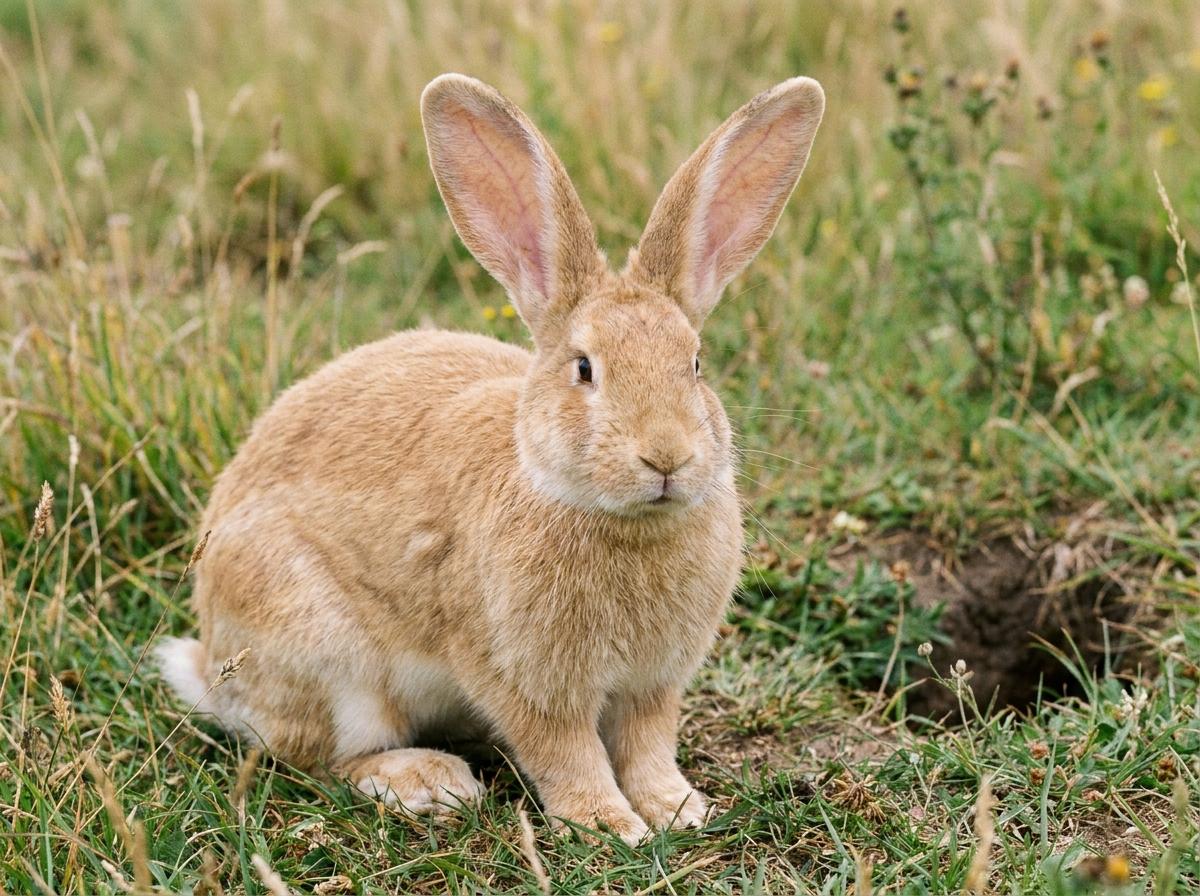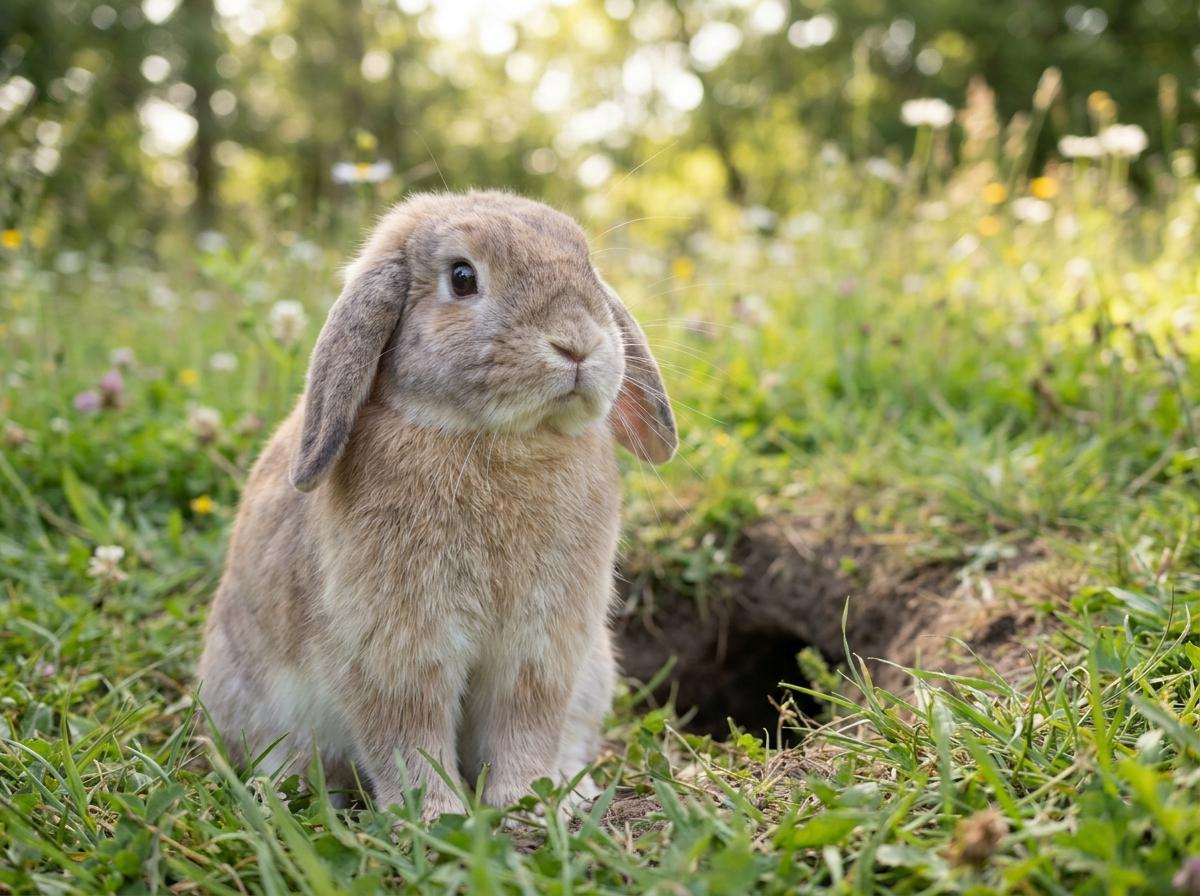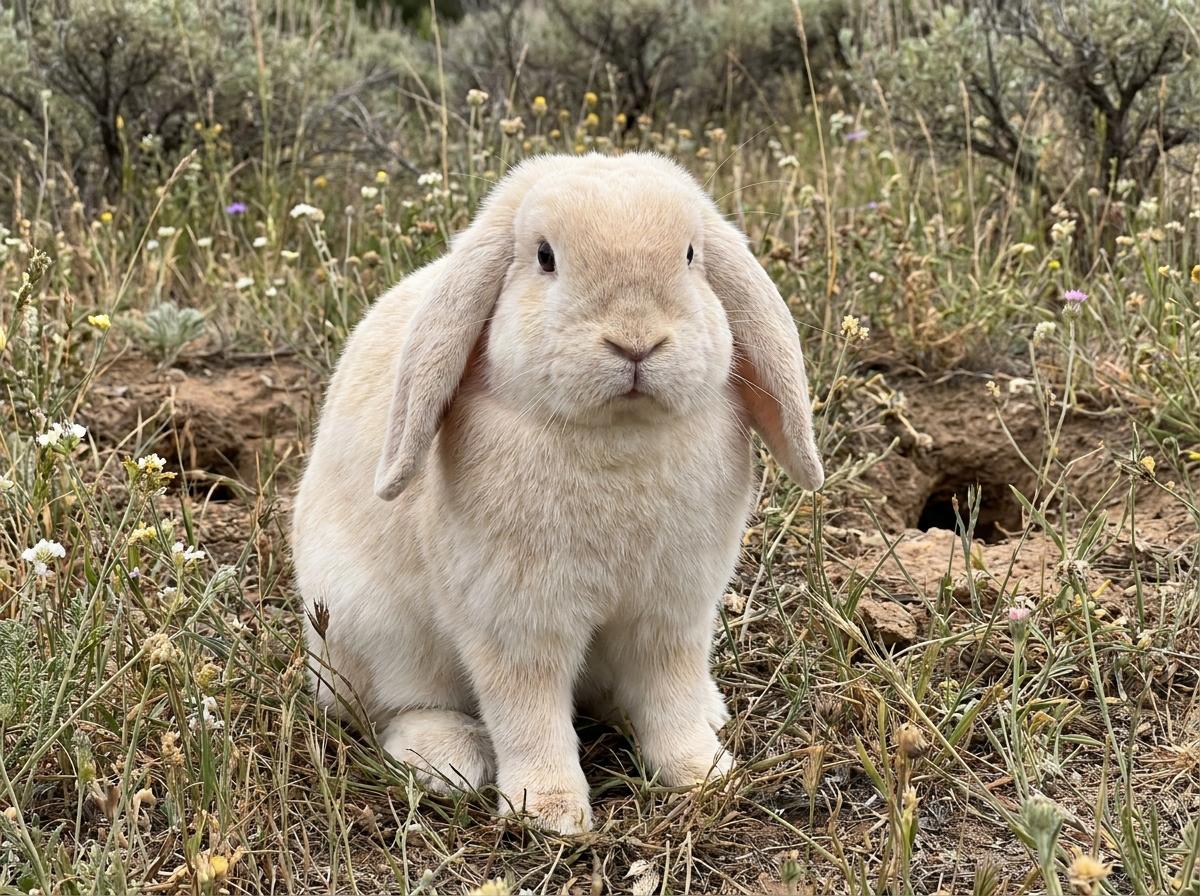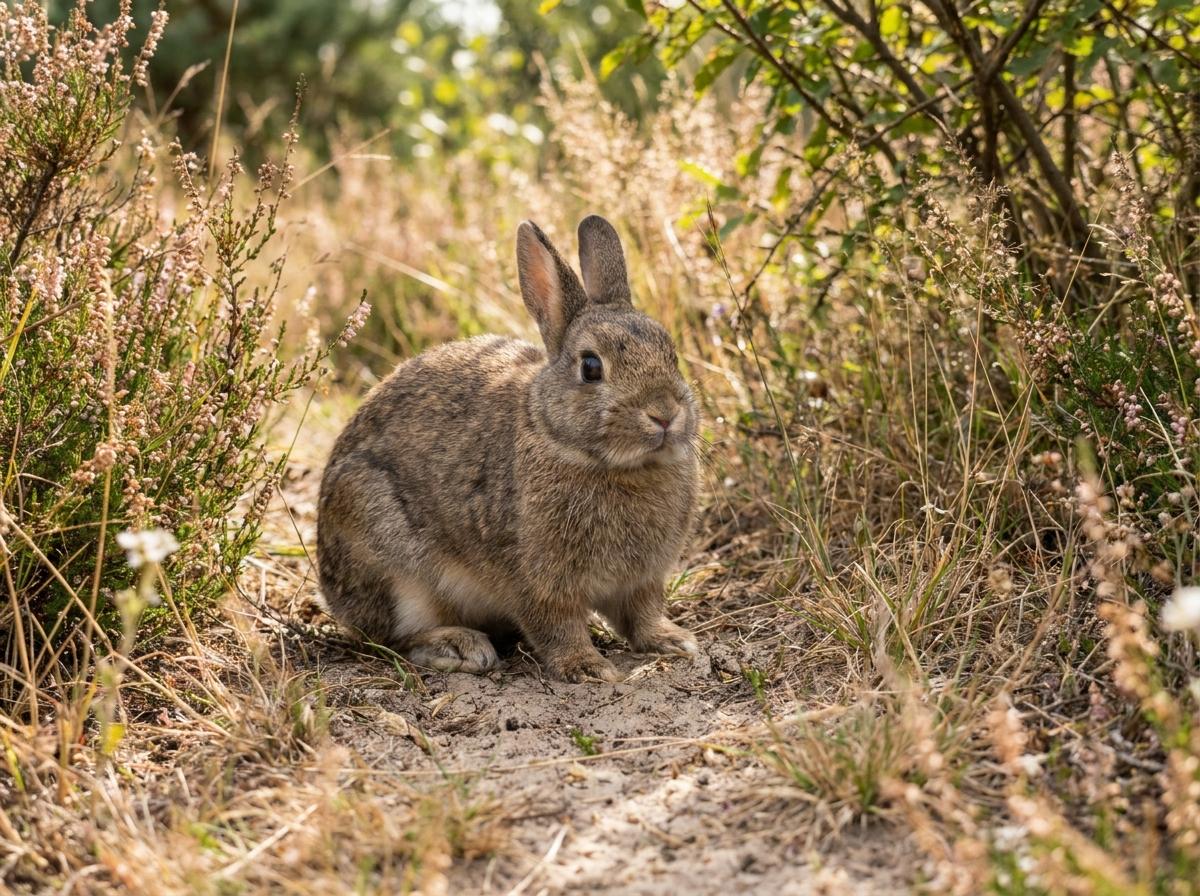


German Lop
Author: Elliott Garber, DVM · Updated
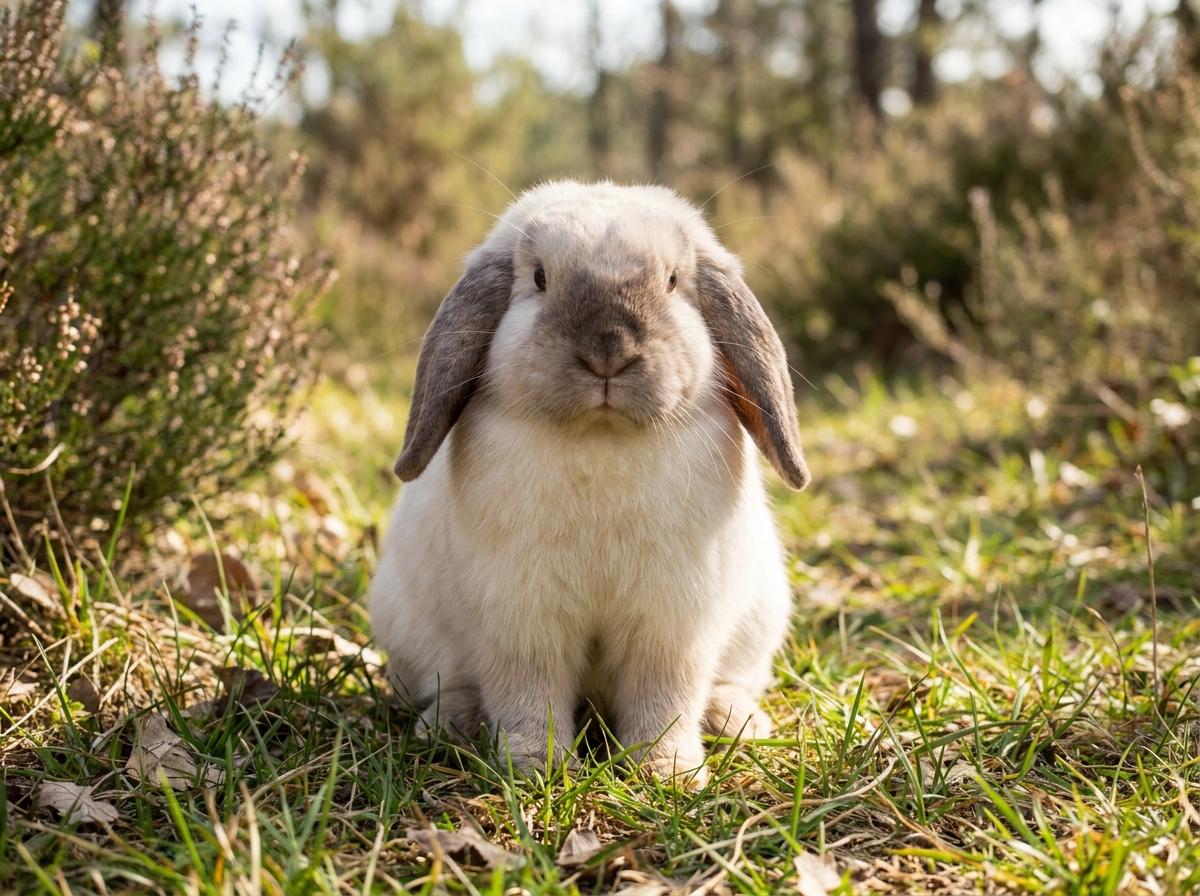
The German Lop is a medium, very thickset lop-eared rabbit weighing 6.5 to 8.5 pounds (2.95 to 3.85 kg) under the standard it is judged against. It is a properly standardized breed, but only in some countries: the British Rabbit Council recognizes it, German and Dutch fanciers have kept its parent stock for decades, and the American Rabbit Breeders Association does not recognize it at all. If you are reading this from the United States, that last fact decides most of what follows, starting with whether the rabbit you are being shown is a German Lop at all. Our rabbit species page compares it with the lops you can actually buy near you.
The confusion goes deeper than a naming quirk. The Mini Lop that American buyers land on instead descends from the same German small-lop stock, imported in the 1970s under its German name. People who mix the two up are closer to right than the names suggest.

| Type | Medium lop rabbit, very cobby and muscular |
|---|---|
| Standard weight | 6.5 to 8.5 lb (2.95 to 3.85 kg) adult, BRC standard L6 |
| Ear span | 11 to 14 in (27.96 to 35.5 cm) across the skull, tip to tip |
| Head | Broad, wide between the eyes, Roman nose, strong crown ridge |
| Coat | Normal length, very dense, rollback, strong guard hairs |
| Colors | All recognized colors plus butterfly. Broken pattern not accepted |
| Registry status | Recognized by the British Rabbit Council. Not an ARBA breed |
| Origin | Bred in Germany from the 1950s, imported to Britain 1987, British standard in force 1 January 1991 |
| Availability | Established in Britain and Europe. Genuinely rare in North America |
Browse listings, public profiles, breeders, or add your animal.
Is the German Lop a recognized breed?
Yes, but you have to say where. Recognition is a decision each national registry makes for itself, and the three that matter here have made three different ones.
In the United States, no. The American Rabbit Breeders Association publishes its recognized breeds and there are five lops on it: the English Lop, the French Lop, the Holland Lop, the Mini Lop and the American Fuzzy Lop. There is no German Lop. So no ARBA show has a class for the breed, no ARBA registration or pedigree exists for it, and no American standard defines what one should weigh. A rabbit advertised in the United States as a German Lop is being described against a standard written on another continent, if against any standard at all.
In Great Britain, yes. The British Rabbit Council keeps the German Lop in its Lop section with its own standard, numbered L6, and its own show ring size (L). That standard is the source of every number on this page. The council now sells the current edition only in print, so the linked copy is archived.
In Germany, the picture is stranger. There is no German breed called the German Lop. The German standard, kept by the Zentralverband Deutscher Rasse-Kaninchenzüchter, has a large lop called the Deutsche Widder and a small one called the Deutsche Kleinwidder, and the British German Lop matches the smaller of the two. Glossing “German Lop” as “Deutsche Widder” misleads buyers about size by roughly double.
What the British standard actually asks for
The BRC standard is short, specific, and worth reading if you are buying: almost every honest description of the breed is a paraphrase of it. It splits 100 points across overall type and shape (30), head and crown (20), ears (20), coat (15), color or pattern (10) and condition (5). Type carries the most, which tells you what the breed is for.
Type. The standard’s own words are “very cobby, massive and muscular”. The neck should not be visible at all. The rabbit should be as broad across the shoulders as across the hindquarters, and from a short nape the back rises in a slight curve to a short, well-rounded, well-muscled rump. Front legs are short, straight and thick. A dewlap in does is permissible.
Head and crown. Strongly developed, with a distinct width between the eyes, full cheeks, and what the standard calls “a Roman nose appearance”, meaning a gently convex profile rather than a flat or dished face.
Ears. Broad, thick and of good substance. They rise from a strong ridge on top of the head called the crown, are carried close to the cheeks with the openings turned inward, and hang straight down just behind the eyes without being carried forward or back. Ear length is measured across the skull, tip to tip: minimum 27.96 cm, maximum 35.5 cm (11 to 14 inches).

That crown is the feature to look for: the raised ridge of cartilage the ears hang from, which separates a rabbit bred to a lop standard from one that simply has floppy ears. In a good German Lop it is obvious to the eye and to the hand.
Coat and color. Fur of normal length, very dense, with strong guard hairs. Color is where the previous version of this page was wrong: the standard accepts “all recognised colours, including the butterfly pattern” but explicitly not the broken pattern, and it lists “white patches on coloured rabbits” as a disqualification. Solid selfs, agoutis, steels, sooty fawn, chinchilla and the butterfly pattern are all in. A colored rabbit carrying random white patches is not.
Weight. Desired adult weight is a minimum of 2.95 kg and a maximum of 3.85 kg, written in the standard as 6.5 lb to 8.5 lb. An adult over 8.5 lb is disqualified, and so is a rabbit under five months shown over 6.5 lb. Because that cap is a disqualification rather than a preference, an oversized rabbit is not a better German Lop, it is one that cannot be shown. Whatever “giant German lop” searches suggest, this is a medium rabbit.
The name problem: Deutsche Widder, Kleinwidder and the American Mini Lop
Almost every English-language description of this breed says its German name is the Deutsche Widder. Put that name into the German standard and you get a completely different animal.
Deutsche Widder is the largest lop breed in Germany. The German lop breeders’ association scores it at full marks between 5.50 and 9.00 kg, with an ear span of 38 to 45 cm, and traces it to lop rabbits brought from Avignon to Germany around 1869, with German Giant blood added later for size. That is a rabbit of roughly 12 to 20 lb with ears half again as long as the British standard allows, and it is not even from the same century.
Deutsche Kleinwidder is the small one, and the numbers line up almost exactly. German breed sources put its full-marks weight at 3.0 to 3.5 kg with an ear span of 30 to 36 cm, against the British German Lop’s 2.95 to 3.85 kg and 27.96 to 35.5 cm. It was bred down from the Deutsche Widder starting in 1954 by a breeder in Bischmisheim, near Saarbrücken, who wanted the same type in a smaller package. The German lop association dates its acceptance into the standard to autumn 1968, and it was shown at the 1970 European show and the 1972 national show in Essen. The same association’s Zwergwidder standard sets the third member of the family, the dwarf lop, at 1.50 to 1.90 kg for full marks with an ear span of 22 to 28 cm. That last figure settles what the German measurement is: no single ear on a 1.7 kg rabbit runs 22 cm, so Behanglänge is the same tip to tip span across the skull the British standard uses, which is what makes the comparison above an honest one.
Being honest about the limits of that: no source states outright that the British German Lop and the German Kleinwidder are one breed under two names. The identification rests on the standards matching on weight and ear span while the Deutsche Widder matches on neither, plus the British club’s own record that “continental weights were roughly 6¾ lbs to 8lbs” when the stock was imported. Read it as the best available reading of the standards rather than a documented equivalence. “Deutsche Widder” is a gloss that does not survive contact with the German standard.
Now the part that matters to American readers. ARBA’s own Mini Lop history says the breed “was brought to the U.S. in the 1970s bearing the name Klein Widder”, was renamed, and became an official ARBA breed in 1980 with a maximum senior weight of 6.5 lb. Klein Widder is that same German small lop. Accounts of which crosses made it differ, as they usually do for a breed assembled in the 1950s, but they agree on the plan: shrink a big lop using dwarf blood.
So the Mini Lop and the German Lop are cousins selected in different directions after 1972. Britain kept the continental size and capped it at 8.5 lb to stay clear of the French Lop. America bred down, and ARBA caps today’s Mini Lop at 6.5 lb. If you want the closest thing to a German Lop that you can register, show and actually buy in the United States, it is a Mini Lop, and that is not a consolation prize.
How the breed reached Britain
The British half of the story is unusually well documented by the National German Lop Club, and it is specific enough to date.
German fanciers in the 1950s liked French Lops but did not have the space for them, so they set out to breed an intermediate lop between the French and the dwarfs. It reached the show bench at an international show in Saarbrücken in 1960 and was standardized in Germany in 1970, then in the Netherlands in 1976 and Switzerland in 1984.
Britain got it late. Evelyne Van Vliet had been breeding the rabbits in Holland since about 1980, and with the late Dave Cannon she arranged the first import. The stock landed in Great Britain on 23 April 1987 and came out of quarantine on 23 October. Those first rabbits were agoutis, and with no British standard yet the Rare Varieties Rabbit Club adopted them as an unstandardized variety and staged classes at its stock shows. Blacks, steels and butterflies followed by 1990, whites in 1993, then the rest of the colors.
The Rare Varieties Rabbit Club drafted the standard, put it to a members’ ballot and presented it to the British Rabbit Council, which accepted it. It came into force on 1 January 1991. Two points had caused argument. Weight was one: the 8.5 lb disqualification was added to the continental figures specifically to stop the breed drifting into French Lop territory. Color was the other, and the committee’s vote to accept agouti alone was overturned by the membership in favor of every recognized color.
British recognition is usually dated to 1990, but the club’s own account is that the standard became operative on 1 January 1991, and the first challenge certificate was won on that first day. The familiar story that a Dutch breeder moved to Britain with her rabbits also compresses what happened: Van Vliet bred them in Holland and arranged the import with a British fancier.
How big do lop rabbits get?
Every figure comes from the relevant registry’s own standard. Under the British Rabbit Council, in ascending order:
- Miniature Lop. Ideal adult weight 1.5 kg, maximum 1.6 kg (3.4 lb ideal, 3.8 lb maximum).
- Dwarf Lop. Minimum 1.93 kg, maximum 2.381 kg (4 lb 4 oz to 5 lb 4 oz). Its ears are not measured at all.
- German Lop. Minimum 2.95 kg, maximum 3.85 kg (6.5 lb to 8.5 lb), ear span 11 to 14 inches.
- Meissner Lop. Easy to miss, because the council files it as a rare variety inside the Lop section: minimum 3.5 kg, ideal 4.5 kg, maximum 5.5 kg (7¾ lb to 12 lb), with a much longer ear at 38 to 42 cm.
- French Lop. “As large as possible”, minimum adult weight 4.535 kg (10 lb), no maximum at any age. A French Lop under 10 lb is disqualified for being too small.
- English Lop. The outlier: its standard puts 50 of its 100 points into four ear categories and asks for size “as large as possible, but not out of proportion”. This is the breed whose ears trail past the jaw.
The ARBA ladder runs Holland Lop at a maximum of 4 lb, Mini Lop at a maximum of 6.5 lb, then the French Lop and English Lop as the large breeds. Notice that the Mini Lop’s ceiling is the German Lop’s floor: a perfectly good large Mini Lop in Ohio would be an undersized German Lop in Yorkshire.
Two answers fall out of that. There is no such thing as a giant German Lop, so a genuinely large lop means a French Lop, a Meissner Lop if you can find one, or in Germany a Deutsche Widder. And a “German Lop” offered at 4 or 5 lb is not one, whatever the seller believes.
Temperament and handling
The breed’s reputation is for a settled, confident rabbit that handles well, and the size probably helps: a solid three-kilo animal tends to be less explosive than a nervous dwarf. The 1987 import leaflet described them as lively but quiet, and British keepers have said much the same since.
Read that as a tendency, not a promise. Personality is shaped far more by early handling, neutering, space and daily contact than by the breed on the pedigree.

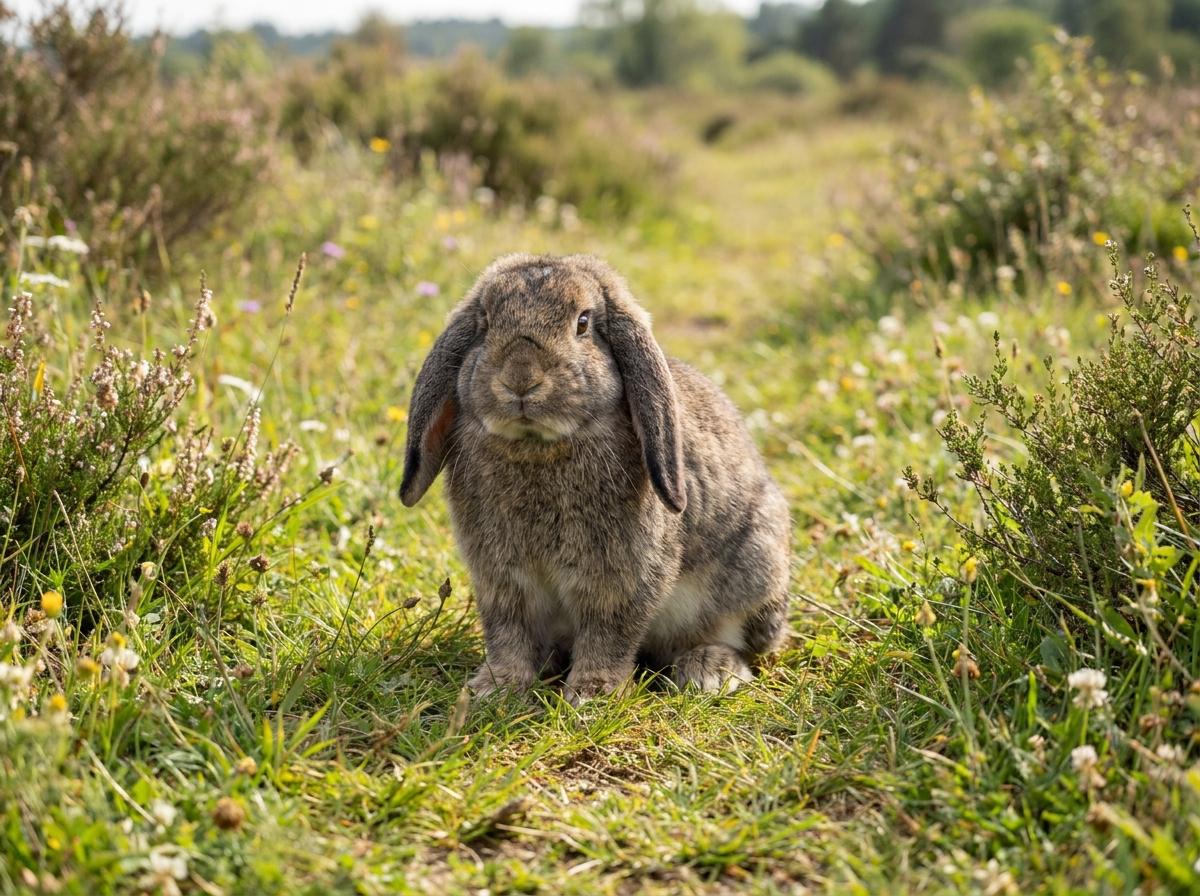
The photograph above shows the right way to interact with one. Rabbits are prey animals and most dislike being lifted and held in the air, which reads to them as restraint rather than affection. Sit on the floor, let the rabbit come to you, and do most of your handling at ground level. When you do have to lift one, support the chest and hindquarters together and keep the rabbit against your body: a struggling rabbit can kick hard enough to fracture its own spine. Children should meet a rabbit at floor level, supervised, every time.
Everyday care
None of this is breed-specific beyond the ears. Take medical decisions to a rabbit-experienced veterinarian.
Space and housing
The traditional hutch is not enough, and has not been for a long time. North Carolina State University’s veterinary hospital sets the floor: the enclosure needs a flat bottom to prevent foot injuries and enough room to hop in any direction, plus a few hours a day outside it in a pen or rabbit-proofed room. British guidance is more specific and worth borrowing: rabbits kept as neutered pairs, with runs at least 3m long, 2m deep and 1m high. University of Liverpool researchers reviewing UK owner survey data found 31.2 percent of rabbits in inadequate housing and 51.4 percent housed alone.

The shed above is the shape of a good setup. Solid floor, never bare wire, because a heavy-bodied rabbit standing on mesh develops pododermatitis, the hock pressure sores that are painful and slow to heal. Deep dry bedding over it. Hay always available and in quantity, not as a garnish. Somewhere to hide, something to go through, something to get on top of, because a rabbit with no cover in an open box is a prey animal with nowhere to go. Clean water in a heavy bowl that will not tip. Ventilation, shade and a roof that keeps rain off.
Note that there are two rabbits in that shed. Rabbits are social, and a compatible neutered pair is the normal recommendation rather than a luxury. Bond them slowly and on neutral ground, and expect intact males to be aggressive toward other rabbits.
Outdoors, summer is the season that kills. Rabbits shed heat poorly and cannot pant effectively, so shade, airflow and cool surfaces matter more than winter warmth for a healthy adult in dry, draft-free, predator-proof housing.
Food and water
Diet is where most pet rabbit health problems start. Grass hay should be the overwhelming majority of it: NC State puts the figure at “80-90% of a rabbit’s diet” and recommends timothy or orchard grass. Merck explains why the supply has to be unlimited rather than generous, which is that rabbits “frequently need to nibble on it to keep peristalsis active”, and indigestible fiber is also what wears the teeth down.
Around that, a measured portion of high-fiber pellet, capped by both sources at about a quarter cup per five pounds of rabbit per day, and leafy greens at roughly half a cup per two pounds of body weight. Fresh water constantly. Fruit and anything sugary or starchy are treats in the literal sense, since low-fiber diets increase intestinal problems. For an 8 lb German Lop the pellet ration is about two fifths of a cup a day, less than most people expect, and hay fills the gap. Our rabbit diet guide has the greens list and the quantities.
Grooming, ears and nails
The dense rollback coat needs a weekly brush, more during a heavy molt, when swallowed fur can contribute to gut trouble. Nails need regular trimming.
Ears need checking, and on a lop that is not optional. A hanging ear does not drain or ventilate the way an upright one does, so wax and debris accumulate in the canal. Look inside both ears regularly, and treat head shaking, scratching, odor, discharge, a head tilt or a flinch at the ear base as a reason to book a veterinary appointment rather than to start cleaning at home.
Health
German Lops have no long list of breed-specific diseases. They do have the health profile of a lop-eared rabbit, and that is worth being clear-eyed about before you buy one rather than after.
The ears carry a real cost. An owner survey of 551 rabbits in PLoS One found that “approximately 25% of lop-eared rabbits had ear conditions indicated by a vet versus 10% of erect-eared rabbits”, with owners reporting lops as roughly 19 times more likely to have impaired hearing or deafness and 5.5 times more likely to have quality of life impaired by an ear problem. A lop ear canal is prone to narrowing, narrowing blocks wax drainage, and trapped wax is where infection starts. The ear checks above are not fussiness.
The dental claim needs correcting, including on this page. A 2019 Veterinary Record study of 30 rescue rabbits, 15 lop and 15 erect, reported more incisor pathology, molar overgrowth and molar spurs in the lops (doi.org/10.1136/vr.105163), and it was repeated everywhere. Three larger studies have not reproduced it, though two of those three draw on the same VetCompass pool of British veterinary records for 2019 and so are not fully independent of each other. A 2025 examination of 435 pedigree rabbits found lops had higher odds of ocular discharge “but not for any dental abnormalities”, its authors noting that the 2019 sample came from one rescue centre where rabbits “could have been relinquished due to pre-existing dental disease”. A study of 161,979 rabbits under UK first opinion veterinary care says it outright: lop ears and flat skulls “were not significant risk factors for dental disease”. Age, low bodyweight and being male were. And a separate conformation cohort of 162,107 rabbits, with ear carriage recorded for 83,821 of them, linked lop ears to perineal fecal impaction and tear duct problems instead.
That last study cuts against this page as well as for it. Ear disease does not appear among its lop findings either, and its authors concluded there is “limited evidence for major links” between ear carriage and disorder risk in pet rabbits. This page still treats the ear risk as real, because the owner survey above measured it directly and a narrowed canal gives it a mechanism, but you should know that the largest study on this page did not turn it up. The dental risk is different: not established, contradicted by two cohorts of more than 160,000 rabbits, and driven by diet rather than ears. Buy from someone breeding for sound ear conformation, check the ears yourself, and budget for ear care.
Dental disease is still the headline problem in pet rabbits generally, whatever their ears do. Teeth grow continuously and depend on a high-fiber diet to wear evenly, and when they do not, molar spurs cut into the cheek and tongue. Watch for dropped food, a new preference for soft food, drooling, a wet chin, weight loss and any change in the droppings.
Gastrointestinal stasis is the emergency. NC State’s threshold is worth memorizing: “not eating for more than 12 hours is always an emergency”. A rabbit that stops eating and stops passing droppings needs a veterinarian the same day.
Vaccination depends on where you live. In Britain and much of Europe, pet rabbits are routinely vaccinated against myxomatosis and rabbit haemorrhagic disease. In the United States, outbreaks of RHDV2 are ongoing and USDA APHIS reports the virus in wild, feral and domestic rabbits, with the first pet-rabbit detections in 2020. There is no cure. APHIS’ Center for Veterinary Biologics has issued a conditional license for a domestically produced RHDV2 vaccine and tells owners to “speak to their veterinarian or State animal health officials about vaccine availability in their State”, because access still varies. No myxomatosis vaccine is available in the United States, and Merck notes there is no effective treatment for it either.
Neutering is standard advice, and not only for behavior. Merck states that “a high prevalence of uterine adenocarcinoma is the main reason for spaying does” and that “some strains of rabbits have been reported to have an 80% likelihood of developing uterine adenocarcinoma by 3 years of age”. It also makes bonding a pair realistic and litter training far easier. Our rabbit spay and neuter guide covers timing and cost.
Lifespan
There is no breed-specific longevity study for the German Lop, so the useful numbers are the ones for pet rabbits generally, and they come in two kinds.
Potential lifespan: a veterinary review of geriatric rabbit care puts “the average life span reported in laboratory and lay literature for the domestic rabbit” at 5 to 10 years. Observed lifespan: a study of 6,349 rabbits under primary veterinary care in England found a median age at death of 4.3 years, and 3.7 years for females against 5.2 for males.
The gap between what a rabbit can live and what rabbits do live is the whole argument for the care section above.
Buying a German Lop
Because the breed is easy to confuse and unrecognized in North America, buy on evidence rather than the label.
Ask which standard it is bred to. In Britain, “bred to the BRC standard” is a meaningful answer, and the breeder should be able to talk about crown, ear span and the 8.5 lb cap. In the United States there is no standard, so ask where the stock came from.
Weigh it. An adult under 6.5 lb or over 8.5 lb is outside the standard. That one check resolves most misidentifications and costs nothing.
Look at both ears, inside and out, for odor, discharge or flinching at the ear base. Then check the bite for overgrown incisors and the hocks for sores, which also tells you what the rabbit has been standing on.
See the parents and the setup. Solid floors, hay everywhere, clean water, room to move. Well-kept parents on a good diet are the most reliable signal you will get. Ask whether the breeder can supply a bonded pair, and plan to neuter both.
If you are in North America and set on the real thing, be realistic: you are looking for imported or European-descended stock and it is scarce. Check current rabbit listings and the breeder directory, and set a listing alert rather than refreshing a search.
Frequently asked questions
How big does a German Lop get?
Adults weigh 6.5 to 8.5 lb (2.95 to 3.85 kg) under the BRC standard, with an 11 to 14 inch ear span measured across the skull. Bigger than a Dwarf Lop, well short of a French Lop.
Are German Lops recognized by ARBA?
No. ARBA recognizes five lops, the English, French, Holland, Mini and American Fuzzy. The German Lop is recognized by the British Rabbit Council, whose standard came into force on 1 January 1991.
Is a German Lop the same as a Deutsche Widder?
No, despite how often English sources say so. The Deutsche Widder is Germany’s largest lop at 5.5 to 9.0 kg with a 38 to 45 cm ear span. The German Lop’s figures match Germany’s small lop, the Deutsche Kleinwidder.
Is a German Lop the same as a Mini Lop?
Not the same breed, but closely related. The Mini Lop came from German small-lop stock imported in the 1970s as the Klein Widder, then bred smaller. Its 6.5 lb ceiling is the German Lop’s minimum weight.
Is there a giant German Lop?
No. The standard disqualifies an adult over 8.5 lb, so oversize is a fault rather than a variety. For a genuinely large lop, look at the French Lop.
Do lop ears need special care?
Yes, and it is the breed’s one genuine health tradeoff. Around 25 percent of lop-eared rabbits have had an ear condition identified by a vet against 10 percent of erect-eared ones. Check both ears regularly and see a veterinarian for head shaking, discharge, odor or a head tilt.
How long do German Lops live?
Veterinary literature puts the domestic rabbit’s average lifespan at 5 to 10 years, while 6,349 rabbits in English veterinary practice showed a median age at death of 4.3 years. There is no breed-specific study, and husbandry explains most of that gap.
Do this next on Creatures
Records, marketplace and directory, in one place.
Compare the lops before you commit. Weight is the deciding number, so read the Mini Lop, French Lop and Holland Lop pages next, or start from the main rabbit species page.
Find one. Browse German Lop listings and search trusted breeders and rescues in the Creatures breeder directory.
Get told when one appears. They are scarce outside Europe, so set a free listing alert instead of checking back. No account needed to start, and saving searches and using your watchlist explains how alerts work.
Add the rabbit you already have. Create a free animal profile in a couple of minutes, no account needed to start. Walkthrough: adding an animal to Creatures.
Keep the weights and ear checks written down. Add a health or care record for weights, ear exams, dental checks and vaccinations. The record sheet opens for any visitor and a free account saves what you enter. See adding a record and health and medical records.
Do not let the annual jobs slip. Set reminders for upcoming care so boosters and checkups arrive before they are overdue.
Breed or sell rabbits? Create a breeder or organization profile so buyers searching this breed can find you.