

Taihu
The Taihu pig is not a single breed. It is a group of related Chinese pig breeds from the farmland around Lake Tai in eastern China, and together they are among the most prolific pigs in the world: their home populations average more than 15 piglets per litter, and the Erhualian is credited in the genetics literature with the largest recorded litters of any pig. If you searched “Taihu pig” in English, though, the animal you probably want is the Meishan. It is the one member of the group that ever left China in any numbers, the only one with a North American breed association, and the source of almost every Western figure quoted about “Taihu” reproduction.
This page keeps those two things separate. Where the evidence is about the group, it says Taihu; where the evidence comes from Meishan herds, it says Meishan. If you are still comparing pigs in general, start from the Creatures pig hub. If you already know you want the animal most Americans mean when they say Taihu, go straight to the Meishan breed page.

Browse listings, public profiles, breeders, or add your animal.
What is a Taihu pig?
“Taihu” is a regional group name. The pigs are indigenous breeds from the low, wet, warm farmland around Lake Tai, where Jiangsu and Zhejiang provinces meet near Shanghai, each associated with its own county or district. What they share is a body type, a coat, a tolerance for rough feed, and above all a level of fertility that made them the most studied village pigs on earth.
The roster is where most English-language pages go wrong, because there is no single agreed list. The clearest way to hold it is by source:
- Six breeds are the ones recognized in the Taihu region by China’s national commission on animal genetic resources: Meishan, Erhualian, Jiaxing Black, Fengjing, Shawutou and Mi.
- Seven appear in the genome study that mapped the group, which added the Hongdenglong after showing it is an independent lineage rather than a sub-population of the Huai pigs it had long been lumped with.
- Hengjing turns up on other lists, including The Livestock Conservancy’s short description of the group and a later conservation-priority analysis of the region. That analysis names it as a breed presently in extinction, though, and leaves it out of its own sampling, so it belongs in the history of the group rather than in a list of pigs you could go and see.
So the honest answer to “how many Taihu breeds are there” is six on China’s official roster, seven in the 2020 genome study once the Hongdenglong is counted, and five in the Conservancy’s shorter list, which leaves out Shawutou and Mi and adds the Hengjing. The number changes because the lists do. If a page gives you one confident figure without saying whose list it is, treat it carefully.
The Meishan itself splits further. There were originally three sub-types, small, middle and large; The Livestock Conservancy reports that only the small and middle survive, that they are managed as separate breeds on Chinese conservation farms, and that only the middle type exists in the United States. The 2021 conservation study treated small and medium Meishan as distinct populations, which is worth knowing if you ever wonder why two “Meishan” datasets do not match.
Taihu or Meishan? Sorting out the names
Most searches for “Taihu pig” in English are really Meishan searches, and the reason is a single event in 1989.
After roughly ten years of negotiation with China, a joint project between the USDA, Iowa State University and the University of Illinois imported Chinese pigs to study prolificacy. Only 99 Meishans came, divided equally by sex and genetic profile among the three facilities. Fengjing and Minzhu pigs arrived in the same effort, and the USDA’s Meat Animal Research Center at Clay Center, Nebraska published a decade of crossbreeding trials on all three. The Livestock Conservancy records this as the third, final and largest export of Meishans China has allowed in modern times; the earlier, smaller ones went to France and England. Iowa State dispersed its herd between 2008 and 2010, and the USDA and Illinois dispersed theirs entirely in 2016, so every Meishan in the country now traces back to those 99 animals.
Nobody is importing Erhualian or Jiaxing Black. So if a North American seller offers you a “Taihu pig,” the reasonable next question is which Taihu breed, and the honest answer is nearly always Meishan.
One correction worth carrying: the fertility superlatives you read about “the Taihu” often belong specifically to the Erhualian, which is named in the literature as holding the largest recorded litter sizes in the world and which can produce more than 15 piglets per litter even at an inbreeding coefficient as high as 0.25. The Meishan is the best documented Taihu pig in the West. It is not the most prolific one at home.
Origin, and how old these pigs really are
The homeland is compact: the flat, canal-cut farmland of the Yangtze delta across Jiangsu, Zhejiang and Shanghai. It is warm, wet, densely farmed country, and pigs there were historically kept a few per household on crop residues, greens and kitchen waste rather than on grain rations. That system is why these breeds tolerate roughage and mature early. A pig that could raise a big litter on poor feed was worth keeping.
The pig-keeping history is genuinely deep. A 2025 study in the Proceedings of the National Academy of Sciences analyzed microfossils in pig dental calculus from two early Neolithic sites in the Lower Yangtze, Jingtoushan and Kuahuqiao, dated between roughly 8,300 and 7,000 years before present, and found pigs eating cooked starchy plants and human waste, with dental measurements indicating domestic and wild animals living side by side.
Two claims often get welded together here, and they should not be. Pigs were being managed in this region 8,000 years ago, which is well evidenced. Today’s named strains descending unbroken from those animals is a much weaker claim, because breed identities in the modern sense are far younger than the husbandry. What is fair to say is that centuries of village selection, not any modern program, fixed the fertility.
What a Taihu pig looks like

A Taihu pig is hard to mistake for a modern commercial hog. Four features carry across the group.
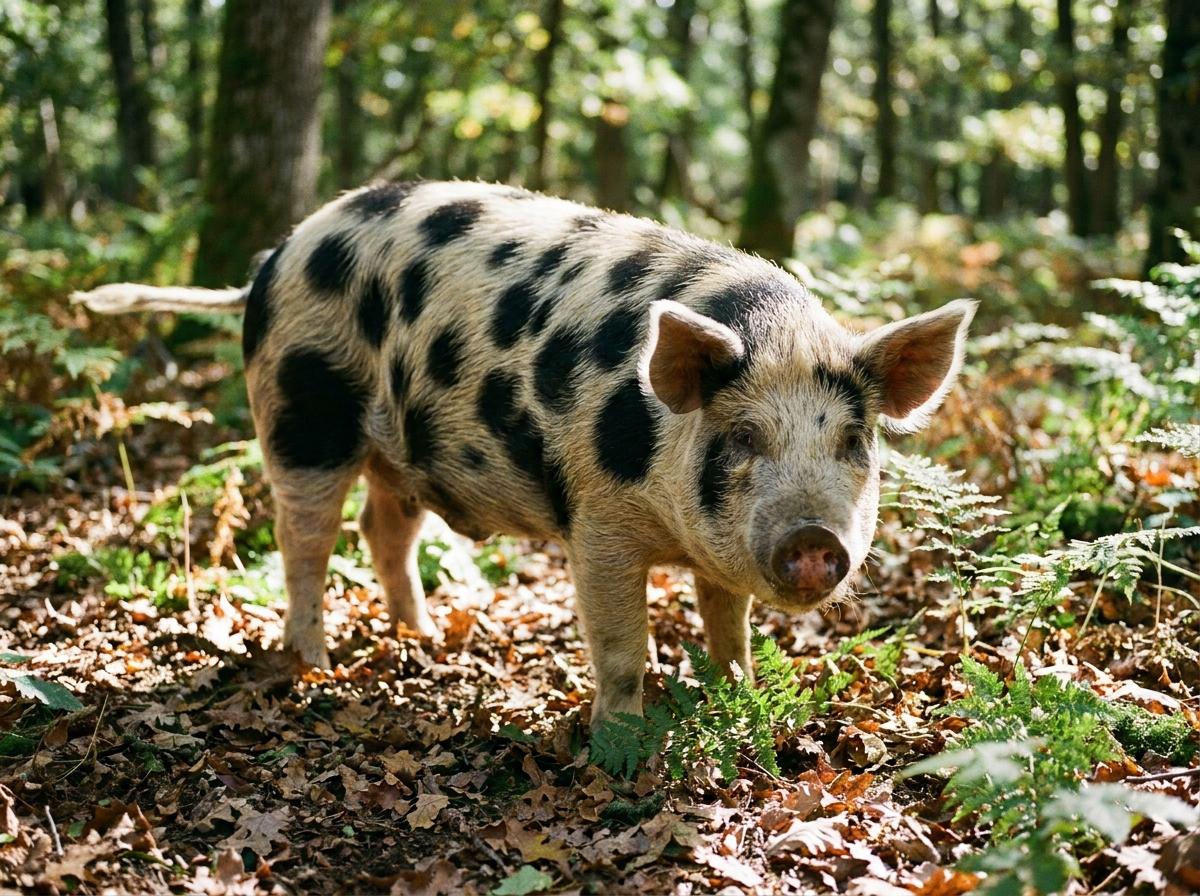
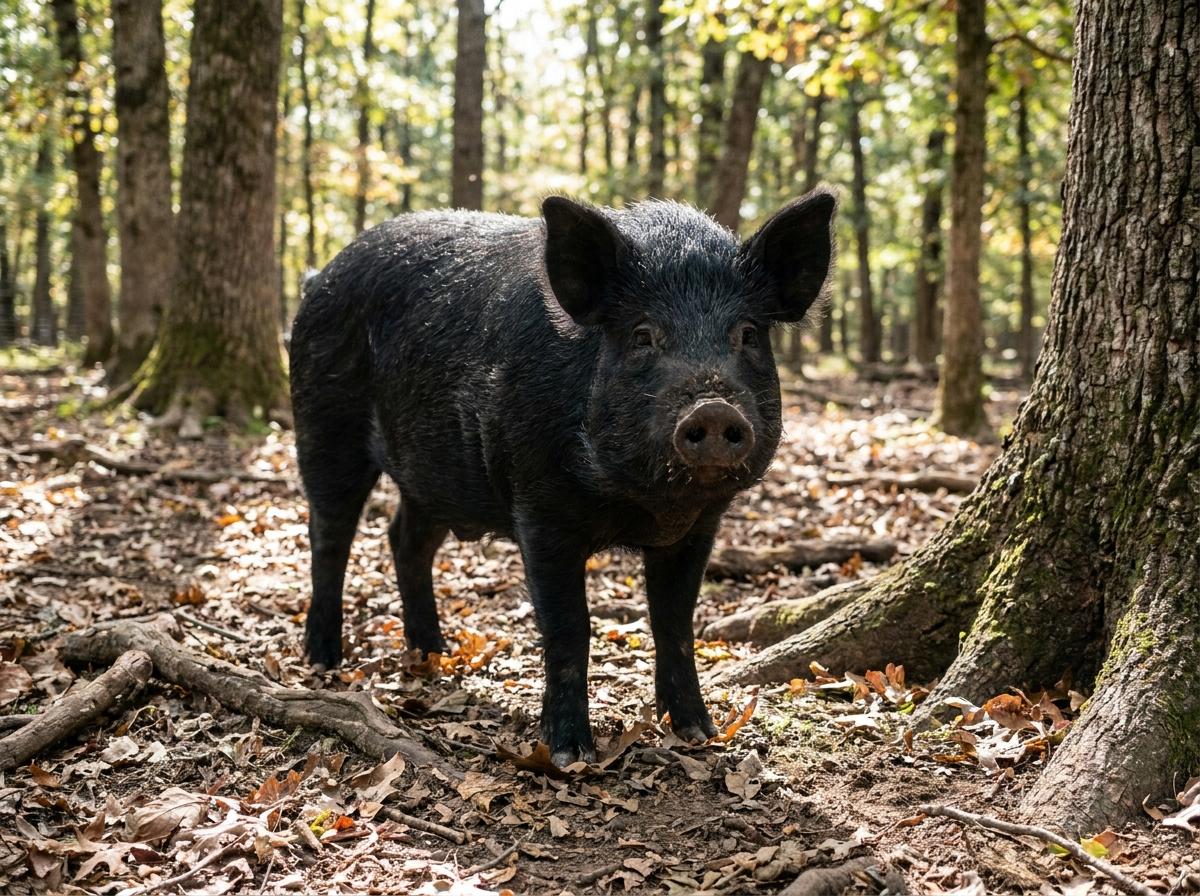
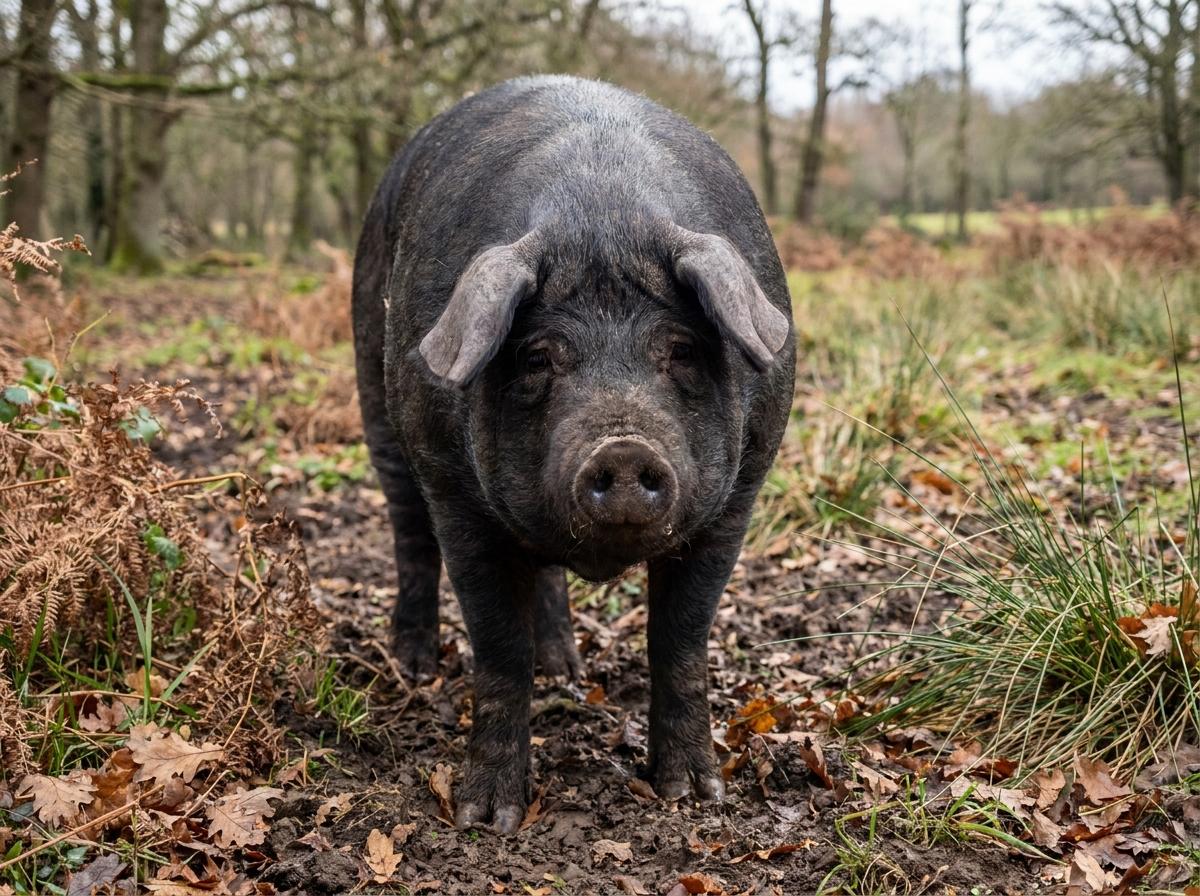
- A heavily wrinkled face and broad forehead. The facial skin is thick and folds into deep creases across the brow, around the eyes and along the muzzle, and the wrinkling deepens with age. On a mature animal this is the single most recognizable trait.
- Very large, soft, pendulous ears. They hang forward and down over the face, long enough to reach toward the corners of the mouth, and they often shade the eyes entirely.
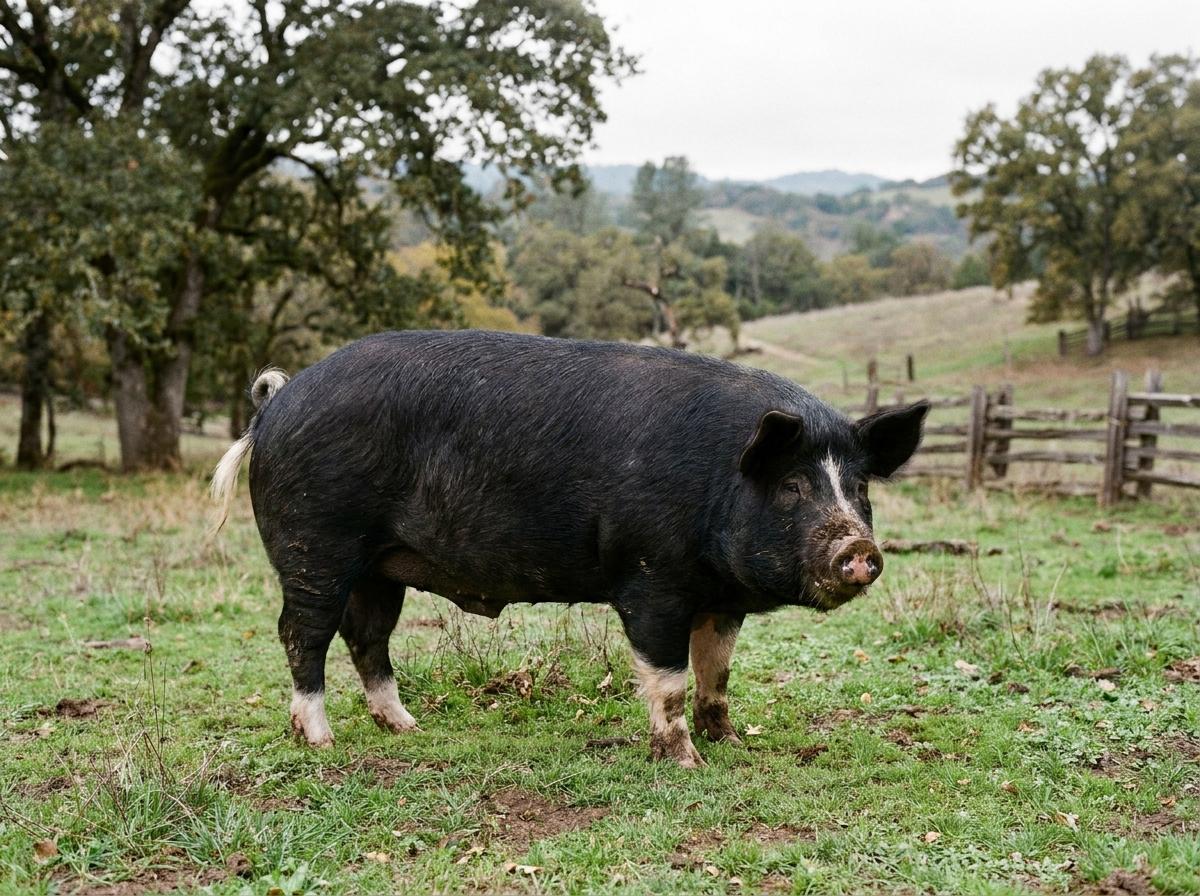
- Dark skin under sparse, coarse hair. The overall impression is black, though the American Meishan Breeders Association’s breed description records the range as light gray to dark gray. White or pink socks above one or more hooves are common and acceptable, as is pink on the nose tip and the belly up to the belt line. Full white belting, or color where the description does not allow it, is treated as a sign of probable crossbreeding.
- A deep, soft, lard-type body. Medium sized, heavy through the middle, with a sagging belly, short sturdy legs and none of the long lean loin of a modern terminal hog.
One more feature belongs with the reproduction story: teat count. The Livestock Conservancy puts Meishan sows at 16 to 18 teats and sometimes over 20, which is the equipment needed to nurse the litters this group is known for. The trait travels in crosses, too. USMARC found that pigs carrying only one eighth Meishan or Fengjing blood still averaged about half a nipple more than comparable Duroc crosses.
The reproduction numbers, and where they come from
This is the whole reason anyone outside China knows these pigs, so it is worth quoting the studies rather than the folklore.
In China. The indigenous Taihu breeds are documented at an average litter size above 15 born. The 2020 genome study of the region reports it citing He et al. 2017 rather than measuring it, so read it as the literature’s accepted number for the group, not a fresh count from any one herd.
In Western herds. Meishan sows typically farrow 14 to 16 piglets by their third litter, occasionally 20 or more, and one sow in the USDA research herd once farrowed 28. Litter size builds with parity, so a first-litter gilt is not the number to plan around.
Against a commercial breed, head to head. University of Illinois researchers compared 21 Meishan and 20 Yorkshire gilts at first farrowing: 12.4 fully formed piglets for the Meishans against 7.4 for the Yorkshires. Reviewing the wider evidence, Haley and Lee put Meishan prolificacy at about three to four piglets above control Large White females.
Why. Not simply because they release more eggs. The dominant explanation across the literature is higher prenatal survival, controlled by the sow’s own genotype rather than by the embryos’. Embryo survival does not differ from Western breeds until day 11 of gestation and then runs higher from day 12, and Haley and Lee report that Meishan sows also have greater uterine capacity than Large White sows, which lets them carry more attached embryos through to term. That is the reason breeders reach for this blood on the female side of a cross: put a Taihu-derived sow under a conventional boar and the litter-size effect largely follows the dam.
And how early. The same Illinois work put Meishan gilts at first estrus at 95 days of age, 105 days earlier than Yorkshire gilts. Meishan sows also carried more corpora lutea than Yorkshire sows at 47 days of a second gestation, 22.7 against 16.3.

The part the headline numbers leave out
Big litters are not free, and a page that only quotes the record is not being straight with you.
- Born is not weaned. The eye-catching figures are live-born counts. What matters on a farm is what leaves the farrowing house, and the Conservancy’s claim is a better weaning-to-farrowing ratio than conventional breeds in study herds, not that all 16 survive.
- The piglets are small. In the Illinois comparison, Meishan piglets averaged 0.9 kg at birth against 1.3 kg for Yorkshire. Small piglets chill fast, so dry bedding, a warm creep and attentive first-day management matter more here than with a conventional litter.
- More mummified fetuses. The same study recorded 1.86 mummified fetuses per Meishan litter against 0.05 per Yorkshire litter. It is a normal consequence of carrying a crowded uterus to term, and something to expect rather than panic over.
- Numbers vary with the herd. The Illinois authors opened by warning that Meishan ovulation and litter-size results have been widely divergent between studies depending on inbreeding, genetic diversity, age, parity and management. Treat any single figure, the ones above included, as a herd result rather than a breed constant.
What the USDA crossbreeding trials actually found
This is where most breed writing quietly stops. Between 1992 and 1998 the Meat Animal Research Center published results from the imported Chinese breeds crossed into commercial lines, and the findings are more mixed than the reputation.
- The maternal advantage is real, and front-loaded. F1 Meishan and Fengjing cross gilts reached puberty youngest and had larger litters than Duroc crosses at 60 and 100 days of gestation, at birth and at weaning. But the paper’s own conclusion was that the Chinese crosses would not be expected to have an advantage in litter size at second parity, and the follow-up at one-quarter Chinese blood found the same pattern.
- Growth pays for it. Measured against one-half Duroc females, bringing one-half Chinese females into a crossbreeding program produced progeny with roughly a 9 percent decrease in growth rate at 154 days of age, plus a smaller, non-significant drop of about 5 percent in yield of trimmed lean cuts at a constant carcass weight.
- The marbling story needs a caveat. Taihu pork has a real reputation for fine-grained, well-marbled meat and is prized on that basis in China and Japan. But in the USMARC sire comparison, barrows sired by Meishan, Fengjing and Minzhu boars produced carcasses with significantly less lean and less marbling than Duroc-sired barrows at a constant 78 kg carcass weight. That is a half-Chinese crossbred comparison at one weight, not a verdict on purebred Meishan pork, but it is the closest thing to a controlled US test there is, and it does not support treating the marbling claim as settled.
None of that makes the breed less interesting. It sharpens the use case. Taihu genetics buy you early-maturing, calm, roughage-tolerant females that fill a first litter, and they cost you growth rate and lean yield in the offspring. Whether that trade works depends on what you are selling.
Temperament, feed and management
Across the strains these are unusually quiet, docile, sedentary pigs, and the reputation is consistent enough across sources to take seriously. The Livestock Conservancy describes Meishans as extremely quiet and sedentary, sleeping much of the day, often needing waking at feeding time, and noisy only when in heat. They are also reported not to test fences and to get along with other livestock.

The other practical virtue is feed. Resistance to roughage is one of the three traits the genomics literature names as common to the group, alongside meat quality and prolificacy, and the Conservancy calls the Meishan a true grazing hog that thrives on a higher-fiber diet. In a low-input or pasture-based system that is a genuine advantage over a hog bred for a high-grain finishing ration.
That is not a license to underfeed. A sow carrying and nursing 15 piglets has enormous demands through late gestation and lactation, and she needs a balanced ration and constant clean water to hold condition and keep the litter alive. Grazing supplements a ration for a lactating sow; it does not replace one.
Two more notes. The Conservancy reports that Meishan piglets are born with more developed digestive systems than conventional pigs, which is believed to make them more resistant to piglet digestive disease and to allow earlier weaning. Treat that as a breed observation, not a proven immunity. And hardiness in a landrace means general robustness, not protection from anything specific: build parasite control, biosecurity and a herd health calendar with a veterinarian who knows your region, and take medical decisions with that veterinarian rather than from a breed page.
How big does a Taihu pig get?
Meishan boars run roughly 275 to 375 lb and sows 300 to 400 lb at maturity, and they get there slowly. This is a medium-sized lard-type pig with a soft, fatty carcass and lower lean yield than a purpose-bred modern hog, which is why Western production moved on from these breeds even after importing them. As a straight market hog it does not compete with a Duroc or a Large White. As a maternal line, a conservation animal, and a source of fat and pork for a program priced on eating quality rather than lean percentage, it earns its keep.
Conservation status, at home and abroad
The paradox of the Taihu pig is that it is world-famous among geneticists and genuinely at risk as a living farm animal.
In China, Western commercial breeds came to dominate the pork industry and the indigenous Taihu populations shrank. The genome study of the region is explicit that these breeds now face population decline, inbreeding depression and lineage admixture, and it found the Hongdenglong highly inbred with the lowest genetic diversity of the seven populations sampled. Conservation farms operate across Jiangsu and Zhejiang, with Erhualian and Meishan each kept at several sites.
In the United States, The Livestock Conservancy currently lists the Meishan as Threatened, with a population that depends on dedicated keepers. The Conservancy is also where the registry’s mechanics are set out: it describes the American Meishan Breeders Association, incorporated in Tennessee in October 2016, as holding the herd book and managing registration services, recognizing foundation pure stock through a documented chain of custody back to one of the three research herds, allowing grade “pure on appearance” registration for females only, tracking the percentage of each bloodline in an animal, making a coefficient of inbreeding available on animals with at least a three-generation pedigree, and tracking litter size as a performance criterion.
That structure exists for a reason. The three research herds spent more than twenty years in genetic isolation and were never interbred, and a USDA genetic study led by Harvey Blackburn sampled DNA from the USMARC and Iowa State herds and compared it with samples from the 1989 importation. Both had drifted from the Chinese founders and from each other. The University of Illinois herd was not sampled, and the association reports the lead researcher’s view that it is safe to assume it drifted too, so the third bloodline is a reasonable inference rather than a measurement. Both the association and the Conservancy state the conclusion plainly: there are three genetically distinct bloodlines of Meishans in the US. Only since 2016 has it been possible to cross them, which is why pedigree and bloodline percentage are what to ask about when you buy.
Can you buy a Taihu pig?
Not a fresh one, and the rule is worth understanding rather than guessing at.
Under 9 CFR 94.10, APHIS considers classical swine fever to exist in every region it has not specifically declared free, and no swine moved from or transiting such a region may be imported into the United States, aside from narrow provisions for the APHIS-defined European region and case-by-case wild swine. China has not been declared free. APHIS separately added China to its list of regions affected by African swine fever on 6 August 2018, and published the notice in March 2019; that notice records that most swine commodities from China were already restricted on the country’s classical swine fever, foot-and-mouth disease and swine vesicular disease status, which is the older mechanism doing the work here. There is no legal pipeline for fresh Taihu genetics from the source.
So the realistic path is a registered Meishan from a North American breeder, descended from the 99 pigs of 1989. Expect a small market, few sellers, waiting lists and scarcity pricing. Buyers outside the US should check their own national import rules, which differ.
What to ask before you buy
- Get the registration and pedigree in writing. Ask whether the animal is registered with the American Meishan Breeders Association, whether it is fully pedigreed or a grade “pure on appearance” female, and which of the three research bloodlines it traces to. With a founding population this small, paperwork is the difference between conserving a breed and blurring it.
- Ask for the coefficient of inbreeding. It is available on registered animals with at least a three-generation pedigree, and it is the most useful single number for a breed rebuilt from 99 founders.
- Buy the maternal traits. Choose sound, well-grown females with good teat count and calm temperament over an animal picked on wrinkles alone.
- Plan the growth curve before you plan the freezer. Expect slow growth and a fatty carcass. If lean market pork is the goal, plan the terminal cross now rather than discovering the yield at the abattoir.
- Line up a veterinarian and a biosecurity plan first. Rare-breed herds are the ones that can least absorb a disease break.
- Keep records from day one. Farrowing dates, born and weaned counts, weights and health events are what let you select and cull on evidence, and for a conservation breed they are part of protecting the population.
You can look for Taihu and Meishan pigs on the Creatures marketplace and search heritage-pig farms in the Creatures breeder directory. Because genuine stock is scarce and moves by waiting list, a saved listing alert beats checking back.
Frequently asked questions
Is the Taihu pig a single breed?
No. Taihu is a regional group from the Lake Tai area. China’s national commission recognizes six members (Meishan, Erhualian, Jiaxing Black, Fengjing, Shawutou and Mi), the main genome study of the region works with seven by adding the Hongdenglong, and other lists add the Hengjing, which the 2021 conservation study records as presently extinct.
Is a Meishan the same thing as a Taihu?
A Meishan is one Taihu breed, not the whole group. It is the one that matters in the West because it is the only member ever exported in numbers, so the two words get used interchangeably in English even though they are not the same thing.
How many piglets does a Taihu sow have?
Chinese populations of the group average above 15 born per litter. Meishan sows in the West typically farrow 14 to 16 by their third litter and occasionally 20 or more, and one USDA research sow farrowed 28. Those are live-born counts, not weaned counts.
Why are Taihu pigs so prolific?
Mainly higher prenatal survival, not a higher ovulation rate alone. More embryos make it to birth, embryo survival runs higher than in Western breeds from day 12 of gestation onward, and the effect is controlled by the sow’s own genes rather than the piglets’. Very early puberty and strong mothering complete the picture.
Can I import a Taihu pig from China?
No. APHIS treats classical swine fever as present in any region it has not declared free, and no domestic swine from such a region may enter the United States; China was also added to the African swine fever region list in August 2018. Every Taihu-type pig in the US descends from historical imports, above all the 99 Meishans of 1989.
Are Taihu pigs good for meat?
They are slow-growing, fatty, lard-type pigs with lower lean yield than modern breeds, so they do not compete as straight market hogs. Their pork is prized in East Asia for its fine grain and fat quality, but the one controlled US comparison found Chinese-sired crossbred carcasses had less lean and less marbling than Duroc-sired ones at the same carcass weight, so treat the marbling reputation as promising rather than proven.
What is a Taihu pig’s temperament like?
Calm and easy. The strains are consistently described as quiet, docile and sedentary, and the sows are attentive mothers. That is a breed tendency, not a guarantee in an individual, and a several-hundred-pound animal still deserves respect.
Do this next on Creatures
Whether you are researching the group, hunting for genuine Meishan stock, or already keeping these pigs, Creatures is the records, marketplace and directory layer to run it in one place.
Compare the breed. See how the Taihu group sits against other pigs on the Creatures pig hub, and read the Meishan breed page for the member you are most likely to actually meet.
Find stock. Browse Taihu and Meishan pigs on the marketplace and search trusted heritage-pig farms in the Creatures breeder directory. New to searching? See saving searches and using your watchlist.
Get alerted. Genuine stock is rare and moves by waiting list, so set a free Taihu pig listing alert and we will tell you when one is posted. No account needed to start.
Add your pig. Already keeping Taihu or Meishan pigs? Create a free animal profile in a few minutes, no account needed to start. The walkthrough is in adding an animal to Creatures.
Track litters and health. Record farrowings, born and weaned counts, and health events on Creatures. The record sheet opens for any visitor to look around, and a free account saves what you enter. See adding a record and health and medical records for the how-to. For a conservation breed, those numbers are the pedigree.
List your farm. Raising a conservation herd? Add your breeder profile and get listed in the breeder directory so buyers searching for this hard-to-find breed can reach you. Running it with family or staff? Read creating an organization and adding your team.
Sell weaner pigs or breeding stock. Learn how seller payout works before you list your first litter.
If you already run a herd, you can also list your farm in the Creatures directory so buyers hunting for this breed can find you instead of giving up.