

Husumer or Danish Protest Pig
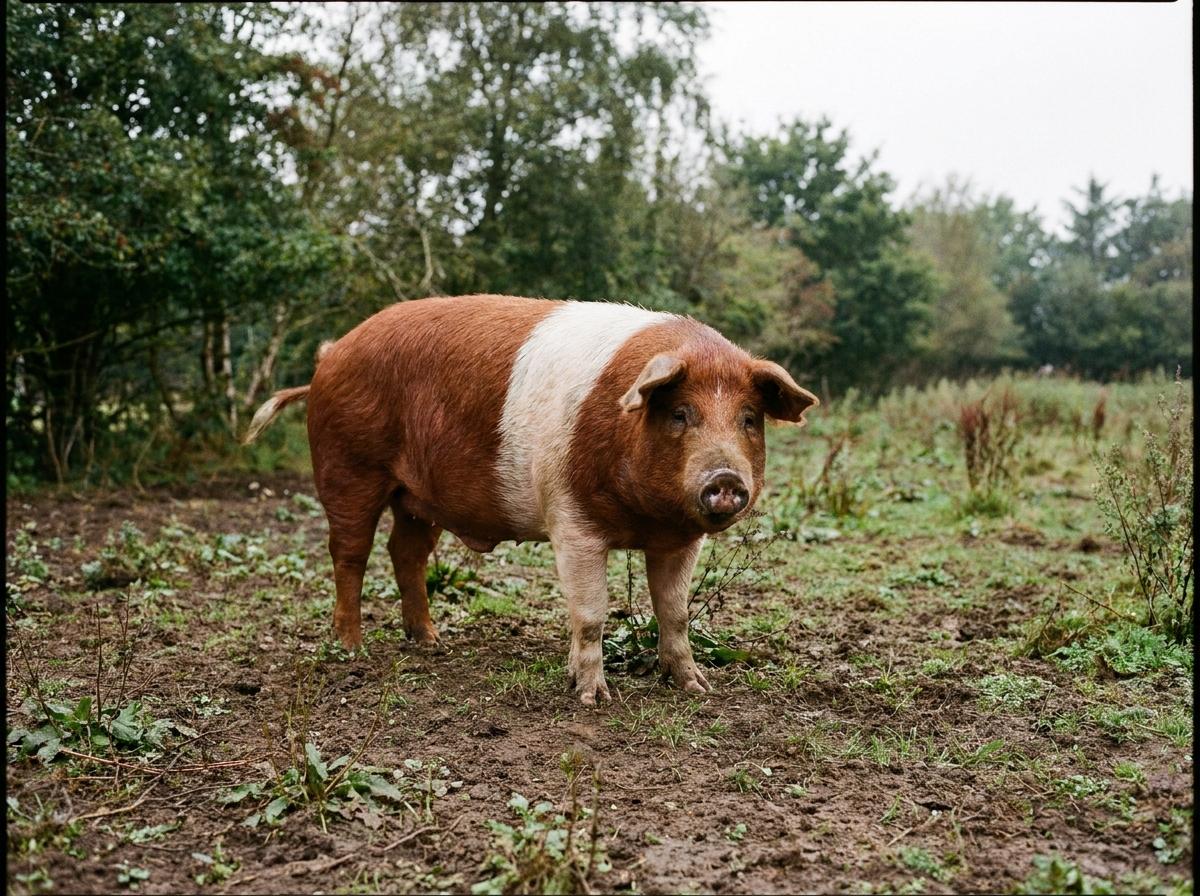
The Husumer, better known as the Danish Protest Pig, is a rare red pig with a broad white belt across its shoulders and forelegs, bred in the 19th century to look like the Danish flag. Despite the “Danish” nickname, it is a German breed from the town of Husum in North Frisia, Schleswig-Holstein, where Danish-minority farmers reportedly bred the red and white coloring as a quiet act of protest after Prussian authorities banned flying the Dannebrog. Today it is one of Europe’s rarest pigs, kept alive almost entirely by German zoos and conservation farms. Be wary of the specific headcounts that circulate for this breed: the figures repeated online do not trace to a current Husumer-specific inventory, and at least one widely quoted herdbook count actually belongs to a different breed, the Angeln Saddleback. What the conservation bodies do say is unambiguous enough without a number attached. This page covers where the breed really comes from, how to tell it apart, what it is like to keep, how endangered it is, and the honest reality of trying to find one.
Browse listings, public profiles, breeders, or add your animal.
What is the Husumer, or Danish Protest Pig?
The Husumer is a heritage German pig breed named for the port town of Husum on the North Frisian coast of Schleswig-Holstein. In German it is the Rotbuntes Husumer Schwein, which translates roughly to “red-pied Husum pig,” and its formal herdbook designation places it as a red variant of the German Saddleback (Deutsches Sattelschwein, Abteilung Rotbuntes Husumer Schwein). The nickname that carries it around the internet, the Danish Protest Pig, comes from history rather than nationality: the animal is German, but its story is bound up with the Danish minority that has lived in the border region for centuries.
The “Danish” label trips people up, so it is worth settling straight away. The breed was developed and is still maintained in Germany. What is Danish about it is the cultural gesture behind its markings, and the community that first favored them. If you are comparing pig breeds more broadly, the Creatures pig species page is a good place to see where this one sits among the more common commercial and heritage hogs.
The Husumer belongs to the saddleback family of pigs, animals with a band of light color wrapping a darker body. What makes it unusual is that the belt was selected not for production or fashion but for what it symbolized. That makes this one of the few livestock breeds whose defining trait is essentially political.
The protest-pig story
The history sits in the aftermath of the 19th-century wars over Schleswig. After the Second Schleswig War in 1864, Prussia and Austria took control of the duchies of Schleswig and Holstein, and the Prussian administration cracked down on Danish national symbols, including public display of the Danish flag, the Dannebrog. The Dannebrog is a white Nordic cross on a red field, so a red animal carrying a bold white cross-stripe reads, at a glance, like the flag itself.
According to the traditional account, Danish-minority farmers in the region leaned into red and white pigs precisely because the colors matched their national flag and could not be confiscated the way a banner could. A pig grazing in a paddock was just a pig. The historical footing here is real if modest: a police report from Husum dated 1881 records that Danish farmers were keeping red and white striped pigs, which is about as close to documentary evidence as a livestock legend usually gets. Whether every family that kept one intended a protest is impossible to know, but the coloring, the community, and the timing all line up, and the “protest pig” name stuck.
The animals were bred up into a recognizable regional type over the following decades and were formally entered into the herdbook in 1954. By that point they were valued as a hardy local farm pig as much as a cultural emblem.

How the breed was actually created
The romantic version is that farmers “bred a flag.” The genetic version is a bit more ordinary and more interesting. The Husumer came together from a few North German sources rather than a single designed lineage. Its foundation includes black and white spotted marsh pigs from Holstein and Jutland, the local landrace stock of the coastal marshes, crossed toward red. Around 1916 and 1917, red and white pigs appeared as color variants (splits) out of the Angeln Saddleback, a neighboring Schleswig-Holstein breed. To deepen and fix the red, breeders then crossed in the English Tamworth, a famously ginger-red breed prized for exactly that pigment.
So the Husumer is best understood as a red-pied offshoot of the Angeln Saddleback, sharpened with Tamworth red and built on native marsh-pig hardiness. Two of those ancestors have their own Creatures pages worth a look if you follow heritage lines: the Tamworth pig and the Angeln Saddleback. The white belt was the trait the community cared about; the rest of the animal is honest North German farm pig.
What a Husumer pig looks like
The markings are the whole point of this breed, so they are also the easiest way to identify one.
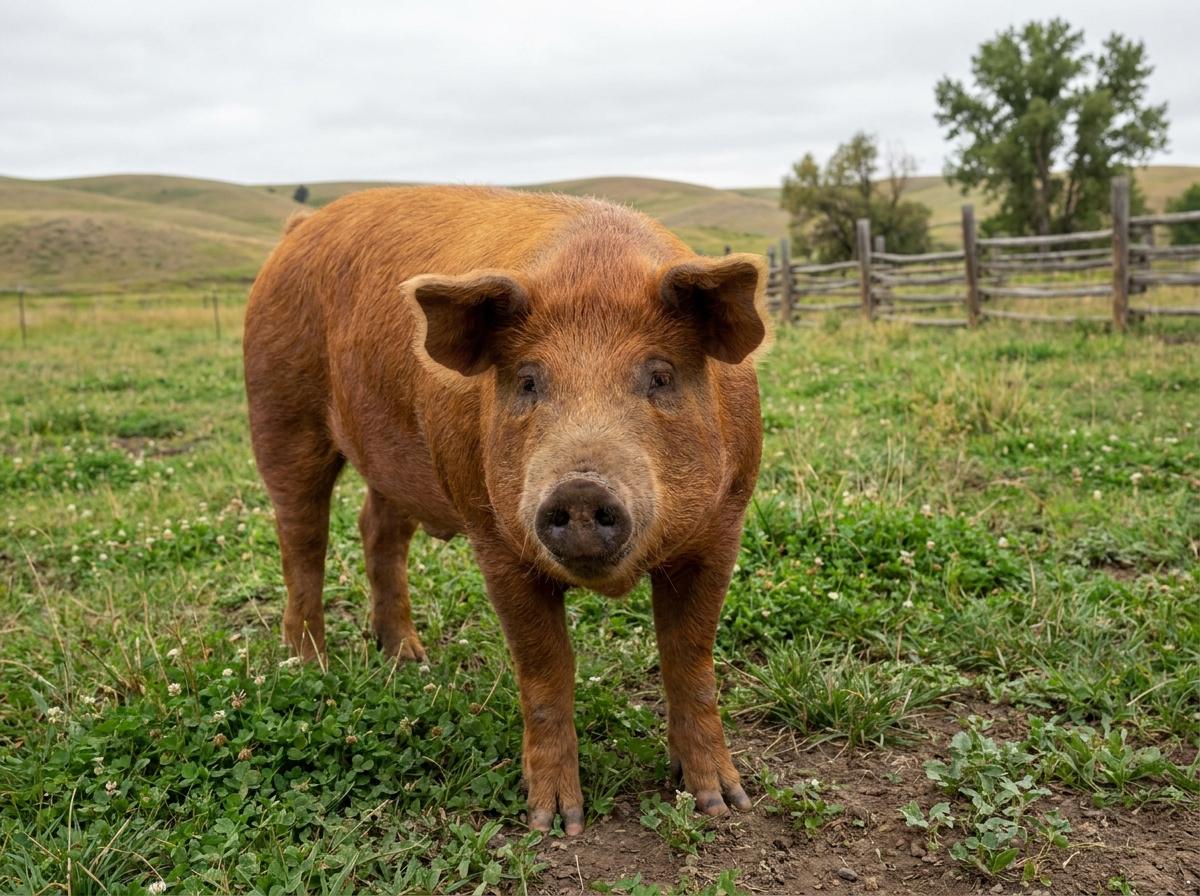
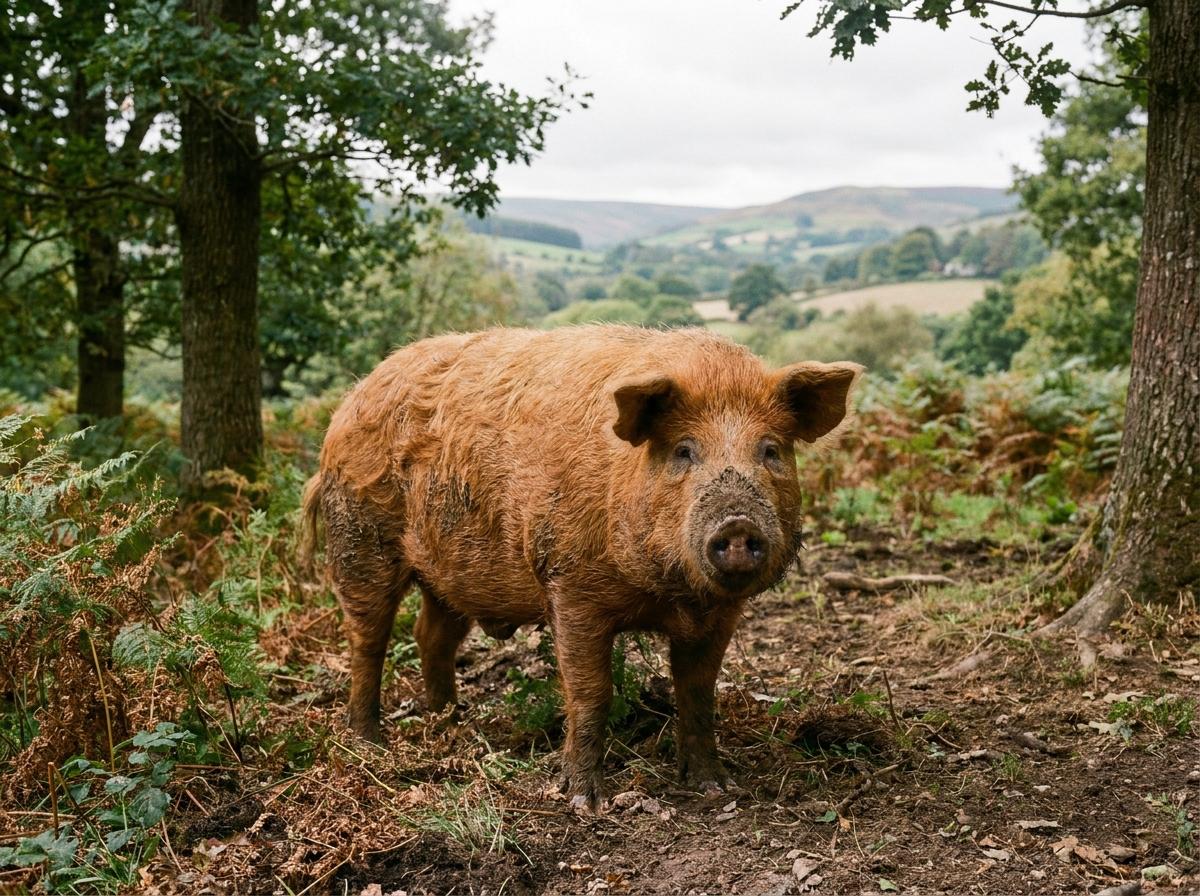
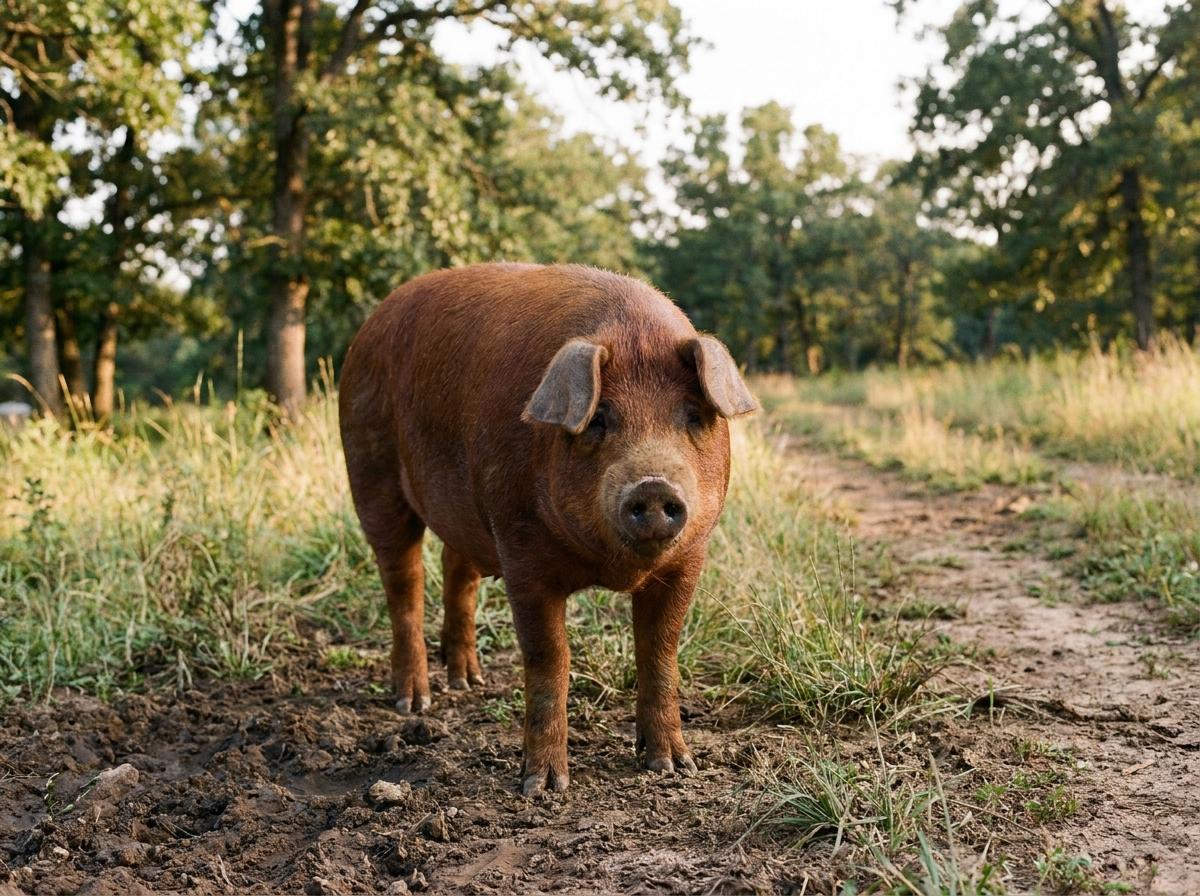
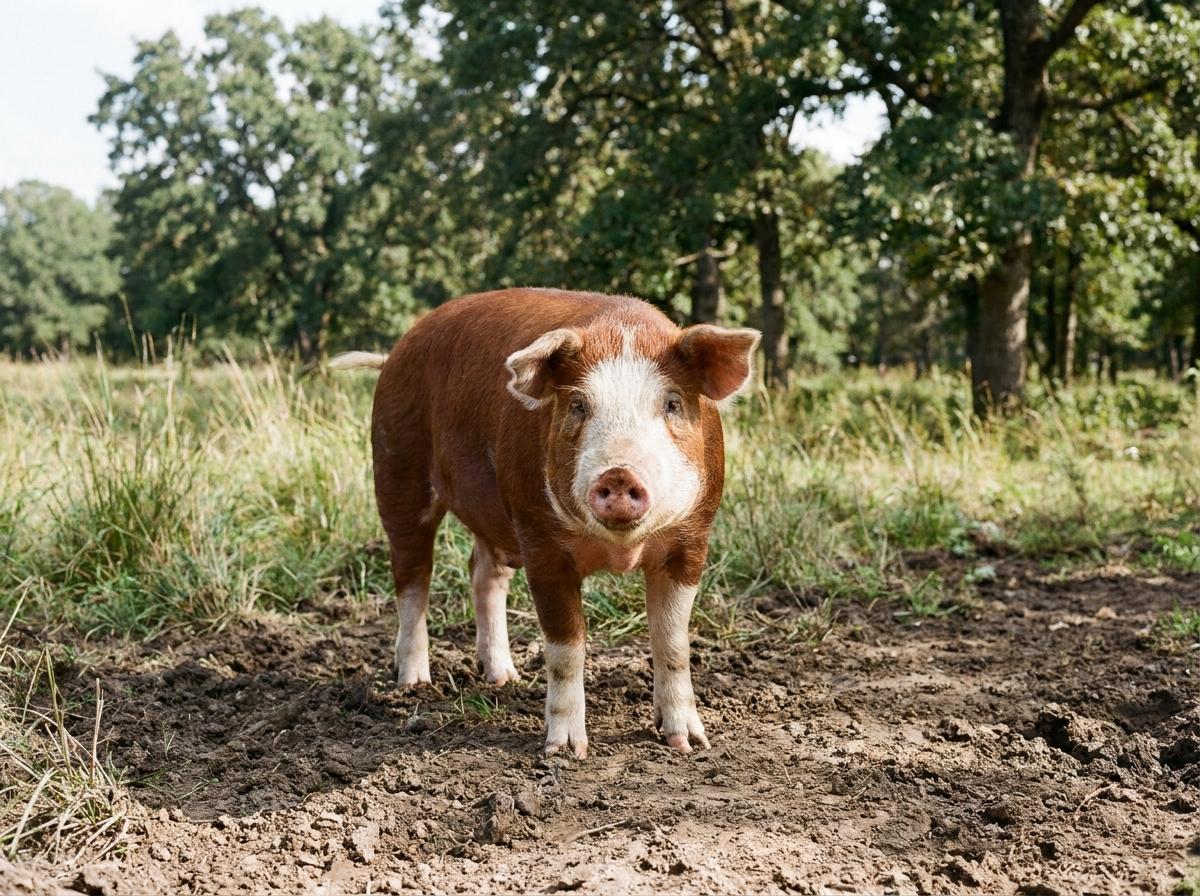
- Red body with a white saddle. The head, neck, rump, and hindquarters are a solid reddish coat, and a broad white band wraps vertically over the shoulders and continues down the forelegs. On a well-marked animal the white forms a clean cross over a red ground, which is exactly the resemblance to the Dannebrog that gave the breed its name.
- Lop ears. The ears are medium sized and hang forward, drooping rather than pricked straight up, a trait inherited from its saddleback and marsh-pig background.
- A long, deep, sturdy frame. This is a full-sized farm hog, not a miniature or pet pig. The body is long and well muscled with the heavy build of a traditional lard-and-meat type.
- A denser coat than modern pigs. Older animals, boars especially, grow noticeably heavier hair, part of what makes the breed comfortable living outdoors year round.
One honest caveat that the breed’s own conservation groups make plainly: because the breed passed through a genetic bottleneck (more on that below), today’s Husumers were rebuilt from crossbred foundation animals selected to match the historic standard rather than descending unbroken from it. The type is consistent and the markings are the real thing, but this is a reconstructed heritage breed, not an untouched relic line.
Size and build
The Husumer is a large pig. Boars stand around 92 cm at the shoulder and can reach roughly 350 kg, while sows stand a little lower, around 85 cm, at roughly 300 kg. Those are mature weights for well-grown breeding animals rather than typical slaughter weights.
Growth is deliberately slow by modern standards. A Husumer reaches about 100 kg live weight only after roughly eight to twelve months, whereas intensively bred commercial hybrids hit market weight far faster. That slow, fatty growth is exactly why the breed was pushed aside by high-performance pigs in the postwar decades, and, as it turns out, exactly why a niche of farmers value it again now.
Temperament and hardiness
The reason conservators enjoy keeping Husumers has little to do with the flag and a lot to do with how easy they are to live with. Across German breed descriptions the same words come up: vital, robust, undemanding (genügsam), winter-hardy, stress-resistant, and calm. Sows are noted for strong, reliable mothering when kept in conditions that suit them.
The hardiness is not marketing. The breed carries a thick fat layer that makes it relatively insensitive to cold, and it is described as well suited to extensive outdoor and pasture husbandry, the kind of low-input, plenty-of-space keeping that many modern pig breeds cannot handle. A Husumer is happy rooting a paddock in weather that would stress a leaner commercial hog. Temperament always varies with the individual animal and with handling, and a 300 kg sow with piglets deserves respect regardless of how placid the breed reads on paper, but as heritage pigs go this is a genuinely good-natured, low-drama animal.

What the breed is used for today
The Husumer is primarily a meat pig, and increasingly a conservation and direct-marketing one. Its slower growth and higher fat produce well-marbled, flavorful pork, which is precisely the quality that suits farmers who sell meat directly to customers rather than into commodity channels. The breed is a recognized passenger on the Slow Food Ark of Taste (Arche des Geschmacks), the catalogue of traditional foods and breeds at risk of disappearing, which reflects that culinary interest.
In practice, most Husumers today live one of two lives. Some are kept by zoos and heritage parks as living exhibits of a regional breed with a memorable backstory. Others are raised on small farms and Arche (ark) farms that finish a handful of animals a year for regional, farm-gate pork and, just as importantly, keep the breeding population alive. Several German federal states offer conservation subsidies for keeping recognized rare pig breeds like this one, which helps make the slow economics work.
Just how rare is it?
Very. The Husumer nearly vanished entirely. The last sow shown with a litter was recorded at Rendsburg in 1968, after which the breed was considered extinct. Pigs matching the description resurfaced in Berlin in 1984, and a dedicated breed association formed that same year to rescue what remained. A conservation society, the Förderverein Rotbuntes Husumer Schwein, was established in 1996 at Hof Lütjensee to organize registered pure breeding.
Precise population figures for this breed need to be handled carefully. A count of “about 140 worldwide” circulates widely, and a herdbook figure of roughly 22 boars and 94 sows is often attached to the Husumer, but that breeding-stock count belongs to the Angeln Saddleback rather than to this breed, and Slow Food Germany indicates the Husumer’s own numbers are lower still. Neither figure traces to a current, dated, Husumer-specific official inventory, so this page does not repeat them as fact. What the authorities do state is clear: Germany’s rare-breed conservation body, the Gesellschaft zur Erhaltung alter und gefährdeter Haustierrassen (GEH), classes the breed as extremely endangered, its most severe category, and the Food and Agriculture Organization has previously listed its status as critical. If you need a hard number, the GEH Red List is the place to look for the current year’s figure rather than any secondhand total. Breeding groups are maintained at institutions such as the Berlin Zoological Garden, Hanover Zoo, and the Tierpark Arche Warder near Kiel, along with a scattering of private ark farms, and the state of Schleswig-Holstein supports the effort for its cultural value.
Numbers that low mean the breed lives or dies on the coordination of a small circle of committed keepers. That is the ordinary reality for a lot of heritage animals. If you find the conservation angle compelling, other rare and unusual creatures on Creatures are documented the same careful way, from the mosaic axolotl to the Gull Dong; rarity always comes down to a handful of people keeping careful records.
Can you actually own one?
Honestly, for most readers, probably not, and it is better to say so plainly than to pretend otherwise.
The entire global population is concentrated in Germany, spread across zoos, conservation parks, and a small number of registered ark farms. There is no meaningful pool of these pigs in North America, and importing live breeding swine across borders is tightly regulated on animal-health grounds, so the idea of shipping in Husumer genetics is not a realistic path for a hobby farmer. If you are outside Germany and set on this exact breed, temper expectations: you are far more likely to admire one at a heritage park than to buy one.
If you are in the breed’s home region, the route in is the conservation network rather than a classifieds ad. Serious keepers work through the breed’s Förderverein and the GEH to source registered animals, because with a population this small every mating is planned to manage genetic diversity, and paperwork and lineage genuinely matter. A responsible seller will talk to you about the herdbook, the animal’s line, and the commitment to breed it on, not just hand over a weaner.
For anyone drawn to the type rather than the exact breed, the more attainable move is to look at the Husumer’s relatives and other saddleback and heritage hogs, which offer similar hardiness and outdoor suitability with a far larger available population. You can browse pigs on the Creatures marketplace and search keepers and farms in the Creatures breeder and farm directory to see what heritage stock is actually available near you.
Frequently asked questions
Is the Danish Protest Pig actually Danish?
No. It is a German breed from Husum in Schleswig-Holstein. The “Danish” name comes from the Danish minority in that border region and the story that they bred the red and white coloring to resemble the Danish flag after Prussian authorities banned flying it.
Why is it called a protest pig?
Because the coloring is said to have been a workaround for a flag ban. After 1864, displaying the Dannebrog was suppressed under Prussian rule, and a red pig with a bold white cross-stripe evoked the flag without being one. A Husum police report from 1881 documents local Danish farmers keeping red and white striped pigs.
How big does a Husumer pig get?
It is a large pig. Boars reach about 92 cm at the shoulder and up to roughly 350 kg, and sows about 85 cm and roughly 300 kg. It grows slowly, reaching around 100 kg live weight only after about eight to twelve months.
How many Danish Protest Pigs are left?
Fewer than almost any other European pig breed, but treat the specific totals you see online with suspicion. The commonly repeated “about 140 worldwide” does not trace to a current official Husumer inventory, and the herdbook count of roughly 22 boars and 94 sows that often accompanies it belongs to the Angeln Saddleback, not this breed. German and international conservation bodies classify the Husumer as extremely endangered; for a current figure, check the GEH Red List directly.
What are Husumer pigs used for?
Mainly meat, prized for well-marbled, flavorful pork from its slower growth and higher fat, and increasingly for conservation. It is on the Slow Food Ark of Taste and is raised on small ark farms that market pork regionally while keeping the breeding population alive.
Are they good pigs to keep?
For the right keeper, yes. They are calm, hardy, undemanding, and well suited to outdoor pasture life, with good mothering. The catch is availability: outside Germany they are almost impossible to obtain, and even within the region they are sourced through the conservation network rather than casual sales.
Do this next on Creatures
Whether you are researching this rare breed, tracking heritage pigs generally, or already keeping saddleback hogs, Creatures is the records, marketplace, and directory layer to do it in one place.
Find heritage stock. Genuine Husumers are confined to Germany, but you can browse Husumer and heritage pigs on the marketplace and search keepers and farms in the Creatures directory. New to searching listings? See saving searches and using your watchlist.
Get alerted. This breed almost never comes up for sale, so set a free Husumer listing alert and Creatures will tell you if one is ever posted. No account needed to start.
Add your pig. Already keeping Husumers or other saddleback hogs? Create a free animal profile in a few minutes. The walkthrough is in adding an animal to Creatures.
Track breeding and health. With a population this small, records are everything. Log litters, weights, and health records on Creatures. The record sheet opens for any visitor to look around, and a free account saves what you enter. See adding a record and health and medical records for the how-to.
List your farm. Run an ark farm or conservation herd? List your operation on Creatures so people searching for this hard-to-find breed can reach you, and read getting listed in the breeder directory and creating an organization and adding your team if you manage the herd with others.