
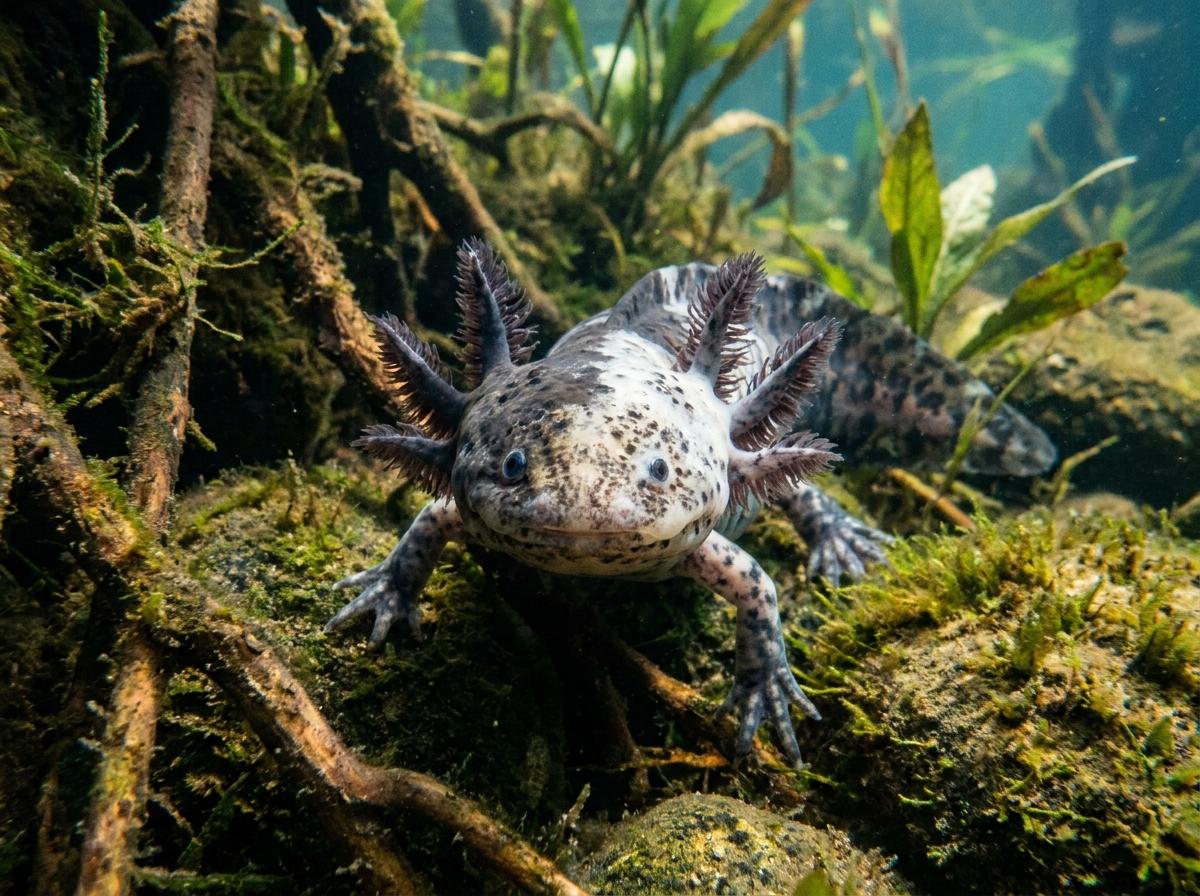
Mosaic
Morph
Author: Elliott Garber, DVM · Updated
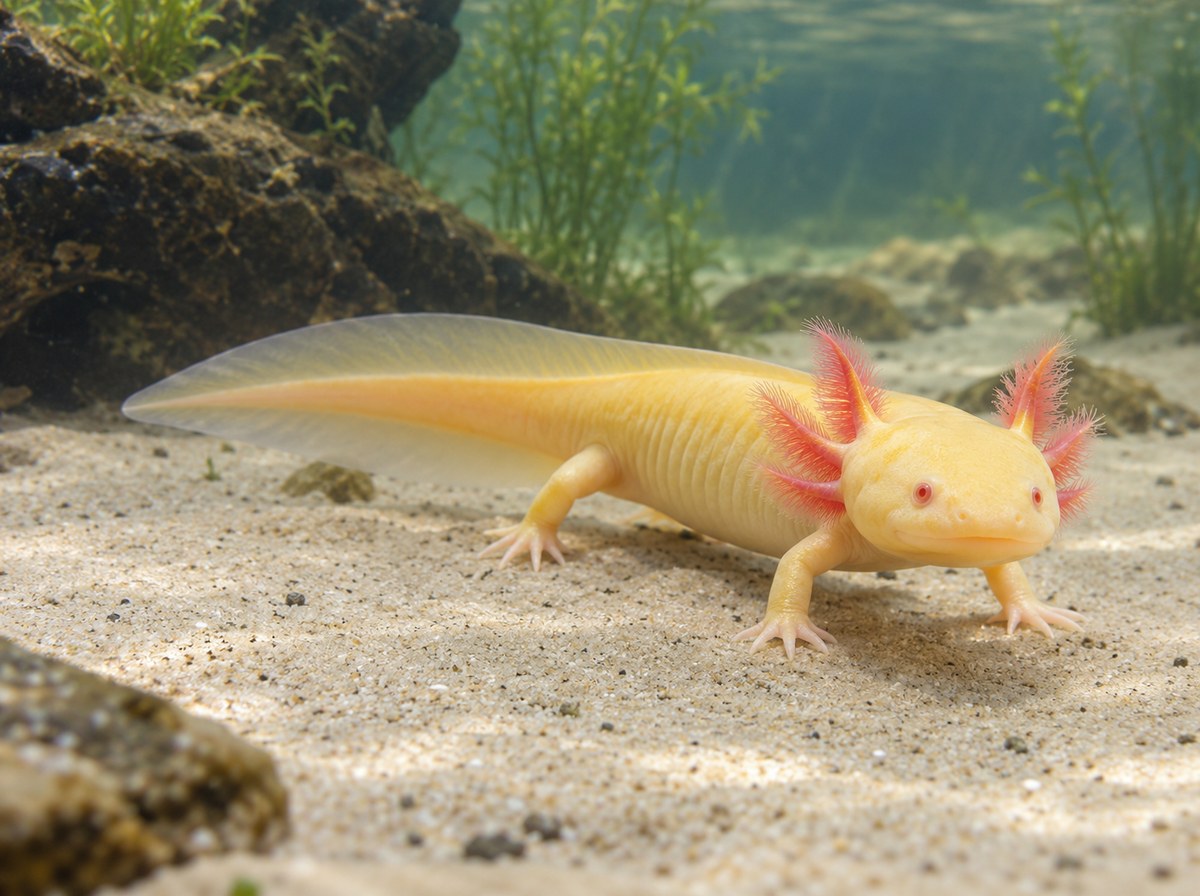
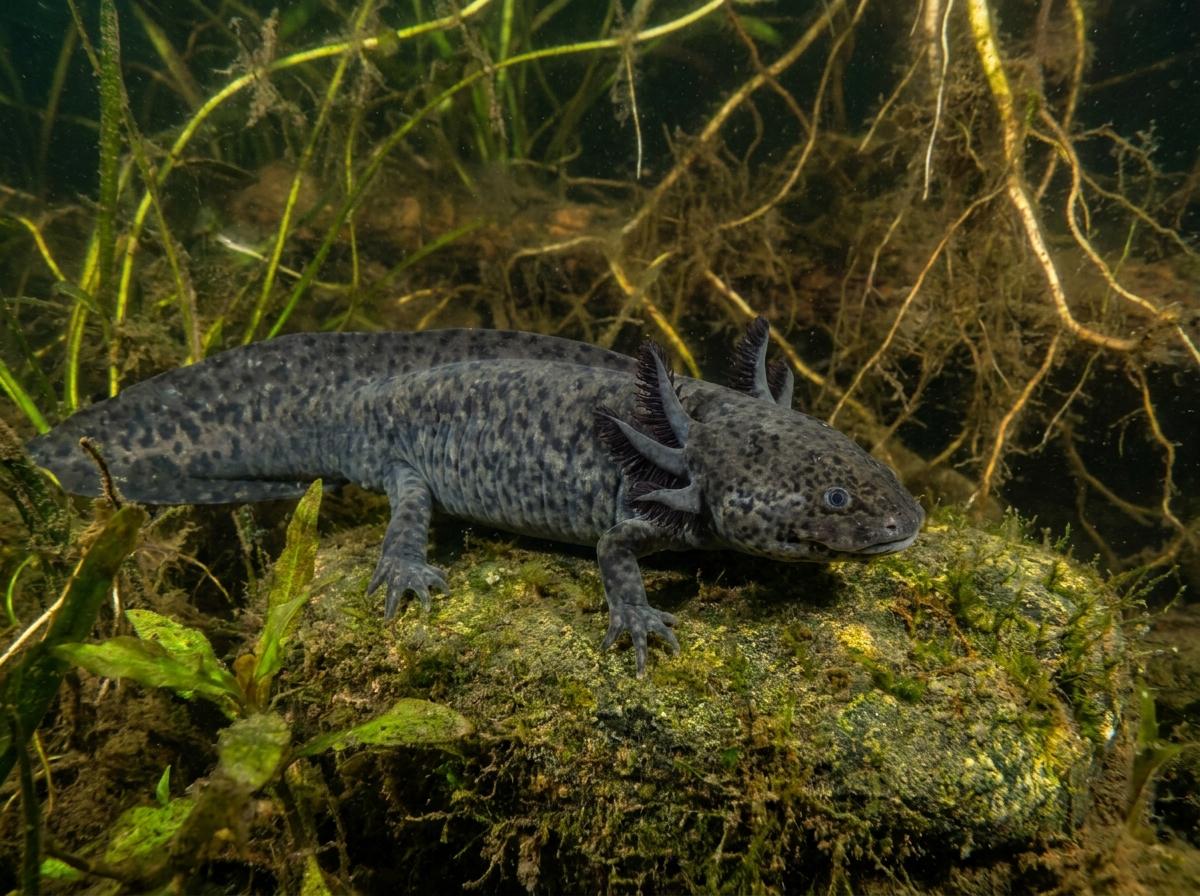
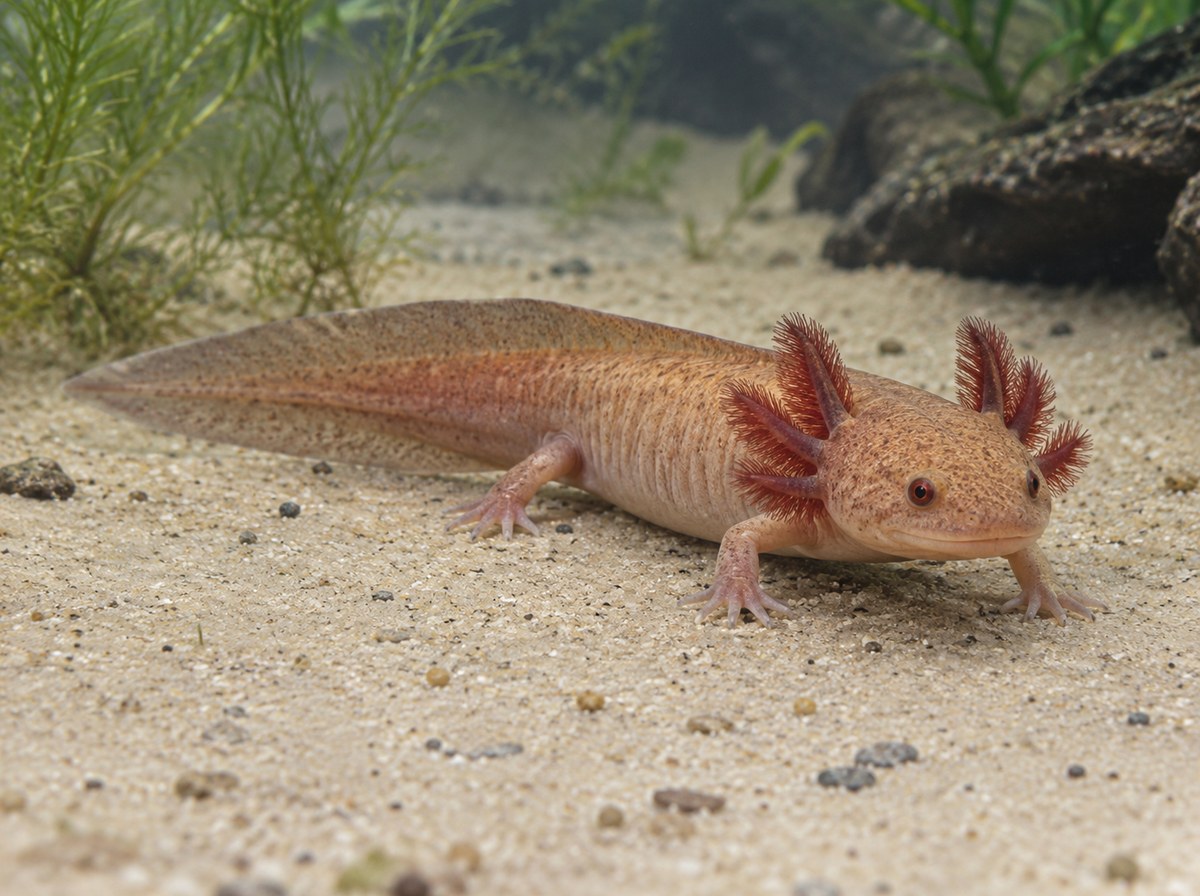
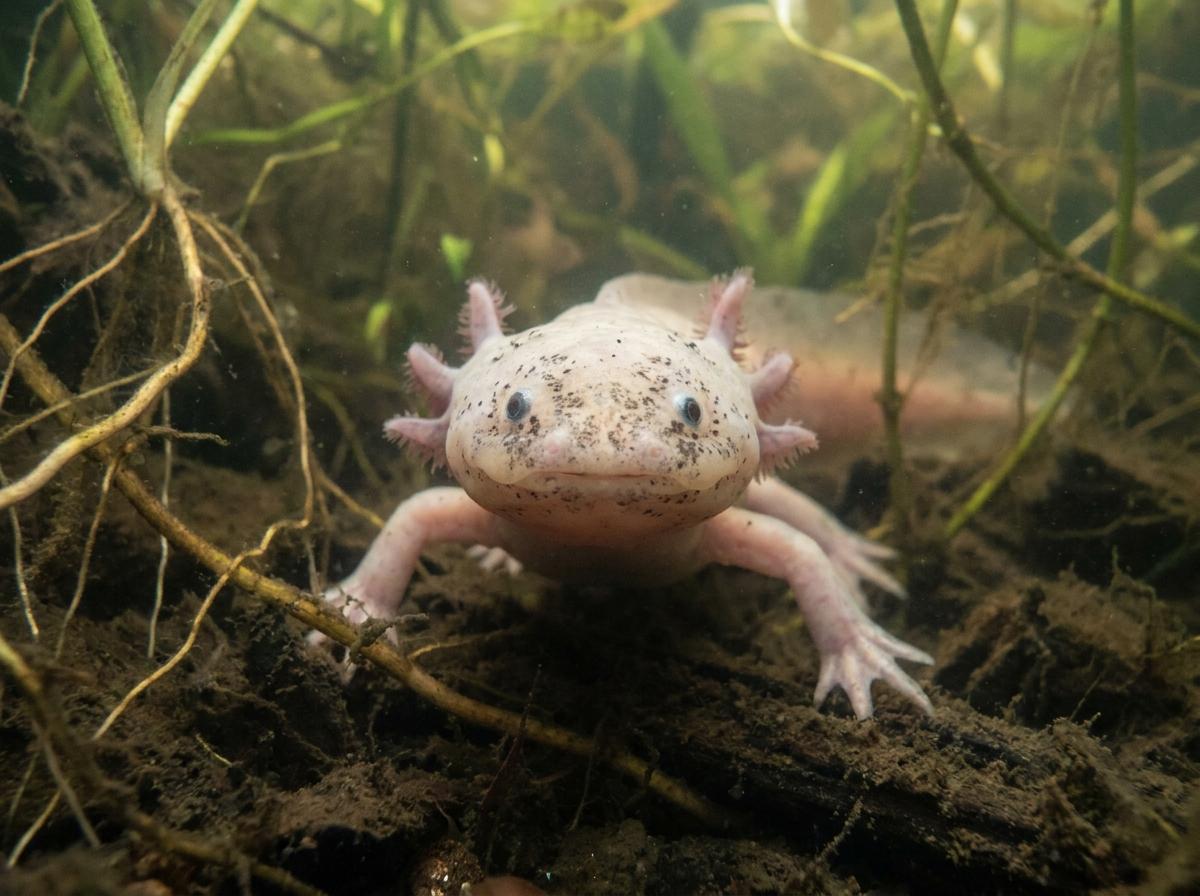
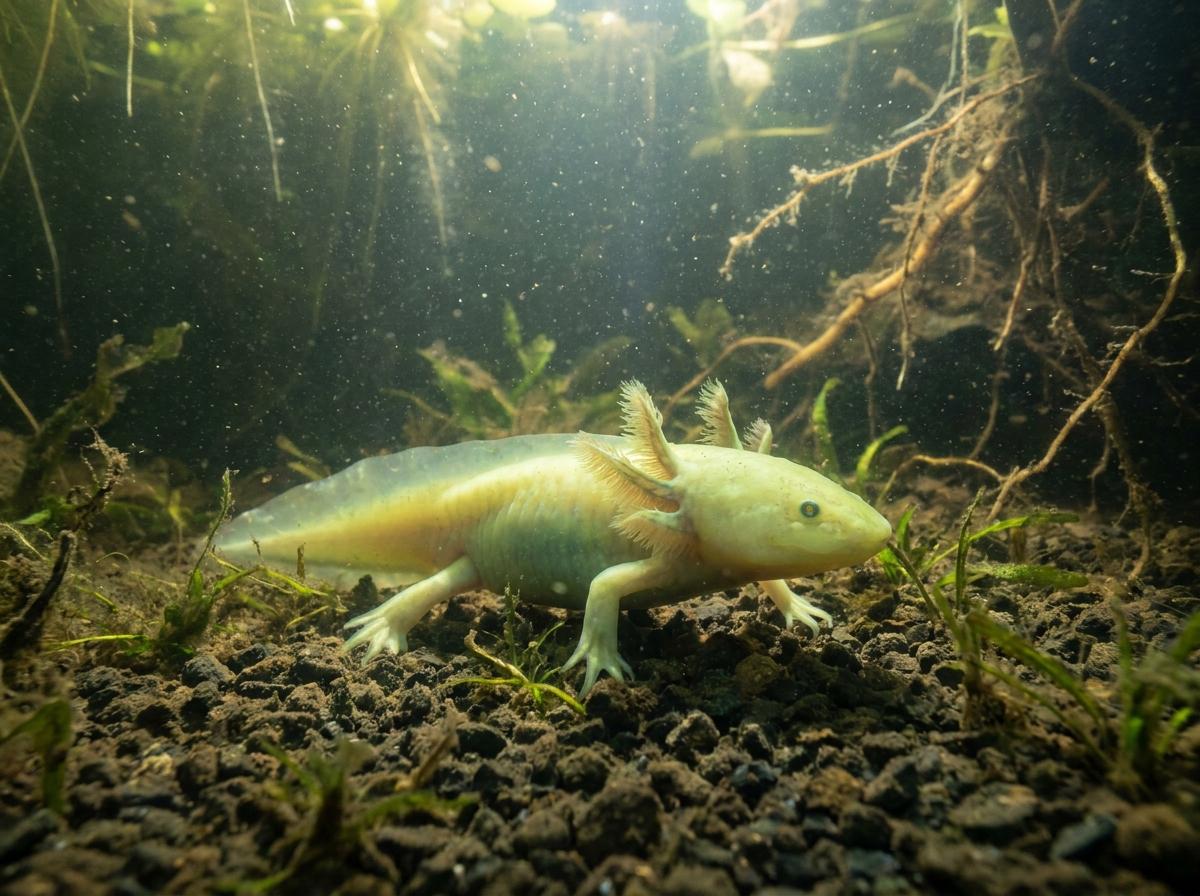
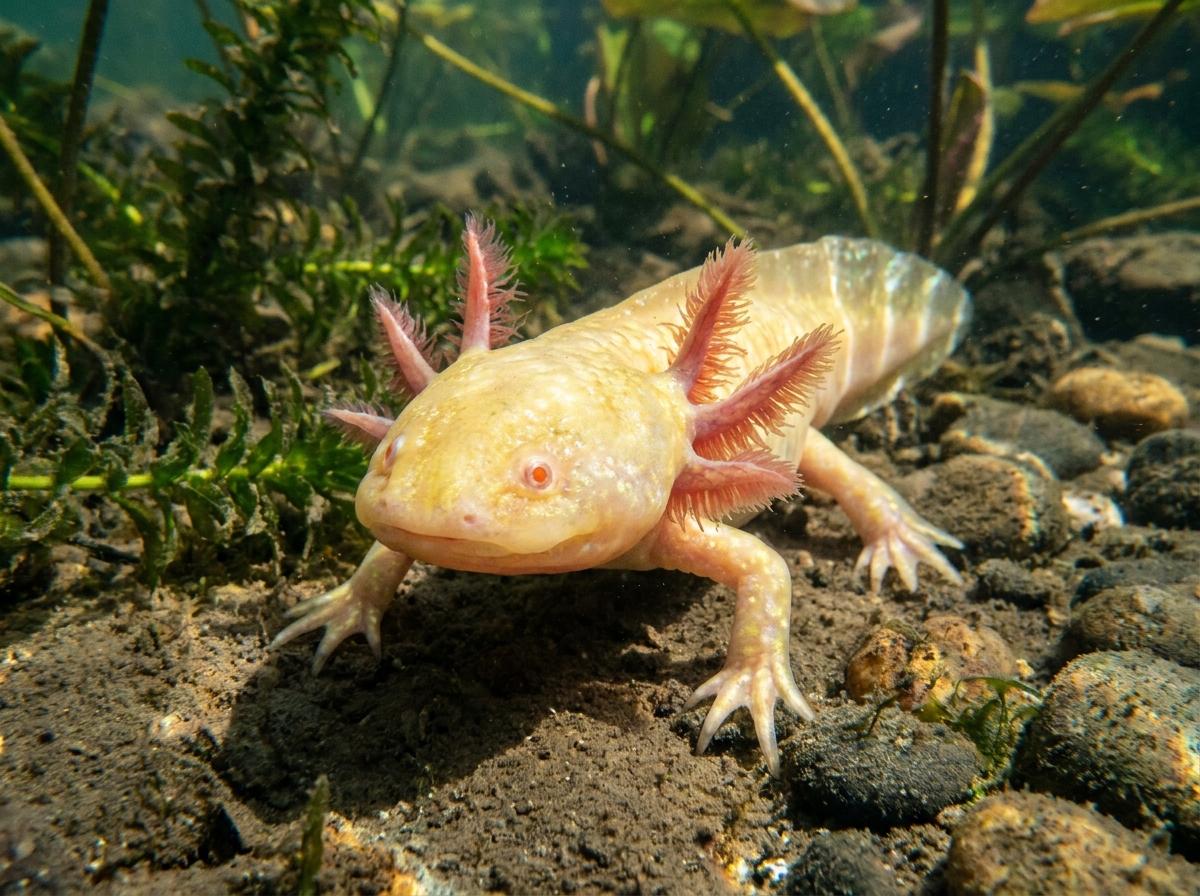
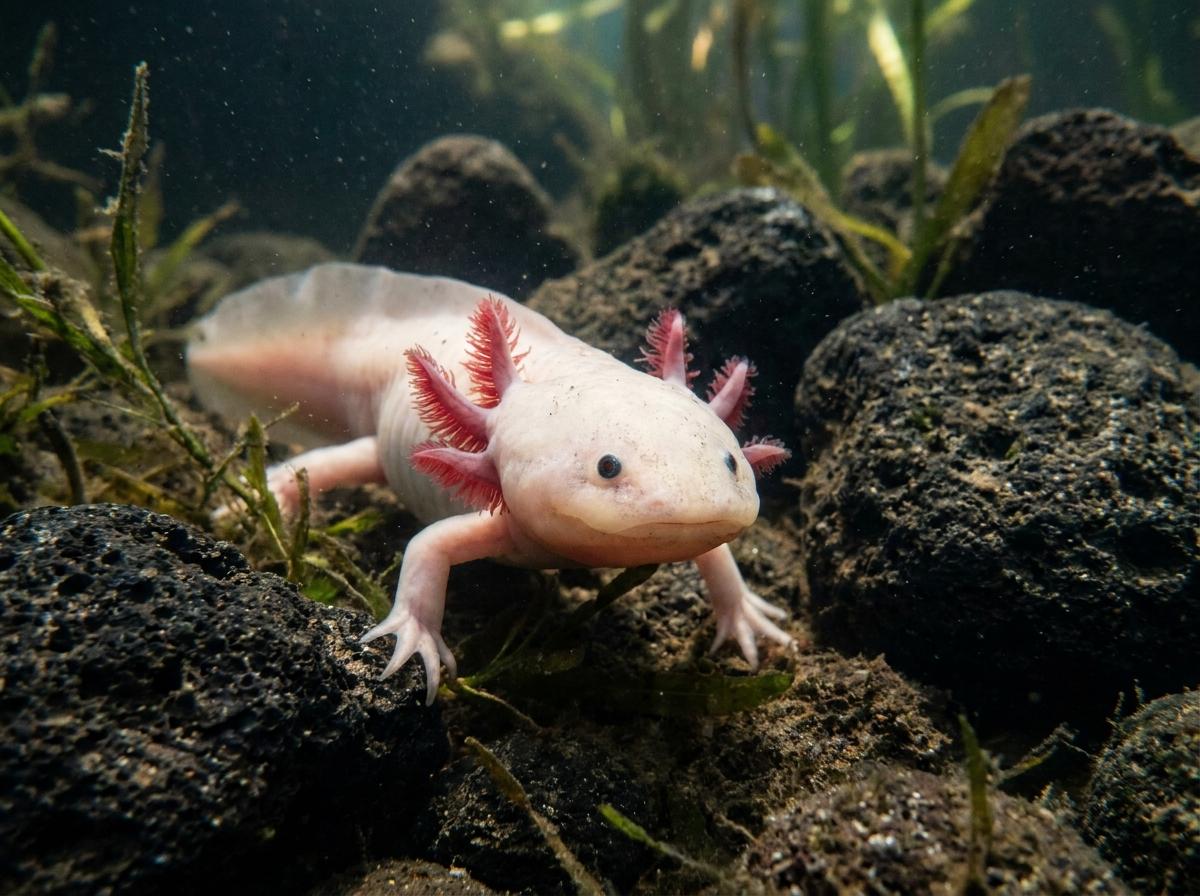
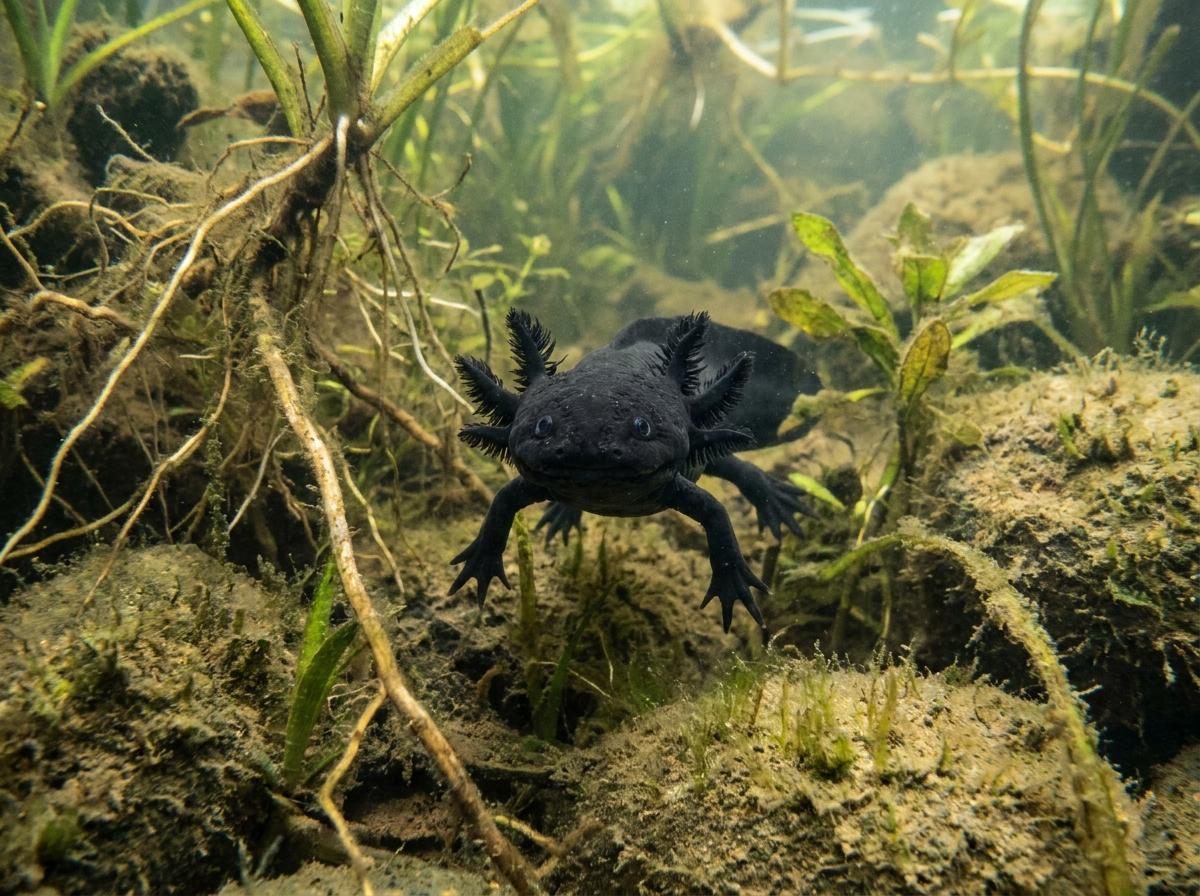
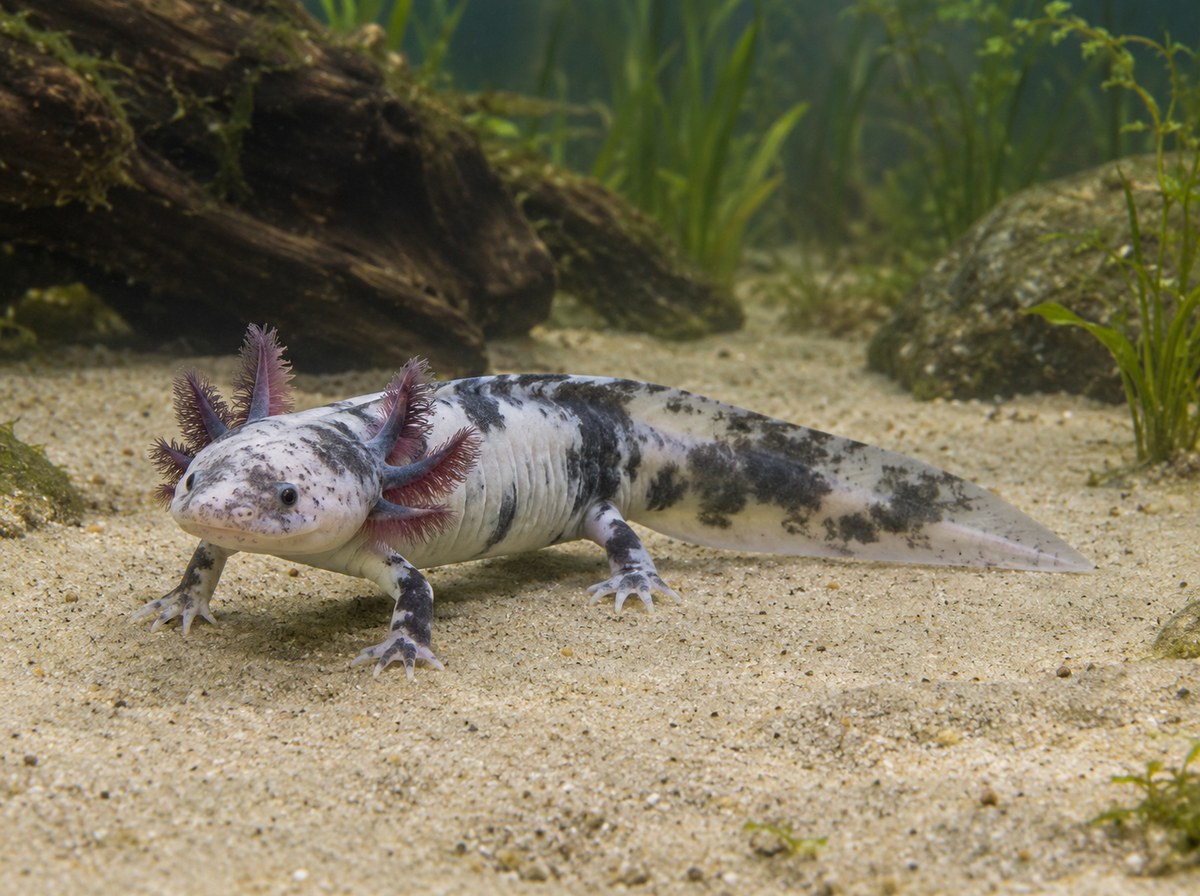
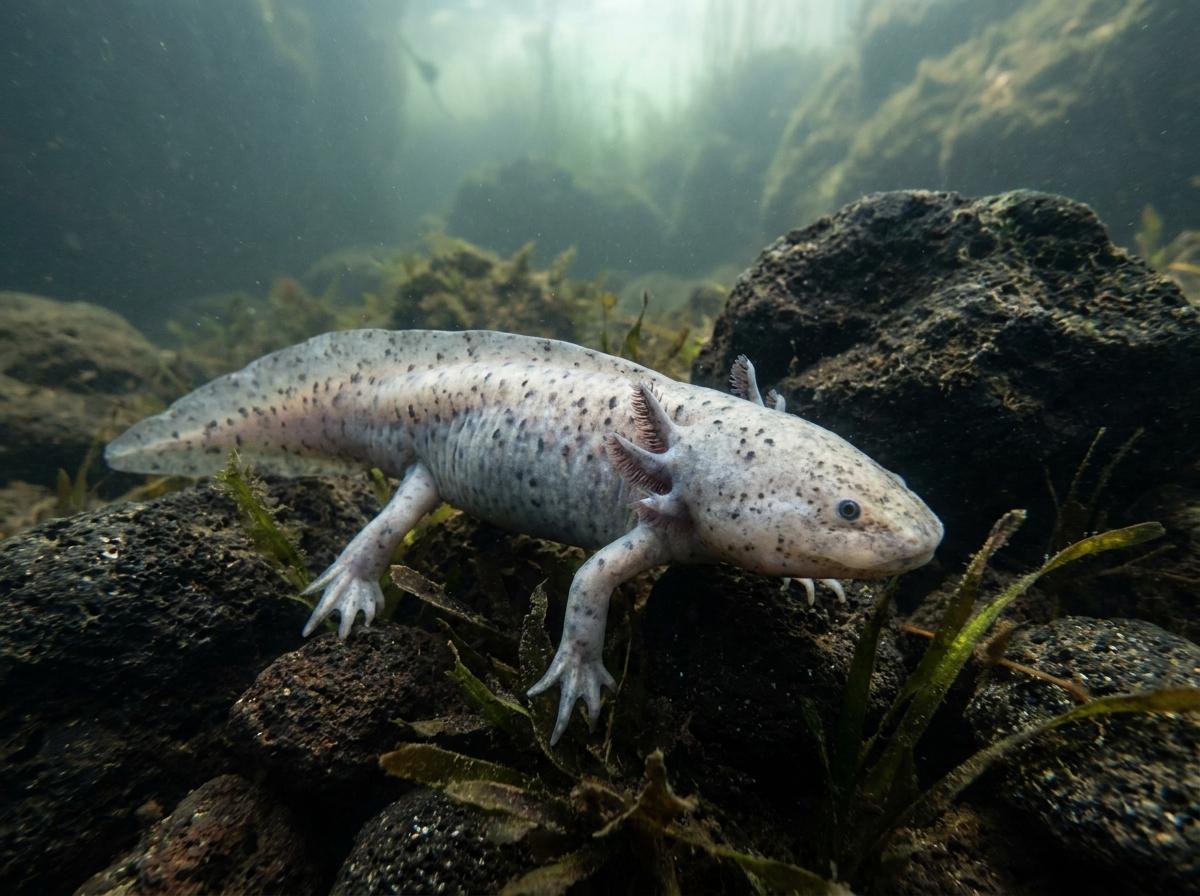
“Mosaic” is a hobby label, not a breed and not a heritable color morph. It describes an axolotl whose body reads as a patchwork of two different colorations at once, sometimes scattered like confetti, sometimes split almost cleanly down the middle. That appearance is consistent with genetic mosaicism, where one embryo ends up carrying two genetically different cell populations, and it is equally consistent with chimerism, where two embryos fuse; it can also be produced by pigment patterning that is neither. Nothing you can see from the outside tells the three apart, because distinguishing them requires genetic sampling that almost no hobby animal ever receives. What is safe to say is that these patchworks are one-off events rather than something a breeder can dial up: the pattern is not predictably reproducible, so you cannot order one and should not trust anyone who promises one. This page explains what the label does and does not mean, how mosaicism and chimerism actually differ, what the visible pattern can and cannot tell you, and how to care for one, which turns out to be exactly like caring for any axolotl.
| What it is | A hobby label for a two-tone patchwork appearance, not a morph; the underlying biology is not established without genetic testing |
|---|---|
| Species | Ambystoma mexicanum, the axolotl (a neotenic salamander) |
| Appearance | Irregular patches of two or more colors; sometimes a near bilateral split |
| Heritable | The visible patchwork is not predictably reproducible; treat any promise of mosaic offspring as unfounded |
| Related pattern | Chimera (from fused embryos); the hobby uses the two terms loosely |
| Care needs | Identical to any axolotl: cool water, soft or bare substrate, carnivore diet |
| Adult size | Commonly about 23 cm (9 in); larger than 30 cm (12 in) is rare |
| Lifespan | Roughly 10 to 15 years in good captive care |
| Legality | Varies by state and is restrictive in some (California, New Jersey; Maine requires a permit). Check current state and local law |
Browse listings, public profiles, breeders, or add your animal.
What is a mosaic axolotl?
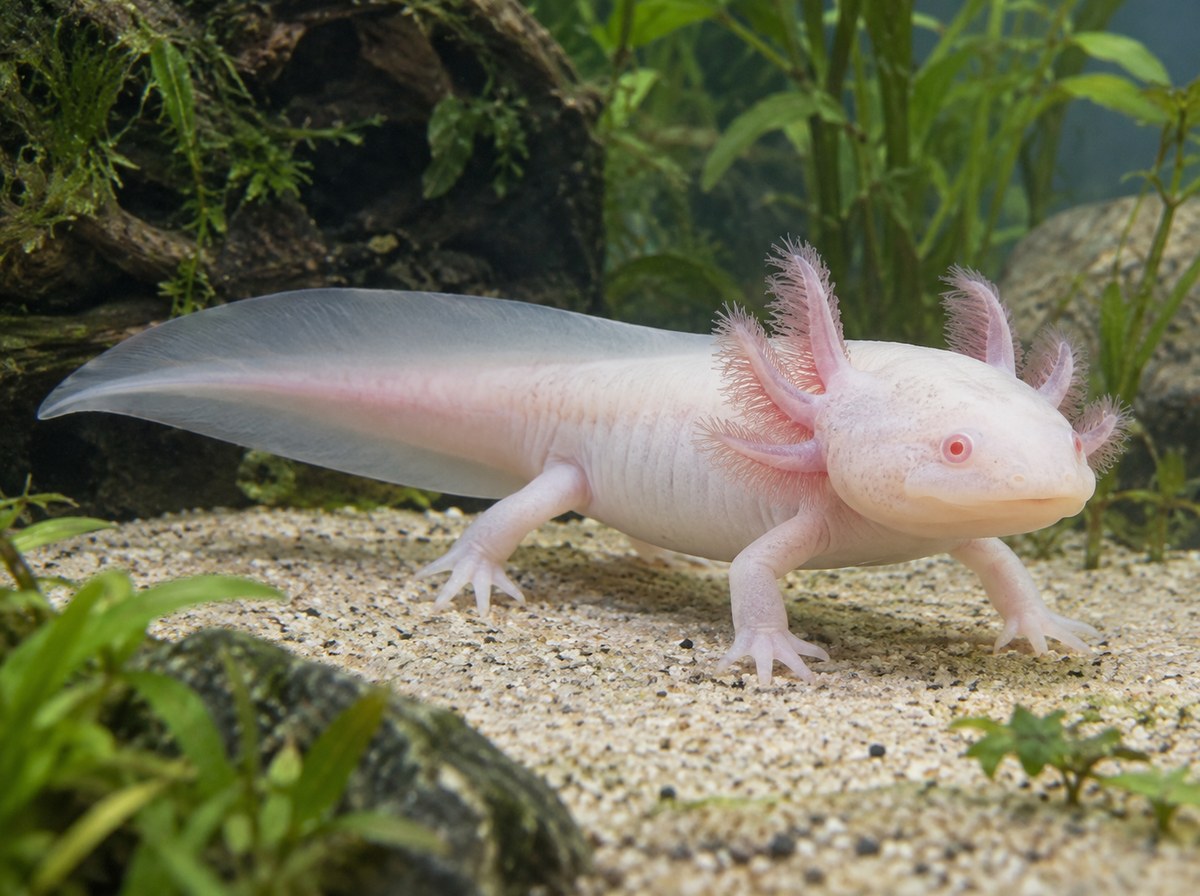
Start with the animal, then the pattern. The axolotl (Ambystoma mexicanum) is a Mexican salamander that stays aquatic and larval for its whole life, a condition called neoteny or paedomorphosis, keeping its feathery external gills and finned tail into adulthood instead of transforming and crawling onto land like most salamanders. It is the same animal biologists prize for regenerating whole limbs, and it is listed by the IUCN as critically endangered in its tiny native range in the canals of Lake Xochimilco in Mexico City, even though captive-bred axolotls are common in the pet and research worlds. The Creatures axolotl species page covers the animal in full; this page is about one specific way an axolotl can look.
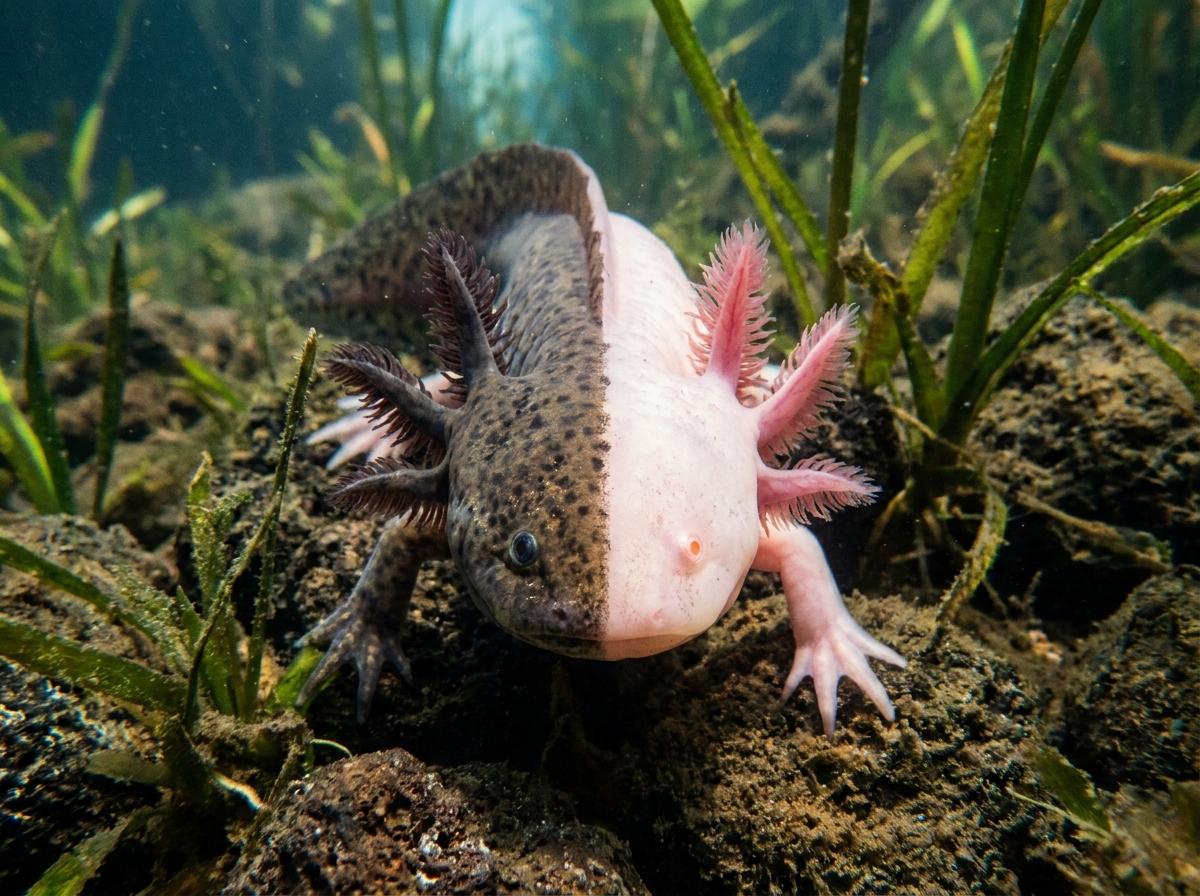
An axolotl sold as a mosaic carries that ordinary biology with an extraordinary skin: one region might show the dark, speckled wild type while an adjacent region shows the pale pink of a leucistic, with an abrupt boundary between them. The usual explanation, and a plausible one, is that the animal’s cells early in development ended up as two genetically different populations, each building pigment to its own instructions. If that is what happened, the boundary runs wherever the two cell lines met, the meeting was set by chance, and the result is not repeatable. Hold that explanation loosely, though. The same appearance can arise from chimerism, and some two-tone patterning has nothing to do with distinct cell lines at all. Without genetic sampling, “two genetically distinct cell populations” is a reasonable hypothesis about the animal in front of you rather than a fact about it.
The word to hold onto is “pattern.” Named axolotl morphs such as wild type, leucistic, albino, melanoid, copper, and axanthic are genetic and predictable, so a breeder can pair adults to aim for them. Mosaic is not one of those. It is a chance patchwork rather than a morph you can select for, and whatever produced it, it sits on top of the ordinary morph colours the animal would otherwise show.
Mosaic and chimera: the distinction that trips people up
In hobby conversation, “mosaic” and “chimera” get used almost interchangeably, and you will see the same photo labeled both ways. In strict biology they name two different origins, and the difference is worth understanding before you pay a rarity premium for either, as long as you also understand that a label on a listing is not a diagnosis of which one, or of either.

Chimerism, as a biological term, means a single individual formed from two separate embryos, or from a single egg fertilized in a way that yields two distinct genomes, that fused into one animal very early. Where it occurs, each region develops from its own founding cell line, which is why chimerism is expected to produce a dramatic split, sometimes close to a perfect line down the midline, with one recognizable morph on the left and another on the right. The bilateral, half-and-half axolotls that go viral are widely assumed to be chimeras on that basis. Assumed is the operative word: absent genetic testing, the assumption rests on appearance, and appearance is exactly what cannot settle it.
A mosaic, strictly speaking, arises from a single fertilized egg in which a change occurs during early cell division, so that some cells carry one genetic makeup and their neighbors carry another. Because the divergence happens within one growing embryo rather than by fusing two of them, the classic mosaic look is finer and more scattered, irregular flecks and patches rather than a clean split. The speckled, confetti-patterned animals you will see labeled “mosaic” fit this description.
The practical takeaways: the two arise by different routes, at the extremes they tend to look different (clean split versus scattered patchwork), and neither is a morph you can breed for. What you must not do is run that tendency backwards and diagnose the mechanism from the photo. A scattered patchwork does not prove mosaicism and a clean split does not prove chimerism; the appearance is suggestive at best, and only genetic sampling settles it. Many sellers apply “mosaic” broadly to any two-tone individual, so treat the label as a description of appearance rather than a claim about developmental biology. If the exact biology matters to you, understand that essentially no hobby animal has been tested, and neither you nor the seller can honestly tell you which one it is.
How the pattern forms
Every axolotl starts as one fertilized egg that divides again and again into the millions of cells that build the body. Skin color is laid down by pigment cells that arise from the neural crest early in that process and migrate out across the body. The mosaic and chimeric patterns both trace back to something unusual happening at that early stage.
In mosaicism, a genetic change occurs in one cell partway through those early divisions, and every cell descended from it inherits the change while the rest of the body carries the original makeup. The pattern on the adult is then essentially a map of which patches of skin descended from which early cell. In chimerism, two cell lines are present from the very start, so the two territories are established earlier and more completely, which is why chimeras tend toward the bold bilateral split.
Timing is the reason these animals do not repeat. The earlier a divergence happens, the larger and more sharply defined the two territories tend to be; the later it happens, the more the second cell line is confined to smaller, scattered pockets. Because that timing is a matter of chance, the resulting pattern is a genuine one-off. It can also cross the eyes and gills, which is why these animals often show two different eye colors or gill filaments that shift color from one side to the other. All of that describes what mosaicism and chimerism do when they occur; none of it lets you look at a given animal and declare which occurred here.
Judging an animal sold or described as a mosaic
Listings frequently attach the label to animals that are simply well-marked. You cannot confirm the biology by eye, so the checks below are not a diagnosis; they are a way of deciding whether the label is being used honestly and whether the animal is worth what is being asked. Appearance and provenance are not genetic tests, and nothing here proves the presence of genetically distinct cell lines.
- Two distinct color schemes, not just variation within one. The animals people mean by the term show regions of clearly different morphs side by side (for example dark wild-type speckle next to pale leucistic skin), not a single morph that happens to be blotchy, and the boundary is often abrupt rather than a gentle gradient. That is a description of the look, not evidence of a mechanism.
- Whether the pattern reaches the eyes and gills. Mismatched eyes or two-toned gill filaments are commonly cited as making a patchwork more striking and more consistent with the usual explanation. It remains consistent-with, not proof-of.
- Irregularity and asymmetry. Tidy, symmetrical patterning is more likely an ordinary heritable morph than the chance patchwork people are paying for.
- Rule out the heritable lookalikes. Several patterns that resemble the mosaic look are genetic and breedable. Piebald is an inherited pattern of dark markings on a pale body, and heavily marked wild types and copper axolotls can look busy on their own. The GFP trait (a green fluorescent protein from research lines) makes animals glow under blue light and is unrelated. If a pattern can be reproduced from a known pairing, whatever it is, it is not the chance one-off being advertised.
- Ask for the parents and clutch. The animals in question typically turn up as a single odd individual in an otherwise normal clutch, with a pattern the parents do not explain. A seller who understands their animals can tell you that story, and a seller selling “mosaic lines” is telling you something else entirely.
Short of genetic work, you are judging by appearance and provenance, and you should price accordingly. Buy the animal in front of you on its health and on clear photos, not on a label.
Why you cannot breed mosaics to order
This is the point that disappoints people, so it is worth stating carefully rather than dramatically: the patchwork appearance is not predictably reproducible. It is the visible result of a chance developmental event in one individual, and chance events do not travel down a pedigree on schedule. Nobody can set out to produce a mosaic-looking axolotl and expect to succeed.
Note the shape of that claim, because the hobby usually overstates it into “mosaics cannot pass it on,” which goes beyond the evidence. Biological mosaicism is not automatically confined to skin: depending on when and where the change arose, it can involve germ cells, which is exactly the route by which something present in a parent can appear in offspring. So the honest position is that the specific patchwork you are looking at is a one-off you should not count on repeating, not that inheritance is categorically impossible. A mosaic-looking animal can be a healthy, fertile parent, and its offspring will generally hatch as ordinary morphs; when another patchwork animal turns up in a clutch, the safe reading is chance rather than a family trait you can now sell.
That unpredictability is why these animals command rarity prices and why the pricing deserves a skeptical eye. Be wary of any seller advertising “mosaic lines” or guaranteeing mosaic offspring from a pairing: nobody can make that promise honestly. The realistic path to the look is patience and watching listings, not a planned breeding.
The color biology underneath
Whatever produced the patchwork, the colours themselves come from the same three pigment cells every axolotl uses. Peer-reviewed work on axolotl pigmentation describes three chromatophore types: melanophores, which carry the brown-to-black pigment melanin; xanthophores, which carry yellow and reddish pteridine pigments; and iridophores, which hold crystallized purines that reflect light and give shine (research on the melanoid variant, published in the journal G3, lays out these three cell types and their genetics). The familiar morphs are recipes built from those cells. Wild type keeps all three. Leucistic animals are pale because their pigment cells never fully populate the skin; that trait has been tied to the Edn3 gene, which normally signals pigment cells to spread across the embryo. Melanoid animals have extra melanophores and lack iridophores, and researchers have shown that variant follows single-gene Mendelian inheritance tied to the Ltk gene.
A patchwork animal just displays two of those recipes on one body. That is why the strongest visual contrast comes when the two zones correspond to very different morphs, such as a dark melanoid or wild type against a pale leucistic or albino. Understanding the pigment layer also helps you read a listing: a “mosaic” whose two zones are barely distinguishable is far less striking, and far easier to confuse with ordinary mottling, than one whose zones pull from opposite ends of the pigment palette.
Caring for a mosaic axolotl
Here is the reassuring part. A mosaic axolotl is, in every way that matters for husbandry, just an axolotl. The pattern is skin-deep and does not change its needs, its temperament, or its lifespan. If you can keep a wild type well, you can keep a mosaic well.

Temperature is the thing most people get wrong. Axolotls are cold-water animals and do best in roughly 60 to 68 degrees Fahrenheit (about 16 to 20 degrees Celsius). Sustained warmth above the low 70s stresses them, suppresses appetite, and invites disease, so most keepers run a cooling fan or a chiller in summer and never use an aquarium heater. This is the single most important care variable.
Give them floor space and a safe bottom. A single adult needs a tank of at least 20 gallons, and more water volume is genuinely easier to keep stable, so a 29 or 40 gallon footprint is a better starting point. Axolotls spend nearly all their time walking the bottom, so floor area matters more than height. Substrate is a safety issue: fine aquarium sand with a grain size under about 1 millimeter, or a bare bottom, are the safe choices. Avoid gravel and small pebbles entirely, because axolotls feed by suction and readily swallow stones, and swallowed gravel is a leading cause of gut impaction, which can be fatal.
Keep the water clean and cycled. Like any aquarium animal, an axolotl needs a fully cycled filter so that ammonia and nitrite stay at zero, gentle flow (they dislike strong currents), and regular water changes. Neutral to slightly alkaline water suits them. Their delicate skin and external gills make them sensitive to poor water quality, so testing and routine maintenance are not optional.
Feed a carnivore diet. Axolotls are carnivores. Earthworms are widely regarded as the closest thing to a complete staple, and sinking axolotl or carnivore pellets make a good supplement. Feed juveniles more often and adults every two to three days, adjusting to body condition. Because keeping records of feeding, growth, and any health changes makes problems easier to catch early, many keepers log them; you can track those records on Creatures once your animal has a profile, and the health and medical records help article walks through what to note.
Health and honest hazards
A mosaic pattern is not a health condition, and there is no evidence the coloration itself brings any extra medical risk. The health concerns for a mosaic are simply the health concerns for the species, and they are worth naming honestly.
The big ones are heat and water quality. Chronic warm water and cycling mistakes (ammonia or nitrite spikes) are behind a large share of pet-axolotl illness. Impaction from swallowed gravel is another real, preventable danger, which is why substrate choice matters so much. Signs that something is wrong include loss of appetite, floating or bloating, curled gill filaments, and skin or gill lesions. Axolotls regenerate remarkably well, but that is no substitute for care, and it does not mean an unwell animal is fine.
For anything beyond routine husbandry, work with a veterinarian who treats amphibians or exotics. Axolotls do not tolerate many common aquarium medications, dosing is weight-specific and species-specific, and self-treating can do more harm than the original problem. This article is educational; medical decisions and any drug dosing belong with a vet who can examine the animal.
Is it legal to own an axolotl?
Legality varies by state in the US, and it is on you to check before you buy. Restrictions generally exist to protect native salamanders from disease or hybridization rather than because of anything the axolotl does wrong, and they come in different strengths, which general lists routinely flatten into a misleading “banned.” California and New Jersey are the states usually described as prohibiting private ownership, and you should treat both cautiously and verify directly. Maine is a good example of why the distinction matters: rather than a flat ban, Maine places the axolotl on its Category 2 Restricted Wildlife list, which means possession requires a permit rather than being impossible. Other states, such as New Mexico, also run permit systems. Rules change, and cities or counties can add their own restrictions, so confirm the current law with your state wildlife agency where you actually live rather than relying on any list, including this one.
It is worth separating two things that sound contradictory. The axolotl is critically endangered in the wild, restricted to a shrinking range around Lake Xochimilco, yet captive-bred axolotls are abundant in the pet and research trade because they breed readily in captivity. A responsibly kept, captive-bred pet is not taken from that wild population. Buying captive-bred stock, and never releasing a pet axolotl into local waters, is the responsible line to hold.
Buying a mosaic, realistically
Because mosaics cannot be produced on demand, availability is unpredictable and prices run high when one does appear. That combination makes it easy to overpay for hype or to be sold an ordinary well-marked animal under a rare-sounding label. A few principles keep you grounded.
Buy health first. A striking pattern on a poorly kept animal is a bad deal; good gills, clear skin, a healthy appetite, and correct body condition matter far more than the coloration. Insist on clear, recent photos of the actual animal, ideally showing the eyes and gills so you can judge how strong the patchwork really is and whether the label matches what you are looking at, and confirm the axolotl is captive-bred and legal to own where you live before any money changes hands.
Because the look cannot be ordered, the practical way to find one is to watch the market patiently. You can browse current axolotl listings on the Creatures marketplace, look for keepers and breeders in the Creatures directory, and, since a true mosaic surfaces only now and then, set a free listing alert (in the hub below) so you hear about one when it is posted rather than refreshing listings by hand.
If unusual animals are your thing, you might also enjoy the breed pages we keep for other uncommon creatures, from the powerful Gull Dong dog to the rare Jianzhou cat. The mosaic axolotl belongs in that same category of animals that are more about individual chance and character than about a fixed, breedable standard.
Frequently asked questions
Is a mosaic axolotl a rare morph?
It is rare, but it is not a morph in the genetic sense. Morphs like leucistic and melanoid are heritable and breedable. “Mosaic” is a hobby label for a chance patchwork appearance in one individual, so it sits outside the standard morph list and cannot be bred to order.
What is the difference between a mosaic and a chimera axolotl?
As biological terms, chimerism means one animal formed from two embryos that fused (or an egg carrying two genomes), often producing a bold, near-symmetrical split, while mosaicism means a change during the early cell divisions of a single embryo, tending toward finer, scattered patches. The catch is that you cannot tell which one you are looking at from a photograph; distinguishing them requires genetic sampling that hobby animals essentially never get. The hobby uses the two words interchangeably, and for a specific animal both are usually unproven.
Can you breed two mosaic axolotls to get mosaic babies?
Not reliably, and nobody can promise it. The visible patchwork is a chance event rather than a trait with predictable inheritance, so a pairing of two patchwork animals should be expected to produce ordinary morphs. Be careful with the stronger claim you will often read, that inheritance is impossible: mosaicism can involve germ cells depending on when it arose, so “not predictably reproducible” is accurate while “categorically cannot be passed on” overstates what is known. Either way, treat any seller guaranteeing mosaic offspring as unreliable.
Do mosaic axolotls need special care?
No. Care is identical to any axolotl: cool water in the low-to-mid 60s Fahrenheit, no heater, a large tank with fine sand or a bare bottom, a fully cycled filter, and a carnivore diet built around earthworms. The pattern does not change husbandry.
How much does a mosaic axolotl cost?
Prices vary widely and run high because supply is unpredictable and the look cannot be produced deliberately. There is no reliable standard price. Judge value by the animal’s health and by clear photos of how strong the patchwork actually is, not by the label, and remember that no seller can offer genetic proof of the underlying biology or guarantee mosaic offspring.
Are axolotls legal to own?
It depends on your state, and the strength of the restriction varies. California and New Jersey are generally described as prohibiting private ownership; Maine restricts rather than bans, listing the axolotl as Category 2 Restricted Wildlife with a permit route; other states such as New Mexico also require permits. Verify the current law with your state wildlife agency, and check your county and city too, before acquiring one, and buy captive-bred animals only.
Do this next on Creatures
Whether you are trying to identify a possible mosaic, hunting for one, or already keeping axolotls, Creatures is the records, marketplace, and directory layer to do it in one place.
Start with the species. Read the broader Creatures axolotl page for care, morphs, and background before you focus in on the mosaic pattern.
Find one. Browse mosaic axolotls on the marketplace and search keepers and breeders in the Creatures directory. New to it? See saving searches and using your watchlist.
Get alerted. A genuine mosaic surfaces only now and then, so set a free mosaic axolotl listing alert and we will tell you when one is posted. No account needed to start.
Add your axolotl. Already keeping one? Create a free animal profile in a few minutes. The walkthrough is in adding an animal to Creatures, and the profile tabs guide shows what each section does.
Track water, feeding, and health. Keep records on Creatures. The record sheet opens for any visitor to look around, and a free account saves what you enter. See adding a record for the full how-to.
List your axolotls. Breed or rehome axolotls? Set up a free breeder or rescue profile so keepers searching for this hard-to-find pattern can reach you.