Mini Alpine
Author: Elliott Garber, DVM · Updated
A Mini Alpine is a miniature dairy goat made by crossing a standard Alpine with a Nigerian Dwarf and then breeding the offspring forward, generation by generation, toward a smaller animal that still looks and milks like an Alpine. The cross itself is the easy part. The part that decides what you are actually buying is the generation, because a Mini Alpine is not one fixed thing. It is a position on a numbered ladder that two registries track formally, and an animal near the bottom of that ladder and an animal near the top can look and perform very differently.
This page walks that ladder in detail, since it is what a sale listing most often leaves out: what F1, F3 and F6 mean, which herdbook each one lands in, the 70/30 rule behind the American and Purebred books, and the rule that resets a breeding program if you go back to a foundation animal. Then height standards, the milk next to both parent breeds, the kidding risk specific to miniature dairy crosses, and the health tests to ask about before money changes hands. To see what is on offer now, current Mini Alpine listings sit on the Creatures marketplace, and the goat species page compares Mini Alpines against other dairy and meat breeds.

| What it is | A miniature dairy goat bred from a standard Alpine and a Nigerian Dwarf, then bred forward |
|---|---|
| Registries | Miniature Dairy Goat Association (MDGA) and The Miniature Goat Registry (TMGR). Neither ADGA nor AGS registers miniature dairy crosses |
| Height cap | MDGA maximum at the withers: does 29 inches, bucks 31 inches. Final height is not reached until 3 to 4 years old |
| Generations | F1 and F2 are Experimental. Conforming F3 to F5 animals may enter American and conforming F6 and up may enter Purebred, subject to each registry’s rules |
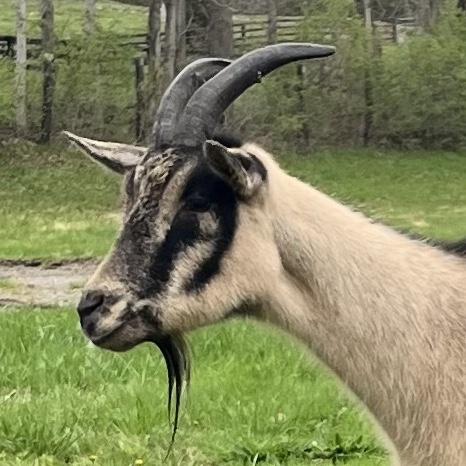
| Ears and face | Fine, narrow, erect ears and a straight or slightly dished face. Anything other than erect ears is a disqualification |
| Color patterns | Cou blanc, cou clair, cou noir, chamoisee, two-tone chamoisee, sundgau, belted and lavender |
| Milk | MDGA reports roughly 2 to 10 pounds a day across the miniature dairy breeds, averaging about 5 to 6 pounds. No published breed average exists for Mini Alpines specifically |
| Best suited to | A family milk supply on small acreage, and keepers who want a dairy goat they can handle alone |
Browse listings, public profiles, breeders, or add your animal.
What a Mini Alpine actually is
The Miniature Dairy Goat Association describes the recipe plainly: a miniature dairy goat comes from breeding a full size dairy doe to a Nigerian Dwarf buck to produce a mid size dairy goat that, other than the smaller size, looks like the standard sized breed. Read that sentence carefully, because the direction of the cross is deliberate and it matters for the doe’s safety. The small parent supplies the buck; the large parent supplies the dam. More on why in the kidding section below.
Do the cross with a standard Alpine and you get a Mini Alpine. MDGA’s registration guidelines list the acceptable parent breeds as Alpine, LaMancha, Nubian, Oberhasli, Saanen, Sable, Toggenburg, Guernsey and Nigerian Dwarf, so the same machinery produces Mini Nubians, Mini Saanens and the rest. The short-eared version is the Mini LaMancha. If you are weighing a Mini Alpine against a floppy eared alternative, the Mini Nubian page covers the other popular choice.
Two things follow from this that catch new buyers out. First, a Mini Alpine is a breed under construction rather than a settled one, which is exactly why the registries number generations at all. Second, the parent breeds are genuinely different animals, so the early crosses show a wide spread of traits and only settle down as the generations accumulate. According to Mississippi State University Extension’s dairy goat breeds guide, Alpines are of European descent and Nigerian Dwarfs are of African descent, and the size gap between them is large. ADGA breed standards put an Alpine doe at a minimum of 30 inches and 135 pounds; a Nigerian Dwarf doe may be no taller than 22.5 inches, and the breed averages about 75 pounds. The floor of one parent breed is a third taller than the ceiling of the other.
The generation ladder, and why it decides what you are buying
Both registries use an F number to say how far an animal sits from the original cross, and both sort animals into herdbooks by that number. The rules below come from the registries’ own published pages, not from sale listings, because sale listings are where this gets muddled.
How the numbering works
MDGA’s generations explainer sets the baseline: foundation animals, meaning purebred Nigerian Dwarfs and the standard breeds, are the 0 generation. An F1 comes from either a Nigerian Dwarf crossed with a standard sized doe of a recognized dairy breed, or a miniature dairy goat crossed with a standard sized goat or a Nigerian Dwarf. Breed two F1s together and you get an F2. Breed two F2s and you get an F3, and so on up.
Then comes the rule that surprises almost everyone. In MDGA’s words, the generation of any kid is one generation higher than the lowest generation of its parents. Breed an F3 to an F1 and the kid is an F2, not an F4. Breed an F6 to an F1 and the kid is still only an F2. Progress up the ladder is set by the lower generation parent, so a breeder who reaches for an unrelated F1 buck to fix an outcross problem drops the whole kid crop back down the ladder in one season.
The same logic produces the reset. MDGA states that if at any time you breed your animals back to a purebred Nigerian Dwarf or a standard dairy goat, the offspring’s classification reverts to first generation Experimental. There is no partial credit for the generations behind it.
The four herdbooks
- Grade. The entry point for animals with unknown ancestry or a mixed dairy background. MDGA’s Grade herdbook keeps all generations there until the unknown percentage is 10 percent or less, at which point the animal moves into the Experimental herdbook as an F1.
- Experimental. Usually F1 and F2 animals. The Experimental herdbook also takes any third generation or higher animal that does not meet the standards for its specific breed, and those carry an asterisk after the registration number to show they do not conform. That asterisk is a genuinely useful thing to look for on a certificate.
- American. Usually F3, F4 and F5. The American herdbook requires that each animal meets all standards for its breed and satisfies the 70/30 rule.
- Purebred. F6 and higher, again meeting all breed standards and the 70/30 rule, per the Purebred herdbook.
The 70/30 rule is straightforward once stated: to enter the American or Purebred herdbooks, a goat may be no more than 70 percent and no less than 30 percent of either of its parent breeds, meaning the standard dairy goat and the Nigerian Dwarf. The effect is to stop the breed drifting back into being an Alpine with one distant small ancestor, or a Nigerian Dwarf with one distant tall one.
Where TMGR differs
The Miniature Goat Registry uses the same F system and the same thresholds. Its FAQ states that F1 means one generation from foundation, that any F3 through F5 animal meeting the breed standard requirements can be considered for American status, and that any F6 animal meeting the standard can be considered for Purebred status.
The differences are in the standards themselves, and they are real. TMGR publishes a height floor rather than a ceiling: all breeds of mini dairy goats have a minimum height requirement of 21 inches for does and 23 inches for bucks once they reach Purebred status. Its Mini Alpine standard is also more permissive on color, describing the breed as lean and refined with erect ears and a straight face, and allowing all colors and combinations, frosted ears and nose, and blue eyes.
So when a seller tells you an animal is “registered Purebred,” the sensible follow up is which registry, because the two books are not interchangeable and the papers say different things. Neither the American Dairy Goat Association nor the American Goat Society keeps a herdbook for miniature dairy crosses: Mississippi State Extension lists the breeds each of them registers, and a mini dairy cross is not among them. A Mini Alpine therefore cannot hold ADGA or AGS papers in its own right, even though its standard bred and Nigerian Dwarf ancestors did.
What to ask, in one line
Ask for the registration certificate and read three things off it: the registry, the herdbook, and the generation. The Mini Alpine’s own certificate comes from MDGA or TMGR and follows that registry’s rules, but its standard Alpine and Nigerian Dwarf foundation ancestors may carry ADGA papers, and our guide to reading ADGA goat pedigrees and registration papers explains the herd books, tattoos and symbols on those. An F1 out of a first cross and an F6 out of six generations of selection are both honestly called Mini Alpines, and they are not the same purchase.
Size, and what the height standards really say
MDGA’s Mini Alpine breed standard sets the maximum height at the withers at 29 inches for does and 31 inches for bucks. Being over height is listed as a disqualification from the American and Purebred herdbooks, alongside being over 70 percent or under 30 percent of either parent breed, and having ears that are anything other than erect on does and bucks.
Three practical notes sit behind those numbers.
The first is timing. The standard is explicit that final height is not achieved until maturity, at 3 to 4 years old. A yearling that measures comfortably under the cap can still grow out of the American or Purebred herdbook, which is a real risk when you buy a young animal on the promise of its papers.
The second is enforcement. MDGA does not require heights to be recorded with the registry except for milk testing and live shows, so it is the breeder’s responsibility to keep their animals within the proper heights. That is a light touch system built on honesty rather than routine measurement. It works well with a careful breeder and not at all with a careless one, so measure the animal yourself, and measure the dam if she is on the property.
The third is where the caps come from. An Alpine doe has an ADGA minimum of 30 inches, and a Nigerian Dwarf doe an ADGA maximum of 22.5 inches. The MDGA Mini Alpine ceiling of 29 inches sits just under the Alpine floor, which is the whole design intent: an animal that reads as an Alpine in every respect except that it is smaller than one is allowed to be.
What a Mini Alpine looks like
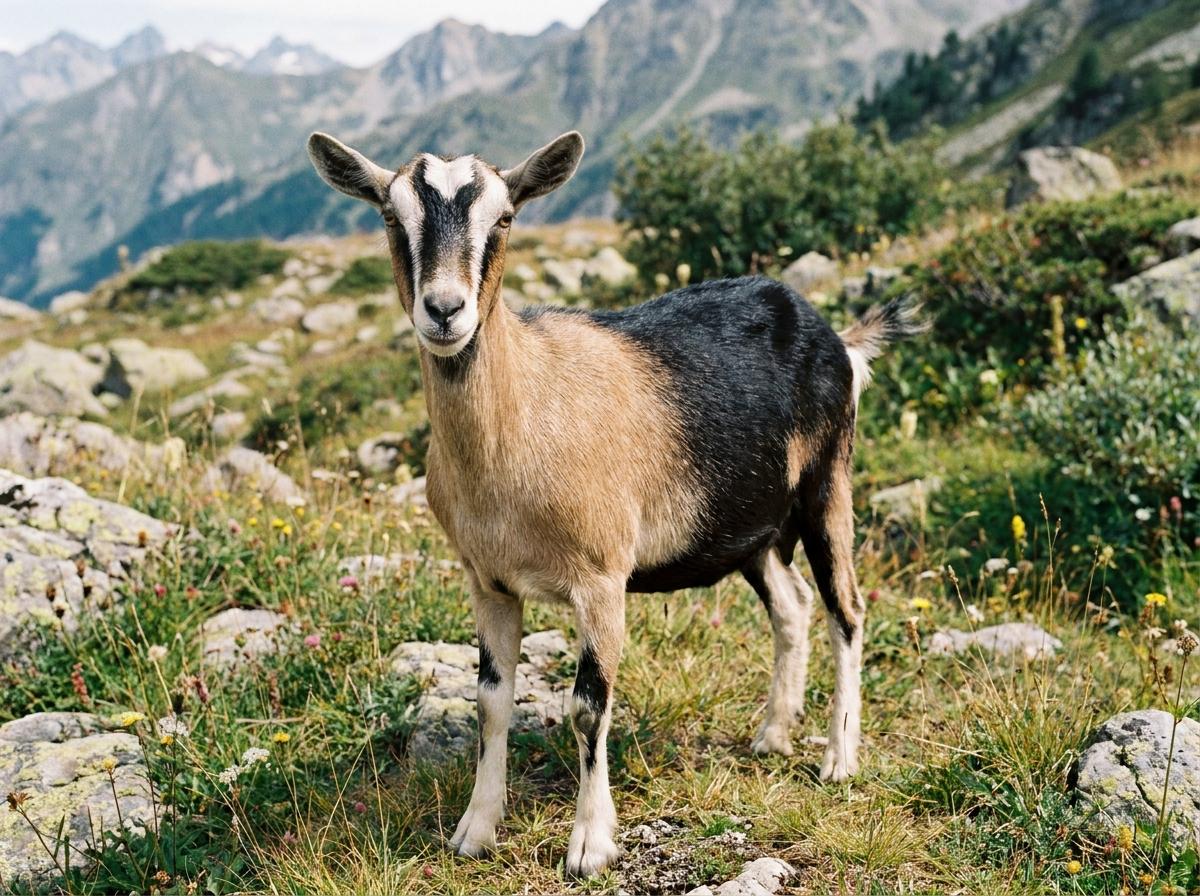
The MDGA standard describes the breed as an alert, gracefully hardy animal that adapts and thrives in any climate while maintaining good health and excellent production, and pins the head type precisely: a straight or slightly dished face and fine, narrow, erect ears give it a clean appearance.
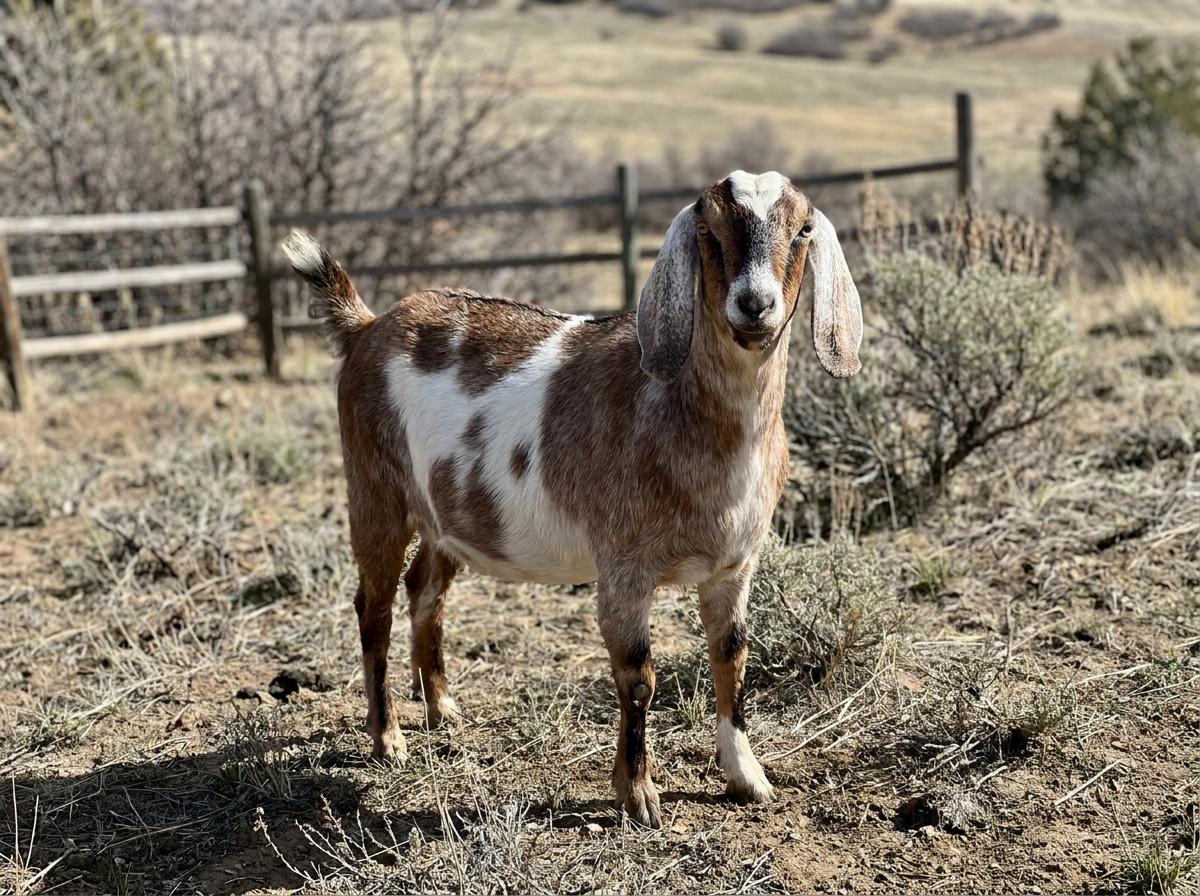
Erect ears are the single most useful field check on this breed, and the reason is structural rather than cosmetic. Alpine ears point up. A Mini Alpine with lop, pendulous or drooping ears is either carrying Nubian ancestry or is not what the seller says, and MDGA lists non erect ears as an outright disqualification for both sexes.
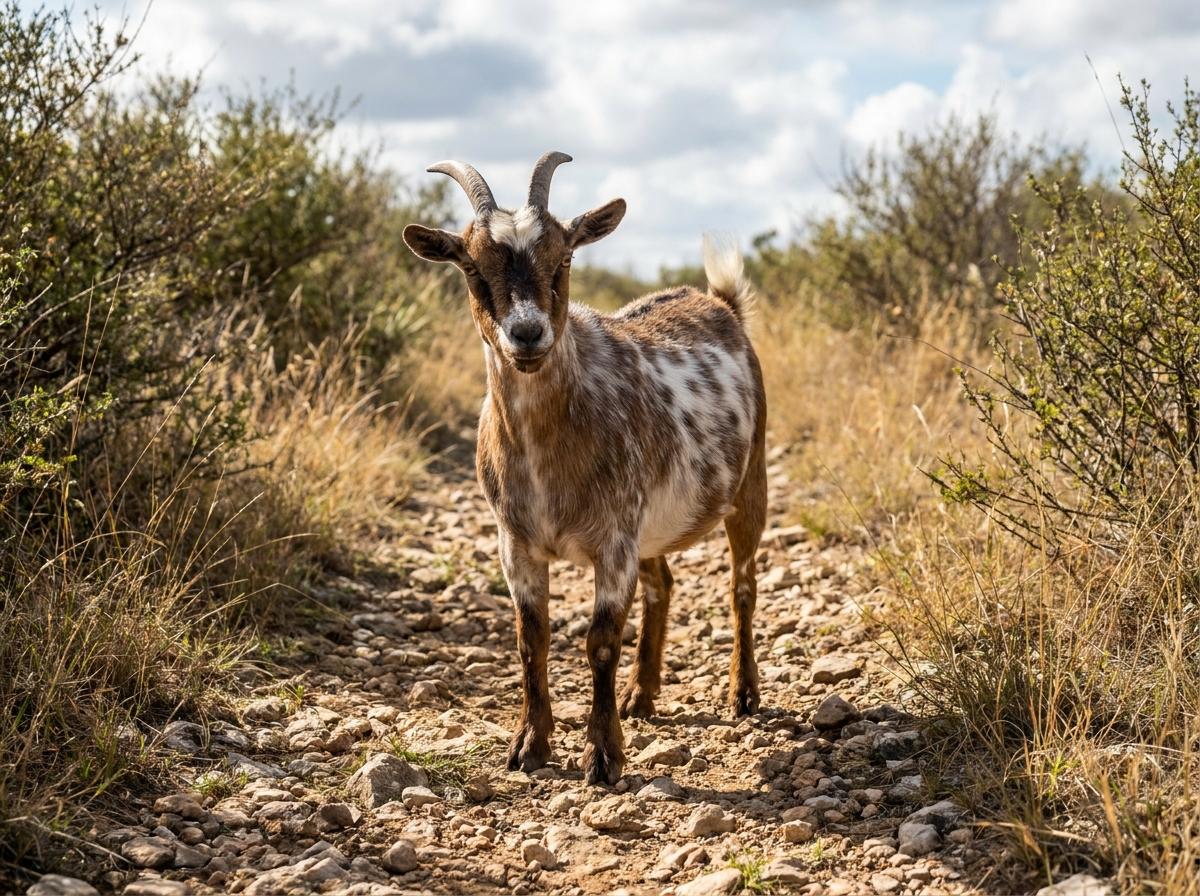
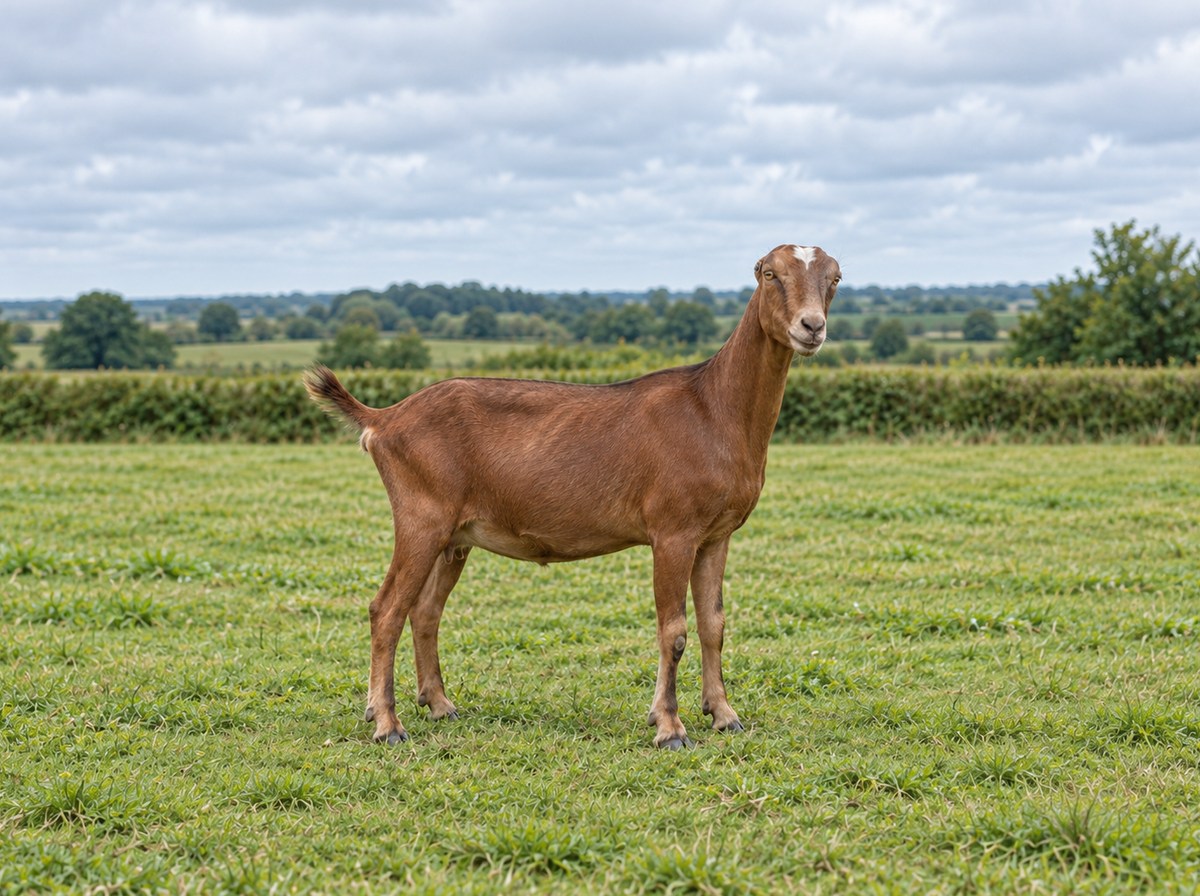
Color is where Alpine genetics show off. The standard recognises belted, sundgau, two-tone chamoisee, chamoisee, cou blanc, cou clair, cou noir and lavender. The French names describe patterns rather than single colors, and Mississippi State Extension glosses the common ones: chamoisee is brown with black markings on the dorsal stripe, face and legs; cou blanc is white on the neck and front of the body with black on the back and rump and black or grey markings on the head; cou noir is black on the front of the body with white behind; cou clair is tan or cream on the front with grey shading behind.
One color rule is worth knowing before you buy a show prospect. MDGA notes that Alpines with Toggenburg color together with white markings, or that are all white, are discriminated against in the show ring but are registerable as Experimental, and that all other color combinations are acceptable in all herdbooks. TMGR takes the opposite approach and allows all colors and combinations. If showing matters to you, the color on the animal in front of you can change which registry you should be dealing with.
Milk: how much, and how rich
This is the reason the breed exists, so it deserves honest numbers rather than sales copy.
Start with the parents. Both sets of figures come from Mississippi State University Extension. An Alpine produces about 2,715 pounds of milk in an average lactation, with a range from 750 to 5,720 pounds, at roughly 3.5 percent milk fat and 2.9 percent protein. A Nigerian Dwarf produces about 795 pounds in an average lactation, with a range from 220 to 2,110 pounds, at greater than 6 percent milk fat and 4.4 percent protein. Dairy goat lactations average 284 days, with a usual range of 275 to 305 days.
Those two profiles are close to opposites: volume with modest butterfat on one side, small volume with very rich milk on the other. The appeal of a Mini Alpine is a working compromise between them, in a body a smaller keeper can manage.

What the compromise actually yields is where the sourcing gets thin. No registry publishes a measured breed average lactation for Mini Alpines. What MDGA does publish is a reported range across the miniature dairy breeds: anywhere from 2 pounds (one quart) to 10 pounds (about a gallon and a quarter) daily, with average production around 5 to 6 pounds. Treat that as the registry’s own reported spread rather than a controlled measurement, and note how wide it is. A quart a day and a gallon a day are different animals in the same sentence.
Two things narrow that spread for a specific goat.
Generation. An early generation animal has had almost no selection applied to it. An F1 sits one cross away from two populations that differ in size, udder shape, teat placement, capacity and butterfat, and nobody has yet chosen between those traits. By F5 or F6 a breeder has made several rounds of selection decisions on exactly the traits a milker cares about, which is why a later generation herd is the more predictable buy. Consistency is the thing the generations are paying for, and it is the practical, non paperwork reason the ladder matters.
Records. MDGA runs an Advanced Registry for goats meeting minimum standards on production tests, with DHIA and in house testing programs offering both 305 day and one day options. Real production data therefore exists for animals whose breeders bother to collect it. Ask whether the dam is on test and ask to see the figures. A seller who can hand you a 305 day record is telling you something a breed average never could, and those numbers are worth keeping on the animal’s own record once she is home.
Kidding, and the risk to understand before you breed
Goats kid unassisted most of the time. The Merck Veterinary Manual puts the incidence of dystocia in goats at under 5 percent, and notes that the most common cause is two or more kids presenting at once, with malposition, fetomaternal mismatch, failure of cervical dilation, vaginal prolapse, uterine torsion and uterine inertia behind it. Its rule of thumb for intervention is that if a doe has been in active labor for 30 minutes with no progress, assistance is likely required.
Miniature dairy breeding adds two concerns on top of that baseline.
The direction of the cross is a safety decision, not a preference. Fetomaternal mismatch means the kid is too large for the dam to deliver. Putting a Nigerian Dwarf buck over a standard sized doe keeps the dam the larger of the two parents. Reversing it, a full sized buck over a small doe, stacks the odds the other way. This is why MDGA describes the cross in one direction only, and it is why a careful breeder will steer you away from putting a standard buck over a miniature doe.
Small breed does are at higher risk when a dystocia is handled badly. A 2023 multicenter study in the Journal of Veterinary Internal Medicine looked at 198 periparturient does across nine university veterinary hospitals. Uterine tears were diagnosed in 32 of 179 does, or 18 percent. The odds of a uterine tear were 5.5 times higher in small breed does that had been manipulated on the farm by a layperson, and does with uterine tears were far less likely to survive than does without them, at 41 percent survival against 87 percent. The authors’ own conclusion is the line to carry away: in the event of dystocia, small breed does are at greater risk of uterine tears and prompt veterinary intervention is critical.
The study grouped Nigerian Dwarfs and Pygmies as its small breeds rather than mini dairy crosses specifically, so read it as the nearest good evidence rather than a measurement of Mini Alpines. The practical instruction survives the caveat intact: know your veterinarian before breeding season, not during it, and call early rather than reaching in yourself.
Pregnancy toxemia is the other problem that clusters around kidding, and it is a feeding problem before it is a veterinary emergency. Merck names inadequate nutrition during late gestation, usually a ration without enough energy density, as the primary predisposing cause, puts the highest risk on does carrying more than one fetus that are either thin or over fat, and states that grain is required as a carbohydrate source during the last six weeks of gestation to keep multiple bearing females healthy. Low blood calcium is common alongside it. Every decision in this section is a veterinary one, so build the plan with a veterinarian who can see the animals rather than from a page.

Herd health: the three tests to ask about
Small dairy herds trade animals constantly, and three chronic diseases move with them. None is curable. All three are worth asking about in writing before you buy, and a good breeder will answer without being pushed.
Caprine arthritis and encephalitis (CAE). Merck describes the chief mode of transmission as ingestion of virus infected colostrum or milk by kids, which is why pooled colostrum is a particular risk. Adults typically show swollen carpal joints and lameness, a firm udder with little milk, or slow weight loss with a good appetite; kids of 2 to 6 months show weakness and hind limb problems. No vaccine or specific treatment exists for any clinical form. Testing uses the agar gel immunodiffusion test or an ELISA, and control rests on separating kids at birth, heat treating colostrum, pasteurizing milk, testing the herd twice a year and segregating or culling positives.
Caseous lymphadenitis (CL). Caused by Corynebacterium pseudotuberculosis, CL produces abscesses in the lymph nodes, commonly the submandibular, parotid, prescapular and prefemoral. Merck states flatly that CL is not considered a curable disease, and that the organism survives on bedding and wood for two months and in soil for eight. Its guidance on new arrivals is the buying rule: examine them thoroughly for clinical signs, keep them isolated until their serologic status is known, and admit only animals that are seronegative with no evidence of present or past lesions.
Johne’s disease (paratuberculosis). Goats are usually infected by the fecal oral route when very young, and the organism also passes in utero and through colostrum and milk. Merck notes that clinical signs may not appear until the animal is much older, that they run to weight loss, submandibular edema and weakness, and that diarrhea is less common in goats than in cattle, so the cattle picture of the disease will mislead you. It recommends fecal PCR testing to identify and remove infected animals, and it cannot be cured.
Two habits cover most of the risk. Buy from herds that test and will show you the results, and quarantine new arrivals well away from your own animals until their own results are in. Merck’s instruction for CL, that new arrivals stay isolated until their serologic status is determined, is the right standard to apply to all three. Keeping the test dates and results attached to each animal, rather than in a folder somewhere, is what makes the second purchase easier than the first. Health and medical records on Creatures are built for exactly this.
Disbudding and horns
Both parent breeds are normally horned, so most Mini Alpine kids are disbudded, and it is the one routine procedure a new owner has to make a decision about in the first two weeks of a kid’s life.
The AVMA policy on disbudding and dehorning sheep and goats states that goats are best disbudded between 5 and 7 days of age, that by 14 days the developing horn tissue has attached to the skull and is harder to remove, and that disbudding should happen before 14 days to avoid having to dehorn. Dehorning a goat over 14 days of age must be performed by a licensed veterinarian. The AVMA also recommends procedures and practices that reduce or eliminate the pain and distress these cause, including clinically effective medications.
That last clause is not a formality. A 2023 review in Animals on pain assessment in goat kids records that many studies have found physiological and behavioral changes indicating pain and distress after disbudding, and calls it a significant cause of welfare compromise in kids. Ask your veterinarian about pain relief rather than treating the procedure as a five minute job with a hot iron.
One genetics note for anyone planning to breed toward naturally hornless animals. Polledness in goats follows a dominant pattern of inheritance, and the same region of the genome is implicated in polled intersex syndrome, so breeding two polled goats together carries a risk of intersex kids. Naturally polled Mini Alpines exist and are appealing, but the mating plan behind them needs thought.
Day to day care
A Mini Alpine is a dairy goat in a smaller package, so the management is standard dairy goat management with the workload scaled down.
Company. Goats are herd animals and a single goat is a poor life. Plan for two at minimum, and a wether makes a cheaper, calmer companion than a buck.
Fencing. Small, agile and curious is a difficult combination. Fence for a goat that will test every gap at ground level, and check that gate gaps and cattle panel squares are small enough that a kid cannot post its head through.
Feeding. Forage or hay is the base, with grain matched to what a doe in milk is actually producing rather than fed by habit. Free choice goat minerals and constant clean water are not optional, and copper and selenium needs vary enough by region that this is a conversation for your veterinarian or extension office rather than a bag to guess at.
Feet and parasites. Hooves need trimming on a schedule. Internal parasites are among the most common health problems in small ruminant herds, and dewormer resistance is a real and growing one, so work from your veterinarian’s advice and from fecal egg counts rather than from a calendar.
Shelter. Dry, draft free and clean, with room to get away from each other and something to climb. The bedded pen in the photograph above is the standard to aim at.
Reminders and upcoming care covers how to schedule hoof trims, worm counts and vaccination dates once so they arrive before they are overdue.
What Mini Alpines cost
There is no authoritative published price for a Mini Alpine, and inventing one would be worse than saying so. Prices are set animal by animal in a small private market, and they are driven by a handful of things you can actually check:
- Generation and herdbook. An F1 out of an unproven first cross and an F6 with six generations of selection behind it are not priced alike, nor should they be.
- Registration. Papers from MDGA or TMGR, and whether the registration number carries the Experimental asterisk.
- Production records. A dam on official milk test with a 305 day record is worth more than a dam with a story.
- Herd health status. Herds that test for CAE, CL and Johne’s and will show you results price accordingly.
- Sex and stage. A doe in milk, a bred doe, a doeling and a wether occupy quite different price bands, and wethers are usually the cheapest way into goat keeping.
Watch current Mini Alpine listings for a few weeks before buying and the local range will show itself faster than any number a page could give you.
A buying checklist
- Read the certificate, not the advert. Registry, herdbook, generation, and whether there is an asterisk after the registration number.
- Measure the animal. And ask the height of the dam and sire, remembering that final height is not reached until 3 to 4 years and the MDGA caps are 29 inches for does and 31 for bucks.
- Check the ears. Fine, narrow and erect. Anything else is a disqualification and a question the seller should answer.
- Ask for milk records. Ideally 305 day records on the dam, and ask whether the herd is on test at all.
- Ask for herd test status in writing for CAE, CL and Johne’s, and quarantine every new arrival away from your herd until its own results are in, whatever the answer.
- Look at the udder and the feet. Attachment and teat placement decide how long a doe stays in the milking string; feet and legs decide whether she gets there.
- Ask which way the original cross went if you are buying breeding stock, and never plan to put a standard buck over a miniature doe.
- Meet the herd, not just the goat. Body condition, cleanliness, water and how the animals behave around the breeder will tell you more than any single animal can.
You can search for breeders and farms in the Creatures breeder directory, and if you are still choosing a breed, the Chyangra and Zalawadi pages cover two working goats from the other end of the spectrum, one combed for cashmere in the Nepali Himalaya and one milked in the dry country of Gujarat. Once you have picked an animal, the goat name generator is a pleasant way to end the process.
Frequently asked questions
What is a Mini Alpine goat?
A miniature dairy goat produced by crossing a standard Alpine with a Nigerian Dwarf and then breeding forward through numbered generations. MDGA caps mature height at 29 inches for does and 31 inches for bucks, and the goal is an animal that reads as an Alpine in type and color at a size a single person can handle.
What do F1, F2 and F3 mean on a Mini Alpine pedigree?
They count generations away from the original cross. F1 is the first cross, two F1s make an F2, two F2s make an F3, and so on. The catch is that a kid’s generation is one higher than its lower generation parent, so an F6 bred to an F1 produces an F2.
Which generation registers as Purebred?
F6 and higher, at both MDGA and TMGR. Generation alone does not decide it: conforming F3 to F5 animals may enter American and conforming F6 and up may enter Purebred, subject to each registry’s rules, and MDGA also applies its 70/30 rule. F1 and F2 are Experimental. Any F3 or higher that fails a breed standard drops back to the Experimental book with an asterisk on its number.
How much milk does a Mini Alpine give?
No registry publishes a measured breed average. MDGA reports roughly 2 to 10 pounds a day across the miniature dairy breeds, averaging about 5 to 6 pounds. For comparison, Mississippi State Extension puts an Alpine at about 2,715 pounds per lactation at 3.5 percent butterfat and a Nigerian Dwarf at about 795 pounds at over 6 percent. Ask a seller for actual test records rather than a breed figure.
Are Mini Alpines harder to kid than standard goats?
Dystocia is uncommon in goats generally, at under 5 percent by Merck’s figure. The concerns specific to miniature dairy breeding are that the cross must run small buck to large doe so the kid is not oversized for the dam, and that small breed does that are handled by an inexperienced person during a dystocia have markedly higher odds of a uterine tear. Call a veterinarian early.
Can a Mini Alpine be registered with ADGA?
No. Neither association keeps a herdbook for miniature dairy crosses. Mini Alpines are registered with MDGA or TMGR, and the standard bred and Nigerian Dwarf ancestors behind them are the animals that carry ADGA or AGS papers.
Do Mini Alpines have floppy ears?
No. Alpine ears are erect, and both the MDGA and TMGR standards call for fine, narrow, erect ears with a straight or slightly dished face. Drooping ears point to Nubian ancestry somewhere, and under the MDGA standard they are a disqualification.
Do Mini Alpine kids need disbudding?
Usually, since both parent breeds are normally horned. The AVMA advises disbudding between 5 and 7 days of age, before 14 days at the latest, with pain relief, and requires a licensed veterinarian for any goat dehorned after 14 days.
Do this next on Creatures
Whether you are choosing between generations, hunting for a bred doe, or already milking a herd of them, Creatures is the records, marketplace and directory layer to do it in one place.
Find stock. Browse Mini Alpine goats on the marketplace and search trusted breeders and farms in the Creatures directory. New to buying here? Start with saving searches and using your watchlist.
Get alerted. Good does sell privately and fast, so set a free Mini Alpine listing alert and we will tell you when one is posted. No account needed to start.
Add your goat. Already keeping Mini Alpines? Create a free animal profile in a few minutes and record the generation and herdbook while the paperwork is in front of you. The walkthrough is in adding an animal to Creatures.
Track milk, kiddings and health. Add a record on Creatures for milk weights, kidding notes, hoof trims and test results. The record sheet opens for any visitor to look around, and a free account saves what you enter. See adding a record and health and medical records for the how to.
List your herd. Breeding Mini Alpines? Create a free breeder profile so buyers searching by generation and herdbook can find you, then read getting listed in the breeder directory and creating an organization and adding your team if you run the herd with someone else.
Sell with confidence. Planning to sell kids this season? Learn how seller payout works before you list.