Minuet
Author: Elliott Garber, DVM · Updated
The Minuet is a cat breed made by crossing the short-legged Munchkin with the Persian group (Persian, Himalayan and Exotic Shorthair). It was first called the Napoleon, was renamed Minuet by The International Cat Association (TICA) in 2015 and reached TICA championship status in January 2016. The goal was a round-faced, plush cat without the flat Persian face, and a single litter can hold both short-legged kittens and kittens with ordinary legs, which TICA now calls Minuet Talls.
That split matters for anyone shopping. Leg length comes from a dominant dwarfism gene, so no breeder can promise every kitten will be short, and short legs alone are not a sign of a good Minuet. When this guide was written no Minuet kittens were listed on Creatures, so the quickest way to hear about one is to set a free Minuet listing alert while you compare the Minuet breeders in the Creatures directory.

| Registry | TICA; championship status since January 2016 |
|---|---|
| Former name | Napoleon, renamed Minuet in 2015 |
| Ancestry | Munchkin crossed with Persian, Himalayan or Exotic Shorthair |
| Versions | Short or long legs, short or long coat (four TICA versions) |
| Build | Medium size, sturdy bone; the standard gives no weight range |
| Colors | All colors and patterns |
| Leg genetics | Dominant dwarfism; two copies are thought to be lethal before birth |
| DNA tests to ask about | PKD1 (kidney cysts) and Persian PRA (blindness) |
Browse listings, public profiles, breeders, or add your animal.
Where the Minuet came from
TICA’s own Minuet breed seminar, written by the breed group, gives the founding story. Joe Smith, a Basset Hound breeder, read a Wall Street Journal article about Munchkins on June 12, 1995. He wanted a short-legged cat with the solid frame he knew from dwarf dog breeds, and a Persian breeder, Deb Kenny, agreed to let him use her cats as outcrosses. He bought a Munchkin kitten in February 1996, and the first litter arrived late in 1997.
TICA classed the new cat as a domestic hybrid breed, meaning a breed built from a cross of two existing breeds that is meant to be neither of them. The original name, Napoleon, never sat well with everyone, and TICA voted to change it to Minuet in 2015. On January 23, 2016, TICA’s board voted unanimously to give the short-legged Minuet full championship status. You will still see “Napoleon” on older pedigrees, in DNA lab breed lists and in search results, so treat the two names as the same breed.
The parent breeds explain most of what you will meet. The Munchkin supplies the short legs and a longer muzzle. The Persian, the pointed Himalayan and the shorthaired Exotic Shorthair supply bone, the round head, the dense coat and every color. TICA still allows outcrosses to both the Persian group and the Munchkin group, so a Minuet pedigree can be young and close to its foundation cats.
Recognition is not universal. The Governing Council of the Cat Fancy (GCCF) in the UK states in its breeding policy that it will not recognize a new breed built on a structural anomaly, and it names shortened limbs, with the Munchkin as the example. If you plan to register or show a cat outside TICA, check that registry’s rules first. The Lambkin, which crosses the Munchkin with the Selkirk Rex, sits in the same debate, while the Lykoi is another TICA breed defined by one unusual trait, in its case a partly hairless roan coat. You can compare more of them on the cat breeds hub.
What the TICA standard asks for
The standard puts most of its weight on the head and body (40 points each), with 20 for coat. It describes a round head that looks broader at the cheeks, large round eyes set wide apart, and medium ears with rounded tips. The key detail is the nose: short and broad with a clear stop, but no break and not snub, with nostrils that are open “for good respiration.”

That nose rule is deliberate. The seminar says the Minuet was never meant to be a mini Persian, and the standard penalizes a snub nose, doming, a brow ridge and excessive tearing. It disqualifies a nose break, protruding eyes, a wry mouth, an undershot or overshot jaw and excessive bowing of the legs. In plain terms, a Minuet with a flat face and runny eyes is a fault, not a premium example.
The body is medium-short, rounded and broad in the chest, with a straight back and substantial, solid bone. On the short-legged cats the legs should be short, well muscled and sturdy, with little or no bowing, and the standard says they “should not be less than one quarter the length of the body.” Talls have the leg length of a medium-sized ordinary cat. The tail should reach at least to the shoulder, with an even thickness and a blunt tip.
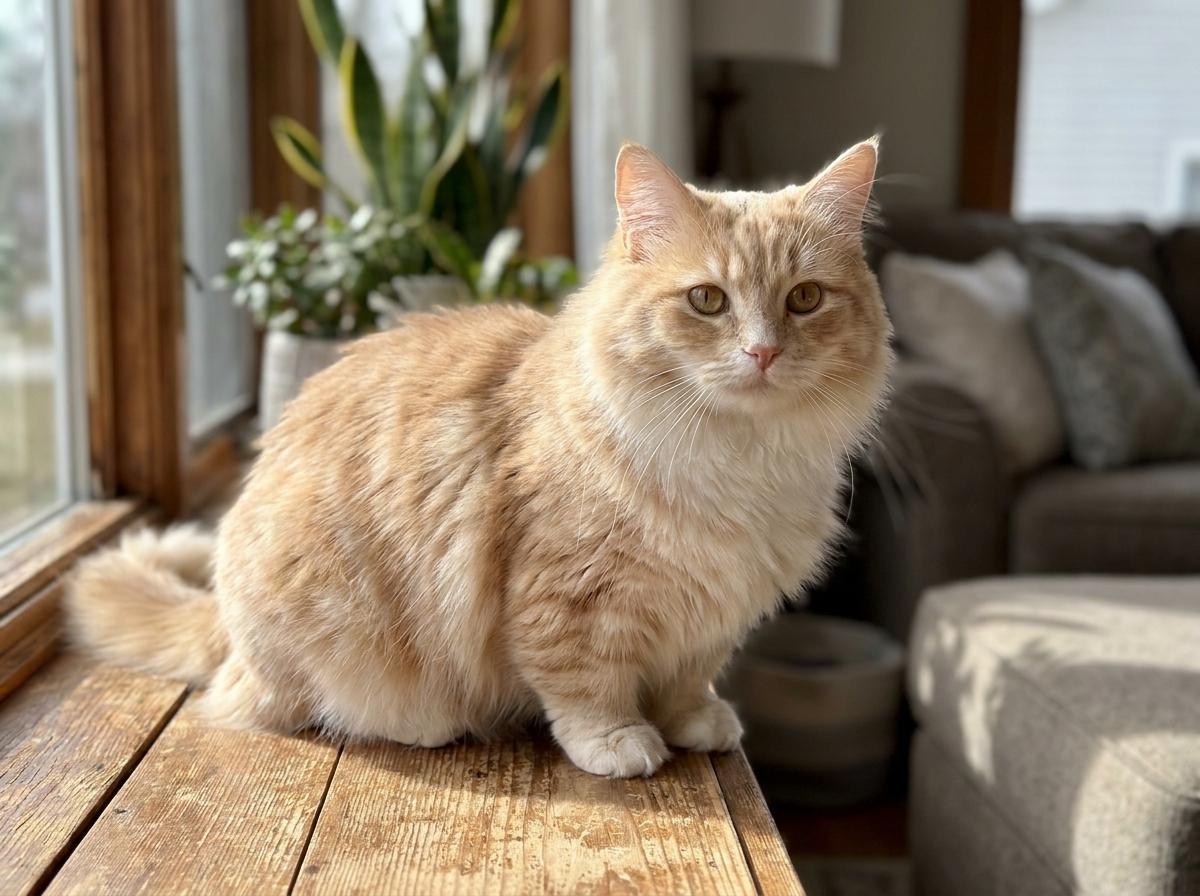
Coat comes in two lengths. Shorthairs have a plush, soft double coat that stands away from the body and runs slightly longer than other shorthair breeds. Longhairs have a full, silky coat with a ruff, britches and a plumed tail, and the standard asks for silky rather than cottony texture. Every color, pattern and eye color is allowed.
The four versions
From May 1, 2026, the seminar says TICA recognizes four versions in championship classes:
- Minuet (MNT): short legs, short coat.
- Minuet Longhair (MNL): short legs, long coat.
- Minuet Tall (MTT): ordinary legs, short coat.
- Minuet Tall Longhair (MTL): ordinary legs, long coat.
According to the seminar, TICA’s board approved the Talls for championship, together with revised wording for the Minuet Breed Group standard, at its August 2025 meeting, with both taking effect on May 1, 2026. Before that, long-legged Minuets were called nonstandard and could not compete in championship, even though breeders were already using them in their programs.
Short legs, tall littermates and the genetics
Minuet leg length follows a simple rule with an awkward consequence. The dwarfism behind the Munchkin’s legs is inherited as a dominant trait, so one copy gives short legs. A 2020 study led by researchers at the University of Missouri, published in PLOS Genetics, traced it to a structural change in a gene called UGDH, found in three unrelated cats with dwarfism. When the team genotyped more cats, they found no cat carrying two copies, and they described the trait in Napoleon cats as “likely homozygous lethal in utero.”
What that means in a litter:
- Short-legged to tall: on average about half the kittens are short-legged and half are tall, and none are lost to the gene.
- Short-legged to short-legged: on average about a quarter of the conceptions carry two copies and do not develop, about half are short-legged and about a quarter are tall.
- Averages are not promises. A real litter can come out all short, all tall or, as the seminar notes, smaller than expected.
This is why many breeders pair a short-legged cat with a Tall. It avoids the expected losses, and the seminar adds that some short-legged males have trouble mounting, which makes tall males useful in a program. It is also why “Minuet Tall” is not a lesser grade. A Tall carries the same head, coat and temperament genes as its short-legged siblings; it simply did not inherit the dwarfism variant.
The welfare debate around dwarf cats
Short legs are the most argued-over thing about this breed, and the honest summary is that the evidence is still thin on both sides. The GCCF position above rests on a welfare principle: its policy is to recognize only breeds able to jump, climb and live a normal cat life. TICA’s breed group answers that the feline dwarfism gene is not the gene behind dwarf dog breeds, and that the cats it has bred move, climb and jump well.
Both sides agree on one point. The seminar says breeders should not breed for extreme shortness, and it reports that University of Missouri geneticist Leslie Lyons warned the breed group directly against it. Cats bred so short that the belly nearly touches the floor are called “rug-huggers” by the breed’s own enthusiasts, and the standard’s quarter-of-body-length minimum exists to keep legs moderate. The seminar also describes an orthopedic study of dwarf cats, with x-rays read at the Orthopedic Foundation for Animals and 34 cats enrolled as of December 2025. No results have been published yet, so treat any claim that the breed is proven sound, or proven unsound, with care.
For a buyer, that turns into a practical test. Look at the adults, not only the kittens. There should be visible clearance between the belly and the floor, the front legs should look straight rather than bowed, and the cat should walk, trot and jump onto low furniture without hesitation. Ask your veterinarian to check gait and joints at the first visit and to tell you what to watch for as the cat ages.
Persian-family health checks
Because every Minuet descends from the Persian group, the Persian-line DNA tests apply. The UC Davis Veterinary Genetics Laboratory lists the Napoleon among the breeds appropriate for its PKD1 test. Feline polycystic kidney disease is autosomal dominant: one copy is enough for a cat to develop kidney cysts, often before 12 months of age, with kidney failure usually coming later. A cat tested N/N cannot pass this variant on.
The same lab lists the Napoleon for its Persian PRA test. This form of progressive retinal atrophy is recessive and leads to blindness in kittens that inherit two copies, so carriers look normal. The seminar says most Minuet breeders test breeding cats for both PKD1 and PRA, and that the breed group has not identified a condition specific to the Minuet. That is the breed group’s own view, not an independent health survey, so read it as a reason to ask for reports rather than a guarantee.
When you ask, be specific. Request the lab reports for both parents, matched to their registered names or microchip numbers, and ask whether any kitten in the litter has been tested itself. A report of N/N from an accredited lab tells you far more than the phrase “health tested” in an advert. Keep copies with the kitten’s vaccination dates and first exam notes; the cat health record template shows a simple way to organize them, and the kitten vaccination schedule helps you spot gaps in what the breeder hands over.
Face shape is the other Persian-family question. The standard’s rules against a nose break, a snub nose and tearing eyes point at the breathing and eye problems that flat-faced cats can have. Watch the parents breathe at rest and look at their eyes, and ask your veterinarian to assess the kitten’s nostrils and tear drainage.
Home setup and activity
The seminar describes Minuets as athletic, saying most can jump onto a kitchen counter. Plan for a climber rather than a cat that stays on the floor. A sturdy cat tree with wide, low platforms gives a short-legged cat a route up and, just as important, a safe route down.

Pet steps beside a bed or sofa are a sensible extra, especially for a kitten, a heavier adult or a senior cat. Keep the cat lean, because extra weight on short legs adds strain; your veterinarian can tell you what a healthy body condition looks like for your cat rather than a breed target. Toys that make the cat chase, pounce and climb suit the build the standard describes.
The breed group calls Minuets sweet and adaptable, attached to the whole household and generally sociable with children, dogs and other cats once introductions are done properly. Treat that as a breed tendency, not a promise. Meeting the parents and asking how the kitten reacts to handling, visitors and other pets tells you more about the individual cat than any breed description.
Coat and eye care
Grooming depends on coat length. A longhaired Minuet has a full undercoat, a ruff and britches, and those are the places that tangle first. A short session with a wide-toothed metal comb several times a week is easier on both of you than a long session after a missed fortnight.

A shorthaired Minuet still has a dense double coat that sheds, so a weekly brush helps. The standard notes that coat density changes with the seasons, climate and hormones, so expect heavier shedding at times. If a mat is close to the skin, get help from a groomer or your veterinarian rather than cutting into it.
Check the eyes and the fur around them while you groom. A well-bred Minuet should not have constant tearing, and new or heavy tearing, squinting or redness is worth a veterinary visit. Log what you see with a date; a pattern is easier for your vet to read than a memory.
Choosing a Minuet kitten
Start with the breeder, not the kitten. On October 17, 2026, the Minuet breeder directory on Creatures listed 7 breeders across 6 states, one of them in Iowa; the directory filters by state as entries change. Directory entries are not confirmed sellers, so use it to compare locations and contact details, then ask each breeder the same questions:
- Which TICA registration and version will the kitten have (MNT, MNL, MTT or MTL), and will the papers transfer with it? The cat pedigree papers guide explains how to read them.
- Can you see PKD1 and PRA reports for both parents, matched to their identities?
- How short are the parents’ legs, and can you watch them move and jump?
- What does the breeder do with Talls in the litter, and how are they priced?
- What is the waitlist and deposit process? The breeder waitlist guide covers the questions worth asking.
On price, there is no reliable public figure for this breed, and isolated adverts are not a market rate. The seminar does note that short-legged kittens are “the more costly” kind, so expect Talls from the same litter to be priced differently. Get a written quote that lists what the fee includes, and budget for the cat itself with the cat cost guide.
Breeding and showing Minuets
Breeding this breed takes more planning than most, because leg length, litter size and Persian-line DNA results all have to be tracked across generations. If you breed, record each pairing with its date so you can follow the pregnancy; the free cat gestation calculator gives a due date, and the guide to how long cats are pregnant covers the signs along the way. On Creatures you can record a breeding on the queen’s profile and then record the litter, noting which kittens are short-legged and which are Talls.
A young breed with frequent outcrosses makes pedigrees worth keeping carefully. The free cat pedigree chart maker lets you lay out the Minuet, Munchkin and Persian-group ancestors with their registered names, and you can keep the lineage on each cat’s profile as described in the Help Center guide to pedigree, family and lineage.
If you show, the cat shows guide explains how TICA and other registries run classes, and you can keep each title and placing on your cat’s profile with show results. Now that Talls compete in championship, record the version alongside each result.
Minuet questions
Is the Minuet the same as the Napoleon?
Yes. Napoleon was the original name, and TICA changed it to Minuet in 2015. Some DNA labs and older pedigrees still use Napoleon.
Do all Minuets have short legs?
No. Litters regularly include long-legged kittens, called Minuet Talls, which have the same head, coat and temperament as their siblings. Since May 2026 they can compete in TICA championship classes.
Do Minuets have health problems?
The main risks to ask about come from the Persian side (PKD1 and PRA, both testable) and from breeding legs too short. The breed group reports no breed-specific condition, but published orthopedic data on dwarf cats is still missing, so buy from a breeder who tests and keeps legs moderate, and keep regular veterinary checks.
How long do Minuets live?
There is no published lifespan study for the Minuet that we could find, so be wary of a precise number in an advert. Ask the breeder how old their oldest cats are, and plan for care well into the senior years.
Can a Minuet jump?
The breed group says most can reach a kitchen counter. A well-proportioned cat should climb and jump readily; a cat that struggles with low furniture deserves a veterinary check.
Do this next on Creatures
Looking for a Minuet? Save a Minuet listing alert and you get an email when one is listed; no account is needed to start. The Help Center explains saved searches and your watchlist. Meanwhile, browse the breeder directory or check current Minuet listings.
The Help Center walks through adding an animal. Still choosing a name? Try the cat name generator.
Then add a record for the parents’ DNA reports, vaccinations or a vet visit. The form opens for visitors, and a free account saves it. See adding a record, health and medical records and reminders and upcoming care for setting the next booster or checkup.
Breed Minuets? Create your cattery’s profile so buyers can find you, then read getting listed in the breeder directory and creating an organization. For more cat breeds and guides, visit the cat hub.