TICA Registration: Litters, Breeder Slips, Cattery Names and Fees
Author: Elliott Garber, DVM · Published
TICA registration usually happens in two steps: the breeder registers the litter, and TICA issues a breeder slip for each kitten, which is then used to register that kitten individually in its owner’s name. A cat bred elsewhere can be registered on its own instead, with a certified three-generation pedigree and proof that you own it. Before you fill in any form, lay out the sire, dam and grandparents with the free cat pedigree chart maker and check each name and number against the parents’ certificates.
Rules and fees checked November 14, 2026. This guide uses The International Cat Association’s Registration Rules (Version A, December 2, 2025), the current registration forms and the TICA price list revised October 15, 2024. TICA notes that prices are subject to change without notice, so confirm the amount in TFMS before you pay.
| Checked | November 14, 2026 |
|---|---|
| Breeder | Registered owner or lessee of the dam at conception |
| Litter rule | Dam must be TICA registered; a non TICA sire needs a certified pedigree |
| Kitten paperwork | One breeder slip per kitten from the registered litter |
| Cat from another registry | Certified pedigree of at least 3 generations plus proof of ownership |
| Name limit | 35 characters including cattery names, “of” and spaces |
| Cattery name | One word, up to 15 letters, registered once |
| Where to submit | TICA’s online system, TFMS, or the Executive Office |
How TICA registration works
TICA’s rules define the breeder of a cat as the registered owner or lessee of the dam at the time of conception. That person registers the litter. Registration of any cat is based on its ancestry as shown by a three-generation pedigree, which is why parent names, numbers and colors matter so much at the litter stage.
Rule 39.9 gives three ways to apply for a cat’s registration:
- A TICA breeder slip. When a litter is registered, TICA issues a slip for each kitten. The owner fills it in to register the kitten individually.
- A certified pedigree from another registry. At least three generations, with a copy of that registry’s certificate showing the applicant owns the cat.
- A breeder-signed pedigree. At least three generations with each ancestor’s name, registration number, color and pattern, signed by the breeder with a statement that it is true and correct, plus proof of ownership.
TICA’s forms say to download the PDF, fill it in, then “Save and Submit” at TFMS, TICA’s online member system, where card and PayPal payments are taken. The price list also accepts checks or money orders in US funds by mail, and says processing starts only once payment has cleared.
If you are new to reading the papers themselves, our guide to checking cat pedigree papers covers what a CFA or TICA certificate should show and how to match it to the cat in front of you.
Registering a litter with TICA
Article Ten of the Registration Rules says a litter must be registered with TICA provided the dam is registered with TICA. If the sire is registered with another association instead, the litter application needs a copy of his certified pedigree showing three generations. If you are not the stud owner, the stud owner signs the litter application, or a breeding certificate signed by the stud owner goes with it. A litter with more than one sire needs a separate application for each sire, with a note that it was a mixed litter.
The current litter registration form asks for:
- Section A, the litter: cattery name, breed, date of birth, and the number of living males and females.
- Section B, the sire: registered name, registration number, breed, color, and the owner or lessee at the time of mating, who signs to certify it.
- Section C, the dam: the same details and signature for the dam’s owner or lessee at mating.
- Section D, each kitten: sex, microchip or tattoo ID, color, eye color, hair length, and whether it is Standard or Non-Standard for the breed (a curled or straight ear in American Curls, a short or long leg in Munchkins, and so on).
- Section E, optional: first and second name choices and the new owner’s details, if you want the kittens registered individually at the same time. This is also where you tick NFB (Not For Breeding) or NFS (Not For Showing).
If you fill in only Section D, breeder slips go to the breeder unless you say otherwise in writing. If you also complete Section E, the kittens are registered individually and the certificates go to the new owners.
Most of what Section D asks for is information you already wrote down at birth. Keeping a dated birth record with each kitten’s sex, color and microchip number saves rebuilding it from memory weeks later. The cat gestation calculator gives you the expected kittening window from the mating date, and our guides on how long cats are pregnant and how many kittens a cat can have cover what to expect before the litter arrives.
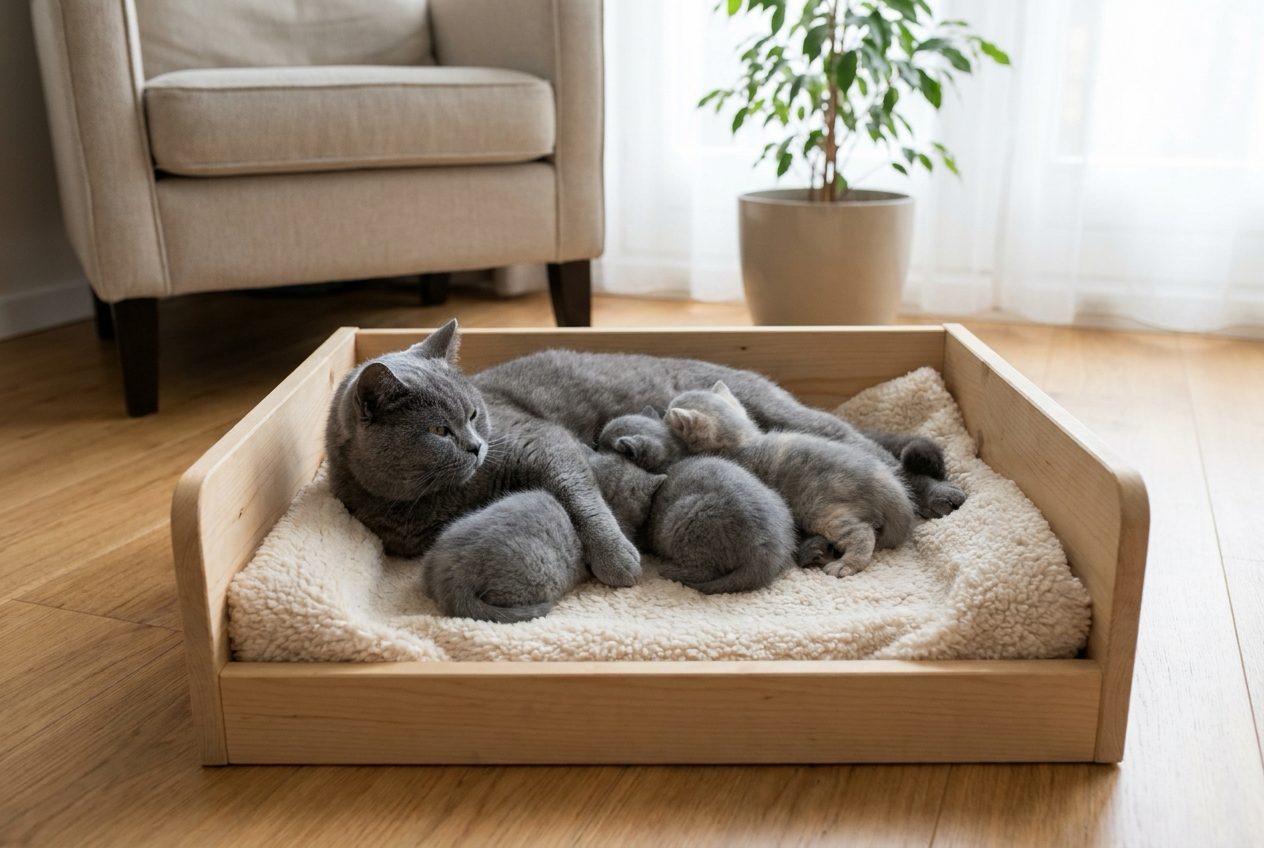
Breeder slips, breeding status and alter agreements
A breeder slip is the paper that lets a kitten from a registered litter be registered on its own. Rule 310.3 says no kitten from a registered litter can be individually registered without it. Rule 39.16 says that, unless there is a written agreement to the contrary, the breeder or seller gives the buyer the breeder slip or the registration certificate and a signed transfer of ownership at the time of transfer, and does not have to hand it over until the kitten is paid for in full.
TICA records each cat’s sex with one of four gender codes: M (fertile male), F (fertile female), N (neutered male) and S (spayed female). Two rules matter at sale time:
- A fertile kitten sold with an alter agreement may be registered as an alter (N or S) at the time of sale, at the seller’s discretion (rule 35.2.3).
- No offspring of a cat registered N or S will be accepted for registration without a petition to the Executive Office and its approval (rule 35.2.4).
So decide, before the slip leaves your hands, whether each kitten is sold as a pet, for breeding or for showing, and write that into your sale terms. The NFB and NFS boxes on the litter form record those choices on the registration itself. Our guide to breeder waitlist management covers how to keep those decisions straight across a waiting list.
Registering a cat from CFA or another registry
To register an adult cat that was registered elsewhere, rule 39.9.2 asks for a certified pedigree of at least three generations from the other registry and a copy of that registry’s certificate showing you own the cat. TICA accepts pedigrees from World Cat Congress member registries and associations it has agreements with, and some clubs approved by a Regional Director. The individual registration form adds that each ancestor on the pedigree must show its name, registration number, color and pattern.
Two details catch people out:
- The name stays. A cat previously registered in another association keeps its name; the only change allowed is adding your cattery suffix (rule 309.9.3).
- Registry codes. If the cat’s cattery name is not a TICA cattery registered to its owner, TICA adds a slash and a two-letter code to the end of the name: /CF for CFA, /FI for FIFe, /GC for GCCF, /ID for an independent registry, /WC for WCF. The form says the name is cut off after 32 characters to make room for that code.
If your cat is registered with CFA too, keep both numbers. The sister guide to CFA registration covers the other association’s litter and blue slip process. Where an ancestor is unknown, our guide to missing cat pedigree ancestors explains how to keep the gap visible instead of filling it with a guess.
Registration numbers and status codes
Every TICA cat gets a unique registration number built from its birth date (six digits) and a sequence number, a registration status code and a description code for breed, gender and color class. The certificate shows the date registered, the cat’s name and number, birth date, breed, color, the sire and dam with their numbers, and the owner and breeder.
The status code tells you how complete the cat’s three-generation pedigree is:
| SB | Stud Book: no unknown, unregistered or other breed cats in three generations |
|---|---|
| 01 | At least one unknown or unregistered parent |
| 02 | At least one unknown or unregistered grandparent |
| 03 | At least one unknown or unregistered great grandparent |
| T (third letter) | Traditional: only the breed in question in three generations |
| V | Variant: crosses outside the breed but within its breed group |
| P | Permissible: outcrosses the breed’s program allows |
| N | Non-Permissible: outcrosses the program does not allow |
TICA registers a cat by its genetic color and pattern, not only by how it looks. A black cat with a smoky undercoat but no silver is registered as black, for example. Being registered in a color does not make a cat eligible to compete in that color, so check the breed standard before you plan a show career. Our guides to cat coat colors and how TICA and CFA cat shows work pick up from there.
Naming rules for TICA cats
TICA’s naming rules are short, and most rejected names break one of them:
- 35 characters. The full name, including cattery names, the word “of” and spaces, may not exceed 35 characters. If it does, the form says the suffix is dropped automatically.
- No special characters such as &, ‘, # or accented letters in the cat’s name.
- No duplicates. Names of cats and catteries may not be duplicated, so give a second choice on the form.
- No owner details. The owner’s name, address and city are not allowed in the cat’s name unless they are part of a TICA registered cattery.
- Ancestors need permission. A cat may not be named after an ancestor without the ancestor’s owner’s written permission, filed with the registrar.
- Changes are limited. A name change can be requested within 45 days (60 in remote areas) of the first certificate, with the original certificate and fee, and only if nothing else has been recorded for the cat, such as a show win or a lease.
If you are short of ideas for a litter theme, the cat name generator is a quick start; count the characters with your cattery name before you commit.
Registering a cattery name
A cattery name is registered permanently, once, on TICA’s cattery registration form. The rules and the current form set these limits:
- One word, using letters, numbers or accented Latin letters, with no spaces or punctuation.
- Up to 15 letters, and at least two letters different from any cattery name already registered.
- Not the name of an accepted breed.
- The word “of” marks a suffix, and translations of “of” are not allowed.
As the breeder, you use your cattery name as a prefix. When you buy a cat bred by someone else, your cattery name can be added as a suffix after “of”, if the name still fits within 35 characters. A cat’s name may carry one prefix and one suffix. If you registered kittens before you had a cattery name, rule 38.6 lets you add the prefix later by paying the correction fee.
The cattery name is also how buyers find you. Our guide to what kitten buyers look for on a cattery website covers what to put in front of them once the name is registered.
Transfers, co-owners and leases
To transfer a registered cat, file a written assignment of ownership with the registrar, surrender the registration certificate and pay the transfer fee (rule 39.15). The individual registration form explains how co-ownership works: when owners’ names are separated by “&”, all of them must sign paperwork; when they are separated by “/”, any one owner may sign things such as a litter application. A transfer of ownership always needs every owner’s signature, whatever the separator. Leases should be recorded with the registrar too, which matters because the lessee at conception counts as the breeder.
TICA registration fees
These are the amounts on the TICA price list revised October 15, 2024, in US dollars; confirm each amount in TFMS before you pay. A one-year membership is $30. Member rates are $2 lower on most litter, kitten and transfer lines, so compare the two columns for the services you expect to use in a year.
| Litter, sire and dam TICA registered | $13 members, $15 non-members |
|---|---|
| Litter, TICA dam only | $16 members, $18 non-members (certified pedigree needed on the sire) |
| Kitten from a breeder slip | $10 members, $12 non-members |
| Cat registered by pedigree | $20 for members and non-members |
| Household pet | $8 members, $10 non-members |
| Transfer of ownership | $13 members, $15 non-members |
| Record or end a lease | $7 members, $9 non-members, each |
| Cattery registration | $75 members, $80 non-members, one time |
| Certified pedigree | $25 for three generations, $50 for five |
The price list also offers a registration incentive: a new cattery that sends its cattery registration together with five individual registrations pays $15 per cat and $40 for the cattery name, with further registrations at $12 each. Rush service, corrections and duplicates have their own lines. TICA also registers household pets separately, with its own form and fee, which is a different record from a pedigreed registration.
Keeping TICA papers with each cat on Creatures
Creatures is where you keep the working records behind the paperwork. It does not file anything with TICA: you still register litters, kittens, cattery names and transfers through TFMS or the Executive Office, and storing a TICA number or certificate on Creatures never registers or certifies a cat.
What that looks like in practice:
- Record the mating. A breeding record takes the sire, picked from your own cats or typed in by name, and the service dates. Turn on due-date tracking and Creatures projects the kittening date and adds reminders. The recording a breeding guide walks through it.
- Record the litter. When the kittens arrive, the birth record creates a profile for each kitten as one litter, so sexes, colors and the birth date sit in one list for Sections A and D. See recording births and creating a litter.
- Store the registration. Add a Registration record to each cat and pick TICA from the registry list, with the registered name, registration number, a link and notes such as “NFB” or “sold with alter agreement”. A cat also registered with CFA gets a second Registration record. Microchip numbers go on the cat’s identifiers. The care, growth and identity records guide covers both.
- Check the pedigree. Each profile carries a pedigree you can view and export as a PDF or image, with an estimated inbreeding coefficient calculated from the ancestry you have entered. The pedigree and lineage guide explains it. Neither that view nor the free chart maker is a TICA certified pedigree.
- Bring in existing papers. Import reads PDFs and photos of certificates and shows the proposed names, IDs and parents for you to check before anything saves; you can start as a visitor, and a free account saves the result. The import guide lists file types and limits.
- Write down your sale terms. Agreements let you issue your own sale contract for e-signature, including when the breeder slip is released and whether the kitten goes as an alter. Creatures does not write the terms for you; see what agreements are and how signing works.
- Show the cattery. A cattery profile under your TICA cattery name can be listed in the breeder directory and can feed a free Creatures website.
Saving any record needs a free account. The add-record form opens for visitors, so you can see the fields before you sign up.
Questions breeders ask about TICA registration
Can a kitten buyer register a TICA kitten without the breeder?
Not from scratch. A kitten from a TICA registered litter is registered individually from its breeder slip, and the breeder supplies that slip, or the completed certificate and a signed transfer, at the time of sale unless your written agreement says otherwise. If the litter was never registered, the other routes still depend on the breeder: a pedigree the breeder signs, or papers from another registry. Ask about the litter registration before you pay.
Can I register a CFA cat with TICA?
Yes. Send a certified pedigree of at least three generations and a copy of the CFA certificate showing you own the cat, with the $20 registration fee. The cat keeps its CFA name, and if its cattery name is not a TICA cattery registered to you, /CF is added to the end.
What does the TICA registration number tell me?
The first six digits are the cat’s birth date, followed by a sequence number. The status code in front of it, such as SBT or 02P, tells you how complete and how purebred the three-generation pedigree is.
Does a pedigree chart count as TICA papers?
No. A chart you make yourself is a working record. TICA issues certified three and five generation pedigrees on request from the registered owner. Use your own chart to check the details before you apply, then keep the official certificate with the cat.
See the cat species guides for the breeding, kitten and show records that sit behind this paperwork.
Do this next on Creatures
Start with the cats whose papers you are handling now: the queen you have just mated, the litter about to go on the TICA form, or the kitten whose breeder slip is about to change hands.
- Add your queen or stud under the registered name you already use. The adding an animal guide walks through the form.
- Add a TICA registration record with the number, status code and any NFB note. The form opens for visitors; a free account saves it. The record guide covers each field.
- Create your cattery profile under your TICA cattery name. It has a guest signup path, and the breeder directory guide explains how listing works.
- Browse the breeder directory to see how other catteries present themselves, or to find a stud owner to contact.
- Save a cat listing alert if you are looking for a registered queen or stud for your program. The saved searches guide explains alerts.
- Browse current cat listings and ask each seller which registry the cat is with, its status code and whether it was sold for breeding.