


Author: Elliott Garber, DVM · Published
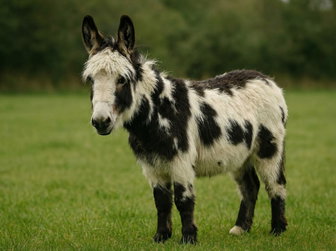
If you have ever stood next to a miniature donkey for the first time, the size is the thing that surprises people most. They look like they should weigh as much as a large dog, then you go to move one and realize there is a lot more animal there than the height suggests. These are compact equines with the heart and bone of a full donkey scaled down, and knowing their real numbers helps you plan everything from shelter and fencing to feed and vet visits.
Miniature donkeys are not simply shrunken standard donkeys. They are a distinct breed, the Miniature Mediterranean Donkey, with deep roots on the islands of Sicily and Sardinia. They first arrived in the United States in the 1920s, and the breed carries a strict height limit that keeps “miniature” meaningful. This guide walks through how tall they get in hands and inches, the registry ceiling, how much they weigh, how a foal grows into a full-size adult, and how they stack up against standard donkeys, mammoth donkeys, ponies, and horses.
Throughout, the figures come from the breed standard and from typical published ranges. Individual animals vary, so treat these as a healthy band rather than a hard rule. If you want to browse real animals and see the range for yourself, the donkey hub on Creatures is a good place to start.
How tall do miniature donkeys get?
Height in donkeys, like in horses, is measured at the withers, which is the highest point of the shoulder where the neck meets the back. You measure straight down to the ground with the animal standing square on a level surface, and you measure to the withers, not to the tips of those famously long ears. Measured the wrong way, an ear can add half a foot of fiction.
Most adult miniature donkeys stand between 30 and 36 inches at the withers, with 32 to 34 inches being the everyday average. There is a mild size difference between the sexes: jacks (males) tend to run about 32 to 34 inches, while jennets (females) tend to be a touch shorter at around 30 to 32 inches. Some sources cite a slightly wider band of 30 to 38 inches when you include outliers, but the practical center of the breed sits right around the height of a kitchen counter.
Donkey and horse people often talk in hands, where one hand equals 4 inches. In those terms a miniature donkey is roughly 7.5 to 9 hands tall. That is a useful frame of reference when you are comparing them to ponies and horses, which are almost always described in hands.
The registry height limit
The number that actually defines the breed is the ceiling. The National Miniature Donkey Association (NMDA), the main registry for the Miniature Mediterranean Donkey, sets the maximum height at 36 inches at the withers, measured at full maturity. An animal taller than 36 inches does not meet the miniature standard. Because young donkeys are still growing, height is monitored until they mature, and registration is tied to registered miniature parentage and DNA verification rather than size alone. On the other end, the NMDA holds a minimum height of about 30 inches for breeding stock, which protects conformation and overall health.
What about “micro” minis?
You will occasionally see donkeys advertised as “micro” minis, usually meaning the very smallest individuals, around 28 to 30 inches or under. “Micro” is a marketing description, not a separate breed or an official registry class. A genuinely tiny donkey can be perfectly healthy, but extreme small size is sometimes pushed at the expense of structure, so look closely at legs, joints, and overall balance, and lean toward verified donkey breeders who can show you the parents and the registration paperwork.
How much do miniature donkeys weigh?
Here is where the surprise lives. A standing-counter-height animal that you can look over the back of still weighs a few hundred pounds. Adult miniature donkeys typically weigh between 200 and 450 pounds (about 91 to 204 kilograms). Most land in the 250 to 400 pound range, and a common everyday average is around 275 pounds. For a rough picture, a healthy mini is in the weight neighborhood of an adult giant panda, or about two large dogs combined.
Sex barely moves the needle here. Jacks and jennets share essentially the same weight range, and the variation you see between two individuals owes far more to diet, exercise, genetics, and overall health than to whether the animal is male or female. A heavier number is not automatically better, either. Show animals often sit toward the leaner 200 to 350 pound part of the range, breeding stock around 250 to 400 pounds, and stockier working types toward 300 to 400 pounds.
Because they descend from animals that survived on sparse Mediterranean islands, miniature donkeys are extremely efficient at storing fat and gain weight easily on rich pasture. A practical body-condition check beats the scale: you want to be able to feel the ribs under a thin layer of flesh without seeing them. A thick, hard crest along the top of the neck (one that can eventually flop permanently to one side), fat pads at the tailhead or behind the shoulders, and rolls along the back all signal too much weight. Prominent ribs and hip bones, hollows around the neck and shoulders, and a dull coat point the other way, toward too little.
From foal to full size: the growth timeline
Miniature donkeys arrive after a long pregnancy, roughly 11 to 13 months, one of the longer gestations among mammals. Newborns are tiny and tough: a foal is usually about 18 to 24 inches tall and weighs somewhere between 18 and 30 pounds at birth, and most are standing and nursing within the first half hour of life. If you are preparing for a new arrival, our guide to raising a miniature donkey foal covers those early weeks in detail.
Growth is front-loaded. A foal does most of its growing in the first year, reaching roughly 80 percent of its adult height by around the 12-month mark, then slows considerably. Weaning typically happens at about 5 to 6 months. Height effectively stabilizes after the first year or two, but full maturity, including filling out in the body, lands around age 3. After that, height holds steady while weight continues to fluctuate within the healthy adult band depending on season and feed.
A rough month-by-month picture looks like this:
- Newborn: 18 to 24 inches tall, 18 to 30 pounds.
- 6 months (around weaning): roughly 80 to 120 pounds.
- 1 year: about 80 percent of adult height, often 150 to 200 pounds.
- 3 years (full maturity): 30 to 36 inches tall, 200 to 450 pounds, settling near 250 to 400.
One quirk worth knowing: because they grow fast early and finish around three, a yearling that looks “almost there” in height can still gain noticeable body weight before it is truly mature, which is exactly why registries verify height at maturity rather than on a young animal.
How miniature donkeys compare to other equines
Size is easiest to understand by comparison, so here is where a miniature donkey sits next to its larger donkey relatives and next to ponies and horses.
Against a standard donkey, the gap is real but not enormous: standard donkeys generally run about 36 to 48 inches (some lines up to roughly 56 inches) and 400 to 570 pounds, so they start right where minis top out. A mammoth donkey, the largest type, is a different animal entirely, standing 54 inches and up and weighing several times what a mini does; you can see the contrast on the mammoth donkey breed profile. Despite the size spread, all three share the same basic shape, the long ears, the sturdy bone, and the dorsal cross marking down the back and shoulders.
Against miniature horses, the heights nearly overlap (mini horses reach up to about 38 inches), but the build does not. A miniature donkey is the stockier of the two, with heavier bone, a thicker neck, stronger hooves, longer ears, and a more barrel-shaped body, while a mini horse is the more refined, delicate-framed animal. Ponies are simply taller, generally 38 to 58 inches, with a chunkier build, thicker mane and tail, and a heavier coat than a mini donkey.
| Equine type | Height at withers | Approx. hands | Typical weight | Build notes |
|---|---|---|---|---|
| Miniature donkey | 30 to 36 in (max 36) | ~7.5 to 9 hh | 200 to 450 lb | Compact, stocky, long ears, dorsal cross |
| Standard donkey | 36 to 48 in (up to ~56) | ~9 to 12 hh | 400 to 570 lb | Same shape, larger frame and muscle |
| Mammoth donkey | 54 in and up | ~13.5 hh+ | ~900 lb and up | Largest donkey type, draft size |
| Pony | 38 to 58 in (up to 14.2 hh) | ~9.5 to 14.2 hh | Varies by breed | Stockier, heavy mane/tail and coat |
| Light horse | ~58 in and up | 14.2 hh and up | ~900 to 1,200 lb | Tall, refined, ridden size |
The takeaway: a miniature donkey is the smallest member of the donkey family, lighter than any standard donkey, taller-feeling than its weight suggests, and stockier than a similarly tall mini horse. That combination, small footprint with surprising substance, is exactly why they suit hobby farms and smaller properties so well.
Why size matters for everyday care
Knowing the numbers is not trivia, it shapes how you keep one. Their efficient metabolism means a mini can get overweight on pasture that would barely sustain a horse, so most do best on mostly grass hay with controlled grazing and very limited treats (a couple of ounces a day, think a slice of carrot, not a scoop of grain). Weigh or body-condition-score monthly, and if an animal needs to slim down, aim for slow loss of no more than about 11 pounds a month rather than a crash diet. Their modest height also sets your fencing, shelter, trailer, and even your dosing math for dewormers and medications, all of which scale to a 200 to 450 pound animal rather than a 1,000 pound one.
For the full picture of feeding, housing, companionship, and health across a 25 to 35 year lifespan, see our complete miniature donkey owner’s guide, and if you are weighing the commitment, the cost guide breaks down purchase price and ongoing expenses.