How Much Milk Does a Goat Produce? Breed Averages per Day and Lactation
Author: Elliott Garber, DVM · Published
A full-size dairy goat on official test produces about 2,000 to 2,700 pounds of milk in a lactation, which is roughly 230 to 315 gallons, or 3 to 4 quarts a day averaged over about ten months; a Nigerian Dwarf averages closer to 800 pounds (about 90 gallons). Those are breed averages from herds on DHIR testing, so the real answer for your doe comes from weighing her milk and writing it down, which the Milking view on Creatures is built for once you sign in to a free account.
Every number below is a herd average from dairy goats on formal production testing, not a promise for a backyard doe. Breed, age, the number of kids she carried, feed, heat, udder health and how often you milk all move the figure, and a doe raising her own kids leaves less in the pail. Treat the breed tables as a yardstick and your own scale as the measurement.
Milk follows kidding, so the next lactation starts with the next breeding. The free goat gestation calculator turns a breeding date or exposure window into an expected kidding window, which is also the date her milk comes in.
Sources checked November 14, 2026. Breed figures come from Penn State Extension’s DHIR table and the Council on Dairy Cattle Breeding goat herd summary; lactation timing comes from Penn State and Alabama Cooperative Extension. Udder problems and sudden drops in milk are a call to your veterinarian, not a records exercise.
| Standard dairy breeds | About 2,000 to 2,700 lb per lactation on DHIR (Penn State, 2019 data) |
|---|---|
| Nigerian Dwarf | About 800 lb per lactation, with the highest butterfat of the dairy breeds |
| In gallons | Divide pounds by 8.62, USDA’s weight of a gallon of milk |
| Daily average | Roughly 3 to 4 quarts for standard breeds, about 1 quart for Nigerian Dwarfs |
| Lactation length | Averages 284 days (Penn State); 210 to 280 days is typical (Alabama Extension) |
| Peak | Four to six weeks after kidding, then a slow decline |
| Best measure | Weigh each doe’s milk at each milking and keep the totals with her record |
How much milk a goat gives per day, per lactation and per year
Goat milk is measured three different ways, and mixing them up is how people end up comparing a “gallon a day” doe with a “2,000 pound” doe and getting confused.
Per lactation. A lactation runs from kidding (freshening) until the doe is dried off. Penn State Extension’s dairy goat production guide puts the average dairy goat lactation at 284 days. Its breed table, built from 2019 DHIR data on records of 275 to 305 days, shows lactation averages from 1,995 pounds for Oberhasli to 2,715 pounds for Alpine, with Nigerian Dwarf at 795 pounds. Registry evaluations use the first 305 days, which is why you see “305-day” figures on production records (ADGA’s production evaluation explainer describes 305-day yields for milk, fat and protein).
Per day. Spread a lactation total over the days in milk and you get an average day, not a typical day. A 2,400 pound lactation over about 300 days is 8 pounds a day, a little under a gallon. Early lactation days run above that average and late lactation days below it, because the daily yield climbs to a peak and then falls.
Per year. Herd summaries often report milk per doe-year. The Council on Dairy Cattle Breeding’s 2021 table of DHI goat herd averages lists 1,955 pounds of milk per doe-year across 18,826 doe-years in 588 herds. A doe-year counts a doe’s time on test across a year, so it is not the same unit as a single lactation record, and in these tables it reads lower than the lactation averages.
Converting pounds to gallons and quarts
Dairy records are kept in pounds because weighing is more accurate than reading a line on a bucket. The USDA’s conversion handbook for agricultural commodities (Agricultural Handbook 697) gives 8.62 pounds per gallon of milk. Use it as the working conversion:
- Gallons = pounds divided by 8.62
- Quarts = pounds divided by 2.16 (a quarter of 8.62)
- 1,000 pounds of milk is roughly 116 gallons
A scale reading is still the better record. Foam, the shape of the pail and the angle you read it at all make volume guesses wander.
Goat milk production by breed
Penn State’s table and the CDCB herd summary come from different years and different units, so read them side by side rather than as one list. Both put Alpine and Saanen at the top on volume, and Nubian and Nigerian Dwarf trade volume for richer milk.
| Alpine | 2,715 lb (about 315 gal); range 750 to 5,720 lb; 3.3% fat |
|---|---|
| Saanen | 2,702 lb (about 313 gal); range 920 to 4,870 lb; 3.3% fat |
| Sable | 2,385 lb (about 277 gal); range 1,540 to 3,120 lb; 3.3% fat |
| LaMancha | 2,298 lb (about 267 gal); range 830 to 4,120 lb; 3.7% fat |
| Toggenburg | 2,237 lb (about 260 gal); range 1,090 to 3,840 lb; 3.1% fat |
| Nubian | 2,018 lb (about 234 gal); range 510 to 3,840 lb; 4.9% fat |
| Oberhasli | 1,995 lb (about 231 gal); range 1,120 to 3,050 lb; 3.7% fat |
| Nigerian Dwarf | 795 lb (about 92 gal); range 220 to 2,110 lb; 6.4% fat |
Gallons are our conversion at 8.62 pounds per gallon. The individual records were not adjusted for age, Penn State notes, which matters: the ranges are wide because a first freshener and a mature doe in her prime sit in the same column.
| Saanen | 2,522 lb milk, 92 lb fat, 75 lb protein (24 herds) |
|---|---|
| Alpine | 2,473 lb milk, 85 lb fat, 72 lb protein (52 herds) |
| Toggenburg | 2,086 lb milk, 76 lb fat, 65 lb protein (9 herds) |
| LaMancha | 1,971 lb milk, 78 lb fat, 65 lb protein (45 herds) |
| Sable | 1,885 lb milk, 78 lb fat, 69 lb protein (3 herds) |
| Nubian | 1,484 lb milk, 71 lb fat, 56 lb protein (73 herds) |
| Oberhasli | 1,428 lb milk, 60 lb fat, 49 lb protein (10 herds) |
| Nigerian Dwarf | 663 lb milk, 40 lb fat (220 herds), 29 lb protein (133 herds) |
| All breeds | 1,955 lb milk, 74 lb fat, 64 lb protein (588 herds) |
Small breed groups (Sable and Toggenburg here) rest on a handful of herds, so one strong herd can move them. For some breeds, Nigerian Dwarf most of all, the CDCB table reports protein from fewer herds than milk.
What the breed numbers mean when you choose a doe
Pounds of milk are only half of the picture. A Nubian’s 4.9% butterfat or a Nigerian Dwarf’s 6.4% gives more cheese or butter per pound than the higher-volume Swiss breeds, which is why many home dairies are happy with less volume. The breed pages go further into type and selection: Alpine, Saanen, Nubian, LaMancha, Toggenburg, Oberhasli, Sable and Nigerian Dwarf. Regional dairy breeds such as the Kamori are not in the US DHIR tables, so treat any single yield figure for them with care.
When you are buying, ask for the doe’s own records and her dam’s, not the breed average. A registered doe with production records on official test tells you far more than a seller’s estimate of “about a gallon a day”. Our guide to dairy goat milk testing explains what a DHIR lactation, a one-day test and a verification test each prove, and linear appraisal records cover the udder and dairy character side.
Why your goat gives more or less than the average
Stage of lactation
Daily yield is not flat. Penn State puts peak production usually four to six weeks after kidding. Alabama Cooperative Extension’s guide to managing milk production in dairy sheep and goats places the goat peak around days 35 to 60 and describes a slow decline afterwards until milking stops. How slowly she declines is called persistency, and it is one of the main differences between a doe who milks well for ten months and one who fades after four. A doe weighed only in her second month will look better than her lactation total; a doe weighed only in late summer will look worse.
Age, kids and breed
Alabama Extension lists breed, age, number of births, litter size, season, diet, health and milking routine as factors in yield and milk quality. Does that give birth to twins produce more milk, Penn State adds. In practice, expect a first freshener to give less than she will as a mature doe, and judge a young doe against her own later lactations rather than against her herdmates.
If kids are nursing, the pail only shows what is left after they drink. Dam-raised kids and a shared-milking routine are good management choices, but they make the pail total an underestimate of what the doe produces. Note “kids on” in her record so the numbers stay comparable. Our bottle-feeding guide for goat kids covers the other route.
Feed, water and heat
Genetics mainly controls milk volume and composition, but diet has a strong influence too, according to Penn State. Alabama Extension describes how the energy demand of early lactation can outrun what a doe eats, so she draws on body reserves, and how heat stress reduces yield, with shade, cool clean water and airflow as the practical answers. The goat feeding guide covers forage, hay and grain. Watching body condition through the lactation helps too; the free goat weight calculator gives a tape estimate when you have no scale big enough for the doe herself.
Udder health
Alabama Extension advises checking the udder and milk at every milking and getting prompt attention for swelling, pain, heat or abnormal milk. If a doe’s milk changes in appearance, her udder is hot, hard or painful, or her yield drops sharply for no clear reason, call your veterinarian. A milk record is useful evidence for that conversation, because it shows exactly when the drop started.
Routine
A regular, calm milking routine supports let-down, according to Alabama Extension. Milking frequency also changes the total: ADGA’s evaluation records store milking frequency alongside each test day for that reason. If you change from twice to once a day, write the date down so a lower total is not mistaken for a problem.
How to measure how much milk your goat produces
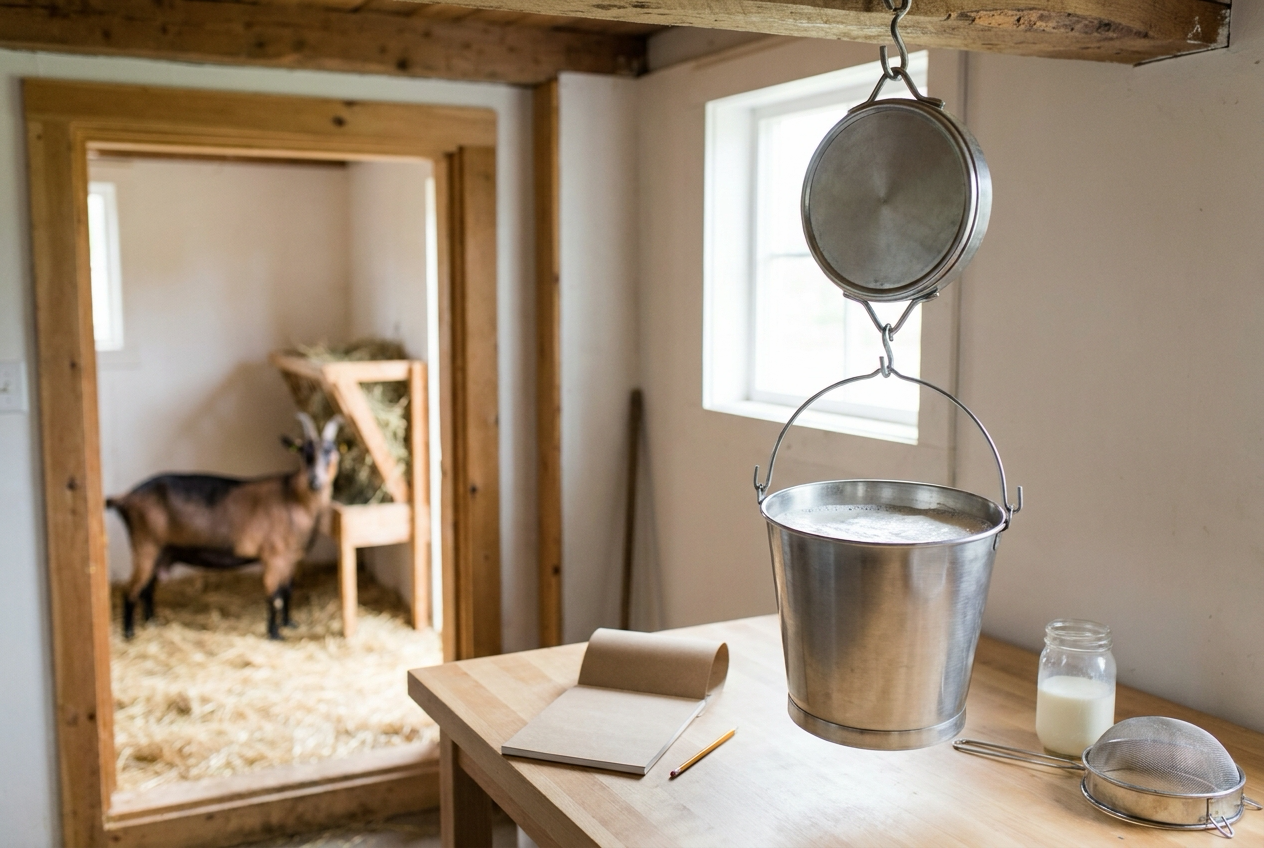
You do not need to be on official test to know what each doe gives. You need a scale, a routine and a place to write it down.
- Use one scale and tare it. A hanging dial scale or a flat kitchen scale works. Weigh the empty pail, or zero the scale with the pail on it, so you record milk only.
- Weigh every doe at every milking, or on a fixed schedule. Daily weights catch problems fastest. If daily is too much, weigh on the same day each week or two and keep the interval steady.
- Record per doe and per session. Morning and evening amounts are often different. Keep them separate so you can see it.
- Note what changed. Kids on or off, a feed change, heat, a move, a sick day. Recording milk yield, days in milk and important events for every animal is exactly what Alabama Extension advises.
- Add up the lactation from kidding. Days in milk start at freshening, so record the kidding date and, later, the dry-off date.
Home weights are management records. They do not become a registry production record, a milk star or a DHIR lactation. If you want recognized records, the milk testing guide walks through enrolling with a DHIA and ADGA. For equipment, the goat milking machine and stand guide compares setups by herd size.
Planning the next lactation
Milk comes in after kidding, so the shape of next year’s milk season is decided at breeding. Record the breeding date or the exposure window, then use the goat gestation calculator to see when she is due. Gestation runs 145 to 155 days, averaging 149, per Penn State. Our goat breeding and heat cycle guide covers timing, and the goat pregnancy test guide covers confirming she settled.
Most herds dry a doe off for a rest before she kids again. Alabama Extension describes a dry period of about 50 days as giving the udder time to recover and the doe time to rebuild body reserves, while noting research in which a shorter dry period did not reduce yield and advising that the best length depends on breed and management. Agree the dry-off date and method with your veterinarian, especially for a high producer.
Staggering kidding dates across the herd spreads milk through the year, a point Penn State makes for dairies that sell to customers year round. When the kids arrive, the goat kidding guide covers labor signs and when to call the veterinarian.
Keep milk records for each goat on Creatures
Creatures keeps milk alongside each goat’s profile, breeding history and health records. With a free account, open Milking and log what each doe gives at each session; the day view shows session totals across the herd, and you can export the records as CSV. Each goat’s profile has her own milk records with a report you can save as a PDF or CSV and a share link, which is handy when a buyer asks what her dam produced.
If you already have numbers, you can bring in milk history rather than retyping it, and the test-day results page reads a photo or PDF of a lab report so component and somatic cell results sit with the doe. Record freshening and dry-off dates as breeding and reproduction records, and when you record a breeding, Creatures projects the due date and shows it on the Breeding dashboard with reminders. Recording a breeding and reminders and upcoming care explain how those dates turn into reminders.
These are your own farm records. Creatures does not submit anything to ADGA, a DHIA or a processing center, and storing a registration number or certificate on a goat’s profile never registers or certifies her. The goat record keeping guide covers what else belongs in each doe’s file.
Questions about goat milk production
How much milk does a goat give per day?
A standard-size dairy doe on test averages roughly 6.5 to 9 pounds a day across her lactation, about 3 to 4 quarts, with more than that near her peak four to six weeks after kidding and less late in lactation. A Nigerian Dwarf averages a little over 2.5 pounds a day, about a quart. These figures come from dividing Penn State’s 2019 DHIR breed averages by about 300 days in milk.
Does a goat have to kid to give milk?
Yes, in normal management. Production starts around kidding and declines through the lactation until the doe is dried off, as Alabama Extension describes, which is why dairy herds plan breedings around the milk season.
Which goat breed gives the most milk?
On volume, Alpine and Saanen top both Penn State’s 2019 lactation averages and the CDCB 2021 doe-year averages. On butterfat, Nigerian Dwarf (6.4%) and Nubian (4.9%) lead in Penn State’s table.
How long does a goat give milk?
Penn State gives an average lactation of 284 days, and Alabama Extension says a full goat lactation usually lasts about 210 to 280 days. Registry evaluations use the first 305 days of a lactation, so a doe milked longer than that is still compared on 305 days.
Is a gallon a day realistic?
For a good standard-size doe near her peak, yes. As an average over a whole lactation, a gallon a day (about 8.6 pounds) is close to the Alpine and Saanen averages in Penn State’s table (about 9 pounds a day over 300 days) and above every other breed’s, so for most does it describes a strong lactation rather than a typical one.
Do this next on Creatures
You are milking, or planning to. Put each doe on a profile, keep her breeding and freshening dates, and her milk numbers will mean something next year.
- Add your doe’s profile with her registration details and identifiers, so her milk records, kiddings and pedigree sit in one place. You can start without an account and sign up in the same flow. Adding an animal shows the fields.
- Record her breeding, freshening or dry-off date so days in milk and the next due date are on her record. The form opens for visitors; a free account saves it. Adding a record walks through the steps.
- Create your dairy’s farm profile so buyers can see your herd and its records under one name. Getting listed in the breeder directory explains how the profile appears.
- Save a goat listing alert if you are looking for a doe with production behind her; you get an email when a matching goat is listed. Saved searches and your watchlist explains the alerts.
- Browse goats for sale and ask each seller for the doe’s own milk records and her dam’s.
- Browse the breeder directory to find dairy goat programs whose records you can ask about before you buy.
More goat guides, from feeding to kidding, are on the goat species page.