American Boer Goat Association (ABGA) Registration: Herd Books, Tattoos, DNA and 2026 Fees
Author: Elliott Garber, DVM · Published
American Boer Goat Association (ABGA) registration records a Boer goat in one of the association’s three herd books: Fullblood, American Purebred or American Percentage. To register a kid you need the sire’s and dam’s registration numbers, the kid’s tattoos, the breeding details and the right owner on the application, all filed through the ABGA office or its online submission. Lay the family out first with the free goat pedigree chart maker, then copy from your originals onto ABGA’s form.
Rules and fees checked November 14, 2026. This guide uses the ABGA Rules and Regulations (the PDF is marked updated July 24, 2026), the ABGA fee schedule that took effect January 1, 2026, the forms page, the tattoo guidelines and the ABGA DNA page. ABGA says its rules can change without notice, so recheck before you file anything that matters.
| Checked | November 14, 2026 |
|---|---|
| Herd books | Fullblood, American Purebred, American Percentage |
| Who applies | The first owner: owner of the dam when the kid is born |
| Who is the breeder | Owner or lessee of the dam on the date of service |
| Tattoos | Herd prefix in the right ear; year letter and serial in the left (2026 is S) |
| DNA | Voluntary since September 1, 2021, unless parentage is in doubt |
| Member registration fee | $20 under 18 months, $24 over 18 months (2026 schedule) |
| Payment | Required before ABGA starts any work (since October 1, 2025) |
Which ABGA herd book your goat belongs in
The association sorts goats by the percentage of Boer blood, averaged from the parents. The rules were last amended on these lines in February 2026, so older summaries (and one line on the current fee page) still show a 99.99% break for Fullblood. The rules PDF is the version to trust:
| Fullblood | 99.5% or higher Boer blood, from Fullblood or American bred Boer stock |
|---|---|
| American Purebred does | At least 93.75% and under 99.5%; shown in the same classes as Fullbloods |
| American Purebred bucks | At least 96.875% and under 99.5% |
| American Percentage does | At least 25% and under 93.75%; unregistered parents can count |
| American Percentage bucks | At least 25% and under 96.875% |
| Bucks under 25% | Not eligible for registration; may qualify for a Listing Paper |
| Wethers 6.25% or more | Record of Pedigree certificate |
| Native on Appearance does | Does that look like Boers, granted 12.5% Boer blood with a full profile photo |
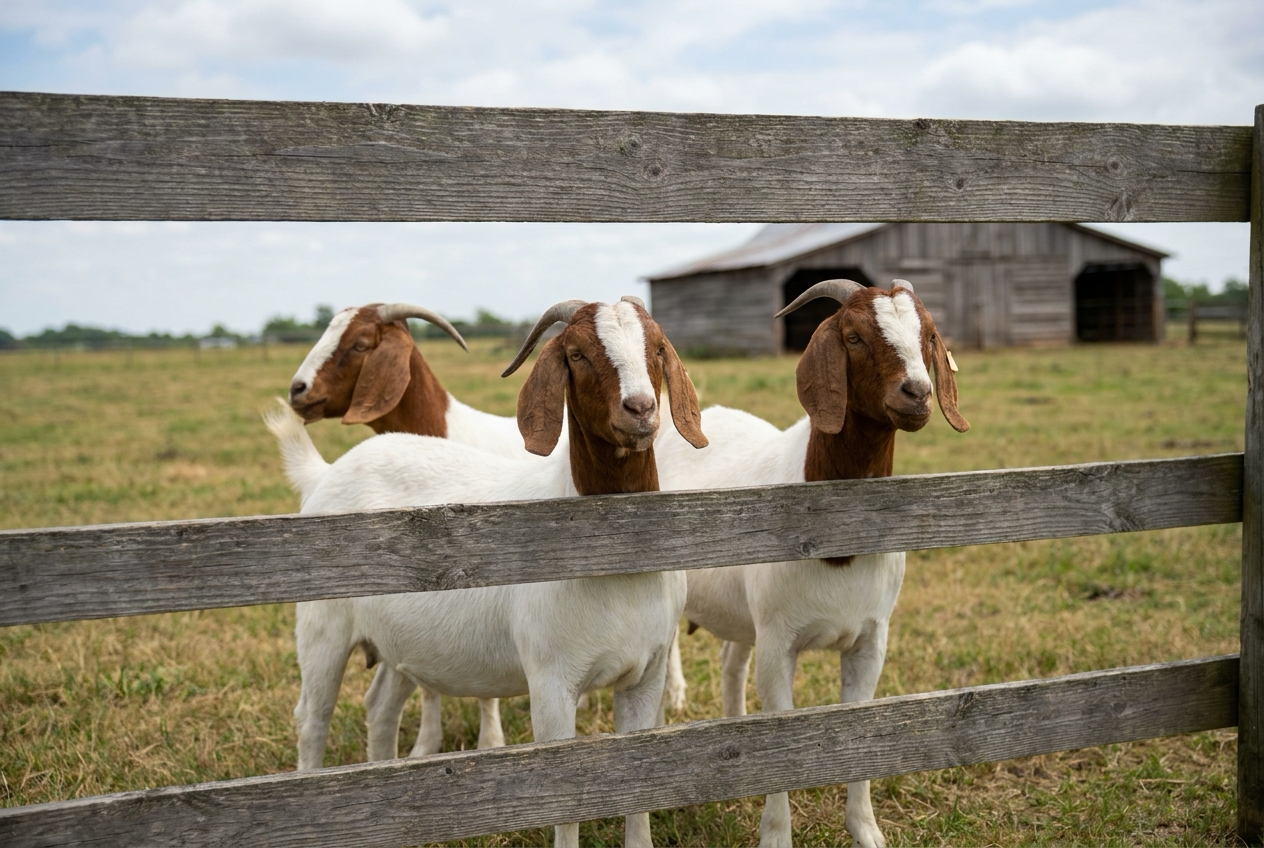
The percentage matters beyond the certificate. A Percentage doe bred up generation by generation eventually reaches Purebred, but only if every step was registered with the correct parents. Keep each animal’s percentage beside its registration number in your own records so you can check the next kid’s eligibility before you fill in the form. On the Native on Appearance route, ABGA notes that the traditional Boer is white bodied with a red head but that no preference is given to color; the traditional by solid red Boer color example shows what to expect from a mixed-color pairing. For the breed itself, start at the Boer goat breed hub.
Who signs: first owner, breeder and the service memo
ABGA separates two roles that people often blur:
- Breeder (Rule 104): the owner or lessee of record of the dam on the date of service.
- First owner and applicant (Rule 103): the owner of the dam on the kid’s birth date. The dam must be on ABGA’s records under exactly the same name as the applicant’s membership on that date, unless a lessee is designated.
If the buck was not registered to the dam’s owner when she was bred, the buck’s owner fills in and signs a Live Coverage Service Memo giving the buck’s name, registration number and the service date (Rule 210C). ABGA’s forms page adds that the memo needs both the buck’s and the doe’s names and registration numbers and the doe’s right and left ear tattoos. For a pasture breeding with no exact date, the rules allow the word “pasture” instead of a date.
A doe sold while pregnant is the common trap. Her kids carry the buyer’s herd prefix tattoo and name (the owner at kidding), but the seller stays listed as breeder, and if the service was not reported on the transfer, the seller has to supply a signed service memo before those kids can be registered (Rules 214 and 306). Settle that paperwork at the sale, not at kidding. The fee schedule also warns that if you are not the breeder and the kid is not from a purchased bred doe, ABGA wants a transfer form and transfer fee with the registration.
Write the service on the doe’s record the day it happens. On Creatures, a breeding record holds the service method, the sire (picked from your animals or typed as an outside buck), the service dates and a projected kidding date, which is exactly what you need for a memo later. The recording a breeding guide shows the form, and goat breeding exposure records covers keeping pen dates honest when you do not know the exact day.
Dates that make a kid ineligible
Rule 209 lists timing problems that stop a registration, and every one of them is a record-keeping problem first:
- A kid born fewer than 140 days after its dam’s previous kidding is not eligible (embryo kids aside).
- A kid born more than 159 days after the service date shown on the certificate, embryo transfer form, transfer or other records is not eligible.
- A kid whose sire or dam was under 90 days old at conception is not eligible.
- Where parentage is uncertain or unknown, ABGA will require DNA testing, and a kid with incorrectly listed parentage waits until DNA confirms the right parents.
The industry standard Boer gestation in the association’s own definitions is 150 days. Plug the service date or the buck exposure window into the goat gestation calculator to see the expected kidding window, and compare the actual birth date against the 159-day limit before you apply. If you are still waiting to confirm she settled, our sister guide on goat pregnancy tests covers the options, and the goat gestation guide has the worked dates.
Herd prefix, herd name and the animal’s name
These are three separate things in ABGA’s system, and only one of them goes in the ear.
Herd prefix (Rule 212). Every applicant, member or not, selects a unique prefix, which is tattooed in the right ear of each goat they register. It can be at most five letters or numbers, with no spaces or special characters, and ABGA will not assign one letter followed by numbers (its examples are D4 and R278). Once assigned, the prefix and tattoo sequence cannot be changed, though a prefix can pass by court order, inheritance or sale on ABGA’s transfer form.
Herd name (Rule 213). Members can also reserve a herd name for naming animals. Only members can hold one, each membership gets one active herd name, it cannot be changed once assigned, and it is limited to 32 characters.
Registered name (Rule 214). The name has two parts: your herd prefix or herd name, then the animal’s own name. ABGA’s example is “Clear View Billy Twin M172”, where Clear View is the herd name. The whole name is limited to 32 letters, numbers and spaces, in English letters and Arabic numerals. Do not build another breeder’s herd name into your kid’s name without their agreement, and expect the original herd name or prefix to stay fixed once the animal is registered.
Tattoos and other permanent ID
According to the tattoo guidelines, all goats must be tattooed at the time of application. The layout:
- Right ear: the applicant’s herd prefix.
- Left ear: a letter for the birth year followed by a serial number for birth order. The letter for 2026 is S and for 2027 is T; ABGA skips I, O, Q and U.
- Uniqueness: ABGA will not register two goats with the same right and left ear combination within 22 years.
- Accuracy: write the tattoo exactly as it appears on the goat, mistakes included. Never list a tattoo that is not actually in the ear (Rule 215B and C).
ABGA’s tattoo page and Rule 215K also accept a permanently implanted microchip “in addition to, or in lieu of” tattoos, with the owner supplying the scanner, and Rule 215L accepts a freeze brand as a method of tattoo. Rule 210, on the other hand, says goats need tattoos as permanent identification to enter the herd books, and an external tag is not permanent identification. If you plan to rely on a microchip alone, ask the ABGA office how it applies to your application before you skip the tattoo.
The tattoo is also what a buyer checks at sale: Rule 304 makes it the seller’s duty to confirm the goat carries legible permanent identification matching its certificate. The goat tattoo guide covers ear placement and keeping a readable tattoo log; it is written around ADGA’s year letters, so use ABGA’s own table for Boer registrations. On Creatures, each goat’s Identifiers page holds the tattoo, microchip and ear tag numbers side by side, so a scrapie tag sits next to the registry tattoo rather than in a separate notebook.
What goes on the ABGA application
Rule 210A lists what a complete application includes. Check each line against your originals before you submit:
- The requested name, following the naming rules above.
- The sire’s name and registration number, and the dam’s registration number.
- Sex, date of birth and how many were born in the litter.
- Type of mating: natural, artificial insemination or embryo transfer.
- Horn information.
- The tattoos as they appear on the goat, plus any external ID such as a scrapie tag.
- Breeder information, and transfer information if the kid is being sold on the application.
- The herd book you are applying under.
- For a half-blood American Percentage doe, the breed of the non-Boer dam, if known.
- Signatures or the electronic equivalent, plus the fee.
ABGA’s forms page has the single registration application, a breeder’s multi-registration form for 10 goats, the service memo, transfer application, lease form and a checklist cover sheet it asks you to include with every packet. An application left incomplete for 90 days after ABGA receives it is void, and an application without its fee counts as incomplete. AI kids need the semen straw details the rules list (buck’s ABGA name and number, collection date, collector ID), and embryo transfer kids need the flush report.
ABGA fees for 2026
These are the member and nonmember rates on the ABGA fee schedule that started January 1, 2026. Since October 1, 2025, ABGA requires payment before it starts any submitted work.
| Fullblood or Purebred, under 18 months | $20 / $50 |
|---|---|
| Fullblood or Purebred, over 18 months | $24 / $60 |
| American Percentage, under 18 months | $20 / $50 |
| American Percentage, over 18 months | $24 / $60 |
| Native on Appearance or Listing Paper | $20 / $50 |
| Transfer of ownership | $10 / $25 |
| Live Coverage Service Memo | $10 / $25 |
| Herd prefix; herd name | $10 / $25; $20 / $50 |
Membership is $75 a year for adults (21 or older on January 1) and $30 for juniors, running January 1 to December 31. The fee page also lists a research fee ($25 member, $62.50 nonmember) for incomplete or illegible forms, revisions you request ($10 / $25 each), duplicate certificates ($10 / $25) and rush service: standard three-business-day rush at $25 per animal for members and same-day at $50, on top of the registration fee. If any of several qualifying first owners is a nonmember, Rule 101 applies nonmember rates to the whole application, so a co-owned doe with one nonmember owner costs more per kid. Use the current fee page for anything not listed here.
DNA testing with ABGA
DNA testing became voluntary on September 1, 2021 (Rule 801), and moved all testing to SNP analysis at UC Davis Veterinary Genetics Laboratory from February 1, 2025. The rules still require DNA when parentage is uncertain, and parent qualification only works when the parent is SNP tested; a parent with only an older STR profile needs an upgrade, or the kid needs the SNP and STR combination test.
The 2026 fee schedule lists $62 per SNP test and $96 for SNP plus STR at member rates, and the DNA page was showing a $5 discount on a limited number of tests when checked. Rule 802 says only current ABGA or JABGA members can request testing, only the current owner can request it (any current or previous owner may pay to upgrade an existing STR profile to SNP), and kits are ordered through ABGA rather than straight from the lab. ABGA’s page describes pulling hair with roots, not cut hair, as the preferred goat sample. Lab turnaround typically runs around 10 to 14 business days from receipt, and SNP samples are run in batches of 24, so plan ahead of a sale.
A DNA result belongs in the goat’s file next to its certificate. On Creatures, a Test Result record has a parentage subtype with sampling and report dates, which keeps the case number and outcome with the right animal.
Transfers when you sell a registered Boer
When a registered goat sells, the owner of record at sale is responsible for completing the transfer, and it must be recorded before the buyer can register that goat’s kids (Rule 300). Use the transfer section on the back of the original certificate; ABGA’s separate transfer application is for when the original certificate is missing, along with a statement that marks the result “Duplicate”. A breeder can also transfer a kid on its registration application with both fees, and a doe sold with an unregistered kid at side needs a completed registration and transfer application for that kid.
Who pays the transfer fee is up to buyer and seller, but the buyer’s membership status sets the rate. Note Rule 311 too: an ABGA transfer is not a conveyance of legal title, and ABGA stays out of the terms of sale. Keep a written bill of sale and agreement alongside the certificate; selling goat kids covers deposits and handoff paperwork, and Creatures invoices can produce a bill of sale for the animal.
Keep the papers with the goat on Creatures
Creatures is where the working record lives; ABGA’s herd book is the official one. Saving a registration number or a scanned certificate on Creatures never registers, transfers or DNA tests a goat with ABGA. You still file every application through ABGA.
What you can keep in one place:
- Registration record for each goat: pick American Boer Goat Association from the registry list, then add the registered name, number, a link and notes such as herd book and percentage. The care, growth and identity records guide covers the registration and ID fields.
- Identifiers: tattoo, microchip and ear tag numbers on the goat’s profile.
- Pedigree: link sire and dam so the profile builds the family tree, with an estimated inbreeding coefficient from the ancestry you have entered. The pedigree, family and lineage guide explains the viewer and exports.
- Kidding: “Record birth or hatch” on the doe creates the kids’ profiles as a litter with the dam and sire already linked, ready for tattoos and applications. See recording births and creating a litter.
- Existing papers: Import reads PDFs and photos of certificates and spreadsheets for you to check before anything saves; you can start as a visitor, and a free account saves the result. The import guide lists file types and limits.
If you also keep dairy goats, goat registries compared and our ADGA registration guide show how a dairy registry differs, from tattoo layout to DNA rules. Show families should read goat shows, since tattoos and certificates are what get checked at the gate. And the same file discipline carries across species: our sister guide to Jockey Club registration covers the Thoroughbred equivalent.
Questions Boer breeders ask
Do I have to DNA test to register with ABGA?
No, not routinely. DNA has been voluntary since September 1, 2021. ABGA can require it when parentage is uncertain or a listed sire is excluded, and parent qualification only works with SNP profiles on file.
I bought a bred Boer doe. Whose name goes on the kids?
The kids carry your herd prefix tattoo and your prefix or herd name as the owner at kidding, and you apply as first owner. The seller remains the breeder. If the service was not written on the transfer, the seller must provide a signed service memo first.
Can a nonmember register a Boer goat?
Yes. Rule 100 lets nonmembers register, and nonmembers also select a herd prefix, but they pay nonmember rates and cannot reserve a herd name or request DNA testing. At $50 against $20 per young kid, the $75 adult membership covers its cost once you register about three young kids a year.
Is a pedigree chart the same as ABGA papers?
No. A chart helps you check parents and spot gaps before you apply. The ABGA certificate, issued from your application, is the registry record. Keep both tied to the same goat.
See all goat guides for breeding, kidding and herd records, and compare meat breeds such as Kiko goats if you run a mixed herd.
Do this next on Creatures
You are a Boer breeder with kids to register and papers to keep straight. Start with the goat whose paperwork is next due, then build out the herd.
- Add your Boer goat with its registered name, tattoos and parents. Adding an animal has a guest signup path; the adding an animal guide walks through it.
- Add an ABGA registration record with the number and herd book. The form opens for visitors; a free account saves it. The adding a record guide covers every record type.
- Create your ranch profile so buyers can see your herd and its papers in one place. The breeder directory guide explains how listings appear.
- Save a Boer goat listing alert to hear when new Boer breeding stock is listed. See saving searches.
- Browse Boer goats for sale and ask each seller for the certificate and the tattoos to match.
- Browse the breeder directory to find Boer ranches and compare their herds.