Goat Tattoo Guide: ADGA Year Letters, Ear Placement and ID Records
Author: Elliott Garber, DVM · Published
For ADGA identification, the herd-assigned tattoo and the individual goat’s tattoo work together. The usual arrangement puts the herd sequence on the goat’s right side and individual identification on its left; LaManchas use the tail web. Keep both strings with the animal’s Creatures profile records so the goat, application and certificate remain connected.
ADGA policy and year-letter chart checked November 12, 2026. The recommended letter for kids born in 2026 is V. This page describes ADGA’s system; another registry’s identification policy may differ.
| Checked | November 12, 2026 |
|---|---|
| 2026 birth-year letter | V in ADGA's recommended year-letter system |
| Herd identity | Use the sequence assigned to your membership |
| Usual location | Herd sequence right; individual sequence left |
| LaMancha | Tail web rather than the very short ears |
| Record | Read the actual goat, then match application and certificate |
Two parts of identification, one actual goat
ADGA requires a dairy goat to be tattooed before it can be accepted for registration or recordation.
Your herd-assigned sequence identifies the herd where the goat was born. The individual sequence distinguishes that animal. A farm nickname, neck tag or stall position can help with everyday work, but keep it separate from the permanent identification recorded on the certificate.
ADGA’s tattoo policy requires members to use their assigned herd sequence. The assigned code has at most four letters and/or numerals; it is not a sequence copied from another breeder. The individual code can use the recommended birth-year letter plus a serial number. For example, V1, V2 and V3 could identify the first three kids in a herd’s 2026 birth order.
Write your planned codes beside the kid’s birth record before preparing equipment. Keep a separate line for each littermate, including sex, dam, birth date and your temporary way of telling the kids apart. A copied code is easy to spot on paper and harder to sort out after it is on an animal.
Which ear or tail-web location?
Use the goat’s own left and right, rather than the sides as you look at its face. ADGA recommends its assigned herd tattoo in the right ear, right tail or center tail, and the individual sequence in the left ear, left tail or center tail. Ears are strongly recommended for breeds other than LaMancha; LaManchas should be tattooed in the tail web. See the official placement policy before a first session.
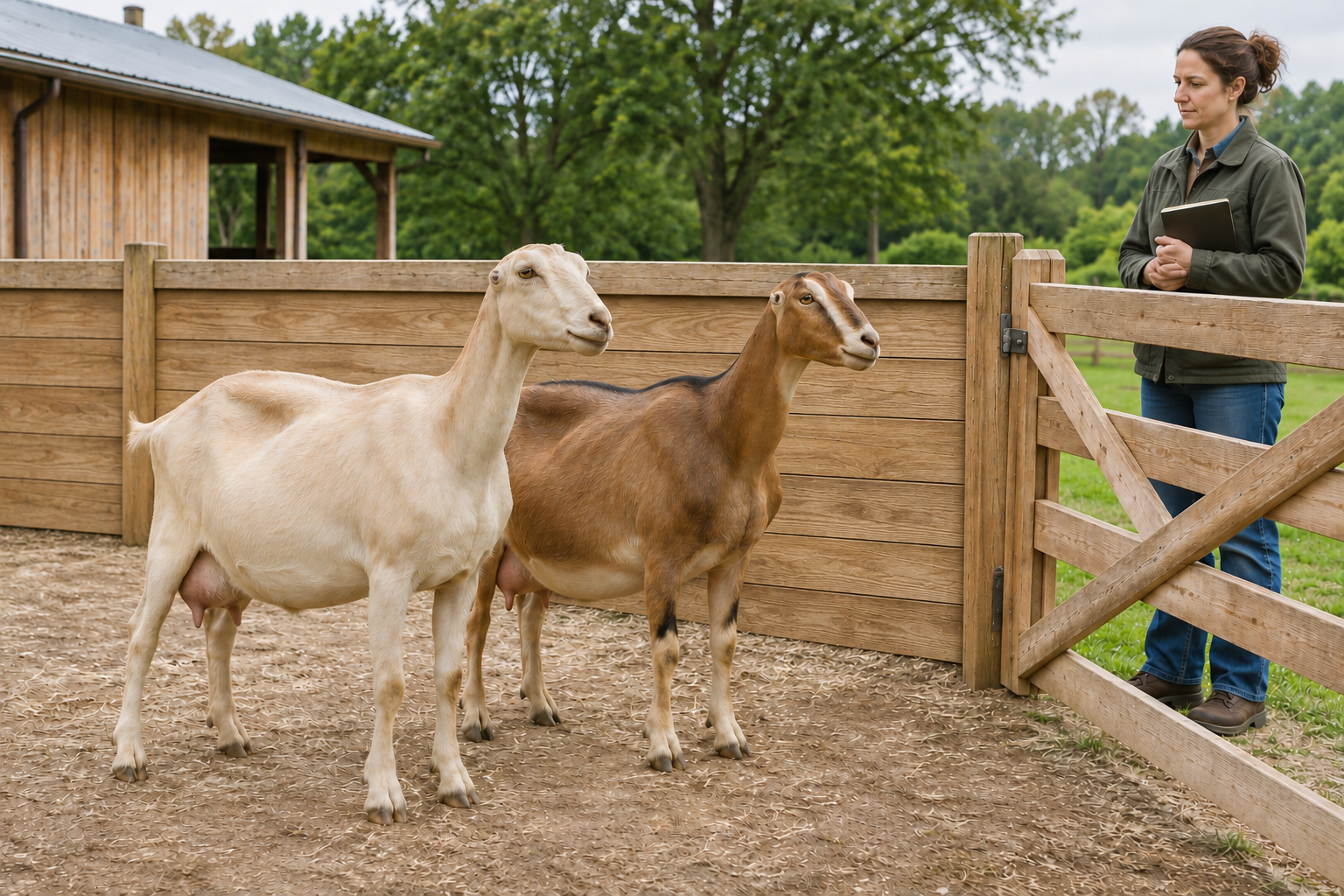
When you write an ID record, include the location as well as the characters. “Left ear V2” contains more useful information than a single loose number in the notebook. For a tail-web tattoo, preserve the exact locations and strings on the papers instead of turning them into a generic “ear number.”
ADGA birth-year letters: chart checked in 2026
The current ADGA year-letter table gives this run:
| Birth year | Recommended letter |
|---|---|
| 2020 | M |
| 2021 | N |
| 2022 | P |
| 2023 | R |
| 2024 | S |
| 2025 | T |
| 2026 | V |
| 2027 | W |
| 2028 | X |
| 2029 | Y |
The system skips G, I, O, Q and U. The letter refers to birth year, not the year you apply for papers. Check older birth years against the complete official table; do not back-calculate through the alphabet without accounting for skipped letters.
Prepare the animal and the record before the procedure
Have an experienced goat handler or veterinarian demonstrate restraint, site selection and technique if this is your first tattooing session. Penn State Extension’s handling guidance emphasizes calm movement, respect for flight zones and moving goats as a group where possible. Set up a clean, secure working area and arrange help before bringing a goat into position.
Use ADGA’s linked tattoo tutorial for the actual preparation and application. It calls for cleaning the site, checking the loaded symbols on paper, selecting the correct space away from veins and cartilage, applying the tattoo and working ink into the mark. Follow its equipment-cleaning and healing directions. Stop and get experienced help if you cannot hold the goat safely or identify the correct site. ADGA’s tattoo tutorial is the procedure source.
Keep the paperwork check separate from the hands-on task:
- Match the goat to the birth record and planned codes.
- Read the loaded symbols and make the paper test impression.
- Have the helper confirm the animal, side and code before application.
- Record what was actually applied, its location, the date and who did it.
- When the mark can be read, compare it with the application before relying on the papers.
The record should describe the actual result, not just the planned code. Do not silently change a form to hide a mismatch.
An illegible or changed tattoo needs a paper trail
The 2026 ADGA Guidebook, Tattoo Policy, covers re-tattooing and certificate revision. It requires the certificate and applicable revision process when a faded or illegible tattoo is re-applied. Contact ADGA about a mismatch or changed sequence before improvising a correction. Preserve the old record and the correspondence with the new evidence.
ADGA treats approved electronic identification as supplemental under specified conditions. Do not assume a chip or a farm tag removes the tattoo requirement. Keep US official movement-ID questions separate too; the sheep and goat scrapie tag guide points to that process.
Keep the tattoo with the kid and its parents on Creatures
Add each kid’s profile using its existing identity and connect the known sire and dam. Keep the herd and individual tattoo strings, their locations and the birth date together. Add the registration number when the certificate arrives, rather than replacing the tattoo with it. They are different identifiers for the same goat.
A paper photo or PDF can help you check the typed record. Sign in with a free account before opening Import; the import guide lists the file types and limits. Read every proposed ID and parent link before saving. A profile record organizes the evidence. ADGA still receives the registration application through its own process.
Our goat pedigree guide helps connect those IDs to ancestry. Use the free goat pedigree chart maker to check names and parent links alongside the tattoo record. The goat record keeping guide covers the wider history. If a goat has papers from more than one organization, read goat registries compared before assuming the same rule applies everywhere.
Questions goat keepers ask
Is V the whole tattoo for a 2026 kid?
The year letter is one part of a recommended individual-ID pattern. Keep the individual serial and herd-assigned sequence as well. A year letter by itself does not distinguish littermates.
Should I copy the certificate or read the goat?
Match both. A certificate helps locate the record, while reading the actual mark checks whether the animal presented agrees with it. Keep notes about anything you cannot read confidently instead of guessing.
Browse the goat species guides for related herd records.
Do this next on Creatures
Keep the paperwork with the goat it identifies. Start with one animal and the certificate or identification record you need to keep next.
- Add your goat’s profile with its existing name and ID. The adding an animal guide walks through the form.
- Add a registration or ID record. The form opens for visitors; a free account is needed to save. Follow the record guide.
- Create your farm profile. This has a guest signup path; the breeder directory guide explains the listing.
- Save a goat listing alert if you are looking for breeding stock.
- Browse current goat listings and ask each seller for the animal’s actual papers.
- Browse the breeder directory to contact farms about their herds.