Plymouth Rock
Author: Elliott Garber, DVM · Published
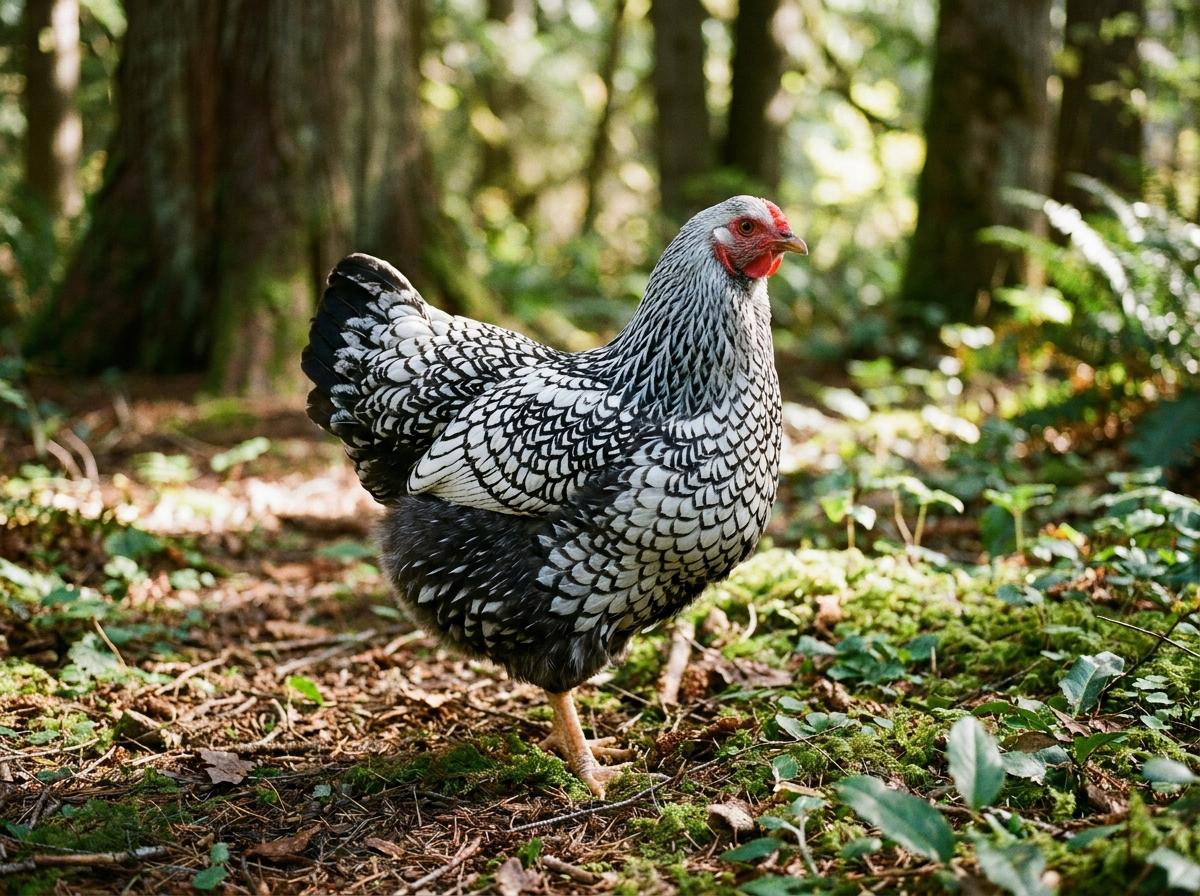
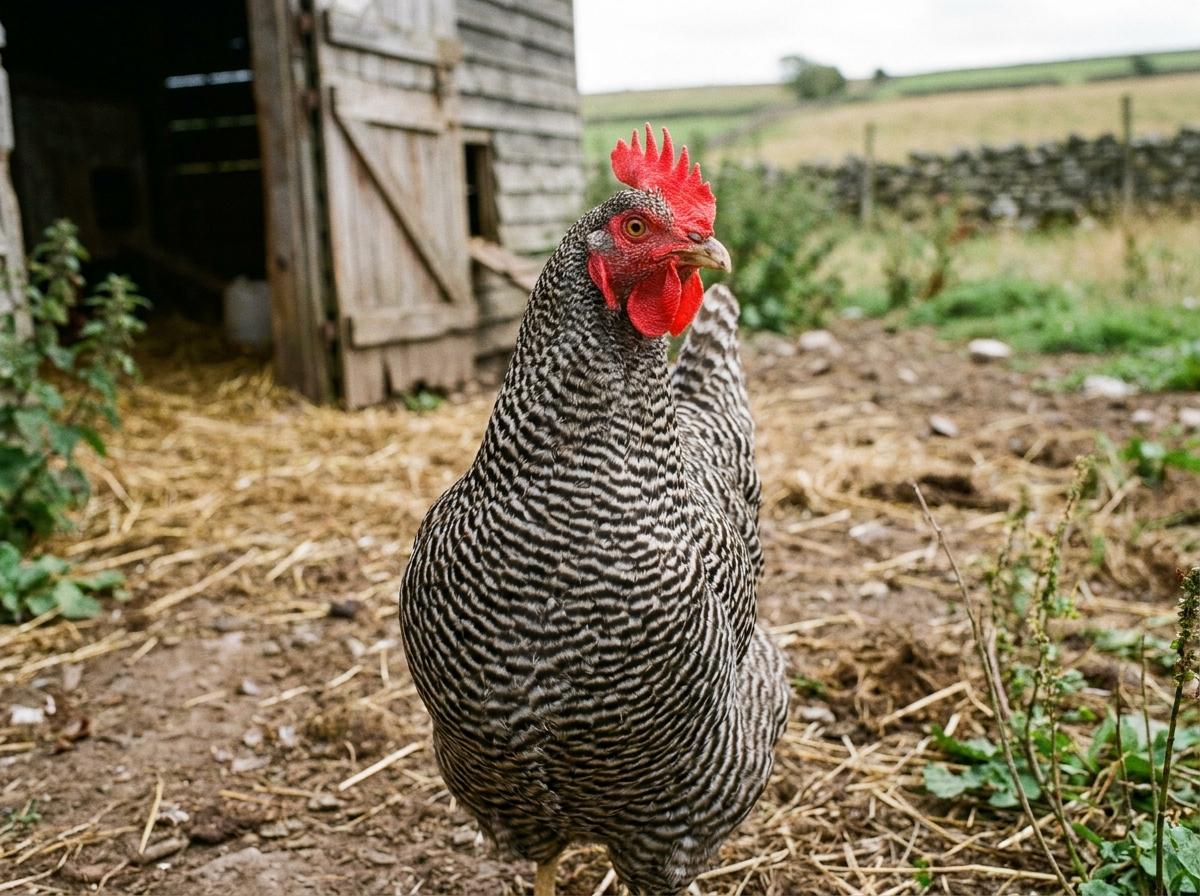
Plymouth Rock is the breed. Barred is one of its varieties, and the one almost everybody means: the black and white striped farm hen people picture when they picture a chicken. Call her a Barred Rock, a Barred Plymouth Rock or just a Rock and every poultry keeper will know what you mean. She is a heavy American dual-purpose bird, single combed, yellow legged and yellow skinned, laying brown eggs at a rate The Livestock Conservancy puts at around 200 a year, and she is about as forgiving a first chicken as exists. If you are shopping rather than reading, Plymouth Rock listings on the Creatures marketplace show what is available right now.
What separates this breed from the other calm brown-egg layers is not temperament. It is the barring. The gene sits on the Z chromosome, which is why a barred cockerel grows up paler than his sisters, why you can sex purebred Barred Rock chicks at hatch by a spot on the head, and why a Barred Rock hen crossed to a red rooster gives chicks you can sex on sight. Everything below names its source, because much of what circulates about this breed comes from catalogue copy rather than a standard.

| Also called | Barred Rock, Barred Plymouth Rock, Rock; “Barred Rock” names the variety, not the breed |
|---|---|
| Origin | New England, United States; first shown in Boston, re-established at Worcester, Massachusetts in 1869 |
| Primary use | Dual purpose, eggs and meat |
| Standard weights | Cock 9.5 lb, hen 7.5 lb, cockerel 8 lb, pullet 6 lb (University of Wisconsin Extension A2880, giving the Standard weights; The Livestock Conservancy gives the same 9.5 and 7.5 lb adult figures) |
| Comb, skin, legs | Single comb; yellow skin; clean unfeathered yellow shanks (A2880) |
| APA large fowl varieties | Seven, all in the American class: Barred, Blue, Buff, Columbian, Partridge, Silver Penciled, White |
| APA and ABA bantam varieties | Eight, in Single Comb Clean Legged: the same seven plus Black |
| Eggs | Brown, large; around 200 a year (The Livestock Conservancy) |
| Temperament | Docile and easily tamed (A2880); calm and good with children (The Livestock Conservancy) |
| Conservation status | Graduated off The Livestock Conservancy’s Conservation Priority List in 2023 |
Browse listings, public profiles, breeders, or add your animal.
Plymouth Rock, Barred Rock, or Barred Plymouth Rock?
All three are correct, and they are not interchangeable.
A breed is a group of birds sharing body shape, skin colour, carriage, toe count and leg feathering, and passing those on. A variety is a subdivision of it, usually by plumage colour or comb type, everything else identical. University of Wisconsin Extension uses Plymouth Rocks as its worked example: Barred, White, Buff and Partridge are varieties of one breed, same body, different colour.
The historical order explains the muddle. Barred came first, and for a while “Plymouth Rock” simply meant a barred bird. As other colours were bred the name moved up a level to cover the breed, and Barred became one variety among several.
What the American Poultry Association actually recognises. The APA publishes its accepted breeds and varieties table, and it is worth reading rather than assuming. Large fowl: seven varieties, all in the American class, being Barred, Blue, Buff, Columbian, Partridge, Silver Penciled and White. Bantams: eight in the Single Comb Clean Legged class, the same seven plus Black. So a Black Plymouth Rock is an accepted variety as a bantam and is not on the large fowl list. Lists that give eight large fowl colours have quietly imported the bantam column.
Bantams are governed by the American Bantam Association, which publishes the Bantam Standard and licenses bantam judges. Its active breed and variety list carries the same eight Plymouth Rock bantam varieties in Single Comb Clean Legged, so the two bodies agree. Wisconsin adds that bantams carry the same requirements for shape, colour and physical features as large fowl and should weigh about one fifth as much.
Britain is a separate system. Standards there are set by The Poultry Club of Great Britain, which classifies the Plymouth Rock as Soft Feather: Heavy rather than American and publishes its full standards in the printed British Poultry Standards rather than on the site. Do not assume the US and UK colour lists match.
What the standard calls for
One caveat first, because it governs every number below. The American Standard of Perfection is a purchased book, and the APA’s site publishes the recognition table but not the weights, scale of points, faults or disqualifications, so the figures here come from extension publications reproducing the Standard weights. Where a show result turns on whether a trait is a fault or a disqualification, buy the Standard or ask a licensed judge rather than trusting any website, this one included.
University of Wisconsin Extension’s A2880 gives the Standard weights as cock 9.5 pounds, hen 7.5 pounds, cockerel 8 pounds and pullet 6 pounds, and The Livestock Conservancy independently gives 9.5 pounds for males and 7.5 for females. Skin colour yellow, eggshell colour brown, use meat and eggs.
The type is a working farm bird rather than a fancy one. A2880 calls for a long broad back, a moderately deep full breast and a single comb of moderate size, notes the wide straight back as a definite breed characteristic, and lists the common faults as shallow breast, high tails, narrow bodies and small size. Those are the extension’s words for faults, not a quotation of the APA’s disqualification list, and the two are different things.
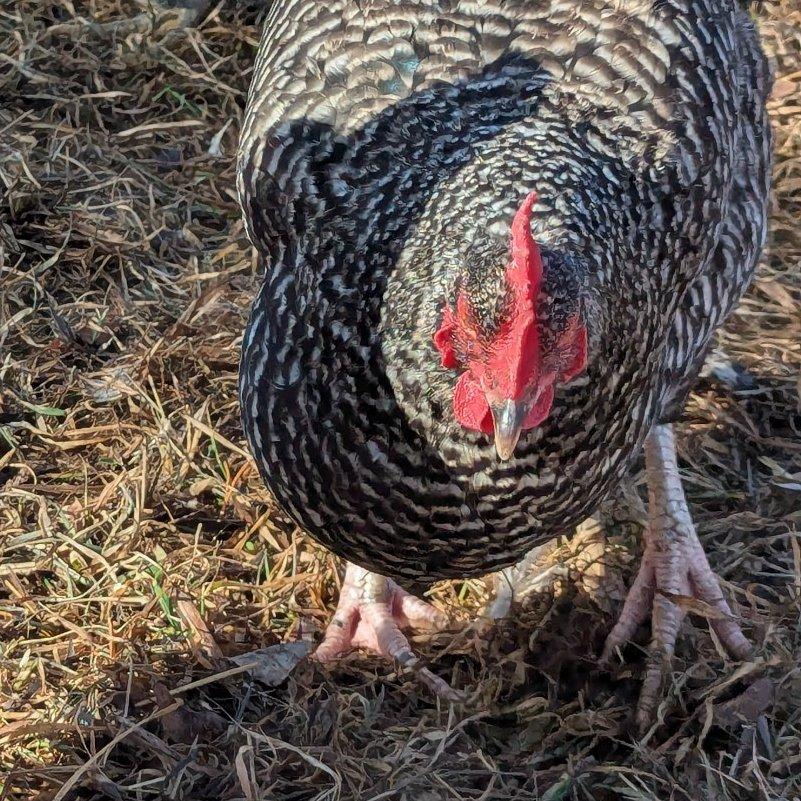
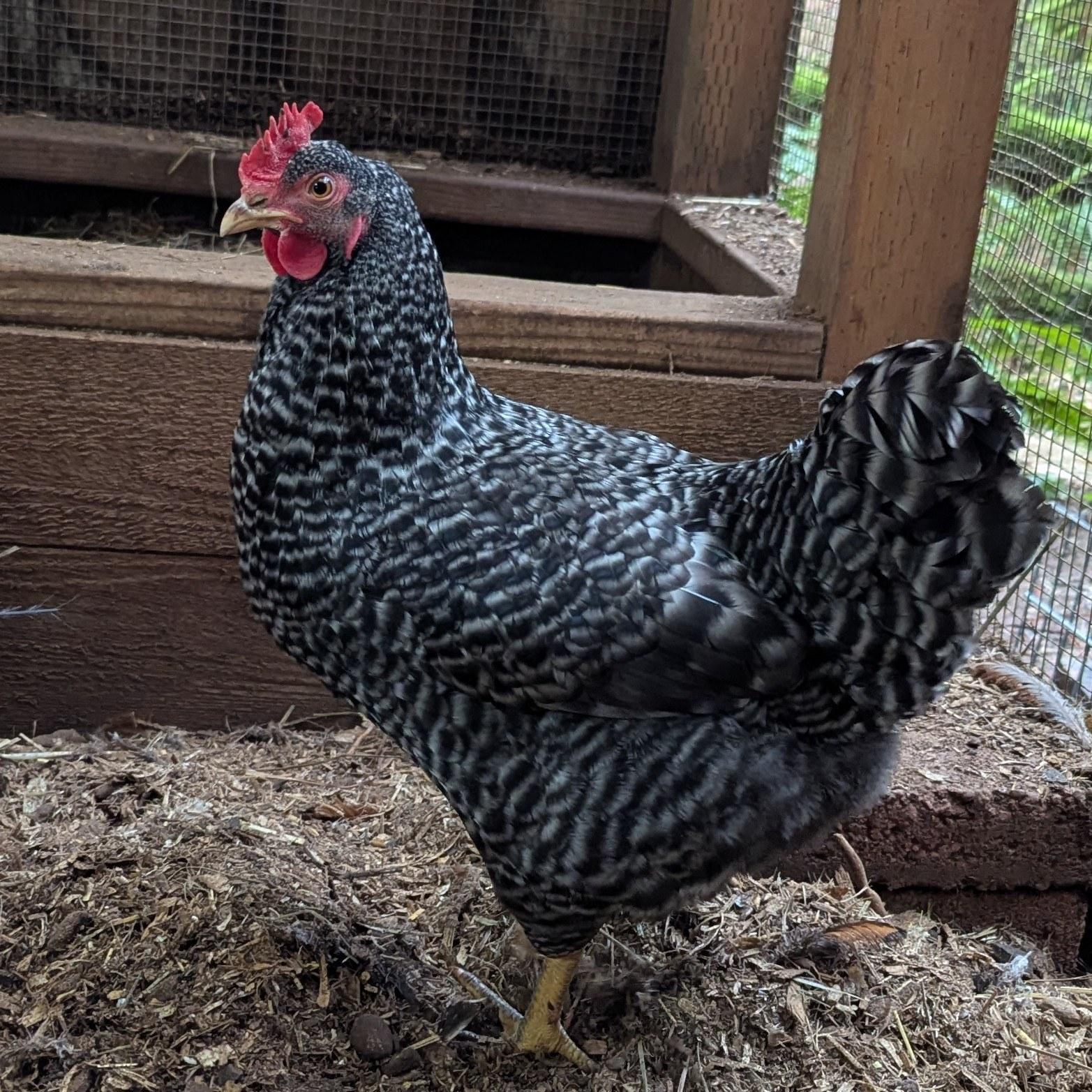
Head detail, from The Livestock Conservancy: bright red single comb, face, wattles and earlobes, the comb carrying five evenly serrated points with those at front and rear shorter than the middle ones. Horn coloured beak, reddish bay eyes, yellow skin and legs, four toes. The barring should read as sharply defined, regular, parallel bars of light that is not quite white on dark that is not quite black.
The barring is sex-linked, and that is the useful part
This is the part of the breed worth actually learning, because it changes what you can do with the birds.
Sex chromosomes work the other way round in birds. As Dr. Jacquie Jacob of the University of Kentucky sets it out for Poultry Extension, the national Cooperative Extension poultry resource: birds use Z and W chromosomes, females are ZW and males are ZZ, so in poultry it is the hen who determines the sex of the chick.
The barring gene rides on the Z. In her guidance on sexing day-old chicks, Jacob states that the Barred Plymouth Rock carries a barring gene (B) on the Z chromosome, that it produces a white bar on an otherwise black feather, and that it is incompletely dominant over the non-barring gene.
Why cockerels look paler than their sisters. A male has two Z chromosomes and can carry two copies of barring; a female has one Z and carries one. The extension guidance puts the consequence plainly: in adults the male, with two barring genes, has feathers with broader white bars than the female with only one, so males are overall lighter in colour. The Livestock Conservancy describes it from the other direction, noting that the gene does not add dark bars to a light feather but prevents pigment on coloured plumage, and that the male’s two copies are why males are usually lighter.
The molecular basis is settled too, if you want it. A 2017 PLOS Genetics paper mapped Sex-linked barring to the CDKN2A locus on the Z chromosome and identified three variant alleles, of which the Barred Plymouth Rock carries B1, the one giving sharp white and pigmented stripes. The proposed mechanism is that raised expression makes melanocyte precursors differentiate early, so the growing feather runs out of pigment cells and lays down a white band until they are replenished.

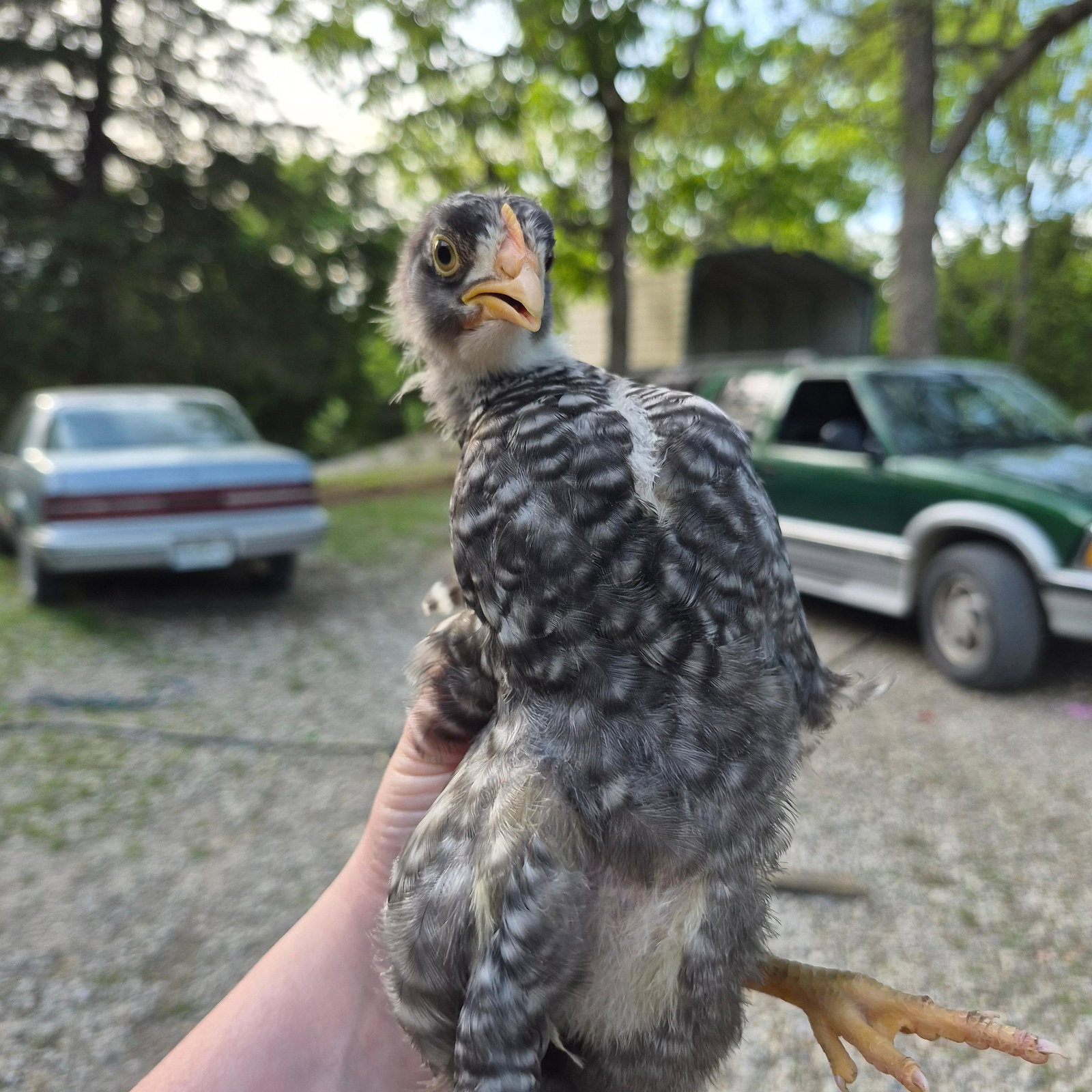
Sexing purebred Barred Rock chicks at hatch. Sex-linked barring also puts a light spot on a chick’s head, and that is the practical payoff. Extension states that purebred Barred Plymouth Rock chicks can be sexed on that spot’s size and shape: males have a large white one, in females it is much smaller and narrower. The honest accuracy figure comes with it, about 80 percent. Useful for splitting a brooder, not a guarantee.
The black sex-link cross. Because barring sits on the Z, one specific cross sorts itself. Extension describes black sex-links, also called Rock Reds, as a barred hen mated to a non-barred rooster, commonly a Barred Plymouth Rock hen with a Rhode Island Red or New Hampshire male. The male chicks feather out barred like their mother; the females come out solid, typically black. At hatch both sexes have black down and the males carry the white head spot. The direction matters: a barred male over a non-barred female does not work. And the offspring of a sex-linked cross cannot make a second one, which is why a home flock’s next generation stops sorting itself.
If that is why you are buying a particular bird, write the parentage down at purchase. You can record parentage and hatch details on a free Creatures animal profile, which beats reconstructing a cross two seasons later.
Eggs: what to expect, honestly
The Livestock Conservancy puts the Plymouth Rock’s rate of lay at around 200 large brown eggs a year, with laying strong for the first few years, then a slow decline, and hens sometimes continuing into their tenth year, which is at the far end of how long backyard hens live.
Treat catalogue numbers above that as strain claims rather than breed claims. Production-bred lines are selected for output and often do better in year one; standard-bred exhibition lines usually do less. Extension’s advice on choosing a breed is the honest version of the trade: commercial-type hens may give a higher level of production initially, but other breeds tend to lay for more years.
The shape of the laying year matters more than the annual total. University of Florida IFAS Extension’s factors affecting egg production in backyard flocks describes a laying cycle of about 12 months: a pullet’s first egg at about 18 to 22 weeks depending on breed and season, production rising sharply to a peak of about 90 percent six to eight weeks later, then declining to about 65 percent after 12 months of lay. Your Rocks will not spread 200 eggs evenly across the calendar.
Day length is the other lever, and extension guidance puts the requirement at about 14 hours of light a day to bring pullets into lay and at least 14 to hold a flock in lay year round, so without supplemental light expect a winter pause. Our chicken egg laying guide has the mechanics.

A trick the yellow skin gives you. Because Plymouth Rocks carry yellow pigment in the skin, you can read where a hen sits in her cycle by how much yellow is left. Extension names Plymouth Rocks and Rhode Island Reds specifically for this and gives the order in which the colour bleaches out: first the vent, then the face, meaning beak, eye ring and earlobe, then the feet, meaning shanks, toes and hock. A pale-legged Rock in midsummer has been laying. A bright yellow one in the same pen has not. That one observation tells you more about which birds are earning their feed than any breed average will.
Dual purpose, then and now
The Merck Veterinary Manual sorts chickens into meat, egg laying and dual purpose, and names the Plymouth Rock first among the dual-purpose breeds that are reasonably good at both and therefore suit most backyard owners. The word doing the work is “reasonably”.
Historically it was more than reasonable. The Livestock Conservancy states that until the Second World War no breed was kept and bred as extensively, on hardiness, docility, broodiness, brown egg production and a carcass considered good eating, and that the Plymouth Rock was a foundation breed of the broiler industry in the 1920s. Wisconsin’s A2880 records where that went: White Plymouth Rock females are the female side of most commercial broilers produced today. The breed did not lose the meat argument so much as get absorbed into the winning side of it.
For a backyard keeper now, a dual-purpose cockerel is a slow, expensive bird next to a modern broiler and worth raising for reasons other than efficiency. The Livestock Conservancy’s Heritage Chicken definition sets a deliberate floor of no less than 16 weeks to market weight so the bird builds skeleton and organs before muscle. Plan for a long grow-out and a firmer, better-flavoured carcass, not a supermarket lookalike.
Where the breed came from
The story is better documented than most, and the two best sources disagree about one date, so here is both. Illinois Extension’s history of breeds says the Plymouth Rock was first exhibited at America’s first poultry show in Boston, gives the year as 1829, and says those original fowls lost their identity. The Livestock Conservancy tells the same sequence but dates that Boston showing to 1849. Both agree on everything after it, so the honest position is a first appearance in Boston at the country’s first poultry exhibition, with the year disputed between two otherwise reliable sources.
From there the accounts converge. The true progenitors of today’s Plymouth Rocks were exhibited at Worcester, Massachusetts in 1869, and they were composites. Illinois Extension names the first and most prominent cross as a Dominique male over Black Cochin or Black Java females, made at Putnam, Connecticut, and notes that the Dominique male was not the rose-combed American Dominique but a single-combed hawk-coloured bird common locally. The Livestock Conservancy lists Spanish, White Cochin, Dominique, Buff Cochin, Black Java and Brahma among the crosses the various claimants said they used. So “developed in Massachusetts” is fair shorthand for where the breed was shown and named, but the foundation cross is credited to Connecticut and the parentage was never settled.
The breed was accepted into the American Poultry Association’s first Standard of Excellence in 1874. The other varieties came later and from elsewhere: Illinois Extension records the Whites as white sports of the Barred, the Buffs as Rhode Island birds first shown as Golden Buffs, the Silver Penciled from New York out of Dark Brahma and Silver Penciled Wyandotte, and the Columbians from Ohio out of Light Brahma, Barred and White Rock and Columbian Wyandotte.
One point of current status is worth correcting, because older articles still get it wrong. The Plymouth Rock is not a conservation-priority breed. The Livestock Conservancy announced in its 2023 Conservation Priority List that Plymouth Rock, with Australorp, Rhode Island Red and Brahma, had large enough global populations to graduate off the list, crediting census data and the growth of backyard chicken keeping.
Heritage stock versus hatchery production strains
Two birds sold as Plymouth Rocks can be genuinely different animals, and this is the most useful thing to understand before buying.
Wisconsin’s A2880 draws the line without taking sides. Hatchery production stock is usually highly productive and carries many of the traits a breeder wants, but a high-production bird is very different from the fully fitted, standardised show bird bred to the breed’s own standard. It names slower growth and greater seasonality as typical of exhibition-type birds, and concludes that both are good sources depending on your goals.
The Poultry Club of Great Britain’s breed page shows how far the split can go. It records that the barred Rock arrived in Britain as a dual-purpose bird and was then developed to an exhibition ideal in which body size and frontal development were neglected to secure long, narrow, finely barred feathers, and that utility breeders responded by using the Canadian barred Rock, a bird with a roomy body and full breast, lower on the leg but coarser in its barring. Fine barring and a big productive body pull against each other, and breeders have chosen differently for a hundred and fifty years.
“Heritage” is a third thing, and a defined term rather than a mood. The Livestock Conservancy’s Heritage Chicken definition requires all four of: parent and grandparent stock of an APA-recognised breed established before the mid twentieth century, with traits meeting the Standard of Perfection; natural mating at both those generations; the genetic ability for a long vigorous outdoor life, with breeding hens productive five to seven years and roosters three to five; and market weight reached in no less than 16 weeks. It treats “heirloom”, “antique”, “old-fashioned” and “old timey” as claims to the same definition. So the breed is eligible, but whether a particular bird is Heritage depends on how it was bred rather than what it is called. Ask.
Temperament, cold, and that single comb
Temperament. A2880 describes Plymouth Rocks as docile, generally not aggressive and quick to tame, while warning that a big active male or hen can be a real problem if one does turn aggressive. The Livestock Conservancy describes calm birds, sweet and docile in both sexes, good with children, easy alongside other breeds and a sound choice for a first-time owner. That matches how the breed behaves in most yards, but it does not mean every cockerel will be pleasant, and a heavy bird that decides to challenge you is a heavy bird.
Cold hardiness is documented, not folklore. University of Minnesota Extension names Plymouth Rock first in its list of heavier breeds that over-winter well, alongside Wyandotte, Ameraucana and Orpington, and notes that smaller breeds with less feathering or large combs and wattles need extra care. The Livestock Conservancy attributes the breed’s cold hardiness to early feathering.

The single comb is the trade-off. Every APA Plymouth Rock variety is single combed, and a single comb freezes more readily than a pea or rose comb. Poultry Extension’s frostbite guidance frames it well: a well-designed, well-maintained coop should prevent frostbite, but at single-digit temperatures and below it becomes a risk, most often overnight in a cold, poorly ventilated coop with damp bedding. Combs, wattles and toes are vulnerable, and roosters are most affected because their combs and wattles are larger.
The prevention is coop management, not heat. That guidance advises leaving deep bedding in place over winter for insulation while topping it up to keep it dry, and increasing ventilation whenever you find morning condensation on windows or uninsulated walls, because the birds themselves put a great deal of moisture into the air. It warns that heat lamps are a real fire risk and that coops are lost to them every year, and says flocks do well at sub-zero temperatures on deep litter with an in-bucket water warmer and no external heat. Minnesota Extension takes a more cautious line, suggesting supplemental heat below 35F at nest box or lower roost height with careful attention to fire safety. Where the two differ, this page follows the advice that puts dry bedding and ventilation first, as does our chicken winter care guide.
If frostbite does happen, the advice is to rewarm slowly, never with a hair dryer or heat lamp, not to rub the area, and not to trim blackened tissue unless it becomes infected, because the dead tissue protects what is under it. Healing takes four to six weeks, and an infected area or an off bird belongs in front of a veterinarian.
Broodiness, honestly. A2880 says Plymouth Rocks normally show broodiness and usually make good mothers, and The Livestock Conservancy calls the hens good sitters and mothers. Useful if you want a hen to hatch a clutch, mildly annoying if you only want eggs, because a broody hen stops laying. They are not in the class of the dedicated setters: our broody hen guide lists Silkie, Orpington, Cochin, Brahma, Australorp and Sussex as the breeds that reliably sit. A Rock is a breed where broodiness was never bred out, not one you can count on for it.
Buying a Plymouth Rock
There is no dependable published market price for the breed and inventing one would not help. The shape is familiar: straight-run chicks from a production line are the cheapest way in, sexed pullets cost more, started pullets more again, standard-bred birds from an exhibition breeder most of all. The premium tracks the breeding programme rather than the plumage. Check the Creatures marketplace and breeder listings in the directory for what people near you are asking.
Before you commit:
- Ask which kind of Rock it is. Production strain or standard-bred, and if standard-bred, to which standard. That decides growth rate, seasonality, size and lay rate more than the breed name does.
- Ask about Marek’s vaccination at hatch. It is given at hatch or in ovo on day 18 of incubation, so it is a hatchery decision that cannot be added later at home. Ask, and record the answer. Our chicken illnesses guide covers what to watch for generally.
- Look at the comb, the legs and the pattern. Every APA Plymouth Rock variety is single combed with clean yellow shanks, so a rose comb, feathered legs or slate legs mean something else. On a bird sold as Barred, the pattern should read as regular parallel bars crossing each feather, not mottling, speckling or irregular white tips.
- If you want pullets, ask how they were sexed. Head-spot sexing of purebred Barred Rock chicks is about 80 percent accurate, so a few cockerels in a batch of day-old pullets is expected rather than dishonest.
- Ask what the seller can show you. Hatch dates, parentage, laying records, treatments. A seller who keeps records is telling you something about the whole operation.
Feeding is the same job as for any backyard flock: our chicken feeding guide covers the complete-feed base, the switch to layer ration, grit and free-choice oyster shell.
Frequently asked questions
How many eggs does a Plymouth Rock lay?
The Livestock Conservancy gives around 200 large brown eggs a year, strong for the first few years and then slowly declining. Expect an uneven year rather than a steady one: UF/IFAS Extension describes a roughly 12-month cycle with the first egg at 18 to 22 weeks, a peak of about 90 percent six to eight weeks later, and a decline to about 65 percent after 12 months of lay.
What is the difference between a Barred Rock and a Plymouth Rock?
None, except that Barred Rock names the variety and Plymouth Rock names the breed. The APA recognises seven large fowl varieties, Barred among them, plus eight in bantams. Nearly everyone searching for “Plymouth Rock” is picturing the Barred variety.
How big do Plymouth Rocks get?
University of Wisconsin Extension gives the Standard weights as 9.5 pounds for a cock, 7.5 for a hen, 8 for a cockerel and 6 for a pullet, and The Livestock Conservancy gives the same adult figures. Bantam Plymouth Rocks are a different animal, roughly a fifth of that.
Are Plymouth Rocks friendly?
Generally yes. Extension describes them as docile and easy to tame, and The Livestock Conservancy as calm, sweet, good with children and a sound choice for a first-time keeper. Individual cockerels can still be difficult, and a nine-pound bird that turns aggressive is worth taking seriously.
Why is my Barred Rock rooster so much lighter than my hens?
Because barring sits on the Z chromosome and he carries two copies where a hen carries one. Extension guidance states that a male with two barring genes has broader white bars, which makes him lighter overall. It is normal, and it is the same mechanism that lets you sex the chicks.
Can you tell male from female Barred Rock chicks at hatch?
In purebred Barred Plymouth Rocks, usually. Extension states that males have a large white spot on top of the head while the female’s is much smaller and narrower, and puts the accuracy at about 80 percent. In a black sex-link cross using a Barred Rock hen the separation is cleaner: males feather out barred, females come out solid.
Are Plymouth Rocks cold hardy?
Yes, and it is documented rather than folklore: University of Minnesota Extension names the breed among the heavier breeds that over-winter well. The caveat is the single comb, more prone to frostbite than a pea or rose comb, so dry bedding and good ventilation matter more than added heat.
Do Plymouth Rocks go broody?
Sometimes. Extension says they normally show broodiness and usually make good mothers, useful if you want chicks and inconvenient if you want eggs. They are not as reliably broody as a Silkie or Cochin.
Is the Plymouth Rock a rare breed?
No. It graduated off The Livestock Conservancy’s Conservation Priority List in 2023. Standard-bred exhibition lines are a far smaller population than production lines, so good standard-bred stock can still take finding.
Do this next on Creatures
Creatures is the records, marketplace and directory layer for the whole job, from finding a good Barred Rock to keeping the flock’s numbers straight.
Find birds. Browse Plymouth Rock chickens on the marketplace and search trusted breeders and farms in the Creatures directory. New to it? Start with saving searches and using your watchlist.
Get alerted. Standard-bred Rocks and started pullets come and go quickly in spring, so set a free Plymouth Rock listing alert and we will tell you when one is posted. No account needed to start.
Add your chickens. Already keeping Rocks? Create a free animal profile in a few minutes, no account needed to start. The walkthrough is in adding an animal to Creatures.
Track laying, hatches and health. Egg counts, hatch dates, parentage on a sex-linked cross, weights and treatments all belong in one place. Add a record to any bird’s profile. The record sheet opens for any visitor to look around, and a free account saves what you enter. See adding a record and health and medical records for the full how to.
List your flock. Selling chicks or started pullets? Create a free organization profile, then get listed in the breeder directory so buyers looking for Plymouth Rocks can reach you. Working with family or staff? See creating an organization and adding your team.
Compare the field. Read how seller payout works before you list, and set the breed against the rest on the Creatures chicken species page, the Rhode Island Red, the Wyandotte and the Dominique, the other hawk-coloured American breed and the one Barred Rocks are most often confused with.