Onagadori
Author: Elliott Garber, DVM · Published
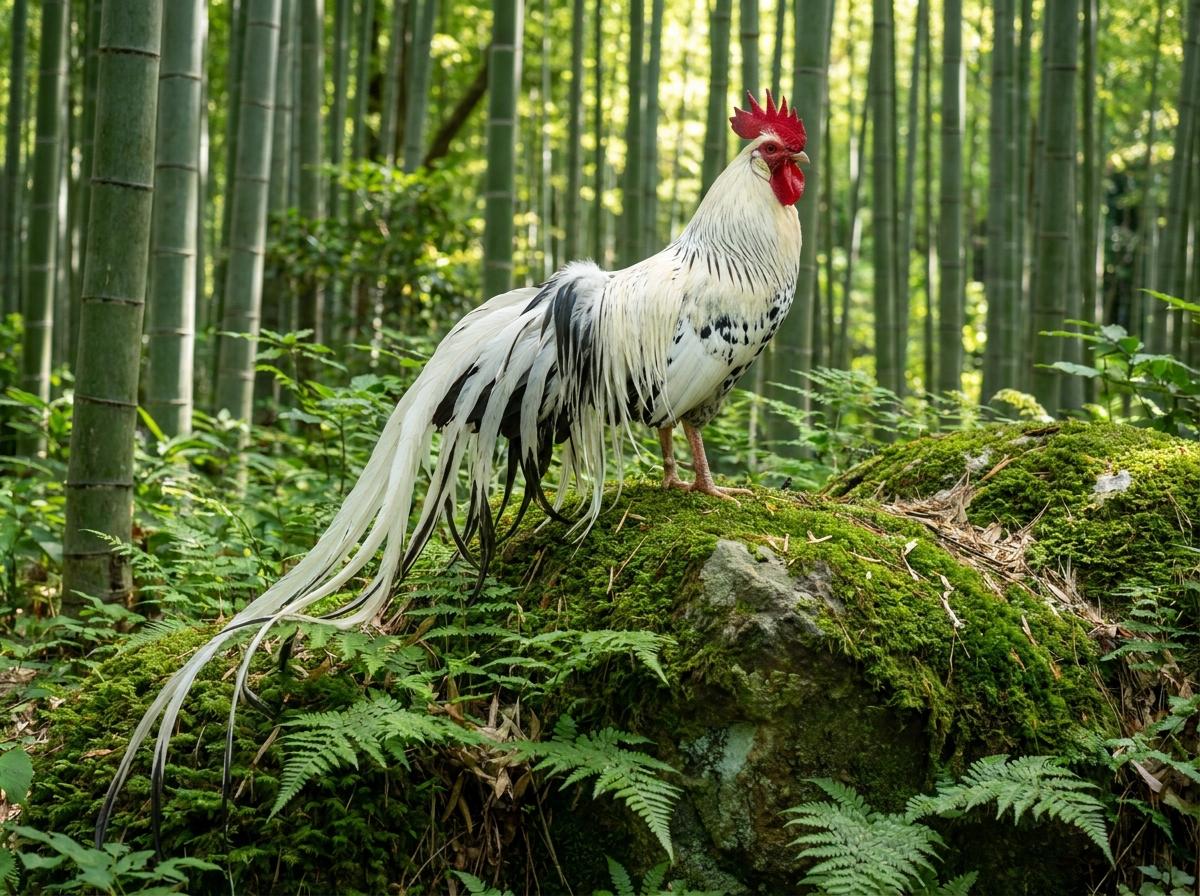
The Onagadori is a Japanese chicken from Kochi Prefecture on the island of Shikoku (the old province of Tosa), and it is famous for one trait: in the best roosters, the main tail feathers and saddle feathers do not molt, so they keep growing year after year. Japan designated the breed a Natural Monument in 1923 and raised it to a Special Natural Monument in 1952, the country’s highest tier of natural heritage protection. A well-kept rooster adds roughly 70 cm to 1 m of tail a year, and exceptional birds have reached about 10 m. True Onagadori are rare even in Japan, where a peer-reviewed study put the population at about 200 adult birds held by several private breeders in Nankoku City.
That rarity shapes the most common question people search: what does an Onagadori cost? The honest answer is that there is no dependable published price, Japanese rules treat special natural monuments as not exportable in principle, and many long-tailed birds sold under the name outside Japan are better described as Phoenix or Yokohama types. This guide explains the breed, its history, the tail, the traditional housing (including its welfare problems), and how to tell the Onagadori apart from its Western relatives. If you keep long-tailed chickens yourself, the Creatures chicken marketplace and a free listing alert, both covered at the end, are the practical next steps.

| Origin | Shinohara, now part of Nankoku City, Kochi Prefecture (old Tosa province), Japan |
|---|---|
| Name | Written 尾長鶏, literally “long-tail chicken”; officially “Tosa no Onagadori” |
| Legal status | Natural Monument 1923; Special Natural Monument since 29 March 1952 |
| Known for | Roosters whose main tail and saddle feathers do not molt and keep growing |
| Tail growth | About 70 cm to 1 m a year; about 2.5 m after three years; exceptional birds about 10 m |
| Varieties | Black-breasted white (shirafuji), black-breasted red (akazasa), white |
| Population | About 200 adult birds with several private breeders in Nankoku City (2014 study) |
| Availability | Export restricted from Japan; no dependable published price anywhere |
Browse listings, public profiles, breeders, or add your animal.
What is an Onagadori?
The Onagadori is one of Japan’s native chicken breeds, and it is the one people picture when they hear about Japanese chickens with tails several metres long. Its full official name is Tosa no Onagadori, “the long-tailed fowl of Tosa.” The Japanese characters, 尾長鶏, read literally as tail, long, chicken. (You will sometimes see the name translated as “honourable long-tailed fowl.” The “o” in Onaga is the character for tail, not the honorific, so that translation is a misreading.)
What sets it apart from every other long-tailed breed is not simply tail length. Many breeds grow long tails and then shed them in the annual molt. In a good Onagadori rooster, a set of tail feathers and the saddle hackles simply never fall out, so they keep lengthening for the life of the bird. Japan’s national cultural properties database, maintained by the Agency for Cultural Affairs, describes it in exactly those terms: a breed of domestic fowl whose tail feathers “grow without being replaced.”
Hens do not grow the extreme tail. They look like slim, upright, ordinary-tailed hens, and the Nankoku City Board of Education’s pamphlet on the breed describes them as the birds “that do not grow long tails.” Everything spectacular about the Onagadori belongs to the roosters.
If you are comparing breeds, the Creatures chicken species page lists every chicken breed with its own page, including the Onagadori’s Japanese relatives the Totenko and the Minohiki, and the Mikawa, another rare Japanese breed with its own Creatures page.
Where the Onagadori comes from
The breed comes from Shinohara, a district that is now part of Nankoku City in Kochi Prefecture. The most useful single source on its history is a pamphlet published by the Nankoku City Board of Education, the local authority responsible for the breed’s home.
The origin story. The pamphlet tells it this way: the Yamauchi lords who ruled the Tosa domain gathered long chicken tail feathers from farmers in the domain to decorate ceremonial spears, and a Shinohara man named Takechi Riemon worked for years to improve his birds until, in the time of the second lord, he produced a remarkable long-tailed fowl. That bird is treated as the start of the original shirafuji variety. A summary published by the Japan Association for Techno-innovation in Agriculture, Forestry and Fisheries (JATAFF) tells a similar story: a sudden change appeared in the Shokoku-type chickens kept by Takechi Riemon in Shinohara, and because every domain wanted long feathers for the plumed spears carried at the front of processions, the Tosa domain is said to have kept the bird secret and forbidden anyone from taking the chickens, or even their eggs, out of the domain.
Treat the details as tradition rather than record. The Nankoku pamphlet itself says legends of crossing chickens with pheasants cannot be confirmed because there is no accurate record. The peer-reviewed literature is more cautious still, saying the breed “is thought to have been created during the Edo Era (1603 to 1867).”
A note on Korea. The original 1923 designation text, still visible in the national database, said the breed was first produced in Korea and later improved in Shinohara. The revised explanation that accompanied the 1952 upgrade says simply that it was created in Shinohara village. Both texts are official; they reflect how thinking about the breed’s origins changed.
Near extinction and recovery. According to the Nankoku pamphlet, a local long-tailed fowl preservation society was founded in 1908, and after the 1923 designation the birds were managed with national funding. During the Second World War their numbers collapsed to nine birds. The preservation society was rebuilt in March 1949 and the breed was brought back through careful breeding.
Related Japanese breeds. Genetic work summarised in the Nankoku pamphlet (microsatellite DNA research led by Professor Masaoki Tsudzuki of Hiroshima University) found that the Onagadori, the Totenko and the Shokoku, all associated with Kochi, are closely related, which fits the traditional account of how the Onagadori was made.
The Special Natural Monument designation
Japan protects natural heritage, including animals, plants and even domestic breeds, under its Law for the Protection of Cultural Properties. Designated items are either Natural Monuments or, for the most important, Special Natural Monuments.
The national database records these facts for the Onagadori:
- Designated a Natural Monument on 7 March 1923, under the name 土佐の長尾鶏 (Tosa no Nagaodori).
- Raised to a Special Natural Monument on 29 March 1952 and renamed “Tosa no Onagadori.”
- Designation criterion: domestic animals unique to Japan.
- Location: “no area specified.” The designation applies to the breed itself rather than to a fixed site, which is the usual pattern for designated domestic breeds.
Several other Japanese chicken breeds are ordinary Natural Monuments. As far as we could find in the national database and JATAFF’s catalogue of special natural monuments, the Onagadori is the only chicken breed in the special tier.
What the designation means for export. Japan’s Ministry of Economy, Trade and Industry states on its page about exporting cultural properties that national treasures, important cultural properties, special natural monuments and natural monuments are, in principle, prohibited from export under the cultural properties law, and that any export needs permission from the Commissioner of the Agency for Cultural Affairs plus an export approval. We did not find an official document spelling out how that rule is applied to individual Onagadori birds or hatching eggs, so we will not claim a precise legal position. The practical effect is clear enough: there is no ordinary, open route for true Onagadori to leave Japan.
The tail: how it grows and how long it gets
This is the part people come for, so it is worth being precise about what the sources actually say.
Which feathers keep growing. The Nankoku pamphlet says the basic ten pairs of tail feathers (20 feathers) are the ones that are not replaced, and that the long curved sickle feathers, called “utaibane,” are one of those ten pairs. A 2014 study in The Journal of Poultry Science (Oka et al.) describes it the same way: males show no molting in some tail feathers and saddle hackles throughout their lives.
Why they do not molt. Chickens normally molt as day length changes, driven by hormones. The Nankoku pamphlet says the Onagadori’s tail does not molt “genetically.” The breed-specific genes behind that have not, as far as we could find, been identified in a published molecular study. Older Western writing often attaches specific gene symbols to the trait; we could not trace those to a primary source, so we leave them out.
How fast it grows. The Nankoku pamphlet puts growth at about 0.7 m a year, varying by bird and by care, which gives a tail of about 2.5 m after three years. JATAFF’s summary says about 1 m a year once the traditional keeping box came into use. Both are consistent with “roughly 70 cm to 1 m a year” for a well-managed rooster. The pamphlet gives the birds’ lifespan as about eight to ten years.
How long it gets. Here the published numbers vary, and it helps to see them side by side:
- The national database’s descriptive text says the tail feathers can reach 6 m.
- The 2014 peer-reviewed study says that in an exceptional case, tail feathers reach 10 m.
- The Nankoku pamphlet says that with centuries of improvement, tails came to reach more than 10 m.
Figures of 12 or 13 m, and “27 feet,” circulate widely online. We could not trace any of them to a primary record, so treat them with caution. The fair summary is that most Onagadori tails measure a few metres, and a few exceptional birds have been measured at around 10 m.
Genetics and management work together. A long tail is not guaranteed by pedigree alone. JATAFF notes that tails grew further after the traditional keeping box was adopted in the Taisho era (1912 to 1926), because the box protects the feathers from breaking. And not every bird of the right colour carries the breed’s distinctive genetic background: the 2014 study notes earlier genetic work (Tadano et al., 2009) showing that even some black-breasted white birds lack the Onagadori-specific genetic make-up, which may be one reason fewer outstanding long-tailed males appear. The authors recommended regular genetic monitoring and systematic breeding from black-breasted white birds that do carry it.
Varieties and appearance
There are three recognised colour varieties, all described in the 2014 study and the Nankoku pamphlet:
- Black-breasted white (shirafuji). The original variety, with silvery-white hackles and saddle, a black breast and a black tail. Earlier genetic work (Tadano et al., 2009) found the Onagadori-specific genetic background mainly in this variety, and the 2014 study found the share of shirafuji birds carrying it rising over time.
- Black-breasted red (akazasa). Red and gold hackles and saddle, black breast and tail. Thought to have come from crossing with other breeds. The 2014 study recorded a significant loss of genetic diversity in this variety between 1999 and 2010.
- White (hakushoku). All white, also thought to have come from crossing. The Nankoku pamphlet dates it to around 1887.

A few other features from the Nankoku pamphlet help identify the breed:
- Comb: single, usually with five to seven points.
- Legs: a bluish grey. The pamphlet points out that the Shokoku, a breed that looks very similar, has yellow legs, which makes the two easy to tell apart.
- Build: a slim, upright bird with a rounded breast, much lighter than a heavy utility breed.
We could not find a published, authoritative weight standard for the breed, so we do not give one.

Traditional housing: the tomebako, and the welfare question
Long-tailed roosters in Japan are traditionally kept in a tall, narrow wooden keeping box, often called a tomebako. We are describing it here because it is central to how the breed’s famous tails are produced, and because you should understand what it involves before admiring the result.
What the box is. The Nankoku pamphlet gives the dimensions: about 180 cm high, 18 cm wide and 82 cm deep, made of boards. A perch sits about 24 cm from the front and about 60 cm below the top. The upper front is a lattice door with a drawer-style feed tray and water container beneath it. One side opens so the bird can be taken in and out and the droppings tray can be removed, and there is a partition so the long tail is not soiled by droppings. Each box holds a single rooster.
How the birds are managed. According to the same pamphlet:
- A rooster may have its tail feathers pulled out at about a year old so the new tail grows in evenly, and it goes into the box once they have regrown to about 30 to 40 cm.
- The box is placed somewhere quiet that stays cool in summer and warm in winter, to reduce stress.
- Birds in boxes are taken out for about ten minutes of exercise roughly twice a week, with care taken that the tail never touches the ground. JATAFF describes a keeper holding the long tail wound in the hand while the bird walks.
- Roosters are traditionally fed grains such as brown rice and wheat, with small amounts of greens and animal protein, and are given sand and calcium during exercise. Hens eat ordinary commercial feed.
- The box is kept clean, the tail is sprayed against parasites, and a soiled tail is washed with soap and dried.
The welfare problem, stated plainly. JATAFF’s own summary says the box works by “extremely restricting free movement” so the feathers are not damaged. A rooster living on a perch in a box 18 cm wide, let out for around twenty minutes a week, cannot walk, scratch, forage, dust-bathe or flap its wings for almost all of its life. Those are behaviours chickens are strongly motivated to perform: a 2026 study in Poultry Science (Bongiorno et al.) notes that cage systems impede laying hens’ foraging, perching, dust bathing and wing flapping, and found that hens denied litter dust-bathed more once access returned. That research is on laying hens, not Onagadori, and we found no published welfare assessment of tomebako keeping itself. But nothing in the evidence suggests long-tailed roosters are exempt from those needs.
Two things are true at once. The keepers in Nankoku are preserving a rare, legally protected breed with evident care for cleanliness, temperature and handling, and they have kept it alive through near-extinction. And the method that produces the longest tails involves a degree of confinement that would not meet the welfare expectations most keepers in Europe or North America apply to chickens. If you keep long-tailed birds, you do not need a tomebako to keep them well: roomy, dry housing, high clean perches, a clean run and careful handling protect feathers without that level of restriction.
Onagadori vs Phoenix vs Yokohama
Outside Japan, most people who want an Onagadori end up looking at a Phoenix or a Yokohama. Both are real, recognised breeds with genuine Japanese long-tailed ancestry. Neither is the same thing as an Onagadori.
Phoenix. According to The Livestock Conservancy, Japanese long-tailed birds taken to Europe struggled in the colder climate, and Hugo du Roi, the first president of the national German poultry association, crossed them with hardier breeds to create the Phoenix. The American Poultry Association recognised the Silver Phoenix in 1965, the Golden in 1983 and the Black-Breasted Red in 2018. The Conservancy also says Phoenix chickens molt every year or every other year, with sickle feathers of about 2 to 5 feet. That is a long, beautiful tail, but not a lifelong non-molting one.
Yokohama. The Conservancy’s Yokohama page says long-tailed chickens were exported to France and Germany through the newly opened port of Yokohama in 1864, and the breed was named after the port rather than any Japanese breed name. It too was developed largely in Germany, including by du Roi. The APA admitted it in 1981 in White and Red Shouldered varieties, and tails of three to four feet have been produced. The Conservancy also notes that in the US, British-type long-tailed birds are called Phoenix rather than Yokohama, so the two names overlap in practice.
Onagadori. A Japanese breed maintained mainly in Nankoku, protected as a Special Natural Monument, and defined by roosters whose tail and saddle feathers do not molt. A US extension summary of the APA’s large fowl classes from Delaware State University lists the Phoenix and the Yokohama but not the Onagadori, and we found no Western standard for it.

A quick way to think about the difference:
- Tail: Onagadori roosters keep growing the same tail for years; Phoenix and Yokohama tails are long but are replaced in the molt.
- Where it lives: Onagadori are concentrated with private breeders in Kochi; Phoenix and Yokohama are kept by fanciers in Europe and North America and appear in Western poultry standards.
- Paperwork: An Onagadori should come with a traceable Japanese origin. A Phoenix or Yokohama is judged against its own standard and needs no Japanese paperwork at all.
Creatures has breed pages for both Western relatives: the Phoenix chicken and the Yokohama chicken.
Onagadori chicken price: the honest answer
People search “Onagadori chicken price” and “Onagadori chicken for sale” every month, so here is the straight answer.
There is no dependable published price. We found no official or authoritative source giving a price for an Onagadori, in Japan or elsewhere, and we will not invent one. For what ordinary backyard birds cost, see how much a chicken costs. In Japan the birds are held by a small number of private breeders and a preservation society, which is not a retail market with posted prices.
Export is restricted in principle. As covered above, Japan’s rules treat special natural monuments as not exportable without specific government permission. We could not confirm any documented legal export of Onagadori stock, which does not prove none has happened, but it does mean the burden of proof sits with any seller.
Many birds sold as “Onagadori” outside Japan are probably something else. Given the export position, a long-tailed bird advertised as an Onagadori in Europe or North America is more likely to be a Phoenix, a Yokohama, or a long-tailed cross than a documented Onagadori. That is not a criticism of those birds, which can be excellent. It is a reason to buy them for what they are and pay accordingly.
Importing into the US is regulated in any case. USDA APHIS requires an import permit, an official health certificate and at least 30 days of quarantine at a USDA Animal Import Center or approved private facility for live poultry, and live poultry may not be imported from countries or zones affected with highly pathogenic avian influenza. Hatching eggs also need a permit, and quarantine where APHIS considers the source region affected by virulent Newcastle disease. Other countries have their own rules; check them before any money changes hands.
If someone offers you an Onagadori, ask:
- Where exactly did the line come from, and how did it leave Japan? A seller with a real Japanese origin should be able to explain it and show paperwork.
- Does the rooster molt its tail? Ask for photos of the same bird across two or more years. A tail that is replaced each year is a Phoenix or Yokohama trait.
- What colour are the legs? Onagadori legs are bluish grey; yellow legs point to other breeds such as the Shokoku.
- What are you actually paying for? Price the bird as the breed you can verify, not the name on the advert.
For practical buying advice that applies to any chicken, including checking a seller and choosing between chicks, pullets and hatching eggs, see our guide to where to buy chickens.
Seeing an Onagadori
The most reliable way to see true Onagadori is in their home district. The Long-Tailed Chicken Center (Chobikei Center) in Shinohara, Nankoku City, is listed by Kochi’s official tourism site as a place to see the birds on a guided visit. Opening times and fees change, so check locally before you travel.
Keeping records for long-tailed birds
Whether you keep Phoenix, Yokohama or another long-tailed breed, the things that matter for a tail are the things worth writing down: hatch date and parentage, molt dates and whether the tail was replaced, measured tail length at regular intervals, perch and bedding changes, parasite treatments, and any feather damage. Our chicken molt guide explains what a normal annual molt looks like, which is the baseline a non-molting tail departs from. Over a few seasons, those records show which birds and which management actually produce and keep long tails, which is exactly how the Onagadori’s own breeders have worked for generations. Health questions about any bird should go to a veterinarian with poultry experience.
Frequently asked questions
What is special about the Onagadori chicken?
In the best roosters, a set of tail feathers and the saddle hackles never molt, so they keep growing for years. Japan made the breed a Special Natural Monument in 1952.
How long can an Onagadori tail grow?
Tails typically grow about 70 cm to 1 m a year and reach about 2.5 m after three years. A peer-reviewed study records an exceptional case of about 10 m. Larger figures that circulate online could not be traced to a primary record.
How much does an Onagadori chicken cost?
There is no dependable published price. True Onagadori are held by a small number of breeders in Japan, and export is restricted in principle, so treat any price you see outside Japan with caution and verify what the bird really is.
Can I buy an Onagadori in the US?
We know of no documented, legal source of true Onagadori in the US. Birds sold under the name are more likely Phoenix, Yokohama or long-tailed crosses. Any import would also need USDA APHIS permits and quarantine.
Is a Phoenix chicken the same as an Onagadori?
No. The Phoenix was developed in Germany from Japanese long-tailed birds crossed with other breeds, and it molts its tail every year or every other year. The Onagadori is the Japanese breed whose roosters do not molt the main tail.
Do Onagadori hens have long tails?
No. The extreme tail is a rooster trait. Hens have ordinary tails.
Are Onagadori kept in boxes?
Traditionally, long-tailed roosters in Japan are kept in a tall, narrow wooden box that restricts movement to protect the tail, with short exercise sessions a couple of times a week. We found no published welfare study of the practice, and it restricts behaviours chickens are strongly motivated to perform.
Do this next on Creatures
Whether you are following the Onagadori from afar or keeping Phoenix, Yokohama or other long-tailed breeds, Creatures is the records, marketplace and directory layer to keep it all in one place.
Get alerted. Onagadori listings are close to nonexistent, so the useful tool is an alert: set a free Onagadori listing alert and we will email you if one is ever posted. No account needed to start. See saving searches and using your watchlist for how alerts work.
Check the market. Look at Onagadori chickens on the Creatures marketplace, and search poultry breeders and farms in the Creatures breeder directory.
Add your bird. Keeping long-tailed chickens? Create a free Onagadori chicken profile in a few minutes, no account needed to start. If your bird is a Phoenix or Yokohama, choose that breed instead so its record stays accurate. The walkthrough is in adding an animal to Creatures.
Record molts, tail length and health. Add a molt, measurement or health record. The record sheet opens for any visitor to look around, and a free account saves what you enter. See adding a record and health and medical records.
List your flock. Breed long-tailed or rare Japanese chickens? Create a free farm or breeder profile so buyers searching for rare breeds can find you, no account needed to start. Read getting listed in the breeder directory.
Explore related breeds. Compare the Phoenix and Yokohama, or read our guide to the Silverudd Blue (Isbar), a very different rare chicken from Sweden.
Name your bird. Try the chicken name generator for your next rooster.