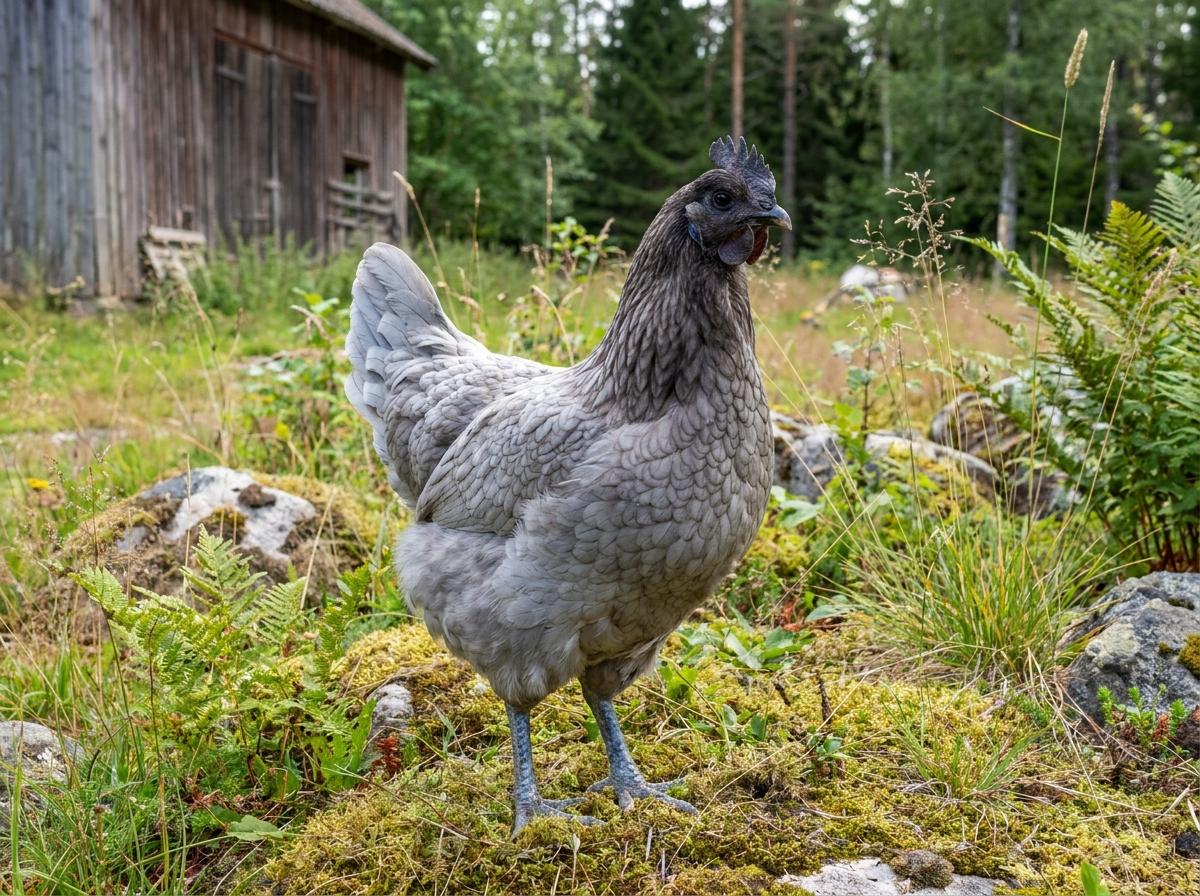
Silverudd Blue/Isbar
Author: Elliott Garber, DVM · Published
The Silverudd Blue (in Swedish, Silverudds Blå) is a Swedish laying breed that puts green eggs in the basket and comes in three plumage colors: blue, black, and splash. It was developed by Martin Silverudd, a pastor in the Småland region of southern Sweden who died in 1986 before he had finished the work. For years it was sold as the Isbar or Blue Isbar, and many sellers outside Sweden still use those names, but the Swedish association that keeps its flock book renamed it Silverudds Blå in 2016 because “Isbar” belongs to a different Silverudd breed. Two popular claims about it are wrong: it is not an autosexing breed, and a black or splash chick from blue parents is not a mistake.
This guide covers the name, the history, the blue, black, and splash genetics, where the green egg color comes from, what the hens are like to keep, and how to buy hatching eggs or chicks with realistic expectations. If you are still comparing breeds, the Creatures chicken species page sets the options side by side, and you can browse Silverudd Blue listings on Creatures while you read.

| Other names | Silverudds Blå (official Swedish name since 2016); formerly Isbar, Blue Isbar, or Swedish green egg layer |
|---|---|
| Origin | Småland, Sweden, bred by Martin Silverudd (died 1986) from Rhode Island Red and New Hampshire stock, with the blue egg gene from the Cream Legbar |
| Flock book | Svenska Kulturhönsföreningen (Swedish Cultural Hen Association); not in the APA or Poultry Club of Great Britain standards |
| Colors | Blue, black, and splash, all accepted; hens should look one color from a distance |
| Eggs | Green shades, 55 to 65 g in the Swedish breed description |
| Laying | About 250 eggs a year is the association’s stated figure and breeding goal, not a guarantee for a backyard hen |
| Adult weight | Hen about 1.5 kg (3.3 lb); cock about 2.5 kg (5.5 lb) |
| Autosexing | No; chicks cannot be sexed by down color |
Browse listings, public profiles, breeders, or add your animal.
Silverudd Blue or Isbar? The name, explained
Searchers type “blue isbar”, “isbar chicken”, and “silverudd blue” for the same bird, and the confusion has a documented cause. The Svenska Kulturhönsföreningen (the Swedish Cultural Hen Association, which keeps the breed’s flock book) explains that Martin Silverudd never called this breed Isbar. His working name for it was Svensk Grönäggsvärpare, “Swedish green egg layer”. After his death the breed became known as Isbar or Isbar Blå, because in his old handwritten notes it had been written up in the same passage as a different, barred green-egg breed, and the name of one stuck to the other.
That mattered for two reasons. First, Silverudd really did create a separate breed called Isbar, a heavier dual-purpose bird that the association describes in Columbian, silver, and barred markings. Second, in poultry naming “bar” signals a barred (cross-striped) bird, and the association says plainly that the blue green-egg breed has never been barred. The association concluded in 2015 that the two were different breeds, and after its 2016 annual meeting the board and breed coordinators decided to rename the blue bird. From March 2016 it has been Silverudds Blå: “Silverudds” to honor the man, “Blå” for the color. The plain “green egg layer” name was dropped so the breed would not be confused with the mixed-breed green-egg layers sold in Sweden.
In English you will see Silverudd Blue, Silverudd’s Blue, and Silverudds Blå used interchangeably. Plenty of hatcheries and breeders outside Sweden still sell the same bird as “Isbar” or “Blue Isbar”. If a listing uses the old name and describes blue, black, and splash birds laying green eggs, it means this breed. If it describes a barred or Columbian-marked heavier bird, it may mean the true Isbar, which is rare outside Sweden.
Martin Silverudd and the breeding goal
Martin Silverudd was a Småland pastor who developed several laying and dual-purpose breeds, and the association describes this breed as part of his gene conservation work. He left no written breed description for the Silverudd Blue. When he died unexpectedly in 1986 the project was unfinished, but a number of his birds were taken on by other keepers, and the Silverudd Blue is now one of the most widely kept of his breeds.
According to the association’s breed description, the breed was built mainly from imported Rhode Island Red and New Hampshire stock, and the blue egg gene came from the English Cream Legbar. The goal was a productive, high-laying hen that was cheap to keep but still large enough to be worth eating, a good forager, hardy against weather and disease, and calm enough not to waste energy. The blue-gray plumage was the color Silverudd was aiming for, and the association notes that black and splash birds come with it as part of the same genetics.
Today the breed sits in the association’s open flock book, which means registered breeders record their birds and breed toward a shared description. That description is still being refined: the association says Silverudd rarely recorded details such as leg color, beak color, or comb shape, and it is working with experienced breeders to write clearer standards.
What a Silverudd Blue looks like
The Swedish breed description asks for a light, hardy bird with a square body. The cock is a little shorter in the back, stands taller, and carries arched tail feathers; the hen’s tail is dense and roughly triangular. Both have a single comb, a dark beak, dark legs tending toward black, clean (unfeathered) shanks, and four toes. The association states that Silverudd used only single-combed breeds, so any other comb shape, or feathered legs, cannot be accepted as purebred.
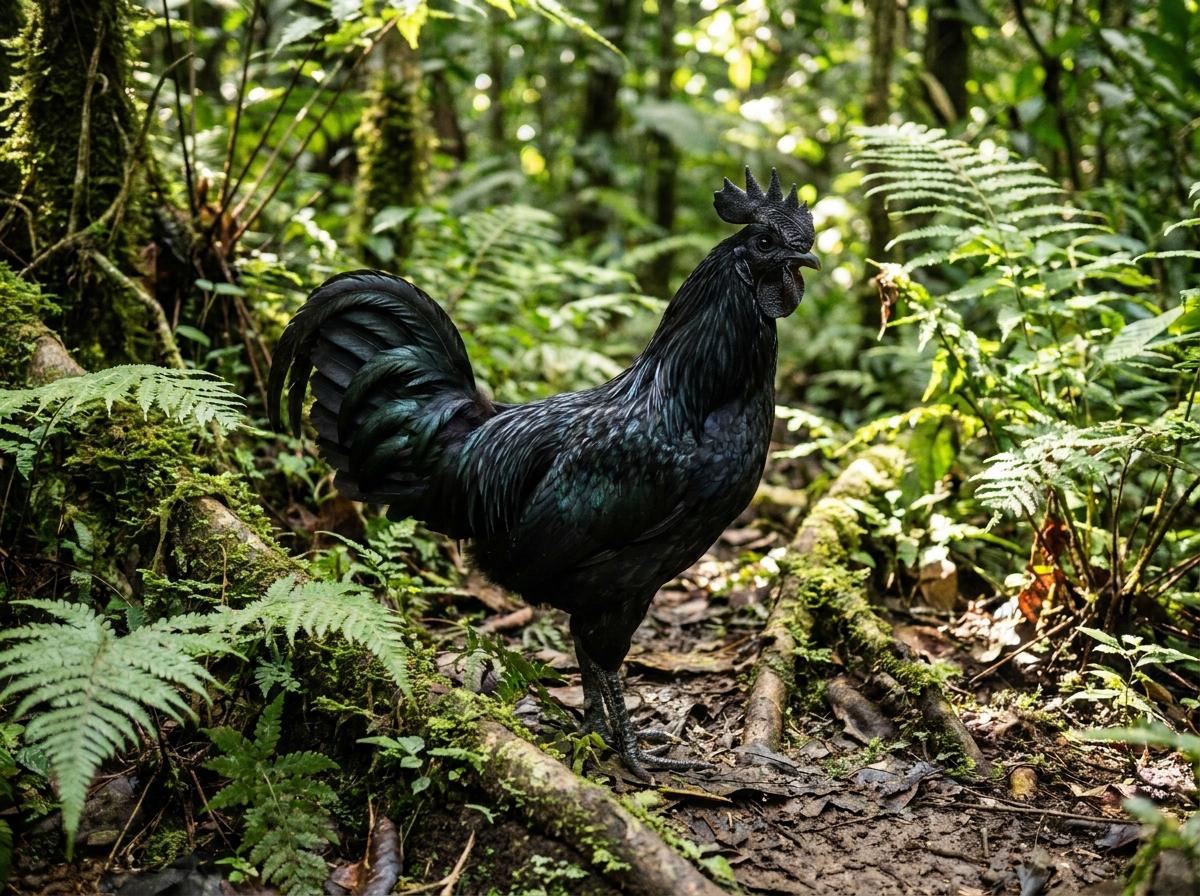
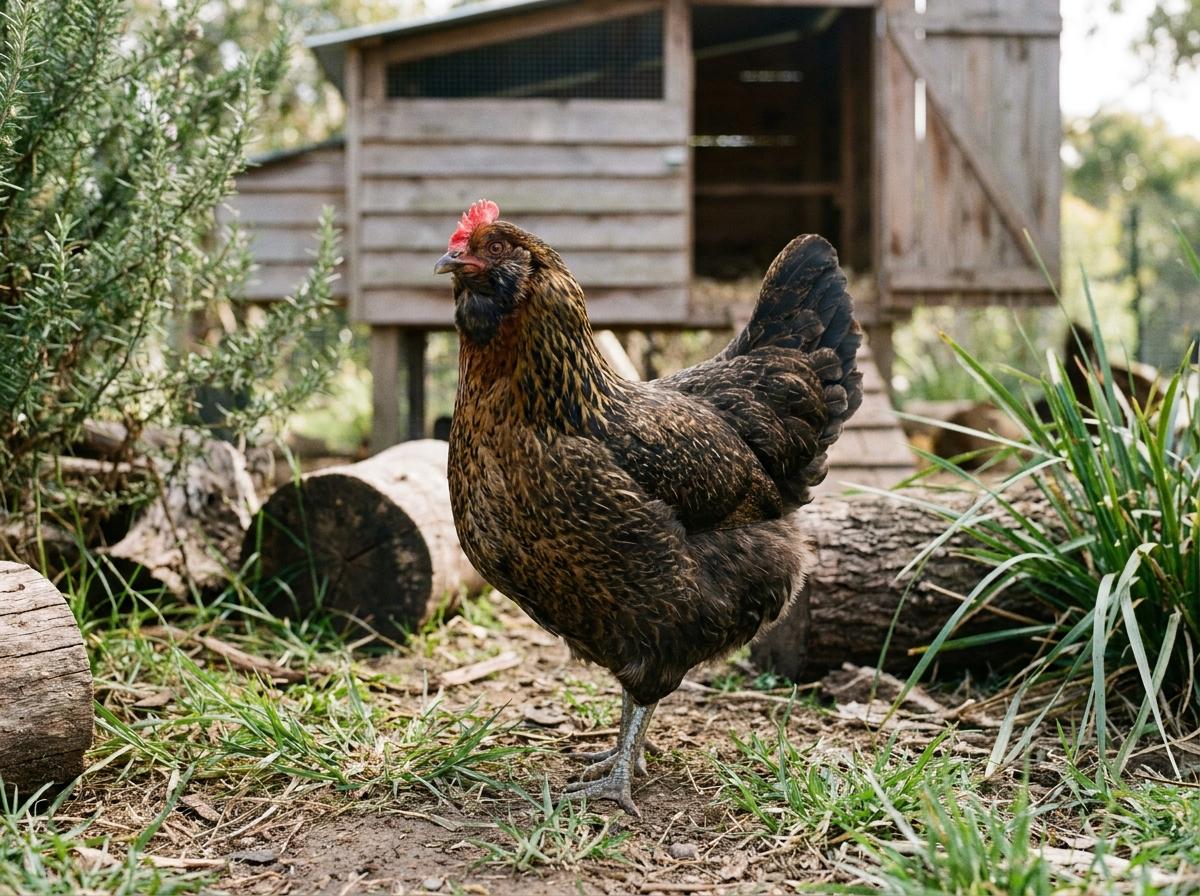
Three plumage colors are accepted: blue, black, and splash. The rule of thumb breeders quote is that the hens should “look self-colored from a distance”, so a good blue hen reads as an even slate gray at a glance, often with a darker neck. Look closer and a blue bird may show faint darker edging on some feathers, but the Silverudd Blue is not judged as a laced breed. In black birds, faint gold or silver in the neck hackle is allowed, and in cocks of any color gold or silver can show through on the hackle, wings, and saddle. The darkest splash birds can look mottled; the association’s tip is that a genuinely mottled bird has paler wing tips.
Adult weights in the Swedish description are about 1.5 kg (3.3 lb) for a hen and 2.5 kg (5.5 lb) for a cock, so this is a medium-to-light utility hen, not a heavy table breed.
Blue, black, and splash: the genetics

The Silverudd Blue’s color comes from the blue dilution gene, the same gene that gives the Andalusian its color. It is often called Andalusian blue. The gene is incompletely dominant (semi-dominant): one copy dilutes black to blue-gray, and two copies dilute it almost to white with dark splashes. Research summaries describe the blue mutation as producing grayish blue birds when heterozygous and near-white birds when homozygous (Minvielle and colleagues, BMC Genetics, 2010), and the idea that the Blue Andalusian’s blue is a heterozygous color was first proposed by Bateson and Saunders in 1902 (OMIA entry for Blue Andalusian plumage). The practical result for breeders is that blue bred to blue gives roughly one black to two blue to one splash, which follows directly from the one-copy, two-copy rule the Swedish association gives for this breed.
The association puts it simply for breeders: the birds are basically black; one copy of the dilution gene makes them blue, and two copies make them splash. Because only the one-copy birds are blue, a flock of blue Silverudd Blues can never breed true for blue. Every generation of blue-to-blue matings will throw black and splash chicks.
Here is what each pairing produces, on average across many chicks:
- Blue x blue: about 1 black to 2 blue to 1 splash.
- Blue x black: about half blue, half black.
- Blue x splash: about half blue, half splash.
- Black x splash: all blue.
- Black x black: all black.
- Splash x splash: all splash.
Those are ratios, not promises for a single hatch. A clutch of ten eggs from blue parents can easily come out with three blacks and no splash.
Two practical points follow. First, black and splash Silverudd Blues are not culls or crossbreds. They are accepted colors in the Swedish description and useful breeding birds, and a splash bred to a black gives an all-blue hatch. Second, off-colors that are not part of this system are a different matter. The association says mottled, wild-type (partridge-like), and white birds sometimes turn up because recessive genes have survived in the breed, and that birds carrying them should be taken out of breeding. A true splash has a pale base with gray or black splashes; a white bird with no splashing, or a mottled bird with white-tipped feathers, is a fault, not a splash.
Chick down colors help you sort a hatch early. The association describes splash chicks as hatching yellow, blue chicks as gray, and black chicks as black with a paler breast and chin.
Green eggs: where the color comes from

A green egg is a blue egg with brown on top. The blue comes from a pigment laid down through the shell, and the gene responsible is dominant: a single copy is enough for a hen to lay blue-based eggs. In chickens it has been traced to an inserted stretch of retroviral DNA near a gene called SLCO1B3 (Wang and colleagues, PLoS Genetics, 2013). The Silverudd Blue got that gene from the Cream Legbar. Its Rhode Island Red and New Hampshire ancestors contributed the brown overlay, and brown over blue gives green.
The Swedish breed description is strict about the result. Eggs should be green; variation in shade is allowed, but no colors other than shades of green. They should be oval and widest at the middle, and they should weigh 55 to 65 g. Pullet eggs can differ in size, shape, and color, and they usually settle after the first molt. A hen whose eggs never settle, or stray far from the description, is one the association suggests taking out of breeding.
The breeding goal is a flock that carries two copies of the blue egg gene, so every daughter lays green. A bird with only one copy can pass on the non-blue version, so some daughters of such birds lay brown eggs instead of green. Breeders select only from green-egg layers to push the flock toward two copies, and the association notes that a DNA test for egg-color status exists; its breed coordinators can advise on it.
A Silverudd Blue should not be confused with an olive egger, which is a cross of a blue-egg breed with a dark-brown-egg breed. Olive eggers can lay similar colors but are not a breed and do not breed true. The Cream Legbar, the Silverudd Blue’s blue-egg ancestor, lays blue eggs rather than green.
Laying, temperament, and broodiness
The association lists the Silverudd Blue at about 250 eggs a year and describes it as a good layer even in winter. Read that figure carefully. On the same site the association says it has not had reliable laying statistics for its breeds, that it is collecting laying reports from breeders, and that figures will be updated as data arrives. The 250 is best understood as the breed’s stated target and reputation, not a measured average. Real hens vary by line, age, feed, and daylight, and every laying breed slows down as it ages.
Hens and cockerels mature at about six months, when the pullets start to lay and the cockerels start to crow. The breed description calls the Silverudd Blue calm and affectionate but alert to danger and predators, quick to learn routines, and an excellent forager that is easy to win over with food. It is described as hardy against disease and weather and as undemanding to keep, doing well outdoors with room to forage.
One trait surprises people who want a hen to hatch their eggs: the Silverudd Blue is bred not to go broody. The association says brooding reduces productivity, so eggs should be hatched in an incubator or under a reliable broody hen of another breed. The guide to hatching eggs in an incubator covers temperatures and timing, and the guide to broody hens explains the natural route.
Is the Silverudd Blue autosexing?
No. This is the most repeated error about the breed, probably because its egg-color ancestor, the Cream Legbar, is autosexing, and because the old name “Isbar” sounds like autosexing breeds such as the Rhodebar and Legbar, whose “-bar” names come from the barring gene that makes their chicks sexable. The Silverudd Blue has no barring, and the Swedish breed description states that it has no sex-identifying traits; its data table answers “autosexing” with a plain no. The separate Isbar breed is also listed as not autosexing.
Blue, black, and splash down colors tell you the chick’s color genotype, not its sex. The association’s practical advice is to look at about three weeks for the chicks that grow a comb and wattles first and set those aside as likely cockerels, while warning that by four weeks the pullets can catch up, and that some pullets older than three weeks go through phases of having larger combs than cockerels. Treat early guesses as guesses, and if you cannot keep a cockerel, plan for some uncertainty until the birds are older.
Recognition status
Recognition is where Silverudd Blue marketing and reality most often part ways. As of September 2026:
- Sweden. The breed’s flock book is kept by the Svenska Kulturhönsföreningen, which lists it in its open flock book and publishes the breed description quoted in this guide. It is a Swedish utility breed with an association-kept flock book, not one of the Swedish landrace breeds (lantraser) conserved in the national genebank program run by other clubs.
- United Kingdom. It does not appear in the Poultry Club of Great Britain’s list of standardized breeds, which does include the autosexing Cream Legbar. So there is no British show standard for it.
- United States. It is not on the American Poultry Association’s list of accepted breeds and varieties, so there is no APA Standard of Perfection description for it.
None of that makes it less useful as a laying hen. It does mean that, outside Sweden, “breed standard” claims for the Silverudd Blue usually trace back to the Swedish association’s description, and it is worth reading that description rather than a seller’s summary of it.
Care and housing

Care for a Silverudd Blue is ordinary care for a hardy laying hen. Nothing in its build calls for special treatment, and its strongest trait, foraging, rewards space.
- Housing. A dry, draft-free, well-ventilated henhouse with perches, nest boxes, and a secure run. Size the run generously; a forager kept in a cramped bare run gets bored and loses the advantage it was bred for. The chicken coop guide covers space, ventilation, and predator-proofing.
- Foraging and predators. A calm, food-motivated bird that ranges well is also a bird that ranges into trouble. Secure fencing and a locked henhouse at night matter more than breed. See protecting your flock from predators.
- Feed. A complete layer ration, with oyster shell available on the side, supports steady laying and strong shells. The differences between starter, grower, and layer feeds are covered in what to feed chickens.
- Winter. The breed was developed in Sweden and has a reputation for cold hardiness, but a single comb can still get frostbite in hard, damp cold. Dry housing and good ventilation do more than heat. The Swedish description says hens given a little extra warmth and light in the harshest weather often lay year-round; whether you add light is your choice, and it is covered in our guide to keeping chickens through winter.
- Health. No breed-specific health problems are documented in the sources we checked. Watch for the usual warning signs, from lethargy to changes in droppings, and bring in a poultry-experienced veterinarian for any bird that looks unwell. The overview of common chicken illnesses lists what to look for.
Adding new birds to an existing flock needs a quarantine period and a slow introduction, whatever the breed. The steps are in adding new chickens to a flock.
Buying Silverudd Blues: hatching eggs, chicks, and started birds
Most people meet the breed through hatching eggs or day-old chicks. There is no reliable national price list, and prices vary with the seller’s lines, egg-color selection, and whether you are buying eggs, chicks, or point-of-lay pullets. Expect to pay more than for a common hatchery layer and less than for a genuinely rare show breed. Our guide to what chickens cost breaks down the full setup budget, which usually dwarfs the price of the birds.
What to expect, and what to ask:
- Mixed colors are normal. Eggs from blue parents hatch black, blue, and splash chicks. A seller who promises “all blue” chicks from blue-to-blue matings is either wrong or selling a black x splash pairing, which is worth asking about.
- Ask about the mothers’ eggs. Good breeders select for green eggs and can tell you how consistent their hens’ egg color is, and whether they have tested for the blue egg gene. A hen from lines that were not selected for green may lay brown.
- Check the basics of type. Single comb, clean legs, dark legs, four toes. Rose or pea combs, feathered legs, five toes, or yellow legs do not match the Swedish description and suggest crossing somewhere in the line. Mottled, white, or partridge-colored birds are off-colors the Swedish association removes from breeding.
- Watch the name. Listings may say Isbar, Blue Isbar, Silverudd’s Blue, or Silverudds Blå. The bird is what matters, not the label. A listing for “Isbar” chicks with barred or Columbian markings may be the true Isbar breed, or something else entirely.
- Health paperwork. In the United States, ask whether the flock takes part in the National Poultry Improvement Plan (NPIP), the cooperative program administered by USDA APHIS that tests participating flocks for diseases such as pullorum-typhoid, and ask about Marek’s disease vaccination for chicks.
- Hatching eggs are a gamble. Shipped eggs can hatch at lower rates than eggs collected locally, and the color mix is unknown until they hatch. Buy more eggs than the number of hens you want, and plan in advance what you will do with cockerels.
Our guide to where to buy chickens explains how to check a source, whether it is a hatchery, a breeder, or a local keeper, and how many chickens to get helps size the order. On Creatures, you can see Silverudd Blue listings and look up keepers in the breeder directory. If nothing is listed near you yet, an alert saves you from checking every week.
Breeding Silverudd Blues and keeping records
Breeding this breed well is mostly a records problem. The traits that matter, egg color, egg size, laying rate, and plumage color, are spread across individual hens and cannot be judged from the flock as a whole.
- Record egg color by hen. In a mixed flock you cannot tell which hen laid which green egg without trap nests, a short period of separate housing, or careful observation at the nest. The Swedish association’s whole breeding plan rests on hatching only from green-egg layers, so knowing which hens they are is the first step. Our article on tracking egg production shows which records actually help.
- Plan color pairings deliberately. Use the pairing list above. Black x splash gives an all-blue hatch; blue x blue gives the full mix.
- Cull for faults, not for color. Off-colors (mottled, white, wild-type), brown-egg layers, wrong combs, and feathered legs are the faults the Swedish description names. Black and splash are not faults.
- Do not select for broodiness. The breed was built not to sit; hatch in an incubator.
- Record weights and egg weights. The description asks for 55 to 65 g eggs and a hen around 1.5 kg, and the association’s goals include lifting egg weight and laying in lines that fall short.
Anyone who takes the breed seriously should read the Swedish description in full and, in Sweden, consider joining the flock book. Elsewhere, a clean record of parents, egg color, and hatch results is what separates a line you can sell with confidence from a basket of green eggs of unknown background. If you want to see how a very different rare breed is kept and recorded, the Onagadori, Japan’s long-tailed chicken, is a useful contrast: a bird kept for its plumage rather than its eggs.
Frequently asked questions
Is Isbar the same as Silverudd Blue?
In most listings, yes: “Isbar” and “Blue Isbar” are old names for the Silverudd Blue. Strictly, Martin Silverudd also created a separate breed called Isbar, and the Swedish association renamed the blue green-egg breed Silverudds Blå in 2016 to end the mix-up.
What color eggs do Silverudd Blues lay?
Green, in shades from olive to lighter green. The Swedish description allows variation in shade but no colors other than green, and gives an egg weight of 55 to 65 g.
Are Silverudd Blues autosexing?
No. The Swedish breed description states that the breed has no sex-identifying traits. Down color shows whether a chick will be black, blue, or splash, not whether it is male or female.
Why did my blue Silverudd Blues hatch black and splash chicks?
Because blue is the one-copy form of the blue dilution gene. Blue bred to blue gives roughly one black, two blue, and one splash chick. Black and splash are accepted colors, not crossbreds.
How many eggs does a Silverudd Blue lay?
The Swedish association lists about 250 a year, but it also says it has lacked reliable laying statistics and is gathering data from breeders. Treat 250 as the breed’s goal and reputation, not a guaranteed average.
Is the Silverudd Blue recognized by the APA or the Poultry Club of Great Britain?
No. As of September 2026 it is not on the APA’s accepted breeds list or the Poultry Club of Great Britain’s breed list. Its flock book is kept in Sweden by the Svenska Kulturhönsföreningen.
Do Silverudd Blues go broody?
They are bred not to. The Swedish association says brooding hurts productivity, so eggs are hatched in an incubator or under a broody hen of another breed.
Do this next on Creatures
Whether you are hunting for hatching eggs, raising your first chicks, or breeding for greener eggs, Creatures keeps the listings, keepers, and flock records in one place.
Compare the egg layers. Read the Cream Legbar page for the breed that gave the Silverudd Blue its blue egg gene, and the olive egger page for the green-egg cross it is often confused with.
Find Silverudd Blues. Browse Silverudd Blue listings on the marketplace and look up trusted keepers in the Creatures breeder directory.
Get alerted. Set a free Silverudd Blue listing alert and we will email you when new eggs, chicks, or birds are posted. No account needed to start. See saving searches and using your watchlist.
Add your birds. Create a free profile for your Silverudd Blue, no account needed to start, so each breeding hen has her own record. The walkthrough is in adding an animal to Creatures.
Keep the records. Add egg color, egg weight, hatch, and health records so you know which hens to breed from. The record sheet opens for any visitor, and a free account saves what you enter. See adding a record and health and medical records.
Breed Silverudd Blues? Create your farm’s profile, no account needed to start, then read creating an organization and getting listed in the breeder directory so buyers looking for green-egg layers can find you.