Giriraja
Author: Elliott Garber, DVM · Published
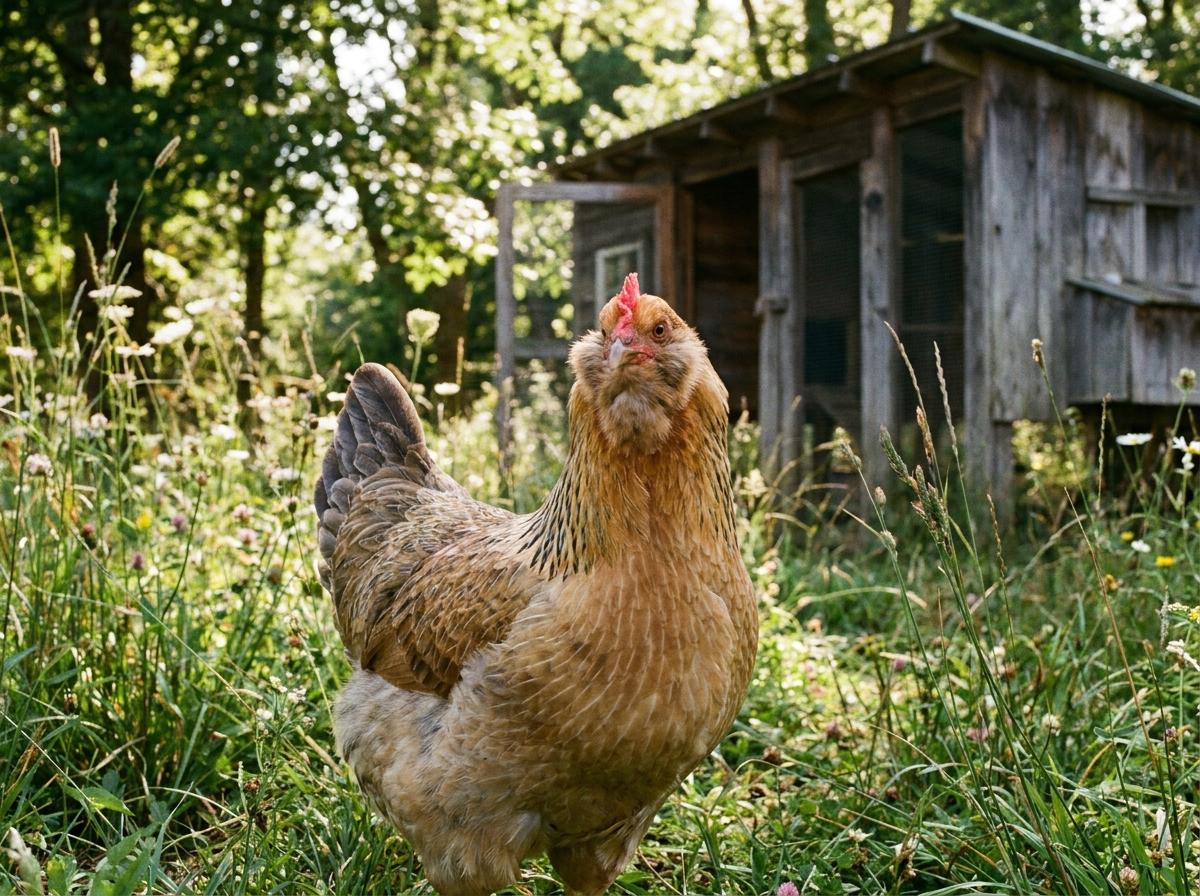
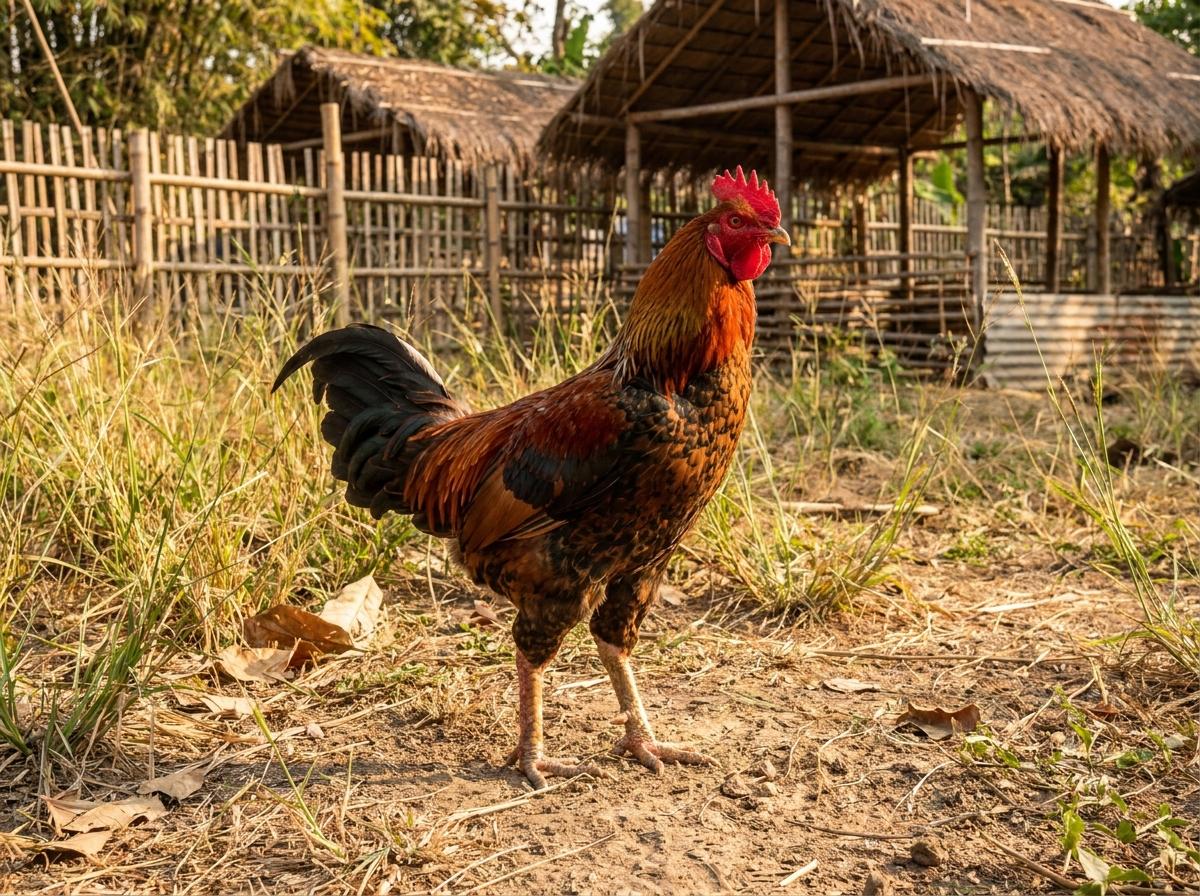
Giriraja is a multi coloured, dual purpose chicken developed in India for backyard and semi intensive smallholder flocks. The Department of Poultry Science at the Veterinary College in Bengaluru, Karnataka released it in 1989, and it was the first improved coloured bird that an Indian public institution released for backyard rearing, built to lift village poultry output without taking away the hen’s ability to scavenge. That origin is the most useful thing to know about it. Giriraja is not an ancient landrace with a village history behind it. It is a designed cross with a stated job.
The job was narrow and worth stating plainly: outproduce the local desi bird on meat and eggs while still surviving village conditions. That second half is where a conventional fast growing broiler is the wrong tool. Those birds are selected for a controlled shed and a measured ration, and EFSA’s assessment of broiler welfare on farm puts locomotory disorders and heat stress among the welfare consequences of growing them that way, to the point of recommending a cap of 50 g of gain a day. Move the same genetics into heat and the mismatch shows up as mortality: a subtropical trial of fast and slow growing genotypes in semi intensive systems lost 17.4 and 18.1 percent of its fast growing birds in the summer run, against 1.4 to 4.3 percent of the slow growing ones. Giriraja was built to sit between the two, so the fair comparison is against the desi hen it was meant to beat, not against a caged commercial strain.
The numbers are where this subject gets messy. Most of what ranks for “giriraja” is chick sellers, and the figures they quote (3 kg hens and 4 kg cocks at six months, 180 to 190 eggs a year) run well above what state animal husbandry departments publish for the same bird. Everything below is sourced to the university that released it, to India’s poultry research institutes, or to state extension material, and each figure says what conditions produced it. If you already keep poultry, the fastest way to settle the question for your own yard is to weigh birds and count eggs: start a free profile for a bird and log weights and lay dates as you go, or compare breeds first on the Creatures chicken species page.

| Origin | Department of Poultry Science, Veterinary College, Bengaluru, Karnataka, India; released 1989 |
|---|---|
| Type | Synthetic dual purpose variety (meat and eggs) for backyard and semi intensive systems, not a landrace |
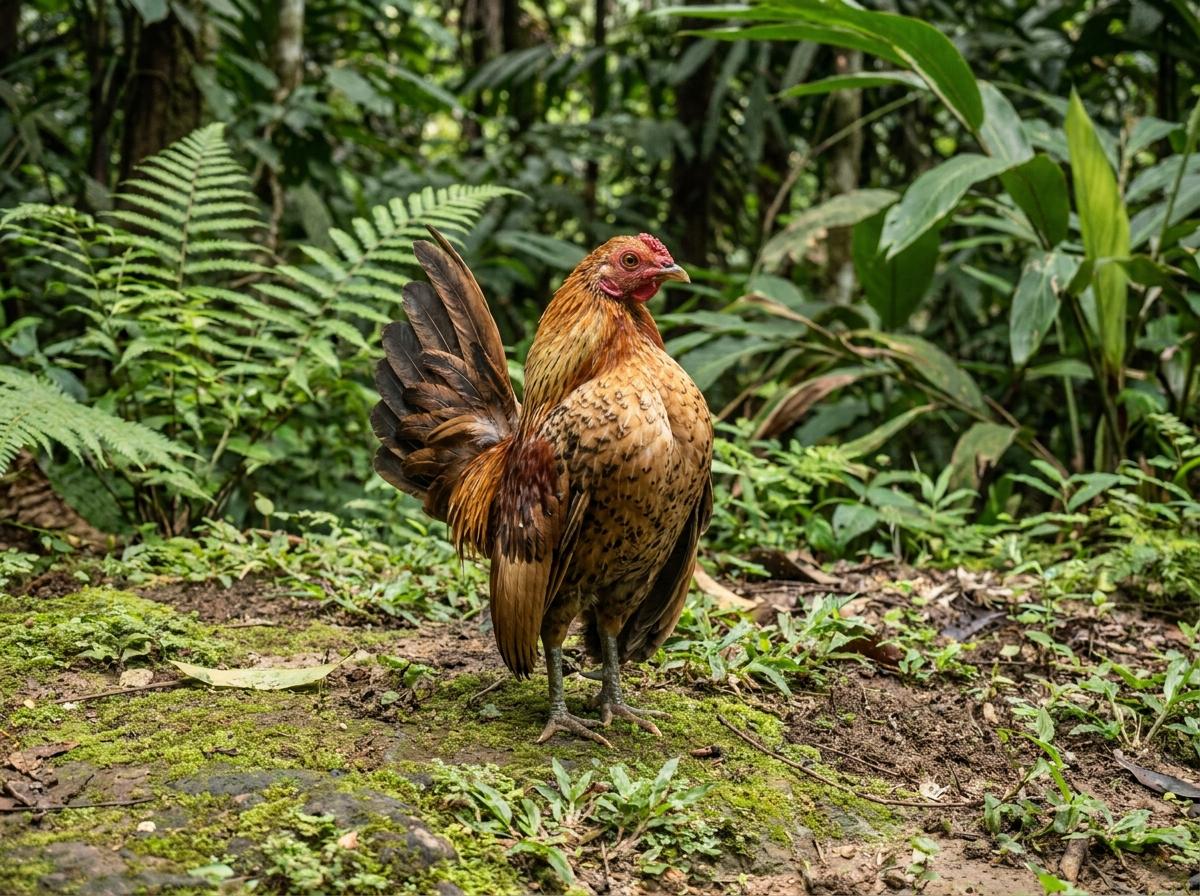
| Appearance | Multi coloured, variegated plumage resembling local birds; single comb; a deeper, heavier frame than a desi hen |
| Growth | About 1.3 to 1.6 kg at 8 weeks in Indian extension figures, against roughly 0.4 to 0.6 kg for local birds |
| Adult weight | Roughly 3.0 to 3.8 kg at 280 days; cockerels are usually sold at 2 to 2.5 kg |
| Age at first egg | About 166 days in extension figures, so roughly 23 to 24 weeks |
| Eggs | Roughly 120 to 150 in the first laying year under backyard care; brown shelled, 50 to 55 g |
| Availability | Widely supplied inside India through state farms, KVKs and private hatcheries; not established as a stock breed elsewhere |
Browse listings, public profiles, breeders, or add your animal.
What Giriraja is, and what it is not
Giriraja is a synthetic variety. The bird you buy is the product of crossing selected parent lines, and those lines are maintained at institutional farms rather than in villages. Assam’s animal husbandry material describes it in one sentence that is hard to improve on: a synthetic multicoloured breed resembling local birds in appearance, scavenging in habit, with disease resistance and high survivability.
Every clause there is doing work. “Resembling local birds” is deliberate: the improved backyard varieties are all selected for coloured, desi looking plumage rather than the white of a commercial bird, and state extension material lists that colour pattern among their selling points. “Scavenging in habit” is the trait a broiler has lost. “High survivability” is the one that decides whether a smallholder flock makes money, because a bird that dies at ten weeks produces nothing regardless of its genetic ceiling.
What Giriraja is not is a show breed. There is no breed standard, no herdbook, and no exhibition classification behind the name. It is production stock, multiplied from parent lines held by the university and by state farms, so two flocks sold under the same name can differ. Nor is it a true breeding bird in the way an Aseel or a Kadaknath is, which matters if you plan to hatch your own replacements. That point comes up again below, because it is the most common thing new keepers get wrong.
The name itself is a clue to how the variety was marketed: giriraja means king of the hills, which is how Assam’s material glosses it too.
Where it came from: Bengaluru, 1989
The Veterinary College at Hebbal in Bengaluru opened in 1958 and became a constituent college of the University of Agricultural Sciences, Bangalore in 1965. It stayed there through the Giriraja work and moved to the newly created Karnataka Veterinary, Animal and Fisheries Sciences University in 2004. So if you see the bird credited to UAS Bangalore in older literature and to KVAFSU in newer material, both are describing the same department in the same city, on either side of a university reorganisation.
The breeding machinery behind it was already old by 1989. The All India Coordinated Research Project on Poultry Breeding centre at that college started on 1 April 1971 and is the oldest surviving AICRP poultry breeding centre in India. Its foundation stock was exotic: strains of White Cornish, New Hampshire and White Rock, with further Cornish and White Plymouth Rock lines imported from the United States in 1972 and 1973. The centre released a coloured broiler called Raja in 1983, later produced Raja II from two synthetic lines, and its own account records that it assisted the Department of Poultry Science in bringing out Giriraja and Swarnadhara.
Read that sequence and the design intent becomes obvious. The variety came out of a meat oriented breeding programme working with heavy exotic lines, aimed at a bird that would look and behave like a country hen. It is closer in ancestry to a Cornish or a New Hampshire than to any Indian village fowl, which is exactly why it grows the way it does and exactly why its progeny do not stay uniform.
The same department released Swarnadhara in 2005 as a second, lighter variety. Karnataka’s poultry unit also still supplies day old chicks, parent stock and hatching eggs of both to farmers, self help groups and state animal husbandry departments, which is the supply chain most Indian buyers actually meet.
What Giriraja actually produces
Published figures for this bird vary more than they should, and the variation is not random: station and semi intensive results sit above true scavenging results, and seller pages sit above both. Here is what public sources report, with the conditions attached.
Growth
Assam’s backyard poultry material puts Giriraja at 1,300 to 1,400 g at eight weeks against 400 to 600 g for native fowl, with a feed conversion ratio of about 3:1 against 4.2:1, and a dressing percentage around 75 against 65 to 68. At 280 days it gives 3,000 to 3,800 g against 1,300 to 1,500 g for the native bird.
A Krishi Vigyan Kendra case study from Buldhana in Maharashtra reports the same shape with slightly different values: day old chicks at 45 to 50 g against 20 to 25 g, about 1.6 kg at eight weeks, and 1 kg of body weight reached in 8 to 9 weeks where a desi bird needs 25 to 30 weeks to get there. The same study says cockerels are sold at a marketable weight of 2 to 2.5 kg.
Those two sources bracket the realistic answer: roughly 1.3 to 1.6 kg at eight weeks, and a cockerel worth selling somewhere between four and six months depending on how much supplementary grain it gets. For scale, the AICRP centre in Bengaluru measured native chickens from Karnataka at an average of 552 g at eight weeks across 2,462 birds in 2023 to 2024. The improved bird is two to three times the weight of the local one at the same age, which is the claim the breeding programme was making and it holds up.
Eggs
Assam’s figures give 73 eggs to 280 days and 120 to 150 eggs to 500 days, with an age at first egg of 166 days, an egg weight of 50 to 55 g, and hatchability of 80 to 85 per cent. Meghalaya’s poultry manual, describing low input birds including Giriraja, says they will lay around 130 to 140 eggs a year with good care and start laying at 22 to 26 weeks, against about 70 eggs a year for a local hen.
Treat 120 to 150 as the honest first year expectation under backyard management, and treat anything above that as a claim about better feeding than most yards provide. For context, India’s own poultry research directorate lists its rural varieties at 100 to 110 eggs a year for Vanaraja and 140 to 150 for Srinidhi under backyard conditions, with its dedicated egg type bird at 160 to 180. Those are the numbers a public institute publishes for its own stock, and they land in the same band.
Survivability, which is the figure that decides profit
Assam gives 85 to 98 per cent survival to eight weeks against 80 to 90 per cent for native fowl. That range is wide because survival in a backyard is a management outcome, not a genetic one. Predation comes up again and again in the field literature as one of the serious constraints on backyard flocks, and a bird that grows faster is worth more to a hawk, a dog and a thief alike.
Nothing in the genetics protects a chick from a jackal. Brooding properly for the first six weeks, shutting birds into a sound night shelter, and vaccinating on schedule move the survival figure far more than the choice between one improved variety and another.
The figures this page does not use
Three claims are common online and are not supported by any institutional source found for this article, so they are left out.
- “3 kg hens and 4 kg cocks at six months.” Extension figures give 3.0 to 3.8 kg at 280 days, which is about nine months, and they do not split the sexes. The six month version appears mainly on chick sales pages.
- “180 to 190 eggs a year.” No government extension source consulted supports it for Giriraja. One route to a figure like that is visible in the literature: the Buldhana study reports 14 to 16 eggs per month, which is a lay rate during production rather than an annual total, since it ignores the weeks before the first egg, the pauses and the moult.
- “Roosters 4 to 5 kg, hens 3 to 4 kg.” This circulates on breed listicles with no source attached and sits above every institutional figure available.
If your birds beat these ranges, that is a real and useful result, and it belongs in your own records rather than in a marketing table. Logging weights and egg counts against dates is how a flock owner finds out which of the published numbers describes their own yard.

Giriraja, Vanaraja, Gramapriya, Swarnadhara and Kaveri
Conflating these is the single most common factual error about Giriraja, including in articles that otherwise get the biology right. They came from different institutions, for different jobs, in different decades. Here is the short version.
- Giriraja. Dual purpose. Department of Poultry Science, Veterinary College, Bengaluru, Karnataka. Released 1989. The heaviest framed of the group and the one usually chosen where meat is the priority.
- Swarnadhara. Dual purpose. Same department, same city, released 2005. A lighter bird than Giriraja, reported to lay somewhat better and, because of its lighter build, to be quicker at getting away from predators in an open yard. Those two comparisons come from press coverage of the department rather than from a published trial, so treat them as directional.
- Vanaraja. Dual purpose. ICAR Directorate of Poultry Research, Rajendranagar, Hyderabad. Its own pamphlet lists it at 100 to 110 eggs a year in backyard conditions and 1.8 to 2.0 kg at three months. It is the one promoted hardest in tribal and remote districts.
- Gramapriya. Not dual purpose. The same Hyderabad directorate developed it as an egg bird for free range, listed at 160 to 180 eggs a year in backyard conditions. If a comparison table shows Gramapriya “beating” Giriraja on eggs, that is a layer being compared with a meat leaning dual purpose bird.
- Srinidhi and Janapriya. Also Hyderabad, also dual purpose, at 140 to 150 eggs a year in the directorate’s own figures.
- Kaveri. A coloured cross distributed through the Central Poultry Development Organisation network rather than a Bangalore or Hyderabad university variety, and assessed in on farm trials by ICAR’s district level farm science centres. Attributions of Kaveri to KVAFSU appear online and do not match the field literature.
The practical takeaway for a buyer: pick on the job, not the fame of the name. For a meat leaning flock where you want big cockerels, Giriraja is the obvious candidate. Where eggs are the point, a purpose bred egg variety will beat it. Where local buyers pay a premium for a desi looking bird, all of the coloured varieties clear that bar and the choice comes down to what your nearest hatchery or state farm can actually deliver as day old chicks.
Two other chickens on Creatures show how differently the rest of Asia has answered the same question. The Dong Tao is a Vietnamese village breed from Hung Yen province, kept for its heavy scaled legs and its place at the table rather than for any yield figure, and the Mikawa is a Japanese breed established in Aichi prefecture during the Meiji era for eggs. Both are fixed, named breeds with a settled type and a pedigree behind them. Giriraja is the other model entirely: parent lines held by an institution, multiplied out to farmers as day old chicks, and judged only on what it produces.
Keeping Giriraja in a backyard system
The management pattern below is what Indian extension services publish for improved backyard birds, and it is the same pattern whether the variety is Giriraja, Vanaraja or Srinidhi. Nothing here replaces a veterinarian: local disease pressure varies enormously, and vaccination and treatment decisions belong to someone who can see your flock.
Brood before you range
Improved chicks cannot go straight into the yard. Extension guidance is to brood for the first six weeks with a heat source, protected floor space and balanced feed, then release the birds to free range at about 42 days. The Buldhana study gives floor space of 0.5 square feet per bird from 0 to 4 weeks, 1.0 from 4 to 8 weeks and 2.0 from 8 to 12 weeks, with feeding space rising from 2.5 cm to 6.5 cm per bird over the same period.
Litter of 5 to 10 cm of sawdust, rice husk or chopped straw, stirred regularly and treated with slaked lime to stop it caking, is the standard recommendation. Wet, caked litter is the fastest route to coccidiosis and to the ammonia that damages young birds’ airways.

Then range them, but shut them in at night
The standard smallholder unit is 10 to 20 birds per household, let out in daylight to scavenge and shut into a night shelter after dark. Keep two or three males in a flock of that size if you want fertile eggs. Give clean drinking water before the birds go out in the morning, and a handful of grain in the evening to bring them back in.
The night shelter carries most of the welfare load. It needs good ventilation, dry footing, adequate light, perches, and construction that a dog or a civet cannot open. Bamboo and timber shelters offer good hiding places for mites and lice, so periodic cleaning is part of the routine rather than an optional extra.
Feed for the gap, not for the whole ration
A ranging bird will usually meet its protein needs by scavenging insects, seeds and kitchen waste. Energy is what runs short. Extension guidance is to top up with locally available cereals, maize, bajra, ragi, jowar or broken rice, mixed with rice bran or polish, and India’s poultry directorate suggests 20 to 30 g of grain per bird in the evening under free range conditions. If you start seeing thin or shell less eggs, add a calcium source such as shell grit or lime powder at roughly 3 to 4 g per bird per day.
Do not economise on water. Clean water is the input that limits everything else in a hot climate, and a heavy dual purpose hen in lay drinks more than a desi hen.
Vaccinate on a schedule and record it
Newcastle disease, called Ranikhet disease in India, is the disease that empties backyard flocks. The published schedule for improved backyard birds vaccinates against Marek’s disease at day old, Newcastle disease at about 5 days and again at 28 days, infectious bursal disease at around 14 days, fowl pox at about 3 weeks, then Newcastle disease with the R2B strain at 9 weeks and fowl pox again at 12 weeks, with Newcastle and pox repeated every six months. Deworming every two to three months is standard for ranging birds because scavenging birds pick up parasites continuously.
That schedule is only useful if you can remember where you are in it. Vaccination dates, deworming dates and treatment records are exactly the sort of thing that lives in someone’s head until the flock changes hands, which is why keeping them on the animal’s own profile is worth the five minutes.
Buying Giriraja stock
Inside India the supply chain is institutional at the top and commercial at the bottom. The Bengaluru department supplies day old chicks, parent stock and hatching eggs to farmers, self help groups, state animal husbandry departments and research organisations, state farms multiply the stock, and private hatcheries sell chicks onward. Public sector day old chicks are typically priced at a few tens of rupees and are sometimes subsidised through state schemes, so the entry cost is low by design. That is the whole point of a rural poultry variety.
Three questions are worth asking any seller.
- What is the parent stock, and where did it come from? The name is not protected. Coloured cross chicks are sold under several names in the same markets, and a bird described as Giriraja may or may not trace to the Bangalore lines.
- What was vaccinated, and when? A chick that has had Marek’s at the hatchery and Newcastle at day five is a different proposition from one that has had neither.
- What did the parent flock actually produce? Weights at age and egg counts beat any breed claim. A seller who keeps records will have them.
Outside India, Giriraja is not established stock. It appears occasionally under that name at small hatcheries in other countries, without any registry or standard behind the label. Importing genuine stock is not a realistic route for most people either: United States rules bar live poultry and hatching eggs originating from regions where highly pathogenic avian influenza or Newcastle disease is considered to exist, and imports otherwise need permits and quarantine, so the disease status of the source region decides the answer before the bird does. If your goal is a hardy, coloured, dual purpose backyard bird outside India, you will do better with a locally available dual purpose breed than with a name imported from a different production system.
You can see what poultry is listed now on the Creatures marketplace, and set a free alert (below) if the breed you want is not there today.
The honest limits
It does not breed true. This is the most important caveat and the one most often skipped. The bird is a synthetic cross, so chicks hatched from your own flock are a further generation of segregation rather than a copy of what you bought. FAO’s guidance on family poultry breeding puts the general case bluntly: if hybrid crossbreeds mate among themselves, potential production falls in the very next generation to the average of the two original genotypes. Extension programmes do suggest keeping a few males so a flock can hatch replacements, and plenty of keepers do exactly that, but expect the second generation to be more variable and less productive than the chicks you paid for. Buying fresh day old chicks each cycle is what the genetics assume.
It needs management to pay off. The same FAO chapter notes that most attempts to replace local birds with improved stock have not succeeded, for lack of the management input the improved potential requires. A Giriraja fed and housed like a desi hen will perform like a slightly better desi hen, and you will have paid more for it.
It is a hardy bird, not an invulnerable one. Disease resistance and high survivability are relative to the local fowl, not absolute. Newcastle disease will still take an unvaccinated flock.
A supply chain, not a heritage breed. If your interest is conservation of Indian poultry genetics, Giriraja is not the bird for it. India’s true native breeds, Aseel, Kadaknath, Ghagus, Nicobari and others, are the ones with genetic conservation value, and several of them are supplied by the same institutes.
Frequently asked questions
Is Giriraja a breed or a cross?
A cross. It is a synthetic dual purpose variety created from exotic parent lines and released in 1989, and it is maintained as parent stock at institutional farms rather than as a self sustaining village breed. There is no breed standard or herdbook for it.
How many eggs does a Giriraja hen lay in a year?
Roughly 120 to 150 in the first laying year under normal backyard care. Assam’s extension figures give 120 to 150 eggs to 500 days and Meghalaya’s poultry manual gives 130 to 140 a year with good care. Higher figures circulate but were not traceable to any institutional source for this article.
When can I sell a Giriraja cockerel?
Extension case study figures put marketable weight at 2 to 2.5 kg, and improved birds reach 1 kg at 8 to 9 weeks where a desi bird takes 25 to 30 weeks. In practice that means somewhere between four and six months, and it depends heavily on how much supplementary grain the birds get.
Can I hatch my own Giriraja replacements?
You can hatch chicks, and many smallholders do, but they will not match the birds you bought. Progeny of a cross segregate, and FAO’s family poultry guidance says production potential falls to the average of the original parent types in the very next generation. Plan on buying day old chicks each cycle if you want consistent output.
What is the difference between Giriraja and Vanaraja?
Different institutions and different design targets. Giriraja came from the Veterinary College in Bengaluru in 1989 and leans towards meat; Vanaraja came from the ICAR Directorate of Poultry Research in Hyderabad and is listed by that directorate at 100 to 110 eggs a year in backyard conditions with 1.8 to 2.0 kg at three months. Neither is simply better; they are supplied by different networks and suit different districts.
Is Giriraja available outside India?
Not as established stock. Birds are occasionally sold abroad under the name, with no registry or standard behind it, and importing genuine stock runs into live poultry import rules tied to the disease status of the source region. Outside India, a locally available dual purpose breed is the practical equivalent.
Is Giriraja good for a first time keeper?
Yes, with the caveat that improved birds reward management. Brooding for six weeks, a predator proof night shelter, clean water and a vaccination schedule are the difference between the published figures and a disappointing flock.
Do this next on Creatures
Whether you are choosing a backyard variety, running a flock already, or supplying chicks to other keepers, Creatures is the records, marketplace and directory layer to do it in one place.
Add your birds. Keeping Giriraja or another coloured backyard variety? Create a free animal profile in a couple of minutes, no account needed to start. The walkthrough is in adding an animal to Creatures.
Track weights, eggs and vaccinations. This is a bird whose published figures vary, so your own records are the only ones that describe your yard. Add a record for a weight, a lay count, a vaccination or a treatment. The record sheet opens for any visitor to look around, and a free account saves what you enter. See adding a record for the full how to.
Find stock. Browse chickens on the marketplace and search trusted breeders and farms in the Creatures directory. New to it? Read saving searches and using your watchlist.
Get alerted. Coloured dual purpose stock comes and goes, so set a free Giriraja listing alert and we will tell you when one is posted. No account needed to start.
List your farm or hatchery. Supplying chicks or hatching eggs? Create a free organization profile, no account needed to start, then read getting listed in the breeder directory and creating an organization and adding your team if you run the operation with other people.
Sell with confidence. Planning to sell birds or eggs? Learn how seller payout works before you list.