
How Long Do Cows Live? Cattle Lifespan on Farms and as Pets
Author: Elliott Garber, DVM · Published
There are two honest answers to “how long do cows live,” and most pages give only one. Cattle kept to old age live roughly 20 years, and the oldest cow ever verified reached 48 years and 9 months. Meanwhile the average dairy cow in the United States spends under three years in the milking herd, and almost every animal raised for beef is harvested before it is two and a half. Both answers are true, they are not in tension, and which one applies to your animal depends almost entirely on its job. If you are starting from the beginning, the Creatures cattle hub covers breeds, prices, and care.
A family milk cow, a pet steer, a registered Highland, a commercial beef cow, and a high producing Holstein are five different lifespan questions wearing the same word. This guide answers each with the numbers that actually stand behind it, and says plainly where no number exists.
One practical thing before the numbers. Write down the birth date. Nearly every longevity decision in cattle runs on age, from when a heifer is bred to whether an older cow gets another season, and by the time it matters nobody remembers. A free cattle profile on Creatures holds the birth date, the tag or registration number, calving history, and a running weight and body condition record in one place.
| Biological life expectancy | About 20 years (De Vries and Marcondes, 2020) |
|---|---|
| Oldest verified cow | 48 years 9 months, Big Bertha, 1944 to 1993 (Guinness World Records) |
| US dairy productive life | Under 3 years in the herd on average; 35.3 months, fewer than three lactations |
| US dairy total lifespan | Roughly 4.5 to 6 years from birth to death, because first calving is at about 2 |
| Beef cow herd life | 7 to 10 years after first calving, at a 10 to 15 percent annual cull rate |
| Fed cattle age at harvest | 2.6 percent of audited fed carcasses were 30 months or older (NBQA 2022) |
| Pet and house cattle | No published longevity dataset; Highland cows are recorded breeding past 18 |
| What usually ends it | Reproductive failure, mastitis, lameness, worn teeth, disease around calving |
The biological answer: about 20 years
The cleanest published figure comes from a peer reviewed review of dairy cow longevity by Albert De Vries at the University of Florida and Marcos Marcondes, in the journal Animal in 2020. Its statement is short and unhedged: the natural life expectancy of dairy cattle is approximately 20 years. That is the number to hold in your head for a cow allowed to simply get old.
Individuals go further. Guinness World Records lists the oldest cow ever at 48 years and 9 months: Big Bertha, who lived from 1944 to 1993 in County Kerry, Ireland. Treat that as any single record deserves. It proves the species can do it and tells you nothing about your animal.
Twenty years is also a ceiling very few cattle in the United States approach, and the reason is not that cattle are fragile. It is that almost all of them have a job, and the job usually ends first.
The production answer, and why it is so much shorter
USDA’s National Agricultural Statistics Service counted 28.5 million beef cows and 9.65 million milk cows in the United States on 1 July 2026, out of 94.2 million cattle and calves in total. Nearly all of those animals are in a production system, and each system has its own arithmetic.
Dairy cows
This is where the gap between the two answers is widest, and the numbers are not seriously disputed. De Vries and Marcondes report that productive lifespan of dairy cattle in the United States averages less than three years, and that individual productive lifespans within a herd range from one day to more than ten years, though it is rare for a dairy cow to reach ten years of age at all.
The mechanism is the annual cull rate. Drawing on Dairy Herd Information Association records from 9,158 herds of more than 50 cows, the review reports an average annual cow cull rate of 38 percent, with a standard deviation of 12 percent. Four percentage points of that were cows sold to other dairies, which means they kept milking somewhere else. The remaining 34 percent worked out to an average productive lifespan of 35.3 months, which the authors describe as fewer than three lactations.
Two things follow, and both are commonly garbled. A cull rate is not a lifespan: 38 percent leaving per year is what produces a mean of just under three years, not a three year contract on any individual cow. And lactations are not years. Three lactations is roughly three years of milking, on top of the two years it took to raise the heifer to her first calving. The authors do that arithmetic themselves and land on a total lifespan from birth to death of between 4.5 and 6 years for a typical US dairy cow.
The reasons cows leave are recorded rather than guessed at. In a dataset of cows calving between 2001 and 2006 across 2,054 herds in the eastern United States, the most common primary disposal code was died, at 20.6 percent of all culling, followed by reproduction at 17.7 percent, injury and other at 14.3 percent, and low production and mastitis at 12.1 percent each. An earlier analysis cited in the same review found up to 80 percent of all culling was attributable to health issues. Read that honestly in both directions. It is not mostly a story of healthy cows retired for economics, and it is not a story of cows worked to death either: died, reproduction, injury, and mastitis are the categories doing the work, and every one is something a veterinarian would rather prevent.
One more number before you generalize. Roughly 10 to 15 percent of dairy heifer calves born alive and intended to become cows never reach a first calving, so the population average already excludes a slice of animals that did not get that far.
Beef cows
A beef cow’s arithmetic is completely different, and the same review states it in one line: annual cull rates for beef cows run approximately 10 to 15 percent, which produces productive lifespans of 7 to 10 years after first calving. Since most beef heifers calve first at about two years old, that describes a cow who is commonly nine to twelve when she leaves.
She stays because she has to earn back what it cost to make her. Nebraska Extension analyzed two heifer development systems over an eleven year lifespan and found that heifers developed on low input forage became profitable at three to four years of age, while heifers developed in a drylot were nine to ten years old before their investment cost was covered. A cow who leaves at five in that second system never paid for herself. Longevity is not sentiment in a cow herd. It is the difference between a profitable female and an expensive one.
How many actually get there is where sources genuinely disagree, and the spread is worth showing rather than splitting. The same Nebraska article reports research from New Mexico and Montana indicating that 30 to 60 percent of heifers remain in the herd after five years of age. A separate study of 3,568 commercial Angus females born between 2006 and 2020 found the probability of remaining in the herd at age five averaged 69.4 percent. Different regions, different systems, different datasets, so the honest summary is that somewhere between a third and two thirds of replacement heifers are still working at five.
The Nebraska work also names the pinch point: the highest open rate falls on two and three year old females, asked to get pregnant while lactating for the first or second time and while still growing themselves. Longevity in a beef herd is mostly decided in those two years.
Steers and finishing cattle
Most cattle in the United States never approach a biological lifespan, and the reason is simply that they were raised for beef. That deserves saying once, plainly, without drama in either direction.
The National Beef Quality Audit is the industry’s own periodic survey of what comes through the plants. Its 2022 round assessed 9,746 fed beef carcasses in plant between July 2021 and November 2022 and found, through evaluation of dentition, that 2.6 percent of carcasses were 30 months of age or older. That leaves 97.4 percent under 30 months. USDA’s Economic Research Service describes the path there: calves are weaned at three to seven months, may spend time on grass or in a backgrounding lot, then spend 90 to 300 days in a feedlot depending on their weight and age at placement.
That is the answer for the large majority of cattle alive in the country today, and it is not what most people mean when they type “how long do cows live.” It is exactly why this page answers both questions instead of picking the flattering one.

Pet cattle, mini cattle, and the family milk cow
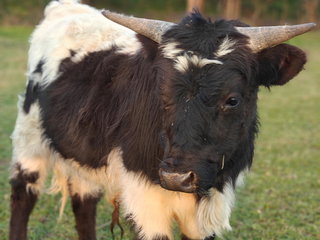
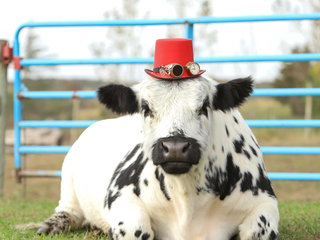
Here is the segment the published research does not cover, and it is growing fast: cattle kept where the economics are absent. Mini Highlands, Dexters, miniature Herefords, a house cow for one family’s milk, a steer that was supposed to be beef and became a lawn ornament with a name.
Be skeptical of any confident number for these animals, including numbers you see elsewhere. Nobody has published a longevity dataset for pet cattle. What can be said is that the culling pressures described above are the reason production cattle leave early, and if you remove those pressures, the biological ceiling is what is left. A cow who is never asked to breed on schedule, never culled for production, and gets her feet and teeth looked after is a cow whose limit is roughly that 20 year figure.
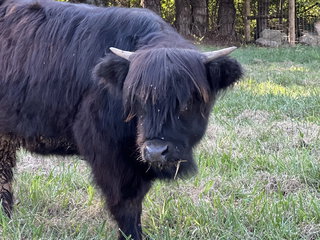
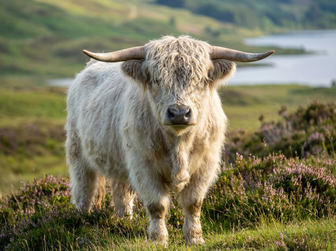
The best sourced signal in that direction comes from a breed known for long working lives. The Highland Cattle Society, the breed’s own registry, describes Highlands as remarkable for their longevity, with many Highland cows breeding at over 18 years of age and having borne fifteen calves. That is a claim about breeding cows still doing a job at 18 in a hill environment, which is a harder test than a pet paddock.
Two cautions, because a pet cow’s risks are not a commercial cow’s. The first is body weight: a grazing animal fed like a pet gets heavy, and the load lands on feet and joints. The second is that nobody is watching a numerical trend for you. A commercial herd catches a failing cow through pregnancy checks, weaning weights, and a scale. A single backyard cow gets caught by whoever notices she looks different, which is exactly the observation a monthly weight or body condition note turns into evidence.
If you are shopping for one of these animals, the Creatures Highland cluster is the deepest coverage on the site: the Highland cattle hub, the miniature Highland guide, and the Highland cow cost guide. For the classic family milk cow, the Jersey breed profile covers the breed most often kept for exactly that job.
What actually limits a cow’s life
Across dairy, beef, and pet cattle, the same short list ends most of them.
Teeth
Cattle have no upper incisors, and the lower ones wear against a dental pad and coarse forage for life. Colorado State University Extension lays out the timetable used at every sale barn in the country: the first permanent incisors erupt between 18 and 24 months, and the corner incisors erupt at 42 to 48 months and are in wear by 60 months, so a cow with all eight permanent incisors is at least five and under ten. After that, wear takes over as the age signal.
The terms matter because they decide culls. Mississippi State University Extension defines cattle with broken or missing teeth as “broken mouth” cattle, notes that it is reasonable to assume a “short mouth” cow is eight years or older, and calls an animal whose incisors are all missing or worn smooth to the gums a “smooth mouth” or “gummer.” Colorado State adds that smooth mouth cows are most likely over ten and may have significant trouble foraging, and therefore trouble maintaining or gaining weight. Sheep and goats are mouthed the same way and lose condition for the same reason: our sheep lifespan guide and goat lifespan guide cover the broken mouth in those species.
That is the whole mechanism, and it is why teeth end more cow lives than any single disease. Mississippi State notes that dental problems affecting forage and feed consumption may be the cause of rapid body condition and weight loss relative to other cattle in the herd. A cow with a worn mouth on rangeland is not sick. She simply cannot harvest enough grass to hold her condition, and coarse forage wears teeth faster. Nebraska Extension’s culling guidance says it directly: older cows being considered for retention should be checked carefully to make sure they have a sound mouth and are likely to sustain productivity for another year or two.
Lameness
The professional edition of the Merck Veterinary Manual describes lameness in cattle as caused mainly by hoof lesions, and states that it poses a severe welfare issue and contributes to growing public concerns regarding the well being and longevity of cattle. In dairy herds it is associated with decreased productivity, decreased reproductive performance, decreased body condition, and a higher risk of culling and death.
It is also the most reversible item on this list. Footing, hoof trimming intervals, and catching a limp in week one instead of week four are under a keeper’s control, and a lame cow attended to early usually stays in the herd.
Reproductive failure
For a beef cow, an open cow is a cull, and that single fact drives more herd exits than any illness. For a dairy cow, reproduction was the second most common disposal code in the eastern US dataset above, at 17.7 percent. Creatures has a calving guide that covers the timeline. For longevity purposes the point is narrower: get breeding dates and pregnancy check results written down, because a cow’s reproductive record is the best single predictor of whether she has another year in her.
Metabolic disease around calving
The weeks either side of calving are the riskiest window in a cow’s year, and the diseases there feed straight into culling. Merck describes parturient paresis, better known as milk fever, as a metabolic disturbance most commonly seen at the onset of lactation after calving, when calcium excretion rises sharply and blood calcium drops. It notes the condition can occur in cows of any age but is most common in high producing dairy cows entering their third or later lactations, with higher incidence in Jersey and Guernsey. The signs are paralysis, sternal recumbency, and cold extremities within 48 hours of calving.
Ketosis compounds it. Merck reports that cows with elevated ketone bodies in early lactation are at increased risk of ketosis, metritis, and displaced abomasum, are less fertile, produce less milk, and are at increased risk of culling in early lactation. A cow can be pushed permanently out of a herd by three weeks that went badly in February.
Mastitis belongs alongside these. Merck notes that with few exceptions, mastitis occurs when microbes enter the teat via the teat canal, and that culling may be a practical option for a chronically infected quarter. It is a management disease, so milking hygiene and housing move the number.
Every condition in this section is one a farm veterinarian would rather prevent than treat, and prevention is scheduled herd work rather than an emergency call. Our guide to finding a large animal vet covers where to look, what a farm call costs, and why the relationship has to exist before you need a prescription.

The records that decide how long a cow lives
Every cull decision on this page is made from information: her age, her calving history, her condition, and whether her mouth and feet will carry her another year. Most of it is lost by the time somebody needs it. Nebraska Extension’s culling guidance simply assumes it exists, telling producers to use their individual records to find the cows that have consistently weaned calves in the bottom of the herd across the last two or three years.
Every animal on Creatures gets a free profile carrying the birth date, the tag or registration number, and its ownership history. What is worth adding to it:
- Birth date and identifiers. The one thing you cannot reconstruct later. Everything else is read against it.
- Calving history. Dates, outcomes, and any assisted calving. This is the record that answers whether an older cow gets another season.
- Weight and body condition over time. A physical measurement record turns “she looks a bit poor” into a curve, and that curve is the earliest signal a mouth is failing.
- Treatments and vaccinations. Vaccination records carry who administered them and when the next dose is due. For any medication, write the product, the date, and the withdrawal period your veterinarian gives you into the record, because that number is worthless in somebody’s memory.
- Examinations and test results. Medical record types on Creatures, including examinations, medications, test results, and surgeries, are private by default, so a herd health history is not something you publish by accident.
Two features do the practical work. Reminders give you a due date dashboard for boosters, pregnancy checks, and recurring care, and you can subscribe to them as a calendar feed. And each animal’s profile will produce a printable packet of registrations, identifiers, pedigree, and records, which is what you want in your hand at a vet visit or a sale. Downloading it needs a free account. After a visit, import the clinic’s PDF or a lab report straight back into the record history instead of retyping it.
Help center: adding an animal, adding a record, health and medical records, and reminders and upcoming care. For the herd level version, see the Creatures cattle record keeping guide.

Cattle lifespan FAQ
How long do cows live as pets?
Take the biological figure of about 20 years as the working answer, because the pressures that shorten a production cow’s life are the ones you have removed. There is no published dataset for pet cattle, so anyone quoting a precise pet cow lifespan is estimating. Feet, teeth, and body weight are what you manage.
Why do dairy cows only live a few years?
They are not dying at three. They are leaving the herd at three. The average US annual dairy cull rate of 38 percent produces a mean productive life of about 35 months, and the recorded reasons are led by death, reproductive failure, injury, low production, and mastitis. A culled cow at four or five is usually sold, not gone.
Do bulls live as long as cows?
Nobody has published a separate life expectancy for bulls, so treat any number you are given as a guess. Breeding bulls in commercial herds turn over for reasons unrelated to health, mainly to avoid breeding their own daughters and to bring in new genetics, so a bull’s herd tenure tells you nothing about his biology.
How can I tell how old a cow is without papers?
Look at her incisors. Colorado State’s schedule gives eruption and wear milestones from 18 months through ten years, and a cow with all eight permanent incisors is at least five and under ten. It is an estimate, not a birth certificate, which is why the birth date is worth recording on the day the calf hits the ground.
Do miniature cattle live longer than full sized cattle?
No published study shows that. What is different about mini and pet cattle is the absence of production culling, not a different biology. Judge a mini cow’s likely lifespan by her feet, her teeth, and her body condition, exactly as you would a full sized one.
Do this next on Creatures
If you own cattle. Create a free profile for each animal and put the birth date and tag number on it the day you get them: add your animal (no account needed to start). Then log calvings, weights, body condition, treatments, and vet visits with add a record, which opens for visitors and needs a free account to save. See adding an animal and adding a record.
If you are looking to buy. Ask every seller for the birth date, calving history, and health records before you talk price, because an unaged cow is an unpriced cow. Browse current listings in the cattle marketplace, compare against the Creatures cow cost guide, or set an alert so you hear when the right animal appears near you: get cattle listing alerts. See saving searches and using your watchlist.
If you breed or sell cattle. A documented age and calving record is what separates a cow that sells well from a cow that sells cheap. Get listed where buyers are already searching in the breeder and farm directory, which lists trusted breeders and farms by species and state, and create your organization profile to publish your animals, records, and available stock under one name. See getting listed in the breeder directory.