

Author: Elliott Garber, DVM · Published
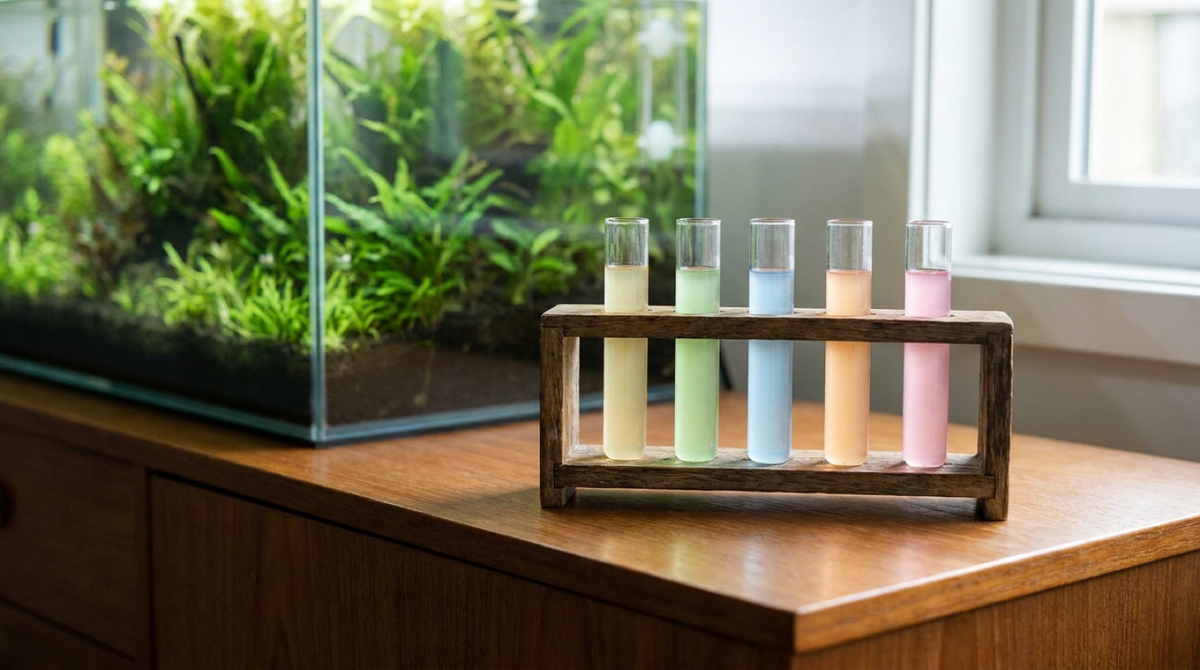
Aquarium water testing means checking ammonia, nitrite, nitrate, pH and temperature on a regular schedule, adding KH, GH and chlorine at key moments, and writing every result down so a slow change shows up before your fish feel it. In an established freshwater tank, ammonia and nitrite should read zero. Test at least every week or two, and right away whenever fish look or act differently. A simple way to keep the results together is to track water quality in a tank or pond on Creatures, where each reading is saved with its unit and charted over time.
The tricky part is rarely doing the test. It is reading it: whether your kit reports total ammonia or free ammonia, nitrite “as N” or “as NO2”, hardness in degrees or in mg/L. This guide covers each aquarium water parameter, a testing schedule drawn from veterinary and extension guidance, how to get readings you can trust, and how to keep them.
| Ammonia | 0 in an established tank; damage reported from about 0.05 mg/L free ammonia (sources do not say as N or as NH3) |
|---|---|
| Nitrite | 0 in an established tank; most kits read it as N (multiply by about 3.3 for NO2) |
| Nitrate | Rises between water changes; most kits read it as N (multiply by about 4.4 for NO3) |
| pH | Lethal limits near 4 and 10 for many freshwater fish; about 7.8 to 8.5 is normal for marine tanks |
| KH (alkalinity) | At least 100 mg/L as calcium carbonate in freshwater systems, per the Merck Veterinary Manual |
| Dissolved oxygen | Above 5 mg/L is optimal for most fish |
| Chlorine | None detectable whenever animals are in the water |
| How often | Every 1 to 2 weeks for routine tests; right away when fish change |
Which aquarium water parameters to test
Five tests cover most freshwater tanks week to week: ammonia, nitrite, nitrate, pH and temperature. KH and GH explain why pH behaves the way it does. Chlorine testing protects every water change. Dissolved oxygen matters most in ponds and warm, crowded tanks, and salinity matters in brackish and marine systems.
Ammonia in a fish tank
Fish excrete ammonia through their gills, uneaten food and decaying matter add more, and some tap and well water carries it too (UF/IFAS Extension, Ammonia in Aquatic Systems). UF/IFAS is blunt about the target: in healthy ponds and tanks ammonia should always be zero, and any ammonia is a sign the system is out of balance. Common causes are overfeeding, too many fish for the filter, a filter that has been disturbed, or a tank that has not finished cycling.
Most kits measure total ammonia nitrogen (TAN): ionized ammonium plus un-ionized “free” ammonia (NH3). Free ammonia is roughly 100 times more toxic, and its share rises with pH and temperature, so a TAN reading means little without the pH and temperature taken at the same time. The UF/IFAS table at 24 °C (75 °F) gives the free share of TAN as about 0.5 percent at pH 7.0, 2 percent at pH 7.6, 5 percent at pH 8.0 and 17 percent at pH 8.6. Applied to a TAN of 1.0 mg/L as N, that is about this much free ammonia, as N and (multiplied by about 1.2) as the whole NH3 molecule:
- pH 7.0: 0.005 mg/L as N (0.006 mg/L as NH3)
- pH 7.6: 0.021 mg/L as N (0.025 mg/L as NH3)
- pH 8.0: 0.050 mg/L as N (0.061 mg/L as NH3)
- pH 8.6: 0.174 mg/L as N (0.211 mg/L as NH3)
UF/IFAS says fish are being damaged whenever un-ionized ammonia is above about 0.05 mg/L and die at about 2.0 mg/L; SRAC Publication 463 ties chronic exposure from about 0.06 mg/L to gill and kidney damage. Neither source says whether those figures are as N or as NH3, so read them as a warning zone rather than an exact cutoff. Even below lethal levels, chronic exposure leaves fish more prone to infection.
Kit chemistry matters too. UF/IFAS explains that the Nessler method reads falsely high if formalin was used in the past 24 to 72 hours or if the water contains ammonia-binding products, including many water conditioners, and it gives false reactions in seawater. The salicylate method is not affected by binders or formalin and is more accurate in seawater. Your kit’s instructions say which method it uses.
Nitrite in a fish tank
Nitrite is the middle step of the nitrogen cycle and is toxic in its own right. It passes through the gills and binds to hemoglobin, turning the blood chocolate brown so it carries less oxygen, and affected fish can suffocate even in well-oxygenated water (SRAC Publication 462, Nitrite in Fish Ponds). Species differ: SRAC lists largemouth bass and bluegill as resistant, channel catfish and tilapia as fairly sensitive, trout as sensitive to extremely small amounts, and goldfish between catfish and bass. In an established tank the reading should be zero; a Southern Regional Aquaculture Center profile of koi and goldfish says to keep nitrite below 0.05 mg/L (SRAC Publication 7201).
The unit is the classic trap. The Merck Veterinary Manual notes that most test kits measure nitrite-nitrogen rather than nitrite, and that a factor of 3.3 converts one to the other (Environmental Diseases of Aquatic Animals). A reading of 0.5 mg/L “as N” is the same water as about 1.6 mg/L “as NO2”. Neither number is more dangerous; they are two ways of writing one result.
Chloride competes with nitrite at the gills, which is why salt is sometimes used against nitrite poisoning. The amount depends on the species and the water, so ask a fish veterinarian before treating; the American Association of Fish Veterinarians keeps a find a fish vet map.
Nitrate
Nitrate is the end product of the cycle and much less toxic than ammonia or nitrite (UF/IFAS). It is not harmless: the Merck manual notes that nitrate blocks iodine uptake by the thyroid and can build to fairly high concentrations. Water changes and plant growth remove it, so on a chart it climbs between water changes and drops after each one. Most nitrate kits read nitrate-nitrogen, and the Merck manual gives a factor of about 4.4 to convert to nitrate (NO3): 10 mg/L “as N” is about 44 mg/L “as NO3”.
The same arithmetic covers ammonia: a result “as NH3” is about 1.2 times the same water’s result “as N”. Each factor is the weight of the whole molecule divided by the weight of its nitrogen atom, which is why they never change the actual risk.
pH
pH tells you how acidic or basic the water is. For many freshwater species the lethal limits are around pH 4 and 10, marine fish are far less tolerant of swings, and about 7.8 to 8.5 is considered normal for marine tanks (Merck). The Southern Regional Aquaculture Center gives 6.5 to 9.0 as the recommended range for aquaculture and notes that fish blood sits near pH 7.4 (SRAC Publication 464). Your species’ own range matters more than any general number.
pH also moves through the day. In planted tanks and ponds it rises in daylight as plants use carbon dioxide and falls at night (SRAC 464), so test at a consistent time. A fall over weeks can point to what veterinarians call old tank syndrome: water topped up for evaporation but rarely changed, until the buffer runs out and pH drops, gradually or suddenly (Merck Veterinary Manual, Management of Aquarium Fish).
KH (carbonate hardness or alkalinity)
KH measures the water’s buffer, its ability to absorb acid without the pH dropping. It is reported in mg/L as calcium carbonate (SRAC 464). The Merck manual calls 100 to 250 mg/L moderate alkalinity suitable for most fish, considers anything under 50 mg/L low, and recommends at least 100 mg/L in freshwater systems and at least 250 mg/L in saltwater systems. Filter bacteria consume alkalinity as they work, and UF/IFAS warns that once it is depleted, pH can drop quickly enough to kill both fish and bacteria. A KH reading that slides week after week is an early warning worth logging.
GH (general hardness)
GH measures dissolved calcium and magnesium. It is also reported in mg/L as calcium carbonate, which is why hardness and alkalinity get confused, though they measure different things and can differ a lot in the same water (SRAC 464). Calcium helps fish hold on to body salts, and the Merck manual flags very soft water, such as deionized water, as a cause of problems. Many aquarium kits report hardness in degrees instead: one German degree (dGH or dKH) equals about 17.8 mg/L as calcium carbonate (Wikipedia, German degree of hardness). Write down which unit your kit uses. If you keep shrimp, the cherry shrimp colony care guide covers the GH, KH and TDS readings shrimp keepers track.
Temperature
Fish are cold-blooded, so every body process follows the water temperature, and the Merck manual warns that sudden changes of even a few degrees can compromise immunity. Check the thermometer daily and match the temperature of new water at every change. Species ranges differ widely: a heated betta tank runs far warmer than an axolotl tank setup.
Dissolved oxygen
The Merck manual puts the optimal dissolved oxygen for most fish above 5 mg/L, with stress below that and deaths possible at 4 mg/L or less. Water temperature has the biggest effect, since warm water holds less oxygen. A well-filtered aquarium with a moving surface rarely needs a dissolved oxygen test, but ponds do, because oxygen is lowest near dawn. Koi pond care by season covers when to test it.
Chlorine and chloramine
Tap water is often treated with chlorine or chloramine. The Merck manual reports harmful effects in fish at chlorine levels as low as 0.02 mg/L and says none should be detectable whenever animals are present. Two details catch people out: water treated only with chloramine tests negative for free chlorine, so test total chlorine, and neutralizing chloramine releases ammonia into the tank. Test the tap water, then the tank water after treatment.
Salinity and the rest
Brackish and marine keepers add salinity or specific gravity to the routine set. Phosphate, calcium, magnesium, total dissolved solids (TDS) and copper are specialist tests for reef, planted, shrimp or treatment tanks; copper usually comes up only during a treatment a veterinarian directs.
How often to test aquarium water
There is no single schedule for every tank, but veterinary and extension guidance lines up well:
- While a new tank is cycling: every day or two for ammonia, nitrite and nitrate, until both ammonia and nitrite stay at zero. The how to cycle a fish tank guide covers this stage.
- Established tank, routine: the Merck pet owner guide lists testing pH, alkalinity, ammonia, nitrite and nitrate every 2 weeks, plus specific gravity for marine tanks (Routine Health Care of Fish). UF/IFAS recommends testing ammonia weekly in any production system. A weekly or fortnightly session suits most home tanks.
- Every day: look at the fish, read the thermometer and check the equipment (Merck).
- Right away: any time the fish’s appearance or behavior changes, including eating less (UF/IFAS). Test after anything that stopped the filter or cut its oxygen too, since filter bacteria can stop working or die without oxygen.
- More often after a treatment: UF/IFAS advises testing ammonia and nitrite more often after a disease treatment, because some medications, especially antibiotics, can harm filter bacteria.
- More often once ammonia shows up: UF/IFAS says to increase testing until the problem is corrected.
- Before adding fish: the Merck pet owner guide says to test water before adding fish to an aquarium or pond.
- Tanks on one shared filter: UF/IFAS says there is no need to test every tank on a shared biofilter each time. Test the most heavily fed tank consistently, spot check the others, and test an individual tank as soon as a fish in it looks wrong.
How to get a reading you can trust
The Merck manual describes inexpensive test kits as easy to use and reasonably accurate, encourages serious hobbyists to own their testing equipment, and notes that many pet stores have very limited testing capability. Consistency matters more than the kit:
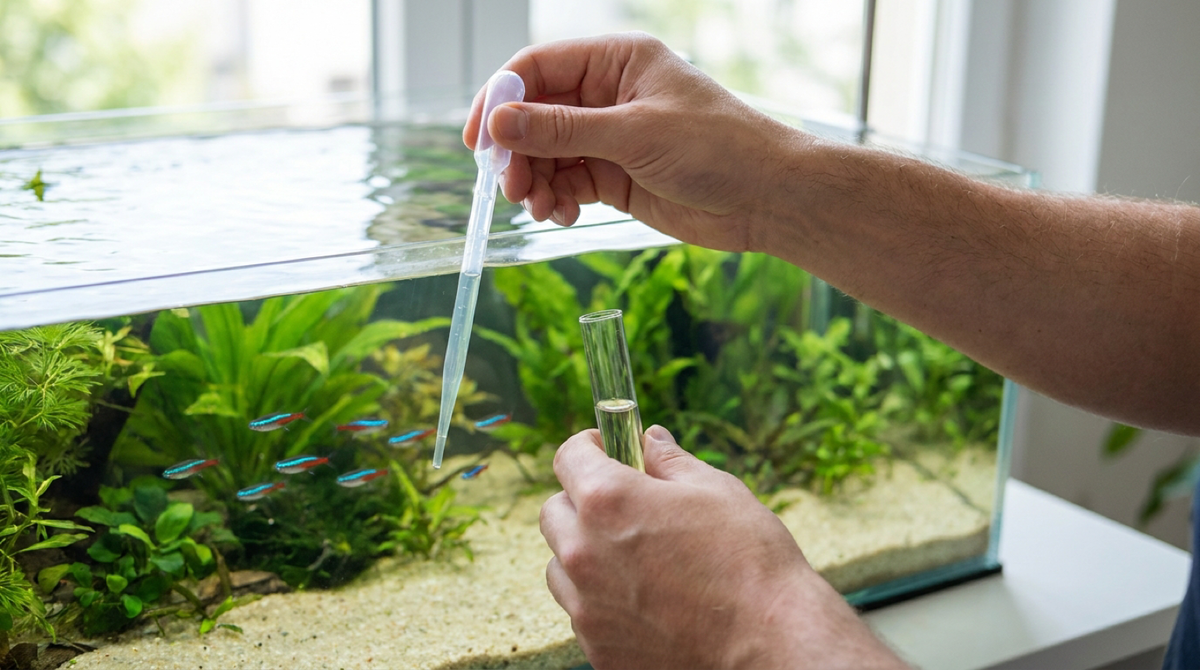
- Same spot, same time, same method. For cycling filters, SRAC recommends sampling from the same place at the same time each day with the same procedure, so the change you see is the water, not your technique (SRAC Publication 4502). The habit serves any tank.
- Follow the kit’s timing exactly. Color tests keep developing; reading early or late shifts the result.
- Test pH promptly. SRAC calls for measuring pH within 30 minutes of taking the sample to keep error down, so do pH first rather than leaving the sample standing.
- Test chlorine where you sample. The Merck manual says chlorine samples should be tested on site.
- Write down the basis and unit. TAN or free ammonia; as N or as NO2; degrees or mg/L.
- Keep the history. UF/IFAS points out that a single lab sample is a one-time snapshot with no insight into past trends, and that fish can fall sick weeks after a water problem has been fixed. Your own records fill that gap.
Turning readings into your own ranges
Sources give starting points, not one answer for every tank. From the guidance above, many keepers settle on:
- ammonia and nitrite at zero in an established tank
- a maximum nitrate they hold with regular water changes
- KH no lower than 100 mg/L as calcium carbonate for freshwater, per the Merck manual
- dissolved oxygen above 5 mg/L where they test it
- pH and temperature inside the range for the species they keep
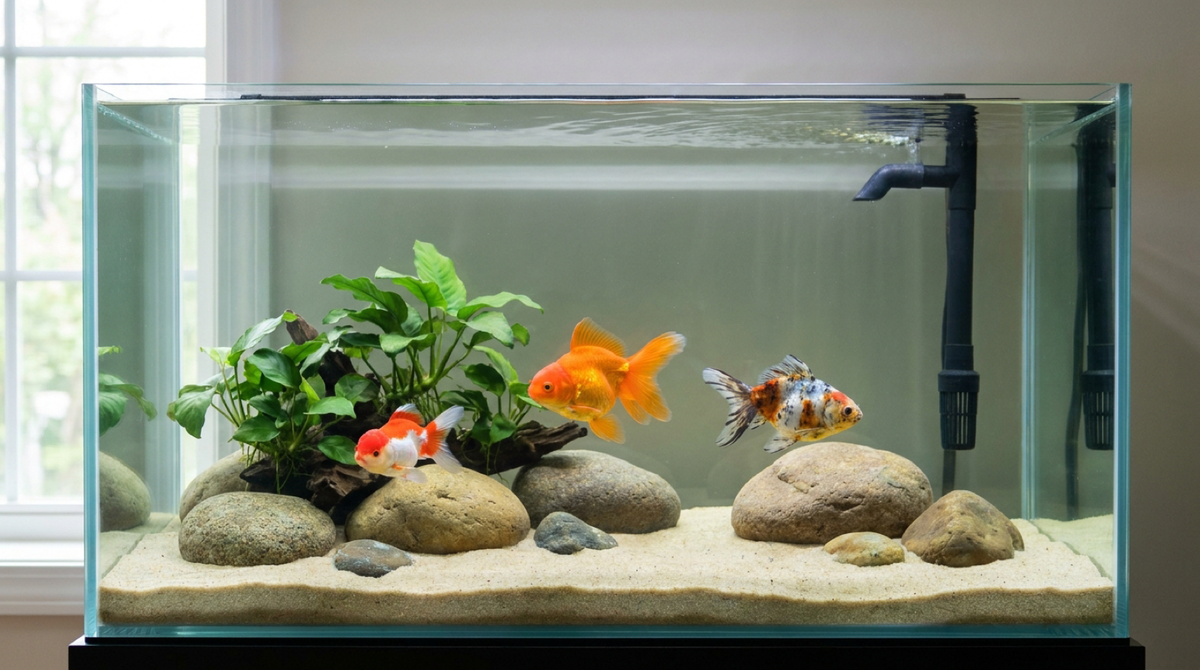
A goldfish tank and a tropical tank will not share every number, which is why the ranges should be yours. Record them where the readings live, so every new result is compared against the same line.
Keeping water test records on Creatures
On Creatures, each tank or pond is a place in Locations, records are free and unlimited, and everything runs in a browser on your phone or computer. Here is what the water records do, in the terms you will see on screen:
- Log water. Enter the time, or just the date, then each Test and Reading. Ammonia can be logged as total ammonia as N (TAN), as NH3, or as free ammonia; nitrite as NO2 or as N; nitrate as NO3 or as N. Temperature can be °F or °C. Other tests include pH, phosphate, calcium, magnesium, TDS, dissolved oxygen, alkalinity, hardness, salinity or conductivity, and copper. A “less than” result is typed as read (<0.25). Zero is a reading; a blank means not measured. Add the kit or meter, the water source and notes.
- Read the history. Current values shows the latest of each test, Water history lists every session, Filter history narrows it down, and Show trends draws a chart per test.
- Set your own ranges. Owners and co-owners can set a minimum, a maximum or both per parameter, in their unit, plus an optional stale time. Latest results then read Within your range, Below your range or Above your range, and Freshness: current or Freshness: stale. These settings never send alerts, and Creatures never sets target ranges for you.
- Correct, do not overwrite. A correction keeps the original; a test that was simply wrong can be voided.
- Share water between tanks. For a sump or central filter, one tank holds the shared water and others connect to it. A shared-water test applies to every connected tank at that time, which fits the UF/IFAS advice about testing one representative tank on a shared system.
- Import past results. Bring in a spreadsheet as CSV, or a Creatures water ZIP: map the columns, pick the tank and units, preview every row and save reviewed batches. Import never creates places or animals.
- Schedule the tests. Add a routine, then Start with a tank or pond routine, and choose the Established tank or pond starter, which includes a water test (starters are editable and never set treatments, dosing or target ranges). Tests then appear on Today, where Record test leads to Save test & complete task. Place reminders arrive in the app, and email for place care is opt in under Settings > Notifications. Care plans explains schedules in detail.
- Take it with you. Download water records gives a spreadsheet, or a ZIP when shared water is involved.
Fish themselves live in the tank too: individuals such as a show betta can be moved in with their location history kept (moving animals and location history), and fish kept by number can be a count group with tank counts (tracking animals without individual profiles). You can keep tank and water records on Creatures, or start with the water records help article to see every screen first.
Aquarium water testing FAQ
What should ammonia be in a fish tank?
Zero in an established tank. UF/IFAS treats any ammonia as a sign something is off: too much food, too many fish, or a filter that has lost capacity.
What does a nitrite reading in an established tank mean?
The bacteria that convert nitrite have fallen behind. Look for a cause: new fish, heavier feeding, a cleaned or replaced filter, a medication, or a power cut. Test daily until it is back at zero, and call a fish veterinarian if the fish show signs of distress.
Are home test kits accurate enough?
For routine keeping, yes. The Merck manual describes inexpensive test kits as easy to use and reasonably accurate. Using the same kit the same way every time matters more than chasing a perfect number.
Should I test my tap water?
Yes, before you rely on it. Check chlorine (total, to catch chloramine), ammonia, pH, KH and GH, and log them as the source water so you can tell later what came from the tap and what came from the tank.
Do ponds need different tests?
The same core tests apply, plus dissolved oxygen and closer attention to temperature through the seasons. See koi pond care by season.
Do this next on Creatures
You keep fish and want their water history in one place. Records are free; saving them needs a free account.
- Add your goldfish and move it into its tank, so its water history and its own records sit side by side. See adding an animal.
- Add a record for what is not a water test, such as a weight or a health note. This opens for visitors; a free account is needed to save it. Follow adding a record, and see health and medical records for vet visits.
- Get an alert for goldfish listings when you are ready to add fish to a stable tank.
- Browse goldfish listings and ask sellers what water the fish are kept in now.
- Explore the breeder directory to find trusted keepers near you.
- Add your breeder profile if you breed fish and want buyers to find your fish room.