

Cherry Shrimp Tank and Colony Care: Water, Breeding and Molting
Author: Elliott Garber, DVM · Published
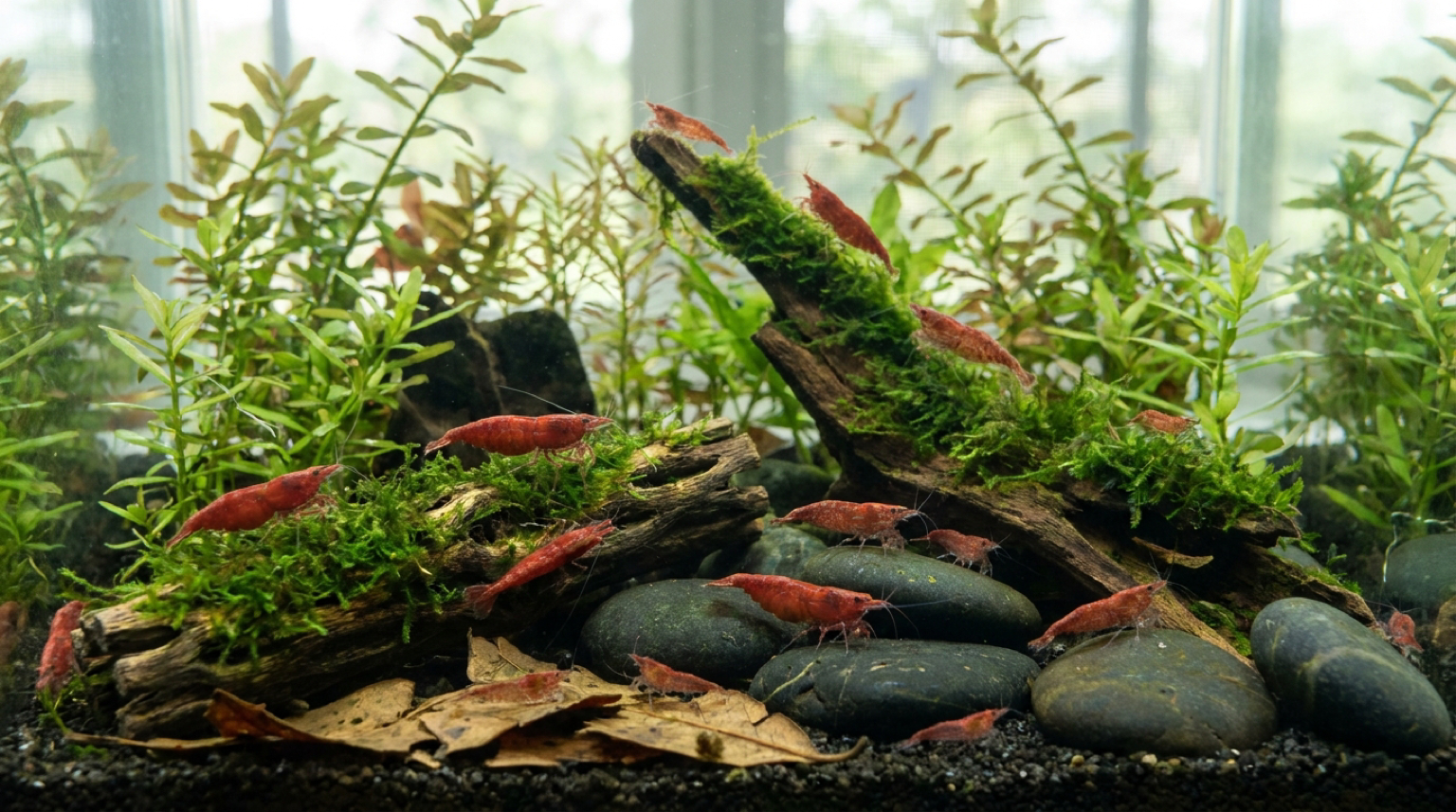
A cherry shrimp tank is a planted, fully cycled freshwater aquarium with no fish big enough to eat shrimp, a steady temperature and steady water chemistry. The shrimp themselves, Neocaridina davidi, are forgiving: captive shrimp have bred anywhere from about 14 to 30 °C and pH 6 to 8.2. In a tank like that a colony grows on its own, because each berried female carries a few dozen eggs for two to three weeks and the young hatch as tiny, complete shrimp.
This guide covers tank setup, the GH, KH, TDS, pH and temperature numbers shrimp keepers argue about (and what the research actually supports), copper, molting, the breeding cycle from saddle to shrimplet, and how to count and grow a colony. The color lines, from red cherry to blue dream, are all on the Creatures cherry shrimp page.
Shrimp keeping runs on numbers, the water’s and the colony’s, so this guide points to the tank water log in the Creatures help center wherever a test matters. When a colony falters, the readings from the week before are the first place to look.
| Species | Neocaridina davidi; cherry shrimp is the red form, and blue dream, orange sakura and the other colors are the same species |
|---|---|
| Adult size | 3 to 4 cm, with females larger than males |
| Temperature | Captive shrimp have bred from about 14 to 30 °C; females raised at 32 °C lost their eggs in a lab study |
| Water in a key lab study | pH 7.5, hardness 80 mg/L as calcium carbonate (about 4.5 dGH, moderately hard), 27 °C |
| Eggs | 43 to 60 per clutch, carried about 16 to 19 days; 12 to 21 days depending on temperature in another study |
| Young | Hatch as 1 to 2 mm miniature shrimp, with no larval stage |
| Breeding age | About one to two months |
| Never | Copper medication or copper-contaminated water, which Merck calls extremely toxic to invertebrates, or fish big enough to eat shrimp |
Setting up a cherry shrimp tank
Cycle the tank before the first shrimp goes in. The Merck Veterinary Manual notes that a new tank’s biofilter can take up to eight weeks to establish, and that animals can be added once no ammonia or nitrite is present. The sister guide on how to cycle a fish tank walks through the timeline, and the same logs work whether the first residents are fish or shrimp.
What a shrimp tank needs beyond that:
- Surfaces to graze. These shrimp spend most of their time grazing biofilm, the thin film of microbes and algae on every surface, and in the wild they feed mostly on leaf litter, according to the University of Florida’s Featured Creatures profile of the cherry shrimp. Live plants, moss on wood or stone, and a few dried leaves give them more of it, and a tank that has been running for weeks has more than a new one.
- No fish that can eat them. Newly hatched shrimp are only 1 to 2 mm long (UF/IFAS), small enough for almost any fish to eat. The surest way to grow a colony is a tank with no fish at all.
- A filter intake that cannot swallow young shrimp. A sponge filter, or a sponge over the intake of any other filter, keeps 1 to 2 mm shrimplets out of the impeller.
- A steady temperature. A heater in a shrimp tank is about holding a number, not about making the water tropical. More on what that number should be below.
In Creatures, a tank like this is a place in Locations: give it a name, Freshwater, its volume, and Established if it has already cycled or Cycling if it is still getting there. The steps are in set up and organize locations.
Cherry shrimp water parameters: what the numbers mean
Shrimp care sheets online quote tight targets for GH, KH and TDS, and they disagree with each other. The research describes a forgiving animal instead. Here is what each number measures and what the sources support.
Temperature. The U.S. Fish and Wildlife Service ecological risk screening summary for the cherry shrimp quotes a 2024 paper that summarizes captive breeding from 14 to 30 °C. Warmer water speeds everything up, but only to a point. In a 2015 lab study of red cherry shrimp by Tropea and colleagues, eggs took about 21 days to hatch at 24 °C, 15 days at 28 °C and 12 days at 32 °C, but females that grew up and mated at 32 °C all lost their eggs. The authors called about 28 °C the best temperature for growing, maturing and breeding, and also warned that it may wear shrimp out. The same FWS summary reports that among feral populations, the share of females carrying eggs was highest in water at 15 to 20 °C and lowest above 25 °C. Faster is not better: pick a steady temperature in the middle of the range and keep it there.
pH. The same 2024 paper gives breeding records from pH 6 to 8.2, and the Tropea lab kept its shrimp at 7.5. pH matters less as a number than as a sign of change: if it moves, ask why.
GH (general hardness). Hardness comes mainly from calcium and magnesium dissolved in the water, according to the U.S. Geological Survey’s hardness of water page, which classes 0 to 60 mg/L (as calcium carbonate) as soft, 61 to 120 as moderately hard, 121 to 180 as hard and more than 180 as very hard. The Tropea lab’s water was 80 mg/L, which is moderately hard and works out to about 4.5 degrees of general hardness (dGH). Shrimp keepers watch GH more closely than fish keepers do because a shrimp rebuilds its shell after every molt, and crustacean shells are hardened with minerals, calcium above all.
KH (carbonate hardness, or alkalinity). KH is the water’s buffer: the carbonate and bicarbonate that soak up acid and hold pH steady. With little KH, pH can drift between water changes. Log it alongside pH so you can see whether one follows the other.
TDS (total dissolved solids). Most TDS pens actually measure how well the water carries an electric current and convert that to a TDS figure. Dissolved salts and other inorganic chemicals conduct, so more of them means a higher reading, as the U.S. Environmental Protection Agency’s conductivity page explains. The pen gives one number for everything dissolved and cannot tell calcium from nitrate, so its real value is as a change detector: a TDS that climbs week after week between water changes says something is building up.
Nitrate, ammonia and nitrite. In a cycled tank, ammonia and nitrite should read zero, and nitrate builds up between water changes. How fast it rises depends on your stocking and feeding, which is exactly why it is worth logging: the trend tells you how often your tank needs a change. The sister guide on aquarium water testing explains kit readings and the “as N” versus “as NO3” labels that make two kits disagree.
The practical rule that falls out of all this: find the water your colony breeds in, write it down as your own range for each test, and keep new water close to it. A shrimp tank that reads the same every week is doing its job.
Copper: keep medications and contaminated water out
Copper is used to treat fish, but never around shrimp. Merck’s aquarium chapter, describing copper treatment for fish, warns that copper is extremely toxic to invertebrates and plants and that they must be taken out of the tank before the water is treated. Research on an Australian freshwater shrimp from the same family as cherry shrimp, the Atyidae, found copper acutely toxic, with free copper ions the most toxic form (Daly and colleagues, 1990).
Those warnings are about copper dissolved in the water, at treatment strength or from contamination. They are not a rule against the trace copper that animals need in their diet: a feeding trial in a farmed marine shrimp, a different species, found copper is a dietary requirement there (Davis and colleagues, 1993). These sources do not establish a safe water level for cherry shrimp, so this guide gives none.
In practice:
- Never treat a shrimp tank with a copper-based medication. If fish in another tank need one, keep that tank’s nets, buckets and water away from the shrimp.
- Read the label of any algae or snail treatment before it goes near a shrimp tank, and leave out any that lists copper as an active ingredient. If a label is unclear, ask a fish veterinarian before using it.
- If you are not sure about your source water or something you added, test for copper and log the result with the date. A clean reading on file is worth having when a colony goes downhill and you are looking for the cause.
Molting: how shrimp grow
Like all arthropods, cherry shrimp grow by shedding their exoskeleton, and they eat the old shell to take back its nutrients (UF/IFAS). So leave molts in the tank. An empty, whole, translucent shrimp shape on the moss is a normal sign of growth, not a dead shrimp. The first molt comes quickly: in a 2025 lab study, newly hatched Neocaridina mostly molted for the first time 40 to 50 hours after hatching (Adachi and colleagues).
If you start finding dead shrimp near their molts, the logs are where to look first: compare the GH, TDS and temperature from the days before with your normal readings, and note any large water change or anything new added to the tank.
Breeding cherry shrimp: saddle, berried females and shrimplets
In a stable tank the colony breeds without help, and the cycle is easy to follow once you know the stages.
- The saddle. A maturing female shows her developing ovaries through the shell as a yellow or green patch behind the head; Tropea’s lab used those visible ovaries to identify females. Keepers call it a saddle.
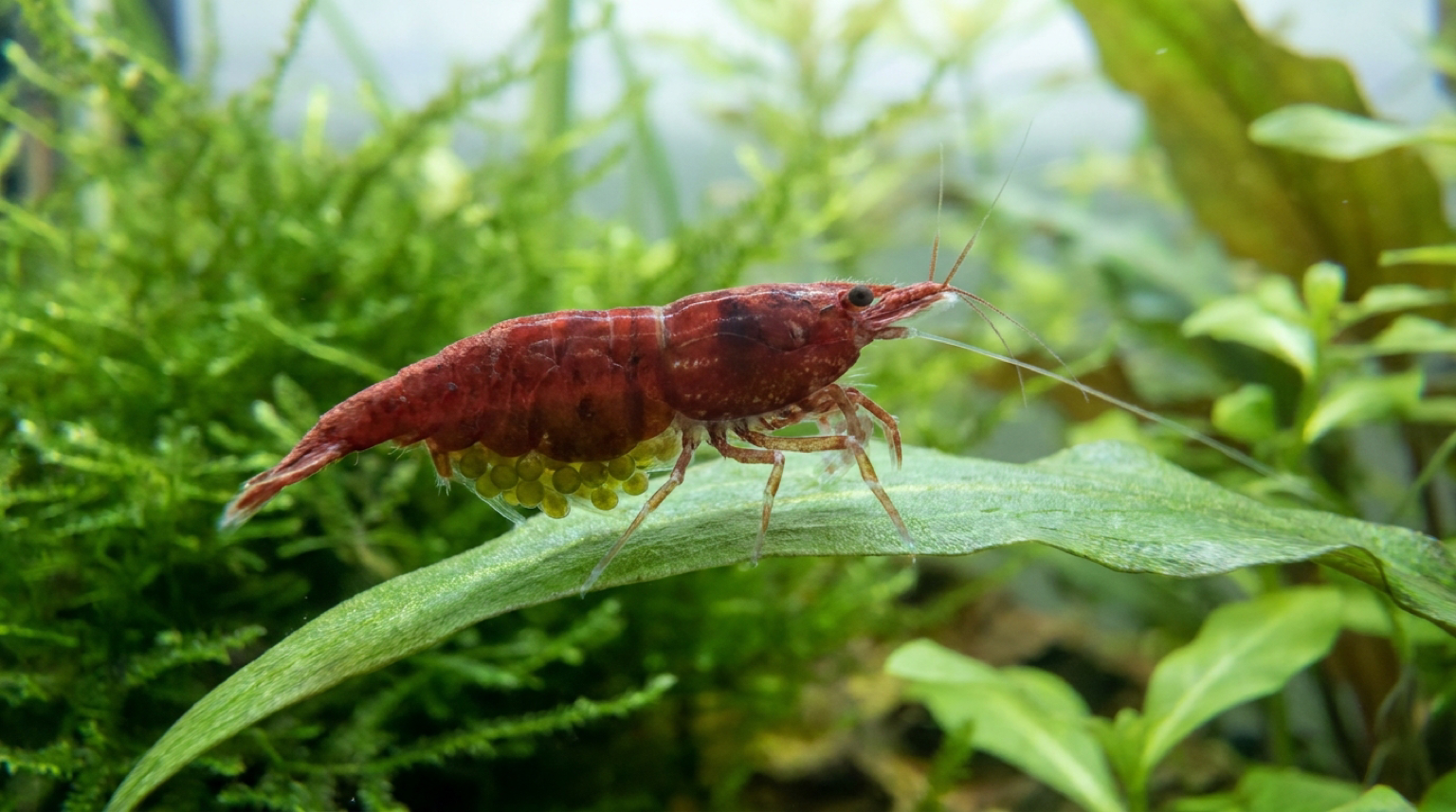
- Berried. After mating, she carries the eggs under her abdomen, where she holds them with her swimming legs and keeps them clean, which prevents fungal growth (UF/IFAS). A female carrying eggs is called berried.
- Incubation. The UF/IFAS profile gives 16 to 19 days and a clutch of 43 to 60 eggs. Temperature sets the pace: 21 days at 24 °C down to 12 at 32 °C in the Tropea study.
- Hatching. There is no larval stage. The young hatch as miniature adults about 1 to 2 mm long. Not every egg becomes a shrimplet: Tropea’s females hatched an average of about 24 young each, at every temperature tested.
- Maturity. The UF/IFAS profile puts sexual maturity at around 30 days; in the Tropea grow-out, the first berried females appeared from about day 50. Plan on one to two months.
If berried females lose their eggs, heat is one cause the research does show: every female raised and mated at 32 °C lost hers. If several females drop clutches, check the temperature log first.
Individual shrimp do not live long. A study of a wild population in Japan, quoted in the FWS summary, estimated about 10 to 13 months for males and 12 to 15 months for females. A colony stays steady because it keeps replacing itself, which is why a colony that stops producing young is worth noticing early.
How a cherry shrimp colony grows, and why to count it
A colony grows in steps: a female hatches a few dozen young, they breed within one to two months, and their young do the same. Counting is how you know whether yours is growing, holding, or quietly shrinking.
Crowding slows cherry shrimp before it kills them, at least in the lab. In a 2017 study (Vazquez and colleagues), young shrimp were raised for 90 days at 2.5, 5 or 10 shrimp per liter. Survival was high at every density, but females at 2.5 per liter ended up 45 percent heavier than those at 10 per liter, and males at the lowest density were 29 percent heavier than at the higher two. The authors put the tolerance down to the species being non-aggressive. A crowded tank shows it first as smaller shrimp.
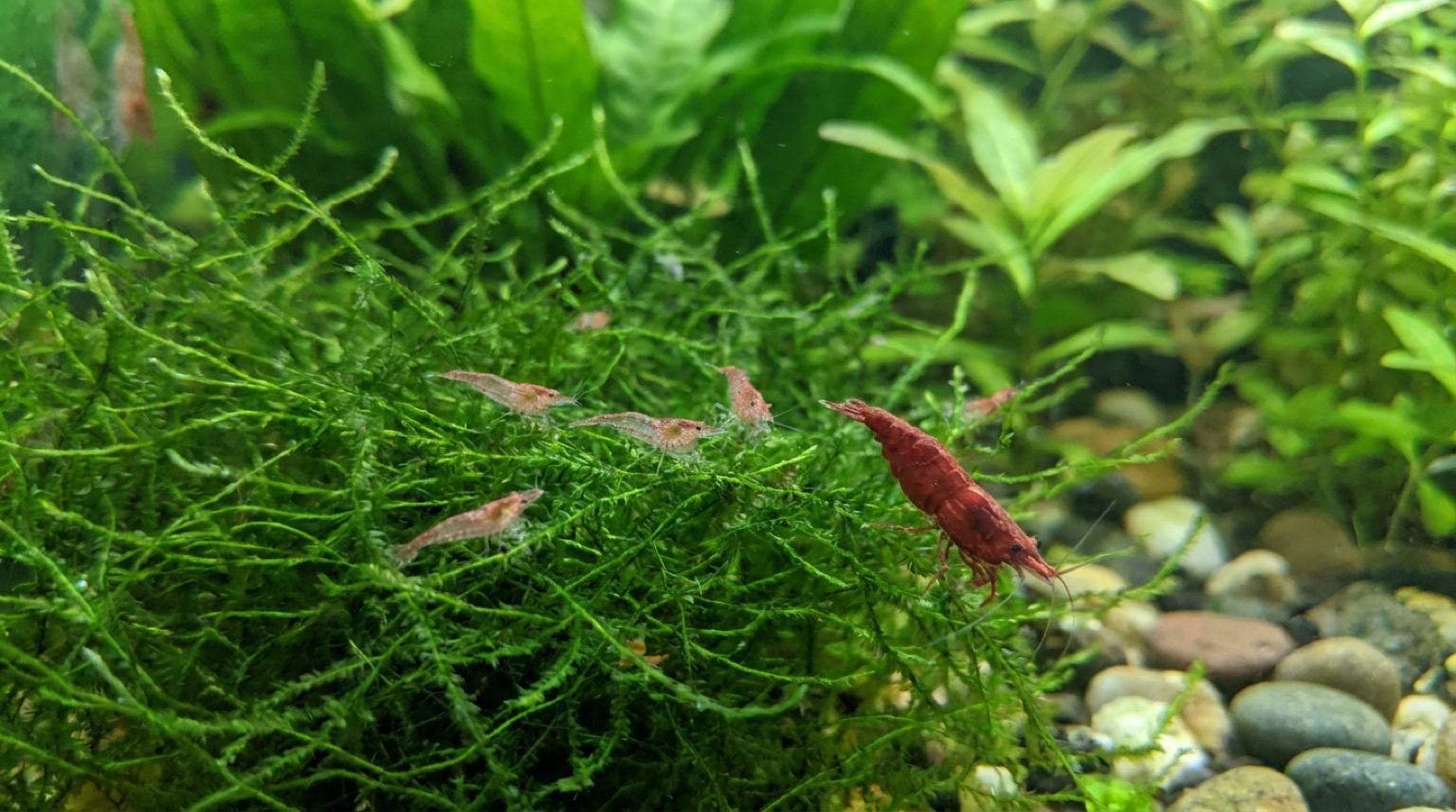
Ways to count a colony you cannot net:
- Count the same way every time. For example, count what is visible in one sweep at feeding time, and call it an estimate. A consistent estimate shows the trend even if it misses shrimp hiding in the moss.
- Count berried females separately. They are the colony’s pipeline. A month with none is worth a look at the logs.
- Recount after every change. Moving shrimp to a second tank, selling some, or finding losses all change the number; record it then rather than reconstructing it later.
Keep color lines in their own tanks. Wild cherry shrimp are transparent or greenish brown, and the bright colors come from generations of selective breeding (UF/IFAS), so keepers who want a line to stay true give it its own tank and do not mix colors. Note which tank holds which line.
When the colony outgrows the tank, sell, trade or give the surplus to another keeper or an aquarium club. Never release shrimp outdoors. The FWS summary rates the species high risk for the United States: it is established outside its native East Asian range in Hawaii, Canada, Japan and several European countries, often in thermally warmed waters, with some evidence that it displaces native shrimp.
Keeping a shrimp colony on Creatures
A shrimp colony suits Creatures’ tank records well: you rarely know an exact count, you care about water trends more than single readings, and the shrimp you sell come out of one particular tank. All of it is free, in a browser on your phone or computer.
- Log the water. On the tank’s page, Log water and add each Test and Reading: Hardness · dGH for GH, Alkalinity · dKH for KH, TDS, nitrate, pH, temperature, and copper when you check it. Type a “less than” result as it reads (<0.25); zero is a reading, and a blank means you did not test. Show trends charts each test over time, and you can bring in old logs from a spreadsheet with Import water records. The full walkthrough is in track water quality in a tank or pond.
- Set your own ranges. For each test, enter your own minimum, maximum or both, in your unit, plus an optional stale time. Each latest result then reads Within your range, Below your range or Above your range, with Freshness: current or Freshness: stale. Creatures never sets target ranges for you, and ranges never send alerts; they label what you logged.
- Schedule the tests. Add a routine, then Start with a tank or pond routine, and pick the Established tank or pond starter, an editable list that includes a water test. The test shows up on Today, and Record test then Save test & complete task logs it. See care plans.
- Record the colony. Under Aquatic observations, choose Record a spawn, drop or colony and pick Living colony. Add a count and mark it Estimated when it is one (a colony takes a number or a blank, not 0). Under Source and parents (optional), note where the shrimp came from and record the line with a trade strain and the line type Color form. You can link up to five water tests from the seven days through the observed date, such as the week the first berried females showed up. Saving creates the colony’s group, with your number as the tank’s first count.
- Keep the counts by tank. From the colony’s page, Count a tank replaces one tank’s number with a fresh count (count Not in a tank or pond too, for any shrimp held elsewhere), and Move some to another tank splits part of the colony into a second tank while it stays one group. Count groups in general are covered in track animals without individual profiles; its Turn on tank counts step is only for an older group you started outside a colony record.
- Sell from a counted tank. Once every tank is counted, an invoice for the group asks which tank or pond the shrimp come from, and only that tank’s count changes when it is paid. Listing is free; completed marketplace sales carry the service fees on the Creatures pricing page.
- Print the records. From the colony’s page, download its records as a ZIP (or all of your aquatic records from Aquatic observations) and print an owner, buyer or club view. Estimated and stale counts keep that wording on paper, so a buyer or club sees exactly how sure you were.
If you are starting from scratch, you can keep your aquarium log and shrimp tank records on Creatures, or read how tank water records work first. Livebearer keepers use the same tank records for each brood; the sister guide on guppy breeding and fry care shows how a drop is recorded.
Frequently asked questions
How long are cherry shrimp berried?
About 16 to 19 days, according to the UF/IFAS profile. Temperature changes it: about 21 days at 24 °C and 12 at 32 °C in one lab study.
How many babies do cherry shrimp have?
A clutch is 43 to 60 eggs (UF/IFAS). Fewer hatch: females in the Tropea lab study hatched about 24 young each on average.
How fast do cherry shrimp breed?
Young shrimp can breed at about one to two months old, and their young follow at the same pace, so a stable colony keeps growing until the tank limits it.
What GH, KH and TDS do cherry shrimp need?
No single number. Captive shrimp have bred from pH 6 to 8.2, and a key lab study used moderately hard water (80 mg/L as calcium carbonate, about 4.5 dGH) at pH 7.5. Find what your colony breeds in, log it, set it as your own range, and keep it steady.
Can cherry shrimp live with fish?
Not with any fish big enough to eat them. Newly hatched shrimp are 1 to 2 mm long, so a breeding colony does best with no fish at all.
Will different colors of Neocaridina interbreed?
Yes. Red cherry, blue dream, orange sakura and the other colors are all the same species, Neocaridina davidi. Keep each line in its own tank if you want it to stay that color.
Is copper safe for shrimp?
Keep copper medications and copper-contaminated water out of a shrimp tank. Merck calls copper extremely toxic to invertebrates at treatment strength, so keep treated water and equipment away too. Trace copper in ordinary foods is a different matter; the sources cited here do not establish a safe dissolved-copper level for cherry shrimp.
Do this next on Creatures
Whether your colony is ten shrimp in a nano tank or a rack of color lines, Creatures keeps the water logs, the counts and each tank’s history in one place.
Start with your shrimp. Add your cherry shrimp, no account needed to start, or keep the colony by number as a count group. The walkthrough is in adding an animal to Creatures, and the tank water log is covered in track water quality in a tank or pond.
Log a record. Add a record to an animal or group, such as a health note. The record sheet opens for any visitor, and a free account saves what you enter. See adding a record.
Show your shrimp room. Create your shrimpery’s profile, no account needed to start, then get listed in the breeder directory so keepers looking for your color lines can find you.
Looking for a new line? Cherry shrimp listings on Creatures are few right now, so the easiest way to catch one is to set a free cherry shrimp listing alert; we will email you when new shrimp are listed. No account needed to start. See saving searches and using your watchlist.
Browse and compare. Check the current cherry shrimp listings on the marketplace and look up breeders in the Creatures breeder directory.
Keep learning. Compare color lines such as fire red on the Creatures cherry shrimp page, and read the sister guides on aquarium water testing and cycling a new tank.