Axolotl Tank Setup: Tank Size, Temperature and Water Parameters
Author: Elliott Garber, DVM · Published
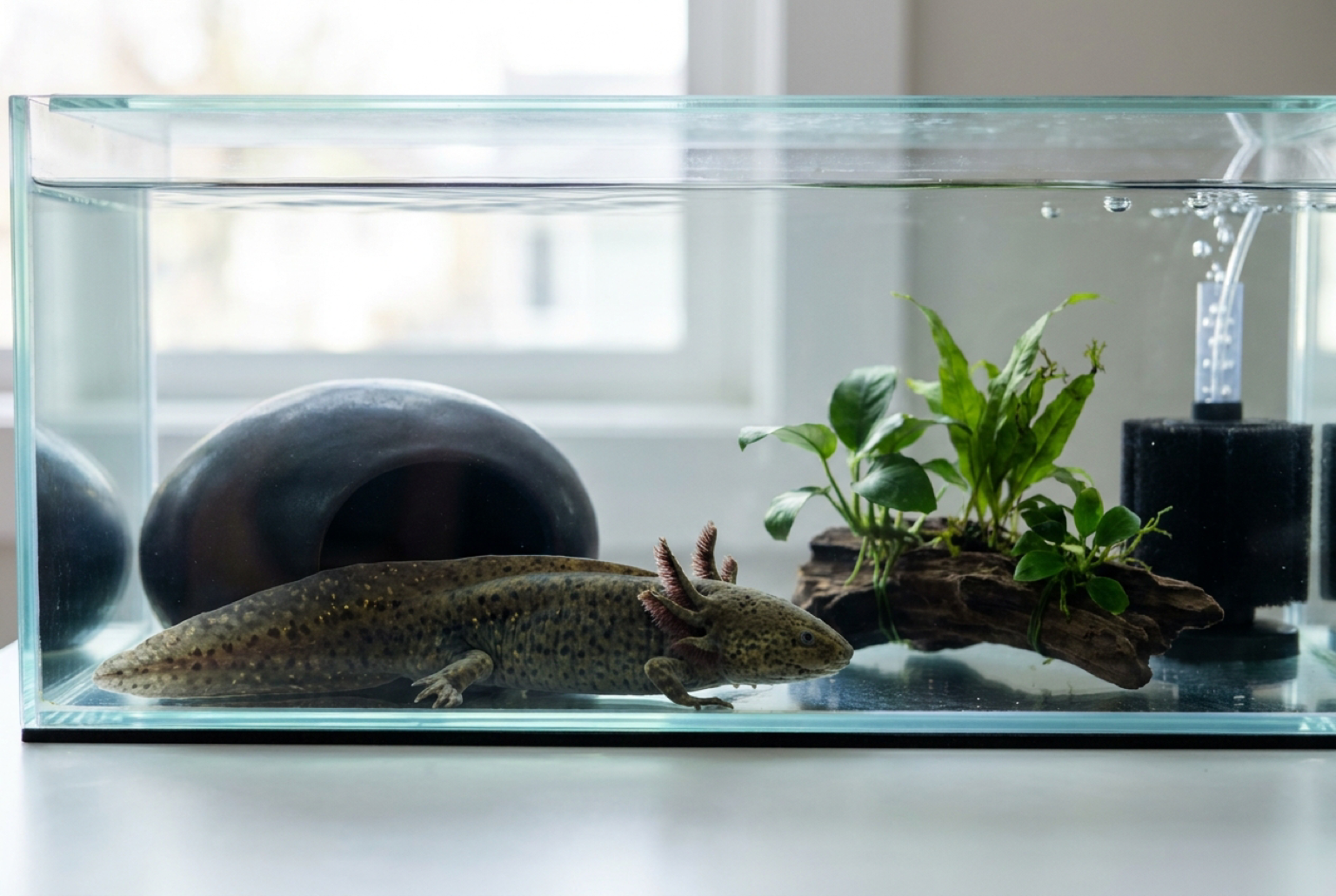
An axolotl tank setup is a cool, fully cycled freshwater aquarium of about 20 US gallons (78 liters) or more for one adult, with a bare floor or fine sand, gentle filtration, a lid and no fish. Keep the water at about 16 to 18 °C (61 to 64 °F) and never above about 22 °C (72 °F), with zero ammonia, zero nitrite, low nitrate and a pH near neutral, roughly 7.0 to 7.6.
Those figures come from the Ambystoma Genetic Stock Center at the University of Kentucky, which breeds the laboratory axolotls used in research and teaching, and from veterinary references linked below. The habit that keeps them true is writing every reading down. A tank on Creatures holds each water test with its date, charts every test over time and lets you set your own ranges; the Track water quality in a tank or pond guide shows the whole flow.
If the axolotl is already home or on its way, start its profile now (no account needed to start) and move it into the tank once the water tests clean. The axolotl species page collects every Creatures guide to the animal.
| Tank size | About 20 US gallons (78 L) or more for one adult; a long, low tank beats a tall one |
|---|---|
| Temperature | 16 to 18 °C (61 to 64 °F); never above about 22 °C (72 °F); no heater |
| pH | About 7.0 to 7.6; 6.5 to 8 is the wider range one stock center guide accepts |
| Ammonia and nitrite | Zero |
| Nitrate | Low; one veterinary sheet prefers under 10 ppm |
| Water | Not distilled or very soft; chlorine and chloramine removed |
| Floor and flow | Bare glass or fine sand, never gravel or pebbles; gentle filter; secure lid |
| Routine | Daily tests while cycling, weekly once established; at least 10 percent of the water changed weekly |
Axolotl tank size
Plan on about 20 US gallons (roughly 78 liters) or more for one adult axolotl. That is the figure in the veterinary-reviewed LafeberVet axolotl information sheet, which lists 10 gallons (38 liters) for a juvenile and 20 gallons or more for a mature adult, and adds that bigger is better.
Research colonies run smaller. The stock center’s 2024 laboratory guide says that, ideally, no more than two adults should share a 10 gallon tank, and its older axolotl husbandry guide gives the same rule of thumb. Those animals have trained staff changing water and checking chemistry on a schedule. A home tank tested once a week has less margin, and more water dilutes waste between changes, so the larger figure is the safer plan for a pet.
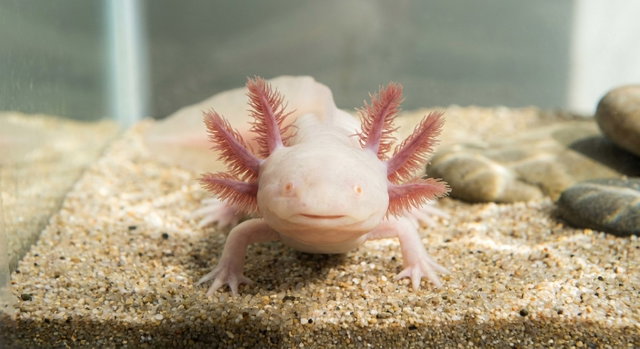
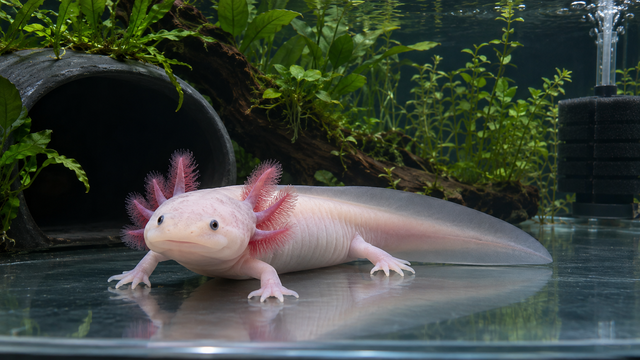
Shape matters as much as gallons. The husbandry guide notes that axolotls spend most of their time lying nearly still on the bottom, so floor area is the space they actually use. A long, low tank gives an adult room to walk and turn; a tall tank of the same volume mostly adds water above its head. One adult per tank is the simplest plan. LafeberVet says adults can share if they have plenty of space; if two do share, give them more floor and a hide each rather than fitting them into a minimum tank.
Young axolotls need different housing. The husbandry guide describes larvae as aggressive and cannibalistic toward each other, and a 2023 guide to establishing a research axolotl colony, written with stock center staff, warns that the largest juveniles nip the limbs and tails of smaller siblings. Keep young animals sorted by size or apart until they are grown.
Axolotl tank temperature
Axolotls are cold-water animals, so warm water is the problem to plan for. The husbandry guide keeps its animals at 15 to 18 °C (60 to 65 °F) and says they should never be kept above about 22 °C (72 °F) or anywhere they get direct sun. The 2023 colony guide calls 16 to 18 °C ideal and links water that stays above 18 °C with a higher risk of a swollen body cavity. The Merck Veterinary Manual’s laboratory animal temperature table runs a little warmer, at 18 to 20 °C (64 to 68 °F), so treat 16 to 18 °C as the target and the low 20s as the ceiling.
An axolotl tank does not need a heater. Most homes run warmer than 18 °C for part of the year, so the real question is how you will keep the water down in summer. Watch the water temperature through a warm spell before you trust a room, keep the tank out of direct sun and away from radiators and heat-producing equipment, and decide on a cooling plan (a cooler room, a fan across the surface or an aquarium chiller) before the water reaches the low 20s rather than after.
Axolotl water parameters
Test these, and keep every result with its date:
- Ammonia: zero. In a healthy tank ammonia should always read zero, according to the University of Florida IFAS fact sheet Ammonia in Aquatic Systems; any reading means waste is outpacing the filter. Most hobby kits measure total ammonia, and the toxic un-ionized share rises with warmer water and higher pH, one more reason to keep an axolotl tank cool and near neutral.
- Nitrite: zero. The 2023 colony guide sets the target for both ammonia and nitrite at zero.
- Nitrate: low. Filter bacteria turn nitrite into nitrate, which is much less toxic but builds up between water changes. The LafeberVet sheet prefers under 10 ppm. Note whether your kit reports nitrate as nitrate (NO3) or as nitrate-nitrogen (N), because the same water reads differently on each.
- pH: about 7.0 to 7.6. The stock center buffers its rearing water to 7.1 to 7.6, and the colony guide calls 7.0 to 7.5 acceptable. The older husbandry guide accepts 6.5 to 8 but warns that ammonia is more toxic at the high end, so test ammonia more carefully if your pH runs high.
- Hardness: not soft. The husbandry guide says never to house axolotls in extremely soft or distilled water, because hard water helps keep their skin, their main defense against infection, intact. The Merck Veterinary Manual’s amphibian housing page also rules out distilled water. If you use a conductivity meter, the colony guide reports that axolotls do well anywhere from 500 to 2,300 µS/cm.
- Chlorine and chloramine: none. The 2024 stock center guide calls the chlorine, chloramine and ammonia added to municipal water toxic to axolotls, and both of its guides say to remove them before the water reaches the tank. Use a conditioner that handles chloramine and follow its label.
- Temperature: read it every time you test the rest, because warm water changes how toxic any ammonia is.
Merck’s amphibian page recommends testing aquatic setups weekly for temperature, pH, hardness, ammonia, nitrite and nitrate. The IFAS fact sheet, written for fish keepers, adds two habits worth copying: keep records of every test, and test more often whenever ammonia shows up until the problem is fixed. The full method for each test, and what the kit units mean, is in our aquarium water testing guide.
Cycle the tank before the axolotl moves in
A new filter has almost no bacteria to process waste. Nitrifying bacteria turn ammonia into nitrite and then nitrite into nitrate, and the IFAS fact sheet says a new biofilter takes six to eight weeks to build up enough of them to keep ammonia and nitrite down. Until it does, both can climb with nothing to remove them. The colony guide says to monitor ammonia daily while a new system’s bacteria are getting established.
Our guide to how to cycle a fish tank walks through cycling an empty tank step by step; the chemistry is the same for axolotls. You know the filter is doing its job when ammonia and nitrite fall back to zero and nitrate starts to show. Fill, condition and cool the tank before you buy, so the six to eight weeks run while you are still choosing an animal. Check your state and local rules at the same time, because some places restrict keeping axolotls.
Floor, filter, lid and hides
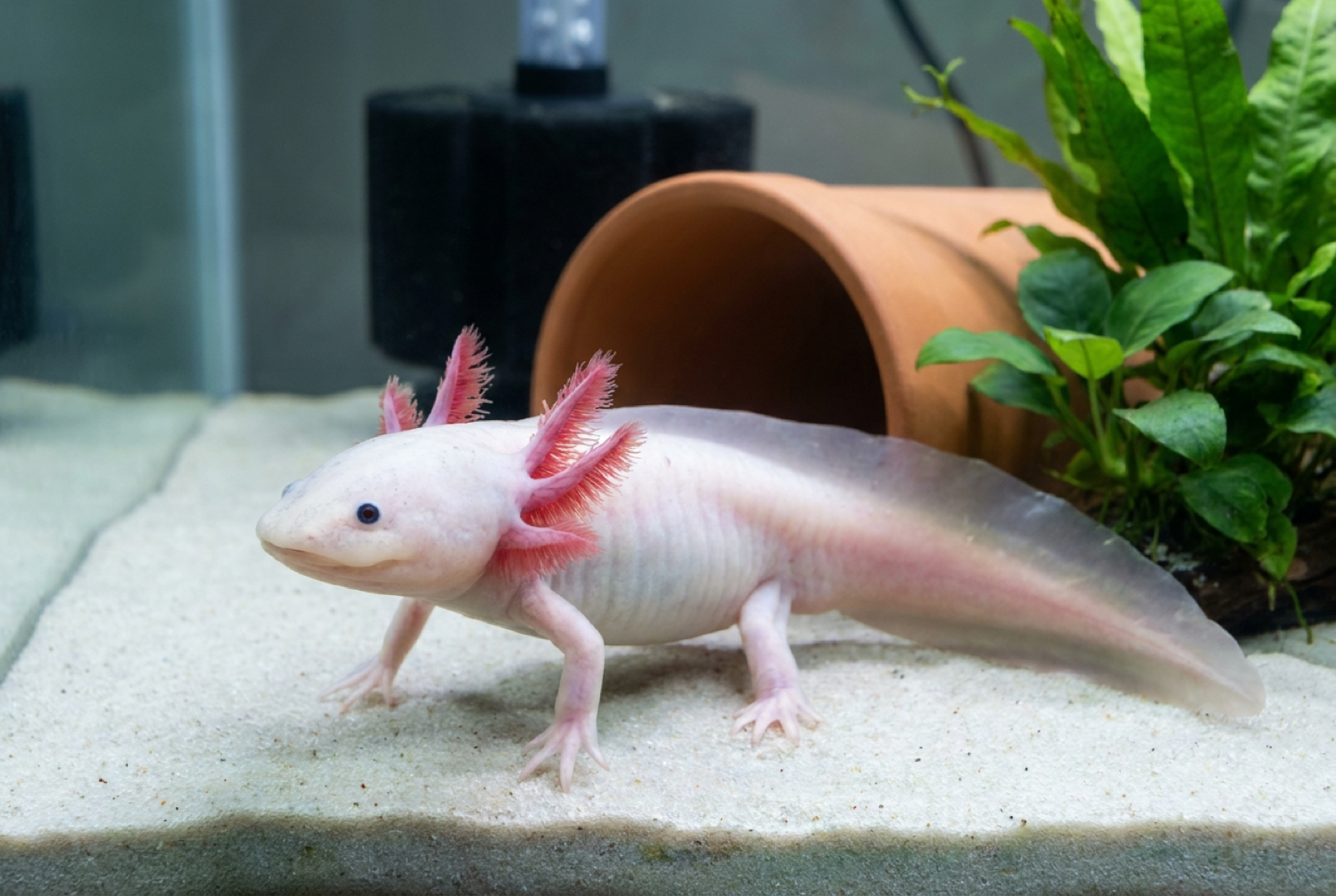
Floor. The 2024 stock center guide discourages any substrate because axolotls swallow small rocks and gravel while feeding, and the older husbandry guide singles out pea-sized gravel. A bare glass floor follows that advice exactly and is the easiest to keep clean. Merck says any gravel should be too large to swallow or small enough to pass through the gut, and LafeberVet recommends fine sand. If you want a softer floor, use a thin layer of fine sand. Never use gravel or pebbles.
Filter and flow. The colony guide says axolotls are sensitive to strong water flow, and the husbandry guide calls rapidly circulating water stressful. A sponge filter, or a filter whose outflow is spread out and slowed, gives biological filtration without blasting the gills.
Lid. Axolotls of all sizes can jump out of a tank and dry out if nobody finds them in time, the colony guide warns. Merck’s housing page says aquariums should have secure, ventilated tops.
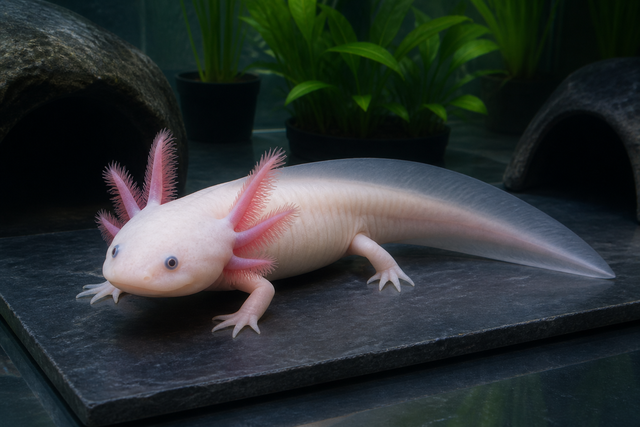
Hides, plants and light. Give each axolotl a smooth cave or tunnel it fits inside. Merck notes that aquatic plants add oxygen, remove waste and provide shelter. No special lighting is needed; LafeberVet says too much light can stress axolotls, and the husbandry guide says to keep the tank out of direct sun.
No tankmates. LafeberVet recommends a species-only tank: small fish can be eaten, and larger or aggressive fish can damage the external gills.
No soap. The colony guide says soap and detergents should never touch axolotl equipment because they are toxic to the animals. Clean with water and a scrubber kept for the tank.
Water changes and a weekly routine
Once the tank is cycled, a simple week covers it:
- Remove uneaten food and waste as soon as you see them. The colony guide names waste and decomposing food as the sources of ammonia.
- Test the water weekly: temperature, pH, ammonia, nitrite and nitrate, plus hardness if your kit has it.
- Change at least 10 percent of the water each week. That is the minimum in the 2024 stock center guide for filtered aquaria and in Merck’s housing page; LafeberVet suggests about 30 percent. Let the nitrate trend decide where in that band you sit.
- Treat and temper the new water first. Remove chlorine and chloramine and bring it close to the tank’s temperature, because sudden changes in the water distress axolotls, the colony guide notes.
- Read the temperature daily in hot weather.
- Test again soon after any surprise. If ammonia or nitrite reads above zero, test more often until both are back to zero, as the IFAS fact sheet advises.
Set up your axolotl tank on Creatures
Everything above is easier to follow when the numbers are in one place, so here is how the tank, its tests and the axolotl fit together on Creatures. Records are free and unlimited, and it runs in a browser on your phone or computer. You can keep tank and water records on Creatures, and the water records guide shows each screen.
- Create the tank. In Locations, add a place of kind Tank. Give it a name and, if you like, choose Freshwater, pick how it is being used (Cycling while the filter matures, Established once it holds steady) and enter the volume in US gallons, liters or Imperial gallons. The new tank’s page offers Log water, Add a routine and Add an animal; all three are optional. Set up and organize locations covers places in general.
- Log water. Select Log water, choose the time or just the date, then add each Test and its Reading: water temperature in °C or °F, pH, ammonia (pick the basis your kit reports, such as total ammonia as N), nitrite, nitrate and hardness. Type a “less than” result as it reads, like <0.25. Zero is a reading; a blank means you did not measure it. Add the kit or meter you used, so a change of kit does not look like a change in the water.
- Set your own ranges. Owners can enter a minimum, a maximum or both for each test in their own unit (for example 16 to 18 °C), plus an optional stale time. The latest result then shows Within your range, Below your range or Above your range, and Freshness: current or stale. Creatures never sets target ranges for you, and these settings never send alerts, so the figures in this guide are yours to adopt or adjust.
- Add a routine. Choose Add a routine, then Start with a tank or pond routine, and pick a Routine starter: Cycling: observe and test while the tank cycles, then Established tank or pond. Both include a water test, and you set how often the tasks repeat. On Today, Record test opens the form with the plan’s tests listed, and Save test & complete task saves the readings and checks the task off. Starters are lists you can edit; they never set treatments, dosing or target ranges. See care plans.
- Watch the trend. Current values shows the latest reading for each test, and Show trends charts one test over time. During cycling that chart is how you see the filter mature: ammonia rising and falling back to zero, nitrite following it, nitrate appearing. Download water records saves a spreadsheet you can hand to a vet.
- Move the axolotl in. When the tank tests clean, move your axolotl’s profile into it with the Move sheet. Its location history keeps which tank it lived in and when; see move animals and review location history. Still choosing a name? Try the free axolotl name generator before you create the profile.
If you already kept readings in a spreadsheet, Import water records brings in a CSV: you map the columns, pick the tank and units, and preview every row before saving.
Signs the tank needs attention
The colony guide names stress and poor water quality as the chief drivers of disease in axolotls. It lists what an ill or stressed axolotl tends to do: float at the surface, refuse food, shed skin or curl its tail. The gill branches may turn paler and smaller, and the animal itself may pale (except dark wild types).
If you see any of that, test the water at once (temperature, ammonia, nitrite, nitrate and pH) and write down what you saw with the date. Then contact a veterinarian who treats amphibians, and bring the water history. Do not add medication on a guess. The health and medical records guide shows how to keep the vet’s findings on the axolotl’s profile.
Common questions
Do axolotls need a heater?
No. They do best at about 16 to 18 °C (61 to 64 °F), cooler than most homes, so plan for keeping the water down rather than up.
Can axolotls live with fish?
No. A species-only tank is the veterinary recommendation: small fish get eaten, and larger fish can damage the gills.
Is a 10 gallon tank big enough for an axolotl?
For a juvenile, LafeberVet says 10 gallons works. For an adult, plan on 20 gallons or more. The stock center’s two-adults-per-10-gallons rule is for a research setting with frequent water changes.
Can I use sand in an axolotl tank?
Fine sand, yes; gravel and pebbles, no. A bare floor is the simplest option and matches the stock center’s advice.
How often should I test axolotl water?
Daily for ammonia and nitrite while the tank cycles, weekly once it is established, and more often after any reading above zero.
Does an axolotl’s color change its care?
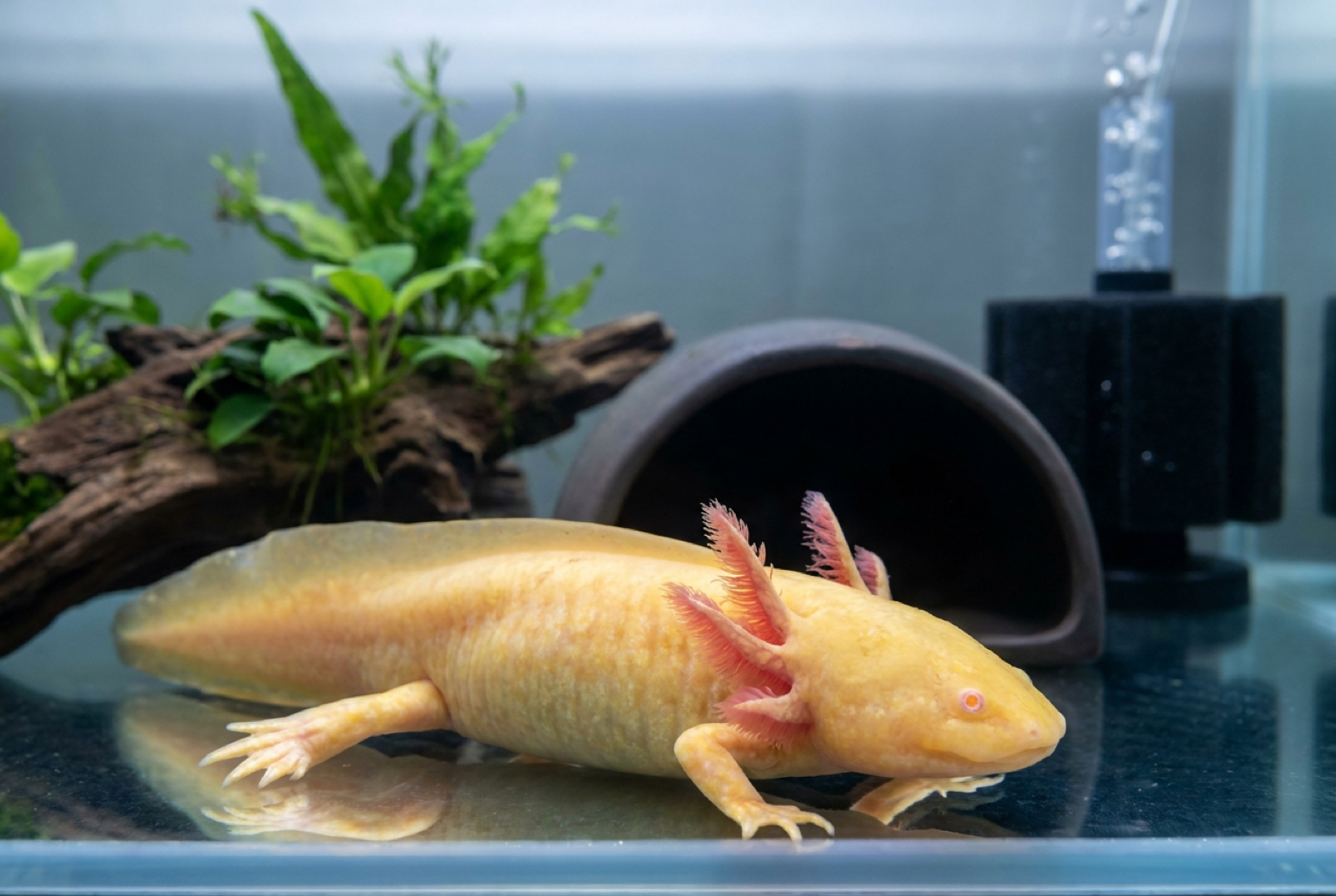
No. Wild type, axanthic, white albino and every other morph in the axolotl colors guide need the same cool, clean water. Budget the tank before the animal with the axolotl cost guide, and see the axolotl lifespan guide for how long the commitment runs.
Do this next on Creatures
Setting up a first axolotl tank, or bringing an existing one’s records together:
- Add your axolotl with its photo, color label and where it came from. You can start without an account; see adding an animal to Creatures.
- Keep tank and water records on Creatures: log water tests, set your own ranges and add a routine. The water records guide walks through it.
- Add a record for a weight, a feeding note or a vet visit. The sheet opens for visitors, and a free account saves what you enter; see adding a record.
- Still looking for an axolotl? Set a free axolotl listing alert and hear when one is listed, no account needed to start. An alert does not promise current stock; see saving searches and using your watchlist.
- Browse axolotls on the Creatures marketplace and ask each seller about the water the animal lives in now.
- Find keepers and breeders in the Creatures breeder directory, the trusted place to start asking questions.
- Breed axolotls? Create a free breeder profile so buyers can find you, no account needed to start.