Koi Pond Care by Season: Water Quality, Feeding and Maintenance All Year
Author: Elliott Garber, DVM · Published
Koi pond care follows the water temperature. Koi are temperate fish, an ornamental form of the common carp, and they do best at about 65 to 75 °F (18 to 24 °C). As the pond warms in spring, feeding, filtration and testing ramp up; summer is about oxygen; fall is about winding down without fouling the water; and winter is about keeping part of the surface open and leaving the fish alone. Through every season koi need the same three things: dissolved oxygen of at least 5 mg/L, ammonia and nitrite at or near zero, and a pond that is not overcrowded.
Because so much hangs on temperature and oxygen, the most useful koi records are a running log of water temperature, dissolved oxygen, ammonia, nitrite and pH, kept for each pond. You can track water quality in a tank or pond on Creatures and chart every reading through the year. This guide goes season by season, then sets out which tests to log and when.
| Best temperature | About 65 to 75 °F (18 to 24 °C) |
|---|---|
| Survival range | About 32 to 95 °F (0 to 35 °C) when the change is gradual |
| Dissolved oxygen | At least 5 mg/L; lowest around dawn in summer |
| Ammonia and nitrite | Free ammonia and nitrite below 0.05 mg/L; total ammonia ideally 0 |
| pH | As close to 7 as practical; koi tolerate about 5 to 9 |
| Depth | Sections 3 to 5 feet deep for winter and summer refuge |
| Stocking | Plan by adult weight, not the size you buy |
| New koi | Quarantine at least 30 days at about 75 °F (24 °C) |
Koi pond basics that shape every season
The temperature, oxygen, ammonia, nitrite and pH figures above come from the Southern Regional Aquaculture Center’s species profile of koi and goldfish (SRAC Publication 7201), which also notes that temperatures outside the best range can suppress the immune system and reduce feeding and growth. Koi are long-lived and large: SRAC records common carp living at least 50 years and growing past 4 feet.
That size is why stocking is the decision that shapes every season. Texas A&M AgriLife Extension calls overstocking the most common mistake pond owners make, and suggests a very basic limit of 1 pound of adult fish per 100 gallons (Ornamental Ponds and Water Gardens in Texas). Its worked example of a 400 gallon pond with a biofilter, a waterfall and a diffuser supports about 8 pounds of adult fish, which it equates to 2 adult koi, because koi in small ponds commonly reach 4 to 5 pounds and can pass 25. Overstocking leads to algae blooms, disease and oxygen crashes, which is the same list of problems this guide spends four seasons avoiding.
Depth matters too. According to the same Texas A&M manual, most ornamental ponds are 18 to 24 inches deep but should have sections 3 to 5 feet deep to resist winter freezes and give fish a cool retreat in summer. It also warns that ponds directly under trees collect leaves that foul the water and clog filters. A koi pond also runs the same nitrogen cycle as an aquarium, so a new pond’s filter needs time to mature before it carries a full load; how to cycle a fish tank explains the process.
Spring: waking up the pond
Spring is one of the two risky swings of the year. Water temperature rises and falls with the weather while filter bacteria and algae are still catching up. SRAC reports that high nitrite in ponds occurs more often in spring and fall, when fluctuating temperatures disrupt the nitrogen cycle (SRAC Publication 462), and that ammonia tends to build through fall and winter as cold water slows nitrifying bacteria (SRAC Publication 463).
- Test before you feed. Check ammonia, nitrite and pH as the pond warms, weekly at least, and more often once anything shows.
- Restart feeding gradually. Fish should finish their food within about 5 minutes; food still left after 10 to 15 minutes means you are overfeeding (Texas A&M), so net it out and offer less next time. If koi do not feed readily, the water may still be too cold for them, or they may be stressed or sick.
- Clean up and check the equipment. Lift out debris that settled over winter and confirm pumps, filters and aeration are running.
- Watch for disease as the water warms. Most fish diseases follow seasonal changes in water temperature, according to Texas A&M. SRAC lists two viral diseases of particular concern: koi herpesvirus (KHV), seen most often at 64 to 81 °F (18 to 27 °C), and spring viremia of carp (SVC), more common at 41 to 64 °F (5 to 18 °C). Both are highly contagious, and their signs can be caused by other problems, so only a laboratory can confirm them. Lethargy, gasping at the surface or unusual swimming is a reason to test the water and call a fish veterinarian; the American Association of Fish Veterinarians keeps a find a fish vet map.
- Quarantine every new koi. The Merck Veterinary Manual recommends quarantining koi for at least 30 days at 24 °C (75 °F) (Management of Aquarium Fish), and Texas A&M advises a separate tank with its own water and equipment.
- Expect spawning. SRAC notes that koi usually spawn in spring as the water approaches 68 °F (20 °C), scattering sticky eggs on plants near the edge, and that adults eat the eggs.
Summer: oxygen sets the limit
Warm water holds less oxygen, and koi use more of it as they eat and grow. In a pond, plants and algae add oxygen by day and use it at night, so dissolved oxygen is usually lowest around dawn; the Merck manual notes that low oxygen in outdoor ponds is most common early in the morning (Environmental Diseases of Aquatic Animals). Merck puts the optimal level for most fish above 5 mg/L, and Texas A&M says fish become severely stressed below 3 ppm and begin to die at 2 ppm.
- Test dissolved oxygen at dawn in hot spells. That is the low point of the day. Note the time with the reading.
- Treat surface gulping as an emergency. Texas A&M names fish gulping at the surface as a sign of oxygen depletion and increased aeration as the best response. Fountains, waterfalls and air diffusers all help.
- Feed less in the heat. The Texas A&M manual advises feeding sparingly above 85 °F and, in hot months, feeding in the early to mid-morning before the water heats up, because warm water plus heavy feeding can lead to oxygen depletion.
- Keep algae in check at the source. Free-floating algae turn the water green, hide the fish and can cause local oxygen crashes. Blooms are controlled, per Texas A&M, by avoiding overstocking, overfeeding and over-fertilizing plants, adding plants or biofiltration, or flushing with fresh water.
- Check pH in the afternoon now and then. Intense photosynthesis can push pond pH above 9, especially in poorly buffered or very soft water (SRAC Publication 464). At high pH, more of any ammonia present is in its toxic free form; the aquarium water testing guide shows how sharply that share rises.
- Dechlorinate top-ups. Evaporation is highest in summer. Tap water treated with chlorine or chloramine is toxic to fish, so treat it before it goes in.
Fall: winding down without fouling the water
Fall is the second risky swing. Water cools, bacteria slow, and the pond receives a load of leaves just as the fish eat less. SRAC’s nitrite and ammonia fact sheets both flag this season.
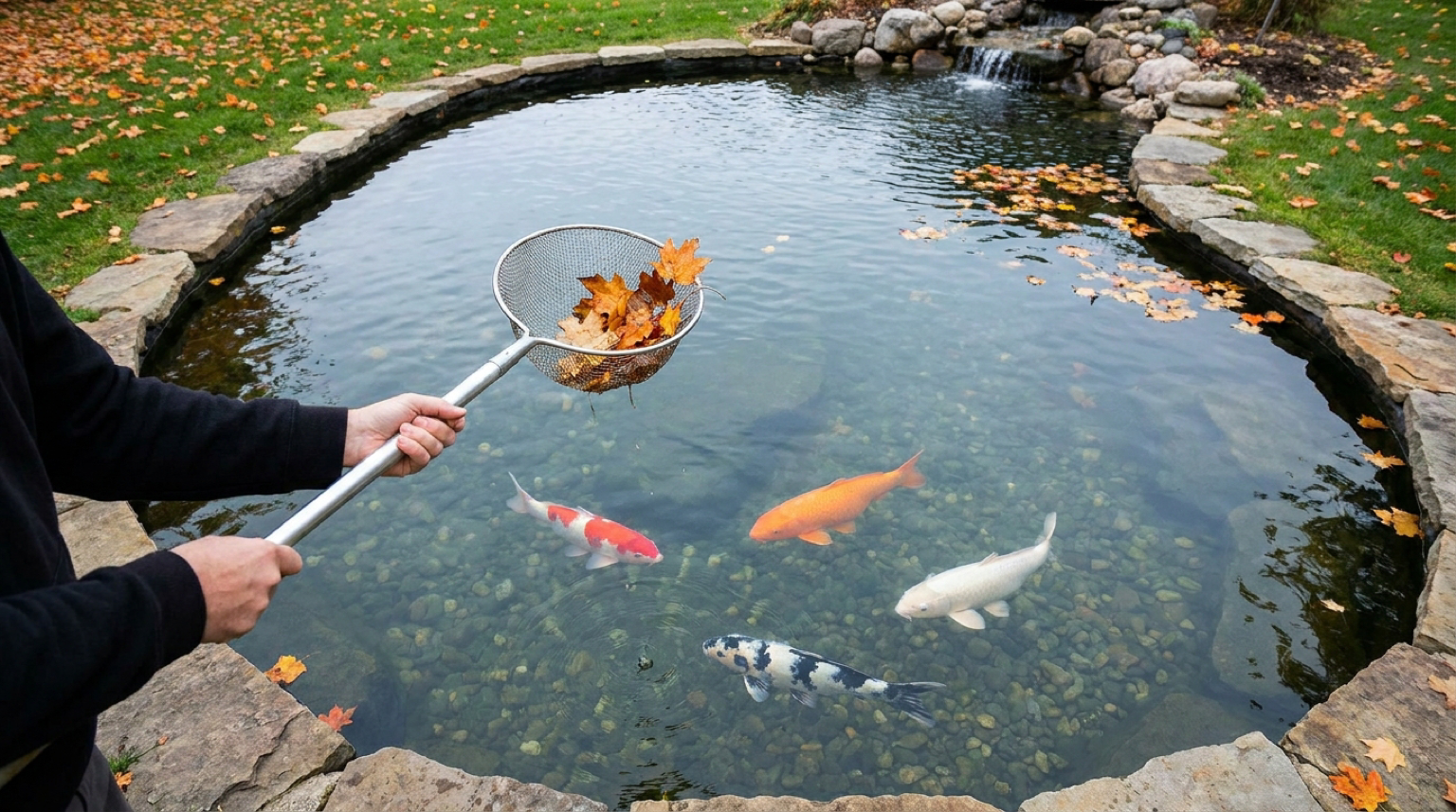
- Keep leaves out. Fallen leaves, Texas A&M warns, can foul the water, release harmful substances and clog filters. Skim often, or net the pond before the leaves drop.
- Cut feeding as the water cools. The Merck pet owner guide says to reduce the amount fed in colder weather, because fish are less active and need less food (Providing a Home for Fish). Follow the fish: offer less, watch what is eaten in a few minutes, and remove the rest. Uneaten food only rots.
- Keep testing ammonia and nitrite. A filter slowing down in cold water with extra organic matter to process is a classic setup for a spike.
- Plan the winter setup. Decide how you will keep part of the surface open, and move any bottom air diffuser up to a shallow shelf before ice season.
Winter: keep part of the surface open
Koi can survive water close to 32 °F (0 °C) if it cools gradually (SRAC 7201). In winter, ponds layer upside down: water is densest at 39 °F and sinks, while colder water and ice sit on top, so fish gather in the deeper, slightly warmer water (Illinois Extension, Under the Ice).
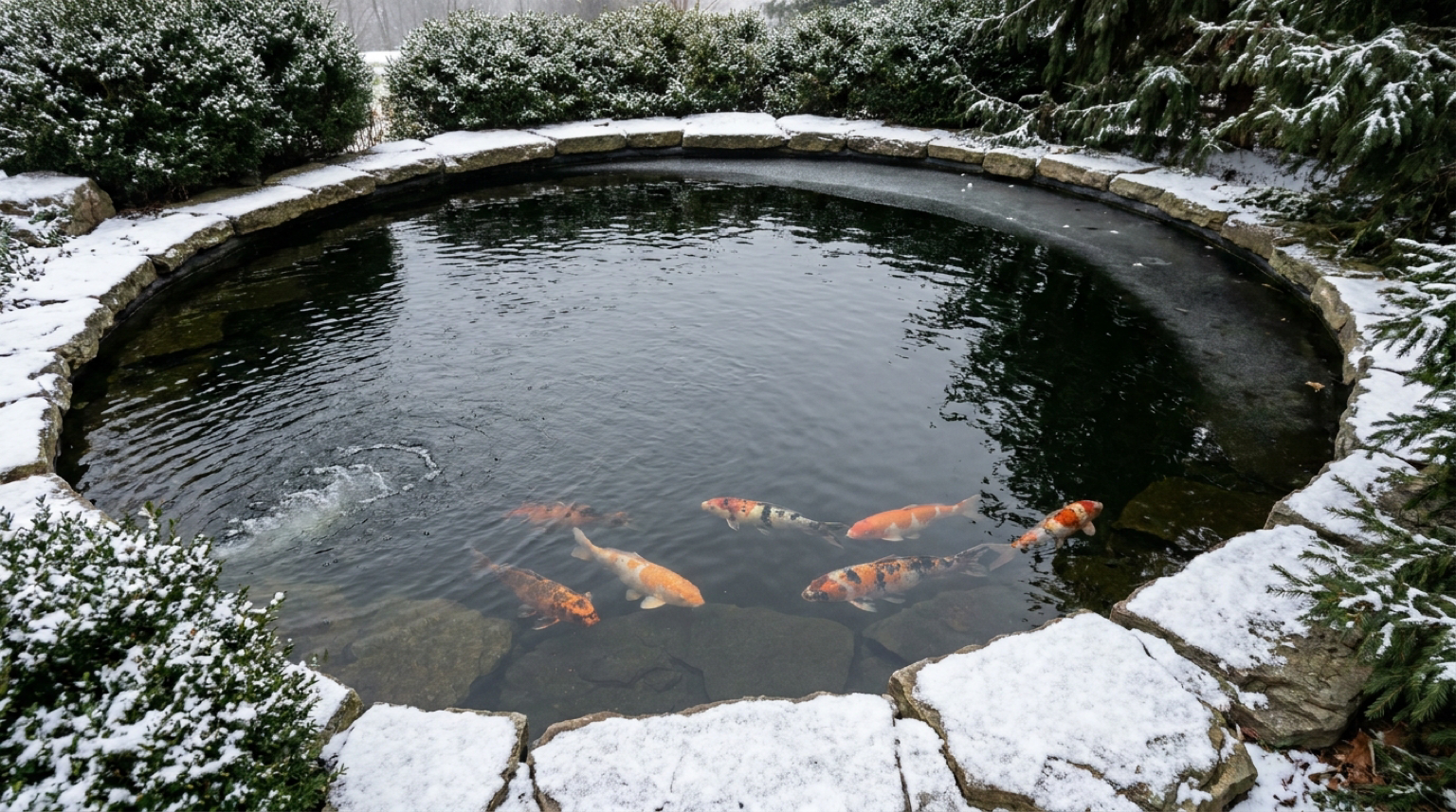
The risk is oxygen. Illinois Extension explains that ice blocks oxygen moving in from the air and snow blocks the light plants need, so oxygen falls through the winter and low oxygen is behind many winter fish kills. Its advice for pond owners:
- Keep an area of open water. Run surface aeration, or use a pond de-icer, so air can reach the water.
- Move bottom diffusers up. A bottom diffuser helps the rest of the year, but Illinois Extension advises moving it to the surface or a shallow area in winter.
- Clear long-lasting snow from part of the ice if it is safe to let light in.
Beyond that, winter care is mostly restraint. The Texas A&M manual says feeding must be reduced or even stopped in cold months, when metabolism is low, and it lists handling and rapid temperature changes among the main stressors of fish. Leave nets and moves for warmer water. Keep reading the temperature, and test ammonia, nitrite and pH less often but on a schedule, using the open area. Fish crowding near the opening can signal low oxygen below.
Which koi pond water tests to log in each season
Water quality guidance from UF/IFAS and the Merck manual sets the base: test ammonia regularly (UF/IFAS recommends weekly in any production system), test right away whenever fish change their behavior or appetite, and test more often once ammonia appears (UF/IFAS Extension, Ammonia in Aquatic Systems). On top of that, the seasons shift the emphasis:
- All year: water temperature as often as you can read it, because it drives everything else; ammonia, nitrite and pH on a regular schedule.
- Spring: ammonia and nitrite weekly or more while temperatures swing; KH every few weeks, since alkalinity changes over weeks to months (SRAC 464).
- Summer: dissolved oxygen at dawn during hot or overcast spells; an occasional afternoon pH; ammonia and nitrite weekly.
- Fall: ammonia and nitrite while leaves are falling and feeding is tapering.
- Winter: temperature weekly; ammonia, nitrite and pH less often; dissolved oxygen if fish gather at the opening.
Running a koi pond on Creatures
On Creatures, a pond is a place in Locations, records are free and unlimited, and everything runs in a browser on your phone or computer, which helps when you are standing at the pond at dawn.
- Create the pond. Give it a name and, if you like, the water type (Freshwater), how it is being used (Established) and its volume in US gallons, Imperial gallons or liters. Setting up and organizing locations covers places in general.
- Log water through the year. Log water takes the time, or just the date, then each Test and Reading: water temperature in °F or °C, dissolved oxygen, ammonia (total ammonia as N, as NH3, or free ammonia), nitrite (as NO2 or as N), pH, alkalinity and hardness. Keep the time on dawn oxygen readings. Add the kit or meter and notes such as “after storm” or “de-icer on”.
- Watch the trends. Show trends plots one dot per reading for the test you pick; switch between water temperature and dissolved oxygen to compare the season’s warming with the summer oxygen dips, and look into what else changed that week before deciding the heat was the cause. Current values gives the latest reading of each test, and Water history keeps every one.
- Set your own ranges. Owners and co-owners can set a minimum dissolved oxygen, a maximum ammonia or nitrite, or any other limit in their own units, plus an optional stale time so a pond that has not been tested lately shows Freshness: stale. Latest readings then read Within your range, Below your range or Above your range. These settings never send alerts, and Creatures never sets target ranges for you.
- Schedule the season’s tests. Choose Add a routine, then Start with a tank or pond routine, then the Established tank or pond starter, which includes a water test. Tests appear on Today, where Record test leads to Save test & complete task. When the season turns, edit the plan’s schedule so tests come more often in summer and less often in winter. Care plans explains how schedules and changes work; place reminders arrive in the app, and email for place care is opt in under Settings > Notifications.
- Quarantine new arrivals in their own tank. Create a separate tank used for Quarantine and add the Quarantine: observe starter, which schedules observations only.
- Count the koi. Show fish can each have a profile and be moved into the pond, keeping their location history (moving animals and location history). Fish kept by number are a count group: on the group page, Turn on tank counts, then Count a tank one pond at a time, with Not in a tank or pond for any fish elsewhere (tracking animals without individual profiles). Whether the pond holds kohaku, showa or taisho sanke, each pond’s count stays its own.
- Record a spring spawn. On the place page, Aquatic observations leads to Record a spawn, drop or colony, where a Spawn or eggs record can link up to five water tests from the seven days through the observed date.
Download water records exports a spreadsheet of the year. You can keep tank and water records on Creatures, or read the water records help article first. Naming a new arrival? The fish name generator works for koi too.
Koi pond care FAQ
When should I stop feeding koi in the fall?
There is no single cutoff that fits every pond. Texas A&M says feeding must be reduced or even stopped during cooler winter months, and the Merck pet owner guide says to feed less in colder weather. Cut back as the water cools, offer only what the koi finish in a few minutes, and stop when they stop taking food readily.
Should I break the ice on a koi pond?
Better to keep an opening from the start. Illinois Extension recommends surface aeration that keeps an area of open water, and moving any bottom diffuser up to the surface or a shallow area for winter.
Do koi need a heated pond?
Not to survive. SRAC notes koi can survive water near 32 °F (0 °C) when the change is gradual. What they need is enough depth, open water for gas exchange and stable conditions.
How many koi can my pond hold?
Fewer than most people expect. The basic Texas A&M guide is 1 pound of adult fish per 100 gallons, rising to about 2 pounds per 100 gallons with good biofiltration and aeration, and adult koi in small ponds commonly weigh 4 to 5 pounds. Pond comet goldfish count toward the same limit.
Is green water bad for koi?
A bloom hides the fish and can cause oxygen crashes, especially at night. The Texas A&M manual ties heavy blooms to too many nutrients from overstocking, overfeeding and over-fertilizing, so fix those first.
Do this next on Creatures
You keep koi and want each pond’s water and fish counted in one place. Records are free; saving them needs a free account.
- Add your koi, then move each show fish into its pond. See adding an animal.
- Add a record for a koi’s weight, a health note or a vet visit. This opens for visitors; a free account is needed to save it. Follow adding a record.
- Get an alert for koi listings so new koi reach you in time to plan a quarantine tank.
- Browse koi listings and ask the seller about the fish’s history and water.
- Explore the breeder directory to find trusted koi keepers near you.
- Add your breeder profile if you breed koi and want buyers to find you.