Author: Elliott Garber, DVM · Published
To cycle a fish tank, run the filter with a steady source of ammonia until the bacteria growing in it turn ammonia into nitrite, and nitrite into nitrate, as fast as ammonia appears. The tank is cycled when ammonia and nitrite both test at zero while ammonia is still going in. In most freshwater tanks that takes about four to eight weeks, and your test results, not the calendar, tell you when it is done. If you want those results charted instead of scribbled on a card, track water quality in a tank or pond on Creatures: a tank set up as Cycling keeps every reading and draws the curve for you.
The whole process is a run of water tests. Ammonia, nitrite and nitrate every day or two, with pH, temperature and carbonate hardness (KH) beside them, each written down with the date and the unit basis your kit uses. This guide walks through why the cycle happens, how long it takes, the fishless and fish-in methods, and how to read the numbers without being fooled by them.
| Typical time | About 4 to 8 weeks for a freshwater tank |
|---|---|
| Finished when | Ammonia and nitrite read 0 on repeated tests while ammonia still goes in, and nitrate is rising |
| Tests to log | Ammonia, nitrite, nitrate, pH, temperature and KH |
| How often | Every day or two, same time, same spot, same method |
| What stalls it | pH below about 6.8, low KH, cold water, chlorine or chloramine, some medications |
| Free ammonia | About 10 times more of the toxic form for each 1 unit rise in pH |
| Before fish | A partial water change, then a few fish at a time |
| On Creatures | A tank set to Cycling with the Cycling: observe and test routine starter |
What the nitrogen cycle does in an aquarium
Fish excrete ammonia, mostly through their gills, and uneaten food and decaying plants add more (UF/IFAS Extension, Ammonia in Aquatic Systems). Ammonia is colorless and odorless even at levels that harm fish, so the only way to know it is there is to test for it.
Two groups of bacteria clear it. Ammonia-oxidizing bacteria (including Nitrosomonas and Nitrosospira) turn ammonia into nitrite, which is also toxic. Nitrite-oxidizing bacteria (including Nitrospira and Nitrobacter) turn nitrite into nitrate, which is much less toxic and leaves the tank through water changes and plant growth. Both groups need oxygen, and the process uses up alkalinity, the water’s buffer. That is why pH drifts down in a tank with little buffer.
These bacteria grow on every wet surface, but mostly on filter media, which offers them the most surface area (SRAC Publication 4502, How to Start a Biofilter). Cycling a tank means growing enough of them before the tank carries a full load of fish. Skip it and you get what veterinarians call new tank syndrome: ammonia, nitrite or both reaching toxic levels, usually within the first six weeks after a tank is set up (Merck Veterinary Manual, Management of Aquarium Fish).
Ponds run the same cycle on the liner, rocks and plants, with algae taking up some of the ammonia. If you keep fish outdoors, koi pond care by season covers how temperature changes the cycle through the year.
How long does it take to cycle a fish tank?
Plan on four to eight weeks. The Merck Veterinary Manual’s pet owner guide says the bacteria usually develop on their own in 4 to 6 weeks (Providing a Home for Fish). Its professional chapter says a tropical tank’s biofilter can take up to 8 weeks to become established, and UF/IFAS gives six to eight weeks for a new biofilter.
What moves the timeline:
- Temperature. Nitrifying bacteria work faster in warm water and slower in cold water. SRAC’s example start-up at 28 °C (about 83 °F) finished quickly for that reason. If you warm the tank to speed things up, SRAC advises going no more than 2 to 3 °C (3.6 to 5.4 °F) above the temperature you will keep the animals at, so the bacteria do not die back when you lower it. Cold-water animals cycle at their own temperature, so an axolotl tank setup usually needs more patience than a heated betta tank.
- pH and KH. SRAC puts the lower healthy pH limit for nitrifying bacteria at about 6.8. UF/IFAS says common nitrifying bacteria stop working effectively when total alkalinity falls below 20 mg/L, and the Merck manual says alkalinity at or below 50 mg/L as calcium carbonate inhibits a biofilter and recommends at least 100 mg/L in freshwater systems. If a cycle stalls with ammonia stuck high, check KH and pH first.
- Oxygen. Nitrification needs oxygen, so keep the filter running and the surface moving.
- Chlorine and chloramine. Most city water carries one or the other, and the Merck pet owner guide notes both are toxic to fish and to the filter bacteria. Treat every fill and top-up with a dechlorinator that handles both.
- Seed material. Moving filter media from an established, healthy tank is the most effective way to add bacteria, according to SRAC, which also warns that anything moved between systems can bring disease with it. Take media only from a tank you trust. Bottled bacteria can shorten the start (SRAC), though the Merck pet owner guide calls them unnecessary for most home aquariums.
- Medication. Some fish treatments, especially antibiotics, can harm the bacteria, and UF/IFAS advises testing ammonia and nitrite more often after any treatment.
How to cycle a fish tank without fish (fishless cycling)
Fishless cycling grows the bacteria before any animal is exposed to ammonia or nitrite. SRAC calls seeding the filter before stocking the more desirable method, because it spares new fish the stress and gives better water quality from the first day.
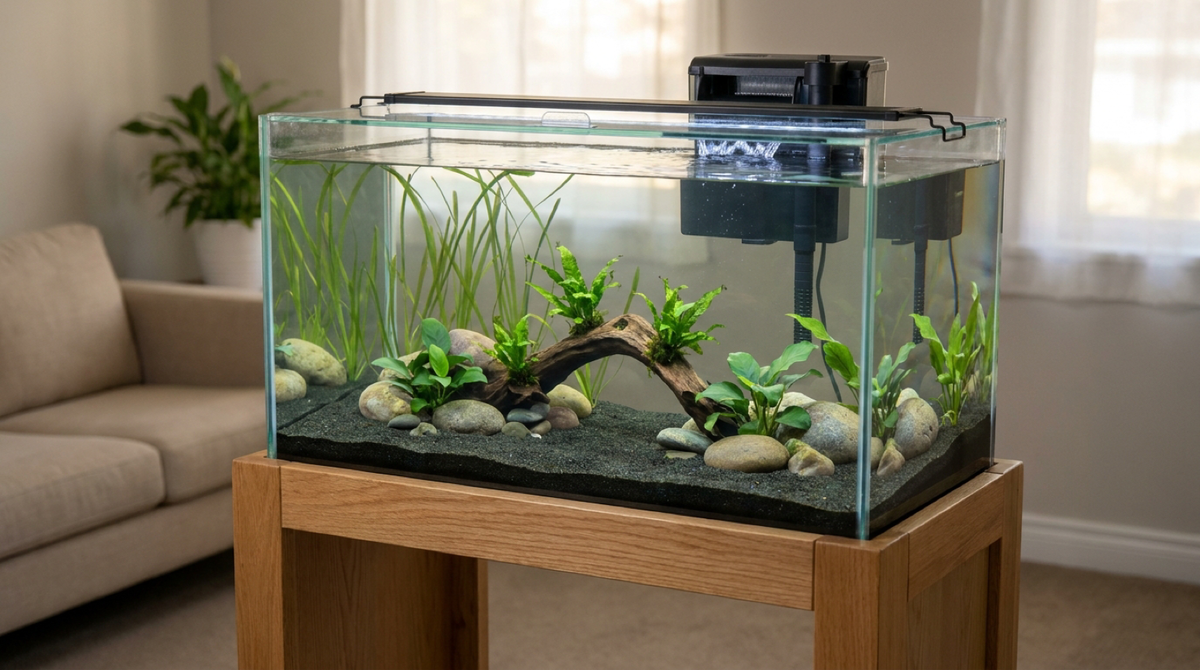
- Set up the tank completely. Substrate, decor, plants, filter running, and the heater set to the temperature your fish will need. Fill with dechlorinated water.
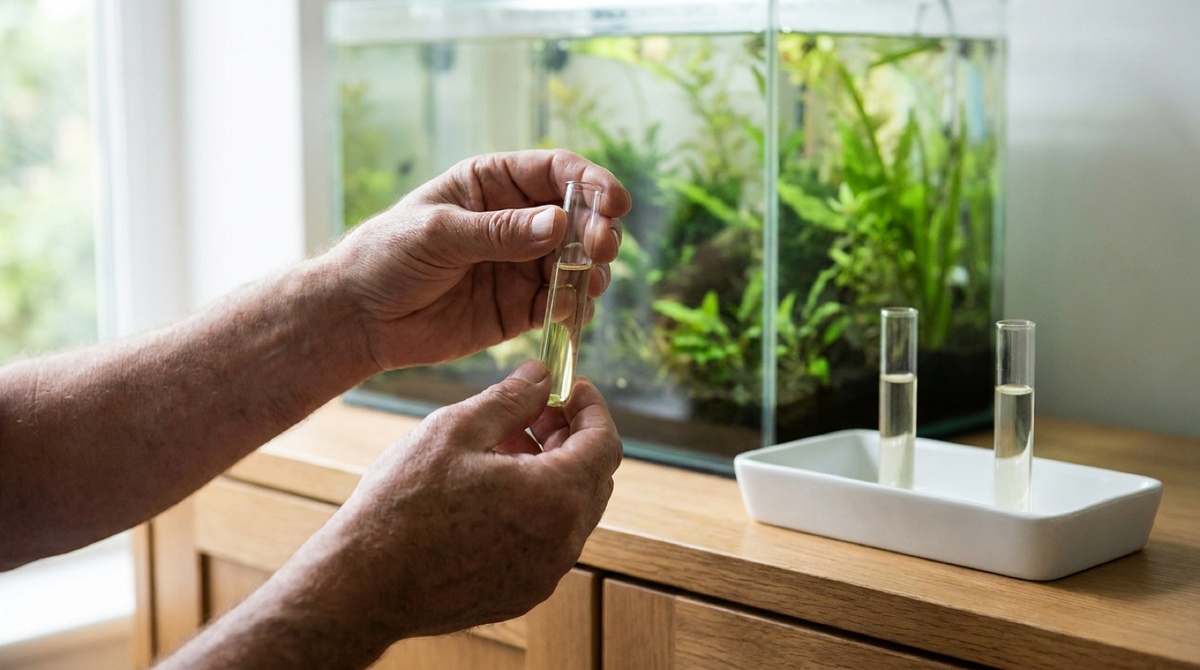
- Test the water you filled it with. Record ammonia, nitrite, nitrate, pH, KH and temperature before you add anything. Some city and well water already contains ammonia (UF/IFAS), and when a dechlorinator breaks down chloramine it releases ammonia into the tank (Merck). This baseline explains early readings later.
- Add an ammonia source. SRAC lists unscented household ammonia, a clear solution with nothing added, among the usual sources; some keepers use a pinch of fish food instead and let it break down. Add a small amount, let it mix through the tank, test, and only then add more. Never use ammonia with scent, soap or dye in it.
- Seed it if you can. A handful of media from a healthy, established filter, or a bottled nitrifying bacteria product used exactly as its label directs.
- Test on a schedule. SRAC recommends sampling from the same spot at the same time each day with the same method, so day to day changes reflect the filter rather than your technique. Daily tests give the clearest curve; every other day still shows its shape.
- Keep feeding the bacteria. Top up the ammonia source when ammonia falls, so the colony keeps growing toward the load your fish will produce.
- Watch the curve. Ammonia climbs, peaks and falls. After a lag, nitrite climbs, peaks and falls. Nitrate rises steadily behind them. SRAC describes exactly this shape, and the top of the nitrite curve is the point where the nitrite-eating bacteria have caught up.
- Call it done on the numbers. When ammonia and nitrite read zero on repeated tests while you are still adding the ammonia source, and nitrate keeps rising, the filter can handle the load. The Merck manual’s rule is simple: once no ammonia or nitrite is present, fish can be added safely.
- Change water, then stock slowly. A large partial water change brings down the nitrate built up during the cycle. Then add fish a few at a time: the Merck pet owner guide suggests 1 or 2 at a time over several weeks, because adding too many at once overwhelms the bacteria. Keep testing after each addition. If you are still choosing species, the best freshwater aquarium fish guide is a good place to start.
Fish-in cycling: when fish are already in the tank
Sometimes fish arrive before the filter is ready: a gift, a rescue, an emergency rehome. SRAC calls stocking without an active biofilter a cold start. It works, but it is slow and stressful for the animals and the keeper, who has to hold ammonia and nitrite down with water changes and cut feeding until the filter catches up.
If you are in that position:
- Stock lightly. Few fish, small fish, and no additions until the numbers settle.
- Test daily. The Merck pet owner guide describes stocking a new aquarium and then checking ammonia and nitrite every day, controlling any rise with frequent water changes.
- Feed less. Food is the main source of ammonia. UF/IFAS notes that reducing or stopping feeding for a short period, such as 1 to 3 days, does not usually harm fish (fry are the exception) and lets the nitrogen cycle catch up.
- Change water with matched, dechlorinated water. UF/IFAS describes a 25% to 50% water change as a way to remove some ammonia, provided the new water has none. Match the temperature too: the Merck manual warns that sudden changes of even a few degrees can weaken a fish’s immune defenses.
- Watch the fish. Gasping at the surface, sitting on the bottom, refusing food or brownish gills are reasons to test right away. Nitrite passes through the gills into the blood and turns it chocolate brown, so affected fish can suffocate even when the water holds enough oxygen (SRAC Publication 462, Nitrite in Fish Ponds).
Chloride competes with nitrite at the gills, which is why salt is sometimes used against nitrite poisoning, but the right approach depends on your species and your water. Ask a fish veterinarian before adding anything to treat fish; the American Association of Fish Veterinarians keeps a find a fish vet map.
Reading cycling tests: total ammonia, free ammonia and “as N”
Two tanks with the same ammonia reading can be in very different danger. Most ammonia kits measure total ammonia nitrogen (TAN), the sum of ionized ammonium and un-ionized “free” ammonia (NH3). The free form is roughly 100 times more toxic to fish, and its share climbs with pH and temperature (UF/IFAS). SRAC’s ammonia fact sheet puts it plainly: every one unit rise in pH raises the toxic fraction about tenfold (SRAC Publication 463, Ammonia in Fish Ponds).
Using the UF/IFAS table at 24 °C (75 °F), the free share of total ammonia is about 0.5 percent at pH 7.0 and 5 percent at pH 8.0. Applied to a total ammonia reading of 1.0 mg/L as N, that is about 0.005 mg/L of free ammonia as N at pH 7.0 and 0.05 mg/L as N at pH 8.0, or about 0.006 and 0.06 mg/L expressed as the whole NH3 molecule. UF/IFAS says un-ionized ammonia damages fish from about 0.05 mg/L, and SRAC ties chronic exposure from about 0.06 mg/L to gill and kidney damage. Neither says whether its figure is as N or as NH3, so treat that range as a warning zone rather than an exact line; at pH 8.0, a reading of 1.0 mg/L is already inside it on either basis. That is why you log pH and temperature beside every ammonia test, and why a fish-in cycle in hard, alkaline water needs extra care.
The second trap is the unit basis. A kit can report the same water two ways:
- Nitrite: the Merck manual notes that most kits measure nitrite-nitrogen rather than nitrite. Multiply an “as N” reading by about 3.3 to express the same water as nitrite (NO2).
- Nitrate: an “as N” nitrate reading times about 4.4 gives nitrate as NO3.
- Ammonia: a reading “as NH3” is about 1.2 times the same water’s reading “as N”.
Each factor is just the weight of the whole molecule divided by the weight of its one nitrogen atom, so none of them changes how toxic the water is; they only change the number. Record exactly the basis your kit’s instructions give, and never mix bases on one chart. The aquarium water testing guide covers each test, kit quirks and how often to test once the tank is running.
Track the cycle on Creatures
A cycle is weeks of repeated tests, exactly the kind of record that ends up on scraps of paper. On Creatures, a tank or pond is a place in Locations. Records are free and unlimited, and everything runs in a browser on your phone or computer.
- Create the tank. Give it a name and, if you like, the water type (Freshwater, Brackish or Marine), how it is being used (choose Cycling) and its volume in liters, US gallons or Imperial gallons. Setting up and organizing locations shows where tanks sit among your places.
- Add the routine. Choose Add a routine, then Start with a tank or pond routine, then the Cycling: observe and test routine starter. It includes a water test and is an editable list; starters never set treatments, dosing or target ranges. Scheduled tests appear on Today, where you tap Record test, enter the readings and Save test & complete task. Care plans explains how schedules work.
- Log every reading. Log water takes the time, or just the date, then each Test and Reading. Ammonia can be logged as total ammonia as N (TAN), as NH3, or as free ammonia; nitrite as NO2 or as N; nitrate as NO3 or as N. A “less than” result is typed as read (<0.25). Zero is a reading, and a blank means you did not measure it. Add the kit or meter, the water source, and notes such as “added ammonia source” or “40% water change”.
- Read the curve. Show trends plots one dot per reading for the test you pick; switch between ammonia, nitrite and nitrate to follow the ammonia peak, the nitrite lag and the nitrate climb. Current values gives the latest of each test, and Water history and Filter history let you look back by date or test.
- Set your own ranges if you want them. Owners and co-owners can set a minimum, a maximum or both for any parameter, in their own unit, plus an optional stale time. The latest result then reads Within your range, Below your range or Above your range, with Freshness: current or Freshness: stale. These settings never send alerts, and Creatures never sets target ranges for you.
- Fix mistakes cleanly. A correction keeps the original reading, and a test that was simply wrong can be voided.
- When it has cycled, move in the fish. Use Add an animal on the tank page. A betta or other individual can have its own profile and be moved into the tank, with its location history kept (moving animals and location history). Fish kept by number, such as a group of guppies, are a count group whose page offers Turn on tank counts (tracking animals without individual profiles). For the ongoing weekly routine, add the Established tank or pond starter.
Download water records exports the whole cycle as a spreadsheet if you ever need to show someone what happened. You can keep tank and water records on Creatures, or read the water records help article first to see each screen. When the first fish arrive, the fish name generator is there for the naming argument.
Tank cycling FAQ
Can I add fish the day I set up the tank?
You can, but you are then fish-in cycling. Keep stocking very light, test daily, and be ready for water changes. Fishless cycling is easier on the fish.
Does cleaning the filter restart the cycle?
It can set it back. Most of the bacteria live on the filter media, so rinse media in tank water you have siphoned out rather than under the tap, since chlorine and chloramine harm the bacteria. Replacing all the media at once removes most of the colony, so stagger replacements, and test ammonia and nitrite for a few days after any filter work.
Will a bottled bacteria product cycle a tank instantly?
SRAC says bacterial preparations can shorten the time it takes to establish a biofilter, and the Merck pet owner guide says commercial products may speed the process slightly. Either way, the tests decide when the tank is ready, not the label.
My ammonia and nitrite read zero after a week. Is the tank cycled?
Only if ammonia was going in the whole time. A tank with no ammonia source reads zero because it has nothing to process, not because the bacteria are established.
Do saltwater tanks cycle the same way?
The same nitrogen cycle applies. SRAC notes that operators report bacterial cultures are essential for starting biofilters in brackish or marine water above 15 ppt salinity, so plan to seed a marine tank.
Do goldfish tanks need cycling?
Yes, every fish tank runs the same nitrogen cycle. Goldfish also grow far beyond the size they are sold at: Texas A&M AgriLife notes that comet goldfish commonly reach 7 to 14 ounces as adults (Ornamental Ponds and Water Gardens in Texas). Size the filter, and the cycle, for the adult fish, not the ones in the bag.
Do this next on Creatures
You are setting up a tank and getting ready for fish. Records are free; saving them needs a free account.
- Add your betta once the tank has cycled, then move it into the tank so its location history starts on day one. See adding an animal.
- Add a record for things that are not water tests, such as a note on where a new fish came from. This opens for visitors; a free account is needed to save it. Follow adding a record.
- Get an alert for betta fish listings so new fish reach you while the cycle finishes.
- Browse guppy listings and ask the seller for the temperature, pH and hardness the fish live in now, so you can match them.
- Explore the breeder directory to find trusted fish keepers near you.
- Add your breeder profile if you breed fish and want a public page for your fish room.