Chicken Shows: How APA and ABA Poultry Shows, Classes and Judging Work
Author: Elliott Garber, DVM · Published
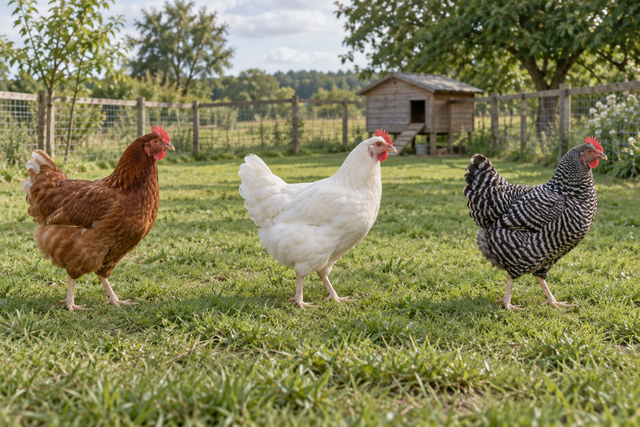
A chicken show is a judged poultry competition where a licensed judge handles each bird in its coop and scores it against the written standard for its breed and variety, not against the other breeds in the hall. In the United States most open chicken shows judge large fowl by the American Poultry Association’s Standard of Perfection and bantams by the American Bantam Association’s Bantam Standard: birds are entered by breed, variety, sex and age, the best of each variety and breed move up to class and division champions, and one bird finishes as Grand Champion of the show.
The paperwork side is simple once you see it. Each entry is a cock, hen, cockerel or pullet of one recognized variety, each club decides its own entry fees, deadlines and health papers, and the national associations award exhibitor points and titles from the official show report. Creatures does not list or run poultry shows today, so find shows through the associations and your fair office. What Creatures does is keep each bird’s results: you can add a show result from another show to a bird’s profile, with the award written exactly as the show printed it.
This guide follows the associations’ own published rules and university extension guidance checked on November 14, 2026. If you are breeding for next season, the sister guide on candling eggs covers the hatch, and the NPIP certification guide covers the flock testing many shows and fairs ask about.
| Standards used | APA Standard of Perfection for large fowl; ABA Bantam Standard for bantams |
|---|---|
| Who hosts | Local, state and breed poultry clubs, plus county and state fairs and 4-H programs |
| Sex and age classes | Cock and hen are over one year old; cockerel and pullet are under one year |
| Award ladder | Best and Reserve of Variety, Best and Reserve of Breed, class champion, division champion, Grand Champion |
| Exhibitor titles | APA Master Exhibitor at 300 points; ABA Master Exhibitor at 20 starred wins |
| Health papers | Many fairs ask for a pullorum clean flock or a recent negative pullorum test |
| Coming home | USDA advises keeping returning show birds apart for at least 30 days |
| Records | Log each placing, class size and band number on the bird’s profile |
Who runs a chicken show
Two national associations write the standards most American shows use. The American Poultry Association says it “creates and manages the Standard Of Perfection for standard Bred Poultry to be exhibited and judged”. The American Bantam Association, which says it has represented bantam breeders since 1914, maintains the Bantam Standard, and its official show rules state plainly that “The ABA Bantam Standard shall be used in judging bantams”.
Neither association puts on most shows itself. Local poultry clubs, breed clubs, state associations and fairs do, and the associations sanction them. A sanction ties the show to the association’s rules and awards. Under the ABA’s official show rules, any poultry association, club or society can host a show and offer ABA special prizes if it follows ABA rules, which “includes a $50 per show sanction fee”. The same rules set the judging staff: at district, state, provincial and special meets, at least one judge must be ABA licensed and not less than half the judging staff must be ABA licensed, with every judge an ABA member in good standing. The show secretary then sends the show report to the ABA within 90 days.
APA shows work on the same model. The APA’s points system page ranks meets as Annual, District, State and Club, and says points are allotted only when “The judging slate at shows must meet the license requirements for a sanctioned meet.” The APA keeps a public Find an Event calendar of upcoming shows and meets, and the ABA links its sanctioned show list from its site. Fairs and 4-H shows are a separate track: they often use the same standards, but the fair book sets the classes, the health rules and who may enter.
If you are new to standard-bred birds, start with one breed you can buy good stock of. The Creatures chicken species page compares breeds, and breed guides such as the Serama guide and Silkie guide describe what their standards ask for.
Classes: large fowl, bantams, varieties, sex and age
Every chicken is entered in one class defined by size, breed, variety, sex and age.
Large fowl or bantam. The APA’s list of accepted breeds and varieties groups large fowl into American, Asiatic, Continental, English and Mediterranean classes, plus AOCCL and AOSB, and groups bantams into Game, Modern Game, SCCL (single comb clean legged), RCCL (rose comb clean legged), AOCCL (all other combs clean legged), Feather Leg and AOSB (all other standard breeds). A Cochin, for example, shows in the Asiatic class as a large fowl and in the Feather Leg class as a bantam. Check the APA list for your breed before you fill in an entry: the class decides which birds yours meets on the way to champion.
Variety. Within a breed, each recognized color or comb type is its own variety, so a Barred Plymouth Rock and a White Plymouth Rock are judged in separate variety classes before they meet. The ABA rules cap birds that are not recognized: a non-recognized variety “may place no higher than BV or RV”, and a non-recognized breed no higher than Best or Reserve of Breed.
Sex and age. Fair books in New York and Arizona define the four terms the same way. The Otsego County 4-H poultry rules from Cornell Cooperative Extension say a cock is a male over one year old, a cockerel a male under one year, a hen a female over one year and a pullet a female under one year, and that birds must be mature enough to judge, “at least 5-months of age in most breeds”. The University of Arizona Extension poultry show rules use the same four sub-lots.
| Cock | Male over one year old |
|---|---|
| Hen | Female over one year old |
| Cockerel | Male under one year old |
| Pullet | Female under one year old |
| Trio (where offered) | One male and two females of the same breed and age |
Some shows also offer trio classes and displays. The Otsego rules define a trio as one male and two females of the same age and breed. Fairs often add production classes for egg or meat birds that may be crossbred and are judged on health, vigor and production traits rather than a breed standard, so read the class list before assuming your hybrid layers have nowhere to go.
How poultry judging works, from variety to Grand Champion
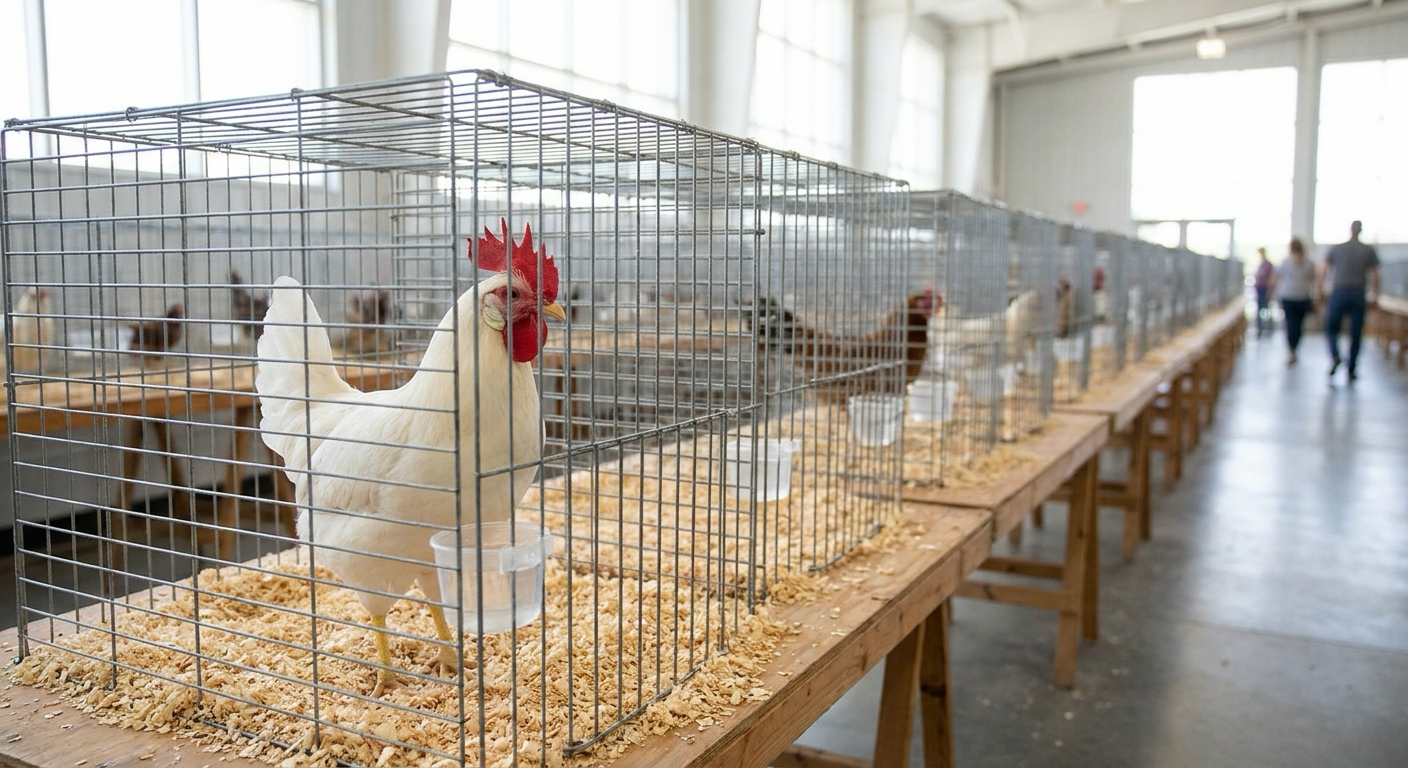
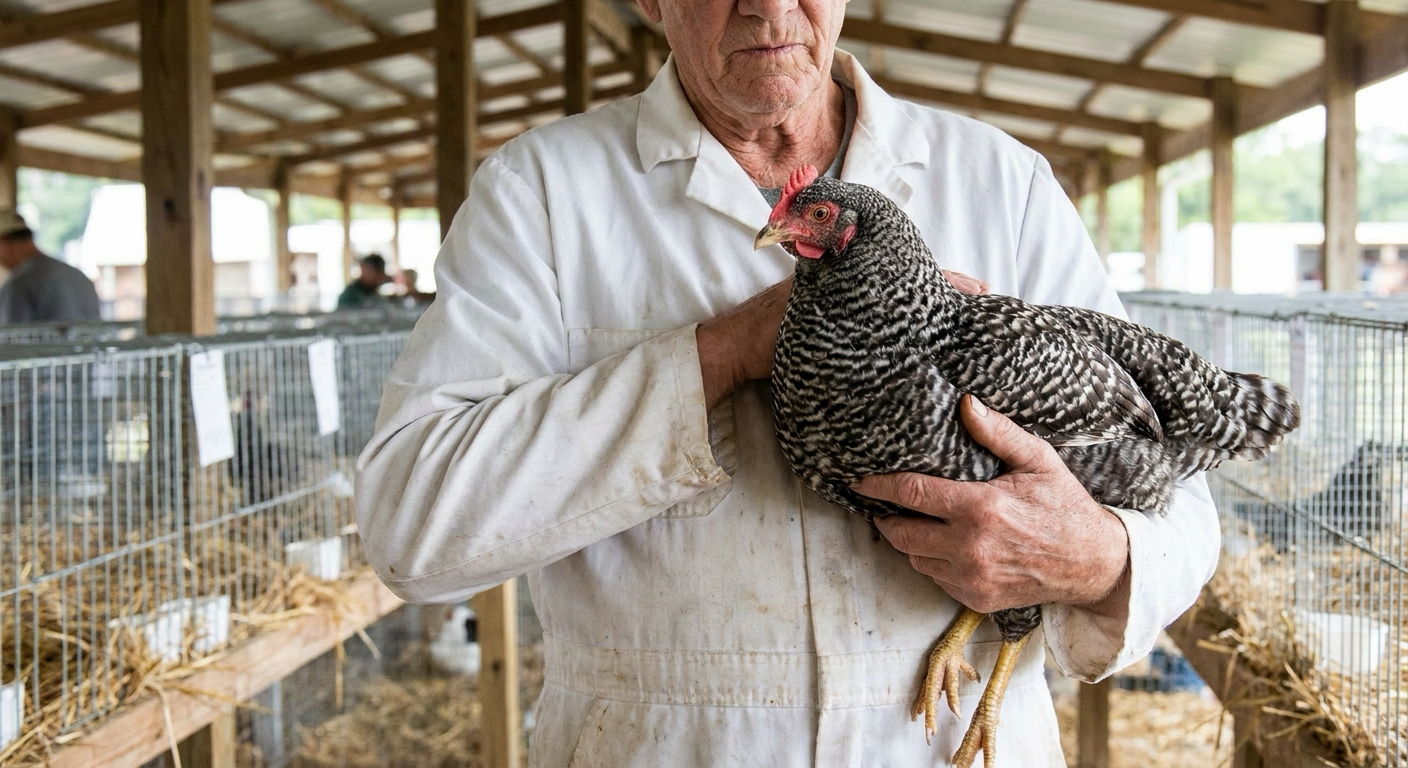
The judge works from the bottom up. The birds stay in their show coops; the judge takes each one out, handles it, checks it against the Standard and puts it back, then marks placings on the coop card or judging sheet.
- Placings within the variety. Cocks, hens, cockerels and pullets of one variety are placed in their own classes.
- Best of Variety (BV) and Reserve of Variety (RV). The variety winners are compared, and the judge picks the best and the reserve.
- Best of Breed (BB) and Reserve of Breed (RB). Every Best of Variety in a breed comes together, and the judge picks the best of the breed and a reserve.
- Class champion and reserve. The breed winners within a class, such as all the Asiatic large fowl or all the Feather Leg bantams, meet for champion and reserve of that class.
- Division champions. Class champions compete for Champion Large Fowl, Champion Bantam and the champions of the other divisions the show offers, such as waterfowl or turkeys.
- Grand Champion of Show. The division champions meet for Grand Champion and Reserve Grand Champion. The Arapahoe County 4-H poultry rules from Colorado State Extension put it the same way for its fair: the Grand Champion “will be determined from the champions of each category”.
The APA names these same tiers in its points table (class champion, reserve class champion, Champion Large Fowl, Champion Bantam, Grand Champion of Show), and the ABA rules use the BV, RV, BB and RB abbreviations, so the ladder above is common to sanctioned shows. Exact award names and whether a show picks reserves at every level are set in the show catalog.
What the judge is looking for
The judge scores type (the body shape that defines the breed), color and pattern, comb and head points, feather quality, condition and health, and looks for disqualifications. A disqualified bird cannot place. Mississippi State University’s extension guide Selecting and Preparing Birds for Exhibition lists the general disqualifications from the Standard, which apply across breeds, including:
- deformed beaks or crooked backs;
- a clipped wing, a split wing or a slipped wing, and twisted wing or tail feathers;
- a wry tail or a squirrel tail, or no main tail feathers at all;
- a lopped single comb (except Mediterranean breeds and New Hampshire females), a lopped rose comb, a split comb, a rose comb with no spike, or side sprigs on a single comb;
- enamel white in the face of Mediterranean breeds, or in the earlobes of American or English breeds;
- feather stubs on the legs or between the toes of clean legged breeds;
- shank or toe color foreign to the breed, black in the quills of white varieties, red or yellow in black plumage, or foreign color in white plumage beyond slight gray ticking.
Breeds also carry their own disqualifications in the Standard, so buy or borrow the current edition for the breeds you keep. Fresh eyes help: ask an experienced exhibitor of your breed to go over your birds with you before you pay entry fees.
Exhibitor points and titles
The associations reward exhibitors, not just birds. Under the APA points system, a class champion earns 25 points at an Annual meet, 15 at a District, 10 at a State and 5 at a Club meet, and a reserve class champion earns 12, 7, 5 or 2. A class champion qualifies for those points only when enough birds were shown in competition: 50 for bantams and 25 for large fowl. The APA names three titles from the running total: Master Exhibitor at 300 points, Grand Master Exhibitor at 200 points in one variety of one breed, and the Hall of Fame at 1,000 points. Points need a current APA membership in the exact name on the membership list, birds that are the exhibitor’s bona fide property, and they are calculated from the show report the club files.
The ABA counts starred wins instead. Its show rules define a starred win as best or reserve in a class of 100 or more birds. Twenty starred wins over any period make an ABA Master Exhibitor; 20 starred wins in one variety, over not less than five years, make a Master Breeder; and five starred wins in one variety earn a Citation of Merit. Only ABA members in good standing receive ABA special prizes and awards.
Both systems run on the same facts: the show, the date, the class, the award, how many birds competed and who owned the bird. Keep those for every placing, because the official report is what counts and your own copy is what lets you check it.
| APA class champion points | 25 Annual, 15 District, 10 State, 5 Club meet |
|---|---|
| APA qualified class | 50 bantams or 25 large fowl shown in competition |
| APA Master Exhibitor | 300 points |
| APA Grand Master Exhibitor | 200 points in one variety of one breed |
| ABA starred win | Best or reserve in a class of 100 or more birds |
| ABA Master Exhibitor | 20 starred wins |
| ABA Master Breeder | 20 starred wins in one variety over at least 5 years |
Getting birds ready for a show
Pick early and pick on the Standard. The Mississippi State guide says to select show birds at least two weeks before the show opens, judging body type for the breed, uniform color, full development and feathers that are not worn or ragged, and to leave home any bird that is unhealthy or carries a disqualification. For a trio, it suggests starting with your best seven or eight pullets and two or three cockerels and watching them in a clean show cage for two or three days before deciding.
Coop train them. A bird that panics when a hand comes through the coop door shows badly. Mississippi State advises handling birds once or twice a day during the last ten days to two weeks before the show, with clean litter, fresh feed and water, a draft-free and well ventilated pen, and separating birds that peck their cage mates. A bird should come out of a coop head first, with a hand over the back holding the wings, and go back in head first, so feathers are not broken on the door.
Wash the birds that need it. White and parti-colored birds nearly always need a bath; Mississippi State says a proper wash “may mean the difference between a blue or a white ribbon”, and that dark birds need at least their feet and shanks washed. Timing advice differs: Mississippi State says at least one day before shipping, or two for beginners, while the University of California authors of the 4-H Poultry Showmanship National Standard say to plan the wash at least three days before. The products differ too, a mild dishwashing liquid in the Mississippi guide and mild soap flakes in the national standard, which warns that detergent can make feathers brittle. Whichever you use, wash in the direction the feathers grow, rinse every trace of soap out, keep the bird’s head above water, and dry it slowly in a warm room free of drafts, one bird to a clean cage. The national standard also advises keeping white varieties indoors and out of the sun, because sun turns white feathers yellow in a way no bath will undo.
Never fake a bird. The national standard calls “faking”, any attempt to hide a defect or disqualification such as dyeing an off-color feather, unethical, along with lying about ownership or giving a bird any product not labeled for poultry to change its behavior. Shows treat it the same way.
Band and travel. Many fairs require a numbered leg band that matches the entry form; the Arizona rules say colored bands without numbers are not acceptable. Mississippi State’s transport checklist is short: a clean carrier with no projecting wires, clean straw or shavings, no overcrowding, and an identification card with your name and address, the breed and variety, and the class. On hot days, travel early, keep carriers out of the sun and never leave birds in a parked vehicle; the chicken heat stress guide covers the warning signs.
Health papers, inspection and biosecurity
Pullorum testing. Pullorum and fowl typhoid are the oldest targets of the National Poultry Improvement Plan, and they are why so many fairs ask for paperwork. The USDA APHIS NPIP reference page describes the plan as “a voluntary federal-state cooperative testing and certification program” and notes that “The vast majority of U.S. states prohibit the entry of any poultry shipments except those designated as pullorum-typhoid clean.” Fair rules follow suit. The Otsego County rules, for example, require that all poultry except waterfowl shown at state or county fairs come from U.S. Pullorum clean flocks or have a negative pullorum-typhoid test within 90 days of the fair. Requirements vary by state and by show, so read the catalog or fair book and ask your state’s animal health office if anything is unclear. The sister guide on NPIP certification explains how flock testing and the classifications work.
Check-in inspection. Expect someone to look at your birds before they are cooped. The Otsego rules say birds are inspected for signs of disease or parasites, lice and mites included, and any bird showing them is removed from the grounds; the Arizona rules give the show committee the final say. The ABA rules tell show management to “immediately remove any bird showing symptoms of disease.” Check every bird around the vent and under the wings a week before the show; the chicken parasites guide shows what to look for.
Bringing birds home. A show mixes birds from many flocks. The USDA’s 2024 NAHMS backyard poultry biosecurity briefing warns that birds at shows, sales or other events “may shed disease-causing germs even if they appear healthy”, and advises isolating poultry new to your flock or coming back from a show for at least 30 days, with separate housing and feed, before they rejoin other poultry. Keep your own carriers, feed cups and grooming kit, and clean them before they go back into your barn. The chicken quarantine and integration guide covers setting up an isolation pen.
Sick birds. The same briefing lists signs of avian influenza in backyard poultry, including difficulty breathing, low energy and appetite, misshapen eggs or a drop in laying, nasal discharge, coughing and sneezing, and diarrhea, and notes that birds sometimes die before showing other signs. If birds are sick or dying after a show, call your veterinarian now, and report it: APHIS’s biosecurity basics page says to report any sick or dying birds to your State veterinarian or to USDA toll-free at 1-866-536-7593. The chicken illnesses guide covers more general warning signs. Shows can add health rules or close at short notice during disease outbreaks, so check the club’s announcements before you load the car.
Youth showmanship
At 4-H and FFA shows the exhibitor is judged as well as the bird. In showmanship, the judge scores how the young person carries, examines, poses and talks about their own bird. The 4-H Poultry Showmanship National Standard has the bird held in profile, resting on the palm of the hand, alert, with wings tucked, and sets out the examination in order: head, each wing, undercolor, width of body, breast and keel, vent (where lice and mites are most likely to show), depth of abdomen, width between the pubic bones, and finally the feet and legs. The showman then poses the bird on the table so the judge sees its profile, and answers questions about the breed, its parts and its care. Most fair books require the showmanship bird to be entered in its breed class too, as the Arizona and Otsego rules do.
Keeping chicken show records on Creatures
Creatures is not the place to find a poultry show; use the APA and ABA calendars and your fair office for that. It is a place to keep what a show bird accumulates, on the bird’s own profile, so the record stays with the bird if you sell it or breed from it.
- Give each show bird a profile. Add the bird with its breed and variety, and record its leg band or wing band number as an identifier, so the number on your entry form, the coop card and the profile all match. The help article on care, growth and identity records covers identifiers.
- Log every placing. On the bird’s Records tab, choose Shows & Titles and add a show result: show name, date, location, judge and class, the award typed as the show wrote it (for example “Best of Variety” or “Reserve Champion Large Fowl”), and the placement, number in class and exhibitors in class. If one bird won several awards at the same show, add another award without retyping the show details. The full walkthrough is in adding a show result from another show.
- Decide what is public. Each result has a visibility switch, a source link to where results are posted, and an optional photo, and a public result can be shared as a post on the bird’s profile. Results you add yourself are marked as reported by the owner, so visitors know where they came from; see show results on your animal’s profile.
- Know what it does not do. Creatures records the facts; it does not calculate APA points or ABA starred wins, and recording a win never certifies a title. The association’s show report and its points list remain the official record.
- Already use Poultry15? The Evans import reads an original Poultry15 XML export, with Chicken as the species, and shows you a preview of the animals, shows and other records before anything is added. Photos do not transfer. See importing from Evans programs.
Breeding your own show stock means knowing which pair produced each winner. The existing guide to chicken hatch records follows one batch from setting to banded chicks, the incubator hatching guide covers temperature and timing, and the sister guide on candling eggs covers checking development along the way.
Frequently asked questions
Do I need to join the APA or ABA to show chickens?
Check the show catalog or fair book first, because clubs and fairs set their own entry rules. Membership matters for awards: APA exhibitor points need a current APA membership, and only ABA members in good standing receive ABA special prizes and awards.
What is the difference between a cockerel and a cock?
Age. A cockerel is a male under one year old and a cock is a male over one year old. The same split separates a pullet (female under one year) from a hen (female over one year).
Can I show a mixed-breed chicken?
Not in standard-bred breed classes, which exist for recognized breeds and varieties. Many fairs offer egg or meat production classes where crossbred birds are allowed and judged on health, vigor and production traits. Under ABA rules, a breed or variety that is not recognized can still be shown but places no higher than Best or Reserve of Breed (or of Variety).
Do show chickens need a pullorum test?
Often. Many state and county fairs require birds from a U.S. Pullorum clean flock or a recent negative pullorum-typhoid test; one New York fair book sets the window at 90 days before the fair. Check the catalog for each show and your state’s rules.
How old does a chicken have to be to show?
There is no single national minimum. Birds must be mature enough to judge against the Standard, and one fair book puts that at about five months for most breeds. Young birds show as cockerels and pullets.
Should I isolate chickens after a show?
Yes. USDA advises keeping birds returning from a show apart from your flock for at least 30 days, with separate housing and feed, because birds can carry disease without looking sick.
Do this next on Creatures
Whether you are entering your first fair or chasing class champions with a barn of bantams, Creatures keeps each bird’s band number, placings and breeding on its own profile.
Add your show bird. Create a free profile for your chicken, no account needed to start, with its breed, variety and band number. The walkthrough is in adding an animal to Creatures.
Record the band, placings and health checks. Add a record for a show result, a pre-show health check or a pullorum test. The record sheet opens for any visitor, and a free account saves what you enter. See adding a record and health and medical records.
Show your flock. Create your poultry farm’s profile, no account needed to start, then get listed in the breeder directory so people looking for show stock can find you.
Looking for show stock? Set a free chicken listing alert and we will email you when a new chicken is listed. No account needed to start. See saving searches and using your watchlist.
Browse and compare. Check the current chicken listings on the marketplace, look up poultry breeders in the Creatures breeder directory, and read where to buy chickens for the questions to ask a seller.
Keep learning. Compare breeds on the Creatures chicken species page, and see how other species do it in the rabbit shows guide and the National Swine Registry guide for show pig papers.