Blue-Eyed Leucistic
Combination
Author: Elliott Garber, DVM · Updated
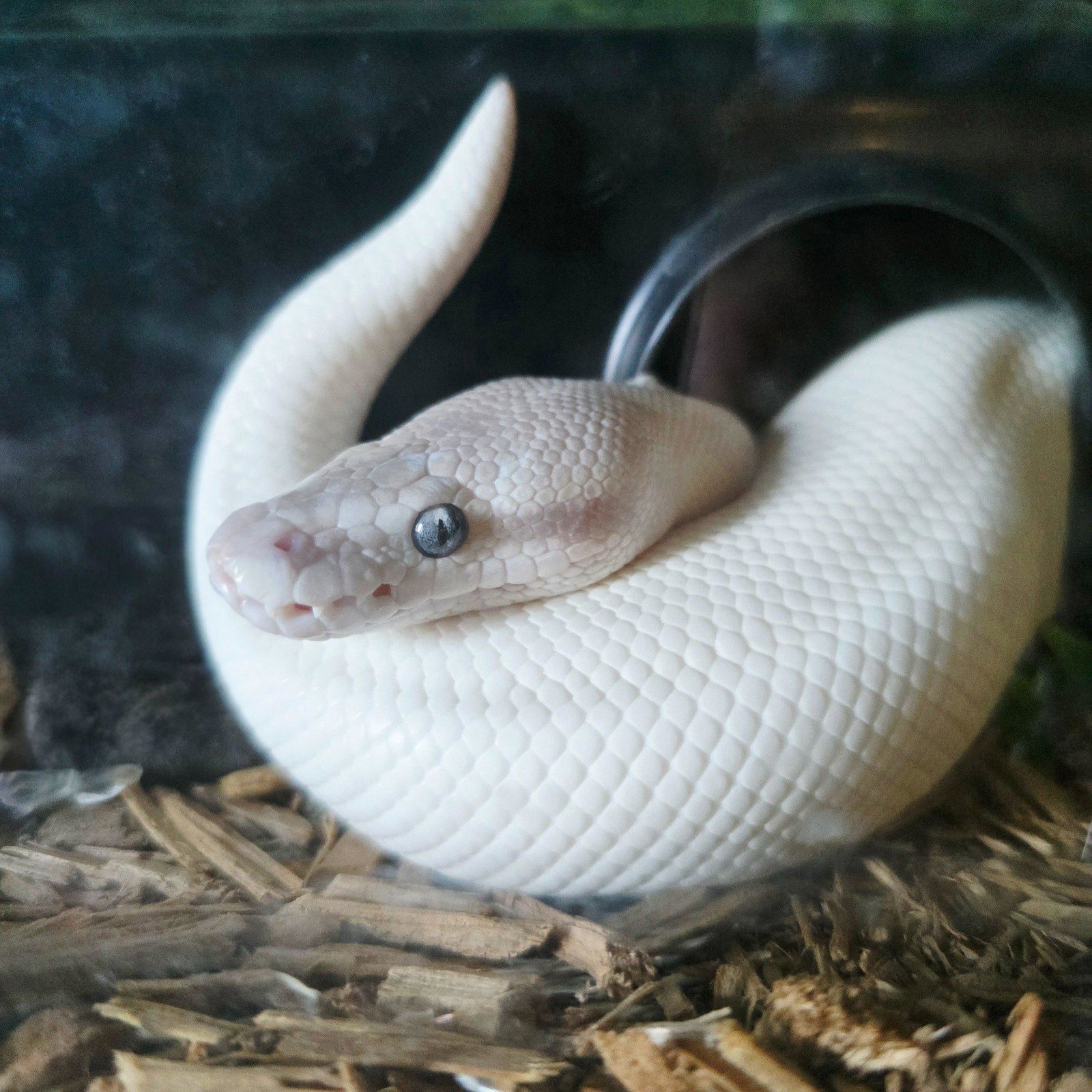
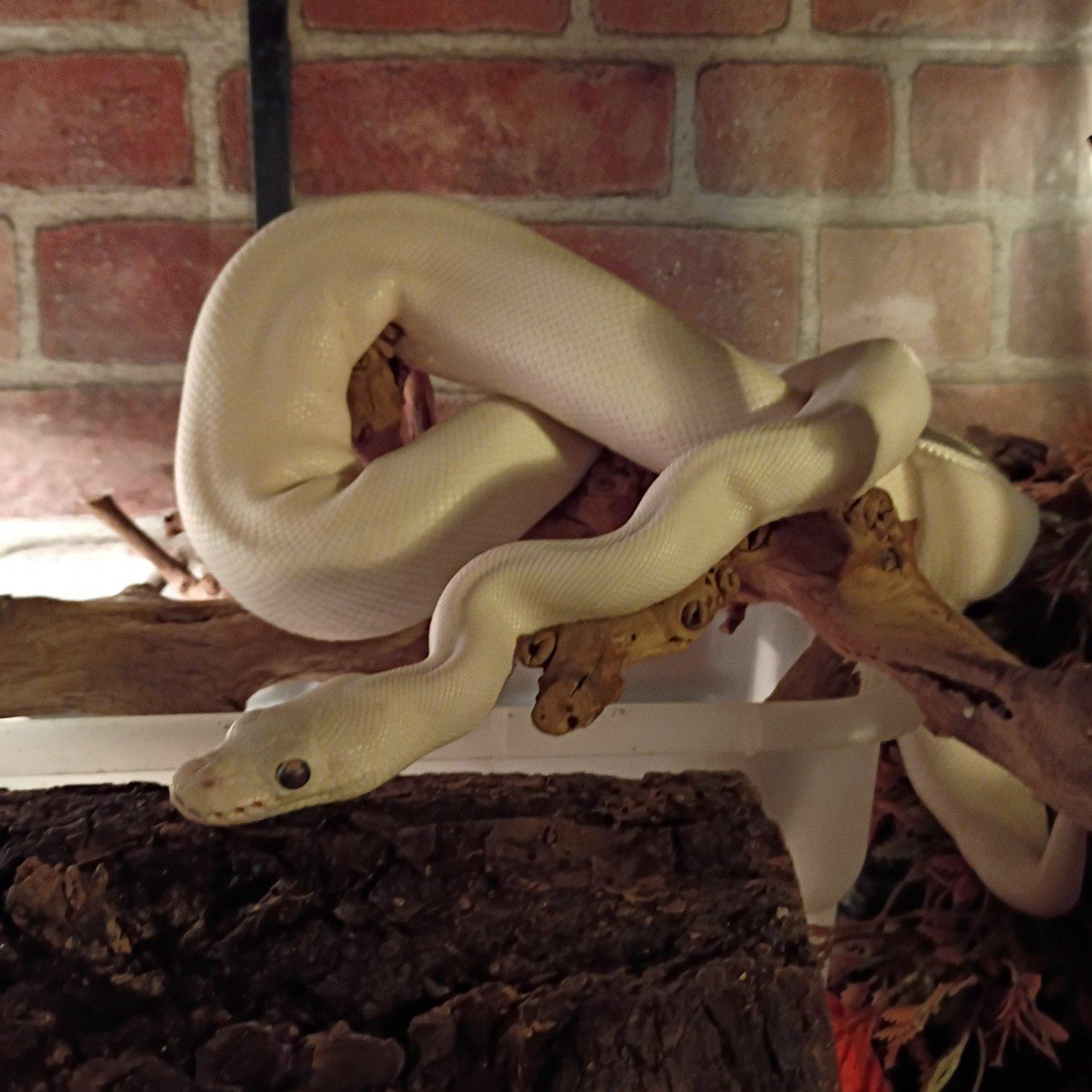
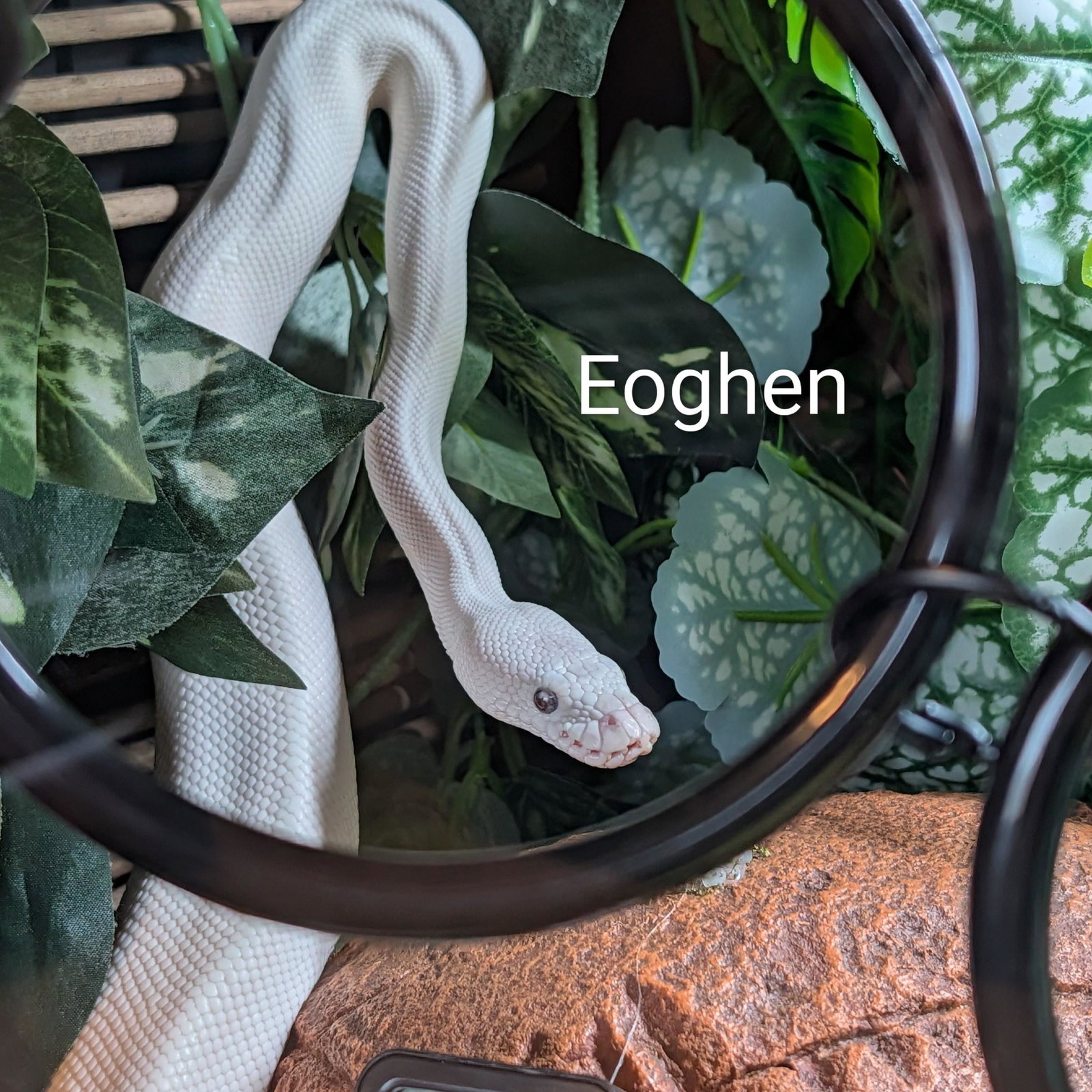
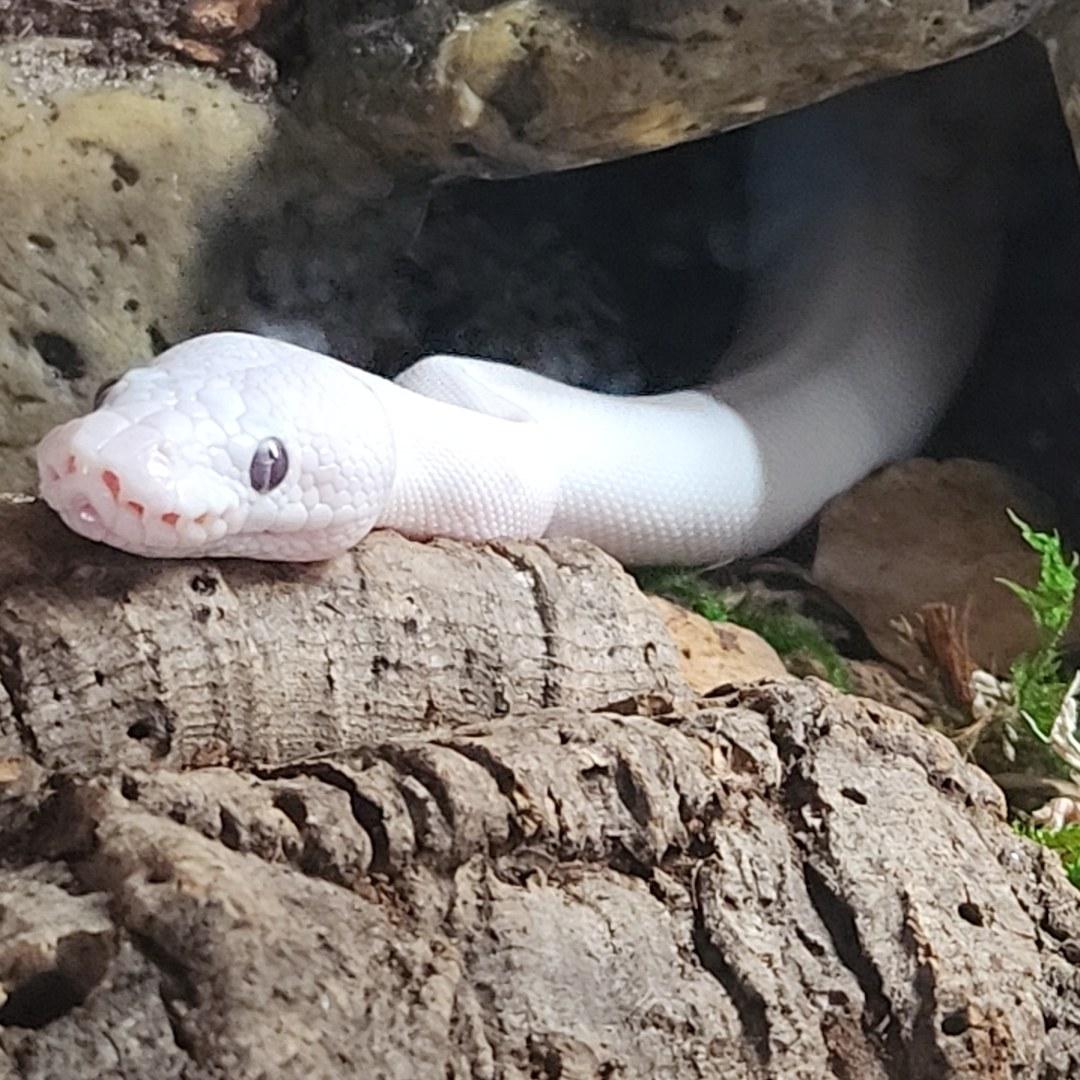
A blue-eyed leucistic ball python, usually shortened to BEL, is a ball python that is white from nose to tail, with no pattern, and has blue eyes. It is not a single gene. A BEL is what you get when a snake inherits two copies of certain genes from a group breeders call the BEL complex (also called the platinum complex): Mojave, Lesser, Butter and Russo are the best known, and pairings such as two Lessers, two Mojaves or a Lesser with a Mojave all produce one. It is leucistic, not albino, which is why the eyes are blue rather than pink. And it is still a ball python, so it lives as long and needs exactly the same care as any other ball python.
This guide covers how the BEL complex works, what the common pairings produce, how to tell a BEL from the other white ball pythons, and what to ask for before you buy one. Creatures has no BEL listings right now, so the easiest way to hear about one is to set a free BEL listing alert (no account needed to start). For day-to-day husbandry in depth, our ball python care guide covers the enclosure, humidity, feeding and shedding.

| What it is | A color combination in the ball python (Python regius), not a separate species and not a single gene |
|---|---|
| Look | Solid white to off-white with no pattern, and blue eyes |
| How it is made | Two copies of BEL-complex genes, for example Lesser x Lesser, Mojave x Mojave, Butter x Mojave or Lesser x Mojave |
| Gene action | Each complex gene shows with one copy. Two Mojave, Lesser or Butter copies, in any mix, make the white form; some other complex pairings keep color. The hobby says codominant; incomplete dominant is the more exact term |
| Look-alikes | Albino (white and yellow, eyes without dark pigment), black-eyed leucistic and ivory (white with dark eyes), high-white piebald (patches of normal pattern) |
| Breeding | A BEL bred to a normal gives no BELs; two BELs built from Mojave, Lesser or Butter give only BELs |
| Adult size | About 0.9 to 1.5 m (3 to 5 ft), females larger |
| Care | Identical to any ball python; nothing about the color changes the husbandry |
Browse listings, public profiles, breeders, or add your animal.
What “blue-eyed leucistic” means
Leucistic and albino both describe a pale snake, but they are different things, and the difference is the whole reason a BEL’s eyes are blue.
Albino means a loss of melanin, the brown-to-black pigment. A 2022 community-science study of pet ball pythons in PLOS ONE (Brown and colleagues) tied the Albino morph to variants in TYR, the gene for the enzyme that starts melanin production, and described albinos as having little or no melanin in the skin and eyes while their red-to-yellow coloring is untouched. So an albino ball python is white and yellow, and its eyes, with no dark pigment in them, usually look pink.
Leucistic goes further. A 2023 study in the journal G3 (Dao and colleagues) points out that all-white skin in a ball python cannot come from a defect in making one pigment, because that would leave the other pigments in place. All-white skin instead suggests that several kinds of color cell (chromatophores) are missing outright: no melanin-bearing cells, so no brown or black, and no yellow-bearing cells, so no yellow. What remains is white skin, and in a BEL, blue eyes rather than an albino’s pink.
Blue-eyed separates the BEL from the near-white ball pythons with dark eyes, such as the black-eyed leucistic and the ivory. More on those below.
The same color words turn up across snake species, but the genes behind them do not cross over. An anery boa constrictor, for example, is missing red pigment because of a different gene in a different snake, and nothing about the BEL complex applies to it.
The BEL complex: which genes make a BEL
Every ball python carries two copies of each gene, one from each parent. Breeders treat Mojave, Lesser, Butter, Russo and a handful of other morphs as different versions of the same gene, what geneticists call alleles. A snake with one of these alleles and one normal copy shows that morph. A snake with two Mojave, Lesser or Butter copies, in any mix, is white with blue eyes, while some pairings with other members keep color (see the pairings section below). That group of alleles is the BEL complex.
The members you will meet most often:
- Mojave. A single-copy morph that the World of Ball Pythons morph database, a widely used hobby reference, describes with browns, blue-grey tones, heavy flaming and an unmarked white belly. Two Mojaves make a super Mojave, which is a BEL.
- Lesser. The same database records that the two-copy form of Lesser is the BEL, sold as a super Lesser.
- Butter. The same database describes Butter as genetically identical to Lesser but descended from a different wild-collected bloodline. A super Butter is a BEL, and a Butter bred to a Lesser behaves like a Lesser bred to a Lesser.
- Russo. Often sold as “Russo het leucistic.” That is a hobby name rather than a description: Russo shows with one copy like the others, and the database notes that it makes blue-eyed leucistic combinations.
- Phantom, Mystic, Special and Bamboo. Placed in the complex by the database, by a 2026 study, or both, but their combinations are where names and looks disagree most. See the section on pairings below.
The “complex” idea comes from breeding results. Pair a Lesser with a Mojave and some of the babies come out white with blue eyes, just like a super Lesser or a super Mojave. That is what you would expect if the morphs were versions of one gene. It is strong hobby evidence, built from decades of clutches, but it is not the same thing as a mapped gene.
Codominant or incomplete dominant?
Listings almost always call these morphs “codominant.” The NIH’s National Human Genome Research Institute defines codominance as two alleles expressed separately and side by side, as in the AB blood type. That is not what happens here. One copy produces a visibly changed, usually lighter snake, and two Mojave, Lesser or Butter copies produce a far stronger version of the same change: an all-white one. That pattern is better described as incomplete dominance, which is how the World of Ball Pythons database classifies Mojave, Lesser, Butter, Russo, Phantom, Mystic and Special.
The practical rule is the same whatever the label: one copy shows, and two Mojave, Lesser or Butter copies make the white form. Pairings with Phantom, Mystic or Special can keep color, as the section on where names and looks disagree explains. There is no hidden “het Lesser” or “het Mojave.” A snake with one copy is a visible Lesser or Mojave.
What the science has, and has not, confirmed
The gene behind the BEL has not been nailed down. Two papers come closest.
The 2023 G3 study by Dao and colleagues refers to a “Blue-Eyed Leucistic series” of morphs, citing standard hobby references, and notes that some morphs in it show stripes along the back. The study’s own work was on a different white snake: it tied the yellow belly series, whose two-copy form is the near-white ivory, to loss-of-function variants in an endothelin receptor gene, EDNRB2. Endothelin signaling helps color cells develop, which fits the missing-cell explanation above. (The journal later corrected the paper’s gene names, which is why some databases still label the gene differently.)
A small 2026 study in the Brazilian Journal of Biology (Kumsiri and Kanchanaphum) went after the BEL directly. It ran quantitative PCR on shed skins from four normal ball pythons, eight from the complex (the authors call it the platinum complex) and four BELs. The normal snakes gave a clear signal for an endothelin receptor B gene (EDNRB), the complex snakes a weaker one, which the authors read as one normal copy instead of two, and the BELs none at all, so the authors propose EDNRB as the candidate gene. Treat it as a promising lead, not an answer. The test primers were designed from the horse gene because no ball python sequence was available, nothing was sequenced, and the authors themselves note that the mechanism is not fully understood and that sequencing is the next step to confirm the suspected deletion. Nobody has yet shown whether the BEL and ivory involve the same gene.
A little hobby history from the database: it dates the first super Mojave to 2000 and the first Lesser and super Lesser to 2001. Those are breeder-reported dates, not an independent record.
What the common pairings produce
The odds below are simple Mendelian math, assuming each complex morph is one allele of the same gene, that one copy shows, and that two Mojave, Lesser or Butter copies in any combination make a BEL. They are averages over many clutches. A ball python clutch runs from 1 to 11 eggs, according to the University of Michigan’s Animal Diversity Web, so any single clutch can land well off them.
- Lesser x normal: about half Lessers, half normals. No BELs.
- Lesser x Lesser: about 1 in 4 BELs (super Lessers), 2 in 4 Lessers and 1 in 4 normals.
- Lesser x Mojave: about 1 in 4 BELs (Lesser Mojaves), 1 in 4 Lessers, 1 in 4 Mojaves and 1 in 4 normals. The normal-looking babies carry nothing from the complex.
- BEL x normal: no BELs. Every baby gets one complex gene from the BEL parent. A super Lesser gives all Lessers; a Lesser Mojave BEL gives about half Lessers and half Mojaves.
- BEL x Lesser (or Mojave, or Butter): about half BELs and half single-gene snakes.
- BEL x BEL, both built from Mojave, Lesser or Butter: every baby is a BEL. Two Lesser Mojave BELs, for example, give about 1 in 4 super Lessers, 2 in 4 Lesser Mojaves and 1 in 4 super Mojaves. They all look white, but they are not genetically the same.
That last line is why the label alone is not enough. Two BELs that look identical can carry different genes, and a breeder who pairs them with something else will get different results. A super Lesser bred to a normal gives a clutch of Lessers; a Lesser Mojave bred to a normal gives a mix. Ask which two genes a BEL carries, and expect the answer to come from its parents.
To explore a pairing, use the free Ball Python Morph Calculator. It shows the possible morphs per egg, carrier chances and sourced health notes for the genes it can calculate.
A BEL can also carry other genes, such as a single copy of a recessive morph, which no snake shows on the outside. Only the records tell you.
Where names and looks disagree
The Phantom, Mystic and Special combinations are the messy corner of the complex. Mojave x Mystic is sold as Mystic Potion, which the World of Ball Pythons database calls a purple snake from the BEL complex; Mojave x Special is sold as Crystal, which it also lists as a BEL-complex combination; and Mojave x Phantom is sold under the hobby name Purple Passion, for which it gives no description. The 2026 study, meanwhile, pictured a Phantom x Mojave snake as one of its examples of BEL variation. So a two-gene snake from this corner may be sold as a BEL or under its own trade name, and may carry a purple tint. When a white snake’s genetics include Phantom, Mystic or Special, look at it yourself after a shed, look at the parents, and do not rely on the trade name.
What a BEL looks like, and the white snakes it gets confused with
A BEL is simple to describe and easy to misidentify from a photo.

- Body: white to off-white from head to tail, belly included, with no pattern. Some BELs carry a trace of color. The 2026 study showed super Mojave BELs with a pale grey-black wash on the head, while BELs without Mojave in them were white across the whole body, and the G3 paper notes stripes along the back in some morphs of the series.
- Eyes: blue. Before every shed a snake’s skin dulls and its eye caps turn opaque, as the Merck Veterinary Manual’s pet-owner chapter on routine care describes, so any snake’s eyes can look milky before a shed. Judge eye color, in person or in a photo, on a freshly shed snake.
The other white and near-white ball pythons, and how they differ:
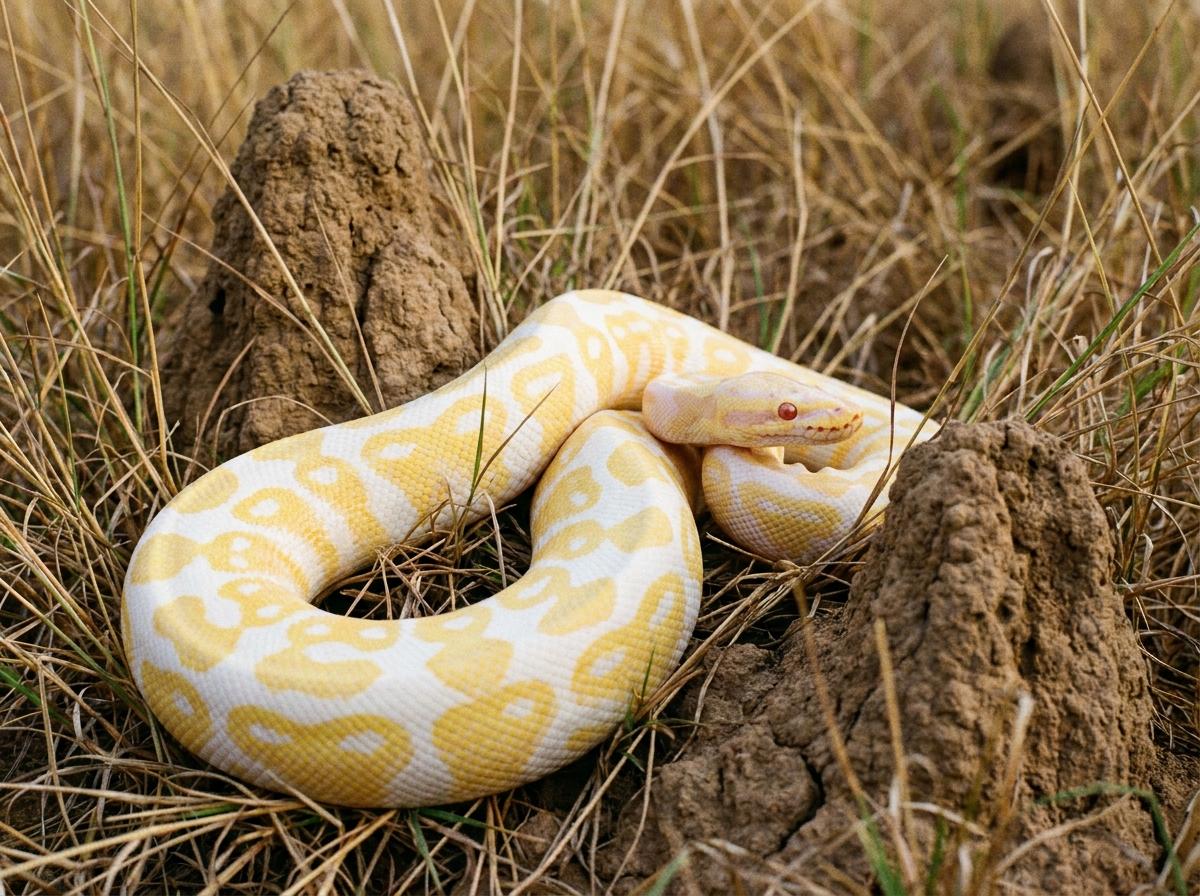
- Albino and lavender albino: melanin gone, yellow kept. Expect a yellow or orange pattern on white or lavender, and eyes without dark pigment. The Brown study tied lavender albino to a different melanin gene, OCA2.
- Black-eyed leucistic: white, but with dark eyes. The usual version is the super Fire, two copies of the Fire gene, which the database also lists as the black-eyed leucistic.
- Ivory: the two-copy form of yellow belly. The 2026 study describes ivories and super Fires alike as having yellow patches along the middle of the back and black eyes.
- High-white piebald: large white areas, but with islands of fully patterned skin. Piebald is a recessive trait from a different gene, so it has nothing to do with the BEL complex.
So the quick field check runs in this order: eye color first (blue, dark or pink), then any yellow, then any patch of normal pattern. After that, the parents’ records settle it.
Size, lifespan and temperament
The genes change pigment, not size, growth or behavior.
Size. Animal Diversity Web puts adult ball pythons at about 0.9 to 1.5 m (3 to 5 ft), with occasional wild reports to 1.83 m, and hatchlings at 25 to 43 cm. Adult females are larger than males.
Lifespan. The same account gives an average captive lifespan of about 20 years, with captive maximums reported from 28 to 50 years. Our ball python lifespan guide explains what those records do and do not mean for planning. A BEL bought as a hatchling is a commitment of two decades or more.
Temperament. The Merck Veterinary Manual describes ball pythons as tending to be shy and docile, with husbandry and nutrition that are relatively easy to get right, and notes that numerous color morphs are available. A BEL behaves like any other ball python, which means a snake that would rather hide than bite, and that tucks its head into a tight ball when it has had enough handling.
One problem that is not a BEL trait: the neurological “wobble” some ball pythons show. A 2022 PLOS ONE study linked the wobble to malformed inner-ear structures in spider morph ball pythons, and no study we found has linked it to the BEL complex. The documented cases are in the spider morph. If a white snake’s genetics include Spider, ask about wobble for that reason.
Housing and care: a BEL is a ball python
Nothing in the veterinary literature asks for anything different for a white ball python. What follows is the short version, with the numbers that matter. The ball python care guide goes deeper on each point.

- One snake per enclosure. Merck’s husbandry chapter says most nonbreeding pet snakes are best kept singly, because feeding injuries are common in groups.
- Enclosure size. Merck’s professional minimum for boas and pythons is 0.6 square meters of floor per meter of snake. A 1.2 m (4 ft) adult needs about 0.72 square meters, which a 4 by 2 ft footprint just clears. The RSPCA’s recommendations, summarized in a 2020 welfare study in Animals (D’Cruze and colleagues), ask for an enclosure at least as long as the snake, with width and height each at least a third of its length. For an average adult, a 4 by 2 ft footprint with about 2 ft of height meets both. Treat that as a floor: the same study’s scoring counted only an enclosure about one and a half times the snake’s length as adequate, so go longer whenever you can, and always for a big female. Merck prefers wood, plastic or fiberglass enclosures to glass aquaria. Fit a lock.
- Heat. Merck’s species table gives the ball python a preferred range of 25 to 30 C (77 to 86 F). Put the heat at one end so the snake can choose along a gradient, run every heat source through a thermostat, and keep two thermometers, one at each end. Merck’s pet-owner housing chapter says heat lamps and ceramic heat emitters should be guarded from contact and placed more than 18 inches (45 cm) above the substrate, and that radiant heat panels can be fixed to the enclosure roof to heat downward. In a 2 ft tall enclosure with 2 to 3 inches of substrate, only a heat source fitted flush to the ceiling keeps that distance. Under-tank heaters should cover no more than 30 percent of the floor. No heat rocks: Merck says they frequently burn larger reptiles.
- Humidity. Merck’s species table lists 50 to 80 percent relative humidity for the ball python, and its pet-owner chapter says to raise humidity slightly once the skin and eye caps turn opaque before a shed. Measure it with a hygrometer.
- Hides. At least two, one at the warm end and one at the cool end. The RSPCA-based scoring in the Animals study counts a hide as adequate only if it covers the whole coiled snake. With only one hide, the snake has to choose between the right temperature and feeling secure.
- Water. A bowl large enough for the snake to soak in fully, per the RSPCA recommendations.
- Substrate. Cypress mulch, aspen shavings, paper-based bedding, peat moss and potting soil have all been used successfully, according to Merck’s pet-owner chapter, which advises against sand, gravel and corncob (easily swallowed) and against cedar and pine shavings (irritant oils). The RSPCA recommendations add that substrate should let the snake burrow. Do not feed on loose bedding; Merck suggests feeding on newspaper in a separate container.
- Food. Thawed or freshly killed rodents, not live ones. Merck advises against live prey because of the injuries prey can inflict on a snake and for the prey’s own welfare. Prey size and feeding intervals are in the care guide.
A white snake does make some problems easier to see. Mites show as dark specks, and stuck shed and dirt stand out on white scales. Use that: look the snake over at every feed.
One more thing to know before you buy. The same 2020 Animals study looked at 4,855 ball pythons on display at six exotic pet expos in North America and Europe in 2018. Every one was in a container shorter than the snake, with no hide and no water, and where morph was recorded, 94 percent were advertised as captive-bred morphs. The cup a BEL comes home in is a transport box, not a model for its home.
Health: what is and is not known about BELs
We found no published study linking the BEL complex itself to a health problem. You will read hobby claims that one BEL recipe or another is more problem-prone than the rest; we found no peer-reviewed comparison of BEL combinations, so judge the individual snake: its feeding record, sheds, weight, eyes and breathing.
The health problems that do matter are the ones every ball python can have. Merck’s chapter on viral diseases of reptiles describes inclusion body disease, caused by a reptarenavirus, as most common in boas and pythons, with a faster and more severe neurological course in pythons. Breeding, fight wounds, fecal contamination and snake mites are the routes Merck names for its spread. Merck’s husbandry chapter recommends a quarantine of 3 to 6 months for any new reptile, so a new BEL should live apart from any snakes you already keep for that long. Respiratory infections, mites, scale rot and mouth infections are covered in the care guide, and none of them are home-treatment projects. Find a vet before you need one; our guide to finding a reptile vet explains how.
Buying a BEL: what to ask for
Because two BELs that look the same can carry different genes, the snake is only half of what you are buying. The records are the other half.

- Which two genes. Super Lesser, super Mojave, super Butter, Lesser Mojave, Butter Mojave, a Russo combination, or something else? If you ever plan to breed, this decides what the snake can produce.
- The parents. Photos of both, with their stated genes. A Lesser Mojave BEL should come from parents that carry Lesser and Mojave between them.
- The eyes after a shed. A photo of the snake freshly shed, with clear eyes, settles blue versus dark.
- Other genes. Anything else the snake carries, stated precisely. “100% het” for a recessive means the breeder knows it is there because of a parent; “50% possible het” or “66% possible het” is a probability, not a fact.
- Hatch date, feeding and shed history, and weight. A young ball python should be eating thawed or pre-killed prey reliably before it goes home. Ask how many meals it has taken.
- Genetic testing. Commercial shed-skin DNA tests now exist for some complex genes. The World of Ball Pythons database, which is published by a genetic-testing lab, lists tests for Mojave, Butter and Lesser, Russo, Special and Phantom, and none for the other combinations. Labels drift when a look is ambiguous: when the G3 study genotyped 130 snakes their owners described as single-copy yellow bellies, 98 carried a yellow belly variant and about one in four carried none.
- Quarantine and mite control. Ask how new animals are quarantined and whether the collection has any history of inclusion body disease.
Written records are what make those answers last past the sale. On Creatures, every animal profile has a Pedigree tab where you can link the sire and dam, including “reference” profiles for parents you do not own, and feeding, shed, weight and test-result records stay with the snake when it is transferred to a new owner. A genetic test report can be attached to a Test Result record. If you want a printable three-generation chart first, the free pedigree chart maker includes ball pythons in its species list and works without an account.
What does a BEL cost?
We could not find a reliable public price index for BELs, so we will not quote one. A few things are clear. BELs are a long-established combination (the database dates the first super Mojave to 2000), so a plain BEL is not priced like a brand-new gene. Snakes carrying additional genes are usually priced higher, and price also varies with sex, size, feeding record and how well the breeder documents the genetics.
Whatever the snake costs, the enclosure, thermostat-controlled heat and a first visit to a reptile vet are a large part of the first-year budget. If you are still weighing a ball python against a smaller first reptile, our crested gecko cost guide prices that alternative line by line.
Is a ball python legal where you live?
Ball pythons are widely kept as pets, but rules on keeping snakes, and pythons in particular, are set by states, counties and cities, and landlords and homeowner associations can add their own. They also change. Check your state wildlife agency and your local ordinances before you buy, and keep any permit with the snake’s records. Outside the US, national and local rules differ widely.
Frequently asked questions
Is a blue-eyed leucistic ball python an albino?
No. An albino loses melanin but keeps its yellow pattern, and its eyes usually look pink. A BEL is white all over, with blue eyes, because several kinds of color cell are missing rather than one pigment.
Is a BEL the same as a super Lesser?
A super Lesser is one kind of BEL. So are a super Mojave, a super Butter, a Lesser Mojave and a Butter Mojave. They look alike and are all sold as BELs, but they carry different gene pairs.
Can two BELs produce normal-looking babies?
Not if both are built from Mojave, Lesser or Butter: every baby inherits one complex gene from each parent, so every baby is a BEL. A BEL bred to a normal produces no BELs at all.
What is the difference between a blue-eyed and a black-eyed leucistic?
The eyes, and the genes behind them. The black-eyed leucistic is usually a super Fire, from a different gene, and the 2026 study describes super Fires as having yellow patches along the back as well as black eyes.
Do BEL ball pythons have health problems?
We found no published evidence of a health problem caused by the BEL complex, and no study comparing BEL recipes. The wobble documented in ball pythons is tied to the Spider morph. Watch a BEL for the problems every ball python can have.
How big does a BEL get?
The same as any ball python: most adults are about 0.9 to 1.5 m (3 to 5 ft), and females are larger than males.
Does a white snake need special lighting?
Not according to any veterinary source we found. Merck lists no special lighting requirement for the ball python, though it still recommends broad-spectrum light as likely beneficial for reptiles in general. A BEL’s enclosure is a ball python enclosure.
Do this next on Creatures
Whether you are still researching, waiting for the right snake or already keeping a BEL, Creatures keeps the listings, breeders, genetics and records in one place.
Get listing alerts. There are no BEL listings right now, so set a free BEL listing alert and we will email you about new matching listings. No account needed to start. See saving searches and using your watchlist.
Look for breeders and listings. Check the ball python breeders in the directory (a short list so far) or browse the full Creatures breeder directory, and check BEL listings on the marketplace. Ask every seller which two genes the snake carries.
Add your snake. Already have a BEL? Create a free profile for your blue-eyed leucistic ball python, no account needed to start, note which two genes it carries, and link its sire and dam on the Pedigree tab. The walkthrough is in adding an animal to Creatures, and reference animals explains how to add parents you do not own. Need a name? Try the ball python name generator.
Keep the records. Add feeding, shed, weight and test-result records so problems show up as a trend and the genetics stay documented. The record sheet opens for any visitor, and a free account saves what you enter. See adding a record and health and medical records, set feeding days and the annual checkup as reminders, and use the ball python feeding and shed log guide to record each event cleanly.
Breed ball pythons? Create your breeding operation’s profile, no account needed to start, then get listed in the breeder directory so buyers looking for documented BEL pairings can find you.