Ball Python Breeding: Pairing, Pre-Lay Shed, Egg Incubation and Clutch Records
Author: Elliott Garber, DVM · Published
Ball python breeding comes down to four things: a mature female in good condition, a pairing you have worked out on paper first, close watching through ovulation and the pre-lay shed, and about two months of steady, warm, humid incubation once the eggs are down. Put the dates you already have into the free ball python incubation calculator: from a pre-lay shed it projects the lay window, and from a lay date it projects the hatch window.
Sources checked November 14, 2026. This guide covers planning, observation, incubation and records. A gravid female who looks unwell, has gone past her expected laying window or has laid only part of a clutch belongs with a reptile veterinarian, and nothing here replaces that visit. There are no drug names or doses in this article.
The numbers below come from the Animal Diversity Web species account, Merck Veterinary Manual, field studies of brooding females and a long-run study of a commercial breeding colony. Where breeders and published sources describe a timing differently, both are named. Treat every date as a window, then write down what your own snakes actually did.
| Maturity | Animal Diversity Web: females 27 to 31 months, males 16 to 18 months |
|---|---|
| Female readiness | Good body condition and a clean health history, not age alone |
| Wild season | Breeding mid September to mid November; laying mid February to early April |
| Pre-lay shed to eggs | About 27 to 35 days in the timing the Creatures calculator uses |
| Clutch size | 1 to 11 eggs; about 7 on average in a large captive colony |
| Incubation | About 88 to 90 F, the range the Creatures calculator assumes; hatch in about two months |
| Hatchlings | 25 to 43 cm long, 65 to 103 g, independent from hatching |
| Call a reptile vet | Past her laying window, a partial clutch, prolapsed tissue or a weak female |
Is your female ready to breed?
Age is the floor, not the answer. Animal Diversity Web gives reproductive maturity at 27 to 31 months for females and 16 to 18 months for males, which is why a male is often used a season or more before a female of the same age. A female who has reached that age but is thin, recovering from illness or still putting on length is not a breeding prospect yet.
Judge her on condition and history. Look for good muscle tone, a rounded rather than ridged back, steady feeding over the months before the season and normal sheds. The dated weights and meals in a ball python feeding and shed log show that trend far better than a single weigh-in on the day you decide. Producing and brooding a clutch costs her body reserves, so a female who goes into the season light comes out of it lighter. There is no single published weight that makes a female ready. Use her own trend and your veterinarian’s opinion of her condition.
Check the plan for the babies before the pairing, too. Animal Diversity Web records clutches of 1 to 11 eggs. A study of a commercial colony in Utah averaged about 7 eggs per clutch across 783 clutches (Morrill and colleagues, Herpetological Review, 2011). Every hatchling needs its own setup, food and records. The RSPCA’s royal python guidance describes the species as naturally solitary and housed alone, so a good clutch means several new enclosures, not one.
The ball python care guide covers the everyday setup your adults should already be in before you breed them.
Plan the pairing on paper first
Work out what the pairing can produce before the snakes meet. The free ball python morph calculator takes each parent’s genes and lists every possible hatchling as a fraction per egg, with het odds for normal-looking babies. It also flags reported health problems with their sources and leaves out genes whose inheritance is not settled rather than guessing.
Those odds are per egg, not per clutch. A pairing with a one in four chance of a recessive visual can produce none in a clutch of six, or three. Possible hets are the other common source of disappointment. Two hets paired together give normal-looking offspring that are each 66% possible hets, and a pairing built on a possible het may not carry the gene at all. Keep the het status you were actually given, with its source, separate from the visual.
Genetics also carries welfare. In a small study of spider morph pythons, Starck and colleagues (PLOS ONE, 2022) reported that all the spider morph snakes they examined showed the wobble condition and had malformations of the inner ear. The ball python morphs guide covers that and other morph health questions, and individual guides such as the piebald ball python and clown ball python explain the recessive odds in detail.
Write down the sire you actually used. If you introduced more than one male to a female in a season, record the possible sires as possible, not as a single certain father.
When ball pythons breed, and how pairing works
In the wild, Animal Diversity Web puts the breeding season mainly from mid September to mid November, matched to the minor rainy season, with laying in the second half of the dry season from mid February to early April and hatching from mid April to mid June. Captive breeders usually plan their own season around the cooler months and a slight seasonal change in their room, then watch the animals rather than the calendar. There is no published cooling temperature that every keeper uses, so change one thing at a time and record what you changed. This is a small seasonal shift in the room, not brumation, which the RSPCA advises against for royal pythons.
Keepers usually introduce the male to the female’s enclosure for a visit and take him out again afterward, rather than housing a pair together. Watch the first introduction, separate them if either is stressed or one tries to feed, and note every date you saw interest or a lock. Those dates matter later: they bracket the window when ovulation is likely.
Expect feeding to change. The RSPCA notes that royals “have a reputation for going off their food,” and many males and some females refuse meals during the season. A short, expected fast in a well-conditioned adult is different from steady weight loss. If a snake is losing condition, or stops eating outside a pattern you have seen before, see a reptile veterinarian.
From ovulation to eggs
The breeding sequence that matters for your calendar runs in three steps: ovulation, the pre-lay shed and laying.
Ovulation. Keepers describe a brief, visible swelling partway down the female’s body. It is easy to miss, and many females ovulate when nobody is watching. Animal Diversity Web gives a “gestation period” of about 44 to 54 days. The Creatures calculator works from ovulation to laying in 44 to 56 days, often around day 50. If you saw ovulation, record the date. If you did not, the pre-lay shed is the more dependable marker.
The pre-lay shed. A gravid female sheds once before she lays. The calculator projects laying 27 to 35 days after that shed, often around day 31, which is breeder-reported timing rather than a clinical rule. This is the shed to write down carefully, because it tightens the window you are planning around.
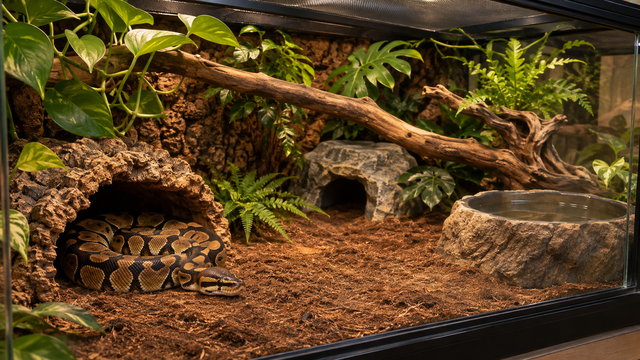
Laying. Give her a suitable laying hide well before the window opens: a secure, roomy hide she can coil inside, with a slightly damp substrate and the same warm and cool sides as her normal enclosure. Merck lists “provision of solitude and a suitable substrate” among the husbandry steps for a female having trouble laying. Disturb her as little as possible as the date approaches.
When to call a reptile veterinarian
Reptile egg retention does not look like a mammal in labor. Merck says dystocia “is generally not a sudden event” in reptiles and that eggs can be retained “for weeks or even months” after the normal laying time. That makes it easy to wait too long, especially when nobody knows the ovulation date. The diagnosis rests on examination, radiographs and ultrasound, and Merck notes that medical management “frequently fails” and surgery is often needed. Call your reptile veterinarian if:
- She is clearly past her projected laying window and still looks gravid, especially if no ovulation or pre-lay shed was recorded.
- She has laid part of a clutch and still looks swollen or keeps straining.
- Tissue protrudes from the vent. Merck lists dystocia and breeding trauma among the causes of vent prolapse. Get her seen promptly and do not try to push it back.
- She is weak, dull or losing condition during gravidity or after laying.
Do not try to massage eggs out or treat her with medicines from another keeper’s routine. If you have not found a reptile veterinarian yet, our guide to finding a reptile vet before you need one explains what to ask before the season starts.
Maternal incubation or an incubator
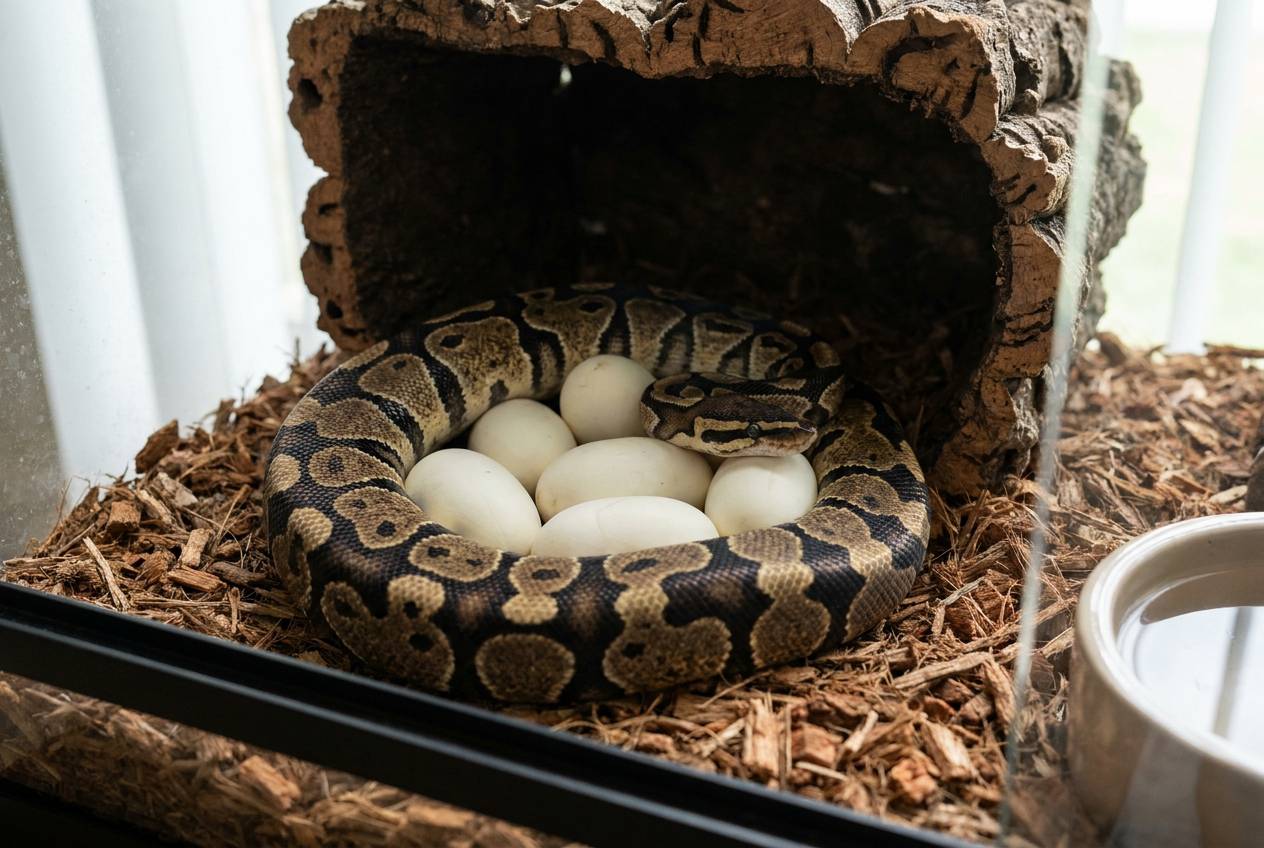
Female ball pythons coil tightly around their eggs until they hatch. Field work by Aubret, Bonnet, Shine and Maumelat on brooding females found that the main benefit is reducing water loss from the eggs. When the researchers added extra eggs to clutches, the enlarged clutches hatched later and more embryos died, because the female could no longer cover all the eggs well enough to stop them drying out (Biological Journal of the Linnean Society, 2003). That finding is a useful reminder of what any incubation setup has to do: hold the eggs warm and humid without letting them dry.
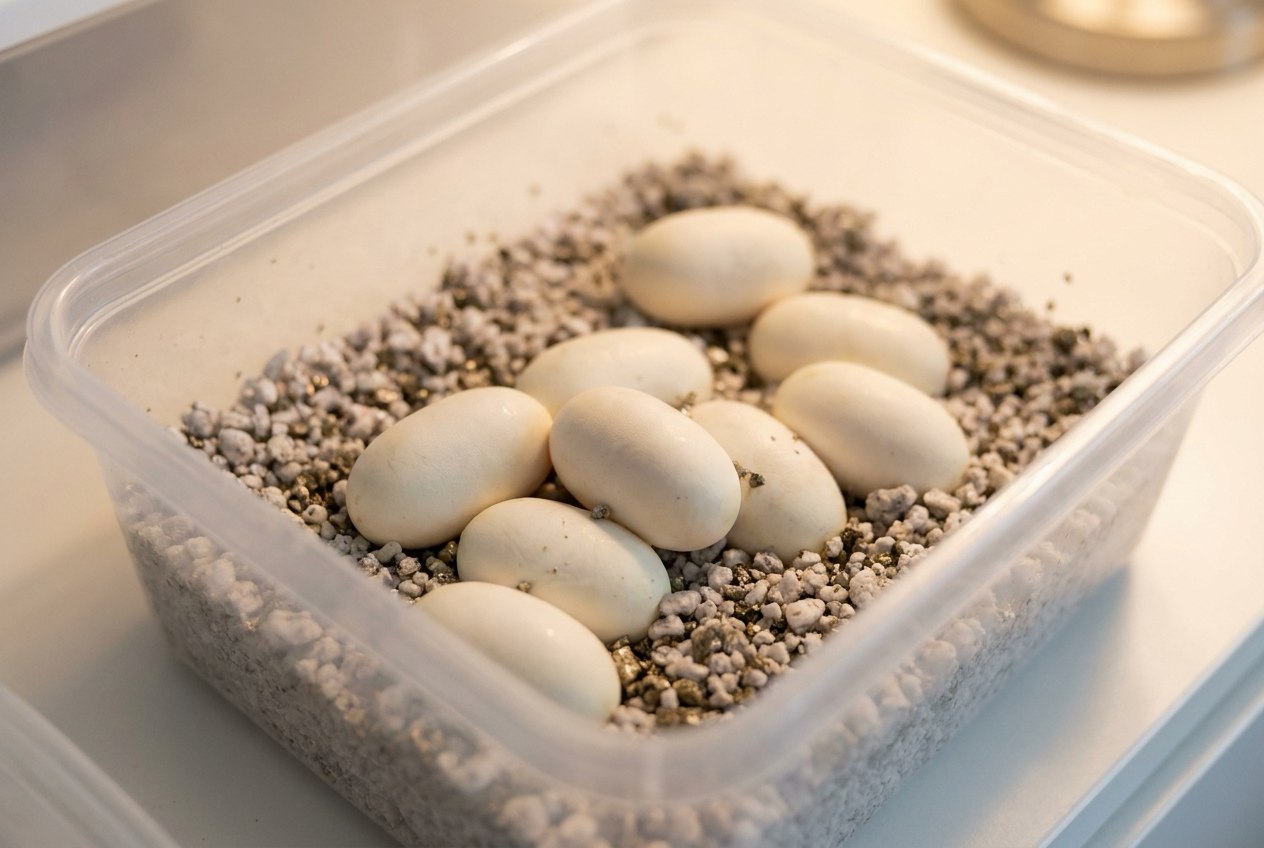
Most captive breeders take the eggs and use an incubator. The Creatures calculator assumes the common incubation range of about 88 to 90 F. Published colony results come from one operation’s own incubators and medium, so treat a figure from someone else’s setup as theirs rather than a target. Your incubator’s own probe reading, checked against a second thermometer at egg level, is the number to trust and to record.
Practical points breeders follow:
- Set the eggs as they were laid. Eggs often stick together in a cluster. Keepers leave stuck eggs together rather than pulling them apart, and keep each egg in the orientation it was found in.
- Hold humidity high without wetting the eggs. Damp medium and a closed box keep the air near saturation. Water pooling on the shells is a different problem from humid air.
- Check, do not fiddle. Open the box briefly to look for collapsing, moldy or discolored eggs and to let in fresh air. Note the date and what you saw.
- Count from the lay date. Record lay date, egg count and any eggs that were obviously infertile or damaged at the start, so your hatch rate later means something.
The incubation calculator gives a planning window, not a promise. Cooler incubators run longer, warmer ones shorter, and individual clutches vary.
Hatching and the first weeks
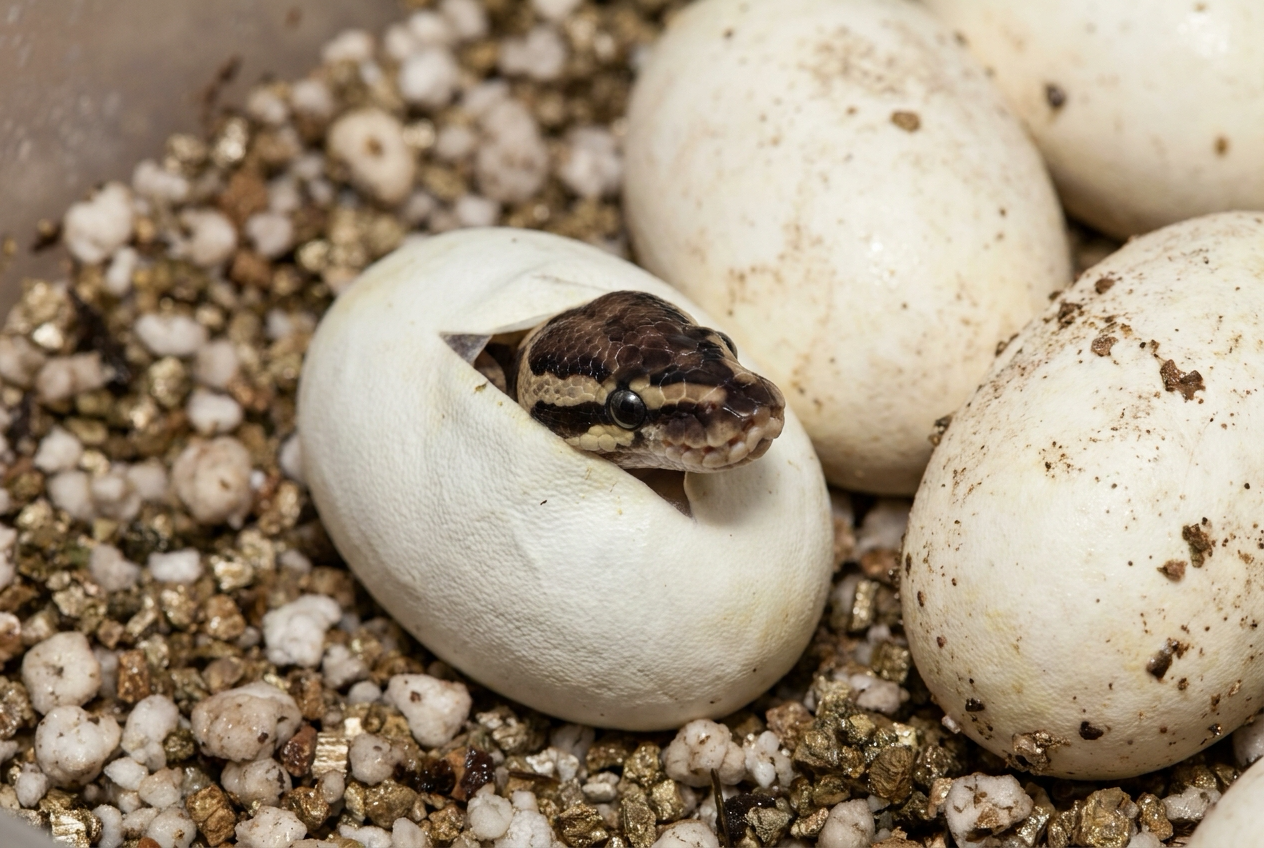
Expect hatching after about two months. Animal Diversity Web describes brooding lasting “approximately 2 months,” the Aubret clutch study incubated for a two-month period, and the Creatures calculator gives 55 to 60 days from laying, most often around day 57. Hatchlings slit the shell with their egg tooth. It is normal for a hatchling to put its head out and then sit in the egg for a while before leaving it. Leave it to come out in its own time, and ask your veterinarian before you intervene on an egg that has not opened when its siblings have.
Animal Diversity Web gives hatchlings as 25 to 43 cm long and 65 to 103 g, and “immediately independent.” Move each one to its own small, secure setup with a hide, water and the same warm and cool sides as an adult, and give it a clean identifier in your records the day it hatches. Weigh each hatchling, note sex if you can determine it, and record visuals and possible hets per animal, not just per clutch.
Many keepers wait until a hatchling has completed its first shed before offering a meal. The ball python feeding chart and the free feeding chart tool cover prey size and intervals from there. A hatchling that will not eat after several offers needs a closer look at its setup, and a reptile veterinarian if it starts to lose weight.
Recording a ball python clutch on Creatures
Everything above turns into dates and counts, and the value of a season’s records shows up the next time you pair the same female. This is how the job maps onto Creatures.
Start with the calculator. The free ball python incubation calculator takes a laid-on date, a pre-lay shed date or an ovulation date. From a lay date it shows the hatch window, and Track this clutch saves it with the egg count once you are signed in. From a pre-lay shed or ovulation date, choose the female to get an Eggs due reminder; a pre-lay shed is saved as a shed record on her too.
Record the breeding on the female. The breeding record (add-record type Breeding and Reproduction) has categories for natural mating, egg laying, incubation and hatching, with fields for the sire (pick one of your own snakes, type a name, or mark it unknown or off-platform), service dates, clutch size, incubation start, and eggs hatched and failed. Recording a breeding walks through it. The record sheet opens for visitors; a free account saves it.
Follow the clutch. Signed in, the Breeding dashboard lists your egg clutches alongside due dates for your females. A clutch keeps per-egg outcomes (hatched, stopped developing, failed without pipping and the other fates), shows the hatch window, and reports the hatch rate of eggs set, plus the rate of developing or fertile eggs when your candling and clear-egg records support it. Those numbers keep one season comparable with the next; they tell you where to look, not what went wrong.
Give each hatchling a profile. Select the parents when you set the clutch: the female it came from, and the male under Father, if known. Record the hatch on the clutch, and the hatchlings stay together as a brood until you create their individual profiles from it, when you are ready. When you create the profiles, Creatures can carry over the parent links; a parent owned by someone else may need their approval first. Linked parents give each profile a pedigree you can export, and the free pedigree chart maker builds a ball python chart for a buyer without an account. Record a hatch and add your chicks walks through the hatch and profile steps, which work the same way for a clutch of snake eggs. From there, each hatchling carries its own weights, feeding and shed records, and the reminders and upcoming care view surfaces what is due.
Run next year’s pairings from your own animals. Signed in, the morph calculator can use your own ball pythons as the parents instead of genes typed by hand, so you are not retyping each parent’s genes every season.
A record keeps your history; it does not certify a morph or prove a het. Label proven and possible hets as what they are, and keep photos of each hatchling’s first shed so buyers can see what they are getting.
Selling hatchlings with the records attached
Once hatchlings are feeding reliably and you know what each one is, the records you kept become the sales history. Listing on Creatures has no listing fee; when an animal sells, a 5% buyer service fee is added at checkout and a 5% seller service fee comes out of the payout (the seller fee is waived for Creatures Pro), and the pricing page has the details. The hatchling’s own profile keeps its hatch date, parents, weights and meals in one place to show a buyer rather than a single photo. The ball python price guide covers what buyers typically pay and what they expect to see.
Sell what you can describe accurately. A “66% possible het” hatchling should be listed as exactly that, with the pairing it came from. The Creatures for breeders page sets out the wider record and selling tools.
If you keep other egg layers, the same clutch workflow applies in our sister guides to bearded dragon breeding and leopard gecko breeding, where incubation temperatures and timings differ. The ball python species page links every ball python guide.
Frequently asked questions
How old does a ball python need to be to breed?
Animal Diversity Web gives reproductive maturity at 27 to 31 months for females and 16 to 18 months for males. Age is only the starting point. Breed a female who is in good condition with a steady feeding and weight history, and ask your veterinarian if you are unsure.
How long after the pre-lay shed do ball pythons lay eggs?
The timing the Creatures calculator uses is 27 to 35 days after the pre-lay shed, often around day 31. That is breeder-reported timing, so treat it as a window. If she goes well past it and still looks gravid, call a reptile veterinarian.
How long do ball python eggs take to hatch?
About two months. Animal Diversity Web describes brooding lasting approximately two months, and the Creatures calculator gives 55 to 60 days from laying at about 88 to 90 F, most often around day 57. Cooler incubation runs longer and warmer runs shorter.
What temperature should ball python eggs be incubated at?
The Creatures calculator assumes the common range of about 88 to 90 F, and its hatch window is an estimate. Hold the temperature steady, check it at egg level with a second thermometer, keep humidity high without wetting the eggs, and record what you measured so next season starts from your own numbers.
How many eggs does a ball python lay?
Animal Diversity Web records clutches of 1 to 11 eggs. A study of 783 captive clutches averaged about 7 eggs. Plan housing and food for a full clutch before you pair.
Should I let the female incubate the eggs herself?
Females brood tightly and, in field studies, brooding mainly protected the eggs from drying out. Most captive breeders use an incubator for steadier conditions. Whichever you choose, record the lay date, egg count and outcomes.
What are the signs of egg binding in a ball python?
Merck notes that reptile egg retention is usually slow rather than sudden, which makes it easy to miss. A female clearly past her laying window, one that has laid only part of a clutch and still looks swollen, tissue at the vent, or a weak and dull female all need a reptile veterinarian. Do not try to massage eggs out.
Do this next on Creatures
Keep the pairing, the clutch and every hatchling with the snakes they belong to.
- Record the pairing, pre-lay shed or egg laying on your female. This opens for visitors; a free account is needed to save it. How to add a record explains the fields.
- Add your ball python’s profile for each breeder and each hatchling, with genes, possible hets and identifiers. Guest signup can start in this flow. Adding an animal shows the fields.
- Create your breeding program’s profile so buyers can find the program behind the hatchlings. Getting listed in the breeder directory explains the public profile.
- Save a ball python listing alert if you are looking for a male or a new female for next season, and get an email when a matching listing appears. Saved searches and your watchlist explains how it works.
- Browse ball python listings to compare animals with their records. Availability changes; no particular morph is promised.
- Browse the breeder directory to find a program to talk to about breeding stock.