Leopard Gecko Breeding: Pairing, Lay Box, Egg Incubation and Temperature Sex
Author: Elliott Garber, DVM · Published
Leopard gecko breeding comes down to four jobs: a female in good condition, a short supervised pairing, a moist lay box ready before she needs it, and eggs held at a steady incubation temperature, which also decides whether the hatchlings come out mostly female or mostly male. The free leopard gecko incubation calculator turns each lay date into a hatch window, so you know when to start checking the tubs.
Sources checked November 14, 2026. Temperature and sex figures below come from peer-reviewed leopard gecko studies, health guidance from the Merck Veterinary Manual and veterinary care sheets. Anything about a sick, egg-bound or underweight female belongs with a reptile veterinarian, and this guide gives no drug or supplement doses.
Among lizards, this is one of the easier species to breed. The Merck Veterinary Manual notes plainly that they are “easily bred in captivity.” Easy does not mean free of risk to the female, and the breeders who keep good females for years are the ones who track weight, lay dates and incubator temperatures rather than relying on memory.
| Sexual maturity | Typically 9 to 18 months (LafeberVet); condition matters more than age |
|---|---|
| Housing | RSPCA advises keeping them alone; introduce the pair briefly and under supervision |
| Clutch | Usually two eggs, sometimes one; several clutches in a season |
| Lay box | Moist soil or a sand and soil mix, in place before she is due |
| Incubation | Damp vermiculite, stable temperature; 28.5 °C (83 °F) cited as optimal in one study |
| Sex | Set by incubation temperature: cool (26 °C) gave all females in the largest study, and no temperature gave all males |
| Upper limit | Constant incubation just above 35 °C (95 °F) appears lethal |
| Records to keep | Weights in grams, pairing dates, lay dates, incubator temperature, hatch outcome per egg |
Before you pair: is she ready?
LafeberVet’s veterinary information sheet on leopard geckos says leopard geckos “typically reach sexual maturity between 9-18 months.” It puts mature males at 60 to 90 grams and notes that females “may be as light as 45 grams.” Treat those numbers as the normal adult range, not a breeding threshold. A female that is merely old enough is not necessarily ready.
What experienced keepers look at is condition: a thick tail carrying fat, steady or rising weight across several weekly weigh-ins, normal sheds and a good feeding response. A female producing eggs is putting calcium and body reserves into every clutch, so a light or slipping female is a reason to wait a season and talk to a reptile vet, not to pair her anyway. LafeberVet advises dusting a non-breeding adult’s food with calcium weekly, “more often if the gecko is actively breeding.” Agree the actual schedule for a breeding female with your vet.
Weigh on a gram kitchen scale and keep every reading. The leopard gecko care guide covers the enclosure, heat and feeding a breeding animal needs before any of this applies. Log each weight as a dated record on her profile so a trend is visible before you put a male in with her.
Check what you are actually pairing. Some morph names carry health questions, and the leopard gecko morphs guide explains which ones to ask a seller about and why a photograph cannot reveal hidden alleles. A dated parentage record matters here: if you plan to sell hatchlings as “het” for anything, a buyer will want to see where that claim came from. The free pedigree chart maker lays out known parents and grandparents, and the pedigree and lineage help article explains how profiles link into a family tree. On a profile pedigree, Creatures shows an estimated inbreeding coefficient calculated from the ancestry you have entered; it is an estimate from your records, not a genetic test, and missing parents are treated as unrelated.
Pairing: keep it short and supervised
These are not social animals. Merck’s husbandry chapter observes that “the solitary reptile pet is often the healthiest,” and the RSPCA’s leopard gecko guidance advises keeping them alone because they can be aggressive. Never house two males together.
Most breeders introduce the female to the male’s enclosure, or the male to hers, and watch. Female receptivity is cyclical. A 2000 study of female leopard geckos found females were not receptive before yolk development began, roughly 20% receptive early in it, about 80% receptive in the late stage just before ovulation, and unreceptive again after ovulation. In practice that means a female that tail-waves, bites or runs is telling you to separate them and try again another day, not that the pairing needs more time.
Watch for bites on the female’s neck or flank and for a dropped tail, and separate the pair if either happens. Write down every introduction, including the ones that did not result in a mating. When a female later lays, the pairing dates are what tell you which male sired the clutch if you work more than one.
The breeding record has categories for natural mating, egg laying, incubation and hatching, with fields for the sire (on Creatures or not), clutch size and eggs hatched. Recording a breeding walks through the form.
The gravid female and the lay box
A gravid female fills out through the belly, and on many females you can see the eggs through the thin skin of the abdomen. The RSPCA leopard gecko care sheet describes exactly that, and warns that adult females “may produce infertile eggs, even without a male present.” It says she must be given a nest box of moist soil or a sand and soil mixture to lay in, “or she may become egg-bound.” That applies to every adult female you keep, paired or not.
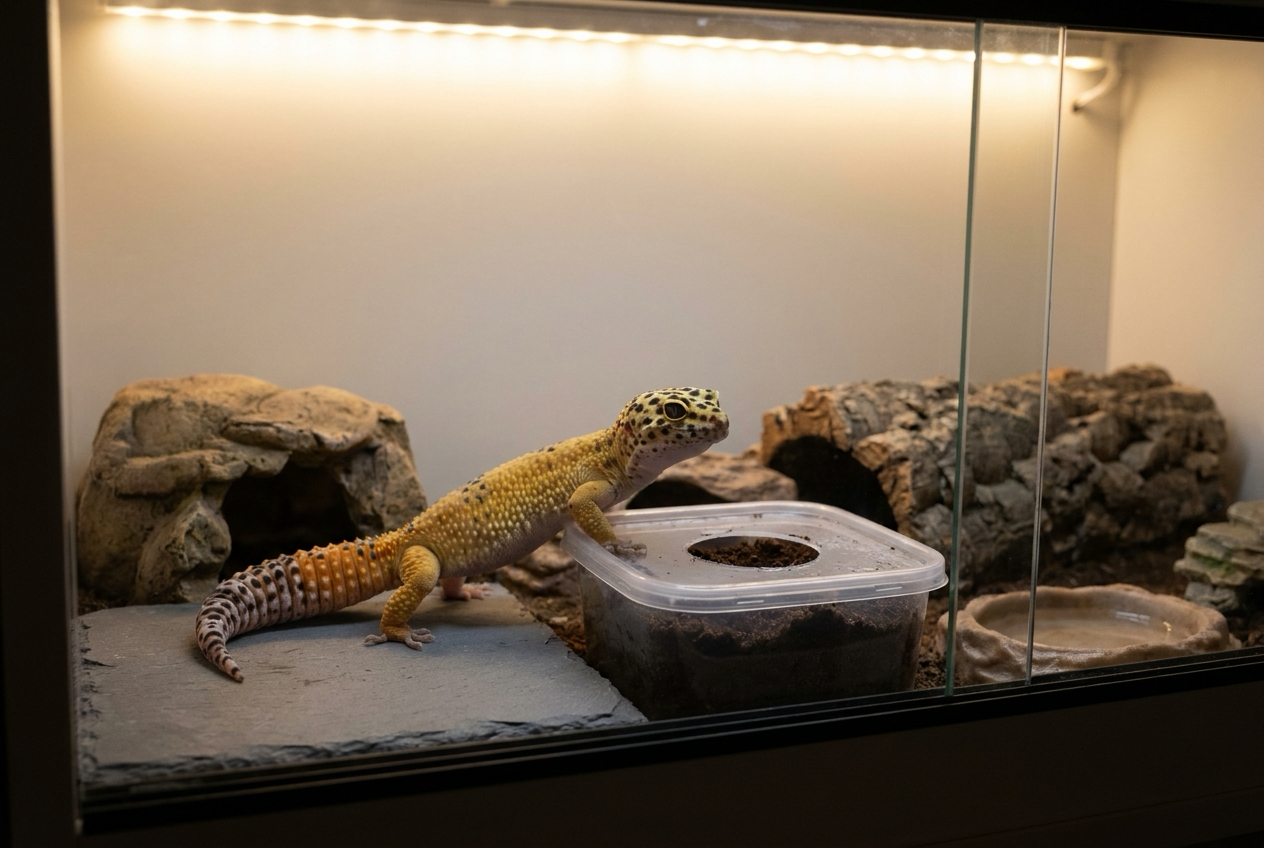
A lay box is usually a lidded plastic tub with an entry hole cut in the top, filled deep enough with damp soil or a sand and soil mix for her to dig. Keep it in the enclosure before she is due rather than adding it once she starts digging at corners. Check the box daily once she looks gravid, so each clutch goes to the incubator the day it is laid.
In a long-running laboratory colony, Rhen and colleagues (Heredity, 2011) reported that “each clutch usually has two eggs, though females occasionally produced one egg,” and that females “can lay up to eight clutches of eggs during a single reproductive season.” Up to eight is a ceiling under laboratory care, not a target. Every clutch costs the female condition, so keep weighing her through the season, and many breeders rest a female that is losing weight.
When laying does not happen
Egg retention in reptiles is slow, not sudden. Merck’s owner guidance on disorders and diseases of reptiles explains that reptiles “may retain eggs or fetuses for weeks or even months after the normal timing of laying,” and that without known breeding dates a normal pregnancy can be hard to tell apart from retained eggs. Diagnosis takes a veterinary exam with x-rays and ultrasound, and the professional chapter on reproductive diseases of reptiles separates two problems: follicles that never ovulate (preovulatory follicular stasis) and shelled eggs that are not laid (dystocia).
Take a female to a reptile vet if she stops eating while visibly gravid, loses weight, strains without producing eggs, or goes well past the interval she normally keeps between clutches. Your pairing and lay dates are the first thing the vet will ask for. Do not try to massage eggs out or give anything at home.
Incubating leopard gecko eggs
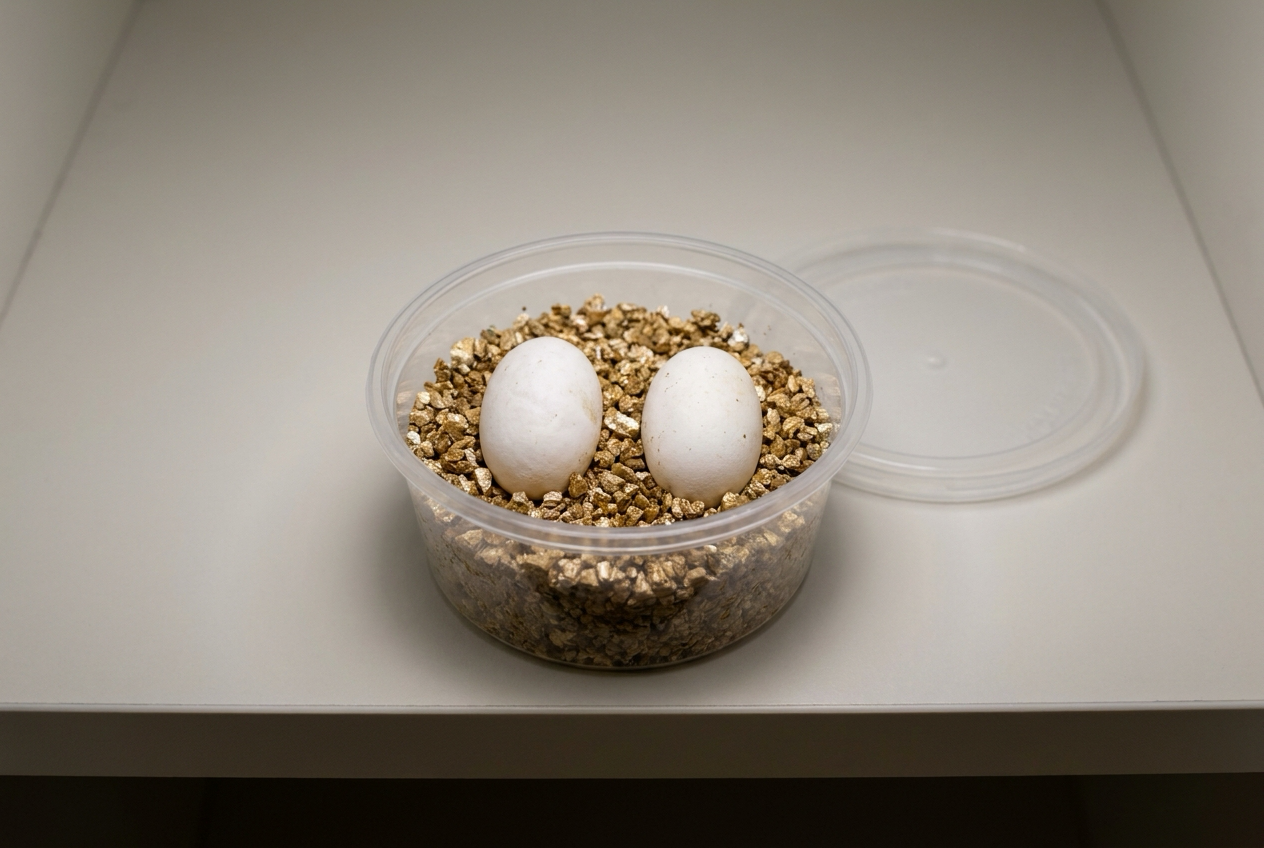
The eggs are white, oval and leathery rather than hard. Move them from the lay box into an incubation container the day you find them. In the Rhen study, each egg sat “in an individual plastic cup with a 1:1 or 1.5:1 ratio of water:vermiculite,” inside an incubator held to within a tenth of a degree. The researchers found that the water content of the vermiculite had no effect on sex ratios; temperature is what matters for sex. Many keepers mark the top of each egg with a soft pencil when they find it and keep that side up, since rotating a reptile egg after it has been laid is widely regarded as a risk to the embryo.
Pick a temperature and hold it. A 2015 crossing study in PLOS ONE incubated leopard gecko eggs at about 28.5 °C (83 °F), “an optimal and preferred incubation temperature,” and hatched 92% of 87 eggs. The upper end is close: Viets and colleagues (1993) found the lethal maximum constant incubation temperature “appears to be just above 35 degrees C” (95 °F). Verify the incubator with a separate calibrated thermometer at egg level, because a thermostat display is not the temperature inside the tub.
Incubation length depends on temperature. A University of Calgary embryonic staging study described a 52 day in-ovo period for its all-female series; warmer incubators hatch sooner and cooler ones later. The leopard gecko incubation calculator gives a hatch window from the lay date. It is a planning tool: it tells you when to watch the tub, and your own incubator temperature and the clutch decide the day.
Choose Track this clutch on the calculator and it opens a clutch with the species and lay date already filled in. With a free account the clutch page counts the days, shows the expected hatch dates and lets you add notes with the temperature and humidity you measured. Set a clutch of eggs and follow incubation explains the clutch page. If you keep several species, the general reptile incubation calculator covers the others; for snakes, see the sister guide on ball python breeding, and for another lizard with a different laying pattern, bearded dragon breeding.
Incubation temperature and sex
The species has temperature-dependent sex determination: the incubation temperature during development, not a sex chromosome, decides whether an embryo becomes male or female. Breeders talk about “female temps” and “male temps,” and the studies support the idea, but not the certainty.
The largest dataset is the Rhen study’s 2,136 hatchlings incubated at constant temperatures. Its counts, simplified:
| 26 °C (79 °F) | All female: 0 males among 305 hatchlings |
|---|---|
| 30 °C (86 °F) | Mostly female: about 31% male (591 hatchlings) |
| 32.5 °C (90.5 °F) | Mostly male: about 66% male (851 hatchlings) |
| 34 °C (93 °F) | Mostly female again: about 11% male (288 hatchlings) |
| Just above 35 °C (95 °F) | Appears lethal at a constant temperature (Viets et al. 1993) |
Three things in that research matter for a breeder planning a clutch:
- Even the “male” temperature produced a third females. At 32.5 °C about one hatchling in three was female. No constant temperature produced all males.
- Hot is not a safe shortcut to females. The 34 °C setting produced mostly females, but it sits close to the lethal limit, so a small thermostat error costs eggs.
- The parents matter too. Sex ratios at 30 °C differed significantly between sires, and ratios shifted between breeding seasons. Two breeders using the same setting can see different results.
There is an older belief that females incubated warm will not breed. Viets and colleagues tested it and found that 12 of 14 mature females incubated at 32.5 °C, and 5 of 6 incubated at 34 °C, produced fertile eggs and viable hatchlings. Incubation temperature has modest, lasting effects on adult hormone levels, but it does not rule a female out of a breeding program.
Record the temperature each clutch was incubated at, and later record which hatchlings turned out male or female. After a few seasons you have your own numbers for your own incubator and your own lines, which beat any general chart.
Hatchlings and their first records
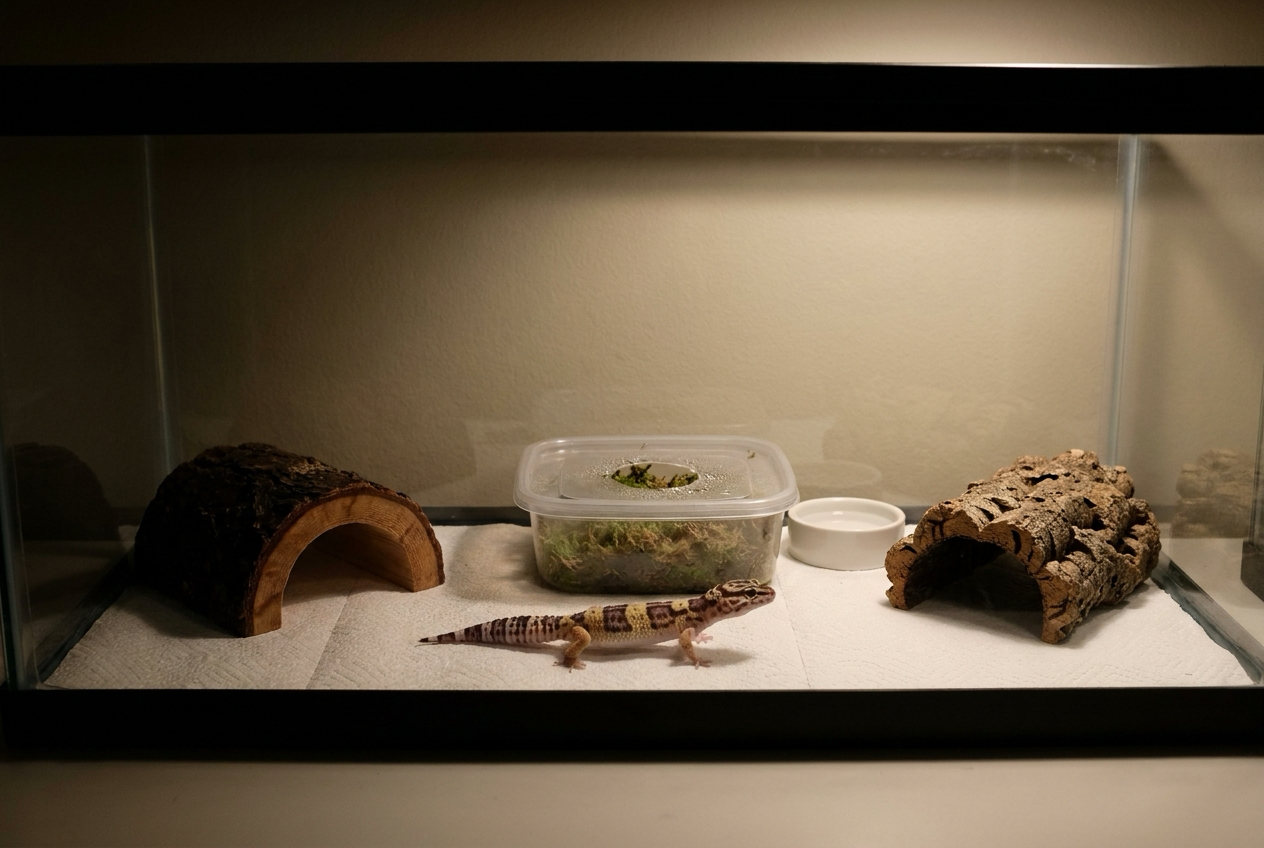
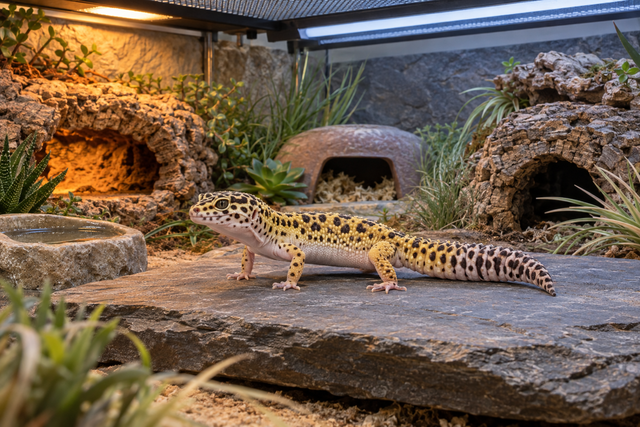
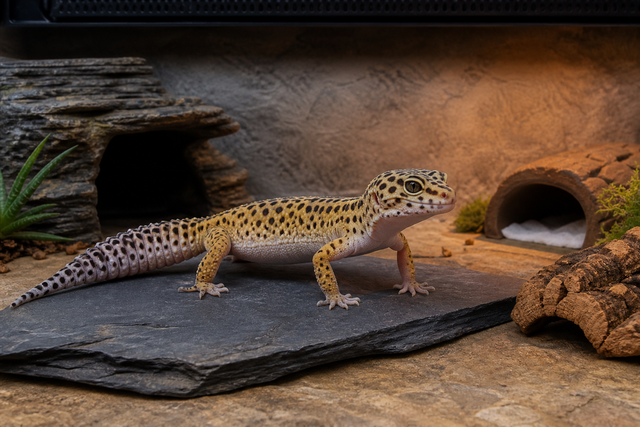
Most hatchlings carry bold dark bands that break up into the adult spotting as they grow, so the pattern you see on day one is often not the pattern you will sell. Photograph each hatchling on a plain background on the day it hatches and again as the bands change. Give each hatchling a setup like the one above: room for a warm end and a cool end with a dry hide at each, a humid hide of damp moss to help it shed, and a shallow dish of water, which is what the RSPCA describes for leopard geckos. Paper towel on the floor makes droppings and sheds easy to see.
When the eggs hatch, record the outcome for each egg on the clutch: hatched, stopped developing, failed, or another result. The hatchlings stay together as a brood until you create their individual profiles from it. Select the parents when you set the clutch (the female, and the male under Father, if known), and Creatures can carry over the parent links when you create the profiles; a parent owned by someone else may need their approval first. Those links are what build the pedigree you will need when a buyer asks about lineage. Record a hatch and add your chicks walks through the hatch and profile steps, which work the same way for gecko eggs. Start each hatchling’s weight history in grams from its first weigh-in; the lifespan guide explains why a long baseline is worth keeping for an animal that can live for decades.
When you are ready to sell, the leopard gecko price guide shows what buyers expect to pay and what they budget for setup, and morph pillars such as the Diablo Blanco guide show the level of genetic detail buyers ask about for a specific line.
Records that make the next season better
A season of leopard gecko breeding produces a lot of dates. The ones worth keeping, and where they live on Creatures:
- Female weights in grams before pairing, through the season and after her last clutch, as dated weight records on her profile.
- Pairings, including failed introductions, as breeding records with the male named.
- Lay dates and egg counts for every clutch, including infertile eggs from an unpaired female, since the interval between clutches is what tells you when something is late.
- Incubation temperature for each clutch, measured at egg level, in the clutch notes.
- Hatch outcome per egg and the sex of each hatchling once it is clear.
The breeding dashboard shows egg clutches at the top for keepers of egg layers, so the season’s incubating clutches sit in one place. Storing a record on Creatures documents what you observed; it is not a genetic test, and it does not certify a morph or a het claim. The leopard gecko species page links every guide in this cluster.
Frequently asked questions
How old does a leopard gecko have to be to breed?
LafeberVet gives sexual maturity as typically 9 to 18 months. Age alone is not the test: breed a female that has reached adult size, holds a steady weight across weekly weigh-ins and carries a thick tail. If she is light or losing weight, wait and ask a reptile vet.
How many eggs does a leopard gecko lay?
Usually two per clutch, occasionally one. In a laboratory colony, females laid up to eight clutches in a season, which is an upper limit rather than something to aim for. Females can lay infertile eggs without a male, so every adult female needs a lay box.
What temperature makes leopard gecko eggs female or male?
In the largest study, 26 °C (79 °F) produced only females, 30 °C (86 °F) and 34 °C (93 °F) mostly females, and 32.5 °C (90.5 °F) mostly males, about two in three. No temperature produced only males, and results varied between sires and seasons. Constant temperatures just above 35 °C (95 °F) appear lethal.
How long do leopard gecko eggs take to hatch?
It depends on temperature. One staging study recorded a 52 day in-ovo period for its all-female series, and warmer incubators hatch sooner. Use the incubation calculator for a window from the lay date, then watch your tubs; your incubator decides the actual day.
Can I leave the male and female together?
The RSPCA advises keeping leopard geckos alone, and a male left with a female can stress and injure her, so introduce them for a supervised pairing and separate them afterward. Some veterinary sources, including LafeberVet, describe a male living with females, but a pairing you supervise and end makes each female’s weight and clutches easier to track.
What if my female is gravid but not laying?
Check that the lay box is moist and deep enough to dig, and that she has privacy. If she stops eating, loses weight, strains or goes well past her usual interval, see a reptile vet. Egg retention in reptiles is slow and needs x-rays or ultrasound to diagnose, and your lay and pairing dates help the vet.
Do this next on Creatures
Keep every pairing, clutch and hatchling with the animals they belong to, so next season starts from your own numbers.
- Add your leopard gecko’s profile for each breeder, with photos and the seller’s original morph wording. Guest signup can start in this flow. Adding an animal shows the fields.
- Add a breeding record for the pairing, the lay date or the hatch. This opens for visitors; a free account is needed to save it. Adding a record explains each type, and care, growth and identity records covers weights.
- Create your breeding operation’s profile so buyers can see your program and the animals behind it. Getting listed in the breeder directory explains the public listing.
- Save a leopard gecko listing search if you are looking for an unrelated male or a new bloodline, and get an email when a matching listing appears. Saved searches and your watchlist explains the alert.
- Browse leopard gecko listings to compare animals and asking prices. What is listed changes from week to week.
- Browse the breeder directory to find trusted programs to ask about lineage and records before you buy breeding stock.