Bearded Dragon Breeding: Pairing, Eggs, Incubation and Hatchlings
Author: Elliott Garber, DVM · Published
Bearded dragon breeding starts with a mature female in good body condition, short supervised introductions to a male, and a deep digging box where she can lay. A clutch usually holds 11 to 30 eggs, and the eggs typically hatch 50 to 80 days after laying. Once you have a lay date, the free bearded dragon incubation calculator turns it into a hatch window you can plan around.
This guide is written for keepers who already keep a healthy adult or two and want to produce one well-managed clutch rather than a lot of hatchlings. The numbers below come from the New Zealand Herpetological Society species page for Pogona vitticeps, the RSPCA, veterinary references and the University of Canberra research group that works on bearded dragon sex determination. Where a source gives a range, the range is what you get here.
| Sexual maturity | 1 to 2 years, tied more to body condition than age |
|---|---|
| Season in the wild | Australian spring, September to November |
| Eggs per clutch | 11 to 30 |
| Clutches per season | Up to four recorded in captivity |
| Hatch time | 50 to 80 days after laying |
| Hatchling size | About 38 mm snout to vent |
| Main risks | Egg binding, calcium drain, and sex reversal of male embryos at high incubation heat |
Before you pair: the female, the male and the hatchlings
The New Zealand Herpetological Society puts sexual maturity at 1 to 2 years and adds that it lines up more closely with body condition than with age. That is the useful part. A female who is still growing, has dropped weight over the cool season or has a history of slow sheds is not a candidate this year, whatever her age. There is no single weight that makes a female ready, so judge her against her own history rather than a number from a forum.
That history is easier to read when it is written down. A monthly weight in grams, kept the way the bearded dragon growth log describes, shows whether she is holding steady, gaining or quietly losing. If anything in that record worries you, have a reptile veterinarian check her before you pair. Our guide on how to find a reptile vet before you need one is worth reading now rather than on the day a female stops eating.
Plan the housing before the eggs exist. The RSPCA bearded dragon advice describes the species as territorial, with males solitary in the wild and females keeping a pecking order that can turn into fights in captive groups, sometimes with bitten toes and tails. It recommends housing bearded dragons separately. Breeding does not change that: the pair meets for introductions and then goes back to separate enclosures. The same logic applies to the young. A female can produce several clutches in one season, and a single clutch can mean dozens of hatchlings that will each need space, light, heat and food as they grow. Count the enclosures and the time before you count the eggs.
Health and husbandry come first for both adults. The basking, UVB and diet setup in the bearded dragon care guide is the baseline a breeding female needs, because egg production draws heavily on calcium and energy.
The breeding season and the cool-season slowdown
In the wild, mating happens in spring, which in Australia is September to November, according to the NZHS species page. Captive dragons follow the season you give them through light and temperature, so many keepers pair in their own spring, after the animals have come out of the cooler, quieter months.
That quiet spell is brumation. The RSPCA describes it as normal for bearded dragons to slow down, sleep more and eat less in cooler seasons, and it is clear that a dragon should not lose weight or stop eating entirely. A dragon that is losing weight during brumation needs a vet visit, and it is not a dragon to breed that season. Weigh during the slowdown so you know which animals came through it in good shape.
Introductions and courtship
The NZHS page describes the courtship sequence. A receptive female waves an arm and bobs her head slowly. The male, with a darkened throat, circles her, and vigorous body bobbing leads to copulation, which involves the male gripping her neck in his jaws. Knowing the sequence helps you tell courtship from a fight.
Keep introductions short and watched. Put the female into the male’s enclosure or a neutral, well-heated space, stay nearby, and separate them if she runs, flattens and hides for a long time, or if either animal is bitten beyond the normal neck grip. Several short introductions over a few days are calmer than leaving a pair together. Write down each date you saw them pair: those dates are your only way to estimate when eggs are coming.
The gravid female and the lay box
Females can produce eggs without ever meeting a male. The RSPCA says this is quite common, and that it is not a problem as long as she has a digging box to lay in. Without one, she may become egg bound, which the RSPCA calls a serious condition. So a lay box belongs in every adult female’s enclosure, bred or not.
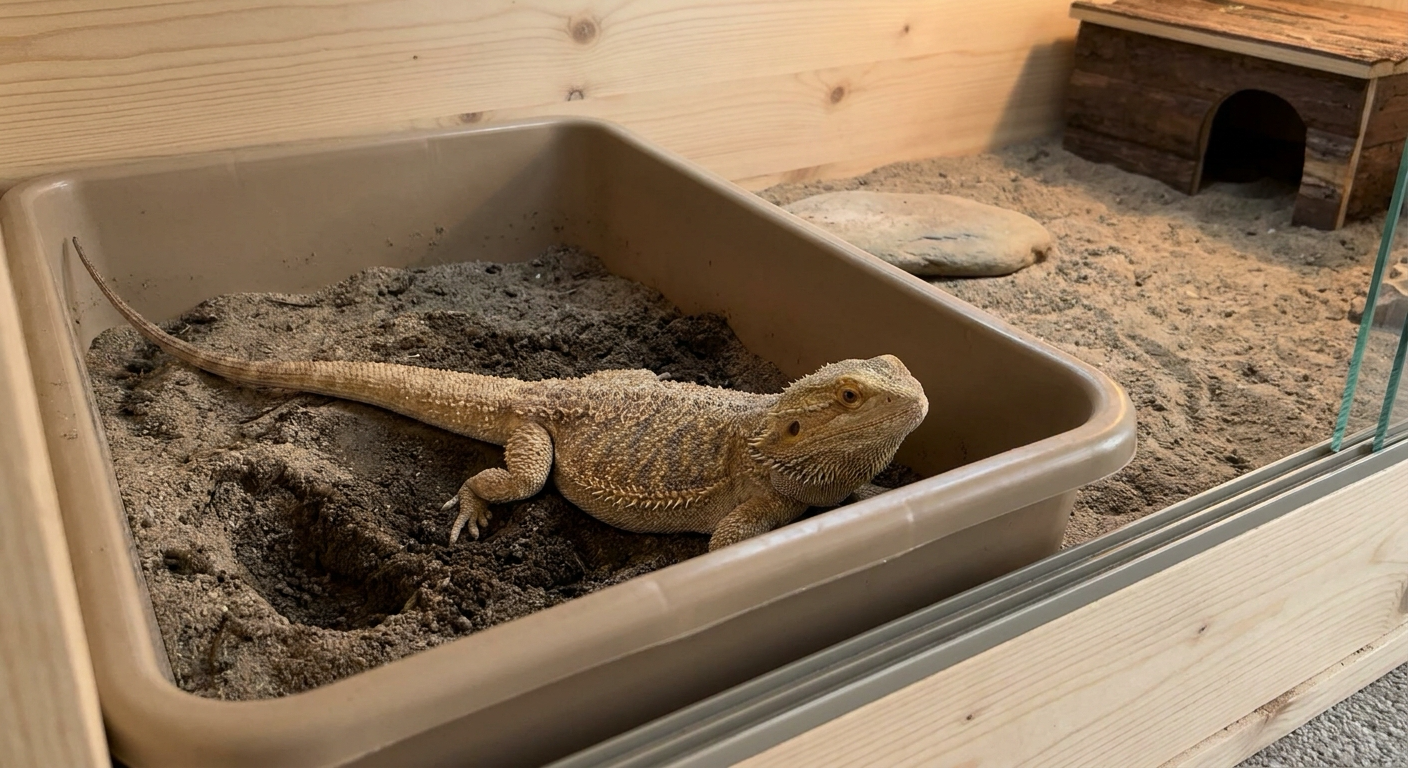
The RSPCA’s own description of a digging box is a plastic tub with an entrance cut in the top, placed in the cool end and filled with a sand and soil mixture. An open-topped tub like the one above also works, as long as it is deep and she can climb in and out easily. Make it deep enough that she can dig a full tunnel and slightly damp enough that the tunnel holds its shape. The NZHS describes wild females excavating a burrow, laying, then backfilling the nest, so expect digging, test holes and restlessness in the days before she lays.
A gravid female often eats less. VCA’s bearded dragon problems page draws the line clearly: a normal gravid dragon may not eat but stays bright, active and alert, while a female with dystocia (egg binding, also called follicular stasis there) stops eating and quickly becomes sick, lethargic or unresponsive. VCA lists poor UV lighting and temperature, an unsuitable nest site, low humidity and poor diet among the causes.
Call a reptile veterinarian now if a gravid female becomes lethargic or unresponsive, strains without producing eggs, has dug repeatedly without laying, or lays part of a clutch and then declines. VCA says a veterinarian familiar with reptiles should examine a female in this state right away and that untreated dystocia is often fatal. Do not try to massage eggs out or treat her at home.
Veterinary references separate two problems that look alike from outside. The Merck Veterinary Manual’s reptile reproductive diseases chapter describes follicular stasis as follicles that fail to ovulate or resorb, with large ovaries and small oviducts, while in dystocia the oviducts are full of eggs. A 2017 review of reproductive medicine in lizards in the Veterinary Clinics of North America notes that the vet must tell them apart because treatment differs. That is a diagnosis for imaging and a clinician, not something to guess at from the enclosure.
After laying, she has spent a large share of her reserves. The RSPCA warns that a female laying very frequently is under a dangerous load on her calcium and energy reserves and needs careful supplement use. Weigh her after each clutch, get her eating well again, and ask your vet about supplementation for a female in a breeding season rather than doubling the dusting on your own.
Bearded dragon eggs: collecting and setting them
The NZHS page gives a clutch of 11 to 30 eggs and records up to four clutches in a season in captivity. Bearded dragon eggs are white, oval and leathery rather than hard shelled. Check the lay box once she has backfilled it and moved away, and dig gently with your fingers, since eggs can sit deep.
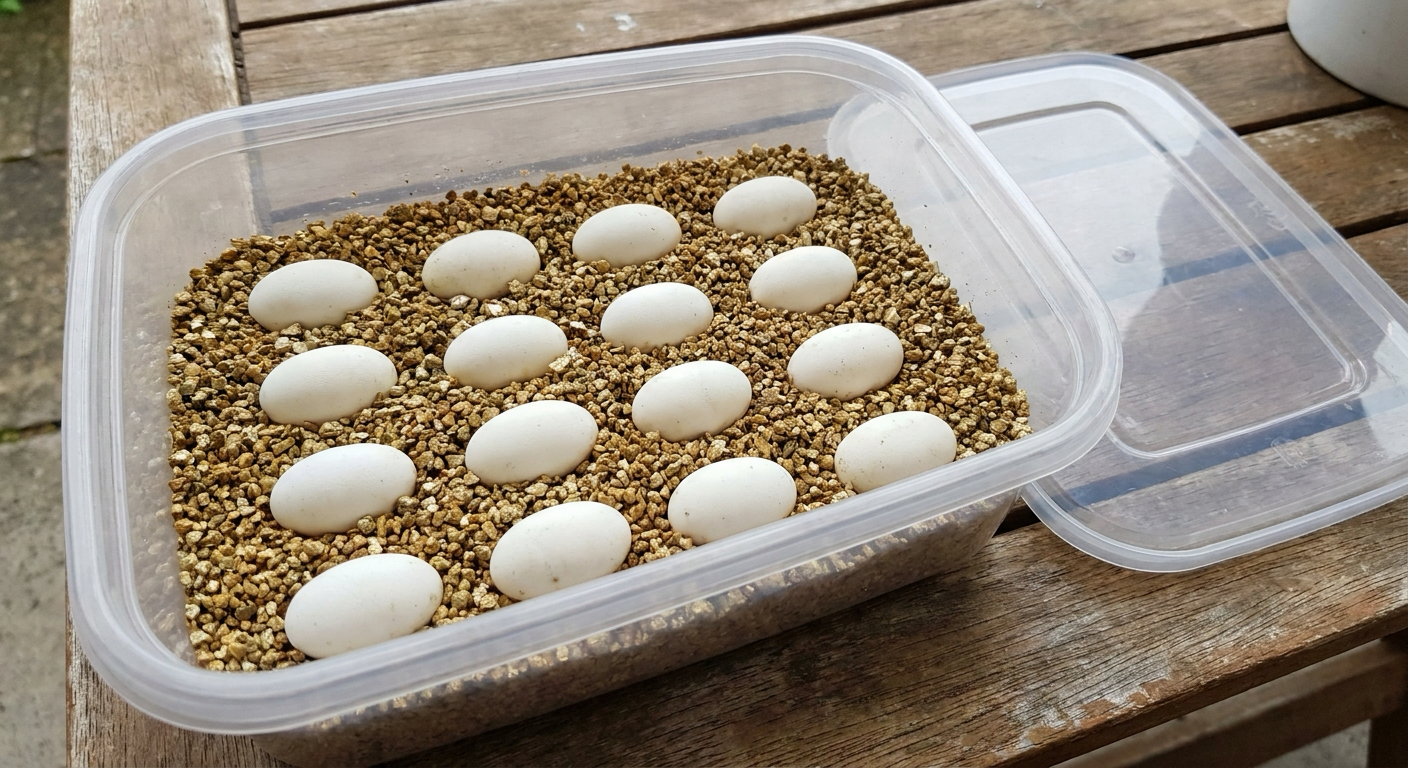
Most keepers move the eggs into a lidded container of a moisture-holding incubation medium such as vermiculite or perlite, each egg in its own shallow hollow, and then into a thermostat-controlled incubator. Two habits matter more than the exact recipe. Set each egg the same side up as you found it and do not roll it afterwards. And write the lay date on your records the same day, because every later date runs from it.
If an egg came from a female who was never paired, it is infertile. The RSPCA also notes that eggs you do not want to incubate should be frozen before disposal if they could be fertile. Do not set eggs you are not prepared to raise.
Incubation temperature, hatch time and sex reversal
Bearded dragons have genetic sex chromosomes: males are ZZ and females ZW. Temperature can override that. A 2007 paper in Science by Quinn and colleagues showed that high incubation temperatures turn genetically male ZZ embryos into females. In 2015, Holleley and colleagues in Nature reported sex-reversed ZZ females in wild populations, and found that offspring of those females had their sex set by incubation temperature alone.
The University of Canberra research colony that produced this work uses 28 °C as its normal incubation temperature and 36 °C as its sex-reversing temperature, according to a 2018 Scientific Reports paper by Whiteley and colleagues. The same paper gives approximate hatching at about 73 days after laying at 28 °C and about 47 days at 36 °C.
| Typical hatch range | 50 to 80 days after laying (NZHS) |
|---|---|
| Research normal temperature | 28 °C, hatching about day 73 (Whiteley 2018) |
| Research sex-reversing temperature | 36 °C, hatching about day 47 (Whiteley 2018) |
| Effect of high heat | ZZ males can develop as females (Quinn 2007, Holleley 2015) |
| Calculator window | Lay date as day 0, most often around day 60 |
Three practical points follow. First, do not run the incubator hot to hurry a clutch: the faster hatch at high temperature is exactly the condition that reverses male embryos, and you will not be able to tell from the hatchling. Second, a steady, moderate temperature is the goal, so check the incubator with a separate thermometer at egg level and log the readings with the clutch. Third, temperature is not a reliable way to choose sex. The research shows a mix of genotype and heat at work, so treat any hatchling’s sex as unknown until it is old enough to confirm.
Warmer incubation brings hatching forward and cooler incubation pushes it later, so a hatch window is an estimate, not a date. The bearded dragon incubation calculator gives the window from the lay date and says the same thing in its limits: temperature and the individual clutch move the hatch date.
Hatchlings: the first weeks
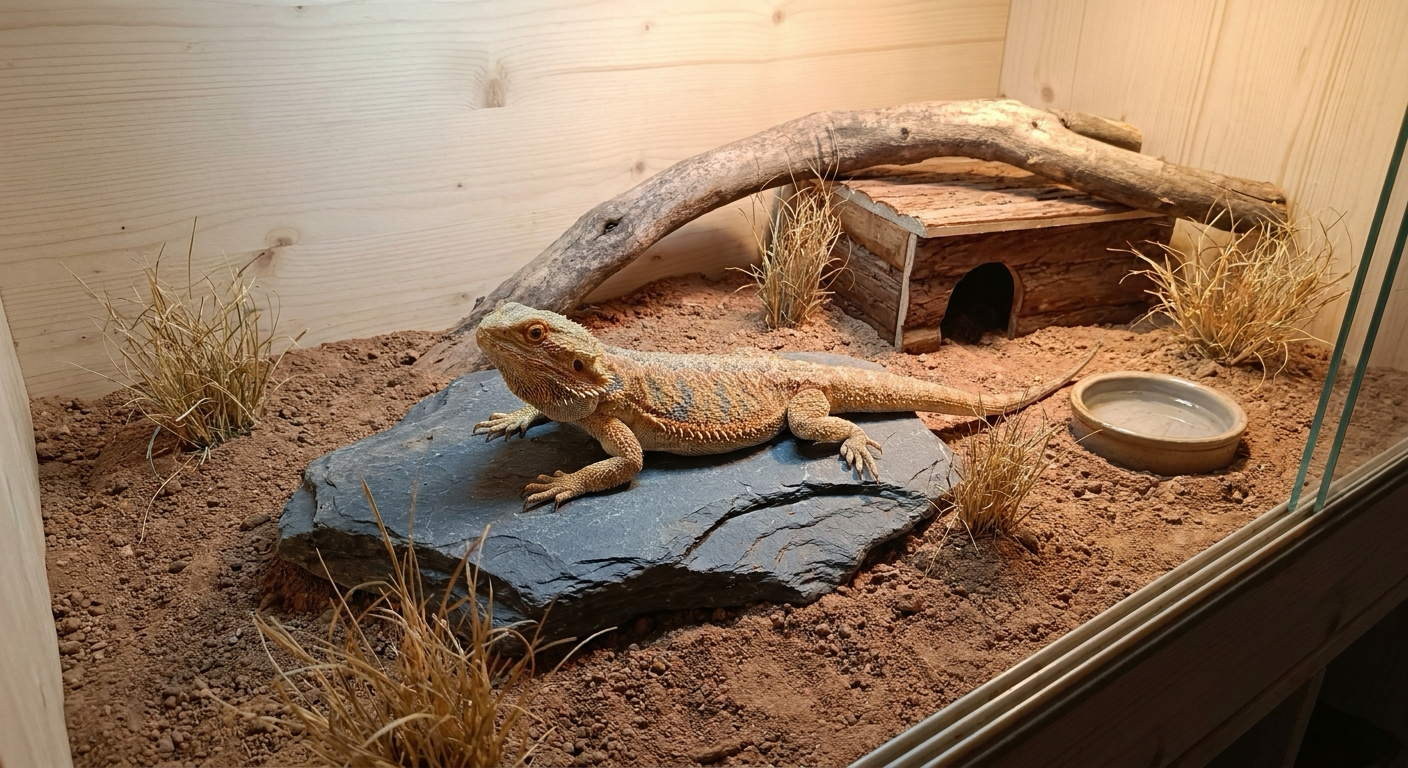
The NZHS page puts a new hatchling at about 38 mm snout to vent, with an egg tooth for slitting the shell. Let them emerge on their own and absorb what is left of the yolk before moving them. Then move hatchlings to a simple, clean enclosure with an easy floor to keep clean: a basking spot under a guarded heat lamp and a UVB tube at one end, a cooler end with a hide to retreat to, and a shallow dish of water.
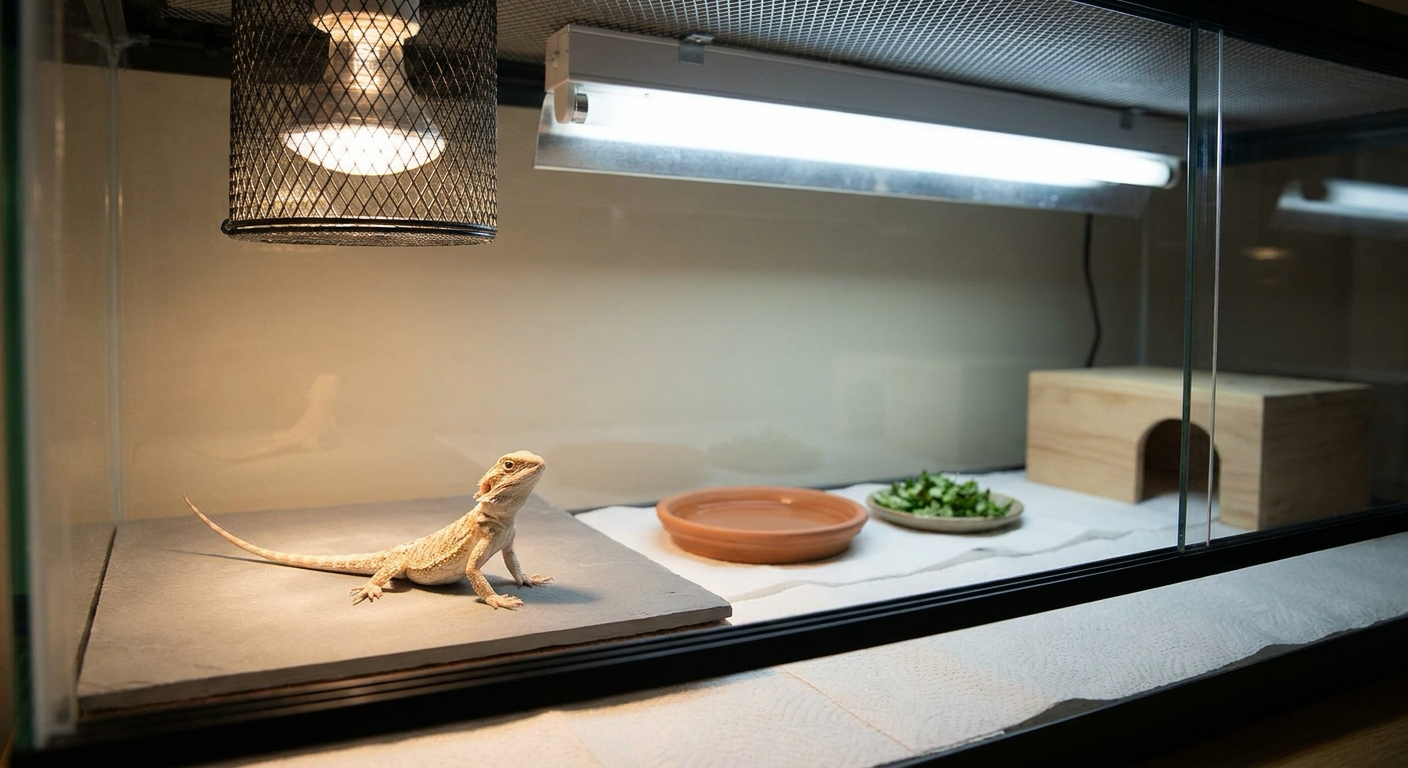
Size differences show up quickly, and bigger siblings can outcompete or injure smaller ones, which fits the RSPCA’s advice on territorial behavior and separate housing. Watch who is eating, split by size early, and weigh each hatchling regularly so a slow grower stands out before it is obvious by eye. The bearded dragon lifespan guide is a reminder of what each hatchling’s future owner is taking on.
If you are pairing for color, be careful what you promise. Our guide to bearded dragon morphs explains which traits have known inheritance and which are line names, and pages such as Citrus bearded dragons and Paradox bearded dragons show why a line name is not a genetic guarantee. Record the parents of every clutch so buyers get the real lineage rather than a label.
Keeping a bearded dragon clutch on Creatures
Creatures is where you can keep the clutch, the parents and the hatchlings connected. Here is what each piece does today.
Start with the hatch window. On the bearded dragon incubation calculator, enter the date she laid. It returns the likely hatch window, counting the lay date as day 0. The calculator works without an account. The general reptile incubation calculator covers the other species if you keep geckos or snakes too.
Track the clutch. Choose Track this clutch and add the egg count. That opens Set eggs with the species and the laid-on date filled in, and saving it needs a free account. The private clutch page then shows the day count, the expected hatch dates and your next check, and the clutch appears under Egg clutches on your Breeding dashboard. The help article on setting a clutch of eggs and following incubation walks through the form.
Record the hatch. When eggs start hatching, Record hatch takes running totals and a reason for each egg that did not hatch: clear, stopped developing, failed after pipping, failed without pipping or broken. Once every egg has an outcome, the clutch shows your hatch rate, and you can create a profile for each hatchling from the brood. The record a hatch guide covers it; the screens are written with chicks in mind, and they work the same way for a reptile clutch.
Keep the pairing and laying with the female. A Breeding and Reproduction record on her profile can note the pairing dates, the male (picked from your animals or typed as a name if he is not on Creatures), egg laying and hatching. See recording a breeding. Her weights go in as Physical Measurement records, which builds the condition history the first section of this guide relies on.
Connect the family. Once the hatchlings have profiles with their parents set, each profile carries a pedigree you can export. The free pedigree chart maker also builds a chart without an account if you want one for a buyer straight away. The help article on pedigree, family and lineage explains how parents link up.
When the young are ready to go, a fixed-price listing has no listing fee; listing an animal at a fixed price covers the steps. If you keep more than dragons, our reptile collection apps comparison sets out how feeding logs, lineage and sales compare across tools.
The same approach to clutches and incubation runs through the sister guides on ball python breeding and leopard gecko breeding, and the bearded dragon species page collects every bearded dragon guide in one place.
Questions breeders ask
Can a female bearded dragon lay eggs without a male?
Yes. The RSPCA says it is quite common for females to develop eggs without ever having been with a male. Those eggs are infertile, but she still needs a digging box to lay them in, because a female with nowhere suitable to lay can become egg bound.
How long do bearded dragon eggs take to hatch?
Usually 50 to 80 days after laying, per the NZHS. Temperature moves the date: in University of Canberra research, eggs at 28 °C hatched at about 73 days and eggs at 36 °C at about 47 days. The faster hatch comes with a real cost, because that heat can turn male embryos into females.
How many eggs does a bearded dragon lay?
The NZHS gives 11 to 30 eggs per clutch, with up to four clutches recorded in one captive season. Every clutch draws on her calcium and energy, so weigh her between clutches and talk to your vet if she is laying very often.
Can I choose the sex of the hatchlings with temperature?
Not reliably. High heat can reverse genetic males into females, but sex in bearded dragons comes from chromosomes and temperature together, and you cannot see the outcome on a hatchling. Incubate at a steady, moderate temperature for healthy hatchlings and confirm sex when they are older.
What should I do if my female stops eating while gravid?
A gravid female who eats less but stays bright and active is usually normal. One who becomes lethargic or unresponsive, strains, or digs repeatedly without laying needs a reptile veterinarian now.
Do this next on Creatures
You are planning a pairing or already have eggs coming. Start with the female, then the record of what happened.
- Add your female bearded dragon so her weights, pairing dates and clutches live in one place. This has a guest signup path, and the adding an animal guide walks through it.
- Record the pairing or the egg laying as a Breeding and Reproduction record. The form opens for visitors, and a free account saves it. The adding a record guide explains each field.
- Create your reptile breeder profile so buyers can find your dragons and see your lines. The breeder directory guide explains how listing works.
- Save a bearded dragon listing alert if you are looking for an unrelated male or female for next season. The saved searches guide shows how alerts arrive.
- Browse bearded dragon listings and ask each seller for the parents and the animal’s weight history.
- Browse the breeder directory to find trusted bearded dragon keepers to talk lines and pairings with.