

Staghound
The American staghound is a working coursing sighthound, and the single most useful thing to know about it is that it is a TYPE rather than a registered breed. There is no studbook, no written standard, and no kennel club recognition. What there is instead is a couple of centuries of Greyhound and Scottish Deerhound crossing on open country, with Borzoi and Irish Wolfhound blood in some lines, all of it selected on one question: can the dog find, run down, and handle fast game across rough ground. That distinction changes almost everything a buyer or a new owner needs to do, from how you read a pedigree to what you can enter the dog in. This page covers what a staghound actually is, where the name comes from (there are three different dogs called staghounds, and only one of them is this one), what they look like, what they are like to live with, the health issues their sighthound ancestry carries, and how to buy one when no registry exists to back the claim. If you are comparing working and coursing dogs more broadly, the Creatures dog species page is the place to put them side by side.

Browse listings, public profiles, breeders, or add your animal.
What is a staghound?
A staghound is a large sighthound built from other sighthounds and kept for coursing, which means finding and catching game by sight and speed rather than by tracking scent. The core cross is Greyhound on Scottish Deerhound: the Greyhound supplies flat speed, the Deerhound supplies a larger frame, more bone, and a harsher coat. Wikipedia’s entry on the American Staghound lists Greyhound, Scottish Deerhound, Irish Wolfhound, and Borzoi as the foundation stock and states plainly that the dog is “not recognized as a breed by any major kennel club.”
Most staghounds today are not first crosses. Generations of staghound bred to staghound have produced dogs that come reasonably true to type, with the parent breeds bred back in when a line needs more speed or more substance. So a staghound is not a random mongrel, and it is not a pedigree dog either. It sits in a third category that the pedigree world has no comfortable slot for: a population bred for a job, with the job as the standard.
There is a precise word for this shape of dog. A longdog is a sighthound crossed with another sighthound. A lurcher is a sighthound crossed with something that is not a sighthound, usually a herding dog, a terrier, or a working farm dog. The distinction is a real one in British coursing vocabulary, even though “lurcher” now gets used loosely for both. By that definition the American staghound is a longdog, and using the right word will save you an argument on your first day in the sport.
Type, not breed: what it actually means for you
This is not a technicality. It has four consequences that matter on the day you buy a puppy.
- No registry means no third party verifies the pedigree. With a recognized breed you can pull a registration certificate and check the parents. With a staghound, the breeder’s own notebook is the entire provenance. Whatever records the seller keeps are what you get, and whatever records you keep are what your buyer gets later.
- No standard means no guaranteed look. Two staghounds from the same litter can differ in coat, size, and outline. Buying one because you liked a photograph of another is a common and expensive mistake.
- Registered breed sport may be closed to you. Some sighthound sport bodies limit entry to recognized breeds, so check a club’s eligibility rules before you plan a season around them.
- Quality varies enormously. The absence of a gatekeeper means the good breeders are very good, because performance is the only currency they have, and the careless ones face no consequences at all. Your defense is records and references, which we cover further down.
Many staghound breeders will tell you they want it this way, on the reasoning that a standard written around appearance is exactly what pulls a working population away from performance. That is practitioner sentiment rather than a documented position of any organization, but it is consistent with how the dogs are actually bred, and it is worth understanding before you ask a staghound breeder when the type will “finally get recognized.”
Three different dogs are called staghounds
Search the word and you will collide with two other animals. Sorting them out takes one paragraph each and saves a lot of confusion.
The English staghound was a pack scent hound, not a sighthound at all. It hunted red deer in England and went extinct in the 19th century when the last pack was sold. The deer-hunting packs that still carry the name in the West Country, such as the Devon and Somerset, are built predominantly from Foxhounds. So a British reader saying “staghound” usually means a pack hound worked in a very different way from anything described on this page.
The Australian staghound, also called the kangaroo dog, is a much closer relative. It was built in the early 1800s from Greyhound and Scottish Deerhound stock, with Borzoi and Saluki added later, for the same reasons and by the same logic as the American dog. It is likewise a type rather than a recognized breed. Australian usage tends to reserve “staghound” for the rougher coated animals and “kangaroo dog” for the whole type.
The American staghound is the plains coursing dog this page is about. When people online argue about whether “the staghound” is a real breed, they are frequently arguing about three separate animals without noticing.
Origin and history
The type came out of a practical problem. As settlement pushed west across the North American grasslands in the 19th century, livestock ran into wolves and coyotes, and open prairie turned out to be terrible country for scent hounds and excellent country for dogs that hunt by eye. Greyhounds could catch a coyote but were sometimes outmatched by it. Deerhounds and Wolfhounds had the power but not the flat speed. Crossing them produced a dog with enough of both, and the plains supplied a merciless selection filter: dogs that could not keep up, or could not take a fight, did not leave descendants.
Coursing on the plains was also sport. Army officers, ranchers, and townspeople ran hounds after jackrabbits and coyotes as a Sunday entertainment through the second half of the 19th century, and the general term for the big rough hounds involved was usually “staghound,” alongside a floating vocabulary of wolfhounds, deerhounds, and cold blooded greyhounds. Quarry has shifted since. Wolf coursing is history, coyote work continues where state law allows it, and a large share of the modern population never hunts anything at all.
Be careful with staghound history generally. Because there was never a registry, there is no studbook to check, and much of what circulates online is anecdote repeated until it hardened. Where a specific date, founder, or famous dog is claimed, treat it as a story unless someone can show you the source.
What a staghound looks like
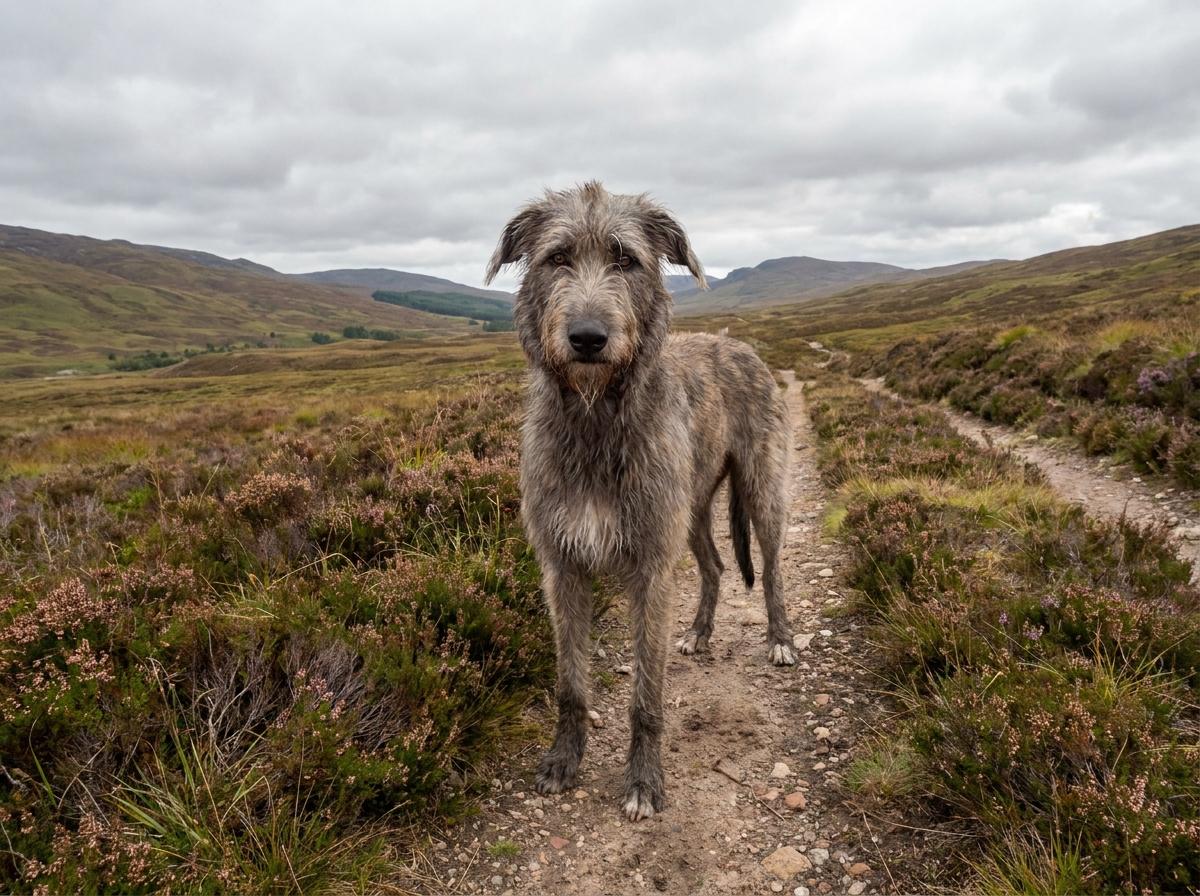
A staghound looks like a big Greyhound, with variation in coat and size. There is no standard to appeal to, so the useful reference points are the two parent breeds, whose standards are published and precise.
- Outline. Deep narrow chest, dramatic tuck up behind the ribcage, arched loin over the hips, long legs, long fine tail. The American Kennel Club’s Scottish Deerhound standard describes the ideal as resembling “a rough-coated Greyhound of larger size and bone,” which is a fair description of a good staghound too.
- Head. Long and narrow with a fine muzzle, little stop, and small folded rose ears that pin back against the neck when the dog moves. A broad skull or heavy hanging ears usually means something other than sighthound in the mix.
- Coat. This is where staghounds vary most, because the parents sit at opposite poles. The AKC Greyhound standard calls for a coat “short, smooth and firm in texture,” while the Deerhound standard asks for hair “harsh and wiry about 3 or 4 inches long.” Coursing people generally sort staghounds into slick, broken, and rough coats, and one litter can contain all three.
- Color. Immaterial, to borrow the Greyhound standard’s own word. Brindle, fawn, blue grey, black, and white marked dogs are all ordinary.
- Size. Reference sources quote roughly 25 to 33 inches and 65 to 100 pounds. For scale, the AKC Deerhound standard sets dogs at 30 to 32 inches and 85 to 110 pounds, and the Greyhound standard gives 65 to 70 pounds for dogs without specifying a height at all. A staghound generally lands somewhere inside that envelope, but nobody is enforcing it.

Temperament and living with one
Sighthounds surprise people. A dog bred to kill coyotes on open ground is, indoors, usually one of the quietest animals in the house. Staghounds are typically calm, affectionate with their own people, socially soft, and inclined to spend most of the day horizontal on the most comfortable surface available. They are not natural guard dogs and they are not barky. What they are is a hunting animal with an off switch.
Three traits define the practical reality of owning one.
Prey drive is the whole dog. This is not a training problem to be solved; it is the trait the type exists for. A staghound that sees a running deer, cat, or rabbit two fields away can be gone before the word leaves your mouth, and at that speed it will be out of earshot in seconds. The working assumption for the rest of the dog’s life is off lead only inside a fence you have personally walked, or in genuinely open country you know, with the dog you have honestly assessed. Small pets in the same household are a real question, not a formality, and worth discussing frankly with the breeder before you commit.
They are sprinters, not marathoners. The exercise need is intensity rather than hours: a chance to run flat out several times a week, plus normal daily walks. A staghound that gets that is a placid housemate. One that never gets to open up is a frustrated animal in a body built to sprint.
They need soft surfaces and warmth. A lean, thin skinned, bony dog develops pressure sores on hard floors and gets cold faster than a thick coated breed. Beds with real padding, in more than one room, are basic equipment rather than a luxury. The slick coated dogs in particular appreciate a coat in cold, wet weather.

Running, sport, and the law

Most staghounds in homes today will never course live game, and there is plenty for them to do without it.
Artificial lure sports are open to unregistered dogs. The AKC Coursing Ability Test is a timed solo run after an artificial lure, 300 yards in under a minute and a half or 600 yards in under two minutes, and it is open to dogs enrolled in AKC Canine Partners, the program “for mixed-breed dogs and dogs ineligible for AKC registration.” That is the practical door into organized sighthound sport for a staghound, and it is the same door for a lurcher or a rescue of unknown parentage. Straight-line racing clubs and local lure trials are worth asking about too. Eligibility rules differ between organizations, so read them before you enter rather than after.
Live coursing and hunting are governed by local law, and the rules are not uniform. In England and Wales, the Hunting Act 2004 prohibits hunting wild mammals with dogs, subject to statutory exemptions set out in section 2 and Schedule 1, and prohibits hare coursing outright. In the United States there is no single national rule: whether you may pursue coyotes, hares, or deer with dogs, in what season, on what land, and under which license is set state by state and sometimes county by county. Some states permit running coyotes with hounds year round, others restrict or prohibit hunting with dogs entirely. Check your own state wildlife agency’s current regulations before you run a dog at anything, and get landowner permission in writing.
Fitness is a training program, not an assumption. A dog that lies on a sofa six days a week and is asked to sprint on the seventh gets hurt. Condition the dog gradually, watch the ground you run it on for holes and wire, and stop while it is still fresh.
Care and management
Feeding. Sighthounds carry very little body fat and are meant to look lean, with the last ribs faintly visible and a clear waist from above. That is correct condition, not underfeeding, and it confuses people who are used to rounder breeds. The reverse mistake is real too: a staghound allowed to get heavy loses the thing it was built for and puts load on its joints. Feed to condition, weigh the dog regularly, and log it so you are working from a trend rather than an impression.
Coat and skin. Slick coats need almost nothing. Broken and rough coats need a weekly going over and occasional tidying of the beard and eyebrows. What all of them need is a check for skin tears after any run in cover, because sighthound skin is thin and tears easily on wire and thorn. A shallow scrape that has stopped bleeding, on a dog that is otherwise acting normally, can usually be cleaned and watched at home. A wound that is deep or gaping, dirty, painful, or still bleeding after a few minutes of pressure needs a veterinarian, and so does any puncture, even a small one, because a puncture can carry dirt or a fragment of wire or thorn well under the skin. The AKC’s dog wound care guidance adds wounds near the eye, wounds with a foreign object in them, and any wound that turns red, hot, swollen, or starts to discharge.
Feet, nails, and teeth. Nails grow fast on a dog that lives on grass and carpet rather than pavement, and overlong nails change how the foot loads. Dental disease is the most commonly recorded problem in pet Greyhounds in the UK, found in 39 percent of dogs in one large primary care veterinary study, and there is no reason to think staghounds are exempt. Get a puppy used to having its mouth handled early.
Records. Because there is no registry, your own records are the only pedigree your dog will ever have. Breeding, litters, weights, vaccinations, injuries, and coursing results all live in one place or they live nowhere. This is the single most useful habit a staghound owner can build, and it is what makes a dog you eventually sell or breed from worth something to the next person.
Health
Staghounds have no breed specific health survey, because they are not a breed. What they do have is the inherited risk profile of their parent breeds, and two items on that list are urgent enough that every owner should know them before the dog needs them.
Anesthesia. Tell your veterinarian the dog is a sighthound cross, before any procedure. Greyhounds and related sighthounds are known to recover slowly from certain injectable anesthetics, including the thiobarbiturates and propofol. The old explanation was low body fat; the current one is genetic. A 2020 study in Scientific Reports identified a CYP2B11 variant that reduces the liver enzyme clearing those drugs, found the highest frequency of it in Greyhounds compared with 63 other breeds, and reported the same haplotype in Whippets, Scottish Deerhounds, Borzoi, and Italian Greyhounds. Since a staghound is built from exactly those breeds, assume the risk applies. Most veterinary practices handle sighthounds routinely once they know, so the fix is a sentence at the front desk rather than anything complicated.
Bloat and gastric torsion. Gastric dilatation and volvulus is an acute, life threatening condition in which the stomach distends and twists, and the Merck Veterinary Manual names deep and narrow chest conformation as a risk factor, with overall mortality around 25 to 30 percent, and about one dog in five dying even with treatment. Every staghound has that conformation. Learn the signs now: unproductive retching, drooling, restlessness, a swelling abdomen. It is a surgical emergency, so the correct response is to drive to a veterinarian immediately, at any hour, rather than to wait and see.
Everything else is the ordinary large sighthound list: sprint injuries to toes, muscles, and tendons, skin lacerations, and in older dogs the bone and heart problems that run through the big sighthound breeds. Ask any breeder directly what has gone wrong in their lines and at what age. On lifespan, there is no staghound figure, but the same UK primary care study put median Greyhound longevity at 11.4 years across 474 deaths, and about 10 to 12 years is a reasonable expectation for a large sighthound. All medical decisions belong with a veterinarian who can examine the dog.
Cost, availability, and buying
Staghounds are not sold the way pedigree puppies are sold. There is no breed club referral list, most litters are placed by word of mouth inside the coursing and lurcher community before anyone advertises, and a good breeder will interview you at least as hard as you interview them. Prices are usually modest by pedigree standards, often a few hundred dollars for a working bred puppy, because the value in this world sits in the dog’s performance and its breeder’s reputation rather than in paperwork. Expect to travel and expect to wait.
What to do instead of checking a registration certificate:
- Ask to see the parents work, or at least to see video. Performance is the standard here, so a breeder who cannot show you the dogs doing the job has nothing to show you.
- Ask what is in the cross and how many generations back. A straight Greyhound on Deerhound first cross, a fifth generation staghound line, and a dog with recent Borzoi in it are three different animals to live with.
- Ask for the health history in the line by name. Anesthetic reactions, bloat, heart problems, early cancers, and injury patterns. Vague reassurance is an answer in itself.
- Ask what records they keep, and get copies of everything: vaccinations, worming, weights, litter details, and the pedigree as they have it written down. This is your dog’s only provenance.
- Be careful with the word itself. Because “staghound” is unregulated, it gets attached to any large scruffy crossbred dog. Ask about the actual parentage rather than accepting the label.
- Consider a rescue. Lurcher and longdog rescues regularly take in staghound type dogs, often adults whose temperament and prey drive are already known quantities, which is genuinely useful information with this type.
You can watch for staghound listings on the Creatures marketplace, look for working dog breeders and rescues in the Creatures directory, and set a free alert (below) so you hear about a litter without refreshing anything.
Frequently asked questions
Is the American staghound a real breed?
It is a real dog and a real, consistent type, but not a breed in the registry sense. No major kennel club recognizes it and no dedicated breed registry exists, so there is no written standard and no third party verification of a pedigree.
What breeds make a staghound?
Greyhound and Scottish Deerhound above all, with Borzoi and Irish Wolfhound in some lines. Most modern staghounds are bred staghound to staghound rather than being first crosses, with a parent breed bred back in when a line needs more speed or more substance.
Is a staghound the same as a lurcher?
Not quite. A lurcher is a sighthound crossed with a non sighthound, such as a herding dog or a terrier. A sighthound crossed with another sighthound is a longdog, which is what a staghound is, though everyday usage blurs the two words.
How big do staghounds get?
Reference sources quote roughly 25 to 33 inches at the shoulder and 65 to 100 pounds. Because there is no standard, treat those numbers as a description of the population rather than a specification, and ask the breeder about the actual size of the parents.
Do staghounds make good pets?
For the right home, yes. They are quiet, clean, and affectionate indoors, and they sleep a great deal. They also need secure fencing, real running room, soft bedding, and an owner who takes prey drive seriously. They are not a good match for a home with free ranging small pets or with no safe place to let a dog run.
Can a staghound compete in dog sports?
Yes. AKC lure coursing ability tests accept dogs enrolled in AKC Canine Partners, the program for mixed breed dogs and dogs ineligible for regular AKC registration. Some other sighthound sport bodies limit entry to recognized breeds, so read a club’s eligibility rules before entering.
How long do staghounds live?
There is no staghound specific figure. A large UK study of Greyhounds under primary veterinary care found a median longevity of 11.4 years, and roughly 10 to 12 years is a reasonable expectation for a big sighthound.
Do this next on Creatures
Whether you are trying to understand the type, waiting for the right litter, or already running staghounds, Creatures is the records, marketplace, and directory layer to do it in one place. For a type with no registry, that record keeping is not administration. It is the pedigree.
Compare the ancestors. Read up on the Greyhound, the Scottish Deerhound, the Borzoi, and the Irish Wolfhound, or browse every working type on the Creatures dog species page. Two other working-dog traditions worth a look: China’s coursing sighthound, the Xigou, and Kashmir’s flock guardian, the Bakharwal.
Watch for a litter. Browse staghound listings on the marketplace and search trusted working dog breeders and rescues in the Creatures directory. New to the marketplace? See saving searches and using your watchlist.
Get alerted. Staghound litters are placed by word of mouth and rarely advertised, so set a free staghound listing alert and we will tell you when one is posted. No account needed to start.
Add your dog. Already running staghounds or another longdog? Create a free animal profile in a few minutes, no account needed to start. The walkthrough is in adding an animal to Creatures. Still choosing a name? Try the dog name generator.
Build the pedigree yourself. With no studbook to fall back on, your notes are the record. Add weights, vaccinations, injuries, and coursing results as they happen. The record sheet opens for any visitor to look around, and you will need a free account to save what you enter. See adding a record and health and medical records for the how to, and note the anesthesia point above in the dog’s file where a veterinarian will see it.
Stay ahead of the routine care. Vaccination boosters, worming, and nail trims are easy to lose track of, so use reminders and upcoming care to have them find you instead.
List your kennel or rescue. Breeding or rehoming working sighthounds? Create a free organization profile, no account needed to start, then get listed in the breeder directory so the people hunting for this type can find you.