Rhodesian Ridgeback
Author: Elliott Garber, DVM · Published
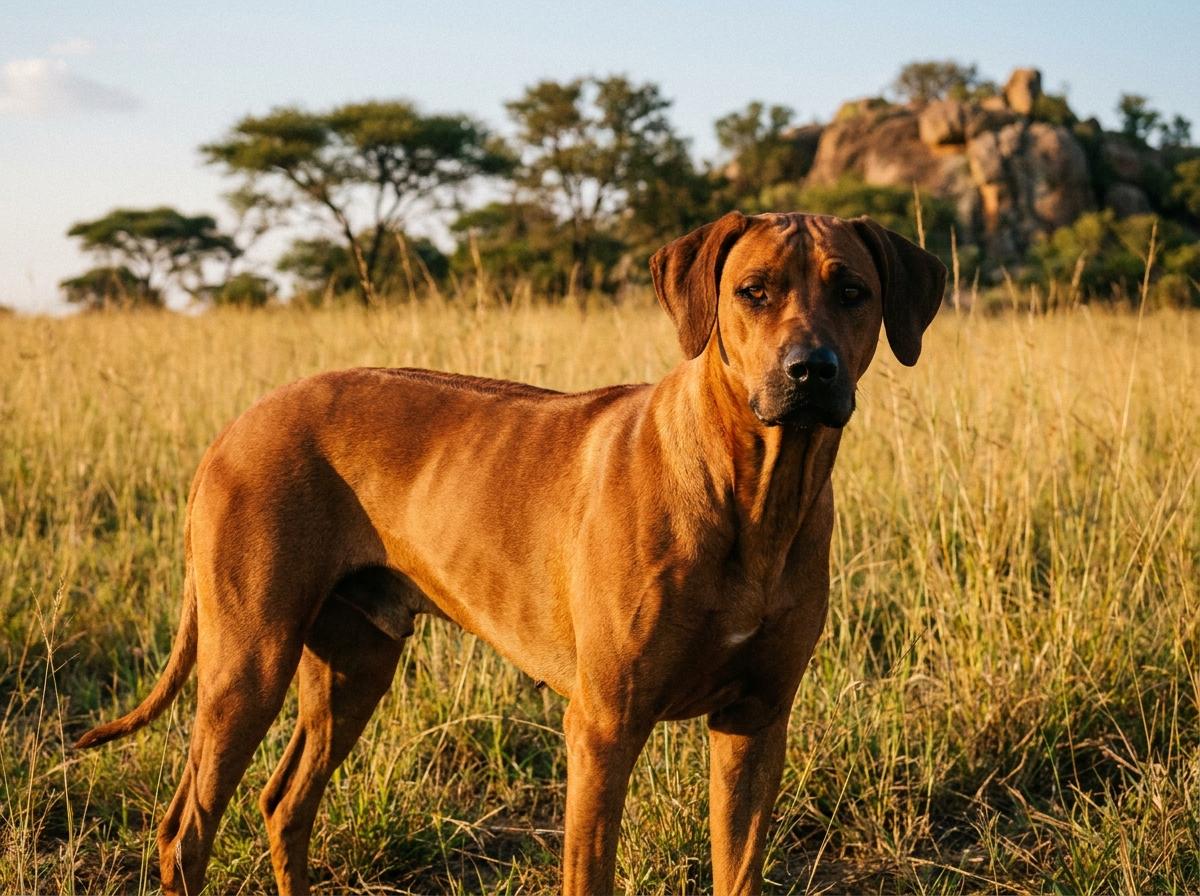
The Rhodesian Ridgeback is an athletic hound whose most recognizable feature is a stripe of hair growing in the opposite direction along its back. That striking detail should be the beginning of your research, not the reason to overlook how a large, capable dog will fit into ordinary life.
Use the Creatures breeder directory to ask about the dogs behind a litter, the breeder’s placement decisions and the records available. A useful conversation should tell you much more than whether the puppy has an attractive ridge. You can also save a Rhodesian Ridgeback listing alert to get an email when a matching animal is listed.

AI-generated illustration.
| Heritage | Southern African hound; AKC Hound Group |
|---|---|
| Colors | Light wheaten to red wheaten |
| AKC height | Males 25 to 27 in; females 24 to 26 in |
| Ridge | Flat reversed hair with two matching whorls |
| Health discussion | Dermoid sinus examination and parent screening |
| Home priority | Secure space, training and manageable routines |
Browse listings, public profiles, breeders, or add your animal.
What the ridge means, and what it does not
The AKC breed account identifies the ridge as backward-growing hair. It also makes an important correction to the breed’s hunting story: Ridgebacks tracked and held lions at bay; they were not dogs expected to kill lions.
That history does not tell you how a modern individual will greet a visitor or live with another pet. Avoid sellers who turn it into a promise of aggression, invulnerability or automatic protection. A companion needs appropriate management and a stable relationship with its household, not an exaggerated legend.
Ridge appearance also does not replace health evidence. A dog can have a visually impressive ridge and still need medical care. The placement discussion should distinguish the dog’s clinical health from the registry’s appearance criteria.
The AKC standard describes light wheaten through red wheaten coats. Males stand 25 to 27 inches and females 24 to 26 inches, with desirable weights around 85 and 70 pounds respectively. Those standard figures describe adult type, not a target to achieve by feeding a puppy more.
A correct ridge lies in the hair on an otherwise normal back. It starts behind the shoulders, tapers toward the hips and has two matching crowns, or whorls, opposite each other near its front. It is neither a skin flap nor a raised spinal structure. Ask to see the dog from above as well as from the side if you are learning how the pattern looks.
Ridgelessness is a disqualification under the AKC conformation standard. That affects show eligibility, not a dog’s worth as a companion. Ask whether a pet placement carries limited registration or other terms and read the agreement before paying. A show-standard distinction should never be used to justify harm to a puppy.
For another short-coated hound comparison, the Chortai guide describes a different hunting background and structure. Keep recorded ancestry separate from a look-alike judgment; the free dog pedigree chart maker can organize the named parents while you check the original papers.
Decide whether your ordinary day fits
Write down a weekday before writing down your ideal weekend with a dog. Include work, travel, meals, rest, walks and who covers the gaps. Then ask a breeder or rescue to compare that schedule with the actual dog you are considering.
Think about control as a practical household arrangement. Who can manage the dog on a lead? What happens when a delivery arrives? Can a visitor enter without an uncontrolled greeting? A secure boundary and a clear arrival routine are useful even when a dog is sociable.
If your shortlist includes another athletic companion such as a Vizsla, compare the routines of real adults instead of choosing from matching activity labels. The dog hub can help broaden the comparison. No breed description substitutes for an honest account of your available time and experience.

AI-generated illustration.
Training for the life you actually share
Start with useful skills: moving through a doorway under control, returning attention to you, settling in a designated place and accepting routine care. Agree on the same cues and rules across the household. A dog should not have to guess which person expects which behavior.
AVSAB recommends reward-based training for dogs. Choose help accordingly, and ask a prospective trainer what they will do when an exercise is too difficult. Breed strength is not a justification for frightening or hurting the learner.
Discuss safe exercise with your veterinarian in the context of age, health and fitness. A puppy, a conditioned adult and a recovering older dog need different plans. Avoid choosing an arbitrary daily mileage because an online breed guide labels the dog athletic. Keep unrestricted running for genuinely secure and appropriate spaces.
The dermoid sinus conversation
A dermoid sinus is a congenital skin tract or pocket along the back’s midline. Hair and debris can collect inside and cause problems. The Merck Veterinary Manual describes inherited dermoid pockets in Ridgebacks and notes that surgical removal is possible.
Research published in Nature Genetics found that the mutation producing the ridge also predisposes dogs to dermoid sinus. A handsome ridge is therefore not health evidence. Ask who examined each puppy, what was found and whether the findings are documented by a veterinarian.
If a history includes surgery or a suspected lesion, request the veterinary records and discuss them with your own veterinarian. Do not try to diagnose or manipulate a suspected opening or lump from written instructions. The location and significance require professional assessment.
The Rhodesian Ridgeback Club of the United States also discusses health screening, including hips and elbows. Ask for actual results tied to the parents’ identities, not just “health tested.” A screening report and a routine wellness examination answer different questions. Neither is a promise that the puppy can never develop a problem.
Coat care is the smaller part of the care plan
A short coat can make a Ridgeback look straightforward to maintain, but plan the whole routine. Ask how the dog accepts a brush, nail handling, ear inspection and entering a vehicle. Demonstrations can reveal where you need instruction or a slower introduction.
Arrange a first veterinary discussion with the existing records available. Ask about feeding, body condition, preventive care and any restrictions relevant to the individual. The puppy vaccination guide helps organize the questions; the clinic decides the plan for your puppy.
Include a place to rest undisturbed. A dog returning from activity should be able to settle without constant attention from children or other pets. Assign an adult to supervise shared spaces and to recognize when an interaction needs to end.
Meet the dog, then read the agreement
A visit should let you see ordinary movement and interaction, not just a posed puppy. Ask about the parents’ behavior, the puppy’s experiences and the reasons the breeder recommends one individual over another. For an adult, request a candid account of known difficulties, previous homes and management needs.
Before paying, read the agreement. Confirm the dog’s identity, registration arrangements, health information, departure timing, deposit terms and return provisions. If a seller promises support, ask what that looks like after the handover.
Do not confuse registration or a directory presence with a guarantee of suitability. Your job is to review the evidence and decide whether the placement works for both the dog and the household. Pressure to pay before you can do that is a reason to slow down.

AI-generated illustration.
Price and costs
Request an itemized, dated quote for the dog and any transport. Then price the things your household will need: a suitable vehicle setup, secure boundaries, durable equipment, veterinary care, training and care when you travel. The dog boarding cost guide can help you ask about that last category.
Rhodesian Ridgeback questions
Is the ridge a spinal structure?
No. The characteristic visible ridge is a pattern of hair growth. A suspected skin or back problem still needs veterinary examination.
Does a ridgeless puppy avoid dermoid sinus risk?
A missing ridge is not a veterinary clearance. The ridge mutation increases susceptibility, but appearance alone cannot settle an individual puppy’s health. Ask for a documented examination rather than accepting either ridge presence or absence as proof.
Were Ridgebacks bred to kill lions?
AKC describes tracking and baying, not killing. That history should not be inflated into a promise about a pet’s behavior.
Is this a good choice for a first dog?
The answer depends on the person, support and individual dog. Evaluate daily management, training help and realistic handling before deciding.
Do this next on Creatures
Still looking? Get an alert when a Rhodesian Ridgeback is listed, browse Rhodesian Ridgeback breeders, or check current Rhodesian Ridgeback listings. The Help Center explains saved searches and email alerts.
Already caring for one? Add a record when you have a dated document or useful observation. The form opens for visitors; a free account is needed to save. The Help Center explains adding an animal and adding a record.
Breeders and organizations can create an organization profile for their work. The organization and team guide explains the setup.