

Bakharwal
Author: Elliott Garber, DVM · Published
The Bakharwal dog is a large, heavy-boned livestock guardian breed from the mountains of Jammu and Kashmir in northern India, developed over centuries by the nomadic Gujjar and Bakarwal herding communities to protect sheep and goats across the high pastures of the Pir Panjal range. It is a working guardian in the classic mold: thick-coated, deep-chested, watchful, and bred to live with a flock rather than in a living room. It is also genuinely rare. The breed has no official standard and no major kennel club recognition, and Indian press reports going back to 2011 describe a population that collapsed during the region’s years of conflict and has never been formally counted. This page covers what the Bakharwal is, where it comes from, what it looks like, how the traditional dogs are kept and fed, what the reported numbers actually say, and what to know if you ever meet one for sale. If you are weighing guardian breeds more broadly, the Creatures dog species page is a good place to compare them side by side.

| Also called | Bakarwal dog, Bakerwali dog, Kashmiri Sheepdog, Kashmir Mastiff |
|---|---|
| Origin | Jammu and Kashmir, India; the Pir Panjal range and adjoining Himalayan pastures |
| Traditional keepers | Gujjar and Bakarwal nomadic herding communities |
| Role | Livestock guardian for sheep and goat flocks; camp and homestead watchdog |
| Size | Commonly described at 24 to 30 inches at the shoulder; published weights vary widely because no official standard exists |
| Coat | Thick double coat of medium length; black and tan is the classic look, with pied and other colors also seen |
| Temperament | Calm, independent, protective; wary of strangers; bred to work without instruction |
| Recognition | Not recognized by any major kennel club; not yet registered by India’s ICAR-NBAGR |
| Status | Reported by Indian media and tribal advocates as rare and declining; no formal census has ever been done |
Browse listings, public profiles, breeders, or add your animal.
What is a Bakharwal dog?
The Bakharwal is the flock guardian of the Bakarwal people, a nomadic pastoral community of Jammu and Kashmir whose name comes from the local word for goat. The Bakarwals are, quite literally, the goat herders, and the dog carries their name because it has walked beside their flocks for as long as anyone can document. Gujjar families, the larger pastoral community the Bakarwals are closely tied to, keep the same dogs, and both groups are officially listed Scheduled Tribes in Jammu and Kashmir.
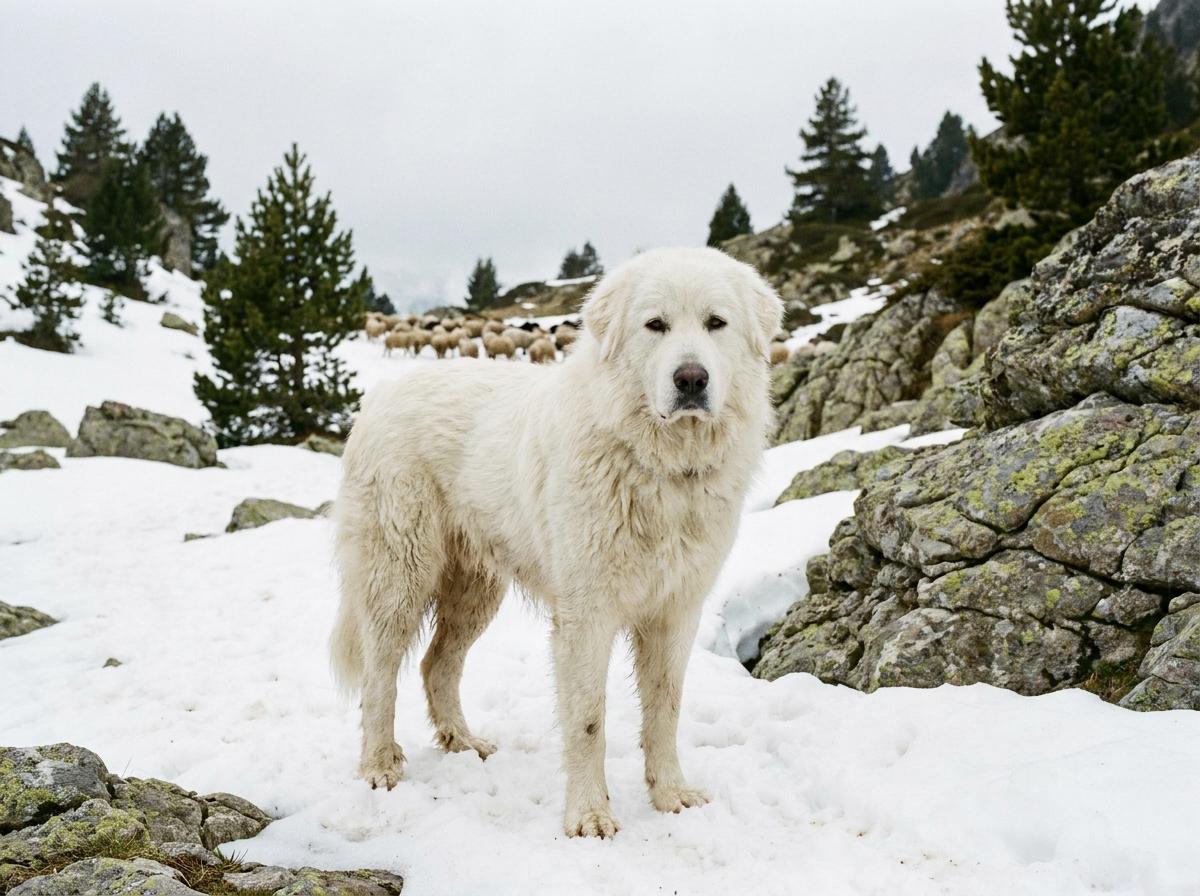
The job description is the key to understanding everything else about the breed. A livestock guardian dog does not herd. It lives inside the flock, day and night, treats the sheep and goats as its own social group, and confronts anything that threatens them. The mountains these flocks graze are working predator country, home to wolves, leopards, and bears, and the dogs are the first and often only line of defense on pastures far from any road. At camp, the same dogs guard the family tent, the pack animals, and the milk stores.
You will see the name spelled several ways, including Bakharwal, Bakarwal, and Bakerwali, and English-language references also use Kashmiri Sheepdog or Kashmir Mastiff for the same dogs. All of these describe one working landrace rather than separate breeds.
Origin and history
The Bakharwal’s history is the history of a migration. Gujjar and Bakarwal families traditionally winter their flocks in the low hills and plains around Jammu, then walk them hundreds of kilometers each spring, over the Pir Panjal passes, to summer on the alpine meadows above the Kashmir valley, returning by the same routes in autumn. The dogs make the entire journey on foot, guard the flock at every overnight halt, and work the high pastures all summer. A dog that could not handle altitude, cold, distance, and predators did not leave descendants, and that unforgiving selection, rather than any studbook, is what shaped the breed.
How the type first arose is not documented. References, including the Wikipedia entry on the breed, repeat a theory that it descends from Tibetan Mastiff type dogs that moved along old trade routes through the western Himalaya, possibly mixed with local Indian dogs, while community tradition simply holds the breed to be ancient, one of the oldest in India. Neither pedigree records nor published genetic studies settle the question, so treat every origin story here as tradition rather than verified history. What is not in dispute is that the dogs belong to the broader family of Himalayan flock guardians kept from Afghanistan across to Nepal, and that the Bakharwal is the strand of that tradition belonging to Jammu and Kashmir’s nomadic herders.
What a Bakharwal looks like
There is no official breed standard, so what follows describes the consistent working type rather than a written specification.
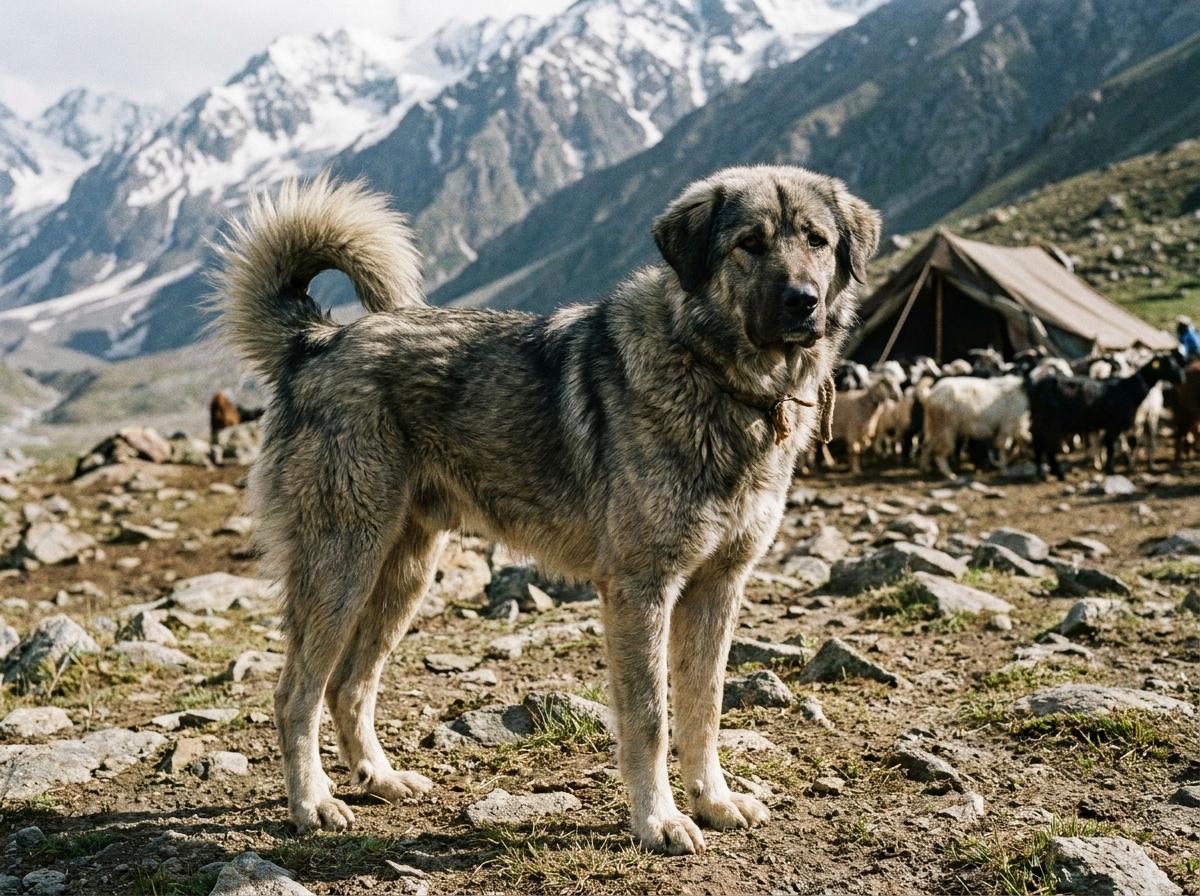
- A big, heavy-boned frame. This is a substantial mountain dog: broad skull, strong muzzle, muscular neck, deep chest, and thick legs. The overall impression is power and endurance rather than speed.
- A thick, weatherproof double coat. The coat is dense and medium long, built for freezing nights on open pasture. It is noticeably heavier around the neck and on the backs of the legs.
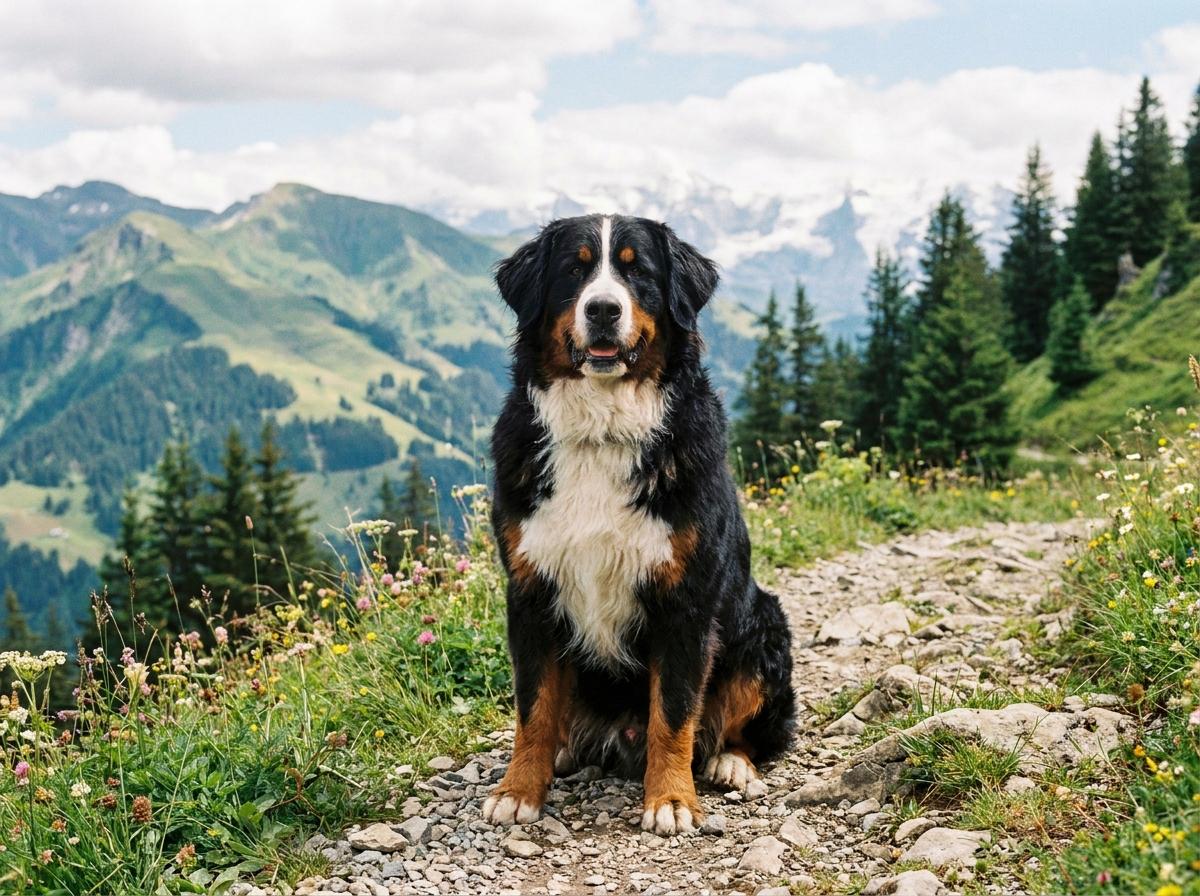
- Black and tan above all. The color most associated with the breed is black with tan points on the muzzle, brows, chest, and legs. Pied dogs (large patches of black or dark color on white) and tricolor dogs are also seen, and references report solid black, fawn, and red animals as well.
- A plumed tail carried over the back. The well-feathered tail, often curling up over the hip when the dog is alert, is one of the breed’s signature outlines. Ears are set high and typically drop forward.
Published size figures for the breed vary. Adults are commonly described at roughly 24 to 30 inches at the shoulder, and most references put mature weights somewhere between about 85 and 130 pounds, but you will also find sources printing considerably higher figures. The spread tells you more about the absence of a standard than about the dogs. Individual animals vary by line, region, and feeding, so treat every published number for this breed as descriptive rather than official.

Temperament and behavior
The Bakharwal has the temperament its work demands.
A guardian bred to make its own decisions at 3 a.m. on a mountainside is, by design, independent. These are calm, steady, watchful dogs, deeply bonded to their flock and their family, and reported by keepers to be gentle with the children of the household. They are also naturally wary of strangers, territorial, and most active at night, when predators move. Barking at the unfamiliar is not a flaw in this breed; it is the job. Expect a dog that thinks for itself, weighs your instructions against its own judgment, and acts without waiting for permission when it perceives a threat.
None of that makes the Bakharwal aggressive by default, but it does make early socialization, secure fencing, and an experienced owner non-negotiable. This is not a first dog, an apartment dog, or a dog park regular. It is happiest and safest with space, a clear guarding role, and people who understand livestock guardian behavior.
The traditional milk and maize diet
One of the most repeated claims about the Bakharwal is that it is a vegetarian dog. Here is what the tradition actually involves.
As reported across Indian press coverage and breed references, herding families traditionally raise these dogs on milk, milk products, and flatbread made from maize or rice, and many keepers deliberately avoid feeding meat. The reported logic is practical: a guardian that has never developed a taste for meat is believed to be safer living unsupervised among lambs and kids. Similar no-meat traditions exist among shepherd cultures elsewhere, and within the Bakarwal community this feeding practice is a genuine, long-standing custom, not an internet invention.
What the tradition is not is a validated nutritional program. Dogs are not obligate carnivores and can digest a varied diet, but a giant working guardian has substantial energy and protein needs, and no controlled research has evaluated the traditional regimen. If you keep a Bakharwal, or any large working dog, build its diet with your veterinarian rather than copying folklore, and treat the milk-and-maize story as heritage worth recording rather than a feeding guide worth imitating.
Living with and caring for a Bakharwal
Space and work
Plan for acreage, livestock, or at minimum a large, securely fenced property with a genuine guarding role. A working guardian without work invents its own, usually in the form of patrolling, digging, and barking. Long daily walks do not substitute for territory and purpose.
Coat and climate
The breed is built for cold altitude. That thick double coat is an asset on winter pasture and a liability in hot, humid lowlands, so in warm climates the dog needs shade, unlimited water, and management that shifts activity to cool hours. Expect heavy seasonal shedding; weekly brushing, stepped up during the molt, keeps the coat functional.
Health basics
There are no published breed-specific health studies, so sensible care follows general large-dog practice: keep the dog lean while growing, discuss joint and skeletal development with your veterinarian, know the signs of bloat in deep-chested breeds, and stay current on rabies vaccination and parasite control, which matter doubly for dogs living with livestock. Reporting from the breed’s home region names disease, alongside conflict, among the pressures that reduced its numbers. No reliable breed-specific lifespan figure exists; large working breeds broadly average around 10 to 12 years, and you should treat that as a general expectation rather than a Bakharwal statistic. For any medical decision, defer to a veterinarian who can examine the animal.
Records
Rare, undocumented breeds are exactly where record keeping earns its keep. A Bakharwal changing hands with written vaccination dates, deworming history, weights, and photographs is a fundamentally better proposition than one traveling on word of mouth. You can keep those records free on a Creatures animal profile, and the help center’s guide to health and medical records shows how owners structure them.

How endangered is the Bakharwal, really?
Nobody knows the number, and every figure you will read deserves its attribution attached.
No formal census of the breed has ever been conducted. A genetics department head at Sher-e-Kashmir University of Agricultural Sciences and Technology said exactly that to the IANS news agency in an April 2012 report that also carried a Bakharwal tribal leader’s warning that the dogs could be gone within four years. What exists in place of a count is a body of consistent journalism and advocacy. In November 2011, The Hindu reported fears within the Gujjar and Bakarwal communities that the breed was heading for extinction, quoting Javaid Rahi of the Tribal Research and Cultural Foundation, which has campaigned for the dog’s protection. Rahi later set the decline out himself in the Jammu newspaper Daily Excelsior in March 2017: fewer than a thousand purebred dogs surviving in the upper pastures against roughly 10,000 in the 1990s, figures he presented as a rough estimate rather than a count. Coverage of the foundation’s own survey work has put the remaining purebred population at only a few hundred.
More than a decade later the breed persists, so the four-year prediction was wrong, but no subsequent account describes a recovery, and recent coverage still calls the dog scarce. The causes cited in reporting are consistent: hundreds of dogs killed during the insurgency years, when a barking guardian could betray movement in the mountains; disrupted migration that pushed dogs into unfamiliar lowland disease exposure; herding families settling out of the nomadic life that required the dogs; crossbreeding with other dogs along the routes; and a slow reproductive rate, with references reporting a single litter a year and often just one to four puppies.
Two things bound what any of these numbers can mean. First, “endangered” here is the language of advocates and journalists, not an official designation; the IUCN does not assess domestic dog breeds, and the Bakharwal appears on no official endangered-breed register. Second, the absence of a census cuts both ways: the situation could be somewhat better or considerably worse than the reported estimates, and anyone quoting a precise population for this breed is passing along a guess.
Where the breed officially stands
Recognition is the one part of the Bakharwal’s story that can be stated exactly.
No major kennel club recognizes the breed, in India or internationally. It has no entry with the FCI, the AKC, or The Kennel Club, and it is not among the Indian breeds registered by the Kennel Club of India.
The more consequential ledger is governmental. ICAR’s National Bureau of Animal Genetic Resources (NBAGR), the agency that maintains India’s official register of indigenous animal genetic resources, began registering native dog breeds in September 2020 with the Rajapalayam, the Chippiparai, and the Mudhol Hound. It has since added the Gaddi dog of Himachal Pradesh in January 2025, the Changkhi of Ladakh, and the Kombai in August 2026, bringing the register to six dog breeds among 262 registered breeds. The Bakharwal is not among the six as of September 2026. Researchers and tribal advocates have called for the breed’s scientific characterization and registration, and the Gaddi’s recent recognition shows the path exists for Himalayan guardians; a documented description, and the conservation attention that follows registration, is precisely what this breed still lacks.
Related Himalayan guardians
The Bakharwal does not stand alone. The western Himalaya keeps a family of related guardian landraces, and the names blur into each other in casual use, so it helps to know the neighbors. The Gaddi dog guards flocks for the Gaddi shepherds of Himachal Pradesh, one mountain range to the southeast, and is now NBAGR-registered. The Himalayan Sheepdog, also called the Bhotia, covers similar work along the hills into Nepal. The Tibetan Mastiff, the giant of the family, is the one with global kennel club recognition and a commercial breeding scene. A dog described as any one of these may, in practice, be a regional cross of several, which is one more reason documentation matters more than labels in this corner of the dog world.
Rare regional breeds like this are worth comparing across cultures. Creatures also profiles the Xigou, China’s ancient sighthound, and the Lobito Herreno, the little herding dog of El Hierro in the Canary Islands, two more working landraces surviving at the edge of official recognition.

Cost and availability
There is no meaningful commercial market for this breed, and you should be suspicious of anyone who suggests otherwise.
Inside Jammu and Kashmir, Bakharwal dogs move the way they always have: bred by herding families, placed within the community, and valued as working partners rather than merchandise. Occasional puppies are advertised elsewhere in India, but there is no established breeder network, no registry to verify what a seller claims, and effectively no export pipeline to North America or Europe. Reliable public pricing does not exist, and we will not invent a figure; treat any confident price quote for a “purebred Bakharwal,” especially outside India, with skepticism, since without papers or a standard, the label rests entirely on the seller’s word.
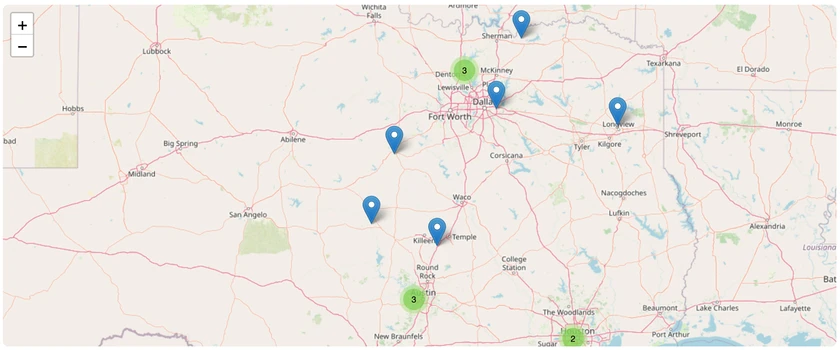
If the breed genuinely fits your situation, patience is the strategy. You can browse dog listings on the Creatures marketplace, search working-dog breeders in the Creatures directory, and set a saved-search alert (below) so a listing finds you rather than the other way around.
Buying and keeping considerations
- Be realistic about the job. This breed exists to guard stock across hard country. If your life cannot offer space and a working role, a Bakharwal is the wrong dog, however compelling its story.
- Verify the individual dog, not the label. With no registry, “Bakharwal” is a claim. Ask to see the parents, the working context, and the dogs’ health history. A seller inside the herding tradition can show you all three; a broker cannot.
- Expect the guardian temperament. Independence, night barking, stranger wariness, and territorial behavior come with the dog. Plan fencing, socialization, and neighbors accordingly.
- Mind the ethics of scarcity. Every documented account places this breed’s survival with the herding communities that created it. Buying a dog out of the working population does nothing for the breed; supporting documentation, records, and the communities’ own conservation appeals does.
- Start records on day one. Photographs, weights, vaccination dates, and parentage notes, kept from the first week, become the paper trail this breed otherwise lacks.
Frequently asked questions
Is the Bakharwal a good family pet?
It is a working livestock guardian, and it is reported to be devoted and gentle within its own household, but it is not a conventional companion breed. Experienced owners with space and a guarding role can keep one well; apartment life and casual ownership do not fit this dog.
Are Bakharwal dogs really vegetarian?
Traditionally, yes, as reported: herding families raise them on milk and maize or rice bread and often avoid feeding meat, reportedly so the dogs never develop a taste for it around lambs. That is a documented cultural practice, not a validated feeding program, and a modern owner should build any working dog’s diet with a veterinarian.
How many Bakharwal dogs are left?
Nobody knows, because a census has never been done. Estimates attributed to the Tribal Research and Cultural Foundation and repeated in Indian media describe a fall from roughly 10,000 in the 1990s to somewhere between a few hundred and a thousand; the foundation’s Javaid Rahi put the surviving purebred population at under a thousand in 2017. The breed is consistently described as scarce today.
Is the Bakharwal recognized by any kennel club?
No. No major kennel club recognizes it, in India or abroad, and it is not yet among the six native dog breeds registered by ICAR-NBAGR, India’s official agency for indigenous breeds.
How is a Bakharwal different from a Tibetan Mastiff?
The Tibetan Mastiff is a recognized, standardized, globally bred giant with a heavy mane and a commercial market. The Bakharwal is an undocumented working landrace, generally described as somewhat lighter and leaner, kept almost entirely by Himalayan herders. A shared ancestry is plausible and often claimed, but no published pedigree or genetic study proves the link.
How long do Bakharwal dogs live?
There is no reliable breed-specific figure. Large working breeds broadly average around 10 to 12 years, and hard mountain work, disease exposure, and predator conflict shorten working lives in the breed’s home range.
Do this next on Creatures
Whether you are researching Himalayan guardians, hoping to find a Bakharwal one day, or already keeping working dogs, Creatures is the records, marketplace, and directory layer to do it in one place.
Compare breeds. Weigh the Bakharwal against other guardian and working breeds on the Creatures dog species page.
Watch for listings. Browse Bakharwal listings on the marketplace and search trusted working-dog breeders in the Creatures directory. New to the marketplace? See saving searches and using your watchlist.
Get alerted. Genuine Bakharwal dogs are vanishingly rare on the open market, so set a free Bakharwal listing alert and we will tell you the moment one is posted. No account needed to start.
Add your dog. Already keeping a Bakharwal or another guardian breed? Create a free animal profile in a few minutes, no account needed to start. The walkthrough is in adding an animal to Creatures.
Build the paper trail. Add vaccination, weight, and health records as they happen. The record sheet opens for any visitor to look around, and you will need a free account to save what you enter. See adding a record for the full how-to.
List your kennel or farm. Work with guardian breeds? Get listed in the breeder directory so buyers searching for rare working dogs can reach you, and read creating an organization and adding your team if you run the operation with others.
Set up your operation. Create a free organization profile for your kennel, farm, or rescue, no account needed to start.
If you breed or work guardian dogs, you can also list your operation in the Creatures directory so the people searching for rare working breeds can find you.