




Xigou
Author: Elliott Garber, DVM · Published
The Xigou (细狗, literally “thin dog”) is an ancient Chinese sighthound: a lean, deep-chested coursing dog developed on the open farmland of northern China to run down hares by sight. Western fanciers sometimes call it the Chinese Saluki, and the resemblance is real, but the Xigou is its own animal, a working landrace with distinct regional types in Shaanxi and Shandong rather than a single standardized show breed. Dogs of this kind appear in Chinese art and literature across two thousand years, from Tang dynasty tomb murals to Qing court paintings. Today the Xigou is rare, its traditional job has largely been closed off by wildlife law, and no major Western registry recognizes it. This page lays out what the breed is, the evidence behind its long history, how the regional types differ, what the dogs are like to live with, and where the population actually stands, flagging the places where the record is thin. If you are weighing it against other uncommon breeds, the Creatures dog species page is a good place to compare side by side.

| Also called | Xiquan (细犬), Chinese Saluki, Chinese Greyhound, slender dog |
|---|---|
| Type | Working sighthound landrace, not a standardized show breed |
| Origin | Plains of northern China, best documented in Shaanxi and Shandong |
| Main types | Shaanxi (smooth), Shandong (smooth and feathered strains), plus Hebei and Mongolian lines |
| Size | Commonly cited around 60 to 78 cm (24 to 31 in) and 20 to 30 kg (44 to 66 lb); no international standard fixes it |
| Coat | Short and smooth in most lines; light fringing on ears, legs, and tail in the feathered Shandong strain |
| Historic use | Coursing hares on open plains; guarding rural homes |
| Recognition | China Kennel Union native breed program (registration since 2017); not recognized by the FCI or AKC |
| Status | Rare and declining; kept by dedicated enthusiasts, almost entirely inside China |
Browse listings, public profiles, breeders, or add your animal.
What is a Xigou?
Xigou means thin dog, and the name is a plain description rather than a brand. Across northern China the same dogs are also written as Xiquan (细犬, “thin hound”), and older texts use the character 猃 (xian) for a long-muzzled hunting dog. None of these names ever belonged to a kennel club. For most of its existence the Xigou has been a landrace: a regional population shaped by work, climate, and local preference rather than by a studbook. Farmers on the wheat plains kept the dogs that could catch hares and guard the courtyard, bred those to each other, and the type maintained itself for centuries without anyone writing a standard.
That history matters for how you read everything else on this page. A landrace has more variation than a registered breed, its documented “facts” are younger than the dogs themselves, and its regional types blur at the edges. It also means the Xigou’s story is genuinely about place: the general profile on Wikipedia organizes the population into Shaanxi, Shandong, Hebei, and Mongolian types, and Chinese sources do the same, with the Shaanxi and Shandong dogs by far the best documented.
The “Chinese Saluki” nickname comes mostly from the feathered strain of the Shandong type, whose fringed ears and tail recall a Saluki’s. It is a useful shorthand for the silhouette and nothing more. No registry treats the Xigou as a Saluki variety, and nobody has fully worked out how the two actually relate.
A coursing lineage older than any kennel club
Slender, long-muzzled hunting dogs run very deep in Chinese sources, and it is worth separating what the record actually shows from what enthusiasts would like it to show.
The word comes first. A hunting song from the state of Qin in the Book of Odes, compiled by roughly the sixth century BCE, describes hounds called xian (猃) riding to the hunt in a light chariot, and early Chinese dictionaries gloss xian specifically as a long-muzzled dog. Qin’s homeland was the Wei River valley of today’s Shaanxi, which is exactly where the smooth-coated Xigou’s coursing culture later flourished. A second early anchor is a famous passage in the Records of the Grand Historian: before his execution in 208 BCE, the Qin chancellor Li Si is said to have told his son how he wished the two of them could once more lead the yellow dog out the east gate of Shangcai to chase the cunning hare. The line says nothing about the dog’s build, but it puts hare coursing with dogs in the Chinese literary record more than two thousand years ago.
The pictures come next. Hunting dogs appear in Han dynasty tomb art, and by the Tang dynasty the depictions become unmistakably sighthound-like. Murals painted around 706 CE in the princely tombs at the Qianling Mausoleum near Xi’an, including the famous hunting procession from the tomb of Crown Prince Zhanghuai, show mounted hunters riding out with falcons, cheetahs, and lean, narrow-bodied hounds. A thousand years later the type was still at court: the Kangxi Emperor (reigned 1661 to 1722) was fond of hare coursing, Chinese accounts link a northern strain of the Xigou to his kennels, and the Jesuit court painter Giuseppe Castiglione’s album Ten Prized Dogs, painted for the Qianlong Emperor in the eighteenth century, portrays mostly slender, long-legged hounds of exactly this kind.
Two caveats belong beside all of that. First, resemblance across centuries is evidence of a continuous tradition of keeping coursing dogs, not proof that today’s Xigou is an unbroken bloodline reaching back to the Tang. Second, the breed’s deeper origins are argued in both directions. Some Chinese accounts describe sighthounds arriving from the west along the Silk Road during the Han era, which would make the Xigou an early cousin of the Saluki family; some enthusiasts argue instead for a native origin, and a few claim it as an ancestor of Western sighthounds, a claim nothing published so far can support. Modern genetics has only recently reached these dogs at all, so for now the fair summary is: very old tradition, unresolved pedigree.

The regional types
Chinese sources sort the surviving population into four regional types. Treat the boundaries as soft; these are local populations of one working landrace, not four sealed breeds.
- Shaanxi Xigou. The heartland type, kept on the Guanzhong plain around Weinan, Xianyang, and Xi’an. It carries a short, smooth coat and a long, narrow, dry head; Chinese fanciers describe the preferred head as sheep-like, with a flat skull and a very slight arc through the muzzle. This is the type most tied to the traditional coursing culture, and the one Chinese conservation work has focused on first.
- Shandong Xigou. Centered on the flat farm country of western Shandong, around Liaocheng, Liangshan, and Jiaxiang. It comes in two strains: a smooth-coated one (huatiao) and a feathered one (fanzi) with silky fringing on the ears, the backs of the legs, and the tail. The feathered dogs are the reason for the Chinese Saluki nickname.
- Hebei Xigou. A less documented northern strain, described in Chinese accounts as closer to a Greyhound in outline and linked by tradition to Qing imperial hunting kennels.
- Mongolian Xigou. The northeastern strain, reported from Inner Mongolia and China’s northeast, with a stockier build and a thicker coat for a colder climate. Documentation is thin, and some of what circulates about it is family lore rather than history.
One practical warning for anyone researching in English: a lot of English-language material spells the heartland type “Shanxi.” Shaanxi (陕西) and Shanxi (山西) are two different neighboring provinces, and the coursing heartland, the Guanzhong plain, is in Shaanxi. The romanization slip has propagated through breed databases for years, so expect to see both spellings for the same dogs.
What a Xigou looks like
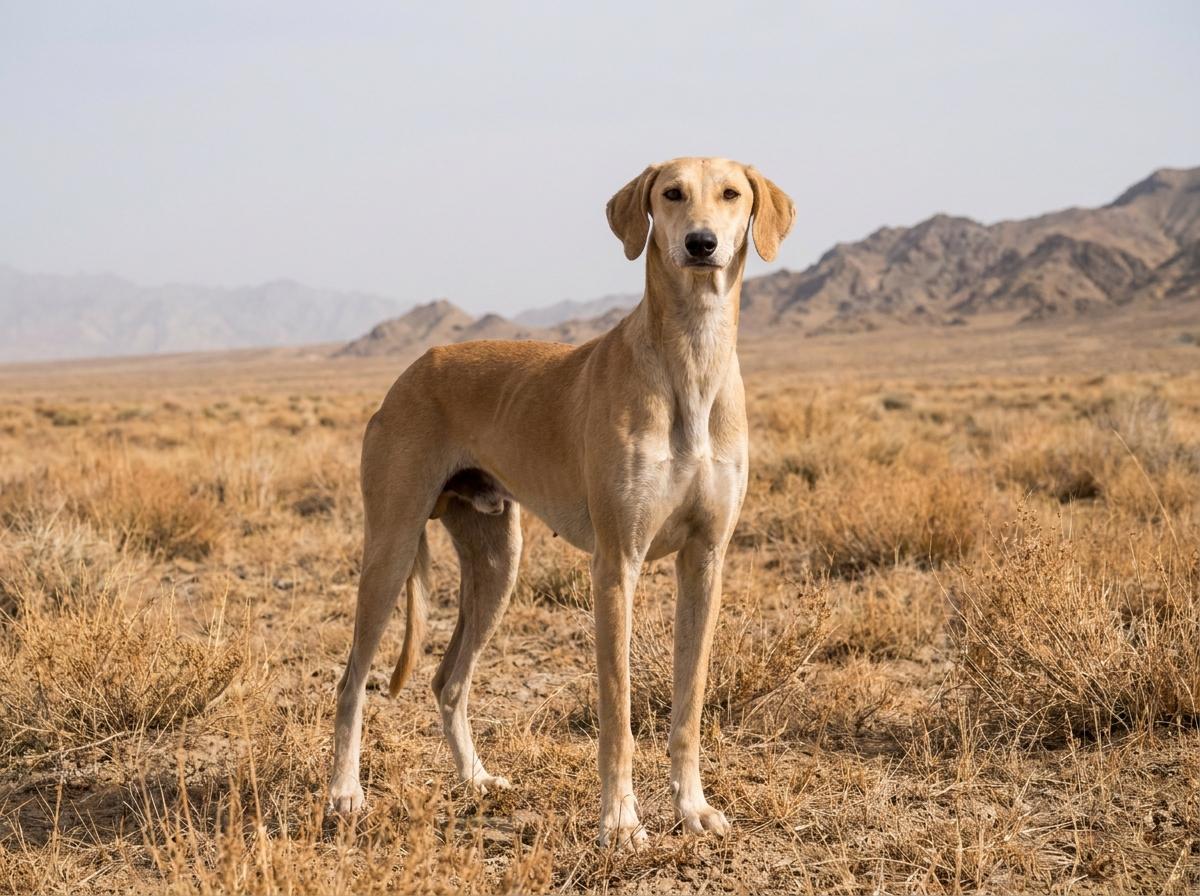
Everything about the Xigou reads as an animal built for a straight, fast run on open ground. The body is deep through the chest and dramatically cut up at the loin, with a tucked abdomen, an arched topline, long fine legs, and a long, thin, low-hung tail that often finishes in a slight curl. The neck is long and slightly arched. The head is the signature: long, narrow, and dry, with a flat skull, little stop, and small, thin drop ears set close together and usually folded back along the head. In motion the whole outline flattens into the classic sighthound double-suspension gallop.
Coats divide into the smooth majority and the feathered Shandong strain. Colors in Chinese accounts run from red, fawn, and yellow through cream and white to black, with brindle and blue-gray also reported; no single color defines the breed. Size figures should be read as descriptive rather than official: commonly cited ranges put the dogs around 60 to 78 cm (24 to 31 in) at the shoulder and 20 to 30 kg (44 to 66 lb), which makes the Xigou taller and lighter-framed than most retrievers, in the same general envelope as a Saluki. There is no international breed standard to settle the numbers, and individual dogs vary by region and strain.
A condition note that matters for a breed like this: a fit Xigou is lean by design, with visible muscle over the loin and hindquarters. Lean is normal; bony and weak is not. If you ever assess one in person, judge condition by muscle and energy, not by the visibility of a sighthound’s naturally prominent last ribs.

Temperament and daily life
Formal temperament studies do not exist for this breed, so read the following as the consistent picture from keepers rather than settled science. Xigou are described as quiet, composed house companions that attach strongly to their own people while staying reserved and watchful with strangers, a blend of coursing dog and courtyard guard that fits their history. They are generally not described as quarrelsome, but they are independent in the way most sighthounds are: bred to make split-second decisions at speed without waiting for instructions.
The practical consequences are the standard sighthound ones, turned up slightly. Prey drive is extreme; a dog developed for two millennia to chase running animals will chase running animals, so off-leash freedom belongs only inside secure fencing, and homes with free-roaming cats, rabbits, or poultry need to think hard before bringing one in. Daily exercise should include real chances to stretch out and sprint, not just leash walks. The short coat and low body fat mean these dogs feel cold and appreciate soft bedding and a coat in winter, with the thicker-coated northeastern strain the partial exception. None of this makes the Xigou difficult; it makes it a specialist, and happiest with people who enjoy what it is.
Whatever you keep, keep records. A rare landrace benefits enormously from documented weights, vaccinations, parasite prevention, and breeding history, because so little about it is written down anywhere else. A free Creatures animal profile gives each dog a place for exactly that, with no account needed to start, and your veterinarian remains the authority for every medical decision.
Coursing culture, the law, and what remains
The Xigou’s traditional sport is xigou nian tu (细狗撵兔), “thin dogs chasing the hare”: farmers gathering on harvested fields in the agricultural off-season to slip their dogs after wild hares, which were treated as crop pests. In the Shaanxi heartland the gatherings clustered around traditional festival days, and the custom was taken seriously enough as folk culture that the Pucheng County tradition was added to Shaanxi Province’s intangible cultural heritage list in 2009.
The legal ground has since shifted underneath it. China’s Wildlife Protection Law requires a hunting license for terrestrial wild animals of important ecological, scientific, or social value, and the national list of those animals, reissued in 2023, lists seven wild hares, among them the tolai hare of the northern plains that this sport depends on. Hunting them without that license is an offense, and serious cases carry criminal liability. Chinese courts and police have prosecuted dog-coursing parties and seized hounds in recent years, and organized live-hare events have been curtailed in many areas. There is also a welfare argument that deserves to be stated plainly: coursing kills hares, which is exactly why live coursing was banned in other countries with deep coursing traditions. The result in China is a heritage listing celebrating a practice the wildlife law now mostly forbids, and nobody should buy one of these dogs planning to course live game.
What remains is the running itself. Enthusiasts increasingly channel the dogs into lure chasing, straight racing, and informal speed trials, which preserve the athletic culture without a dead hare at the end of it. For the breed’s future that shift is probably the single most important development, because a working landrace with no legal work tends to stop being bred at all.
Conservation and recognition
Nobody can tell you how many Xigou exist, and any precise number you see should be treated with suspicion. What is documented is the direction: Chinese accounts consistently describe a population that fell steeply as hunting was restricted, farm work mechanized, and rural life urbanized, leaving the dogs to dedicated enthusiast circles rather than everyday farmyards.
Organized conservation has started, from inside China. The China Kennel Union, the country’s FCI-affiliated kennel organization, runs a conservation club for Chinese native breeds, and the Xigou is one of the breeds it took up first. By the club’s own account of its 2017 season, a Shaanxi Xigou seminar and the first assessment registration were held in Xi’an that April, and the union’s first specialty show devoted to a single native breed, the Shaanxi Xigou, followed in Xianyang in September. The breed is also one of five in the union’s native breed standards manual, which was still being illustrated in 2018. What has not surfaced is a published conservation standard for the Shaanxi type carrying a verifiable date, so treat any year you see attached to one the way you would treat a population figure. Science is starting to catch up too: a 2023 genomic study of Chinese indigenous dogs in Frontiers in Veterinary Science sampled thin dog populations from both Shaanxi and Shandong among its fourteen study populations, an early step toward understanding how distinct these lines really are.
International recognition does not exist. The Xigou is not recognized by the FCI, the AKC, or any other major kennel club outside China, no international studbook covers it, and essentially no established breeding population exists outside China; a handful of individual exports is the ceiling of the breed’s Western footprint so far. Recognition at home is the exception, since the China Kennel Union has registered Shaanxi dogs through its native breed conservation program since 2017. That still puts the Xigou in a category readers of this series will recognize. Like the American staghound, it is a working sighthound bred for what it can do rather than to an international standard, and like the Bakharwal dog of the western Himalayas, it is an old regional landrace whose documentation is thinner than its history. For all three, the useful response is the same: record what actually exists, accurately labeled, rather than waiting for a registry to do it first.
One caution follows directly from the rarity. When a name gets rare and romantic, mislabeling follows, and slender crossbred dogs are already offered under the Xigou name inside and outside China. Provenance, photographs of the parents, and written records are worth far more than a seller’s use of the word.

Finding a Xigou
For most readers outside China, the realistic answer is: not soon. There is no Western breeder network, no rescue pipeline, and no import route you can simply order from, so acquiring one means years of relationship-building with Chinese enthusiast circles, export logistics, and your country’s dog import rules. Inside China, dogs change hands through those same enthusiast networks, mostly by reputation.
Given that timeline, the useful move now is to let the search run on its own. Set a free listing alert for Xigou on Creatures and you will be emailed if one is ever listed, which beats checking manually for a dog this rare; no account is needed to start. You can browse the dog marketplace and the breeder directory for sighthound breeders and rescues in the meantime, and if you already keep a rare or unregistered sighthound of any kind, giving it a documented profile is the most concrete thing anyone can do for dogs that registries do not track.
Frequently asked questions
Is a Xigou the same as a Saluki?
No. The feathered Shandong strain looks Saluki-like, which is where the Chinese Saluki nickname comes from, but the Xigou is a distinct Chinese landrace with its own regional types. Whether the two share deep ancestry via the Silk Road is an open question that genetics has not yet answered.
Is the Xigou recognized by the AKC or FCI?
No. Its only formal recognition is inside China, where the China Kennel Union’s native breed conservation club has run assessment registration for the Shaanxi type since April 2017 and carries the breed in its native breed standards manual.
What does “Xigou” mean?
Thin dog. Xi (细) means thin or slender, gou (狗) means dog. The written form Xiquan (细犬) means the same thing with the more formal word for dog.
Are Xigou good family pets?
Keepers describe calm, quiet, deeply attached companions that are reserved with strangers. The hard requirements are sighthound ones: secure fencing, real sprint exercise, leashes anywhere unfenced, and caution around small pets, because the prey drive is extreme.
How many Xigou are left?
No reliable census exists. The breed is consistently described as rare and declining, which is why the China Kennel Union began conservation registration for the Shaanxi type in 2017. Treat any precise population number as invented.
Is the celestial hound of Chinese mythology a Xigou?
The howling celestial dog of the god Erlang Shen is traditionally described as a slender white hunting dog, and Xigou fanciers enjoy claiming it as their breed. It is a charming association, not history.
Do this next on Creatures
Whether you are researching the breed from afar, keeping sighthounds today, or one of the few people working with actual Xigou, Creatures is the records, marketplace, and directory layer to do it in one place.
Get alerted. Xigou listings are vanishingly rare, so set a free Xigou listing alert and Creatures will tell you the moment one is posted. No account needed to start. How it works: saving searches and using your watchlist.
Watch the market. Browse Xigou on the marketplace, and look for sighthound breeders and rescues in the Creatures directory.
Add your dog. Keep a Xigou, a staghound, or any sighthound? Create a free animal profile in a few minutes, no account needed to start. The walkthrough is in adding an animal to Creatures.
Start its records. Add weights, vaccinations, and health events as they happen. The record sheet opens for any visitor to look around, and a free account saves what you enter. See adding a record and health and medical records for the how-to.
Represent the breed. Breed sighthounds, or run a kennel or rescue? Create your organization’s profile, then get listed in the breeder directory so the people searching for rare sighthounds can find you. Team setup lives in creating an organization and adding your team.
Keep exploring. Compare the Xigou with the American staghound and the Bakharwal dog, or browse every breed from the Creatures dog species page.
If you breed or rescue sighthounds, you can also list your kennel or organization in the Creatures directory so buyers searching for rare coursing breeds can reach you.