Breeding Heifers: When to Breed, Target Weights and First-Calf Heifer Care
Author: Elliott Garber, DVM · Published
Breed beef heifers at about 13 to 15 months of age so they calve as two-year-olds, but only once they have reached their target weight and are cycling. The traditional target is 60 to 65% of the mature weight of the cows in your own herd; current extension research shows many heifers reach similar overall pregnancy rates at 50 to 57% when feed is limited, though fewer conceive in the first 21 days. Weigh them, or estimate with the free cattle weight calculator, well before the bull goes out so there is still time to change the ration.
Age alone is the wrong trigger. Mississippi State Extension’s 2025 heifer publication says heifers should reach puberty by about 12 months so they can conceive at 15 months, and that heifers bred on their third or later heat after puberty showed about 21% higher fertility in earlier research. A heifer that is old enough but light, or heavy enough but not cycling, is a heifer at risk of calving late or coming up open.
Dairy heifers follow the same logic on different numbers: about 55% of mature body weight and 90% of mature height at 13 to 15 months, calving at 22 to 24 months, as Penn State Extension and Wisconsin Extension set out. The plan below covers both, with the beef numbers first because most of the questions about first-calf heifers come from cow-calf herds.
Sources checked November 14, 2026. Targets come from Merck Veterinary Manual and university extension publications, each linked where it is used. Your veterinarian decides synchronization protocols, vaccines and any reproductive exam; this guide gives no drug names, doses or protocols.
| Beef breeding age | About 13 to 15 months, to calve at 22 to 24 months (Merck) |
|---|---|
| Beef target weight | 60 to 65% of herd mature weight traditionally; 50 to 57% supported in some systems |
| Dairy target | About 55% of mature weight and 90% of mature height at 13 to 15 months |
| Puberty first | Cycling a few heats before breeding; fertility rises about 21% by the third heat |
| Breeding season | Start heifers 3 to 4 weeks ahead of the mature cows |
| At first calving | About 85% of mature weight and body condition score 5 to 6 |
| Calving watch | Check calving heifers every 3 to 5 hours; call the vet early for a stalled calving |
When to breed heifers: age and weight together
Merck Veterinary Manual’s breeding programs chapter describes beef heifers bred at 13 to 15 months and calving at 22 to 24 months, which leaves them time to rebreed with the mature cow herd. Missouri Extension’s heifer development publication G2091 frames the same goal as puberty and conception at roughly 15 months so the heifer calves at two years old.
Hitting that age depends on growth. Puberty is a function of breed, age and weight, in Merck’s words, so a heifer that falls behind on gain falls behind on cycling too.
Start from your own cows’ mature weight
Every percentage target is a share of the mature weight of cows in your herd, not a breed average from a website. Weigh a handful of mature cows in moderate condition, or estimate them, and use that number. A herd of moderate 1,100 pound cows and a herd of 1,400 pound cows need very different heifer targets.
The table from Mississippi State shows how wide the gap is between the two common targets:
| 900 lb mature cows | 496 lb at 55%; 584 lb at 65% |
|---|---|
| 1,000 lb mature cows | 549 lb at 55%; 650 lb at 65% |
| 1,100 lb mature cows | 604 lb at 55%; 714 lb at 65% |
| 1,200 lb mature cows | 659 lb at 55%; 780 lb at 65% |
| 1,300 lb mature cows | 714 lb at 55%; 844 lb at 65% |
65% or 55%: which target fits your herd
The sources do not agree on one number, and the disagreement is useful:
- The traditional target. Mississippi State and Iowa State’s April 2026 Growing Beef heifer article both give 60 to 65% of mature weight at breeding. Merck’s chapter is higher still, at least 65 to 75% of projected mature weight for a heifer bred at 14 months.
- The lower target. Missouri Extension and Nebraska BeefWatch report heifers developed to about 50 to 55% of mature weight without lower overall pregnancy rates, and Missouri notes no differences in calving difficulty or rebreeding in that work. Iowa State says 55 to 57% may be sufficient.
- The trade-off. In one study Mississippi State cites (Kasimanickam and colleagues, 2021), heifers developed to 65% reached puberty, conceived and calved in the first 21 days at higher rates than heifers developed to 55%, with no difference in calving difficulty. Other research on 50 to 55% targets found overall pregnancy rates unchanged but fewer heifers conceiving in the first 21 days, at lower feed cost. Much of the low-target research used crossbred heifers, which tend to reach puberty earlier than purebreds.
In practice: the lower target tends to suit herds with limited feed, moderate-framed crossbred cows and a willingness to cull heifers that do not settle early. The higher target suits herds that have few replacements to spare, plan to breed by AI on a set day, or run purebred or Bos indicus-influenced heifers. Bos indicus-based heifers, Mississippi State notes, typically reach puberty and target weight later, between 15 and 24 months, compared with 12 to 14 months for Bos taurus-based heifers. Discuss the choice with your veterinarian or extension agent before the weaning-to-breeding feeding plan is set.
Avoid the opposite mistake as well. Mississippi State warns that over-conditioning developing heifers can lower fertility, and gives body condition score 6 as a good target at breeding. Iowa State says 5 or 6.
Dairy heifers
Dairy herds breed by size rather than by birthday. Penn State says Holstein heifers should reach 55% of mature body weight, often 750 to 800 pounds, and 90% of mature height by 13 to 15 months. Wisconsin Extension warns that breeding strictly by age leaves some heifers too small and others too big, and that undersized heifers are prone to more problems at calving and produce less milk over their lifetime. Merck puts the most profitable dairy first calving at 23 to 25 months; the extension sources aim for 22 to 24. Either way, size decides the date.
Puberty, the third heat and the prebreeding exam
A heifer can be heavy enough and still not cycling. The Mississippi State publication recommends that heifers reach puberty one to three months before breeding, because fertility on the third or later heat after puberty was about 21% higher than on the first heat. Iowa State gives the same figure. That is the biological reason heifers that calve late as two-year-olds keep calving late: the ones that cycled early settle early.
Watching for heats in the weeks before breeding is the cheapest way to know which heifers are cycling. The cow heat cycle guide covers the signs and how long a heat lasts.
Many herds add a prebreeding exam. Missouri Extension describes reproductive tract scoring as a veterinarian’s exam, done at around 12 to 15 months and before bull turnout or AI, that scores the tract from 1 to 5 by puberty status:
| Score 1 | Infantile or underdeveloped tract |
|---|---|
| Score 2 | Not close to cycling, but more developed than a 1 |
| Score 3 | Near puberty, not yet cycling |
| Score 4 | Cycling, in the first phase of the estrous cycle |
| Score 5 | Cycling, in the second phase of the estrous cycle |
Heifers scoring 1 or 2 may not be cycling when the bull goes in. A group full of low scores a month out is a signal to talk to your veterinarian about the ration and the breeding date, not a reason to push ahead and hope.
The same visit can include pelvic measurement. Iowa State treats it as a culling tool rather than a selection tool: measure the heifers and cull those at the bottom of the group, rather than keeping the biggest. Your veterinarian performs both exams; record the scores they give you rather than trying to score a tract yourself.
Weigh heifers early and track the gain
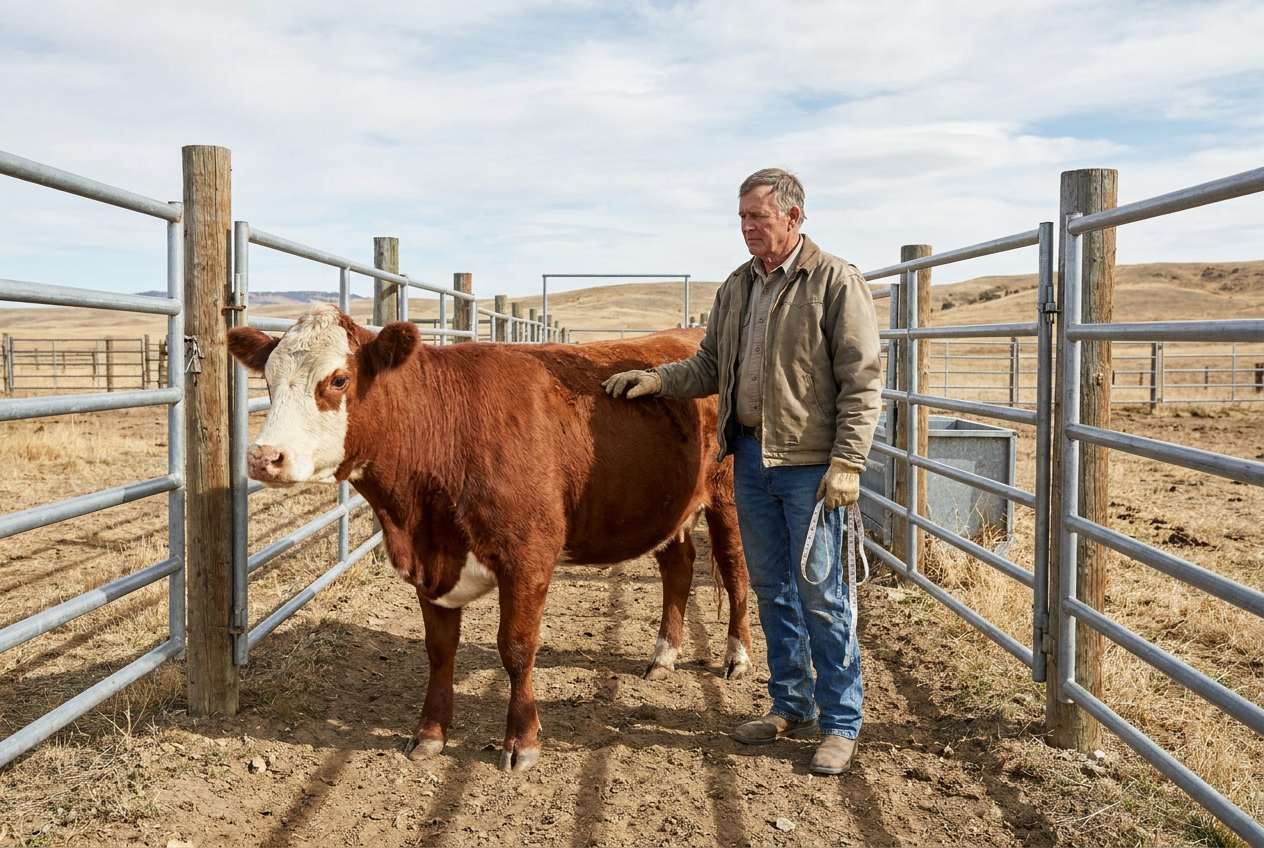
You cannot hit a target weight you never measure. The Mississippi State team suggests weighing developing heifers every 30 days and adjusting feed; Penn State says the only real way to tell how heifers are growing is to weigh and measure them several times a year. If there is no scale, a heart girth tape is the usual fallback: Penn State notes weight tapes are accurate to within 3 to 5% for animals over 330 pounds. The free cattle weight calculator takes heart girth and body length and returns an estimate; estimating animal weight with the weight calculator explains the measurements. Tape and scale numbers are not interchangeable, so note which one you used on every weigh day. The guide to weighing cattle compares the options.
Turn the target into a daily gain so the ration has a job to do. A worked example, using Mississippi State’s table:
- Mature cows in this herd weigh about 1,200 pounds, so the 65% target is 780 pounds and the 55% target is 659 pounds.
- A heifer weighs 550 pounds at weaning, and the heifer breeding season starts in 200 days.
- At 65% she needs (780 minus 550) divided by 200, or about 1.15 pounds a day. At 55% she needs about 0.55 pounds a day.
Nebraska’s BeefWatch article makes the same calculation with roughly 210 days between weaning and breeding. Recheck the actual gain at each weigh day: a group that is behind at day 60 can be caught up; a group that is behind at day 180 usually cannot without overfeeding late. The calf growth chart guide shows how to read a weight trend without overclaiming from one weigh day, and the cattle feeding guide covers forage and supplement basics.
Plan the heifer breeding season
Start heifers ahead of the cows
Merck says the breeding season for virgin beef heifers should start 3 weeks before the main cow herd; Iowa State says 3 to 4 weeks. Heifers that calve before the cows get closer attention at calving, and they gain the extra time they need to cycle again and rebreed with the mature herd the next year. Put that start date on paper first and work back to the weaning and weighing schedule.
Keep the heifer season short and defined so that late heifers are easy to see. A heifer that conceives late calves late, and she tends to stay late.
Pick the bull or the semen for calving ease
Iowa State’s advice is direct: select calving ease bulls, using calving ease EPDs, to reduce difficult births. That applies to a cleanup bull as much as to AI sires. The bull semen cost guide and the cattle AI cost guide cover the budget side, and our cattle artificial insemination guide walks through the AI breeding itself. If you synchronize heifers for timed AI, your veterinarian chooses the protocol; this guide does not give one.
Breed more heifers than you need
Merck notes that virgin heifers usually show a higher attrition rate, and suggests breeding more than you need to keep or grow the herd, for example 150% of the replacements required. The extra heifers that settle early are your choice of the best; the ones that do not settle can be marketed as feeders while they are still young. Missouri Extension adds that heifers with obvious fertility problems at the pre-breeding exam can be marketed as feeder heifers.
Plan prebreeding vaccinations with your veterinarian well before the breeding season so they are not given at turnout. The cattle vaccination guide covers which vaccines usually come up at the heifer stage.
After breeding: pregnancy check and open heifers
Confirm pregnancy rather than assuming it. A veterinarian’s pregnancy check sorts the heifers that settled early from the late ones and the opens, and gives you an estimated calving date to plan the calving pen around. The timing and methods (palpation, ultrasound, blood tests) are in our cattle pregnancy check guide. Use the cattle gestation calculator to turn each breeding date into a projected calving date and window, and the cow gestation guide for the calendar behind it.
Decide in advance what happens to open heifers. Most cow-calf herds market them rather than carry them a year, which is why breeding extra heifers makes sense in the first place.
Bred heifers keep growing. Mississippi State says heifers should reach about 85% of mature weight before calving, and South Dakota State gives the same figure together with body condition score 6 at calving. Keep weighing or scoring them through pregnancy; a heifer that drops condition in late gestation pays for it after calving.
First-calf heifers: calving and rebreeding
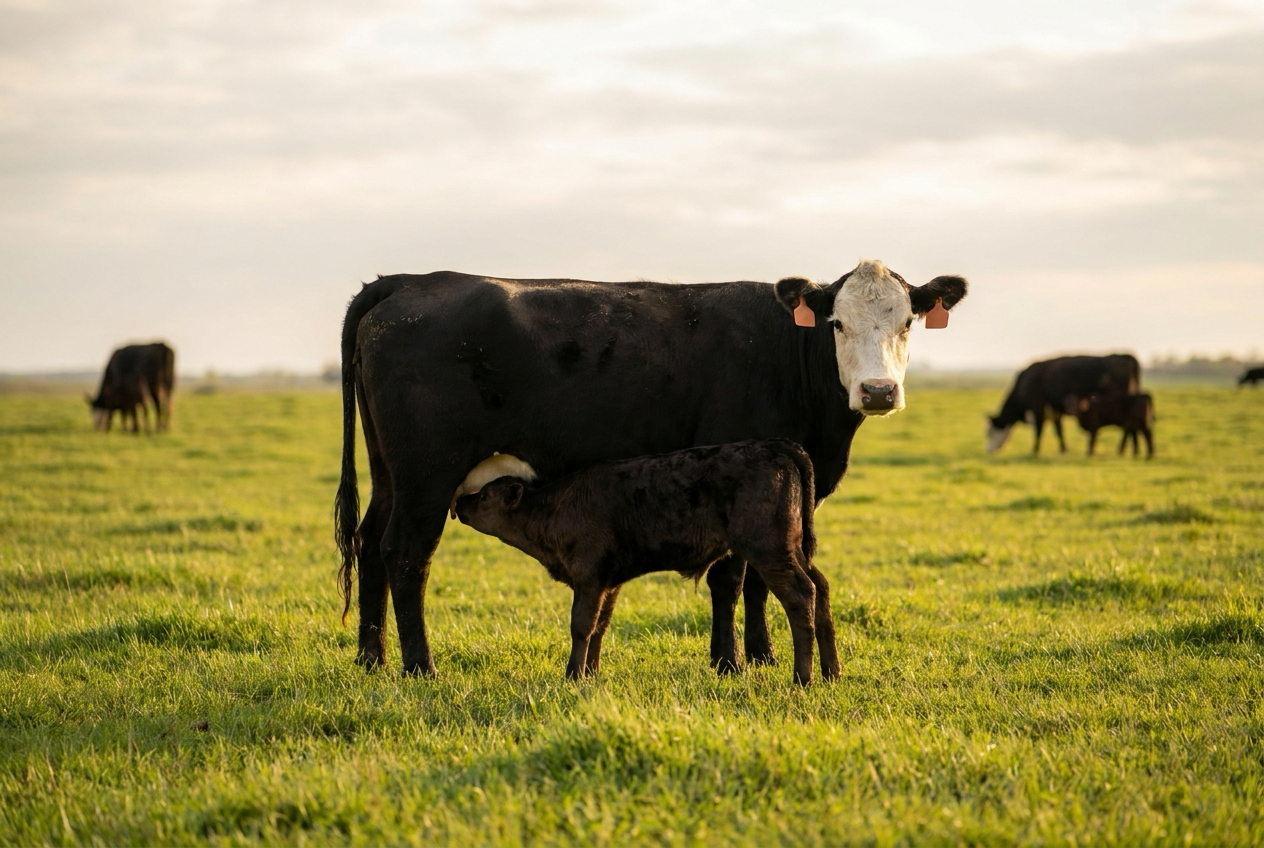
First-calf heifers need more attention than mature cows at both ends of the year. SDSU Extension estimates that 10 to 15% of first-calf heifers experience calving difficulty, and recommends checking calving heifers every 3 to 5 hours. Calving the heifers before the cows, in a pasture or pen close to the house, makes those checks realistic.
Know the call points before the first heifer starts. A heifer straining hard with no progress, a calf that appears and does not advance, an abnormal presentation or a heifer that becomes exhausted needs your veterinarian now. Our calving guide lists the signs of normal labor and when to call for help; calving season planning covers setting up the whole season.
Body condition matters after calving too. SDSU says heifers above score 6 may have impaired milk production, while thin heifers will likely have a longer interval before they cycle again. A first-calf heifer is still growing and nursing at the same time, so she often needs extra energy compared with the mature cows; SDSU notes that a thin heifer will need supplemented energy to meet her demands. Many herds feed first-calf heifers as their own group for this reason.
The payoff of calving the heifers early shows up the next spring. South Dakota State and Merck both point out that early calving gives the young cow more time to recover and rebreed early in the next season. A heifer that calves late as a two-year-old has less time to cycle before the bull goes in.
For dairy heifers, Penn State and Wisconsin aim for 85 to 90% of mature body weight after calving.
Tracking replacement heifers on Creatures
Creatures is the records layer for this job. It does not score, select or rank heifers for you, and it does not track EPDs; your veterinarian’s exams and your own eye do that. What it does is keep each heifer’s weights, breedings and calving history in one place so the decisions are easier at the next weigh day and the next pregnancy check.
- Give each heifer a profile. Add each heifer with her ear tag or other identifiers, birth date, dam and sire (how to add an animal). If the heifers are registered, the registration number can go on her profile as a record. Storing a number on Creatures never registers or transfers an animal with a breed association; that is still done with the registry.
- Record weigh days. Log a single heifer’s weight with a physical measurement record, or weigh the whole replacement group in one sitting with batch measurements for a group. Each heifer gets her own record, and you mark whether the value was measured on a scale or estimated by tape. Body condition can be recorded as an observed score the same way.
- Record the breeding. Recording a breeding takes the method (natural service or artificial insemination), the bull or AI sire on or off Creatures, and the date or exposure range. A tracked breeding gives each heifer a due date, window and reminders, including a pregnancy check reminder. After saving one heifer, you can log the same date and sire for the others bred that day.
- Record the pregnancy check. A Pregnancy Check record holds the result (pregnant, open or not sure). Her due date comes from the tracked breeding in step 3. For a heifer with no known service date, such as one bought bred, a Pregnant check with your veterinarian’s estimate of how far along she is sets one. If the exam shows her date is off, correct it with Change dates or due date on her breeding.
- Watch the calving list. The breeding dashboard shows which heifers are due soon and which are overdue against their projected date, so the heifer pen gets checked first. Recording the birth creates the calf’s profile linked to its dam.
- Plan the routine. Care plans include starter protocols for the cattle breeding preseason and estrus synchronization for heifers; see breeding and reproductive care protocols. Treat them as a checklist you adapt with your veterinarian, not as a prescription.
The calculators and the cattle pedigree chart maker work without an account. Saving profiles and records needs a free account. For what else belongs in a herd file, see cattle record keeping, and the cattle hub for every cattle guide.
Frequently asked questions
What is the best age to breed a heifer?
For beef heifers, about 13 to 15 months, so they calve at 22 to 24 months, provided they have reached their target weight and are cycling. Bos indicus-influenced heifers often reach puberty later. Dairy heifers are bred by size at about 55% of mature weight and 90% of mature height, which most reach at 13 to 15 months.
How much should a heifer weigh when you breed her?
A share of your own herd’s mature cow weight: 60 to 65% is the traditional target, and research supports 50 to 57% in many systems. For 1,200 pound cows that is roughly 660 to 780 pounds. Merck’s chapter gives a higher figure of 65 to 75% for a heifer bred at 14 months, so set your target with your veterinarian.
Can you breed a heifer too young?
Yes. A heifer bred before she is grown enough or cycling is more likely to fail to conceive, calve with difficulty or struggle to rebreed. Breed by weight and puberty status, and use the calendar only as the outer frame.
Why breed heifers before the cows?
Merck and Iowa State recommend starting the heifer season 3 to 4 weeks before the cow herd. First-calf heifers take longer to cycle after calving, so the head start gives them time to rebreed with the cows the next year, and it puts them in the calving pen when you have time to watch them.
What is a first-calf heifer?
A heifer carrying or nursing her first calf. She is still growing, so she needs more nutrition and more attention at calving than a mature cow, and SDSU recommends she reach about 85% of mature weight and body condition 6 by calving.
Do I need a reproductive tract score?
It is optional but useful. Missouri Extension describes it as a veterinarian’s exam at 12 to 15 months that scores tract development from 1 to 5, and it flags heifers unlikely to be cycling before money is spent breeding them.
Do this next on Creatures
Developing replacement heifers this season? Start with the animals and the weigh days, then the breedings.
- Add each heifer: Add a heifer to Creatures with her tag, birth date and parents. You can start without an account and sign up inline to save. Help: adding an animal.
- Log a weight or a breeding: Add a weight record for a weigh day, or record the breeding to get a projected calving date. The form opens for visitors; a free account saves it. Help: growth and identity records.
- Set up your ranch profile: Create your ranch or breeder profile so buyers can see your herd and records in one place. Help: getting listed in the breeder directory.
- Get alerts for replacement stock: Save a cattle listing alert and hear when new cattle are listed, if you are buying heifers rather than raising them.
- Browse cattle for sale: See cattle listed on the marketplace.
- Find breeders: Browse the breeder directory for trusted cattle breeders near you.