




Seraphim Pigeon
Author: Elliott Garber, DVM · Published
The Seraphim pigeon is a modern American fancy pigeon, not an angel, religious symbol, or white release dove. Its signature is a transformation: youngsters hatch and feather in colored pattern, then molt toward the clean white adult described by the breed club. The adult is upright and frilled, with a pointed rear crest, dark bull eyes, a pale functional beak, and lightly feathered feet. Start at the Creatures pigeon hub for species context, or check Seraphim pigeon listings if you are evaluating an individual bird.
The breed is young enough that its origin is documented. Anne Ellis developed it in East Moline, Illinois, beginning in 1986. The National Pigeon Association recognized it in 1995, and the French national pigeon body followed in 1997. The standard and history come from the organizations that maintain the fancy, not from mythology attached to the name.

| Animal | Domestic fancy pigeon |
|---|---|
| Origin | East Moline, Illinois, United States; development began in 1986 |
| US recognition | National Pigeon Association, 1995 |
| NPA group | Owls and Frills |
| Young-bird color | Colored, described by the breed club as Satinette-marked piebald |
| Adult color | White after progressive molting; timing and completeness vary |
| Head | Rounded head ending in a narrow pointed peak, with a convex mane down the neck |
| Front | Projected chest with a prominent reversed-feather frill |
| Feet | Small feathers and an ankle sweep, not massive muffs |
| Name | One Seraph; more than one Seraphim, not “Seraphims” |
Browse listings, public profiles, breeders, or add your animal.
A modern breed with a documented origin
The Seraphim Club International encyclopedia credits Anne, also known as Anya, Ellis with developing the breed in East Moline beginning in 1986. It records National Pigeon Association recognition in 1995 and French recognition in 1997. Those dates make the Seraphim a modern created fancy, not an ancient Mediterranean pigeon rediscovered under a dramatic name.
The National Pigeon Association breed list places Seraphim in Owls and Frills. The NPA’s current Book of Standards is the governing US reference for exhibition. A web article can explain the bird, but a show decision belongs to the current standard and licensed judges.
The language has one useful detail. The breed club specifies Seraph for one bird and Seraphim for more than one. “Seraphims” adds a second English plural ending to a word already used as plural by the club.
From colored youngster to white adult
Seraphim youngsters do not begin as miniature white adults. The club describes juveniles with recessive red or yellow patterned color, then progressive whitening through molts. Some birds may need two molts to approach the adult ideal. That is an observation and selection goal, not a deadline that every individual must meet.
Take dated photographs in the same light after each molt. Record hatch date, juvenile color, first molt, later clearing, and any persistent colored feathers. A one-time sale photo cannot show the trajectory.
The club describes the underlying bird as genetically related to a Satinette-marked piebald and discusses white-sides and tail mechanisms. It also says research is ongoing. That caveat matters: the page does not reduce the breed to one certain gene, predict every mating, or promise that two visually white adults will produce a fixed outcome. Ask a breeder for the actual parents, siblings, and multigenerational records.
The adult outline
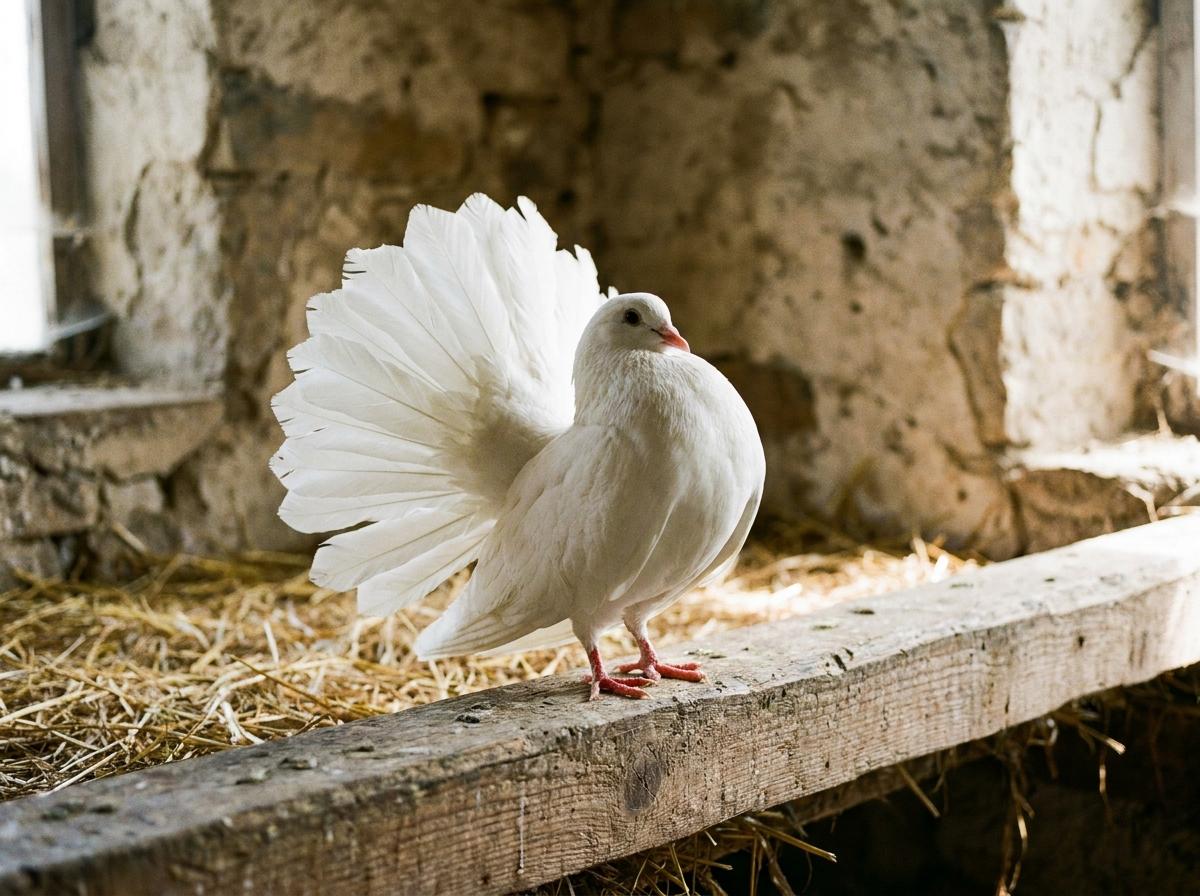
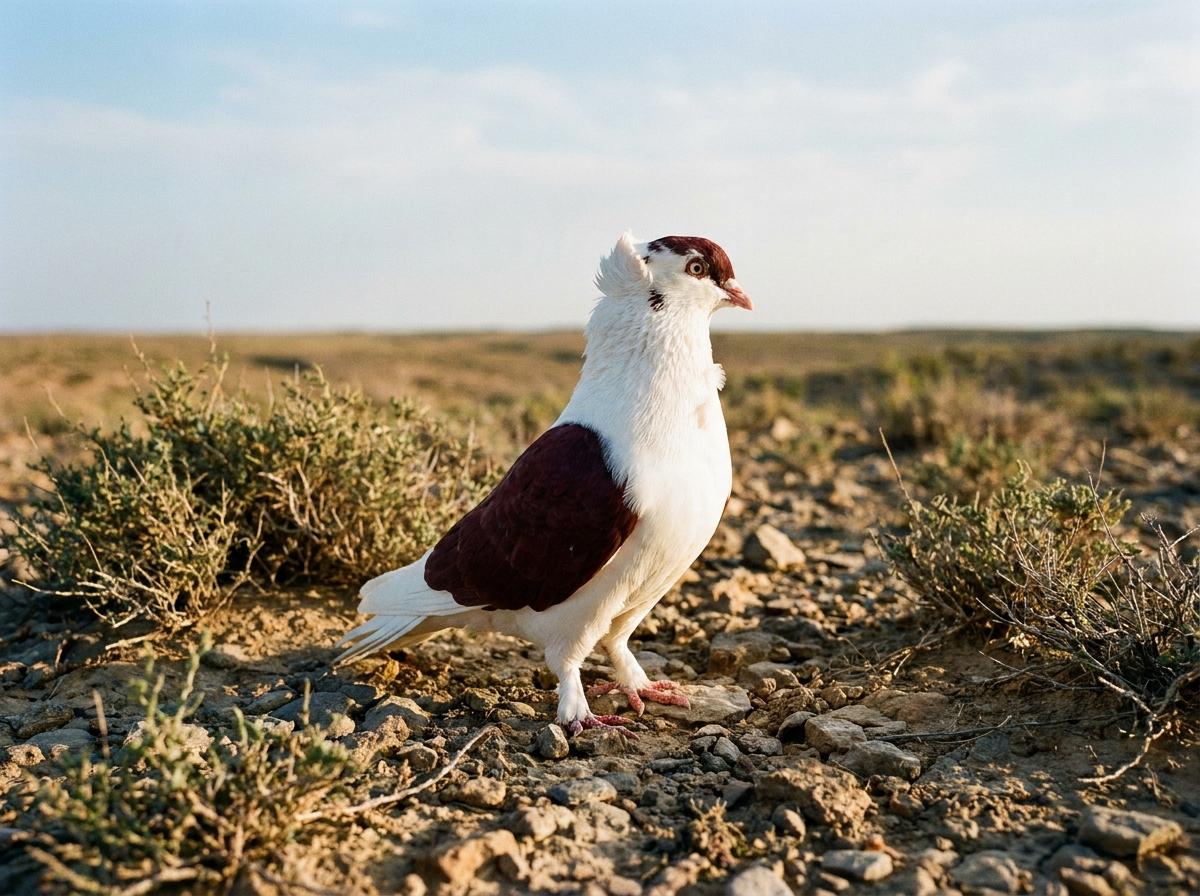
The ideal adult is white, statuesque, and upright. Head sits high, tail lower, and chest projects forward. Closed flights rest over the tail. The back should look smooth, and the wing butts remain defined rather than disappearing into a ball of feather.
This is not a Fantail. The tail is carried low rather than opened into a vertical fan. It is not a Jacobin, whose hood encloses the head. It is not a Frillback, whose wing and shield feathers curl. The Seraphim’s decorative features concentrate at head, neck, chest, and feet while the body and flight feathers remain smooth.
Head, peak, mane, and frill
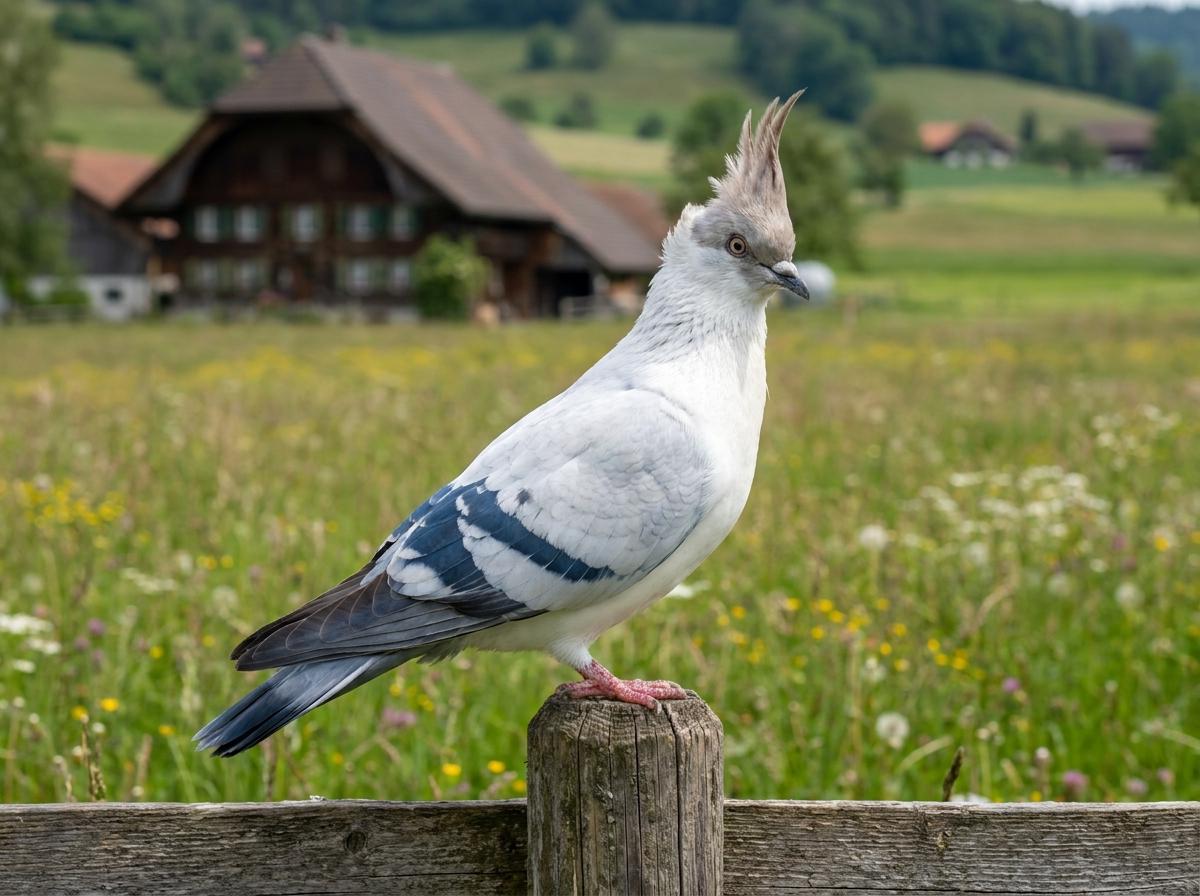
The rounded head flows rearward into a narrow point or peak. From that peak, the breed club calls for a convex mane continuing toward the shoulder. In front, reversed feathers form a prominent chest frill.

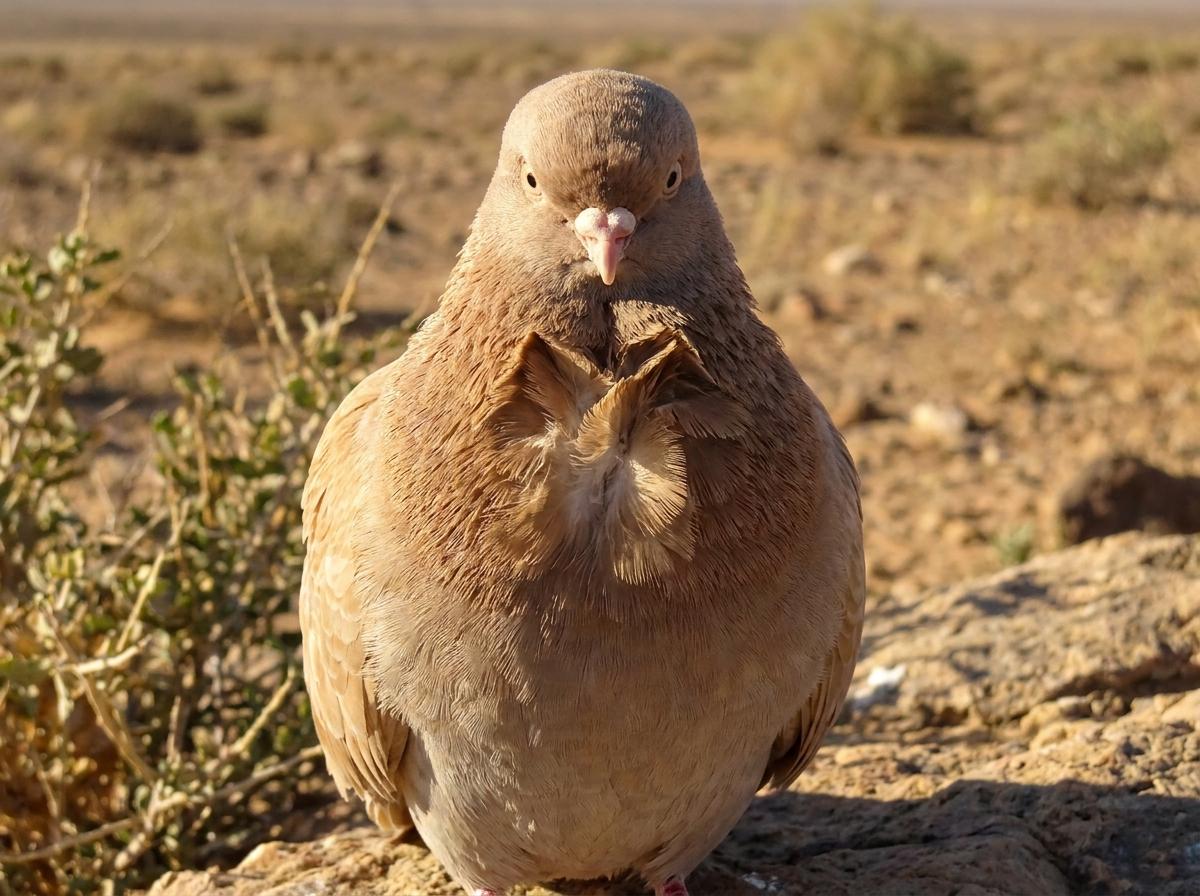
The installed close portrait shows the traits without claiming exhibition perfection. Its peak is long and sharply resolved, the dark eye is surrounded by pale tissue, and the front feathers reverse outward. The beak remains large enough to look functional. A breeder should never select such an extreme short beak that adults struggle to feed young.
The club’s written ideal calls the eye a bull eye, meaning dark. The cere and beak are light. A bright orange iris, long dove-like beak, smooth uncrested head, or shell crest spanning the whole rear skull does not match the same picture.
Feet and feather condition
Seraphim have foot feathering, but the specialist description calls for small feathers and an ankle sweep. Huge muffs that obscure movement belong to a different outline. Feet and lower feathers need regular inspection because loft moisture and droppings can cling to them.
Do not scrub a show bird on a fixed cosmetic schedule. Keep floors and shelves dry, provide bathing water, and let clean husbandry do most of the work. If a foot feather breaks, the priority is bleeding control and health, not immediate show appearance. Persistent swelling, a constricting fiber, limping, or a wound belongs in front of an avian veterinarian.
Loft design for a fancy pigeon
The Association of Avian Veterinarians’ pigeon husbandry handout recommends space arranged for horizontal flight, protection from predators and rodents, shelter, ventilation, dry conditions, social contact, bathing, flat shelves, and natural perches. It warns against wire perches and damp, mold-prone conditions.

The image is a welfare-forward example, not a construction drawing. It shows two birds, a broad shelf, varied natural perches, a shallow bath, solid flooring, a mounted cup, and a long covered mesh flight. Seed hulls are visible on the floor, which means the scene still needs routine cleaning; the alt does not call it spotless.
Priorities for a real loft:
- Build for horizontal movement rather than height alone. Birds need room to fly between stable landing places.
- Use secure exterior mesh and close gaps against rodents and predators. Inspect after storms and any time digging or chewing appears.
- Maintain a solid floor, shelves, and dry nest areas. Remove wet material promptly and maintain airflow above bird level without creating a direct draft.
- Offer broad flat resting shelves as well as natural perches of varied diameter. Avoid wire perches that load the same small foot area.
- Provide clean drinking water apart from bathing water. Change a bath after birds have used or fouled it.
- Provide enough resources and visual escape routes that one bird cannot monopolize every perch, nest, or container.
Feeding, breeding, and records
The breed standard does not create a special Seraphim diet. Feed a balanced pigeon ration appropriate to life stage and activity, supply fresh water, and discuss mineral and grit needs with an avian veterinarian or experienced pigeon nutrition source. Avoid using seed selection as a substitute for complete nutrition.
Before breeding, record both birds’ identities, bands, hatch dates, juvenile markings, molt history, fertility, hatch results, and ability to feed young. The club specifically values a beak large enough for normal parenting. Foster use, hand feeding, or repeated poor chick growth should be recorded rather than hidden behind a show result.
Pairing two birds because both look white today misses the breed’s central feature. Their juvenile colors, clearing pattern, siblings, and offspring provide more breeding information than the adult photograph alone.
Health warning signs
There is no defensible Seraphim-specific disease-prevalence list in the sources used here. General pigeon health still applies. Watch appetite, droppings, breathing, posture, flight, feet, feather quality, and the social behavior of each bird.
Seek prompt avian-veterinary advice for open-mouth breathing at rest, tail bobbing with breaths, discharge, repeated vomiting, neurologic signs, inability to perch or fly normally, a rapidly enlarging swelling, active bleeding, severe lameness, or a bird sitting fluffed and unresponsive. Separate a sick bird when advised and preserve warmth without overheating. The AAV’s bird owner resources help locate broader husbandry and veterinary material.
Use daily notes and photographs to catch a change. White plumage makes some stains obvious, but clean feathers do not prove health, and powder down can make a loft look dusty even when disease is not present.
Finding a Seraphim pigeon
Current price and availability are too variable for a universal figure. Search Seraphim pigeon listings and the Creatures breeder directory, then verify the bird and the program.
Ask to see:
- the exact band and pedigree identity;
- dated juvenile and post-molt photographs of the bird;
- both parents as youngsters and adults where records exist;
- the breeder’s standard reference and club involvement;
- fertility, hatch, parenting, and health history for close relatives;
- the loft, quarantine practice, transfer paperwork, and current diet.
Avoid a seller who uses a generic white dove photo, cannot show the peak and chest frill, or promises that every colored youngster will become a perfect white show adult on one exact molt.
Frequently asked questions
What is a Seraphim pigeon?
It is a modern American fancy pigeon developed by Anne Ellis beginning in 1986 and recognized by the NPA in 1995. It belongs in the Owls and Frills group.
Are Seraphim pigeons born white?
No. The breed club describes colored juveniles that molt toward white. The timing and completeness vary, and some birds need more than one molt.
What does an adult look like?
The adult ideal is white and upright, with a rounded head ending in a pointed peak, convex mane, prominent chest frill, dark bull eyes, pale beak, smooth body feathering, and small feathering at the feet.
Is a Seraphim a white dove?
It is a domestic fancy pigeon with a specific standard. A generic white release dove lacks the documented structure, ancestry, and color-change history that define this breed.
What is the plural of Seraph?
The specialist club uses Seraph for one and Seraphim for more than one. It does not use “Seraphims.”
Is the white color caused by one known gene?
The club discusses a Satinette-marked piebald base plus white-sides and tail mechanisms, but states that research is ongoing. Do not treat that as one settled inheritance formula.
Do Seraphim pigeons need a special loft?
They need the same fundamentals as well-kept domestic pigeons: horizontal flight space, predator and rodent protection, ventilation, dry solid surfaces, social contact, varied safe perches, shelves, clean water, and bathing access. Foot and chest feathering make cleanliness especially visible.
Are they rare or expensive?
No reliable current market-wide figure was found. Availability is regional and the value of a bird depends on pedigree, age, clearing, structure, health, and breeder records.
Do this next on Creatures
Find birds. Browse Seraphim pigeon listings and search the Creatures breeder directory. See saving searches and using your watchlist.
Get alerted. Set a free Seraphim listing alert rather than relying on generic white-pigeon searches.
Add your pigeon. Create a free animal profile for band, hatch date, pedigree, juvenile color, and molt photographs. Follow adding an animal to Creatures.
Track the transformation. Open the record sheet as a visitor; a free account is required to save molt photographs, weights, breeding, treatments, and veterinary findings. See adding a record and health and medical records.
Represent your loft. Create an organization profile, then use getting listed in the breeder directory.
Keep the identity specific. Return to the pigeon species page and preserve band, pedigree, and juvenile-to-adult photographs rather than filing the bird as a generic white dove. For another same-round avian identity page built around cautious phenotype and provenance, see the Banaba chicken.