


African Owl
Author: Elliott Garber, DVM · Published
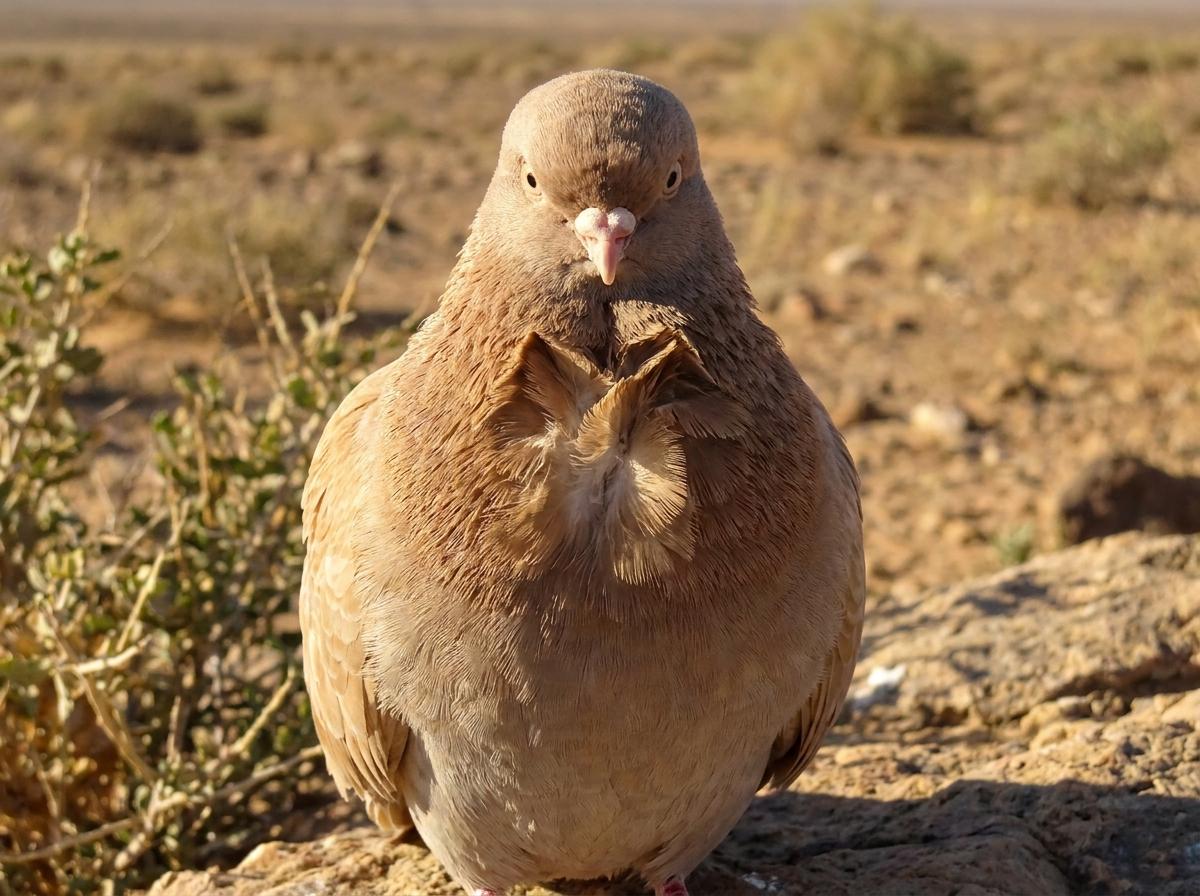
The African Owl is a small, short beaked fancy pigeon kept almost entirely for show and companionship rather than for work. Its trademark is a tiny, stout, downturned beak that gives the whole “owl” family of pigeons its name, set into a round, full cheeked head above a frill of feathers running down the breast. It is one of the calmest and most people friendly pigeons you can keep, which is a large part of its appeal, but it carries one serious catch that every honest keeper mentions first: that short beak makes most pairs poor at feeding their own babies, so raising young usually means fostering the eggs under another breed or hand rearing. This page covers where the breed came from, how to recognize a good one, what living with them is actually like, and what to think about before you bring a pair home, with the harder breeding reality explained in full rather than glossed over.
| Also called | Foreign Owl (the older English name) |
|---|---|
| Origin | Traced to Tunisia in North Africa; brought into England in the 19th century |
| Breed group | Owls and Frills (National Pigeon Association) |
| Primary use | Show and pet; not a utility, racing, or meat breed |
| Defining trait | Very short, stout, downturned beak and a round, full cheeked head |
| Size | A small pigeon, commonly described as roughly 20 cm (about 8 in) tall |
| Colors | Many, including white, black, blue, silver, dun, lavender, brown, khaki, yellow, red, cream, almond, and grizzle |
| Breeding note | Most pairs cannot rear their own young; fostering to feeder pigeons or hand rearing is usually needed |
Browse listings, public profiles, breeders, or add your animal.
What is an African Owl pigeon?
The African Owl is a breed of fancy pigeon, which means it descends from the same wild rock dove (Columba livia) as every other domestic pigeon but has been selected over generations for looks rather than for a job. It belongs to the group of breeds fanciers call “owls,” all of which share a very short beak and a frill of reversed feathers down the front of the chest. The National Pigeon Association, the main show registry in the United States, files it in the “Owls and Frills” group alongside relatives such as the English Owl and the various Old Frills and Turbits.
The name has nothing to do with the bird of prey. It comes from the beak: shorten a pigeon’s face enough and the round head with a stubby, downturned bill starts to read as owlish, and that is exactly the look breeders have chased in this family. Among the owl breeds the African is one of the smaller and rounder, and it is prized for a compact, tidy shape and an unusually gentle disposition. If you are weighing it against other pigeons, the broader Creatures pigeon species page is a good place to compare owl breeds against the fliers, utility birds, and other fancy types.
Set your expectations before going further: this is an ornamental and companion bird. It does not race, it was not developed for the table, and it is not a hardy free ranging homer. People keep African Owls because they are beautiful, calm, and rewarding to handle, and the good keepers go in knowing the breeding side takes real effort.
Origin and history
The African Owl traces to North Africa, with Tunisia named in the fancier literature as its source, and it reached England in the 19th century (Wendell Levi’s reference work “The Pigeon” and older nineteenth century fancier writing are the sources usually cited for this history). When these smaller imported owls arrived, England already had a larger owl type of its own, so the newcomers were first called “Foreign Owls” simply to tell them apart. Over time the established larger bird settled into the name English Owl, and the smaller foreign import became the African Owl. So the two names are a size and origin story, not two unrelated breeds: the African is the smaller, the English the larger.
The owl style of pigeon is old. The frilled, short faced ornamental birds that the African belongs to were being written about in European pigeon books well before the African itself became fashionable in Britain, so the breed sits within a long ornamental tradition rather than being a modern invention. What the 19th century English fanciers did was refine the imported African into the tidy, round headed show bird recognized today.
Nineteenth century keepers also left an honest warning in the record. Writing in “The Practical Pigeon Keeper” (1879), Lewis Wright called foreign owls “exceedingly delicate birds” that needed lofts “well ventilated, yet perfectly free from damp and draught, else they die by dozens.” That reputation for fragility has followed the breed, and while modern husbandry has taken a lot of the edge off it, the underlying point still holds: these are not tough outdoor survivors, and they reward careful, dry, draft free housing.
What an African Owl looks like
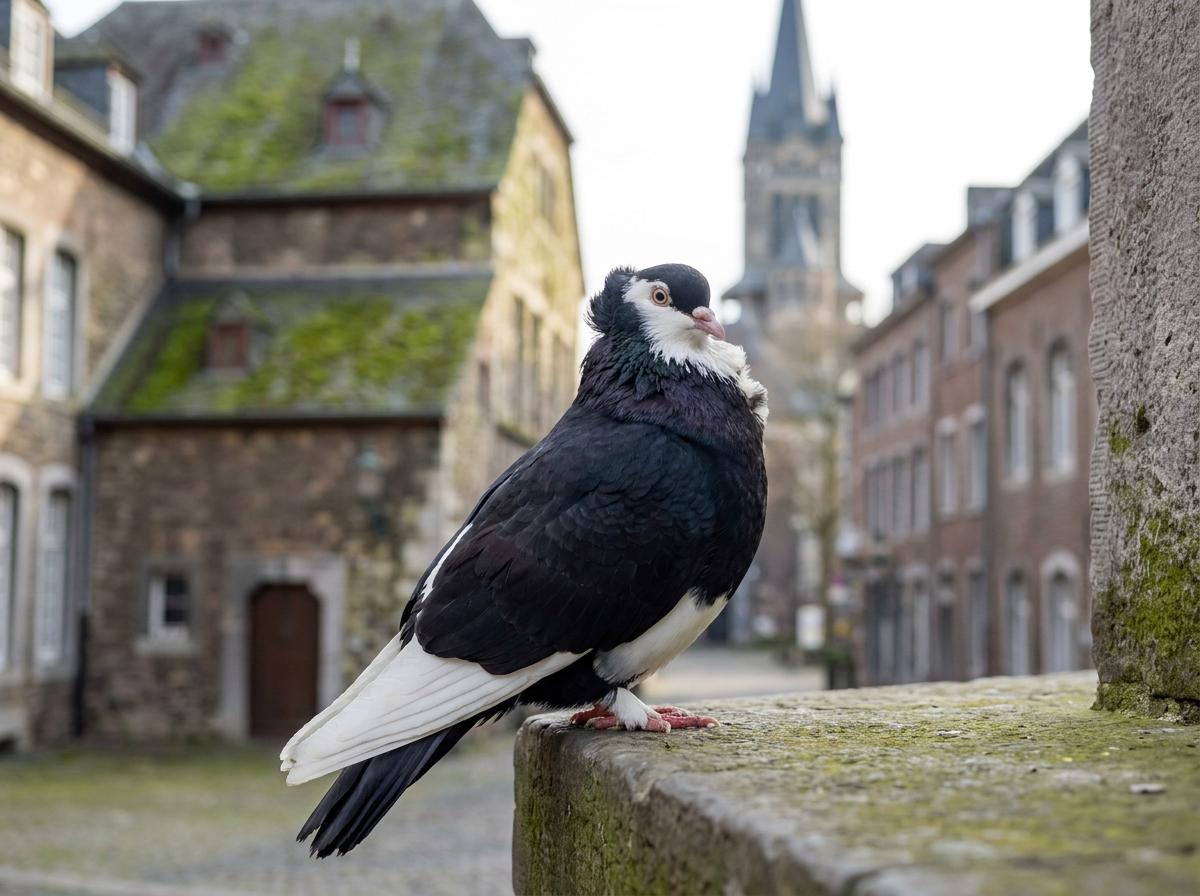
Once you know the handful of features that define the breed, an African Owl is hard to mistake for an ordinary pigeon. The show standard describes an animal built around a big round head and a tiny beak, everything else kept small, neat, and cobby.
The beak, and where the “owl” name comes from
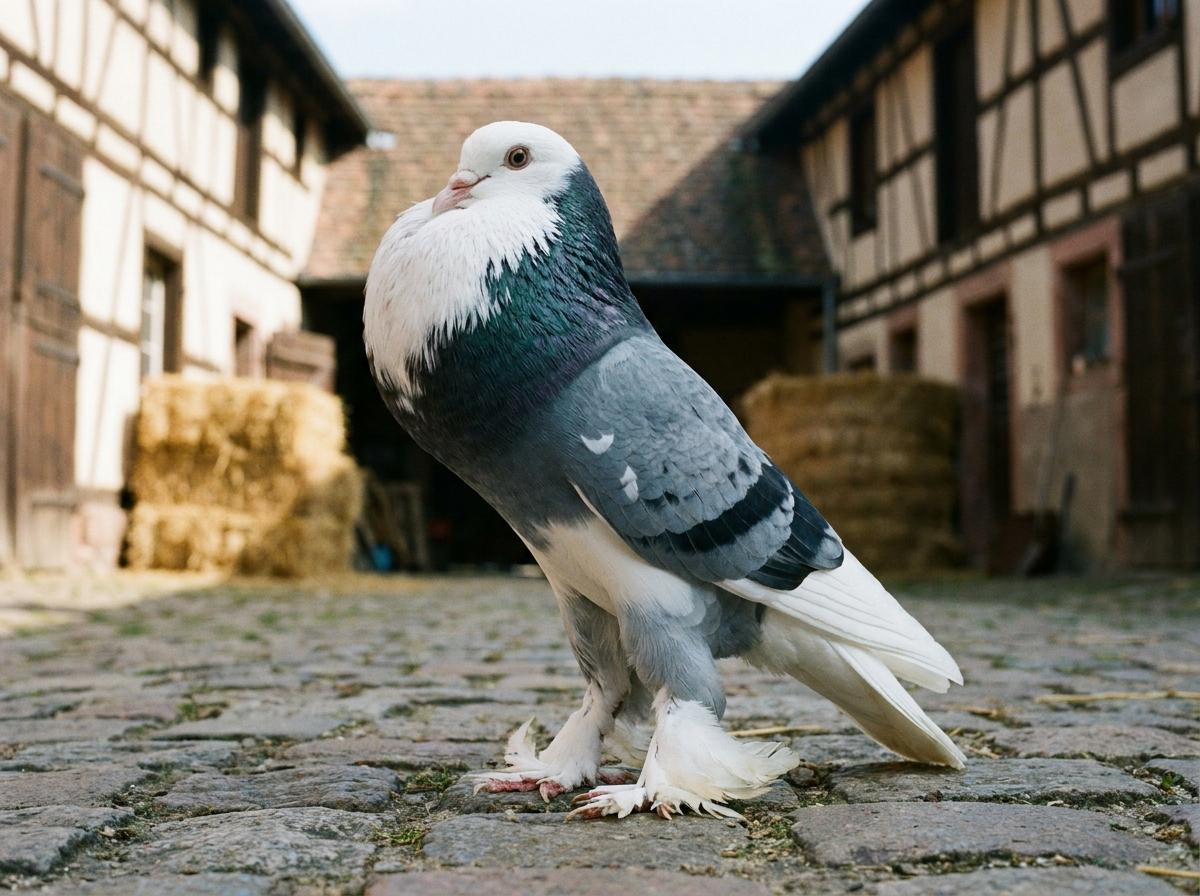
The single most important feature is the beak. It is very short, thick at the base, and turned slightly down, and in the show ring the shorter and stouter it looks the better. That extreme shortening is the whole point of the owl family, and it is also, as the breeding section below explains, the source of the breed’s biggest practical challenge. If a bird in front of you has a long or slender beak, it is not a good African Owl, whatever else it has going for it.
Head, eyes, and cere
The head is meant to be large in proportion to the body, round, and as globular as possible from every angle, with a high, well filled forehead and full cheeks, so that in side view the head looks almost circular with the eye near its center. That round, full cheeked head is the second signature trait after the beak.
Eye color follows the plumage. In self colored birds (a solid color all over) the standard calls for a bold, bright currant red eye. White birds and pieds are the exception and carry a darker or paler eye instead (whites are typically bull or a claret shade, pieds bull or gravel), so do not expect a fiery red eye on a white bird and count it as a fault. The eye cere, the ring of bare skin around the eye, should be fine, neat, and smooth rather than thick or coarse, and its color also tracks the plumage, dark on blacks and blues, lighter on other colors, and a powdered white on white birds.

The jabot, body, and stance
Down the front of the breast runs the jabot, a frill of feathers that stands out from the chest, sometimes also called the tie or the cravat. It is a shared owl breed trait and one of the things that gives these pigeons their dressed up look. Unlike some crested breeds, the African Owl’s head itself is smooth, with no shell crest or peak, so the frill on the chest is the only ornamental feathering.
The body is short, plump, and cobby, carried fairly upright, with a neat wedge shaped tail and small, clean, unfeathered legs and feet. Nothing about the frame is meant to look long or rangy. Put together, a good African Owl reads as a small, tidy bird with an oversized round head, a stubby beak, a proud little frilled chest, and bold eyes.
Colors
African Owls come in a wide range of colors. Commonly listed varieties include white, black, blue, silver, dun, lavender, brown, khaki, yellow, red, cream, almond, and patterned forms such as check, mealy, and grizzle. Color is judged on top of structure, not instead of it, so a well built bird in a plain color is worth more to a serious breeder than a poorly built bird in a flashy one. For a pet, of course, you can simply pick the color you like best.

Temperament
The African Owl’s reputation is built as much on its personality as on its looks. Keepers consistently describe the breed as calm, gentle, and remarkably tame, one of the quietest and most easily handled of all the fancy pigeons. Many settle quickly to being picked up and worked with, which makes them a favorite of people who want a pigeon they can actually interact with rather than just admire from across a loft. Treat that as the strong consensus of keepers and show breeders rather than a laboratory finding, and remember that individual temperament still varies with how much gentle, regular handling a bird gets, especially when young.
That docility, combined with the small size and the ornamental look, is why the breed is so often recommended as a companion or show pigeon rather than a working one. It is a bird bred to be lived with and looked at closely.
The breeding reality: why they usually cannot raise their own young
This is the part of owning African Owls that separates people who have actually kept them from people who have only read a glowing breed summary, and it is the single most important thing to understand before you buy a pair with any thought of raising babies.
The short beak that defines the breed also makes most African Owls poor at feeding their own squabs. Pigeons feed newly hatched young on “crop milk,” a rich secretion the parents produce, and the chick feeds by putting its beak inside the parent’s. A parent with a normal beak manages this easily. A parent with the deliberately shortened owl beak often cannot get enough food into the chick reliably, and this is a known limitation across the short beaked and short faced pigeon breeds, not a fault of one bad pair. The result is that many African Owl squabs, left with only their own parents, do poorly or fail to thrive.
The standard answer among experienced breeders is to use “feeder” pigeons: hardy, plainer birds with normal beaks, usually a utility type, kept as foster parents. Breeders time things so that the feeder pair is sitting on eggs of the same age, then swap the valuable African Owl eggs or newly hatched chicks under the feeders, who raise them without trouble. Some keepers hand rear instead, feeding the chicks themselves, but that is a real commitment of time and skill and is easy to get wrong, so fostering under experienced feeders is the more common and more forgiving route. Either way, planning your foster system is not optional if you intend to breed; it is the core of the job.
None of this affects the bird as a pet. A single African Owl or a non breeding pair is simply a calm, pretty companion. The feeding limitation only becomes your problem the moment you want babies, and at that point it becomes the whole problem, so decide up front which kind of keeper you intend to be. Because this is a management challenge rather than a medical one, it is also worth saying clearly: anything that looks like genuine illness, weakness, or a struggling chick that is not simply under fed is a question for an avian veterinarian, not for a home remedy.
Care and housing
Beyond breeding, African Owls are kept much like other small fancy pigeons, with extra attention paid to shelter because of the breed’s old reputation for delicacy.
Housing. Give them a clean, dry, draft free loft with good ventilation but no cold wind blowing directly on the birds, which is exactly the balance the nineteenth century writers were pointing at. Provide perches or nest boxes, dry bedding, and enough room that birds are not crowded. Damp is the enemy of pigeon health generally, and of this breed’s respiratory comfort in particular.
Feeding the adults. Adult African Owls eat a normal pigeon diet of a good seed or grain pigeon mix, with grit and fresh clean water always available, plus the mineral and vitamin supplementation your feed program calls for. The short beak is a problem for feeding chicks, not for the adults feeding themselves, so grown birds manage ordinary pigeon feed without special measures. Keep an eye on body condition and adjust as needed.
Health. Routine pigeon care applies: keep the loft clean, watch for the common pigeon health problems (respiratory issues, parasites, and the protozoal and viral diseases pigeons are prone to), quarantine new birds before introducing them, and build a relationship with a veterinarian who is comfortable with birds. Do not attempt to diagnose or medicate a sick pigeon from a checklist, and leave all medication and dosing decisions to your vet, who can actually examine the bird. Good records of each bird’s pairings, treatments, and any health events make those veterinary conversations far more useful, and they are easy to keep as you go rather than reconstruct from memory later.
Lifespan. There is no reliable breed specific lifespan figure for the African Owl, so treat published numbers with caution. As a general guide, well kept domestic pigeons commonly live around 10 to 15 years, and some individuals reach 20 or more with excellent care, so plan for a genuine long term commitment rather than a short lived pet.
Size, availability, and getting one
The African Owl is a small pigeon. It is regularly described as around 20 cm (roughly 8 inches) tall, and while that figure comes from breed descriptions rather than a formal measured survey, it fits the breed’s clear identity as one of the smaller, more compact owls, distinctly smaller than its English Owl cousin.
As a living animal to buy, the African Owl is a specialist show and hobby breed rather than a mass produced pet, so you will usually find them through pigeon fanciers, owl breed enthusiasts, and poultry or pigeon shows rather than in general pet shops. Availability varies a lot by region and by how many serious owl breeders are active near you. Because the breeding is demanding, good stock tends to move within the fancy, so patience and a few conversations with established keepers go a long way. You can browse current pigeon listings on the Creatures marketplace and look for keepers and clubs in the Creatures breeder directory, and if none are listed near you right now, a saved listing alert (below) is the simplest way to hear about one when it appears.
When you do find birds, buy on structure and health, not just on color or a pretty photograph:
- Check the beak and head first. A genuinely short, stout beak and a round, full cheeked head are what make the breed. A long or slender beak means a poor example, however nice the color.
- Look at overall condition. Bright eyes, clean nostrils and vent, smooth well kept feathers, and lively behavior all matter more than markings. Given the breed’s history of delicacy, buy from a keeper whose loft is visibly clean and dry.
- Ask about the breeding setup. A serious breeder will talk openly about feeders and fostering. If a seller claims their African Owls raise their own young effortlessly with no fostering at all, ask more questions, because that runs against how the breed generally behaves.
- Ask for any records. Pairings, hatch history, and health treatments tell you more about a bird and a loft than appearance alone.
- Confirm what you are buying. Make sure the bird is actually an African Owl and not another small owl or short faced breed sold under the wrong name.
Whether you keep African Owls as calm companions or as a show project, Creatures gives you one place to keep each bird’s profile, health and breeding records, and pedigree, and to connect with other keepers, which is especially handy for a breed where fostering arrangements and careful record keeping are part of everyday life. If you are still exploring other breeds too, you can browse profiles across species, from the Santa Ines sheep to the Colorado Ranger horse, in the same way.
Frequently asked questions
Why is it called an “owl” pigeon?
The name comes from the beak, not from any owl. Owl breeds have a very short beak that, set into a round head, gives a slightly owlish face. The African Owl is one member of that short beaked owl family.
Why is the African Owl called “African,” and how is it different from the English Owl?
The breed traces to North Africa (Tunisia in the usual accounts) and reached England in the 19th century, where the smaller imported birds were first called “Foreign Owls” to distinguish them from a larger owl type England already had. That larger bird became the English Owl, and the smaller import the African Owl. The main difference is size: the African is the smaller, rounder bird.
Can African Owls raise their own babies?
Usually not well. The short beak that defines the breed makes it hard for most pairs to feed their own chicks, so breeders typically foster the eggs or squabs under hardy “feeder” pigeons with normal beaks, or hand rear them. As pets or show birds they are lovely and low drama; the difficulty only applies when you want young.
Are African Owls good pets?
For the right keeper, yes. They are small, quiet, and among the tamest and most handleable of fancy pigeons, which makes them a popular companion and show bird. Just go in understanding the dry, draft free housing they prefer, the general pigeon health care they need, and the fostering reality if you ever breed them.
How long do African Owl pigeons live?
There is no reliable breed specific figure. Well cared for domestic pigeons generally live around 10 to 15 years, with some reaching 20 or more, so treat one as a long term commitment.
What colors do they come in?
A wide range, including white, black, blue, silver, dun, lavender, brown, khaki, yellow, red, cream, almond, and patterned types like check, mealy, and grizzle.
Do this next on Creatures
Whether you are researching the breed, hoping to find one, or already keeping African Owls, Creatures is the records, marketplace, and directory layer to do it in one place.
Add your bird. Already keeping African Owls? Create a free animal profile in a few minutes. The walkthrough is in adding an animal to Creatures. No account needed to start.
Track health and breeding. Keep pairings, fostering, and health records on Creatures. The record sheet opens for any visitor to look around, and you will need a free account to save what you enter. See adding a record and health and medical records for the how to.
Never miss care. Set molt, worming, or vet visit reminders so nothing slips; learn how in reminders and upcoming care.
Find stock. Browse African Owl pigeons on the marketplace and search trusted keepers and clubs in the Creatures directory.
Get alerted. Good African Owls move within the fancy, so set a free African Owl listing alert and we will tell you when one is posted. No account needed to start.
List your loft. Breed or show African Owls? List your loft or club on Creatures so buyers looking for this specialist breed can reach you.