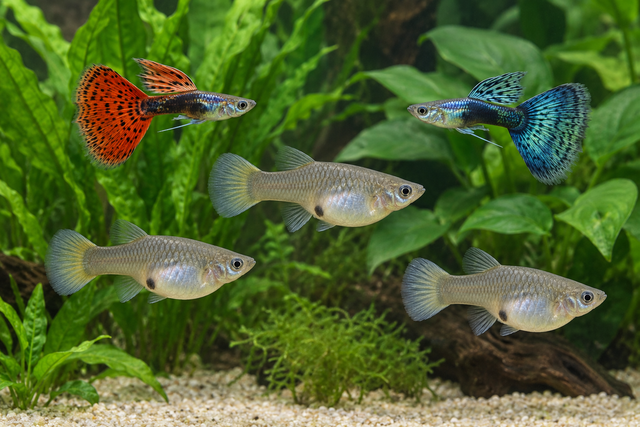
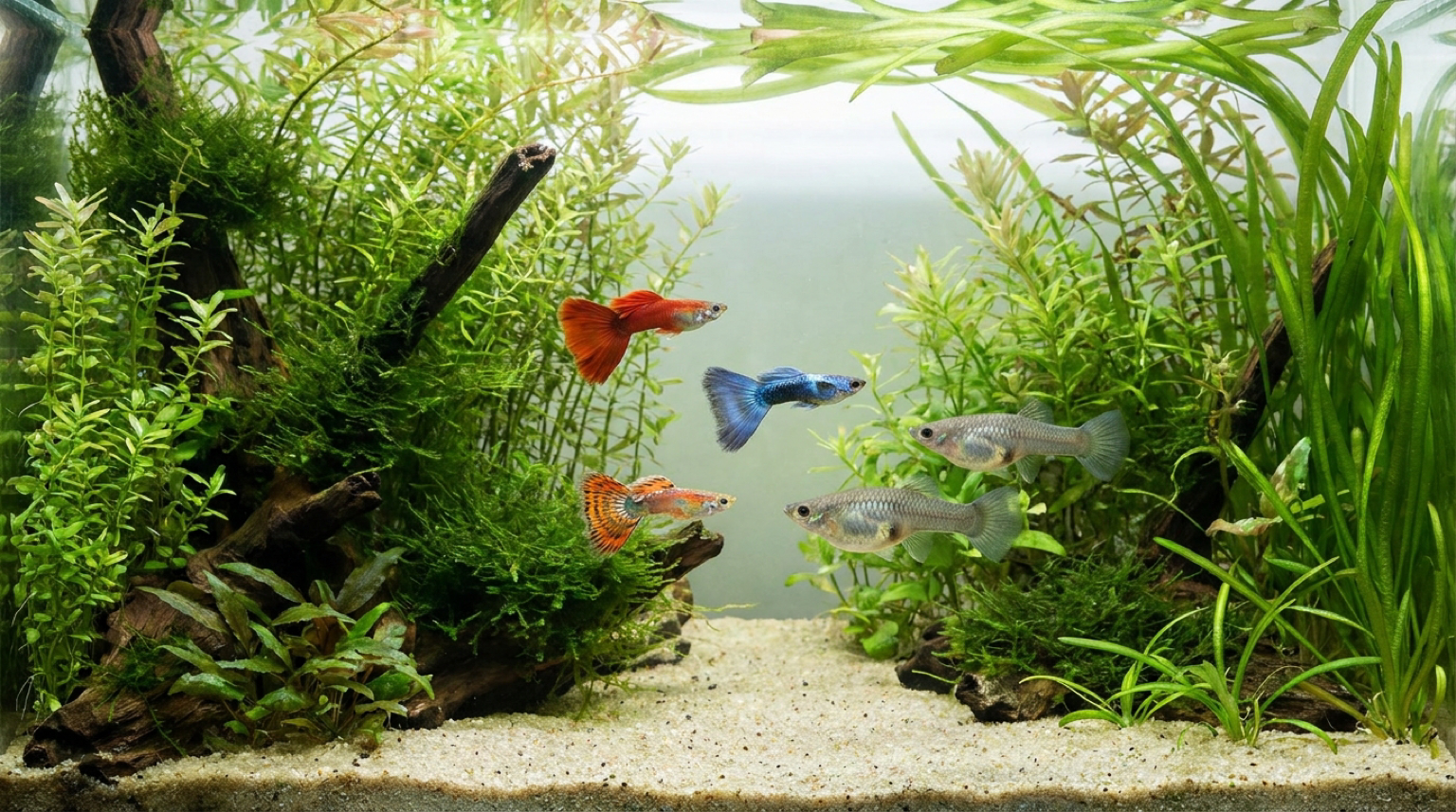
Guppy Breeding and Fry Care: Pregnant Guppy Signs to Raising Fry
Author: Elliott Garber, DVM · Published
A pregnant guppy carries her brood for about four weeks, then gives birth to live, free-swimming fry: a laboratory study of breeding guppies recorded gestations of 25 to 35 days, averaging 28, and the usual brood is 20 to 40 fry, with a dozen to 60 on record. Guppy fry care comes down to three things: cover from the adults, which will eat them, tiny food several times a day, and clean water in a tank that was cycled before the drop.
This guide covers how to tell a guppy is pregnant and close to dropping, where the drop should happen, how fast fry grow and when you can sex them, and how breeders split males from females to keep a line. Guppies breed whether you plan it or not, so the records matter as much as the fish: which female dropped, how many fry, and which tank they went to. New to the species? Start with the Creatures guppy page, which links every guppy variety and guide.
Most of what goes wrong with fry is water, so this guide points to the tank water log in the Creatures help center wherever a test matters. A brood of 30 in a small grow-out tank changes the water faster than any display tank you have kept.
| Gestation | About four weeks: 25 to 35 days (average 28) in a lab study; longer in cool water |
|---|---|
| Brood size | Usually 20 to 40 fry; 12 to 60 recorded, with larger females having more |
| Drop is close | Darker, larger gravid spot in front of the anal fin, deep belly, and about four weeks since her last drop |
| Fry at birth | About 6.5 to 7.5 mm, able to swim and eat from the start |
| First food | Newly hatched brine shrimp from birth to six weeks, with fine dry food added after the first two days |
| Sexing | Male anal fin starts to lengthen at about 3 weeks; sexes clear by about 5 weeks |
| Split the sexes | At 3 to 6 weeks, before males mature at about 2 months |
| Sperm storage | One mating can give several broods, so a female can drop with no male present |
How long are guppies pregnant?
Guppy gestation is about four weeks, and most sources give a span of four to six. The U.S. Fish and Wildlife Service ecological risk screening summary for the guppy quotes FishBase: after a gestation of four to six weeks a female gives birth to 20 to 40 live young, and she may produce young every four weeks. In a laboratory study at the University of Dhaka (Shahjahan and colleagues, 2013), gestation ran 25 to 35 days with an average of 28, and broods ranged from 12 to 60 fry, with larger females producing more. The International Fancy Guppy Association’s basic care page puts show strains at 30 to 50 fry every 28 to 30 days.
Temperature is the main reason the numbers spread. In a study of the eastern mosquitofish, a close livebearing relative, females kept at 25 °C (77 °F) gave birth after about 29 days on average, while those at 23 °C (73 °F) took about 39, and the authors note guppy gestation stretching to 40 to 60 days in water cooler than the species prefers. The IFGA keeps guppies at 75 to 82 °F (about 24 to 28 °C). A cool tank can run a week or more late without anything being wrong, which is one more reason to log the tank’s temperature alongside the drop dates.
Two more facts change how you plan:
- A female can drop fry with no male in the tank. Female guppies store sperm. The FWS summary notes it, and in the Dhaka study a single mating produced three to five broods. A female bought from a mixed shop tank can keep giving birth for months.
- She can conceive again within hours. The same study found females ready to conceive again within a few hours of giving birth, so with males present the next brood is already on its way.
How to tell a pregnant guppy is close to dropping
Mature female guppies carry a gravid spot, the dark patch on the lower belly just in front of the anal fin. The FWS summary describes pregnant females as recognizable by a dark triangle between the anal and pelvic fins. In the mosquitofish study, the spot turned out to be pigment over the sac that holds the embryos, not the babies themselves, and it darkened as they developed: females with only unfertilized eggs had consistently pale spots, and females with the darkest spots gave birth within one to five days. Nobody has published the same calibration for guppies, so read the spot as a guide, not a countdown.
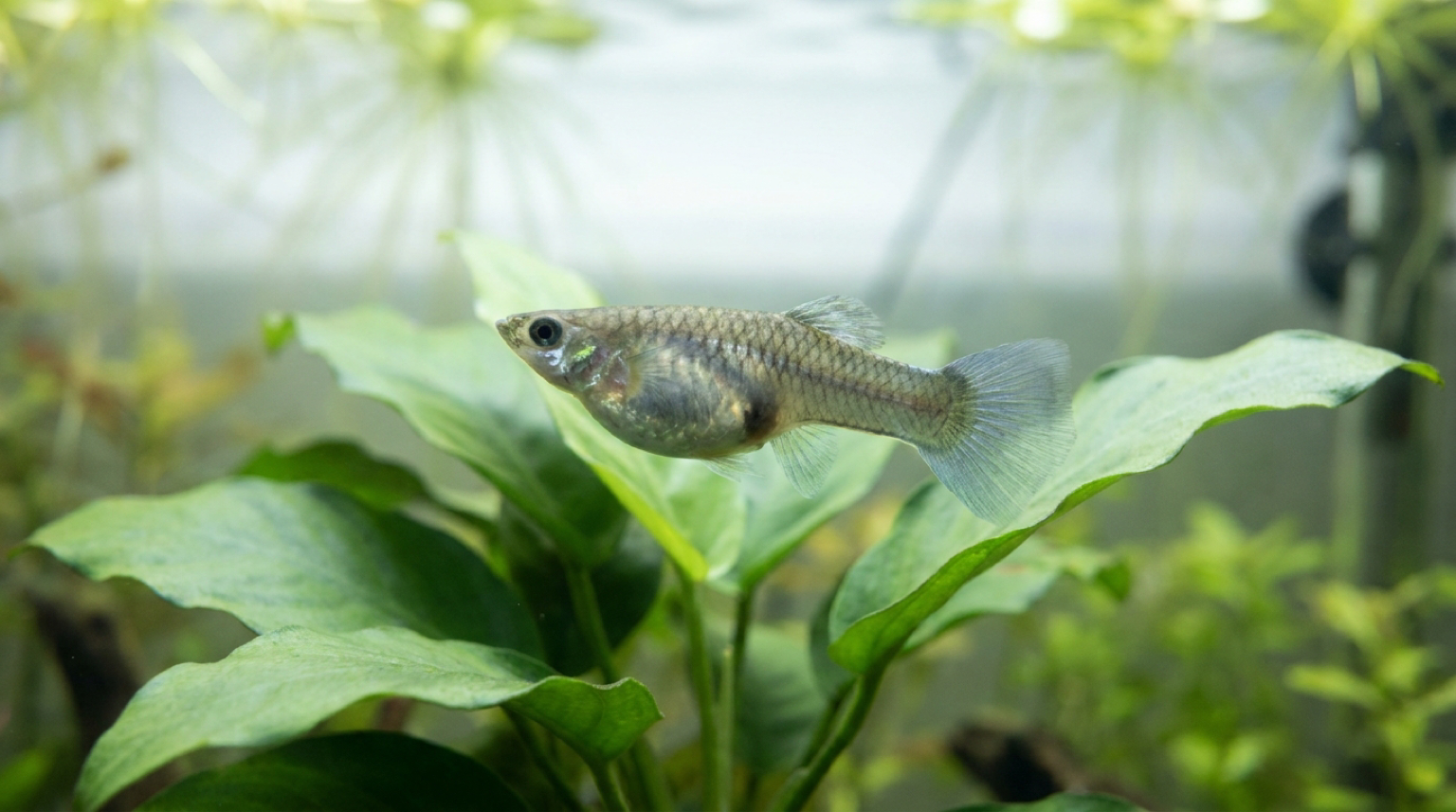
The signs breeders watch as a drop gets close:
- A darker, larger gravid spot. It is easier to see on pale strains than on dark ones.
- A deep, squared-off belly. Seen from the side, many females near term look boxy behind the gills rather than smoothly rounded. This is a breeder’s cue rather than a measured one, and small or first-time mothers can show it less.
- Time since her last drop. If you record each drop date, the next one usually comes about four weeks later in a warm tank. This is the most reliable signal you have, and the easiest to lose if you rely on memory.
Some signs are not labor. A female that breathes hard at the surface, clamps her fins, lies on the bottom, or swells until her scales stand out from her body is showing signs of illness, not an overdue brood. Call a veterinarian who treats fish; the American Association of Fish Veterinarians keeps a find a fish vet map.
Where the drop should happen: plants, a breeder box or a fry tank
Guppies give no parental care, and adults eat newborn fry. The FWS summary notes that parents may prey on their own young, and researchers working on guppy hatcheries describe cannibalism by adults as a major cause of fry loss; in their aquarium trials, adults that had gone unfed ate more newborns (Barki and colleagues, 2014). That is why the IFGA’s breeding page tells you to keep an expectant female well fed.
Three setups work, and each has a cost:
- A heavily planted tank. Dense, fine-leaved plants, moss, and floating plants at the surface give fry cover from the moment they are born, and the mother is never confined. Some fry are still eaten, so you raise fewer. This suits a community tank where a few survivors are welcome.
- A breeder box inside a larger, mature tank. The IFGA’s method is a large breeder trap in a 10 gallon tank: the female goes in to drop, the fry get a safe place away from her, and she comes out as soon as the fry are born. Use the largest box you can fit, move her in late (when the spot and shape say the drop is close), and keep the box in the main tank’s water so temperature and chemistry match. A trap confines her closely, so the shorter her stay, the better.
- A separate fry tank. Many breeders raise fry in their own small tank for the first few weeks (IFGA). It is the cleanest way to raise and count a brood, but the tank has to be ready before the drop. The Merck Veterinary Manual notes that a new tropical tank’s biofilter can take up to eight weeks to establish, and that fish can go in once no ammonia or nitrite is present. A grow-out tank started the week of the drop is the wrong order; the sister guide on how to cycle a fish tank covers the timeline.
Whichever you choose, fry belong in an established, filtered tank with real water volume, never in a cup or a jar on the shelf.
Guppy fry care: the first six weeks
Newborn guppy fry are fully formed. In the Dhaka study they measured about 6.5 to 7.5 mm at birth, could swim, feed and avoid danger from the start, and settled to search for food within an hour or two. They are born with working jaws, so unlike the fry of many egg-laying fish they can take food on day one.
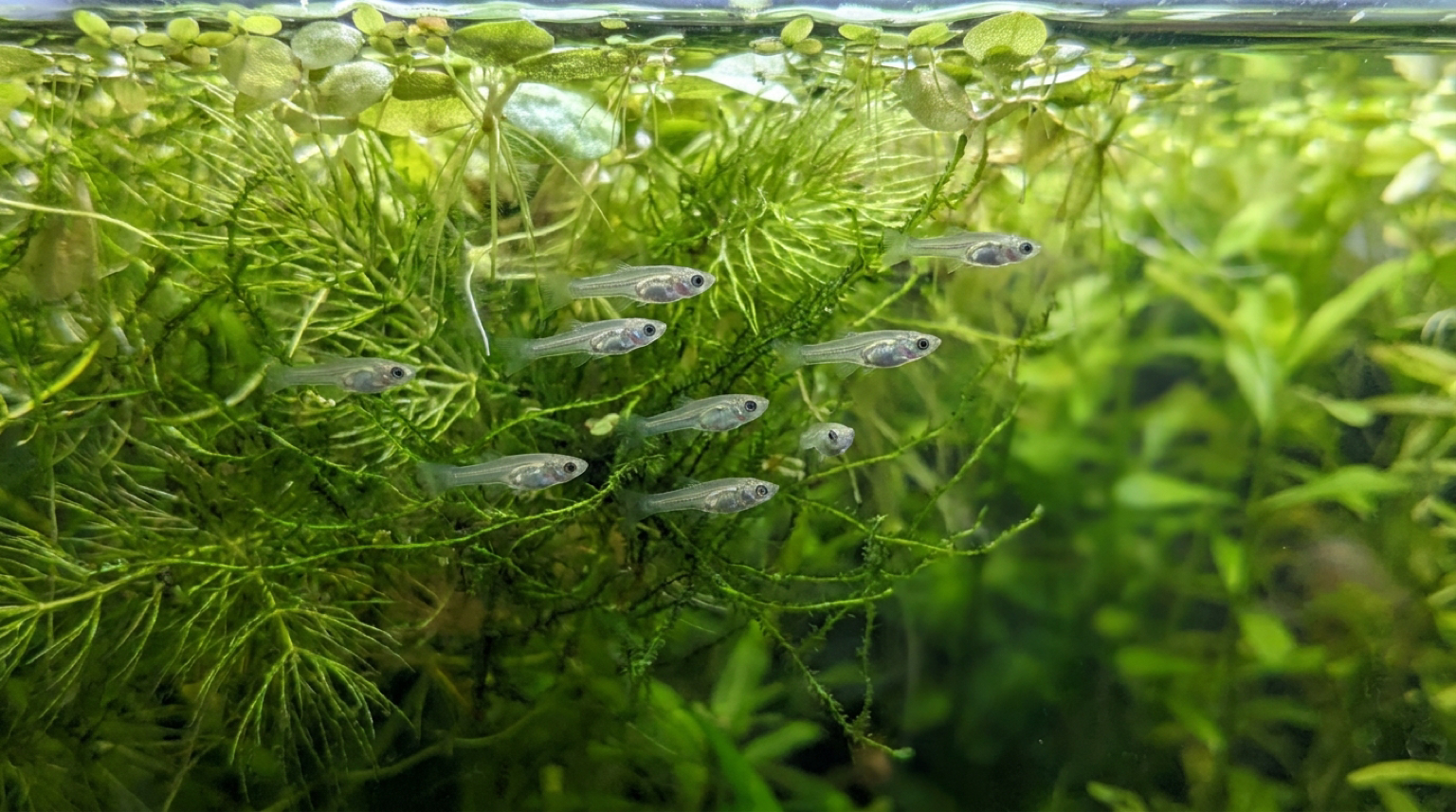
Food. The IFGA feeds newly hatched brine shrimp from birth to six weeks and starts adding dry food after the first two days. Brine shrimp eggs kept at 80 °F with strong aeration hatch in 24 to 36 hours, by the IFGA’s count, so a hatchery started the day you move the female is ready when the fry are. Feed small amounts several times a day. If you cannot hatch brine shrimp, a fine powdered or crushed dry food fed little and often is the usual fallback.
Water. Frequent feeding in a small volume builds waste quickly. Test ammonia and nitrite in the fry tank more often than in your display tank, and change water on a schedule; the IFGA notes some breeders change 30 to 40 percent of the water weekly. The sister guide on aquarium water testing explains what each kit reading means, including the “as N” and “as NO2” labels that make two kits disagree. Log each test against the fry tank so you see a trend rather than a single number.
Room. The IFGA keeps no more than 10 to 20 young in a 10 gallon tank and, by two months, no more than about one fish per gallon for best growth. A brood of 40 outgrows one 10 gallon tank quickly, which is why breeders split broods across tanks. The guppy cost guide prices that second tank.
Temperature. Keep it steady within the IFGA’s 75 to 82 °F range.
Back with the adults? Only once they are too big to fit in an adult’s mouth, and there is no fixed age for that. If you are keeping a line, the IFGA approach is to raise each female’s young separately and grow them on by sex, so the question never comes up.
Guppy fry growth and sexing, week by week
The Dhaka study photographed fry at set ages, which gives a useful calendar. These are lab ages for one population; your strain and temperature will shift them.
- Birth: about 6.5 to 7.5 mm, transparent or grayish.
- 2 weeks: 7.5 to 9.5 mm. Female bellies start to look slightly wider; anal fins still look alike.
- 3 weeks: the male’s anal fin lengthens into a tube, the start of the gonopodium, while the female’s stays small and rounded.
- 4 weeks: male tails begin to show color, and females are getting larger than males.
- 5 weeks: the sexes are clearly distinguishable by size, tail and anal fin.
- 7 weeks: males start following females, and some females show a gravid spot.
- 8 weeks: sexually mature in that study.
The FWS summary gives maturity as about two months for males and three for females, and the Dhaka fish first dropped fry at three to four months. Color takes longer than sex: the IFGA says reds, greens and blues can be selected at about three months, while albinos, yellows and pastels need four to five.
So the window to split the sexes is about three to six weeks, the IFGA’s range, and it closes when the first males mature at around eight weeks. Leave them together past that and you no longer know who fathered the next brood.
Separating sexes and keeping a guppy line
If you only want a few fry from a community tank, you can skip this section. If you want a strain that stays true, separation is the whole method. The IFGA warns that leaving all the fish together to breed makes a strain deteriorate quickly. Left together, whichever males mature first sire the next generation, not the ones you would have picked.
The IFGA’s line-breeding outline:
- Start from a trio. Two females and one male let you run two parallel lines.
- Keep each female’s young separate. Each brood is its own family, raised in its own tank.
- Pick the breeders. Choose the best two females and the best male and give them a small breeding tank of their own. The IFGA selects and breeds females at two to four months, and puts peak breeding at about three to seven months of age.
- Record every drop. The IFGA’s own list is the number of young, the number of males and females, and how many fish were removed from the line.
For what to look for when you choose, the show guppy guide walks through the IFGA selection order (size, tail base, tail and dorsal match, spine), and the delta guppy guide explains the tail shape most show lines are built on.
New stock is how a line gets fresh blood, and it can bring disease in with it. Merck calls 30 days the minimum quarantine for new fish, so set up a quarantine tank before you buy a new male.
Deciding which fish stay in the line
Every breeder decides which fish continue the line. The IFGA’s guidance is to remove deformed and weak fish while sorting, and then to keep selecting the largest, best-shaped males and the best females. The rest still need a good place to go: an all-male display tank, which cannot breed; another keeper; a local aquarium society; or a shop that takes stock. For a fish whose deformity affects its welfare, ask a veterinarian who treats fish about humane options.
Never release a guppy outdoors, into a pond, ditch or stream. The FWS summary, quoting the U.S. Geological Survey, lists guppies as locally established in warm-water sites in Hawaii, Idaho, New Mexico, Nevada, Texas and Wyoming, with most introductions probably from fish farm or aquarium releases.
Recording drops and grow-out on Creatures
Guppy breeding produces a lot of numbers quickly: drop dates, brood counts, which tank each batch went to, what was lost, and which fish you kept. Creatures keeps them on the tank itself, free, in a browser on your phone or computer.
- Set up the tanks. Add each tank in Locations with a name, Freshwater, its volume, and how it is used: Breeding / grow-out for a fry tank, Established for the display tank. See set up and organize locations.
- Give the breeders profiles. The trio you breed from gets individual profiles, as described in adding an animal to Creatures, so the drop can name them as parents. Move each fish into its tank and the location history keeps where it has lived (move animals and review location history).
- Record the drop. On the tank’s page, under Aquatic observations, choose Record a spawn, drop or colony and pick Livebearer drop. Enter How many you saw and mark it Counted or Estimated (forty fry darting through moss is honestly an estimate until you can net them); the drop saves it as its Newly born entry, and Record births adds later counts. Name the parents from your own fish with how sure you are: Presumed for the female in the breeder box, Candidate for a male that may have sired the brood. Leave the sire empty when a female came from a mixed tank and could be carrying stored sperm; parents can stay unknown. A parent you do not own goes in the source notes, and strain details go in their own fields, such as a trade strain and a line type like Color form. You can link up to five water tests from the seven days through the drop date.
- Run the grow-out. From the drop’s group you can split the batch across tanks, move part of it, record losses as you find them (Creatures never assumes a death), recount a tank, set the feeding stage, and promote keepers to individual profiles once you can tell them apart. Counts stay reconciled tank by tank. See track animals without individual profiles and split, merge, or archive a group. If you name your keepers, the free fish name generator helps.
- Schedule the checks. Add a routine, then Start with a tank or pond routine, and pick the Grow-out starter. It is an editable list that includes a water test; set how often it repeats and which tests you use. The tasks show up on Today, where Record test and Save test & complete task log the readings and check the task off. Starters never set treatments, dosing or target ranges. You can set your own ranges for temperature, ammonia or nitrite, and each result then reads Within your range, Below your range or Above your range; ranges label results and never send alerts. The care plans help article covers editing a plan.
- Print the records. Download a ZIP of your aquatic breeding records and print them in an owner view, a buyer view where you can hide a parent as “Parent not shared”, or a club view for your aquarium society. Counted, estimated and stale counts keep that wording on paper.
If you have not set up a tank yet, you can keep your aquarium log and tank records on Creatures, or read how tank water records work first. Shrimp keepers use the same records for a colony instead of a drop; the sister guide on cherry shrimp colony care shows how.
Frequently asked questions
How long is a guppy pregnant?
About four weeks in a warm tank: 25 to 35 days, averaging 28, in one lab study, and four to six weeks in the FWS summary. Cooler water stretches it.
How many babies does a guppy have?
Usually 20 to 40 fry per brood. Broods of a dozen up to 60 are on record, and larger, older females have more.
Can a guppy get pregnant without a male?
Not without ever mating, but she can give birth without a male in the tank. Female guppies store sperm, and one mating gave three to five broods in a lab study, so a female from a mixed shop tank can keep dropping fry for months.
How do I know when my guppy is about to give birth?
Look for a gravid spot that has grown darker and larger, a deep belly that looks squared off behind the gills, and about four weeks since her last drop. The drop date in your records is the most dependable of the three.
Do guppies eat their babies?
Yes. Adults, including the mother, eat newborn fry, and hungry adults eat more. Dense plants, a breeder box inside a larger tank, or a separate fry tank keeps them apart.
When can I tell male and female guppy fry apart?
The male’s anal fin starts to lengthen into a gonopodium at about three weeks, and the sexes are clear by about five weeks. Separate them by six weeks if you want to control which fish breed.
Do this next on Creatures
Whether you are raising your first surprise brood or running a fishroom of show lines, Creatures keeps the parents, the drop counts and each grow-out tank’s number in one place.
Add your breeders. Create a free profile for each guppy in your trio, no account needed to start, so every drop can name its parents. The walkthrough is in adding an animal to Creatures.
Log a record. Add a record to a breeder’s profile, such as a health note or a measurement. The record sheet opens for any visitor, and a free account saves what you enter. See adding a record, and keep fry tank tests in the tank water log.
Show your fishroom. Create your fishroom or breeding program’s profile, no account needed to start, then get listed in the breeder directory so keepers looking for your strain can find you.
Looking for new blood? Guppy listings on Creatures are few right now, so the easiest way to catch one is to set a free guppy listing alert; we will email you when a new guppy is listed. No account needed to start. See saving searches and using your watchlist.
Browse and compare. Check the current guppy listings on the marketplace and look up breeders in the Creatures breeder directory.
Keep learning. Compare strains on the Creatures guppy page, including Endler guppies, and set up the fry tank’s water with the sister guide on cycling a fish tank.