Show
Variety
Author: Elliott Garber, DVM · Published
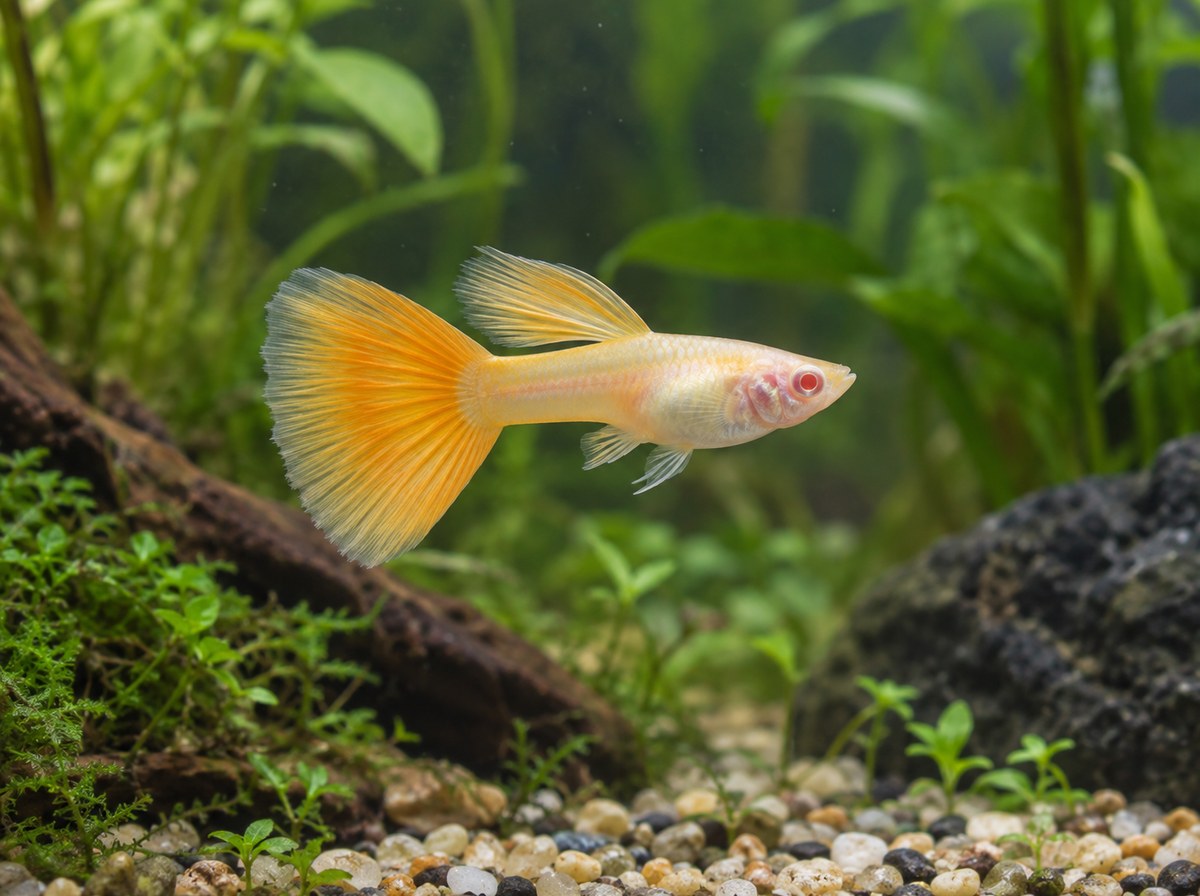
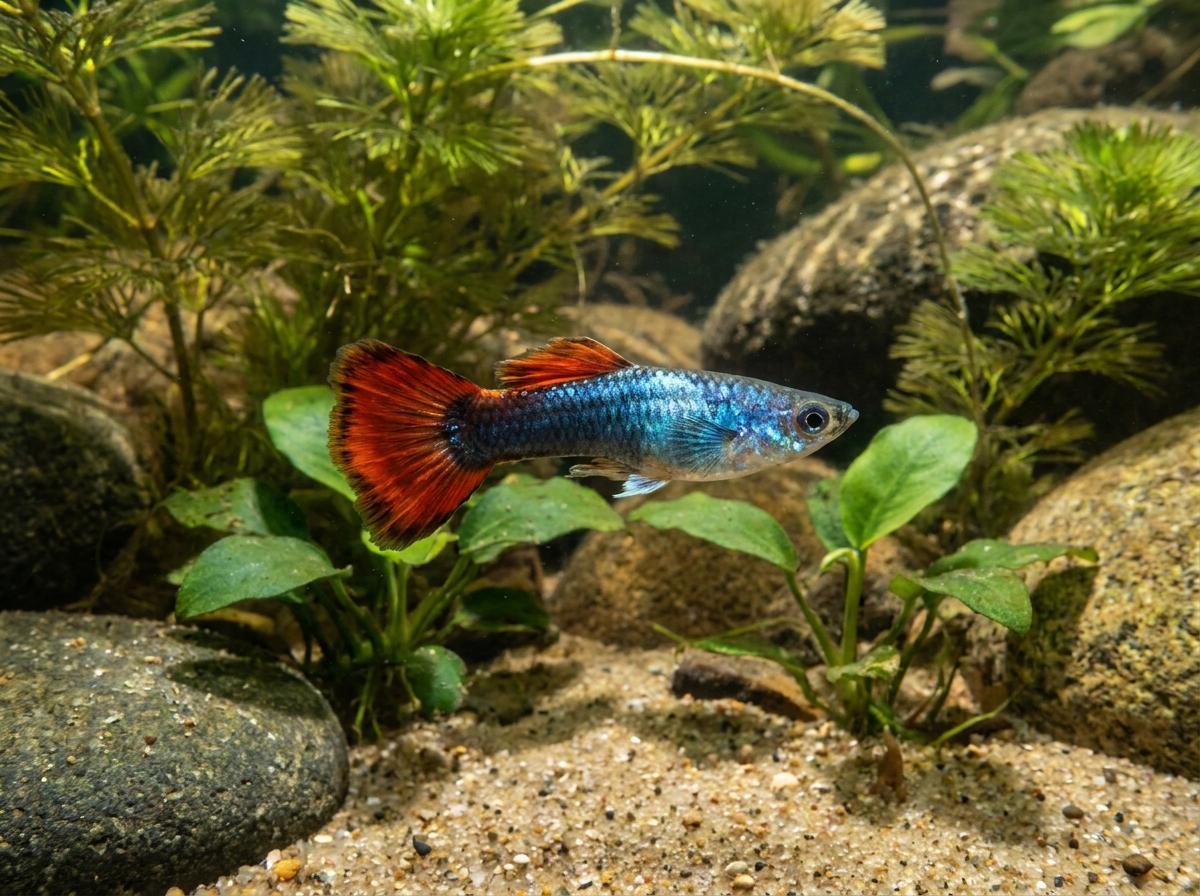
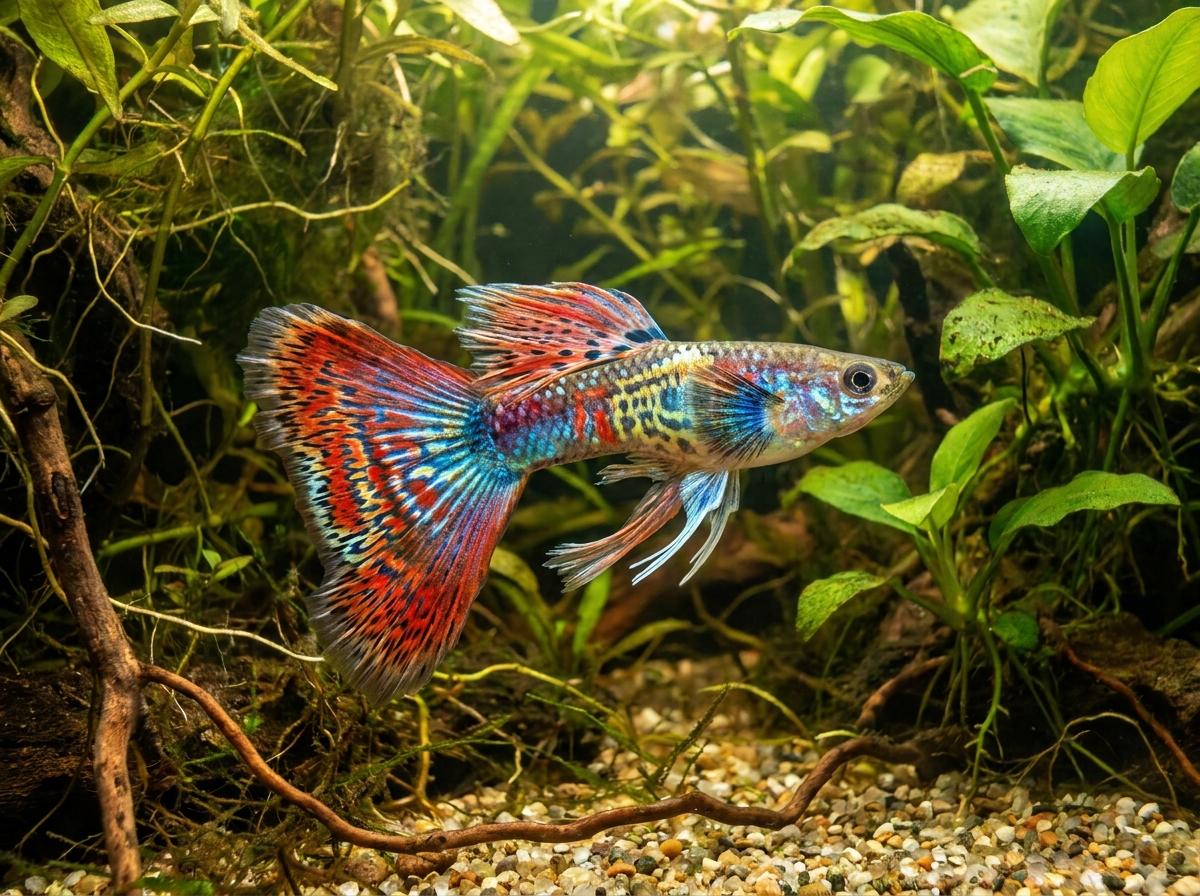
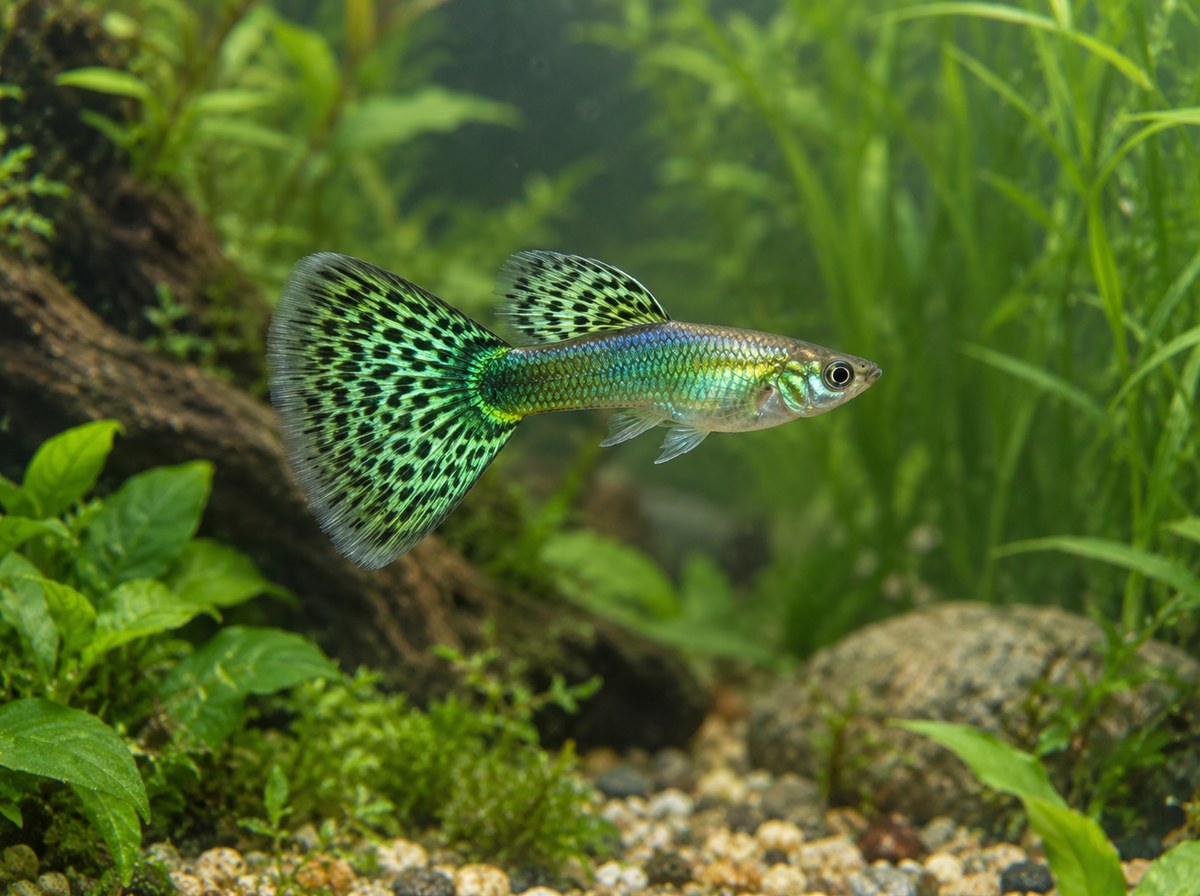
A show guppy is not a breed and not a color. It is a fancy guppy, Poecilia reticulata, bred in a closed line toward a written show standard and then judged against it, fish by fish. To see show potential in your own guppies, look for what the judges score: a big male with a thick tail base and a straight spine, a broad tail that matches the dorsal fin in color and pattern, a long dorsal held upright, and color that covers the whole fish. The fish can carry any of the tail shapes and colors listed on the Creatures guppy species page; “show” describes how it was bred and what it is measured against.
In North America the measuring stick is the International Fancy Guppy Association (IFGA), which sanctions club shows and sorts entries into color classes. The most detailed standard anyone can read online is the Judging Standard for World Guppy Contests, a 100 point system that spends most of its points on the fins. This page walks through both, then covers how breeders pick show prospects from a drop of fry, how they keep a line going, and how to buy into one.
Show-line guppies are rarely listed on Creatures right now, so the easiest way to hear about one is to set a free show guppy listing alert (no account needed to start). The breeder directory’s fancy guppy category lists one breeder so far; if you breed a line yourself, you can add your fish room there too.

| What it is | A fancy guppy (Poecilia reticulata) from a closed line bred to a show standard; not a breed, a color or a tail shape on its own |
|---|---|
| Standards | IFGA color classes in North America; the public Judging Standard for World Guppy Contests |
| Scoring | World standard: 100 points, 44 of them on the tail and 23 on the dorsal fin |
| Disqualified on the bench | Deformed spine, humpback, flat body, missing fin parts, signs of disease, a listless fish |
| When to pick young males | Reds, greens and blues at about 3 months; albinos, yellows and pastels at 4 to 5 months (IFGA) |
| How lines are sold | Usually as trios, one male and two females, ideally 3 to 4 months old (IFGA) |
| Space for one line | About 8 to 10 tanks per strain, by the IFGA’s own estimate |
| Water | Heated, filtered and cycled; 75 to 82 F (about 24 to 28 C); grow-outs at about one fish per gallon from two months |
Browse listings, public profiles, breeders, or add your animal.
What makes a guppy a show guppy
Every name in a guppy listing answers one of a few separate questions. “Delta” and “round tail” describe the shape of the tail. “Half black“, “snakeskin” and “Moscow” describe color and pattern. “Albino” describes the base color underneath. “Show” answers a different question altogether: what was this fish bred for, and what is it being measured against?
That is why a show guppy can be almost any color. The IFGA’s show class sheet lists 25 color classes for deltas alone, from red, blue and green through half black pastel, purple and two kinds of snakeskin, plus a catch-all called AOC, short for any other color. The color names you see on the Creatures show guppy page (AOC, bicolor, purple, half black) match the class names on that sheet.
What separates a show fish from a shop fish is consistency. A fancy guppy from a mixed tank may be striking on its own, but a show line is a closed population kept apart for generations, so that brothers from the same drop look alike and their sons look like them. The IFGA’s beginner pages are blunt about two things buyers trip over. Its basic care page warns that the label “IFGA quality” is frequently misused, so ask the breeder for actual show results, and its breeding page tells beginners to avoid pet shop guppies as a starting point for a show line.
The species under all of this is the ordinary guppy. The US Geological Survey’s species profile gives its native range as the southern Lesser Antilles and northern South America, from western Venezuela to Guyana, and lists males to about 2.5 cm and females to about 6 cm in standard length (snout to the base of the tail, not counting the fin). Show breeding selects hard for size, and body length is one of the things judges measure.
How to spot a potential show guppy
You cannot pick a show guppy at birth, and you usually cannot pick one at six weeks either. The skill is in knowing when to look, what to look at first, and what to throw out without a second glance. The steps below follow the IFGA’s basics of breeding show guppies, with the bench faults from the world standard added where they help you decide.

1. Split the sexes early
Between about three and six weeks, the females start to show the gravid spot, a dark patch on the belly between the pelvic and anal fins, and the males do not. That is the time to separate them. Leave a drop together and the smaller, more active males breed the females first, before you have chosen anything; the IFGA warns that leaving all the fish together to breed makes a strain deteriorate fast. While you sort, remove any fish that is visibly deformed or weak.
2. Grow them on with room and food
Show fish are made in the first three months. The IFGA’s guidance is to keep no more than 10 to 20 young in a 10 gallon tank, and by two months to have no more than about one fish per gallon so they reach full size. Feed small amounts often (show breeders feed several times a day, with live baby brine shrimp from birth) and keep the water clean, because a fish stunted early will not catch up on the bench.
3. Wait for the color to show
Not every strain matures at the same speed. The IFGA puts reds, greens and blues at about three months for selection, while albinos, yellows and pastels can need four to five months. Judging a slow strain at a fast strain’s age is an easy way to throw away a good male.
4. Pick the males in order
When the drop is old enough, the IFGA sorts males in four passes, keeping fewer each time:
- Size first. Take the largest males of the drop, and check that they have a thick caudal peduncle, the muscular base of the tail, because a thin peduncle cannot carry a big tail. The world standard gives full body length points to a male of 26 mm (about one inch) standard length or more.
- Tail and dorsal shape next. For a delta line, look for a wide, triangular tail. By this age the dorsal fin should be lengthening with clean, smooth edges.
- Then the match. The tail and dorsal should match in color and pattern. The world standard pays for this directly: up to 2 of the dorsal color points go to a dorsal of the same color, pattern and tone as the tail.
- Then the cuts. Drop any fish with a curved spine, a flat head or weak, washed out color.
5. Check the faults that end a fish’s day on the bench
The world standard disqualifies an entry outright for a deformed spine, a humpback, a flat body, missing fin parts, signs of disease or a lack of vitality, in a male or a female. Its spine check is simple enough to use at home: with the fish at rest, imagine a line from the snout to the middle of the end of the peduncle. On a straight fish that line passes through the middle of the body at the front of the dorsal fin. If it sags toward the belly the fish is scored as curved, and if it touches or crosses the lower edge, it is a humpback and out.
6. Watch it swim before you decide
Judges look at fins as the fish carries them, without tapping the glass or otherwise stimulating it. The dorsal should stand up and open, and the tail should be held spread. Vitality carries 5 points in the world standard, and a male that courts females earns all 5. A gorgeous male that hangs his fins or sits on the bottom is losing points, and a truly listless fish is disqualified.
7. Pick the females too
Females carry half the line. The IFGA picks them at two to four months: the largest of the drop with the thickest peduncle (it notes that these tend to produce the best show males), then the largest and widest tails with dorsals to match, then color where the strain shows it in females. The world standard expects a female to be about 1.5 to 2 times the male’s standard length, the same base color as the male, and clearly from the same line.
8. Write every drop down
The IFGA treats records as part of breeding, not paperwork: for each drop, note how many young, how many males and females, and how many were culled, so you learn which female throws the males you want. After a few generations, that tally is the only reliable way to tell a lucky drop from a good female.
What judges score: the 100 point card
The IFGA keeps its full judging book for members, so its exact point values are not public and this page does not guess at them. The standard that anyone can read is the Judging Standard for World Guppy Contests, a 2007 document hosted by the Confederação dos Criadores de Guppy do Brasil (CCG), Brazil’s national guppy breeders’ body, which also appears on the IFGA’s list of sanctioned clubs. It judges each fish against the standard rather than against the other fish on the bench, so every entry that meets the standard can score full marks.

The card has ten parts:
- Body length, 8 points. Standard length, snout to the end of the peduncle. 26 mm or more earns all 8; under 14 mm earns 1.
- Body shape, 8 points. A straight or very gently rounded back line, a smoothly rounded belly seen from the front, a peduncle with nearly parallel upper and lower edges and a length of 1.5 to 2.25 times its height, and a straight body (the spine check above).
- Body color, 12 points. Scored by how much of the body is colored (100 percent coverage earns 12), with up to half taken off for dull or blurry color.
- Dorsal length, 5 points. The longest dorsal ray should reach the end of the first third of the tail (for roundtails, the start of the tail).
- Dorsal shape, 8 points. For triangle tails such as the delta, a rectangular, trapeze or parallelogram dorsal about three times as long as it is high, with straight, unsplit edges, held erect.
- Dorsal color, 10 points. Coverage and quality, with up to 2 points for matching the tail.
- Caudal length, 10 points. Scored as a ratio to body length; for a triangle tail the target is a tail 8/10 as long as the body.
- Caudal shape, 20 points. Shape (10), condition (5: no ragged edges, splits or missing pieces) and display (5: held open). The triangletail, the international name for what North American shows call a delta, should open at 70 degrees or more from the peduncle.
- Caudal color, 14 points. Coverage and quality, with clear or whitish margins costing points.
- Vitality, 5 points. Courting earns 5, active swimming with fins up earns 4, hanging fins 3, hovering motionless 2, lying on the bottom 1.
Add those up and the shape of the hobby is plain. The tail alone carries 44 of the 100 points and the dorsal another 23, so 67 points, two thirds of a show guppy’s score, are in its fins. Body color, length and shape together are worth 28. Scores from several judges are averaged after dropping the highest and lowest, and ties are broken on caudal shape, then caudal color, then body color.
Two more rules matter to anyone breeding toward this standard. First, the female is judged with the male: she must look like she comes from his line, be the same base color, and be healthy and fit to breed, and up to 10 points can be taken off for her faults. A female who clearly belongs to a different strain disqualifies the whole entry. Second, extended fin types such as ribbons and swallows are scored on the same card with up to 10 points of penalties for their own faults. If you want the tail geometry in more depth, the delta guppy guide covers how the triangletail differs from the fantail and veiltail.
Other fancy fish shows work the same way; the standard for the celestial eye goldfish, for example, gives half its points to the eyes.
Who sets the standard: IFGA classes
The IFGA runs the North American show system through sanctioned clubs, and its published show class sheet is required at every sanctioned show. The sheet has 25 single-male delta color classes plus novice and junior, the same list again as tank classes of two matched males, a short “other caudals” column (veil, single sword and double sword), nine female color classes plus novice and junior, and breeder classes of five matched males or three matched females, all colors combined.
Two things stand out. Delta is the default body plan for a North American show male: every other tail type shares one short column. And matched entries (two males in a tank class, five males or three females in a breeder class) reward a line that breeds true, not one lucky fish.
You do not have to be an IFGA member to enter a show. Membership (at the time of writing, $25 a year or $150 for life on the IFGA’s membership page) is what makes you eligible for season points, class championships, the Grand Overall Male and Female awards and the Master Breeder title, which the IFGA’s judging board created in November 2004 for breeders who win consistently over several years and serve the hobby. Membership also unlocks the full judging book.
Building a line: trios, sons and daughters
A show line usually starts with a trio, one male and two females, and the IFGA’s breeding page explains why that shape is useful. Keep each female’s young separate and you have two parallel families of half brothers and sisters. After a few generations the two families drift apart enough that you can cross them back together to keep the strain strong, without bringing in outside fish.
The IFGA describes three breeding techniques:
- Inbreeding: mating close relatives, such as brother to sister or father to daughter, to fix a look quickly.
- Line breeding: keeping separate branches from the original trio and crossing between them, or mating more distant relatives such as half siblings and cousins.
- Outcrossing: mating two compatible pure strains, for example fish of the same color from two different breeders.
For setting up a pair or trio, the IFGA suggests putting your best male with your best two females in a small 2 or 5 gallon tank so the male can find them, and adding a brother if the females are not pregnant within two months. Using one male lets you see what he passes to his sons. The first drop usually comes four to six weeks after the trio settles in. Small tanks swing in temperature and water quality faster than big ones, so they need the same heater, filter and water-change routine as the rest of the room.
Why the females matter
Breeders have long seen color patterns pass from father to son, which suggested the color genes ride on the Y chromosome. A 2022 study by Paris and colleagues, following four lines bred down the male line for 40 generations, tied the differences between them to a region on an ordinary chromosome instead, which the authors think works together with the Y. The practical point: females carry color genes you cannot see, which is why the world standard judges the female with the male. Keep and record the females from every drop.
The cost of a narrow line
Closing a line fixes a look, and it also narrows the gene pool. A 2020 study in Molecular Ecology by Smallbone and colleagues notes that ornamental guppies have been selected over more than a hundred generations into roughly a hundred strains. Compared with descendants of wild-caught fish, the ornamental guppies they tested carried significantly fewer immune gene (MHC) variants per fish and were significantly more susceptible to the skin parasite Gyrodactylus turnbulli, with peak infections about ten times heavier. Outcrossing within a color, which the IFGA lists as a normal breeding tool, may also help health: bringing in fish of the same color from another proven breeder is how breeders add some variety back, though no study has measured how much it restores.
Keeping a show line
The fish are ordinary guppies, but a show line asks more of you than a community tank: more tanks, more water changes and more feeding. The guppy species page covers the basics of the species. What changes for a show line is mostly scale.
Tanks, and how many
The IFGA estimates that keeping a strain properly takes 8 to 10 tanks, and that is the most useful number on this page for anyone deciding whether to start. You need room for the breeding trio, for each drop of fry, for growing males and females apart, and for holding back keepers. The IFGA’s beginner page calls bare 10 gallon tanks very practical, with 5 and 20 gallon tanks also good choices; some breeders grow babies in 10s and keep show fish in 20s. It also points out why culling is unavoidable: in its experience each female drops 30 to 50 fry every 28 to 30 days, so a fish room that keeps everything runs out of space within months.
Bare tanks are easy to siphon, but there is a welfare case for cover. In a 2025 study in Frontiers in Fish Science, Manenti and colleagues kept guppies in 60 liter tanks at one fish per 3 liters and 24 C, either empty, with gravel and a piece of wood, or with gravel, wood and plants including a floating plant. The fish in the most enriched tanks fed from the wood and the floating roots and courted significantly more, fish in the less enriched tanks spent more time hiding, and water cortisol, a stress marker, was significantly higher where enrichment was low. A clump of moss or floating plants in a grow-out tank costs little, gives fry and harassed females somewhere to go, and does not get in the way of a siphon.
Heat, filtration and water
- Temperature. The IFGA gives 75 to 82 F (about 24 to 28 C) and notes that temperature affects growth. Breeders with many tanks often heat the room; with a few tanks, give each one its own heater and a thermometer.
- Filtration. Sponge filters and box filters are the breeders’ standards: cheap, gentle and safe for fry. The IFGA says to clean either kind at least every other week; a sponge only needs squeezing out.
- Cycling. Cycle every tank before fish go in; the IFGA allows two to three weeks for the beneficial bacteria to establish, and delta guppy care covers cycling and water in more depth.
- Water quality. The IFGA attributes 95 percent of the problems guppy breeders have to water quality. It gives pH 6.5 to 7.8 (7.0 ideal), says guppies seem to do better in harder water, and stresses that sudden swings in pH or hardness do more harm than the exact number. Treat tap water for chlorine and chloramine.
- Water changes. Some show breeders change 30 to 40 percent weekly, and some run automatic daily systems. The IFGA’s view is that water changes make or break show fish.
Feeding
The IFGA starts newborn fry on newly hatched brine shrimp, adding fine flake after the first couple of days. From six weeks the IFGA recommends feeding sparingly but often, up to six to eight small meals a day in a show room, with two of them live or frozen food. That schedule only works with frequent water changes; in a home setup, fewer small meals and clean water beat a heavy feeding schedule you cannot keep up with.
Quarantine and health
Quarantine every new fish, including show stock from a good breeder. The Merck Veterinary Manual gives 30 days as the minimum, with longer periods where needed, and describes a simple quarantine setup: a 10 gallon tank, a sponge filter, an air pump and a heater, with its own nets and siphon. In the study above, ornamental guppies were far more susceptible to a common skin parasite than wild-type fish, so this is not optional caution.
When fish do get sick, take medication decisions to a veterinarian who treats fish. Breeder guides, including the IFGA’s own, list medicines and doses, and the University of Illinois veterinary college warns that a lot of internet treatment advice can make a sick fish worse. Recording what you saw, when, and what you changed gives the vet something to work with.
Entering your first guppy show
The IFGA posts each season’s show schedule, with sanctioned club shows from spring into the autumn and an annual show and meeting. You can carry fish in or ship them, and the IFGA’s page on how shows work covers the details: two copies of the entry form, entry fees, return shipping arranged in advance, and fish timed to arrive by the Friday of show week.
A few practical points from that guide:
- Do not feed for 24 hours before shipping or benching. It cuts waste in the bag and on the bench, which stresses the fish.
- Bag and box properly. Fish travel in bags inside a shipping box, with paperwork and payment in a waterproof bag at the top.
- Decide in advance whether your fish come home or go into the show auction, which almost every IFGA show holds; the auction is also a good place to see and buy fish from established lines.
On the day, officials bench the entries, the senior judge sets up judging teams, and a show of 400 to 500 entries typically takes three to four hours to judge. Each class places first through fourth where entries allow, and the first place fish from every class go on to compete for Best of Show.
For newcomers, the IFGA runs four novice classes at every show (delta, tank, female and veil or sword), with points that build toward a season Novice Championship. A public library article on the Novice Championship explains that the novice classes are meant for exhibitors who have not yet won an IFGA annual award, so you compete against other beginners rather than against master breeders.
Buying show guppies
Show stock usually moves between breeders, at club auctions and by mail. That makes the seller’s record the main thing you are buying, along with the fish themselves.

- Buy a trio from a proven line. Guppies are normally sold in trios of one male and two females. The IFGA suggests young, healthy fish of about three to four months: they ship better, settle faster and give you their peak breeding months, which it puts at about three to seven months of age.
- Ask for results, not labels. Ask which shows the line has placed at, in which classes, and for how many generations it has been kept. A fish described as “IFGA quality” with no show record behind it is just a description.
- Ask which standard and class the line is bred toward. A line bred for IFGA delta classes is not the same as one bred for an international standard, and a fish that excels in one system may be classed differently in another.
- Ask about the females. They should come from the same line as the male. The world standard disqualifies a mismatched female for good reason.
- Start with one strain. The IFGA warns beginners, on two separate pages, not to come home with more strains than their tanks can hold. At 8 to 10 tanks a strain, two strains is already a fish room.
- Look at fins and spines in person or on video. Torn edges, clamped fins and bent backs are faults on the bench and signs of trouble at home.
- Plan the arrival. Have a cycled, heated quarantine tank ready before the fish ship. The IFGA describes mixing tank water into the shipping water a little at a time over about an hour, and not worrying if new fish hide or eat little at first: settling in can take up to a week.
For prices, the guppy cost guide breaks down what the fish, the setup and the running costs look like. Creatures files guppies under one guppy page; its breeder directory also has a separate fancy guppy category, which lists one breeder, in Florida.
What to do with the fish you do not keep
Selecting a show line means most of every drop does not make the cut. In breeding language that is culling, and it means removing a fish from the breeding program. Culls are often healthy, attractive fish, and they can go to pet homes, club auctions, local fish shops or other keepers. If a fish is sick or badly deformed and has to be put down, ask a veterinarian about a humane method rather than improvising one.
What you must never do is release surplus guppies into a pond, creek, ditch or drain. The USGS records the guppy as established in warm water sites in several US states, most of them probably from fish farm and aquarium releases, and as a threat to native fish, and the US Fish and Wildlife Service risk screening rates the species’ overall risk as high. The delta guppy guide covers the documented damage in more detail.
The same federal screening describes males as continuously chasing and mating females, and work by Killen and colleagues documents the cost to females, from extra energy spent to less time feeding. That is one more reason show breeders raise the sexes apart, and why a mixed tank of surplus fish should hold more females than males, or a single sex.
Frequently asked questions
How can I tell if my guppy has show potential?
Wait until the strain has colored up, then pick the largest males with a thick tail base, a broad tail of the right shape for the line, a long dorsal held upright, and a dorsal that matches the tail in color and pattern. Rule out any fish with a curved spine, flat head, ragged fins or weak color. Then watch it swim: judges score fins as the fish carries them.
At what age can you tell a show guppy?
Sexes can usually be separated at three to six weeks. The IFGA puts selection at about three months for fast strains such as reds, greens and blues, and four to five months for slower ones such as albinos, yellows and pastels.
What do guppy judges look for?
Under the world standard, two thirds of the 100 points sit on the fins: 44 on the tail and 23 on the dorsal. The rest covers body length, body shape, body color and vitality. Spine deformities, missing fin parts, signs of disease and listlessness disqualify an entry outright.
Do I need to join the IFGA to show my guppies?
No. Anyone can enter an IFGA show. Membership is what counts your placings toward season points, annual awards and the Master Breeder title, and it gives you the full judging book.
Are show guppies harder to keep than other guppies?
Their needs are the same, but their margin is thinner. Research on ornamental guppies has found reduced immune gene variety and much heavier parasite loads than in wild-type fish, and torn or ragged fins cost points on the bench. Clean water, quarantine and a vet who treats fish matter more, not less.
Do this next on Creatures
Whether you are sorting your first drop for keepers or looking for a line to start with, Creatures keeps the records, the alerts and the breeder directory in one place.
Add your breeders. Create a free profile for your keeper male or a breeding female with its line, color class and photos, no account needed to start. The walkthrough is in adding an animal to Creatures. Need a name for a keeper? Try the fish name generator.
Log every drop. Add a record for a drop, a cull, a water test or a quarantine start. The record sheet opens for any visitor to look around, and a free account saves what you enter. See adding a record, and use tracking animals without individual profiles to follow a whole drop by count until you pick your keepers.
Get alerted. No show guppies are listed right now, so set a free show guppy listing alert and we will email you when one is posted. No account needed to start. See saving searches and using your watchlist.
Browse. Check show guppies on the marketplace and look for breeders in the Creatures breeder directory (one fancy guppy breeder is listed so far).
List your fish room. Breed and show guppies? Create a free breeder profile so buyers looking for a specific line can find you, no account needed to start. Read getting listed in the breeder directory.