Author: Elliott Garber, DVM · Published
Official scrapie identification connects a sheep or goat to its flock history. Before a sale or movement, check which official ID and movement documents apply to that animal and destination; an ordinary farm tag is not automatically official ID. Keep the complete official number, your management ID and movement papers together in Creatures animal records.
USDA APHIS guidance checked November 12, 2026. This page covers the federal framework for sheep and goats. Ask your State Veterinarian about state requirements and your APHIS Veterinary Services office about a specific exception before relying on it. Creatures records information; it does not issue official tags, authorize movement or certify compliance.
| Request tags or IDs | Call 866-USDA-TAG (866-873-2824) |
|---|---|
| First-time tag offer | Up to 100 plastic flock ID tags while available funds last |
| Applicator | Buy the compatible applicator separately |
| Official animal ID | Full number on the approved tag, tattoo or device |
| Flock ID | Identifies the flock; it is not the entire individual number |
| Before movement | Check animal class, destination, documents and state requirements |
Who needs official ID before a sale or movement?
Start with APHIS Animal ID and Recordkeeping for Sheep and Goats, its official-ID decision tree and your State Veterinarian. Nearly all sheep and goats need official identification before interstate commerce or a change of ownership, but the federal rules include conditions and exceptions.
| Animal or movement | Federal planning point | What to confirm before loading |
|---|---|---|
| Ewes, rams, does or bucks outside slaughter channels | Official identification is generally required, regardless of age | Acceptable individual ID, plus an interstate certificate of veterinary inspection (ICVI) to cross a state line. APHIS lists exceptions for movement with an owner/hauler statement to a federally approved market or to another premises of the same flock without a change of ownership. |
| Animals 18 months or older in slaughter channels | Official identification is generally required | Tag and documentation requirements for the route |
| Castrated sheep or goats under 18 months | Federal individual-ID exemption described by APHIS | Whether state or destination requirements are stricter |
| Sexually intact animals under 18 months in slaughter channels | Group ID and owner/hauler statement conditions can apply | The animals remain in qualifying slaughter channels |
| Certain direct-to-slaughter, approved-market or same-owner management moves | Specific group/lot and documentation exceptions exist | Every condition, including origin and commingling restrictions |
| Scrapie-positive, exposed, high-risk or suspect animals | Movement is restricted | Follow APHIS or State Veterinarian instructions |
An official tag identifies the animal. It is not a health certificate and it is not a breed registration.
“Under 18 months” is not a general exemption for breeding stock. Likewise, a farm calling a trip “direct” does not establish an exception. The APHIS factsheet describes specific conditions, including qualifying destination facilities and, for some movements, animals from the same flock of origin, group identification and an owner/hauler statement.
Do not infer that staying inside one state always removes the requirement. The factsheet describes limited intrastate exceptions and explicitly warns that state rules can be stricter. Ask about the actual animals, ownership, route and destination.
How to get a flock ID and official tags
The current APHIS sheep and goat identification page gives 866-USDA-TAG (866-873-2824) for official tags, a flock ID, a premises ID or help with the identification program. The telephone tree routes you to the relevant APHIS or state office.
Have your contact details, the location of the flock or herd and the purpose of the request ready. If you already have a flock or premises number, use the existing information when asking the office to check your record. Do not create a second identity in your own notebook because you cannot find the first confirmation.
APHIS currently offers first-time participants up to 100 plastic flock ID tags free of charge until available funds are expended. Producers must purchase the compatible applicator from the manufacturer. This is not an unlimited free-tag program. Additional tags or a different approved type or color can be purchased from approved manufacturers through the current APHIS guidance.
Ask the supplier and office which number is needed for the device you intend to order. The APHIS factsheet distinguishes flock IDs from location-based premises IDs, and notes that electronic devices require the applicable PIN or LID. Do not treat every “premises number” as interchangeable.
Farm number, flock number and individual official number
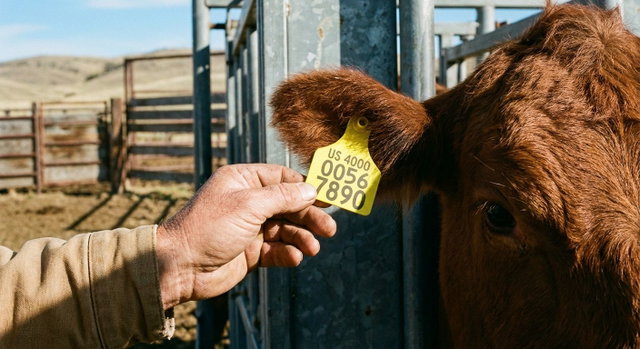
Your farm’s management tag can be short and convenient. Official ID has a different job. For flock ID tags, APHIS describes the number as the assigned flock ID followed by an individual animal number. Preserve the complete string exactly, including letters and leading zeros.
Keep separate fields or clearly labeled notes for the farm ID, official ID and any breed-registry number. A ewe called “37” on the feeding sheet may have a much longer official tag number. Both can belong to the same profile, but one should not overwrite the other.
Before a batch is sold, compare each actual animal with the inventory. Record the date official ID was applied and which animals received which numbers. If you apply identification to animals born elsewhere, retain the origin details required by APHIS. For lost or unreadable official ID, ask the office for the authorized replacement and record-linking procedure rather than removing or substituting tags on your own.
Can a tattoo or microchip replace an eartag?
Sometimes, with additional conditions. APHIS maintains a current list of approved registry tattoos. Approval depends on the registry’s identification and traceability system, not simply on a tattoo looking permanent. The accompanying registration and ownership documentation also matters.
The APHIS identification reference guide describes requirements for registry tattoos, APHIS flock ID tattoos and electronic implants, including documents and a reader where applicable. A microchip number copied into a profile is not enough to establish acceptance for a particular journey.
APHIS states that tattoos and implants cannot serve as the sole official identification for animals moving to slaughter or through a livestock market. Use the current program instructions and ask the office before relying on an alternative. If the certificate still names a previous owner, ask the office which transfer documents and timing apply before moving the animal.
Keep the paperwork after the animals leave
The APHIS factsheet requires records for five years after sale or other disposal. When applying official ID, the required information includes flock-of-origin and owner details, date, animal count, breed and class, official numbers and relevant group identification. For purchases, sales and other transfers, retain the date, number of animals, the other party’s name and address, animal details and required movement documents.
Record the sale with the exact animals and IDs, and attach the certificate or owner/hauler statement to a dated record on each animal’s profile. Keep the seller and buyer details in the private record, rather than a public listing description. Before the vehicle leaves, compare the papers with the loaded animals. A transfer entry in Creatures does not file a government document or replace required inspection paperwork.
The sheep flock record book and sheep group care records help organize daily work around that identity. For breed paperwork, use the separate Katahdin registration and Dorper registration guides. Breed registration and federal official ID answer different questions.
For goat breeder identification, see the goat tattoo guide. Browse sheep, goats and the regulations library for related work. This Learn article uses sheep in the actions below; the official-ID framework discussed applies to both species with the stated conditions.
Do this next on Creatures
Keep official IDs and the sale or movement history attached to the animal you actually worked with. Animal profiles and records are free and unlimited; you need a free account to save your work.
- Add your sheep, then use Add identifier on the profile for the full official number and farm tag. See how to add an animal.
- Add a record for today’s observation. This opens for visitors; a free account is needed to save it. Follow adding a record and keep reminders and upcoming care separate from completed work.
- Add your breeder profile when you want a public introduction to your program. Read getting listed in the breeder directory.
- Create a listing alert for future searches.
- Browse sheep listings and ask sellers for the individual animal’s records.
- Explore the breeder directory when you need to find and contact keepers yourself.